
|
시장보고서
상품코드
2073349
TTS(Text-to-Speech) : 시장 점유율 분석, 업계 동향 및 통계, 성장 예측(2026-2031년)Text-to-Speech - Market Share Analysis, Industry Trends & Statistics, Growth Forecasts (2026 - 2031) |
||||||
 Mordor Intelligence
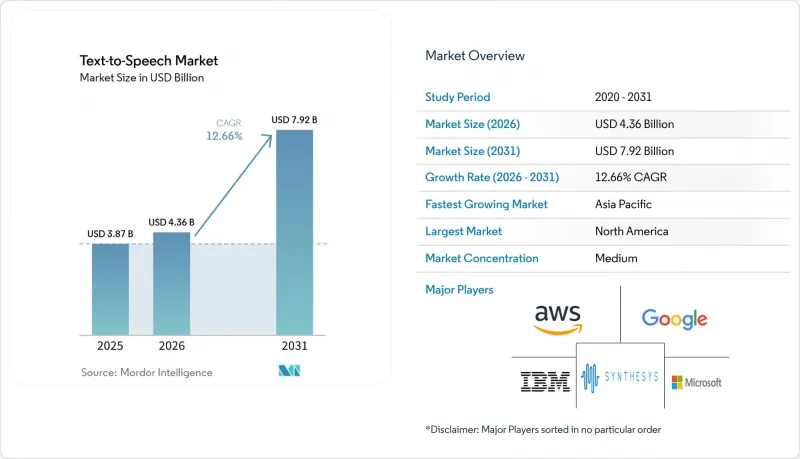
Mordor Intelligence에 의하면, TTS(Text-to-Speech) 시장 규모는 2025년 38억 7,000만 달러로 평가되었습니다. 2026년에는 43억 6,000만 달러로 확대되어 2026년부터 2031년에 걸쳐 CAGR 12.66%로 성장을 지속하여, 2031년에는 79억 2,000만 달러에 이를 것으로 예측됩니다.
본 보고서는 구성 요소(소프트웨어 및 서비스), 배포 모드(클라우드 기반, On-Premise형, 엣지 임베디드형), 음성 유형(신경망/AI 기반, 표준 연결형, 하이브리드형), 용도(소비자용 미디어 및 엔터테인먼트, e-러닝·교육, 고객 서비스 등), 언어(영어, 스페인어, 힌디어, 중국어 등), 지역별로 분류되어 있습니다. 시장 전망은 금액(달러) 기준으로 제시되어 있습니다.
세계의 TTS(Text-to-Speech) 시장 동향 및 인사이트
음성 지원 기기 및 스마트 스피커의 보급
스마트 스피커 OEM 업체들은 2023년 1분기 실적 부진에서 벗어나 출하량 회복세를 되찾기 위해, 자연스러운 음성 출력을 중시하는 대규모 언어 모델을 점점 더 많이 탑재하고 있습니다. 아마존의 ‘ Alexa Teacher Model"와 바이두의 ERNIE가 탑재된 어시스턴트는 매력적인 음성이 기기의 사용자 참여도를 얼마나 높이는지를 보여주고 있습니다. 자동차 제조업체들도 그 혜택을 누리고 있습니다. 르노의 “Reno Companion"는 감정이 풍부한 TTS를 활용해 차량 내 상호작용을 더욱 풍요롭게 하고 있으며, 소비자용 전자기기 이외의 분야에서 성장 가능성을 부각시키고 있습니다. 엣지 최적화 모델은 현재, 개인정보 보호와 가동 시간 확보를 위해 로컬에서 음성 출력이 필요한 IoT 센서, 온도 조절기, 웨어러블 기기를 지원하고 있습니다. 청각적 품질 저하 없이 뉴럴 보이스를 압축할 수 있는 업체들은 새로운 기기 설계 프로젝트를 수주하고 있습니다.
인간과 유사한 음질을 구현하는 신경망 기반 TTS의 급속한 발전
신경망 아키텍처를 통해 프로소디, 속도, 감정을 단순히 연결하는 데 그치지 않고 모델링할 수 있게 되었으며, 20개 이상의 언어에서 동시에 자연스러움이 향상되고 있습니다. NICT의 21개 언어 지원 시스템은 규모가 확대되더라도 품질이 저하될 필요가 없음을 보여주었습니다. 한편, 마이크로소프트가 2025년 2월, 인도의 캐릭터인 아티와 아르준을 필두로 한 14종의 새로운 HD 음성을 출시한 것은 문화적 배려를 중시하는 음성으로의 상업적 전환을 강조하는 것입니다. 대부분의 클라우드 API에서 지연 시간이 실시간 수준으로 단축됨에 따라, 기업들은 눈에 띄는 지연 없이 대화형 지원 및 인터랙티브 미디어를 도입할 수 있게 되었습니다. 그 결과, 콜센터 자동화 및 스트리밍 컨텐츠 더빙 분야의 조달 과정에서 신경망 음성 기술이 표준 사양으로 자리 잡았습니다.
음성 복제나 딥페이크의 악용이 늘어나면서 사용자의 신뢰를 훼손하고 있습니다.
미국 연방거래위원회(FTC)는 “음성 복제 과제"를 통해 클로닝의 위험성에 초점을 맞추고, 생체 인증의 보안을 훼손하는 사기 시나리오를 강조했습니다. OpenAI가 15초 분량의 샘플만으로 목소리를 재현할 수 있는 능력과, 화자 식별 시스템에 대한 공격 성공률이 95-97%에 달한다는 조사 결과는 생성 기술과 감지 기술 간의 기술적 격차를 여실히 드러내고 있습니다. “NO FAKES 법"와 테네시주의 “ELVIS법"과 같은 입법안은 동의 확인 절차를 갖추지 않은 공급업체에 규정 준수 비용이 발생할 것임을 예고하고 있으며, 기업을 견고한 출처 관리 체제를 갖춘 공급업체로 유도하고 있습니다.
부문별 분석
2025년, TTS(Text-to-Speech) 시장의 도입 사례 대부분은 코어 엔진과 API에 의해 뒷받침되었기 때문에 소프트웨어 시장 점유율은 75.72%를 유지했습니다. 그럼에도 불구하고, 기업들이 발음 조정, 문화적 타당성 검증, 지속적인 품질 보증이 필요한 맞춤형 음성 서비스 및 다국어 서비스를 요구함에 따라 서비스 매출은 연평균 성장률(CAGR) 13.04%를 나타낼 것으로 전망됩니다. 이러한 서비스에는 대개 이용 현황 분석 기능이 포함되어 있어, 클라이언트가 청취자의 참여도를 추적하고 스크립트를 개선하는 데 도움이 됩니다. 또한, 아웃소싱을 통해 사내 계산언어학자의 부족 문제를 완화하기 위해서는 전문 벤더의 존재가 필수적입니다.
서비스 주도형 계약으로의 전환은 TTS 업계가 성숙 단계에 접어들었음을 보여주며, 차별화의 기준이 ‘음성을 발화할 수 있는지"에서 “우리 회사만의 독특한 사운드로 들리는가"로 전환되고 있습니다. 맞춤형 음성 프로젝트에는 브랜드 톤에 관한 워크숍, 억양 조정, 반복적인 신경망 모델 재학습 등이 포함됩니다. 동의 획득 및 접근성 관련 규정 준수 도구를 이러한 서비스에 통합할 수 있는 제공업체는 범용 TTS API 라이선스를 이미 보유한 조직들 사이에서도 롱테일 확장 예산을 확보하고 있습니다.
2025년에도 거의 즉각적인 프로비저닝과 빈번한 모델 업데이트 덕분에 클라우드 기반 서비스는 TTS(Text-to-Speech) 시장 점유율의 63.35%를 차지했습니다. 그러나 엣지 임베디드형 배포는 연평균 성장률(CAGR) 14.12%로 확대되고 있으며, 이는 데이터 주권과 실시간 신뢰성으로의 구조적 전환을 반영하고 있습니다. 자동차 분야의 활용 사례는 이러한 변화를 상징하고 있습니다. 차량용 어시스턴트는 휴대전화 통신이 두절된 경우에도 응답할 수 있어야 하며, 동의 없이 생체 인증용 음성을 외부로 전송해서는 안 됩니다.
Nix-TTS와 같은 소형 모델은 싱글 보드 컴퓨터에서도 고음질 음성 재생이 가능함을 입증함으로써, 스마트 가전 및 의료기기로의 적용 범위를 넓히고 있습니다. 현재 각 반도체 업체들은 100밀리초 미만의 지연 시간을 유지하는 신경망 추론 가속기를 출시하고 있으며, 이를 통해 기기와 인간 간의 대화에서 발생하는 지각적 격차를 해소하고 있습니다. 네트워크 연결이 불안정한 기업이나 규제 대상 데이터를 취급하는 기업에게 있어, 엣지 배포는 품질을 희생하지 않고도 규정 준수를 확보할 수 있는 수단이 됩니다.
지역별 분석
2025년, 북미는 TTS(Text-to-Speech) 시장의 36.78%를 차지했습니다. 이는 연방 정부용 모든 소프트웨어에 대해 음성 출력을 필수 요건으로 규정하는 “섹션 508"의 조달 기준에 힘입은 결과입니다. 미국에 본사를 둔 각 클라우드 하이퍼스케일러 기업들은 TTS를 광범위한 AI 제품군에 포함시켜, 스타트업이 음성 기능을 추가할 때의 진입 장벽을 낮추고 있습니다. 한편, 개인정보 보호를 둘러싼 논의와 음성 복제 기술에 대한 연방거래위원회(FTC)의 감시 강화로 인해, 기업들은 투명성이 높은 동의 절차를 갖춘 서비스 제공업체를 선택하고 있습니다. 벤처 캐피털의 지원을 받는 혁신가들은 캘리포니아주의 AI 허브 주변에 모여들고 있으며, 기능 출시 속도와 특허 출원을 가속화하고 있습니다.
아시아태평양은 스마트폰 보급률이 높고, 소비자들이 주요 입력 수단으로서 음성에 친숙한 점 덕분에, TTS(Text-to-Speech) 시장에서 지역별 가장 빠른 연평균 성장률(CAGR) 14.86%를 나타낼 것으로 전망됩니다. 중국의 AI 부양책에 따른 자금 지원과 인도의 디지털 공공 인프라 프로젝트에서는 대규모 현지어 지원이 요구되고 있으며, 이것이 API의 대량 이용을 이끌고 있습니다. 한국과 일본의 OEM 기업들은 자동차와 스마트 TV에 뉴럴 보이스 기술을 탑재하고 있는 반면, 동남아시아의 개발자들은 언어 모델의 격차를 해소하기 위해 공공 부문 연구 기관과 협력하고 있습니다. 농촌 지역의 불안정한 통신 환경과 생체 인증 데이터에 관한 주권법 때문에 이 지역에서는 기기 내 음성 처리가 점점 더 중요해지고 있습니다.
유럽에서는 GDPR(EU 개인정보보호규정) 및 각국의 접근성 관련 법규에 힘입어, 도입이 착실히 진행되고 있습니다. 독일의 자동차 부품 제조업체들은 차량 안전 기준을 충족하기 위해 현지 음성 처리 기능을 탑재하고 있으며, 프랑스와 스페인의 방송사들은 다국어 시청자층에 대응하기 위해 현지화에 투자하고 있습니다. On-Premise 배포에 대한 선호도는 다른 지역보다 높은데, 이는 음성 로그를 클라우드에 저장하는 것에 대한 문화적 신중함을 반영하고 있습니다. AI 투명성에 관한 규제 당국의 조사는 EU 전역의 기술 기준을 형성할 것이며, 이는 수출 시장에도 파급될 가능성이 있습니다.
기타 혜택 :
- 엑셀 형식 시장 예측(ME) 시트
- 3개월간의 애널리스트 지원
자주 묻는 질문
목차
제1장 서론
제2장 조사 방법
제3장 주요 요약
제4장 시장 구도
제5장 시장 규모 및 성장 예측
제6장 경쟁 구도
제7장 시장 기회 및 향후 전망
KTH 26.07.08According to Mordor Intelligence, the text-to-Speech market size is expected to grow from USD 3.87 billion in 2025 to USD 4.36 billion in 2026 and is forecast to reach USD 7.92 billion by 2031 at 12.66% CAGR over 2026-2031.
This report is Segmented by Component (Software and Services), Deployment Mode (Cloud-Based, On-Premise, and Edge Embedded), Voice Type (Neural/AI-based, Standard Concatenative, and Hybrid), Application (Consumer Media and Entertainment, E-Learning and Education, Customer Service, and More), Language (English, Spanish, Hindi, Chinese, and More), and Geography. The Market Forecasts are Provided in Terms of Value (USD).
Global Text-to-Speech Market Trends and Insights
Proliferation of voice-enabled devices and smart speakers
Smart-speaker OEMs increasingly embed large language models that depend on natural-sounding output to regain shipment momentum after the Q1 2023 downturn. Amazon's Alexa Teacher Model and Baidu's ERNIE-powered assistants illustrate how compelling voices raise device engagement. Carmakers also benefit; Renault's Reno companion uses emotive TTS to enrich in-vehicle interaction, highlighting growth in non-consumer electronics verticals. Edge-optimized models now power IoT sensors, thermostats, and wearables that must speak locally for privacy and uptime. Vendors able to compress neural voices without audible degradation are capturing new device design-wins.
Rapid improvements in neural TTS delivering near-human quality
Neural architectures allow prosody, pacing, and emotion to be modelled rather than concatenated, lifting naturalness in 20+ languages simultaneously. NICT's 21-language system showed that quality does not have to fall when scale rises, while Microsoft's February 2025 roll-out of 14 new HD voices, led by Indian characters Aarti and Arjun, underscores the commercial pivot toward culturally aware speech. Latency has dropped to real-time for most cloud APIs, letting brands deploy conversational support and interactive media without perceptible lag. As a result, neural speech is now the default specification in procurement cycles for call-center automation and streaming content dubbing.
Rising voice-cloning/deep-fake misuse eroding user trust
The US Federal Trade Commission spotlighted cloning risks through its Voice Cloning Challenge, emphasising fraud scenarios that undermine biometric security. OpenAI's ability to replicate a voice from a 15-second sample and research showing 95-97% attack success against speaker-ID systems highlight the technological gap between generation and detection. Legislative proposals such as the NO FAKES Act and Tennessee's ELVIS Act foreshadow compliance costs for vendors that lack consent-verification pipelines, nudging enterprises toward providers with robust provenance controls.
Other drivers and restraints analyzed in the detailed report include:
- Expansion of e-learning and digital content consumption
- Mandates for digital accessibility (Section 508, WCAG)
- Data-privacy concerns in cloud-based TTS
For complete list of drivers and restraints, kindly check the Table Of Contents.
Segment Analysis
Software maintained 75.72% share in 2025 as core engines and APIs underpin most deployments within the Text-to-Speech market. Nevertheless, services revenue is scaling at 13.04% CAGR as enterprises seek custom voices and multilingual roll-outs that demand phonetic tuning, cultural vetting, and ongoing quality assurance. These services often bundle usage analytics, helping clients track listener engagement and refine scripts. Outsourcing also mitigates the scarcity of in-house computational linguists, making specialised vendors indispensable.
The pivot toward service-led contracts illustrates a maturation point in the Text-to-Speech industry where differentiation moves from "does it talk" to "does it sound like us." Custom voice projects encompass brand-tone workshops, accent calibration, and iterative neural-model retraining. Providers able to package these offerings with compliance tooling for consent and accessibility are capturing long-tail expansion budgets even among organisations that already licence generic TTS APIs.
Cloud delivery still contributed 63.35% of the Text-to-Speech market share in 2025 due to near-instant provisioning and frequent model updates. Edge-embedded deployments, however, are advancing at 14.12% CAGR, reflecting a structural pivot toward data sovereignty and real-time reliability. Automotive use cases typify the shift: in-cabin assistants must respond even when cellular coverage drops and must not send biometric audio off-board without consent.
Smaller models such as Nix-TTS demonstrate that high-fidelity speech can run on single-board computers, broadening applicability to smart appliances and medical instruments. Semiconductor vendors now ship neural-network inference accelerators that maintain under-100-millisecond latency, eliminating the perception gap between device and human conversation. For enterprises with intermittent connectivity or regulated data, the edge path offers compliance without sacrificing quality.
Complete Report Scope:
- By Component
- Software
- Services
- By Deployment Mode
- Cloud-Based
- On-Premise
- Edge Embedded
- By Voice Type
- Neural/AI-based
- Standard Concatenative
- Hybrid
- By Application
- Consumer Media and Entertainment
- E-Learning and Education
- Accessibility for Visually Impaired
- Customer Service/IVR
- Automotive and Transportation
- Healthcare Assistive
- Robotics and IoT
- Other Applications
- By Language
- English
- Chinese
- Spanish
- Hindi
- German
- French
- Turkish
- Other Languages
- By Geography
- North America
- United States
- Canada
- Mexico
- South America
- Brazil
- Argentina
- Rest of South America
- Europe
- United Kingdom
- Germany
- France
- Italy
- Spain
- Russia
- Rest of Europe
- Asia-Pacific
- China
- India
- Japan
- South Korea
- Australia and New Zealand
- Rest of Asia-Pacific
- Middle East and Africa
- Middle East
- Saudi Arabia
- United Arab Emirates
- Turkey
- Rest of Middle East
- Africa
- South Africa
- Nigeria
- Rest of Africa
- Middle East
- North America
Geography Analysis
North America anchored 36.78% of the Text-to-Speech market in 2025, propelled by Section 508 procurement filters that make voice output a checklist item for all federal-facing software.US-based cloud hyperscalers bundle TTS alongside broader AI suites, lowering entry barriers for startups to add speech. Meanwhile, privacy debates and FTC scrutiny of voice cloning push enterprises toward providers with transparent consent workflows. Venture-backed innovators cluster around Californian AI hubs, accelerating feature cadence and patent filings.
Asia-Pacific is on course for a 14.86% CAGR, the swiftest regional pace in the Text-to-Speech market, thanks to smartphone saturation and consumer comfort with voice as the primary input. China's AI stimulus funds and India's Digital Public Infrastructure projects require large-scale vernacular support, driving bulk API consumption. Korean and Japanese OEMs integrate neural voices into cars and smart-TVs, while Southeast Asian developers work with public-sector research labs to fill language-model gaps. The regional blueprint increasingly emphasises on-device speech due to patchy connectivity across rural districts and sovereignty laws over biometric data.
Europe continues steady adoption underpinned by GDPR and national accessibility statutes. Automotive suppliers in Germany embed local speech processing to meet in-vehicle safety mandates, and broadcasters in France and Spain invest in localisation to address multilingual audiences. Preference for on-premise deployment is higher than in other regions, reflecting cultural caution toward cloud storage of voice logs. Regulatory probes into AI transparency are likely to shape pan-EU technical standards that spill over into export markets.
- Amazon Web Services, Inc. (Amazon Polly)
- Google LLC (Cloud TTS)
- Microsoft Corporation (Azure Cognitive Services)
- IBM Corporation (Watson TTS)
- iFlytek Co., Ltd.
- Baidu, Inc.
- Nuance Communications (Microsoft)
- ReadSpeaker B.V.
- Acapela Group
- CereProc Ltd.
- NeoSpeech Inc.
- Lovo Inc.
- Murf AI
- WellSaid Labs
- Speechify Inc.
- Synthesys.io
- Veritone Inc.
- Sensory Inc.
- Descript Inc.
- SoundHound AI, Inc. (Houndify)
Additional Benefits:
- The market estimate (ME) sheet in Excel format
- 3 months of analyst support
TABLE OF CONTENTS
1 INTRODUCTION
- 1.1 Study Assumptions and Market Definition
- 1.2 Scope of the Study
2 RESEARCH METHODOLOGY
3 EXECUTIVE SUMMARY
4 MARKET LANDSCAPE
- 4.1 Market Overview
- 4.2 Market Drivers
- 4.2.1 Proliferation of voice-enabled devices and smart speakers
- 4.2.2 Rapid improvements in neural TTS delivering near-human quality
- 4.2.3 Expansion of e-learning and digital content consumption
- 4.2.4 Mandates for digital accessibility (Section 508, WCAG)
- 4.2.5 Edge-AI accelerators enabling offline TTS in embedded IoT
- 4.2.6 Synthetic-voice IP licensing unlocking new revenue streams
- 4.3 Market Restraints
- 4.3.1 Accuracy limitations for tonal and low-resource languages
- 4.3.2 Data-privacy concerns in cloud-based TTS
- 4.3.3 Rising voice-cloning/deep-fake misuse eroding user trust
- 4.3.4 Escalating GPU compute costs for smaller vendors
- 4.4 Industry Ecosystem Analysis
- 4.5 Technological Outlook
- 4.6 Porter's Five Forces Analysis
- 4.6.1 Bargaining Power of Buyers
- 4.6.2 Bargaining Power of Suppliers
- 4.6.3 Threat of New Entrants
- 4.6.4 Threat of Substitutes
- 4.6.5 Intensity of Competitive Rivalry
5 MARKET SIZE AND GROWTH FORECASTS (VALUES)
- 5.1 By Component
- 5.1.1 Software
- 5.1.2 Services
- 5.2 By Deployment Mode
- 5.2.1 Cloud-Based
- 5.2.2 On-Premise
- 5.2.3 Edge Embedded
- 5.3 By Voice Type
- 5.3.1 Neural/AI-based
- 5.3.2 Standard Concatenative
- 5.3.3 Hybrid
- 5.4 By Application
- 5.4.1 Consumer Media and Entertainment
- 5.4.2 E-Learning and Education
- 5.4.3 Accessibility for Visually Impaired
- 5.4.4 Customer Service/IVR
- 5.4.5 Automotive and Transportation
- 5.4.6 Healthcare Assistive
- 5.4.7 Robotics and IoT
- 5.4.8 Other Applications
- 5.5 By Language
- 5.5.1 English
- 5.5.2 Chinese
- 5.5.3 Spanish
- 5.5.4 Hindi
- 5.5.5 German
- 5.5.6 French
- 5.5.7 Turkish
- 5.5.8 Other Languages
- 5.6 By Geography
- 5.6.1 North America
- 5.6.1.1 United States
- 5.6.1.2 Canada
- 5.6.1.3 Mexico
- 5.6.2 South America
- 5.6.2.1 Brazil
- 5.6.2.2 Argentina
- 5.6.2.3 Rest of South America
- 5.6.3 Europe
- 5.6.3.1 United Kingdom
- 5.6.3.2 Germany
- 5.6.3.3 France
- 5.6.3.4 Italy
- 5.6.3.5 Spain
- 5.6.3.6 Russia
- 5.6.3.7 Rest of Europe
- 5.6.4 Asia-Pacific
- 5.6.4.1 China
- 5.6.4.2 India
- 5.6.4.3 Japan
- 5.6.4.4 South Korea
- 5.6.4.5 Australia and New Zealand
- 5.6.4.6 Rest of Asia-Pacific
- 5.6.5 Middle East and Africa
- 5.6.5.1 Middle East
- 5.6.5.1.1 Saudi Arabia
- 5.6.5.1.2 United Arab Emirates
- 5.6.5.1.3 Turkey
- 5.6.5.1.4 Rest of Middle East
- 5.6.5.2 Africa
- 5.6.5.2.1 South Africa
- 5.6.5.2.2 Nigeria
- 5.6.5.2.3 Rest of Africa
- 5.6.5.1 Middle East
- 5.6.1 North America
6 COMPETITIVE LANDSCAPE
- 6.1 Market Concentration
- 6.2 Strategic Moves
- 6.3 Market Share Analysis
- 6.4 Company Profiles (includes Global level Overview, Market level overview, Core Segments, Financials as available, Strategic Information, Market Rank/Share for key companies, Products and Services, and Recent Developments)
- 6.4.1 Amazon Web Services, Inc. (Amazon Polly)
- 6.4.2 Google LLC (Cloud TTS)
- 6.4.3 Microsoft Corporation (Azure Cognitive Services)
- 6.4.4 IBM Corporation (Watson TTS)
- 6.4.5 iFlytek Co., Ltd.
- 6.4.6 Baidu, Inc.
- 6.4.7 Nuance Communications (Microsoft)
- 6.4.8 ReadSpeaker B.V.
- 6.4.9 Acapela Group
- 6.4.10 CereProc Ltd.
- 6.4.11 NeoSpeech Inc.
- 6.4.12 Lovo Inc.
- 6.4.13 Murf AI
- 6.4.14 WellSaid Labs
- 6.4.15 Speechify Inc.
- 6.4.16 Synthesys.io
- 6.4.17 Veritone Inc.
- 6.4.18 Sensory Inc.
- 6.4.19 Descript Inc.
- 6.4.20 SoundHound AI, Inc. (Houndify)
7 MARKET OPPORTUNITIES AND FUTURE OUTLOOK
- 7.1 White-space and Unmet-Need Assessment