

|
시장보고서
상품코드
2073362
고급차 렌탈 : 시장 점유율 분석, 업계 동향 및 통계, 성장 예측(2026-2031년)Luxury Car Rental - Market Share Analysis, Industry Trends & Statistics, Growth Forecasts (2026 - 2031) |
||||||
 Mordor Intelligence
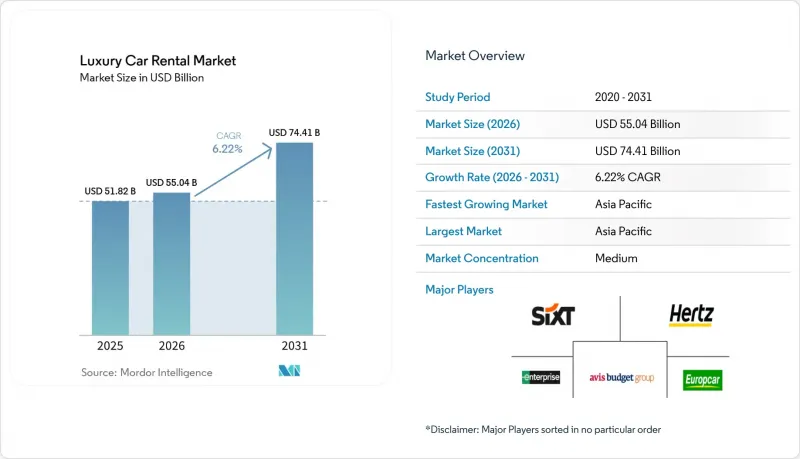
Mordor Intelligence에 의하면, 고급차 렌탈 시장 규모는 2025년에 518억 2,000만 달러로 평가되었습니다. 2026년 550억 4,000만 달러에서 2031년까지 744억 1,000만 달러에 이를 것으로 예상되며, 예측 기간(2026-2031년) CAGR은 6.22%를 나타낼 전망입니다.
본 보고서는 차종(해치백, 세단 등), 렌탈 기간(단기·장기), 예약 유형(온라인 예약 등), 운전 형태(자가 운전·운전기사 포함), 구동 방식(내연기관 등), 고객 유형(레저 목적의 개인·법인/MICE), 서비스 제공 장소(공항 등), 지역별로 분류되어 있습니다. 시장 전망은 금액(달러) 기준으로 제시되어 있습니다.
세계의 고급차 렌탈 시장 동향 및 인사이트
팬데믹 이후 여가 및 비즈니스 여행의 급증
세계 비즈니스 여행 지출이 증가하고 있으며, 2024년에는 기업 구매 담당자의 52%가 예산을 증액하고, 직원의 46%가 업무 출장을 개인적인 여가 목적으로 연장함에 따라 고급 차량 렌탈에 대한 수요가 더욱 높아졌습니다. 부유층의 럭셔리 여행 지출은 2028년까지 42% 증가할 것으로 예상되며, 체험형 모빌리티는 이제 휴가 패키지의 핵심 요소로 자리 잡았습니다. 여행객들이 다목적 여행에서 고급 차량의 가치를 최대한 활용하려는 가운데, 업체 측에서는 평균 렌탈 기간이 길어지고 있다는 보고가 있습니다. 법인 고객은 마스터 계약을 통해 더 대규모의 차량 풀을 확보함으로써, 성수기 공급을 보장하는 동시에 가격 결정력을 높이고 있습니다.
전 세계 고자산가(HNWI) 인구와 가처분 소득 증가
중국은 2030년까지 세계 최대의 개인용 럭셔리 시장이 될 것으로 예상되며, 중국 소비자의 40%가 ESG 기준을 충족하는 제품에 대해 추가 비용을 지불할 것으로 전망됩니다. 밀레니얼 세대와 여성은 현재 고자산가(HNWI) 자산의 3분의 1을 보유하고 있으며, 디지털 예약, 웰니스 기능 통합, 브랜드 신뢰성을 중요시하고 있습니다. 60세 미만의 고급 여행객 중 80%는 소유물보다 경험을 더 중요하게 여기며, 이러한 사고방식은 인기 있는 모델의 온디맨드 이용을 촉진하고 있습니다. 이러한 인구 동향의 변화에 따라 차량 내장재 맞춤화, 차량용 웰니스 기술, 그리고 1일 이용 요금을 높게 책정할 수 있는 한정 사양 트림 등 차량 구성이 재편되고 있습니다.
고급차의 높은 자본 비용과 가속화된 감가상각
첨단 운전 지원 하드웨어와 배터리 팩의 도입으로 인해, 현재 플래그십 모델 출시에는 팬데믹 이전 수준에 비해 22% 더 많은 설비 투자가 필요하게 되었습니다. 테슬라의 가격 인하로 인해 2024년에는 중고 전기차의 잔존 가치가 최대 17% 하락했으며, 이에 따라 허츠사는 2만 대의 차량을 처분하고 2억 4,500만 달러의 감손 처리를 할 수밖에 없었습니다. 사업자들이 보유 비용 상승분을 소비자에게 전가함에 따라, 2025년에는 전 세계 평균 일일 대여 요금이 2.4% 상승하여 46.5달러에 달했습니다. 자금 조달의 유연성이 제한된 소규모 프랜차이즈 가맹점은 차량 교체 주기가 늦어지면서 대기업과의 기술 격차가 확대되고 있습니다.
부문별 분석
2025년, 스포츠 유틸리티 차량(SUV)은 고급차 렌탈 시장의 38.02%를 차지하며, 넉넉한 실내 공간, 높은 시트 위치, 유연한 적재 공간에 대한 소비자의 선호도가 높아지고 있음을 여실히 보여주었습니다. 이 부문은 2031년까지 연평균 8.27%의 성장률을 보일 것으로 예측되며, 레인지로버, 메르세데스-벤츠 G-클래스, BMW iX와 같은 유력 브랜드들이 성장을 주도할 것으로 보입니다. 로터스 엘레트레와 같은 전기 SUV가 주요 렌터카 업체의 차고에 서서히 도입되기 시작하고 있으며, 이는 지속가능성과 럭셔리가 융합되고 있음을 보여줍니다. 세단은 여전히 운전기사를 둔 경영진들 사이에서 인기를 끌고 있는 반면, 스포츠카와 슈퍼카는 주말의 호화로운 즐거움과 인플루언서들의 컨텐츠 제작 수요를 충족시키고 있습니다.
해치백은 유럽의 좁은 도로에서 틈새 시장을 공략하며 그 매력을 유지하고 있는 반면, MPV는 걸프협력회의(GCC) 지역의 휴양지에서 호화로운 가족 여행을 뒷받침하고 있습니다. 자동차 제조업체들이 마케팅 예산을 날렵한 실루엣의 차종에 할당하는 가운데, 렌터카 업체들은 향후 수요에 대비해 프리미엄 SUV의 재고를 확대되고 있습니다. SUV 고급차 렌탈 시장 규모는 예측 기간 동안 점유율을 4.3포인트 확대하며, 그 우위를 더욱 넓힐 것으로 전망됩니다.
2025년에는 단기 렌탈(30일 미만)이 63.58%의 점유율을 차지하며 고급차 렌탈 시장을 주도했습니다. 이는 주로 공항에서 출발하는 여행 때문인 것입니다. 그러나 장기 렌탈 및 구독 모델이 연평균 성장률(CAGR) 9.31%를 기록하며 가장 빠르게 성장하는 부문으로 부상하고 있습니다. 이러한 급속한 성장은 예측 가능한 월별 지불액, 유지보수 비용의 정액제, 그리고 다양한 차종 라인업에 대한 고객의 선호에 크게 기인하고 있습니다. 구독 이용자의 절반은 4개월마다 차종을 변경하고 있으며, 이로 인해 자산당 이용 주기가 향상되어 투하자본이익률(ROCE)이 개선되고 있습니다.
기업의 차량 관리 담당자들은 감가상각 위험을 피하고, 구매 결정을 내리기 전에 전기차(EV) 도입을 시범적으로 진행하기 위해 6개월에서 24개월 단위의 렌탈 서비스를 활용하고 있습니다. 그 결과, 고급차 렌탈 시장에서는 핀테크를 활용한 결제 플랜, 텔레매틱스를 기반으로 한 마모 및 손상 모니터링, 컨시어지による 반납 서비스 등이 도입되고 있습니다. 따라서 고급차 렌탈 업계와 운영리스 사업자 간의 경계가 모호해지고 있어, 정책 입안자들에게 현물 급여 처리에 관한 세법 개정을 촉구하고 있습니다.
2025년에는 온라인 예약이 고급차 렌탈 시장에서 47.12%의 점유율을 차지하며 두 자릿수 성장 궤도에 올라섰습니다. 한편, 애그리게이터와 OTA 플랫폼은 2026년부터 2031년까지 연평균 성장률(CAGR) 10.34%를 기록하며 성장할 것으로 전망됩니다. 이러한 성장세는 모바일 중심의 설계, 실시간 예약 가능 여부 표시, 그리고 원활한 결제 절차에 힘입어 더욱 가속화되고 있습니다. 어그리게이터는 항공사나 호텔의 로열티 혜택을 묶어 제공함으로써, 사업자가 막대한 마케팅 비용을 들이지 않고도 노출을 확대되고 있습니다. SIXT 등 대형 업체들이 운영하는 전용 앱에는 원터치 업그레이드 기능과 단계별 탄소 상쇄 옵션이 탑재되어 있어, 지갑 점유율 확대에 기여하고 있습니다.
오프라인 여행 상담사는 여전히 여러 국가를 아우르는 복잡한 여정 처리를 담당하고 있지만, 현재는 클라우드 기반 재고 파이프라인을 활용하여 실시간으로 견적을 제시하고 있습니다. 키리스 픽업 기술 덕분에 고객은 카운터를 완전히 거치지 않고도 이용할 수 있게 되어, 인건비 절감과 고객 만족도 향상으로 이어지고 있습니다. 이러한 혁신 덕분에, 고수익 부문에서 고급차 렌탈 시장은 차량 공유 서비스와의 경쟁력을 유지하고 있습니다.
지역별 분석
2025년, 아시아태평양은 고급차 렌탈 시장 매출의 38.24%를 차지했습니다. 이는 중국에서 활기를 띠고 있는 럭셔리 생태계와 도시 지역의 부유층이 급속히 증가하는 추세에 힘입은 결과입니다. 2031년까지의 지역별 연평균 성장률(CAGR)은 11.52%로, 다른 모든 지역을 상회하고 있습니다. 이는 전기차(EV)에 대한 지원책, 일본과 태국의 인바운드 관광 회복, 그리고 싱가포르와 인도의 초고소득 가구의 급증에 힘입은 결과입니다. 엔터프라이즈 모빌리티가 프랜차이즈 제휴를 통해 푸켓과 방콕에 진출한 것은 동남아시아의 레저 거점이 지닌 매력을 여실히 보여주고 있습니다.
북미는 기업 대상 여행의 탄탄한 기반과 정교한 로열티 프로그램을 바탕으로, 여전히 성숙한 고수익 시장으로 자리매김하고 있습니다. 2024년 말까지 미국의 공항 이용객 수는 2019년의 기록에 근접했으며, 프리미엄 렌터카 수요가 회복된 데다 캐나다 및 멕시코와의 국경을 넘나드는 왕래가 여행 패턴의 다양화를 가져왔습니다. 엔터프라이즈 모빌리티의 사상 최대 매출액인 380억 달러는 차량 공급이 부족한 상황에서도 가격 결정력을 입증하고 있습니다. 디지털 결제 지갑과 비접촉식 픽업의 높은 보급률은 해당 지역의 기술적 우위를 더욱 공고히 하고 있습니다.
기후 변화 대책에 대한 규제, 다양한 세제, 그리고 불안정한 거시경제 상황이 유럽의 향후 방향을 결정하고 있습니다. 각 사업자들은 암스테르담, 파리, 밀라노의 제로 배출 구역 도입에 대비해 차량의 전기화를 가속화하고 있으며, 많은 경우 구형 내연기관 차량을 규제가 완화된 동유럽 시장으로 전환하고 있습니다. 중동 및 아프리카에서는 GCC 국가들의 관광 산업 회복과 남아프리카공화국 및 케냐의 프리미엄 사파리 투어가 견인 역할을 하며 한 자릿수 중반대의 성장률을 기록하고 있지만, 환율 변동과 수입 관세가 이익률 확대를 억제하고 있습니다.
기타 혜택 :
- 엑셀 형식 시장 예측(ME) 시트
- 3개월간의 애널리스트 지원
자주 묻는 질문
목차
제1장 서론
제2장 조사 방법
제3장 주요 요약
제4장 시장 구도
제5장 시장 규모 및 성장 예측
제6장 경쟁 구도
제7장 시장 기회 및 향후 전망
KTH 26.07.08According to Mordor Intelligence, the luxury car rental market size was valued at USD 51.82 billion in 2025 and estimated to grow from USD 55.04 billion in 2026 to reach USD 74.41 billion by 2031, at a CAGR of 6.22% during the forecast period (2026-2031).
This report is Segmented by Vehicle Model Style (Hatchback, Sedan, and More), Rental Duration (Short-Term and Long-Term), Booking Type (Online Booking and More), Drive Type (Self-Driven and Chauffeur-Driven), Propulsion Type (ICE and More), Customer (Leisure Individual and Corporate / MICE), Service Location (Airport and More), and Geography. The Market Forecasts are Provided in Terms of Value (USD).
Global Luxury Car Rental Market Trends and Insights
Surge in Post-Pandemic Leisure & Business Travel
Global business-travel outlays are increasing, and fifty-two percent of corporate buyers increased budgets in 2024, and 46% of employees extended work trips for personal leisure, reinforcing premium rental demand. Luxury travel spending among affluent segments is on track to rise 42% by 2028, with experiential mobility now a core component of vacation packages. Operators report longer average rental lengths as travelers look to maximize value from high-end vehicles during multi-purpose trips. Corporate accounts are taking bigger fleets under master contracts, guaranteeing supply during peak periods, and increasing pricing power.
Growing Global HNWI Population & Disposable Incomes
China is forecast to become the world's largest personal-luxury arena by 2030, and 40% of its consumers will pay premiums for ESG-aligned products. Millennials and women now hold one-third of HNWI wealth, demanding digital booking, wellness integration, and brand authenticity. Eighty percent of luxury travelers under 60 prefer experiences over possessions, a mindset that favors on-demand access to marquee models. These demographic shifts are reshaping fleet mixes toward bespoke interiors, in-car wellness tech, and limited-edition trims that command higher daily rates.
High Capital Cost & Accelerated Depreciation of Luxury Vehicles
Acquiring flagship models now requires 22% higher capex than pre-pandemic levels, driven by advanced driver-assist hardware and battery packs. Tesla's price cuts shaved up to 17% off used-EV residuals in 2024, prompting Hertz to liquidate 20,000 cars and absorb a USD 245 million writedown. Average global daily rental rates are expected to climb 2.4% to USD 46.5 in 2025 as operators pass on higher holding costs. Smaller franchisees with limited financing flexibility face slower fleet refresh cycles, widening the technology gap versus majors.
Other drivers and restraints analyzed in the detailed report include:
- Expansion of Digital-First Aggregator & Subscription Platforms
- Rapid EV Penetration in Premium Fleets to Meet City-Center Zero-Emission Rules
- Rising Preference for Ride-Hailing & Micro-Mobility in Urban Cores
For complete list of drivers and restraints, kindly check the Table Of Contents.
Segment Analysis
In 2025, Sport Utility Vehicles (SUVs) captured 38.02% of the luxury car rental market, underscoring a growing consumer preference for spacious interiors, elevated seating, and adaptable cargo space. This segment is set to expand at an annual rate of 8.27% through 2031, with prominent brands like Range Rover, Mercedes-Benz G-Class, and BMW iX leading the charge. Electric SUVs like the Lotus Eletre are trickling into flagship rental garages, signaling how sustainability and luxury converge. Sedans retain relevance among chauffeur-driven executives, while sports and supercars cater to weekend indulgence and influencer content creation.
Hatchbacks maintain niche appeal in Europe's narrow streets, whereas MPVs support luxury family travel in Gulf Cooperation Council (GCC) resorts. As OEMs allocate marketing budgets toward high-riding silhouettes, rental companies expand premium SUV inventory to future-proof demand. The luxury car rental market size for SUVs is expected to widen its lead by adding 4.3 percentage points of share during the forecast horizon.
In 2025, short-term rentals (under 30 days) dominated the luxury car rental market with a 63.58% share, primarily driven by airport-origin trips. However, long-term rentals and subscription models are emerging as the fastest-growing segments, boasting a 9.31% CAGR. This surge is largely attributed to the customer preference for predictable monthly payments, bundled maintenance, and a diverse vehicle selection. Half of subscribers swap models every four months, driving higher utilization cycles per asset and improving return on capital employed.
Corporate fleet managers lean on six- to 24-month rentals to avoid depreciation exposure and to pilot EV adoption before making procurement decisions. As a result, the luxury car rental market is integrating fintech payment plans, telematics-based wear-and-tear monitoring, and concierge drop-off services. Therefore, the luxury car rental industry is blurring boundaries with operating lease providers, galvanizing policymakers to update tax codes around benefit-in-kind treatment.
Online bookings secured a 47.12% share of the luxury car rental market in 2025 and are on a double-digit growth trajectory, while aggregator and OTA platforms are set to grow at a 10.34% CAGR during 2026-2031.. This momentum is fueled by mobile-centric designs, real-time availability showcases, and seamless checkout processes. Aggregators bundle loyalty perks across airlines and hotels, amplifying exposure without heavy marketing spend by operators. Direct apps run by majors such as SIXT now embed one-tap upgrades and tiered carbon-offset options, deepening wallet share.
Offline travel advisers still handle complex multi-country itineraries but now rely on cloud-based inventory pipes to quote in real time. Keyless pickup technology lets clients bypass counters altogether, shrinking labor costs and raising customer satisfaction scores. These innovations keep the luxury car rental market competitive against ride-hail alternatives in high-yield segments.
Complete Report Scope:
- By Vehicle Model Style
- Hatchback
- Sedan
- Sport Utility Vehicle
- Multi-Purpose Vehicle
- Sports & Super-car
- By Rental Duration
- Short-term ( Less Than 30 days)
- Long-term / Subscription (More Than 30 days)
- By Booking Channel
- Online Direct (own website / app)
- Online Aggregator / OTA
- Offline Travel Agent / Walk-in
- By Drive Type
- Self-drive
- Chauffeur-drive
- By Propulsion Type
- Internal Combustion Engine
- Battery-Electric Vehicle
- Hybrid and Plug-in Hybrid Vehicle
- By Customer Type
- Leisure Individual
- Corporate / MICE
- By Service Location
- Airport
- Urban Downtown
- Resort / Tourist Hotspot
- By Geography
- North America
- United States
- Canada
- Rest of North America
- South America
- Brazil
- Argentina
- Rest of South America
- Europe
- Germany
- United Kingdom
- France
- Italy
- Spain
- Russia
- Rest of Europe
- Asia-Pacific
- China
- India
- Japan
- South Korea
- Rest of Asia-Pacific
- Middle East and Africa
- United Arab Emirates
- Saudi Arabia
- Rest of Middle East and Africa
- North America
Geography Analysis
Asia-Pacific accounted for 38.24% of the luxury car rental market revenue in 2025, propelled by China's thriving luxury ecosystem and rapid urban affluence. Regional CAGR of 11.52% through 2031 surpasses all peers, driven by supportive EV incentives, inbound tourism rebounds in Japan and Thailand, and the surge of ultra-high-net-worth families in Singapore and India. Enterprise Mobility's entrance into Phuket and Bangkok via franchise partnerships illustrates the magnetism of Southeast Asian leisure hubs.
North America remains a mature, high-yield arena with deep corporate-travel roots and sophisticated loyalty programs. By late 2024, U.S. airport throughput had neared 2019 records, revitalizing premium rentals, while cross-border traffic with Canada and Mexico broadened trip patterns. Enterprise Mobility's record USD 38 billion turnover underscores pricing power amid constrained fleet supply. The high penetration of digital payment wallets and contactless pick-up further cements the region's technological edge.
Climate mandates, heterogeneous tax regimes, and volatile macroeconomic conditions shape Europe's pathway. Operators accelerate fleet electrification to comply with zero-emission zones in Amsterdam, Paris, and Milan, often re-routing older ICE cars to less restrictive markets in Eastern Europe. The Middle East and Africa post mid-single-digit growth, led by GCC tourism recovery and premium safari circuits in South Africa and Kenya, although currency volatility and import duties temper margin expansion.
- Enterprise Holdings Inc.
- The Hertz Corporation
- Avis Budget Group Inc.
- Sixt SE
- Europcar Mobility Group
- National Car Rental
- Alamo Rent A Car
- Budget Rent A Car
- Luxury Car Rentals LLC (Resla)
- Turo Inc.
- Getaround Inc.
- Zoomcar Ltd.
- Silvercar by Audi
- Blue Car Rental ehf
- VIP Rent A Car LLC
- eZhire Technologies FZ LLC
- Friends Car Rental LLC
- Auto Europe Group
- Chauffeur-First Ltd.
- Dream Collection UK
Additional Benefits:
- The market estimate (ME) sheet in Excel format
- 3 months of analyst support
TABLE OF CONTENTS
1 Introduction
- 1.1 Study Assumptions & Market Definition
- 1.2 Scope of the Study
2 Research Methodology
3 Executive Summary
4 Market Landscape
- 4.1 Market Overview
- 4.2 Market Drivers
- 4.2.1 Surge in post-pandemic leisure and business travel
- 4.2.2 Growing global HNWI population and disposable incomes
- 4.2.3 Expansion of digital-first aggregator and subscription platforms
- 4.2.4 Rapid EV penetration in premium fleets to meet city-center zero-emission rules
- 4.2.5 Experiential gifting and influencer marketing fueling aspirational demand (under-reported)
- 4.2.6 Blockchain-enabled asset tracking reducing fraud and downtime (under-reported)
- 4.3 Market Restraints
- 4.3.1 High capital cost and accelerated depreciation of luxury vehicles
- 4.3.2 Rising preference for ride-hailing and micro-mobility in urban cores
- 4.3.3 Stringent insurance, liability and age-limit regulations
- 4.3.4 Supply constraints for premium EV models delaying fleet renewal (under-reported)
- 4.4 Value / Supply-Chain Analysis
- 4.5 Regulatory Landscape
- 4.6 Technological Outlook (connected, autonomous & electrified fleets)
- 4.7 Porter's Five Forces
- 4.7.1 Threat of New Entrants
- 4.7.2 Bargaining Power of Buyers
- 4.7.3 Bargaining Power of Suppliers
- 4.7.4 Threat of Substitutes
- 4.7.5 Competitive Rivalry
5 Market Size & Growth Forecasts (Value, USD)
- 5.1 By Vehicle Model Style
- 5.1.1 Hatchback
- 5.1.2 Sedan
- 5.1.3 Sport Utility Vehicle
- 5.1.4 Multi-Purpose Vehicle
- 5.1.5 Sports & Super-car
- 5.2 By Rental Duration
- 5.2.1 Short-term ( Less Than 30 days)
- 5.2.2 Long-term / Subscription (More Than 30 days)
- 5.3 By Booking Channel
- 5.3.1 Online Direct (own website / app)
- 5.3.2 Online Aggregator / OTA
- 5.3.3 Offline Travel Agent / Walk-in
- 5.4 By Drive Type
- 5.4.1 Self-drive
- 5.4.2 Chauffeur-drive
- 5.5 By Propulsion Type
- 5.5.1 Internal Combustion Engine
- 5.5.2 Battery-Electric Vehicle
- 5.5.3 Hybrid and Plug-in Hybrid Vehicle
- 5.6 By Customer Type
- 5.6.1 Leisure Individual
- 5.6.2 Corporate / MICE
- 5.7 By Service Location
- 5.7.1 Airport
- 5.7.2 Urban Downtown
- 5.7.3 Resort / Tourist Hotspot
- 5.8 By Geography
- 5.8.1 North America
- 5.8.1.1 United States
- 5.8.1.2 Canada
- 5.8.1.3 Rest of North America
- 5.8.2 South America
- 5.8.2.1 Brazil
- 5.8.2.2 Argentina
- 5.8.2.3 Rest of South America
- 5.8.3 Europe
- 5.8.3.1 Germany
- 5.8.3.2 United Kingdom
- 5.8.3.3 France
- 5.8.3.4 Italy
- 5.8.3.5 Spain
- 5.8.3.6 Russia
- 5.8.3.7 Rest of Europe
- 5.8.4 Asia-Pacific
- 5.8.4.1 China
- 5.8.4.2 India
- 5.8.4.3 Japan
- 5.8.4.4 South Korea
- 5.8.4.5 Rest of Asia-Pacific
- 5.8.5 Middle East and Africa
- 5.8.5.1 United Arab Emirates
- 5.8.5.2 Saudi Arabia
- 5.8.5.3 Rest of Middle East and Africa
- 5.8.1 North America
6 Competitive Landscape
- 6.1 Market Concentration
- 6.2 Strategic Moves (M&A, franchise expansions, EV fleet roll-outs)
- 6.3 Market Share Analysis
- 6.4 Company Profiles (includes Global level Overview, Market level overview, Core Segments, Financials as available, Strategic Information, Market Rank/Share for key companies, Products & Services, and Recent Developments)
- 6.4.1 Enterprise Holdings Inc.
- 6.4.2 The Hertz Corporation
- 6.4.3 Avis Budget Group Inc.
- 6.4.4 Sixt SE
- 6.4.5 Europcar Mobility Group
- 6.4.6 National Car Rental
- 6.4.7 Alamo Rent A Car
- 6.4.8 Budget Rent A Car
- 6.4.9 Luxury Car Rentals LLC (Resla)
- 6.4.10 Turo Inc.
- 6.4.11 Getaround Inc.
- 6.4.12 Zoomcar Ltd.
- 6.4.13 Silvercar by Audi
- 6.4.14 Blue Car Rental ehf
- 6.4.15 VIP Rent A Car LLC
- 6.4.16 eZhire Technologies FZ LLC
- 6.4.17 Friends Car Rental LLC
- 6.4.18 Auto Europe Group
- 6.4.19 Chauffeur-First Ltd.
- 6.4.20 Dream Collection UK


