|
시장보고서
상품코드
2073416
모바일 3D : 시장 점유율 분석, 업계 동향 및 통계, 성장 예측(2026-2031년)Mobile 3D - Market Share Analysis, Industry Trends & Statistics, Growth Forecasts (2026 - 2031) |
||||||
 Mordor Intelligence
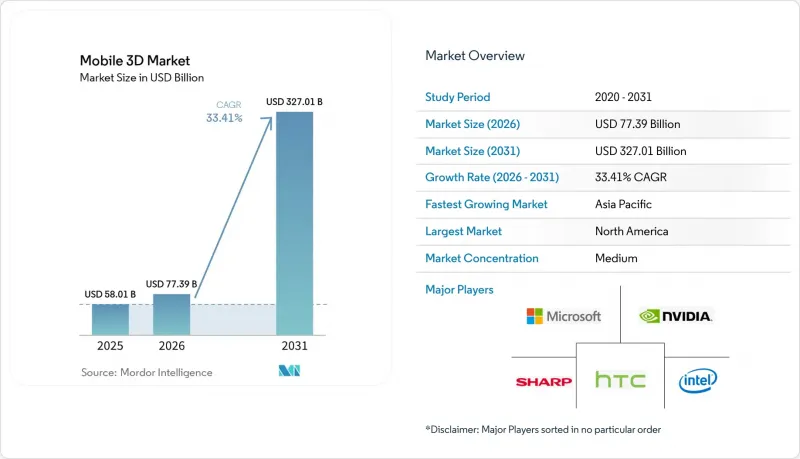
Mordor Intelligence에 의하면, 2026년 모바일 3D 시장 규모는 773억 9,000만 달러에 달할 것으로 예상되고, 2025년 580억 1,000만 달러에서 확대해, 2031년에는 3,270억 1,000만 달러에 이를 것으로 예측됩니다.
2026년부터 2031년까지의 연평균 성장률(CAGR)은 33.41%를 나타낼 것으로 전망됩니다.
본 보고서는 3D 지원 모바일 기기(스마트폰, 태블릿 등), 기기 구성 요소(3D 이미지 센서, 3D GPU/ISP 등), 3D 기술(비행 시간법(ToF), 구조화된 광 등), 3D 용도(모바일 게임, 지도·내비게이션, 애니메이션·3D 컨텐츠 제작 등) 및 지역별로 분류되어 있습니다.
세계의 모바일 3D 시장 동향 및 인사이트
3D 센싱 카메라 모듈(ToF/구조화된 광)의 급속한 보급
현재, 비행시간법(ToF) 및 구조화된 광 배열은 인물 사진 촬영 및 증강현실(AR) 오버레이를 위한 고정밀 깊이 캡처를 지원하고 있습니다. 소니는 급증하는 수요에 대응하기 위해 2024년에 태국의 레이저 다이오드 공장을 확장하고, VCSEL 생산 규모를 확대하기 위해 2,000개의 일자리를 창출했습니다. 삼성의 ‘"ISOCELL Vizion 33D"는 거리 측정 정확도를 향상시켰으며, iPhone 15 Pro에 탑재된 Apple의 공간 동영상 기능은 네이티브 3D 촬영에 대한 소비자의 높은 수요를 여실히 보여주고 있습니다. Meta의 간접 ToF 관련 특허는 모션 블러를 줄이고 전력 효율을 개선하여, 콤팩트한 본체에서도 반응성을 높여줍니다. 산업 분야에서는 로봇 공학 및 자동화를 뒷받침하는 물체 측정 정밀도 향상으로 인한 혜택을 누리고 있습니다.
모바일 AR 게임과 소셜 미디어 필터의 급증
인스타그램을 통해 대중화된 AR 게임과 얼굴 필터는 3D 기능의 일상적인 사용을 촉진하고 있습니다. 4만 2,000건의 인스타그램 필터를 대상으로 한 학술연구에 따르면, 미화 필터가 게시물의 20%를 차지하고 있어 실시간 얼굴 보정에 대한 수요가 높음을 보여주고 있습니다. 에릭슨의 보고서에 따르면, 5G 가입자들은 안정적인 대역폭 덕분에 AR에 대한 참여도가 현저히 높아지고 있습니다. 퀄컴 기기 내부의 "Stable Diffusion"는 15초 이내에 사진처럼 사실적인 장면을 생성하며, 수백만 대의 스마트폰에 크리에이터용 도구를 제공합니다. 이러한 발전에 따라 사용자 생성형 3D 컨텐츠의 진입 장벽이 낮아지면서, 소셜 플랫폼 전반에 걸쳐 네트워크 효과가 확대되고 있습니다.
3D 하드웨어 및 컨텐츠 제작에 드는 높은 비용
Vision Pro의 제조 비용이 1,519달러라는 사실은 마이크로 OLED와 센서 어셈블리로 인한 가격 상승 부담을 여실히 드러내고 있습니다. 컨텐츠 제작 팀 역시 가파른 학습 곡선에 직면해 있어, 소규모 스튜디오 시장 진입을 제한하고 있습니다. 그럼에도 불구하고, 하우덴사는 초기 투자가 필요한 분야에서도 맞춤형 AR 워크플로우를 통해 측정 가능한 유지보수 비용 절감이 실현되고 있다고 보고하고 있습니다. 부품의 양산화로 인해 가격은 점차 하락하고 있지만, 특히 피처폰에서 스마트폰으로의 전환이 여전히 진행 중인 신흥 시장에서는 일반 사용자에게 합리적인 가격을 제공하는 것이 중기적인 과제로 남아 있습니다.
부문별 분석
2025년, 스마트폰은 모바일 3D 시장의 71.20%를 차지했습니다. 이는 기존 보급 대수의 우위와 하드웨어의 연간 업데이트 주기를 반영한 것입니다. 현재 플래그십 모델에는 ToF 어레이, AI 가속기, OLED 디스플레이가 기본으로 탑재되어 있으며, 이들이 공간 컴퓨팅 로드맵의 기반을 형성하고 있습니다. 삼성의 갤럭시 S25 시리즈는 AI를 활용한 ‘"ProVisual" 이미징 기능을 통해 일상적인 사진을 깊이 맵이 포함된 3D 자산으로 변환한다는 점에서 이를 좋은 예로 들 수 있습니다. 접이식 단말기는 사용자의 몰입감을 높이는 다층적 인터페이스를 도입하고 있으며, 태블릿과 노트북은 3D 협업을 더 큰 화면으로 확장하고 있습니다.
AR/VR 헤드셋은 현재 시장 규모가 작음에도 불구하고 연평균 성장률(CAGR) 34.85%라는 가장 빠른 성장세를 보이고 있습니다. 메타의 리얼리티 랩스는 44억 달러의 영업 손실을 기록했음에도 불구하고 사상 최대의 매출을 달성하며, 소비자의 잠재적 수요가 높음을 입증하고 있습니다. 구글과 삼성은 2026년에 안드로이드 XR 글래스를 출시할 예정이며, 플랫폼 차원의 노력을 밝히고 있습니다. 이러한 기기들은 몰입형 게임부터 현장 유지보수용 오버레이에 이르기까지, 엔터테인먼트와 기업 분야의 가교 역할을 합니다. 출하 대수가 증가함에 따라, 웨어러블용 모바일 3D 시장 규모는 예측 기간 동안 스마트폰과의 격차를 점차 좁혀갈 것으로 전망됩니다.
2025년 기준으로 3D 이미지 센서는 모바일 3D 시장 규모의 45.80%를 차지하며, 스마트폰, 태블릿, 헤드셋에서 깊이 캡처의 기반이 되었습니다. 소니의 태국 내 사업 확대로 인해, 자동차용 LiDAR 및 모바일용 ToF 모듈 모두에 필요한 다이오드의 생산 능력이 확보되어, 단기적인 공급 병목 현상이 완화될 것입니다. VCSEL 이미터공급이 여전히 부족한 상황인 만큼, 각 OEM 업체들은 가능한 한 이중 조달을 추진하고 있습니다.
OLED 마이크로디스플레이는 연간 34.2%의 성장률을 기록하며, 성장세가 두드러지는 분야로 자리매김하고 있습니다. LG디스플레이와 중국의 신생 기업들이 증착 라인을 확충함에 따라 비용 곡선은 하락 추세를 보이고 있으며, 리드타임도 단축되고 있습니다. 디스플레이의 혁신은 지연 시간의 급격한 증가를 초래하지 않으면서 고화소 밀도를 처리할 수 있는 전용 3D GPU 및 ISP에 대한 수요도 촉진하고 있습니다. 부품 분야에서는 선순환 현상이 나타나고 있습니다. 부품 비용의 감소가 보급을 촉진하고, 이는 다시 추가적인 공정 개선의 자금원이 되어 모바일 3D 시장의 혁신 주기를 활발하게 유지하고 있습니다.
지역별 분석
2025년에는 기업의 투자와 높은 가처분 소득에 힘입어 북미가 모바일 3D 시장 점유율의 39.40%를 차지하며 1위를 차지했습니다. 메타(Meta)사의 AR/VR 분야 누적 투자액이 1,000억 달러를 넘어섬에 따라, 해당 지역의 연구개발 열기가 더욱 고조되고 있습니다. 산업 분야의 기업들은 AR을 활용한 업무 흐름을 통해 생산성이 향상되었다고 보고하고 있는 반면, 소비자들은 최첨단 3D 기능을 탑재한 프리미엄 스마트폰을 적극적으로 채택하고 있습니다.
아시아태평양은 2031년까지 연평균 성장률(CAGR)이 39.10%에 달하고, 성장의 견인차 역할을 하고 있습니다. 중국에서는 로봇공학 분야 수요를 배경으로, 2024년 3D 산업용 카메라 매출액이 23억 6,200만 위안(3억 3,400만 달러)에 달했습니다. 이 지역은 GDP에 8,800억 달러 규모의 모바일 부가가치를 창출하고 있으며, 공급 거점인 동시에 수요의 중심지로서의 입지를 확고히 하고 있습니다. 한국과 일본의 기업들은 디스플레이 및 홀로프로세서에 대한 연구를 추진하는 한편, 베트남과 인도의 수탁 제조업체들은 AR 웨어러블 기기의 새로운 조립 수주를 확보하고 있습니다.
유럽에서는 자동차 및 항공우주 분야의 '인더스트리 4.0'프로젝트를 원동력으로 삼아, 꾸준한 보급이 진행되고 있습니다. 규제를 통해 안전한 데이터 처리가 지원되고 있으며, 기업들이 엣지 AI 3D 도구의 시범 도입을 추진하도록 장려되고 있습니다. 중동 및 아프리카 및 라틴아메리카는 여전히 모바일 3D 시장으로서 발전 단계에 있지만, 5G 보급률이 상승하고 도시화가 진행되고 있어 하드웨어 비용이 낮아지면 도입이 가속화될 수 있는 기반이 마련되어 있습니다.
기타 혜택 :
- 엑셀 형식 시장 예측(ME) 시트
- 3개월간의 애널리스트 지원
자주 묻는 질문
목차
제1장 서론
제2장 조사 방법
제3장 주요 요약
제4장 시장 구도
제5장 시장 규모 및 성장 예측
제6장 경쟁 구도
제7장 시장 기회 및 향후 전망
KTH 26.07.07According to Mordor Intelligence, mobile 3D market size in 2026 is estimated at USD 77.39 billion, growing from 2025 value of USD 58.01 billion with 2031 projections showing USD 327.01 billion, growing at 33.41% CAGR over 2026-2031.
This report is Segmented by 3D Enabled Mobile Devices (Smartphones, Tablets, and More), Device Components (3D Image Sensors, 3D GPUs/ISPs, and More), 3D Technology (Time-Of-Flight (ToF), Structured-Light, and More), 3D Applications (Mobile Gaming, Maps and Navigation, Animations and 3D Content Creation, and More), and Geography.
Global Mobile 3D Market Trends and Insights
Rapid Adoption of 3D Sensing Camera Modules (ToF / Structured-Light)
Time-of-Flight and structured-light arrays now underpin precise depth capture for portrait imaging and augmented-reality overlays. Sony expanded its Thai laser-diode plant in 2024 to meet surging demand, adding 2,000 jobs to scale VCSEL output.Samsung's ISOCELL Vizion 33D boosts range accuracy, and Apple's spatial-video feature on iPhone 15 Pro underlines consumer appetite for native 3D capture. Meta's indirect-ToF patent improves motion-blur mitigation and power efficiency, enhancing responsiveness in compact form factors. Industrial sectors gain from object measurement precision that supports robotics and automation.
Surge in Mobile AR Gaming and Social-Media Filters
AR games and face filters popularized by Instagram drive habitual use of 3D features. Academic review of 42,000 Instagram effects found beautification filters represented 20% of uploads, illustrating demand for real-time facial augmentation. Ericsson reports that 5G subscribers show materially higher AR engagement due to stable bandwidth. Qualcomm's on-device Stable Diffusion generates photorealistic scenes under 15 seconds, opening creator tools to millions of handsets. These developments lower barriers for user-generated 3D content and amplify network effects across social platforms.
High Cost of 3D Hardware and Content Creation
Vision Pro's manufacturing cost of USD 1,519 exposes the premium burden of micro-OLED and sensor assemblies. Content teams also face steep learning curves, limiting smaller studios. Howden nonetheless reports measurable maintenance savings from custom AR workflows despite upfront spend. Component scale-up is pushing prices lower, yet mainstream affordability remains a mid-term challenge, especially in emerging markets where feature-phone transitions still play out.
Other drivers and restraints analyzed in the detailed report include:
- Edge-AI on-Device 3D Reconstruction for Offline AR
- Cost Decline of OLED Micro-Displays Enabling Spatial Content
- Battery Drain and Thermal Limits in Intensive 3D Processing
For complete list of drivers and restraints, kindly check the Table Of Contents.
Segment Analysis
Smartphones captured 71.20% of the Mobile 3D market in 2025, reflecting the installed base advantage and annual hardware refresh cycles. Flagship handsets now bundle ToF arrays, AI accelerators, and OLED displays, forming the baseline for spatial computing roadmaps. Samsung's Galaxy S25 series exemplifies this with AI-powered ProVisual imaging that turns everyday photos into depth-mapped 3D assets. Foldables introduce layered interfaces that deepen user immersion, while tablets and notebooks extend 3D collaboration to larger canvases.
AR/VR eyewear commands a smaller numerator today but posts the fastest ascent at 34.85% CAGR. Meta's Reality Labs, despite USD 4.4 billion operating losses, booked record revenue, underscoring latent consumer pull. Google and Samsung will debut Android XR glasses in 2026, signaling platform-level commitment. These devices bridge entertainment and enterprise, from immersive games to on-site maintenance overlays. As volumes scale, the Mobile 3D market size for wearables will close the gap with smartphones over the forecast window.
3D image sensors held 45.80% of the Mobile 3D market size in 2025, serving as the cornerstone for depth capture across phones, tablets, and headsets. Sony's Thai expansion secures diode capacity for both automotive LiDAR and mobile ToF modules, easing short-term bottlenecks. VCSEL emitters remain supply-constrained, prompting OEMs to dual-source where possible.
OLED micro-displays are the momentum story, growing 34.2% annually. Cost curves bend downward as LG Display and Chinese entrants ramp deposition lines, shortening lead times. Display innovation also spurs demand for dedicated 3D GPUs and ISPs that manage higher pixel densities without latency spikes. The components segment illustrates a virtuous loop: lower part costs lift adoption, which in turn funds further process improvements, keeping the Mobile 3D market innovation cycle brisk.
Complete Report Scope:
- By 3D Enabled Mobile Devices
- Smartphones
- Foldable and Dual-Screen Phones
- Tablets
- Notebooks
- AR/VR Eyewear and Head-Mounted Displays
- Other 3D-Enabled Devices
- By Device Components
- 3D Image Sensors (ToF, Structured-Light)
- 3D Displays and OLED Micro-Displays
- Depth-Sensing Modules and VCSELs
- 3D GPUs / ISPs
- Software SDKs and Middleware
- By 3D Technology
- Time-of-Flight (ToF)
- Structured-Light
- Stereo Vision
- Light-Field / Holographic
- Other Emerging Technologies
- By 3D Applications
- Mobile Gaming
- Maps and Navigation
- Animations and 3D Content Creation
- Advertising and Social-Media Filters
- Industrial and Enterprise AR
- Other Applications
- By Geography
- North America
- United States
- Canada
- Mexico
- South America
- Brazil
- Argentina
- Rest of South America
- Europe
- United Kingdom
- Germany
- France
- Italy
- Russia
- Rest of Europe
- Asia Pacific
- China
- India
- Japan
- South Korea
- ASEAN
- Rest of Asia Pacific
- Middle East and Africa
- Middle East
- Saudi Arabia
- United Arab Emirates
- Turkey
- Rest of Middle East
- Africa
- South Africa
- Nigeria
- Rest of Africa
- Middle East
- North America
Geography Analysis
North America led with a 39.40% Mobile 3D market share in 2025, buoyed by enterprise investments and high discretionary income. Meta's cumulative AR/VR outlay topping USD 100 billion amplifies regional R&D momentum. Industrial firms report productivity gains from AR-enabled workflows, while consumers readily adopt premium smartphones that showcase bleeding-edge 3D features.
Asia Pacific is the growth pacesetter at a 39.10% CAGR through 2031. China's 3D industrial camera revenue reached CNY 2.362 billion (USD 334 million) in 2024 on the back of robotics demand. The region contributes USD 880 billion of mobile value-added to GDP, positioning it as both supplier and demand center. Korean and Japanese firms push display and holo-processor research, while contract manufacturers in Vietnam and India absorb new assembly mandates for AR wearables.
Europe records steady take-up driven by Industry 4.0 projects in automotive and aerospace. Regulation supports secure data handling, encouraging enterprises to trial edge-AI 3D tools. Middle East and Africa and Latin America remain nascent Mobile 3D markets, yet rising 5G penetration and urbanization lay groundwork for accelerated adoption once hardware costs dip.
- Apple Inc.
- Samsung Electronics Co. Ltd.
- Qualcomm Inc.
- LG Electronics Inc.
- Sony Corporation
- Google LLC
- Huawei Technologies Co. Ltd.
- Intel Corporation
- Nvidia Corporation
- AMS OSRAM AG
- Infineon Technologies AG
- STMicroelectronics N.V.
- pmdtechnologies ag
- MediaTek Inc.
- Xreal Technology (Formerly Nreal)
- Meta Platforms Inc.
- Xiaomi Corporation
- Oppo Mobile Telecommunications Corp.
- Vivo Communication Technology Co.
- Lenovo Group Limited
- Sharp Corporation
- HTC Corporation
- Hitachi Ltd.
- The 3M Company
Additional Benefits:
- The market estimate (ME) sheet in Excel format
- 3 months of analyst support
TABLE OF CONTENTS
1 INTRODUCTION
- 1.1 Study Assumptions and Market Definition
- 1.2 Scope of the Study
2 RESEARCH METHODOLOGY
3 EXECUTIVE SUMMARY
4 MARKET LANDSCAPE
- 4.1 Market Overview
- 4.2 Market Drivers
- 4.2.1 Rise in smartphone penetration and 5G upgrades
- 4.2.2 Rapid adoption of 3D sensing camera modules (ToF / Structured-Light)
- 4.2.3 Surge in mobile AR gaming and social-media filters
- 4.2.4 Cost decline of OLED micro-displays enabling spatial content
- 4.2.5 Edge-AI on-device 3D reconstruction for offline AR
- 4.2.6 Foldable and dual-screen form-factors driving layered 3D UI
- 4.3 Market Restraints
- 4.3.1 High cost of 3D hardware and content creation
- 4.3.2 Battery drain and thermal limits in intensive 3D processing
- 4.3.3 VCSEL supply-chain bottlenecks limiting sensor output
- 4.3.4 Lack of open, cross-platform 3D file standards
- 4.4 Value Chain Analysis
- 4.5 Regulatory Landscape
- 4.6 Technological Outlook
- 4.7 Porter's Five Forces Analysis
- 4.7.1 Bargaining Power of Suppliers
- 4.7.2 Bargaining Power of Buyers/Consumers
- 4.7.3 Threat of New Entrants
- 4.7.4 Threat of Substitute Products
- 4.7.5 Intensity of Competitive Rivalry
5 MARKET SIZE AND GROWTH FORECASTS (VALUE)
- 5.1 By 3D Enabled Mobile Devices
- 5.1.1 Smartphones
- 5.1.2 Foldable and Dual-Screen Phones
- 5.1.3 Tablets
- 5.1.4 Notebooks
- 5.1.5 AR/VR Eyewear and Head-Mounted Displays
- 5.1.6 Other 3D-Enabled Devices
- 5.2 By Device Components
- 5.2.1 3D Image Sensors (ToF, Structured-Light)
- 5.2.2 3D Displays and OLED Micro-Displays
- 5.2.3 Depth-Sensing Modules and VCSELs
- 5.2.4 3D GPUs / ISPs
- 5.2.5 Software SDKs and Middleware
- 5.3 By 3D Technology
- 5.3.1 Time-of-Flight (ToF)
- 5.3.2 Structured-Light
- 5.3.3 Stereo Vision
- 5.3.4 Light-Field / Holographic
- 5.3.5 Other Emerging Technologies
- 5.4 By 3D Applications
- 5.4.1 Mobile Gaming
- 5.4.2 Maps and Navigation
- 5.4.3 Animations and 3D Content Creation
- 5.4.4 Advertising and Social-Media Filters
- 5.4.5 Industrial and Enterprise AR
- 5.4.6 Other Applications
- 5.5 By Geography
- 5.5.1 North America
- 5.5.1.1 United States
- 5.5.1.2 Canada
- 5.5.1.3 Mexico
- 5.5.2 South America
- 5.5.2.1 Brazil
- 5.5.2.2 Argentina
- 5.5.2.3 Rest of South America
- 5.5.3 Europe
- 5.5.3.1 United Kingdom
- 5.5.3.2 Germany
- 5.5.3.3 France
- 5.5.3.4 Italy
- 5.5.3.5 Russia
- 5.5.3.6 Rest of Europe
- 5.5.4 Asia Pacific
- 5.5.4.1 China
- 5.5.4.2 India
- 5.5.4.3 Japan
- 5.5.4.4 South Korea
- 5.5.4.5 ASEAN
- 5.5.4.6 Rest of Asia Pacific
- 5.5.5 Middle East and Africa
- 5.5.5.1 Middle East
- 5.5.5.1.1 Saudi Arabia
- 5.5.5.1.2 United Arab Emirates
- 5.5.5.1.3 Turkey
- 5.5.5.1.4 Rest of Middle East
- 5.5.5.2 Africa
- 5.5.5.2.1 South Africa
- 5.5.5.2.2 Nigeria
- 5.5.5.2.3 Rest of Africa
- 5.5.5.1 Middle East
- 5.5.1 North America
6 COMPETITIVE LANDSCAPE
- 6.1 Market Concentration
- 6.2 Strategic Moves
- 6.3 Market Share Analysis
- 6.4 Company Profiles {includes Global level Overview, Market level overview, Core Segments, Financials as available, Strategic Information, Market Rank/Share for key companies, Products and Services, and Recent Developments}
- 6.4.1 Apple Inc.
- 6.4.2 Samsung Electronics Co. Ltd.
- 6.4.3 Qualcomm Inc.
- 6.4.4 LG Electronics Inc.
- 6.4.5 Sony Corporation
- 6.4.6 Google LLC
- 6.4.7 Huawei Technologies Co. Ltd.
- 6.4.8 Intel Corporation
- 6.4.9 Nvidia Corporation
- 6.4.10 AMS OSRAM AG
- 6.4.11 Infineon Technologies AG
- 6.4.12 STMicroelectronics N.V.
- 6.4.13 pmdtechnologies ag
- 6.4.14 MediaTek Inc.
- 6.4.15 Xreal Technology (Formerly Nreal)
- 6.4.16 Meta Platforms Inc.
- 6.4.17 Xiaomi Corporation
- 6.4.18 Oppo Mobile Telecommunications Corp.
- 6.4.19 Vivo Communication Technology Co.
- 6.4.20 Lenovo Group Limited
- 6.4.21 Sharp Corporation
- 6.4.22 HTC Corporation
- 6.4.23 Hitachi Ltd.
- 6.4.24 The 3M Company
7 MARKET OPPORTUNITIES AND FUTURE OUTLOOK
- 7.1 White-space and Unmet-need Assessment