

|
시장보고서
상품코드
2073420
모듈형 UPS : 시장 점유율 분석, 업계 동향 및 통계, 성장 예측(2026-2031년)Modular UPS - Market Share Analysis, Industry Trends & Statistics, Growth Forecasts (2026 - 2031) |
||||||
 Mordor Intelligence
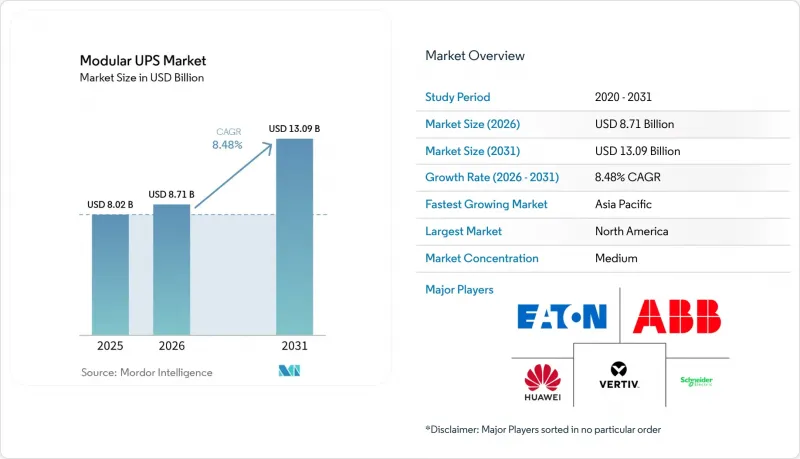
Mordor Intelligence에 의하면, 모듈형 UPS 시장 규모는 2025년 80억 2,000만 달러로 평가되었습니다. 2026년 87억 1,000만 달러에서 2031년까지 130억 9,000만 달러로 확대될 것으로 예측되며 2026년부터 2031년까지 연평균 복합 성장률(CAGR)은 8.48%를 나타낼 전망입니다.
본 보고서는 출력 용량(50 KVA 이하, 51-100 KVA, 101-300 KVA, 301-500 KVA 및 500 KVA 초과), 최종 사용자 산업(데이터센터, 산업 제조, 통신, 상업용 건물, 은행, 금융서비스 및 보험(BFSI), 정부 기관, 의료, 기타), 상수(단상, 3상), 구성 요소(솔루션, 서비스) 및 지역별로 분류되어 있습니다. 시장 전망치는 금액(달러)으로 표시되어 있습니다.
세계의 모듈형 UPS 시장 동향 및 분석
하이퍼스케일 및 코로케이션 데이터센터의 확대
하이퍼스케일 클라우드 제공업체는 GPU 클러스터가 도입될 경우에만 전력 인프라를 확장할 수 있도록 모듈형 토폴로지를 지정하고 있습니다. 마이크로소프트는 단계적 확장을 위해 1.5기가와트의 AI 훈련 용량을 확보하고, 필요에 따라 추가 모듈을 도입할 수 있는 프레임 기반 UPS 시스템을 도입하기로 규정했습니다. 주요 코로케이션 기업들도 마찬가지로 신규 건설 기준을 변경하고 있으며, 한 사업자는 2025년에 가동을 시작한 시설의 3분의 2 이상에서 임차인과의 계약이 체결될 때까지 초기 투자금 1억 8,000만 달러를 유보하기 위해 모듈형 전원 프레임이 채택되었음을 확인했습니다. 이러한 투자 연기는 투자자본이익률(ROIC)을 향상시키고, 임대 수요가 위축되었을 때 개발자가 자산의 노후화로 인한 손실을 입는 것을 방지합니다.
모듈식 확장성을 통한 총 소유 비용(TCO) 절감
모듈식 프레임의 경우, UPS 전체를 불필요하게 대형화하지 않고 모듈을 하나만 추가해도 N+1의 이중화를 실현할 수 있으므로, 하드웨어 비용을 약 15-20% 절감할 수 있습니다. 기술자가 30분 이내에 유닛을 핫스왑할 수 있으므로 정기 유지보수가 간소화됩니다. 이를 통해 대규모 데이터센터에서 가동 중단으로 인한 손실로 시간당 9,000달러의 비용이 발생할 수 있는 우회 작업 시간을 없앨 수 있습니다. 슈나이더 일렉트릭의 EcoStruxure 플랫폼은 UPS 운영과 빌딩 관리 소프트웨어를 연동하여 시간대별 요금제에 따라 충전을 최적화함으로써, 여러 사업장에서 진행된 시범 운영을 통해 전기 요금을 8% 절감했습니다.
모놀리식형 UPS에 비해 높은 초기 투자 비용
모듈형 프레임은 모든 모듈을 장착할 경우 구매 가격이 25-35% 더 비싸집니다. 이러한 높은 가격 때문에 수명 주기 전반에 걸친 경제적 이점보다는 초기 비용을 중시하는 구매자들은 종종 도입을 주저하게 됩니다. 신흥 시장을 대상으로 한 조사에서 데이터센터 개발자의 62%가 모듈식 설계 도입의 가장 큰 장애물로 프로젝트 자금 조달의 어려움을 꼽고 있다는 사실이 일관되게 드러나고 있습니다. “서비스형 플랫폼(PaaS)" 서비스는 설비 투자(Capex)를 운영 비용(OpEx)으로 전환하는 수단을 제공하지만, 이를 이용하려면 투자 적격 등급의 신용 등급이 필요합니다. 안타깝게도 많은 지역 사업자들은 이 기준을 충족하는 데 어려움을 겪고 있으며, 이로 인해 이러한 솔루션을 활용하는 능력이 더욱 저해되고 있습니다.
부문별 분석
500kVA를 초과하는 대규모 설비는 2031년까지 연평균 성장률(CAGR) 11.53%를 나타낼 것으로 예측되며, 이는 모듈형 UPS 시장 내에서 가장 높은 성장률입니다. 이 사업자는 UPS, 개폐 장치, 액체 냉각식 버스웨이를 결합한 컨테이너형 전원 블록을 도입했으며, 이를 통해 10메가와트의 보호 대상 부하를 단일 ISO 컨테이너에 담아 공장에서 출하할 수 있게 되었습니다. 이러한 접근 방식을 통해 건설 기간이 18개월에서 6개월로 단축되었으며, 랙 밀도가 전년 대비 두 배로 증가할 가능성이 있는 AI 훈련 클러스터와도 잘 어울립니다. 2025년 모듈형 UPS 시장 점유율의 38.14%를 차지한 51-100kVA 구간은 부하 증가가 예측 가능한 연간 주기를 따르는 중규모 코로케이션 및 기업의 시스템 갱신 프로젝트에서 여전히 기본적인 선택지로 자리 잡고 있습니다.
대용량 모듈로의 전환은 디지털 인프라 전반에서 나타나는 통합 추세를 반영하고 있습니다. 신규 하이퍼스케일 시설의 평균 랙 밀도는 이미 15kW를 넘어섰으며, 2027년까지 20kW에 달할 것으로 예측됩니다. IEC 62040-3의 성능 등급에 기반한 표준화를 통해 사업자는 하나의 프레임 내에 여러 공급업체의 모듈을 혼합하여 사용할 수 있게 되어, 벤더 종속성을 피하면서 구성 요소 간의 경쟁을 촉진할 수 있습니다.
데이터센터는 2025년 시장 규모의 62.14%를 차지하며, 모듈형 UPS 시장에서 지금까지 보여온 압도적인 우위를 입증했습니다. 그러나 부지 확보의 제약과 전력 계통 연결 대기 시간으로 인해 개발 일정이 장기화되면서, 이 부문의 성장은 둔화되고 있습니다. 반면, 의료 분야는 2031년까지 연평균 9.12%의 성장률이 예상됩니다. 병원 그룹은 집중형 모놀리식 시스템에서 임상 업무 현장에 가까운 곳에 설치되는 분산형 모듈식 유닛으로 전환하고 있으며, 이를 통해 배터리실의 점유 면적을 3분의 2로 줄여, 수익을 창출하는 의료기기를 위한 고가의 바닥 면적을 확보하고 있습니다.
제조, 통신, 은행 업계의 도입 사례가 2차 성장의 원동력이 되고 있습니다. 통신 분야에서는 모듈형 UPS가 5G 코어 노드의 상시 가동을 보장하고 있으며, 제조 분야에서는 예기치 못한 전압 저하를 허용할 수 없는 인더스트리 4.0 조립 라인을 뒷받침하는 기반이 되고 있습니다. 상업용 빌딩이나 정부 시설에서도 엣지 컴퓨팅 및 공공 안전 시스템을 보호하기 위해 이 기술이 점차 도입되고 있지만, 이러한 분야에서의 보급률은 여전히 15% 미만에 그치고 있습니다.
지역별 분석
아시아태평양은 모듈형 UPS 시장 규모에서 가장 큰 증가분을 기록할 것으로 예상되며, 2031년까지 연평균 성장률(CAGR) 10.32%로 성장할 전망입니다. 중국 국가발전개혁위원회는 2024년에 136억 달러 상당의 컴퓨팅 인프라 프로젝트를 승인했으며, 이 중 78%는 단계적 도입을 가능하게 하기 위해 모듈형 UPS 프레임을 지정했습니다. 인도의 “디지털 인디아"이니셔티브는 2급 도시의 AI 대응 데이터 홀에 12억 달러를 투자하고 있으며, 마찬가지로 “성장에 따른 과금(pay-as-you-grow)"형식의 전원 보호가 중요시되고 있습니다. 일본과 한국에서는 자율주행차 및 혼합현실(MR) 생태계를 뒷받침하는 엣지 마이크로사이트가 추가되고 있으며, 이 모든 분야에서 10밀리초 미만의 지연 시간을 보장하기 위해 내결함성이 뛰어난 3상 UPS가 요구되고 있습니다.
북미는 미국에서 이미 발표된 데이터센터 프로젝트의 파이프라인이 2.8기가와트에 달함에 따라, 2025년에도 42.53%라는 압도적인 점유율을 유지했습니다. 그러나 버지니아주, 텍사스주, 캘리포니아주에서는 계통 연계까지의 대기 기간이 평균 24-36개월에 달하기 때문에 성장세가 둔화되고 있습니다. 사업자들은 지속적인 전력 공급이 시작될 때까지 도매 전력 시장에서 수익을 창출할 수 있는 계통 연계형 UPS 시스템을 도입함으로써 지연 위험을 줄이고 있습니다.
유럽은 재생에너지 및 전력 계통의 통합을 위한 기술 실증의 장으로 계속해서 자리 잡고 있습니다. 독일에서는 2025년 말까지 부가 서비스 시장에서 47메가와트시의 모듈형 UPS 용량이 등록되었으며, 태양광 발전으로 인해 정오에 전력 공급이 과잉될 때 배터리를 활용하여 수익을 창출하고 있습니다. 중동 역시 새로운 거점으로 부상하고 있습니다. 사우디아라비아 공공투자기금은 2025년, 주변 온도 50℃의 환경에 적합한 인산철 리튬계 모듈형 UPS를 지정받은 4곳의 코로케이션 캠퍼스에 자금을 지원했습니다. 남미와 아프리카에서는 프로젝트 파이낸싱의 제약과 송전망의 안정성 부족으로 인해 도입이 지연되고 있지만, 브라질과 남아프리카공화국에서 진행된 시범 도입을 통해 빈번하게 발생하는 전압 변동 속에서도 이 아키텍처의 견고성이 입증되었습니다.
기타 혜택 :
- 엑셀 형식 시장 예측(ME) 시트
- 3개월간의 애널리스트 지원
자주 묻는 질문
목차
제1장 서론
제2장 조사 방법
제3장 주요 요약
제4장 시장 구도
제5장 시장 규모 및 성장 예측
제6장 경쟁 구도
제7장 시장 기회 및 향후 전망
KTH 26.07.08According to Mordor Intelligence, the modular UPS market size is projected to expand from USD 8.02 billion in 2025 and USD 8.71 billion in 2026 to USD 13.09 billion by 2031, registering a CAGR of 8.48% between 2026 and 2031.
This report is Segmented by Power Capacity (<=50 KVA, 51-100 KVA, 101-300 KVA, 301-500 KVA, and >500 KVA), End User Industry (Data Centers, Industrial Manufacturing, Telecommunications, Commercial Buildings, BFSI, Government, Healthcare, and More), Phase Type (Single-Phase, and Three-Phase), Component (Solutions, and Services), and Geography. The Market Forecasts are Provided in Value (USD).
Global Modular UPS Market Trends and Insights
Expansion of Hyperscale and Colocation Data Centers
Hyperscale cloud providers are specifying modular topologies so that power infrastructure scales only when GPU clusters are installed. Microsoft earmarked 1.5 gigawatts of AI-training capacity for phased rollout, stipulating frame-based UPS systems that accept additional modules on demand. Leading colocation firms likewise shifted new-build standards, with one operator confirming that more than two-thirds of facilities commissioned in 2025 used modular power frames to defer USD 180 million in initial outlay until tenant contracts closed. Such deferral improves return on invested capital and shields developers from stranded assets when leasing momentum softens.
Lower Total Cost of Ownership Through Modular Scalability
A modular frame achieves N+1 redundancy by adding one extra module rather than oversizing the entire UPS, trimming hardware expense by roughly 15-20%. Routine maintenance becomes simpler because technicians hot-swap units in under 30 minutes, eliminating bypass windows that can cost large data centers USD 9,000 per hour in downtime penalties. Schneider Electric's EcoStruxure platform links UPS operations with building-management software, optimizing charging based on time-of-use tariffs and reducing electricity bills by 8% in multi-site pilots.
High Up-Front Capital Expenditure Versus Monolithic UPS
When fully populated, modular frames come with a 25-35% purchase premium. This higher price tag often discourages buyers who focus more on the initial cost rather than considering the long-term benefits of lifecycle economics. In emerging markets, surveys consistently reveal that 62% of data-center developers identify limited access to project financing as the primary obstacle to adopting modular designs. While power-as-a-service offerings provide a way to shift capital expenditures (capex) into operational expenditures (opex), they come with the requirement of investment-grade credit ratings. Unfortunately, many regional operators find it challenging to meet this benchmark, further hindering their ability to leverage such solutions.
Other drivers and restraints analyzed in the detailed report include:
- Rapid Edge and 5G Micro-Data-Center Deployment
- Grid-Interactive UPS Monetization via Demand-Response
- Limited Awareness Beyond IT-Intensive Verticals
For complete list of drivers and restraints, kindly check the Table Of Contents.
Segment Analysis
Large-scale installations above 500 kVA are projected to post an 11.53% CAGR to 2031, the fastest within the Modular UPS market. Operators deploy containerized power blocks that combine UPS, switchgear, and liquid-cooled busways, allowing 10 megawatts of protected load to leave the factory in a single ISO container. This approach compresses construction schedules from 18 to 6 months and aligns well with AI training clusters that can double rack density year-over-year. The 51-100 kVA bracket, which held 38.14% of the Modular UPS market share in 2025, remains the baseline choice for mid-tier colocation and enterprise refresh projects where load ramps follow predictable annual cycles.
The pivot toward high-capacity modules mirrors consolidation trends across the digital-infrastructure landscape. Average rack density in new hyperscale halls already exceeds 15 kilowatts and is projected to reach 20 kilowatts by 2027. Standardization around IEC 62040-3 performance classes enables operators to mix modules from several suppliers inside one frame, avoiding vendor lock-in and maintaining components in competitive tension.
Data centers captured 62.14% of 2025 value, underscoring their historical dominance in the Modular UPS market size. Growth within this segment is moderating, however, as land constraints and utility interconnection queues elongate development timelines. Healthcare, by contrast, is forecast to expand at 9.12% through 2031. Hospital groups are migrating from centralized, monolithic systems to distributed modular units that sit nearer to clinical loads, trimming battery-room footprint by two-thirds and freeing expensive floor space for revenue-generating medical equipment.
Industrial manufacturing, telecommunications, and banking installations represent secondary growth engines. In telecommunications, modular UPS secures always-on operation of 5G core nodes, while in manufacturing the architecture underpins Industry 4.0 assembly lines that cannot tolerate unexpected voltage sags. Commercial buildings and government facilities are also incrementally adopting the technology to protect edge compute and public-safety systems, although penetration here remains below 15%.
Complete Report Scope:
- By Power Capacity
- <= 50 kVA
- 51 - 100 kVA
- 101 - 300 kVA
- 301 - 500 kVA
- > 500 kVA
- By End User Industry
- Data Centers
- Industrial Manufacturing
- Telecommunications
- Commercial Buildings
- Banking, Financial Services and Insurance
- Government and Public Infrastructure
- Healthcare
- Rest of End User Industries
- By Phase Type
- Single-Phase
- Three-Phase
- By Component
- Solutions (Hardware)
- Services
- By Geography
- North America
- United States
- Canada
- Mexico
- South America
- Brazil
- Argentina
- Rest of South America
- Europe
- Germany
- United Kingdom
- France
- Italy
- Spain
- Rest of Europe
- Asia Pacific
- China
- Japan
- South Korea
- India
- Australia
- New Zealand
- Rest of Asia-Pacific
- Middle East and Africa
- Middle East
- United Arab Emirates
- Saudi Arabia
- Turkey
- Rest of Middle East
- Africa
- South Africa
- Nigeria
- Kenya
- Rest of Africa
- Middle East
- North America
Geography Analysis
Asia-Pacific is forecast to add the greatest incremental value to the Modular UPS market size, expanding at a 10.32% CAGR through 2031. China's National Development and Reform Commission cleared USD 13.6 billion of computing-infrastructure projects during 2024, with 78% specifying modular UPS frames to enable staged rollout. India's Digital India initiative is channeling USD 1.2 billion toward AI-ready data halls in Tier 2 cities, likewise favoring pay-as-you-grow power protection. Japan and South Korea are adding edge micro-sites that anchor autonomous-vehicle and mixed-reality ecosystems, all of which demand resilient three-phase UPS to guarantee sub-10-millisecond latency.
North America retained a commanding 42.53% share in 2025 thanks to a 2.8-gigawatt pipeline of announced U.S. data-center projects. Growth is slowing, however, as queue times for grid interconnection average 24-36 months in Virginia, Texas, and California. Operators are mitigating delay risk by incorporating grid-interactive UPS systems capable of earning revenue in wholesale power markets while awaiting permanent feeds.
Europe remains a technology test-bed for renewable-grid integration. Germany registered 47 megawatt-hours of modular UPS capacity in ancillary-services markets by end-2025, monetizing batteries during solar-induced midday oversupply. The Middle East is another emerging node; Saudi Arabia's Public Investment Fund financed four colocation campuses in 2025 that specified lithium-iron-phosphate-based modular UPS suitable for 50 °C ambient temperatures. South America and Africa trail on adoption, hampered by limited project finance and weaker grid stability, yet pilot deployments in Brazil and South Africa are demonstrating the architecture's resilience during frequent voltage excursions.
- Schneider Electric SE
- Huawei Technologies Co. Ltd.
- Vertiv Holdings Co.
- Eaton Corporation plc
- ABB Ltd.
- Delta Electronics Inc.
- Riello UPS (Riello Elettronica)
- AEG Power Solutions
- Socomec Group
- Borri S.p.A.
- Kehua Data Co. Ltd.
- KSTAR Science and Technology
- CyberPower Systems Inc.
- Tripp Lite (by Eaton)
- Gamatronic (SolarEdge)
- Salicru S.A.
- Piller Power Systems
- Centiel SA
- Hitec Power Protection
- Statron AG
- PowerShield Ltd.
- Fuji Electric Co. Ltd.
- Mitsubishi Electric Corp.
- Toshiba Energy Systems and Solutions
- Shenzhen Zhicheng Champion Co. Ltd.
- Zhongheng Electric
Additional Benefits:
- The market estimate (ME) sheet in Excel format
- 3 months of analyst support
TABLE OF CONTENTS
1 INTRODUCTION
- 1.1 Study Assumptions and Market Definition
- 1.2 Scope of the Study
2 RESEARCH METHODOLOGY
3 EXECUTIVE SUMMARY
4 MARKET LANDSCAPE
- 4.1 Market Overview
- 4.2 Market Drivers
- 4.2.1 Expansion of Hyperscale and Colocation Data Centers
- 4.2.2 Lower Total Cost of Ownership Through Modular Scalability
- 4.2.3 Rapid Edge and 5G Micro-Data-Center Deployment
- 4.2.4 Grid-Interactive UPS Monetization via Demand-Response
- 4.2.5 Lithium-ion Module Adoption Boosting Power Density
- 4.2.6 Circular-Economy Refurbishment and Redeployment Models
- 4.3 Market Restraints
- 4.3.1 High Up-Front Capital Expenditure Versus Monolithic UPS
- 4.3.2 Limited Awareness Beyond IT-Intensive Verticals
- 4.3.3 Power-Electronics Component Supply Volatility
- 4.3.4 Cyber-Security Exposure in Networked UPS Architectures
- 4.4 Industry Value-Chain Analysis
- 4.5 Regulatory Landscape
- 4.6 Technological Outlook
- 4.7 Porter's Five Forces Analysis
- 4.7.1 Bargaining Power of Buyers
- 4.7.2 Bargaining Power of Suppliers
- 4.7.3 Threat of New Entrants
- 4.7.4 Threat of Substitutes
- 4.7.5 Competitive Rivalry
5 MARKET SIZE AND GROWTH FORECASTS (VALUE)
- 5.1 By Power Capacity
- 5.1.1 <= 50 kVA
- 5.1.2 51 - 100 kVA
- 5.1.3 101 - 300 kVA
- 5.1.4 301 - 500 kVA
- 5.1.5 > 500 kVA
- 5.2 By End User Industry
- 5.2.1 Data Centers
- 5.2.2 Industrial Manufacturing
- 5.2.3 Telecommunications
- 5.2.4 Commercial Buildings
- 5.2.5 Banking, Financial Services and Insurance
- 5.2.6 Government and Public Infrastructure
- 5.2.7 Healthcare
- 5.2.8 Rest of End User Industries
- 5.3 By Phase Type
- 5.3.1 Single-Phase
- 5.3.2 Three-Phase
- 5.4 By Component
- 5.4.1 Solutions (Hardware)
- 5.4.2 Services
- 5.5 By Geography
- 5.5.1 North America
- 5.5.1.1 United States
- 5.5.1.2 Canada
- 5.5.1.3 Mexico
- 5.5.2 South America
- 5.5.2.1 Brazil
- 5.5.2.2 Argentina
- 5.5.2.3 Rest of South America
- 5.5.3 Europe
- 5.5.3.1 Germany
- 5.5.3.2 United Kingdom
- 5.5.3.3 France
- 5.5.3.4 Italy
- 5.5.3.5 Spain
- 5.5.3.6 Rest of Europe
- 5.5.4 Asia Pacific
- 5.5.4.1 China
- 5.5.4.2 Japan
- 5.5.4.3 South Korea
- 5.5.4.4 India
- 5.5.4.5 Australia
- 5.5.4.6 New Zealand
- 5.5.4.7 Rest of Asia-Pacific
- 5.5.5 Middle East and Africa
- 5.5.5.1 Middle East
- 5.5.5.1.1 United Arab Emirates
- 5.5.5.1.2 Saudi Arabia
- 5.5.5.1.3 Turkey
- 5.5.5.1.4 Rest of Middle East
- 5.5.5.2 Africa
- 5.5.5.2.1 South Africa
- 5.5.5.2.2 Nigeria
- 5.5.5.2.3 Kenya
- 5.5.5.2.4 Rest of Africa
- 5.5.5.1 Middle East
- 5.5.1 North America
6 COMPETITIVE LANDSCAPE
- 6.1 Market Concentration
- 6.2 Strategic Moves
- 6.3 Market Share Analysis
- 6.4 Company Profiles (includes Global Level Overview, Market Level Overview, Core Segments, Financials as available, Strategic Information, Market Rank/Share, Products and Services, Recent Developments)
- 6.4.1 Schneider Electric SE
- 6.4.2 Huawei Technologies Co. Ltd.
- 6.4.3 Vertiv Holdings Co.
- 6.4.4 Eaton Corporation plc
- 6.4.5 ABB Ltd.
- 6.4.6 Delta Electronics Inc.
- 6.4.7 Riello UPS (Riello Elettronica)
- 6.4.8 AEG Power Solutions
- 6.4.9 Socomec Group
- 6.4.10 Borri S.p.A.
- 6.4.11 Kehua Data Co. Ltd.
- 6.4.12 KSTAR Science and Technology
- 6.4.13 CyberPower Systems Inc.
- 6.4.14 Tripp Lite (by Eaton)
- 6.4.15 Gamatronic (SolarEdge)
- 6.4.16 Salicru S.A.
- 6.4.17 Piller Power Systems
- 6.4.18 Centiel SA
- 6.4.19 Hitec Power Protection
- 6.4.20 Statron AG
- 6.4.21 PowerShield Ltd.
- 6.4.22 Fuji Electric Co. Ltd.
- 6.4.23 Mitsubishi Electric Corp.
- 6.4.24 Toshiba Energy Systems and Solutions
- 6.4.25 Shenzhen Zhicheng Champion Co. Ltd.
- 6.4.26 Zhongheng Electric
7 MARKET OPPORTUNITIES AND FUTURE OUTLOOK
- 7.1 White-Space and Unmet-Need Assessment


