
|
시장보고서
상품코드
2073486
재생 항공 연료 : 시장 점유율 분석, 업계 동향 및 통계, 성장 예측(2026-2031년) |
||||||
 Mordor Intelligence
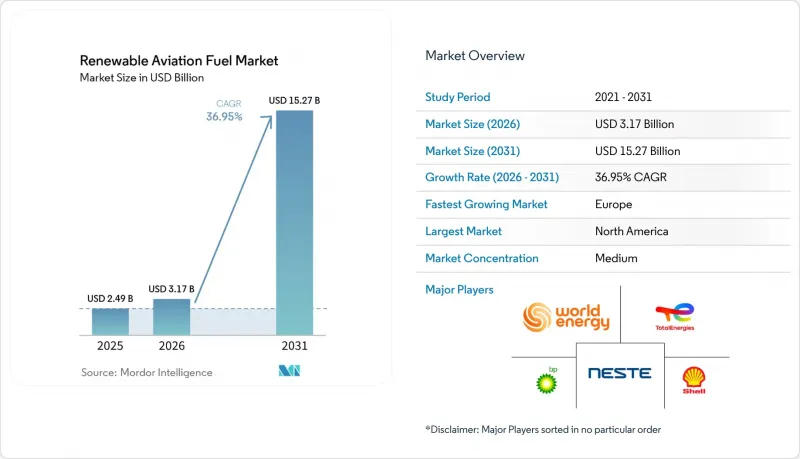
Mordor Intelligence에 의하면, 재생 항공 연료 시장 규모는 2025년 24억 9,000만 달러로 평가되었습니다. 2026년 31억 7,000만 달러에서 2031년까지 152억 7,000만 달러로 확대되며 2026년부터 2031년까지 연평균 복합 성장률(CAGR)은 36.95%를 나타낼 전망입니다.
본 보고서는 원료(사용 후 식용유 및 폐유지, 산업용 CO2 및 그린 수소 등), 기술(수소화 처리 에스테르 및 지방산, 알코올-투-제트 등), 혼합 비율(최대 10% 혼합, 10-50% 혼합, 50-100% 혼합), 용도(민간 항공사 등), 지역(북미, 유럽, 아시아태평양, 남미, 중동 및 아프리카)별로 분류되어 있습니다.
세계의 재생 항공 연료 시장 동향 및 인사이트
온실가스(GHG) 배출에 관한 정부 규제 강화
자발적인 체계 대신, 법적 구속력이 있는 의무가 주요 수요 동력이 되고 있습니다. EU의 “ReFuelEU Aviation”이 규정에 따르면 2025년에는 2%, 2030년까지는 6%, 2050년까지는 70%의 SAF 혼합이 의무화되어 있으며, 이를 위반할 경우 CO₂ 환산 1톤당 95유로의 벌금이 부과됩니다. 이 법에서는 합성 연료에 관한 세부 목표로 2030년까지 1.2%, 2050년까지 35%를 규정하고 있으며, 이에 따라 '파워 투 리퀴드(P2L)'해당 방식에 대한 투자가 촉진되고 있습니다. CORSIA의 첫 번째 이행 단계는 2024년에 시작되었지만, SAF 1리터당 탄소 상쇄량의 3.5배에 해당하는 적격 크레딧을 창출하기 때문에 항공사들은 직접 혼합 방식을 선호하고 있습니다. 2030년까지 10%의 혼합을 의무화하는 일본의 규제와, 단계적으로 1-2%의 혼합을 의무화하는 인도의 규제는 아시아 내 규제 추세를 더욱 강화하고 있으며, 이 지역에서의 보급을 좌우하는 요인은 원료의 확보 가능성보다는 법적으로 정해진 최소 혼합 비율이라는 점을 여실히 보여주고 있습니다.
항공사의 탄소 중립 약속
항공사 차원의 공약은 자본 위험을 완화하는 대규모의 장기 계약으로 이어지고 있습니다. 유나이티드 항공은 네스테사로부터 9억 갤런을 포함해, 향후 20년에 걸쳐 총 15억 갤런의 SAF를 구매하기로 합의했습니다. 에어프랑스-KLM은 토탈에너지스와 80만 톤 규모의 10년 계약을 체결하여 그랑퓌 바이오 정유시설의 수익 기반을 확립했습니다. 에미레이트 항공은 SAF 조달에 연간 2억 달러를 배정하며, 유럽 및 아시아로부터의 수입에 적극적인 태도를 보였습니다. 이러한 인수 계약을 통해, 현물 가격의 Jet A-1 대비 갤런당 1.50-2.50달러의 프리미엄을 적용하여 공급량을 확보함으로써, 프로젝트 파이낸싱 대출 기관이 요구하는 수익 안정성 기준을 충족하고 있습니다.
기존 제트 연료에 비해 높은 생산 비용
2025년에도 SAF의 가격은 Jet A-1의 2-5배 수준에 머물렀습니다. HEFA의 생산 비용은 갤런당 3-6달러인 반면, 석유 유래 제트 연료는 2-3달러입니다. 한편, e-연료는 보조금 적용 전에는 갤런당 8달러를 넘는 경우가 많았습니다. 미국 섹션 45Z 세액 공제(1갤런당 1.75달러)로 인해 그 차이는 줄어들겠지만, 2027년에 만료되므로 장기적인 경제성은 불투명합니다. 높은 자본 집약도가 위험을 증폭시키고 있으며, PtL 플랜트는 연간 생산 능력 10만 톤당 약 10억 달러의 투자가 필요합니다.
부문별 분석
2025년 기준으로 재생 항공 연료 시장 점유율의 40.4%를 폐식용유 및 폐유지가 차지했으며, 이는 HEFA(폐식용유)의 성숙도와 확립된 회수 네트워크를 반영한 것입니다. 산업용 CO₂와 그린 수소를 결합한 연료는 ReFuelEU의 합성 연료 관련 하위 의무 조항이 구매를 보장하고 있기 때문에 2031년까지 연평균 성장률(CAGR) 59.5%를 나타낼 것으로 예측되며, 이는 모든 원료 중 가장 빠른 성장 속도입니다. 동물성 지방은 여전히 공급량에 제약을 받고 있는 반면, 리그노셀룰로오스계 바이오매스는 Fulcrum BioEnergy만이 상업적 규모로 전개하고 있는 자본 집약적인 가스화-FT 공법으로 인해 성장이 둔화되고 있습니다.
지질 원료에 대한 수요가 급속히 부족해지고 있습니다. 전 세계 사용 후 식용유(UCO) 수입이 급증함에 따라, 유럽집행위원회는 인증 체인에 대한 감사를 실시하고, 보다 엄격한 추적성 기준 도입을 검토하고 있습니다. 식물성 기름은 지속가능성 측면에서 엄격한 감시를 받고 있으며, EU는 2024년에 팜유 유래 HEFA를 배제하고, 조달처를 수율이 낮은 대두유와 유채유로 전환했습니다. 지질 원료공급 상한선이 다가오는 가운데, 합성 e-SAF는 2050년까지 EU 법규에서 정한 35%의 혼합 요건을 충족할 수 있는 유일한 수단으로 부상하고 있습니다.
2025년에는 네스테(Nestle)의 싱가포르 공장(생산 능력 190만 톤)과 토탈에너지(TotalEnergies)의 그랑퓌(Grand-Puy) 시설의 전환을 원동력으로 삼아, HEFA가 재생 항공 연료 시장 규모의 69.9%를 차지하며 압도적인 점유율을 확립했습니다. 그러나 지질에 대한 의존도로 인해 향후 생산량은 연간 약 1,000만 톤으로 제한될 것입니다. PtL/e-SAF는 전해조 비용의 감소와 중동의 초저비용 태양광 발전 공급 확대에 힘입어 연평균 성장률(CAGR) 55.8%로 급증할 것으로 전망됩니다. ATJ와 FT-SPK는 과도기적인 역할을 수행하고 있습니다. 란자제트(LanzaJet)사의 프리덤 파인즈 공장은 2025년에 1,000만 갤런에 도달할 전망이며, 한편 벨로시스(Velosis)사는 도시 고형 폐기물 처리 노선에 대해 마침내 ASTM 승인을 획득했고, 바이유 퓨얼스(Bayou Fuels)의 건설이 본격화되었습니다.
HEFA의 브라운필드 부문에서의 우위는 당분간 계속해서 견고할 것입니다. 정유시설에서의 공동 처리를 통해, 그린필드 건설에 비해 설비 투자를 최대 50% 절감할 수 있습니다. 그렇긴 하지만, 정책의 확실성이 높아짐에 따라 투자자들의 관심은 15년간의 전력 구매 계약이 수반되는 PtL 프로젝트로 쏠리고 있습니다. 기술 라이선싱은 전략적 병목 현상이 되고 있습니다. 하네웰 UOP의 "에코파인잉(Ecofining)" 이 공정은 전 세계 HEFA 처리 능력의 70% 이상을 담당하고 있으며, 2024년에는 2억 달러의 라이선스 수익을 창출했습니다.
지역별 분석
유럽은 2031년까지 연평균 성장률(CAGR) 43.0%를 나타낼 것으로 예측되며, 2025년에 북미가 재생 항공 연료 시장에서 42.6%의 점유율을 차지했음에도 불구하고 유럽이 북미를 앞설 것으로 전망됩니다. EU에서는 2024년에 19만 3,000톤의 SAF를 혼합했으나, 이는 제트 연료 소비량의 고작 0.6%에 불과합니다. 그러나 이미 발표된 프로젝트에 따라, 주로 네덜란드, 프랑스, 독일에서 2030년까지 생산 능력이 320만 톤으로 확대될 전망입니다. 암스테르담, 파리, 프랑크푸르트의 공항 인프라 정비 계획은 물류 비용을 절감하고 공급 기반을 강화할 것입니다.
북미는 월드 에너지사의 파라마운트 정유시설에서 확립된 HEFA 생산 능력과, '인플레이션 억제법'에 따른 넉넉한 생산 크레딧의 혜택을 누리고 있습니다. 제45Z조에서는 갤런당 최대 1.75달러의 지원이 제공되고 있지만, 2027년 이후 갱신 위험에 직면해 있어 일부 개발업체들은 투자 결정을 미루고 있습니다. 캐나다는 2030년까지 국내 생산 비율 10%를 목표로 11억 달러 규모의 보조금 제도를 도입했으나, 재생 가능 디젤과의 원료 경쟁으로 인해 당분간 성장이 제한되고 있습니다.
아시아태평양에서는 움직임이 활발해지고 있습니다. 싱가포르에서는 2026년에 1%의 혼합 의무가 도입되며, 일본은 2030년까지 10%를 목표로 하고 있고, 인도는 2028년까지 1-2%의 요건을 단계적으로 도입할 예정입니다. 중국은 2025년까지 5만 톤 생산을 목표로 했으나, 원료 부족으로 인해 3만 톤에 그쳤습니다. 호주는 2025년에 SAF 자금으로 7억 2,000만 달러를 출연했으며, 2030년까지 10%의 혼합 비율을 목표로 하고 있습니다. 중동은 PtL의 허브로서의 입지를 다져가고 있으며, 마스다르가 아부다비에 건설 중인 20만 톤 규모의 시설에서는 저비용 태양광 발전을 활용할 예정입니다. 또한, UAE의 에미레이트 항공은 15년간의 인수 계약을 체결했습니다.
기타 혜택 :
- 엑셀 형식 시장 예측(ME) 시트
- 3개월간의 애널리스트 지원
자주 묻는 질문
목차
제1장 서론
제2장 조사 방법
제3장 주요 요약
제4장 시장 구도
제5장 시장 규모 및 성장 예측
제6장 경쟁 구도
제7장 시장 기회 및 향후 전망
KTHAccording to Mordor Intelligence, the renewable aviation fuel market size is projected to expand from USD 2.49 billion in 2025 and USD 3.17 billion in 2026 to USD 15.27 billion by 2031, registering a CAGR of 36.95% between 2026 to 2031.
This report is Segmented by Feedstock (Used Cooking Oil and Waste Fats, Industrial CO2 and Green H2, and More), Technology (Hydroprocessed Esters and Fatty Acids, Alcohol-To-Jet, and More), Blending Level (Up To 10% Blend, 10 To 50% Blend, and 50 To 100% Blend), Application (Commercial Airlines, and More), and Geography (North America, Europe, Asia-Pacific, South America, and Middle-East and Africa).
Global Renewable Aviation Fuel Market Trends and Insights
Increased Government Regulations for GHG Emissions
Binding mandates are replacing voluntary frameworks as the principal demand catalyst. The EU's ReFuelEU Aviation regulation compels a 2% SAF blend in 2025, 6% by 2030, and 70% by 2050, with penalties of EUR 95 per ton of CO2-equivalent for non-compliance. The same law carves out a synthetic fuel sub-target of 1.2% by 2030 and 35% by 2050, steering investment toward power-to-liquid pathways. CORSIA's first compliance phase began in 2024, and because each liter of SAF yields 3.5 times more eligible credits than carbon offsets, airlines favor direct blending. Japan's 10% mandate for 2030 and India's phased 1-2% mandates deepen regulatory momentum in Asia, underscoring that statutory blend floors, not feedstock availability, dictate regional uptake.
Airline Net-Zero Emission Commitments
Carrier-level pledges translate into sizable, long-term contracts that de-risk capital. United Airlines agreed to purchase 1.5 billion gallons of SAF over 20 years, including 900 million gallons from Neste. Air France-KLM inked a 10-year deal for 800,000 tons with TotalEnergies, anchoring revenue for the Grandpuits biorefinery. Emirates earmarked USD 200 million annually for SAF procurement, signaling willingness to import from Europe and Asia. These offtakes lock in volume at USD 1.50-2.50 per gallon premiums over spot Jet A-1, satisfying project-finance lenders' revenue-certainty tests.
High Production Cost vs. Conventional Jet Fuel
SAF prices remained 2-5 times higher than Jet A-1 in 2025. HEFA costs USD 3-6 per gallon to produce versus USD 2-3 for petroleum jet, while e-fuels often exceeded USD 8 per gallon before subsidies. The U.S. Section 45Z credit of USD 1.75 per gallon narrows the gap but expires in 2027, clouding long-term economics. Capital intensity amplifies risk; PtL plants require about USD 1 billion for 100,000 tons of annual capacity.
Other drivers and restraints analyzed in the detailed report include:
- Corporate Travel Decarbonization Pressure
- Electro-Fuels (PtL) Technology Breakthroughs
- Feedstock Supply Competition & Constraints
For complete list of drivers and restraints, kindly check the Table Of Contents.
Segment Analysis
Used cooking oil and waste fats accounted for 40.4% of the renewable aviation fuel market share in 2025, reflecting HEFA maturity and entrenched collection networks. Industrial CO2 paired with green hydrogen is forecast to grow at a 59.5% CAGR through 2031, the fastest among all feedstocks, as ReFuelEU's synthetic sub-mandate underwrites offtake. Animal fats remain volume-constrained, while lignocellulosic biomass trails due to capital-intensive gasification-FT processes that only Fulcrum BioEnergy has scaled commercially.
Demand for lipid feedstocks is tightening rapidly. Global UCO imports surged, prompting the European Commission to audit certification chains and consider stricter traceability standards. Vegetable oils face sustainability scrutiny; the EU excluded palm oil-derived HEFA in 2024, redirecting procurement toward lower-yield soybean and rapeseed oils. As lipid ceilings loom, synthetic e-SAF emerges as the only route capable of delivering the 35% blend requirement embedded in EU law by 2050.
HEFA dominated with 69.9% of the renewable aviation fuel market size in 2025, driven by Neste's 1.9 million tons Singapore facility and TotalEnergies' Grandpuits conversion. Yet lipid reliance caps future output at roughly 10 million tons annually. PtL/e-SAF is projected to surge at 55.8% CAGR, aided by falling electrolyzer costs and growing availability of ultralow-cost solar in the Middle East. ATJ and FT-SPK play transitional roles: LanzaJet's Freedom Pines plant reached 10 million gallons in 2025, while Velocys finally obtained ASTM approval for its municipal solid-waste route, unlocking Bayou Fuels construction.
HEFA's brownfield advantage remains strong in the near term; co-processing at petroleum refineries slashes capex by up to 50% relative to greenfield builds. Nevertheless, investors are gravitating toward PtL projects with 15-year offtake agreements as policy certainty improves. Technology licensing has become a strategic choke-point: Honeywell UOP's Ecofining process underpins more than 70% of global HEFA capacity and generated USD 200 million in license fees in 2024.
Complete Report Scope:
- By Feedstock
- Used Cooking Oil and Waste Fats
- Animal Fat
- Vegetable Oils
- Lignocellulosic Biomass
- Industrial CO2 and Green H2
- By Technology
- Hydroprocessed Esters and Fatty Acids (HEFA)
- Fischer-Tropsch SPK (FT-SPK)
- Alcohol-to-Jet (ATJ)
- Synthesised Iso-Paraffinic (SIP)
- Catalytic Hydro-thermolysis Jet (CHJ)
- Power-to-Liquid/e-SAF
- By Blending Level
- Up to 10% Blend
- 10 to 50% Blend
- 50 to 100% Blend
- By Application
- Commercial Airlines
- Defense/Military Aviation
- General and Business Aviation
- By Geography
- North America
- United States
- Canada
- Mexico
- Europe
- United Kingdom
- Germany
- France
- Italy
- Spain
- NORDIC Countries
- Russia
- Rest of Europe
- Asia-Pacific
- China
- India
- Japan
- South Korea
- ASEAN Countries
- Australia and New Zealand
- Rest of Asia-Pacific
- South America
- Brazil
- Argentina
- Chile
- Rest of South America
- Middle East and Africa
- Saudi Arabia
- United Arab Emirates
- South Africa
- Kenya
- Rest of Middle East and Africa
- North America
Geography Analysis
Europe is expected to record a 43.0% CAGR through 2031, surpassing North America despite North America's 42.6% renewable aviation fuel market share in 2025. The EU blended 193,000 tons of SAF in 2024, just 0.6% of jet fuel consumption, yet announced projects would lift capacity to 3.2 million tons by 2030, mainly in the Netherlands, France, and Germany. Airport infrastructure programs in Amsterdam, Paris, and Frankfurt reduce logistics costs and anchor supply.
North America benefits from established HEFA capacity at World Energy's Paramount refinery and generous production credits under the Inflation Reduction Act. Section 45Z offers up to USD 1.75 per gallon but faces renewal risk after 2027, causing some developers to delay investment decisions. Canada introduced a USD 1.1 billion subsidy scheme targeting 10% domestic production by 2030, but feedstock competition from renewable diesel limits immediate growth.
Asia-Pacific is awakening. Singapore's 1% mandate launches in 2026, Japan targets 10% by 2030, and India phases in 1-2% requirements by 2028. China aims for 50,000 tons of output by 2025, but fell short at 30,000 tons due to feedstock scarcity. Australia committed USD 720 million to SAF funding in 2025, targeting 10% blend by 2030. The Middle East positions itself as a PtL hub; Masdar's 200,000 ton Abu Dhabi facility will leverage low-cost solar, and the UAE's Emirates has signed a 15-year offtake agreement.
- Neste Oyj
- TotalEnergies SE
- Shell plc
- BP plc
- Chevron Corporation
- World Energy LLC
- LanzaJet Inc.
- LanzaTech Global Inc.
- Gevo Inc.
- Fulcrum BioEnergy Inc.
- Aemetis Inc.
- Honeywell International Inc. (UOP)
- Red Rock Biofuels LLC
- SG Preston Company
- SkyNRG BV
- Swedish Biofuels AB
- Virent Inc.
- HIF Global
- Alder Fuels
- Twelve Benefit Corporation
- Velocys plc
Additional Benefits:
- The market estimate (ME) sheet in Excel format
- 3 months of analyst support
TABLE OF CONTENTS
1 Introduction
- 1.1 Study Assumptions & Market Definition
- 1.2 Scope of the Study
2 Research Methodology
3 Executive Summary
4 Market Landscape
- 4.1 Market Overview
- 4.2 Market Drivers
- 4.2.1 Increased government regulations for GHG emissions
- 4.2.2 Airline net-zero emission commitments
- 4.2.3 Corporate travel decarbonization pressure
- 4.2.4 Electro-fuels (PtL) technology breakthroughs
- 4.2.5 Regional airport SAF-infrastructure funding
- 4.3 Market Restraints
- 4.3.1 High production cost vs. conventional jet fuel
- 4.3.2 Feedstock supply competition & constraints
- 4.3.3 Volatility in policy-driven credits (RIN/SAFc)
- 4.3.4 Certification & safety-approval delays
- 4.4 Supply Chain Analysis
- 4.5 Regulatory Landscape
- 4.6 Technological Outlook
- 4.7 Porter's Five Forces
- 4.7.1 Bargaining Power of Suppliers
- 4.7.2 Bargaining Power of Buyers
- 4.7.3 Threat of New Entrants
- 4.7.4 Threat of Substitute Products & Services
- 4.7.5 Intensity of Competitive Rivalry
5 Market Size & Growth Forecasts
- 5.1 By Feedstock
- 5.1.1 Used Cooking Oil and Waste Fats
- 5.1.2 Animal Fat
- 5.1.3 Vegetable Oils
- 5.1.4 Lignocellulosic Biomass
- 5.1.5 Industrial CO2 and Green H2
- 5.2 By Technology
- 5.2.1 Hydroprocessed Esters and Fatty Acids (HEFA)
- 5.2.2 Fischer-Tropsch SPK (FT-SPK)
- 5.2.3 Alcohol-to-Jet (ATJ)
- 5.2.4 Synthesised Iso-Paraffinic (SIP)
- 5.2.5 Catalytic Hydro-thermolysis Jet (CHJ)
- 5.2.6 Power-to-Liquid/e-SAF
- 5.3 By Blending Level
- 5.3.1 Up to 10% Blend
- 5.3.2 10 to 50% Blend
- 5.3.3 50 to 100% Blend
- 5.4 By Application
- 5.4.1 Commercial Airlines
- 5.4.2 Defense/Military Aviation
- 5.4.3 General and Business Aviation
- 5.5 By Geography
- 5.5.1 North America
- 5.5.1.1 United States
- 5.5.1.2 Canada
- 5.5.1.3 Mexico
- 5.5.2 Europe
- 5.5.2.1 United Kingdom
- 5.5.2.2 Germany
- 5.5.2.3 France
- 5.5.2.4 Italy
- 5.5.2.5 Spain
- 5.5.2.6 NORDIC Countries
- 5.5.2.7 Russia
- 5.5.2.8 Rest of Europe
- 5.5.3 Asia-Pacific
- 5.5.3.1 China
- 5.5.3.2 India
- 5.5.3.3 Japan
- 5.5.3.4 South Korea
- 5.5.3.5 ASEAN Countries
- 5.5.3.6 Australia and New Zealand
- 5.5.3.7 Rest of Asia-Pacific
- 5.5.4 South America
- 5.5.4.1 Brazil
- 5.5.4.2 Argentina
- 5.5.4.3 Chile
- 5.5.4.4 Rest of South America
- 5.5.5 Middle East and Africa
- 5.5.5.1 Saudi Arabia
- 5.5.5.2 United Arab Emirates
- 5.5.5.3 South Africa
- 5.5.5.4 Kenya
- 5.5.5.5 Rest of Middle East and Africa
- 5.5.1 North America
6 Competitive Landscape
- 6.1 Market Concentration
- 6.2 Strategic Moves (M&A, Partnerships, PPAs)
- 6.3 Market Share Analysis (Market Rank/Share for key companies)
- 6.4 Company Profiles (includes Global level Overview, Market level overview, Core Segments, Financials as available, Strategic Information, Products & Services, and Recent Developments)
- 6.4.1 Neste Oyj
- 6.4.2 TotalEnergies SE
- 6.4.3 Shell plc
- 6.4.4 BP plc
- 6.4.5 Chevron Corporation
- 6.4.6 World Energy LLC
- 6.4.7 LanzaJet Inc.
- 6.4.8 LanzaTech Global Inc.
- 6.4.9 Gevo Inc.
- 6.4.10 Fulcrum BioEnergy Inc.
- 6.4.11 Aemetis Inc.
- 6.4.12 Honeywell International Inc. (UOP)
- 6.4.13 Red Rock Biofuels LLC
- 6.4.14 SG Preston Company
- 6.4.15 SkyNRG BV
- 6.4.16 Swedish Biofuels AB
- 6.4.17 Virent Inc.
- 6.4.18 HIF Global
- 6.4.19 Alder Fuels
- 6.4.20 Twelve Benefit Corporation
- 6.4.21 Velocys plc
7 Market Opportunities & Future Outlook
- 7.1 White-space & Unmet-need Assessment