|
시장보고서
상품코드
2073488
소프트웨어 정의 스토리지(SDS) : 시장 점유율 분석, 업계 동향 및 통계, 성장 예측(2026-2031년)Software-Defined Storage - Market Share Analysis, Industry Trends & Statistics, Growth Forecasts (2026 - 2031) |
||||||
 Mordor Intelligence
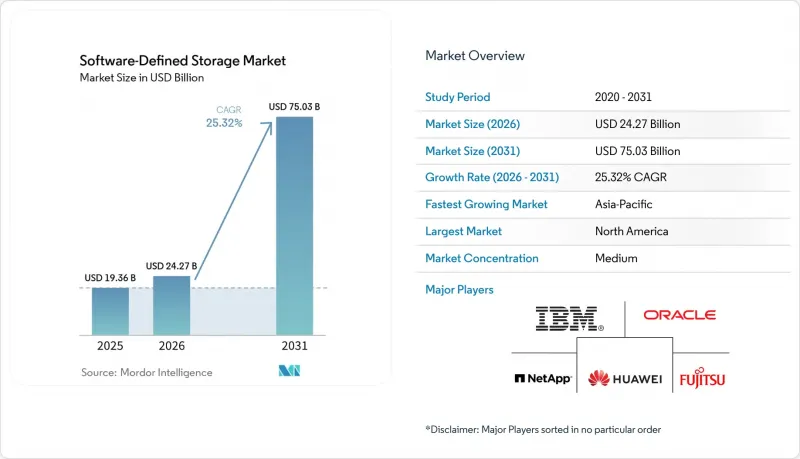
Mordor Intelligence에 의하면, 소프트웨어 정의 스토리지(SDS) 시장 규모는 2026년에 242억 7,000만 달러에 이르고, 2031년까지 750억 3,000만 달러로 확대되며 예측 기간 중 연평균 복합 성장률(CAGR)은 25.32%를 나타낼 전망입니다.
본 보고서는 스토리지 유형(블록, 파일, 오브젝트, 기타), 도입 형태(On-Premise, 프라이빗 클라우드, 기타), 조직 규모(중소기업, 대기업), 최종 사용자 산업(은행 및 금융 서비스·보험, 통신·정보 기술, 기타), 지역별로 분류되어 있습니다. 시장 전망은 금액(달러) 기준으로 제시되어 있습니다.
세계의 소프트웨어 정의 스토리지(SDS) 시장 동향 및 인사이트
비정형 데이터의 기하급수적인 증가
2025년, 전 세계 데이터 양은 더욱 방대한 제타바이트 규모로 확대되었으며, 그 대부분은 동영상, 센서 로그, 이미지 파일 등의 비정형 데이터로 구성되었습니다. 기존의 스케일업형 어레이는 월간 페타바이트 규모의 데이터 양을 경제적으로 처리할 수 없기 때문에 기업들은 키-밸류 스토어에 메타데이터를 스트라이핑하여 선형적인 용량 확장을 실현하는 수평 확장 가능한 소프트웨어 정의 클러스터를 채택하고 있습니다. 예를 들어, 어떤 거래 모니터링 시스템에서는 MiFID II 준수를 위해 매일 12테라바이트를 아카이브하고 있지만, S3의 ‘1기가바이트당 월 0.004달러"라는 가격 정책 덕분에 블록 스토리지 비용의 6분의 1 수준으로 해결할 수 있습니다. 컴퓨터 비전을 활용한 검사를 수행하는 제조업체에서는 라인당 하루 800기가바이트의 이미지 데이터를 처리하고 있으며, 지연 시간을 100밀리초 이하로 억제할 수 있는 병렬 객체 쓰기 기능이 필요합니다. HIPAA 규정을 준수하는 의료 기관에서는 현재 소프트웨어 정의 아카이브를 통해 보존 작업을 자동화하여 감사 준비 시간을 70% 단축하고 있습니다.
비용 측면에서의 우위, 독점형 어레이에서 상용 하드웨어로의 전환
독점형 어레이의 비용은 사용 가능한 기가바이트당 8-15달러이지만, x86 서버 기반의 소프트웨어 정의 환경에서는 0.50-2달러에 용량을 제공할 수 있어 75-90%의 비용 절감을 실현합니다. 기업들은 감가상각이 완료된 컴퓨팅 노드를 재사용함으로써 하드웨어의 수명을 연장하고, 10페타바이트 규모의 스토리지 환경당 200만 달러의 교체 비용을 미루고 있습니다. NVMe-over-Fabrics를 통해 기존 지연 시간 문제가 해소되어, 분산형 스토리지가 어레이와 동등한 IOPS 밀도를 실현할 수 있게 되었습니다. 인도 및 인도네시아에서 도입이 확대되고 있는 ARM 기반 클러스터는 전력 소비를 40% 절감하며, 전기 요금이 높은 지역에서는 총 소유 비용을 추가로 18% 낮추고 있습니다.
레거시 스토리지 환경에서의 통합 복잡성
기업은 평균 11가지 유형의 서로 다른 스토리지 시스템을 보유하고 있으며, 다운타임 없이 페타바이트 규모의 데이터를 마이그레이션하려면 치밀한 존 구성과 LUN 매핑이 필요합니다. 파이버 채널 패브릭은 NVMe-over-TCP로 변환할 수 없는 독자적인 제어 방식에 의존하고 있기 때문에 프로토콜 게이트웨이가 지연 시간을 증가시켜 단일 장애 지점이 되어 버립니다. 기존 백업 도구는 테이프 라이브러리를 전제로 하고 있기 때문에 가상 테이프 에뮬레이션 계층을 도입할 수밖에 없게 되어 클라우드의 경제성이 저하됩니다. IBM z/OS를 사용하는 금융 기관에서는 수십년전의 채널 프로그램을 재컴파일하지 않고서는 FICON 스토리지를 x86 기반으로 단순히 교체할 수 없습니다. 법적 보존 대상 데이터의 보관 이력 증명은 이행 기간을 최대 6개월 연장하게 됩니다.
부문별 분석
오브젝트 스토리지는 2025년에 소프트웨어 정의 스토리지(SDS) 시장 점유율의 42.64%를 차지했으며, On-Premise와 클라우드 버킷에 걸쳐 있는 데이터 레이크를 통합하는 S3 API를 바탕으로 연평균 성장률(CAGR) 26.22%를 기록하며 성장할 것으로 전망됩니다. 이 부문은 월 1기가바이트당 0.004달러 이하로 “11 나인"의 내구성을 실현하는 이레이저 코딩의 이점을 누리고 있어, 비용 면에서의 우위를 더욱 공고히 하고 있습니다. 블록 스토리지는 지연 시간에 민감한 데이터베이스 분야에서 여전히 확고한 입지를 다지고 있으며, NVMe-over-TCP를 통합함으로써 마이크로초 단위의 IOPS 성능 한계를 넓혀가고 있습니다. 오브젝트 백엔드 기반으로 구축된 파일 게이트웨이는 엔터프라이즈 공유 환경에서의 SMB 및 NFS 워크플로를 유지하면서, 부서별 이용 사례에서의 도입을 확대되고 있습니다. 하이퍼 컨버지드 인프라는 동일한 노드에서 컴퓨팅과 스토리지를 통합하고 있어, 턴키 방식의 도입을 원하는 중견 기업의 IT 부서에 매력적인 솔루션입니다. 규제의 영향으로 의료 부문에서는 WORM(한 번 쓰기, 영구 읽기) 보장을 갖춘 오브젝트 스토리지로의 전환이 진행되고 있지만, 반면 트레이딩 데스크에서는 예측 가능한 마이크로초 단위의 쓰기 응답 시간을 확보하기 위해 여전히 코어 원장을 블록 볼륨에 의존하고 있습니다. 오브젝트 플랫폼용 소프트웨어 정의 스토리지(SDS) 시장 규모는 수천 대의 GPU에 걸친 병렬 읽기가 필요한 AI 모델 학습 파이프라인에 힘입어 2031년까지 두 배로 증가할 전망입니다. 각 벤더사는 CPU를 통한 복사 처리를 우회하여 에포크 시간을 몇 초 단축하는 GPU 직접 프로토콜을 추가함으로써, 기존 어레이와의 격차를 더욱 벌리고 있습니다.
현재 오브젝트 스토리지 구현에서는 단일 네임스페이스 내에서 NVMe SSD를 활용한 고성능 티어와 저비용 HDD 티어를 제공하고 있으며, 관리자는 액세스 빈도가 낮은 로그를 자동으로 아카이브하는 정책을 정의할 수 있게 되었습니다. MinIO와 Ceph는 16+4 레이아웃에서 90%의 스토리지 효율을 달성하는 오류 정정 코딩의 개선 버전을 출시했으며, RAID 6에 비해 용량 오버헤드를 줄였습니다. 한편, 각 클라우드 제공업체들은 AI 훈련을 위해 1밀리초 미만의 액세스 속도를 실현하는 단일 존 터보 계층을 구축하고 있으며, 이는 오브젝트 스토리지가 처리량과 지연 시간이라는 두 가지 워크로드를 모두 충족할 수 있음을 보여줍니다. 기업들이 마이크로서비스를 도입함에 따라, 각 서비스는 이벤트를 오브젝트 버킷에 직접 기록하게 되어 파일 시스템의 필요성이 사라지고, DevOps 파이프라인이 간소화되고 있습니다. 프로토콜 간의 차이를 추상화하는 네임스페이스 가상화를 원동력으로 삼아, 객체, 파일, 블록의 의미론이 융합되며, 소프트웨어 정의 스토리지(SDS) 시장에서는 통합이 더욱 가속화될 것으로 예측됩니다.
매니지드 서비스를 통해 조달상의 장벽이 해소된 결과, 2025년에는 퍼블릭 클라우드가 매출의 55.83%를 차지했습니다. 그러나 규제 대상 산업의 경우, 클라우드의 버스트 용량을 활용하면서도 특정 데이터를 로컬에 보관해야 하기 때문에 하이브리드 구성은 연평균 성장률(CAGR) 26.55%를 나타낼 것으로 전망됩니다. 유럽의 은행들은 GDPR(EU 개인정보보호규정) 준수를 위해 기본 사본을 On-Premise에 보관하는 한편, 부정 행위 분석을 위해 익명화된 데이터를 퍼블릭 클라우드로 복제함으로써 규정 준수 및 확장성 간의 균형을 맞추고 있습니다. 미국의 연방 기관들은 FedRAMP 인증을 받은 리전을 활용하면서도, 사업 연속성 계획을 위해 온사이트 복제본을 유지하고 있습니다. 프라이빗 클라우드는 코로케이션에 이미 투자한 기업들 사이에서 여전히 중요한 위치를 차지하고 있으며, 하이퍼스케일 수준의 사용자 경험을 재현한 셀프 서비스 포털을 제공합니다. 에어 갭이 적용된 정부 네트워크에서는 기밀 워크로드를 위해 Ceph 클러스터가 도입되어 있으며, 이는 주권의 중요성을 보여줍니다. 멀티 클라우드 오케스트레이션 도구는 AWS, Azure, Google에 걸친 작업을 통합하여, 플랫폼을 변경하지 않고도 장애 전환을 가능하게 합니다. 조직들이 비용, 지연 시간, 규제 측면에서 인프라 구성을 최적화해 나감에 따라, 하이브리드 모드와 관련된 소프트웨어 정의 스토리지(SDS) 시장 규모는 2029년 이후 순수 퍼블릭 클라우드에 대한 지출을 넘어설 것으로 예측됩니다.
기술 혁신의 핵심은 양방향 데이터 마이그레이션성에 있습니다. 현재 여러 벤더들은 On-Premise VMware 볼륨의 스냅샷을 생성하고, 이를 Amazon EBS나 Azure Managed Disks에 네이티브 방식으로 마운트하는 솔루션 엔진을 제공합니다. 렌더 팜용 클라우드 버스트는 이제 일상적인 일이 되었으며, 스튜디오에서는 동일한 오브젝트 버킷에 액세스하는 수천 개의 스팟 인스턴스를 가동하고 있습니다. 변경된 블록을 압축 및 암호화한 후 대상 리전으로 스트리밍하는 지속적 복제 소프트웨어를 통해 재해 복구의 RPO가 15분 이하로 단축되었습니다. 컴플라이언스 감사에서는 소프트웨어 정의 플랫폼을 통해 생성된 불변 로그가 인용되어, 수동 증거 수집 주기가 30% 단축되었습니다. 또한 이 기업은 지사에서 데이터를 로컬에 캐시하고, 사용 빈도가 낮은 파일을 클라우드 아카이브 계층으로 이전하는 엣지 게이트웨이를 도입하고 있는데, 이는 On-Premise와 퍼블릭 클라우드 중 하나를 선택해야 하는 이분법적 접근이 아니라, 연속적인 선택지가 있음을 반영하고 있습니다. 그 결과, 소프트웨어 정의 스토리지(SDS) 시장은 도입 단계에서의 사일로화에서 유동적인 데이터 패브릭으로의 전환을 계속하고 있습니다.
지역별 분석
북미는 1,800억 달러를 넘는 하이퍼스케일러의 설비 투자와, 영구 볼륨을 몇 초 만에 프로비저닝하는 쿠버네티스 CSI의 조기 도입에 힘입어 2025년 매출의 38.73%를 계속 차지했습니다. 연방 정부 기관은 FedRAMP 인증을 받은 클라우드를 활용하여 데이터센터의 물리적 공간을 50% 줄이고 있습니다. 캐나다의 금융 기업들은 PIPEDA를 준수하기 위해 고객 데이터를 On-Premise에 보관하면서, 분석 처리는 클라우드 샌드박스 환경에서 수행하고 있습니다. 멕시코의 핀테크 허브에서는 실시간 결제 및 데이터 상주 요건을 충족하기 위해 소프트웨어 정의 스토리지가 도입되고 있습니다.
아시아태평양은 중국의 사이버 보안법, 인도의 디지털 공공 인프라, 아세안(ASEAN)의 5G 엣지 구축에 힘입어 연평균 성장률(CAGR) 26.45%로 성장하고 있습니다. 주권 클라우드 규정을 준수하기 위해, 중국 본토의 복제본은 국경 내에 보관되어 있습니다. 인도의 UPI는 2025년 12월까지 월간 116억 건의 거래를 처리했으므로, 수평 확장 가능한 클러스터를 도입할 수밖에 없는 상황이었습니다. 일본의 개인정보보호법에 따라 제조업체와 병원에서의 하이브리드 도입이 촉진될 것입니다. 한국의 통신 사업자들은 기지국에 AR 컨텐츠 캐시를 호스팅하여 지연 시간을 8밀리초로 단축하고 있습니다. 아세안(ASEAN)은 현지에서 복제품을 의무화하는 주권 구역을 설정하고 있습니다.
유럽에서는 GDPR(EU 개인정보보호규정) 및 디지털 운영 복원력법을 통해 규제가 강화되고 있으며, 자동화된 데이터 분류와 위변조가 불가능한 감사 추적이 추진되고 있습니다. 독일의 BSI는 EU 역내에서 멀티 리전 복제본을 권장하고 있습니다. 영국의 NHS는 영상 아카이브를 통합하여 방사선 진단 보고서 작성 시간을 48시간에서 6시간으로 단축했습니다. 프랑스의 헬스 데이터 허브는 CNIL의 개인정보 보호 요건을 준수하면서 연구용으로 120페타바이트의 데이터를 관리하고 있습니다. 남미에서는 브라질의 LGPD와 아르헨티나의 데이터 보호법이 도입되었으며, 중동에서는 “비전 2030"의 프로그램이 리야드에서의 하이퍼스케일 구축을 뒷받침하고 있습니다. 아프리카에서는 남아프리카공화국의 은행과 나이지리아의 핀테크 기업들이 POPIA를 준수하는 클라우드 플랫폼을 도입함에 따라 성장이 가속화되고 있습니다.
기타 혜택
- 엑셀 형식 시장 예측(ME) 시트
- 3개월간의 애널리스트 지원
자주 묻는 질문
목차
제1장 서론
제2장 조사 방법
제3장 주요 요약
제4장 시장 구도
제5장 시장 규모 및 성장 예측
제6장 경쟁 구도
제7장 시장 기회 및 향후 전망
KTH 26.07.08According to Mordor Intelligence, the software-defined storage market size reached USD 24.27 billion in 2026 and is projected to climb to USD 75.03 billion by 2031, reflecting a 25.32% CAGR over the forecast horizon.
This report is Segmented by Storage Type (Block, File, Object, and More), Deployment Mode (On-Premises, Private Cloud, and More), Organisation Size (Small and Medium Enterprises, and Large Enterprises), End-User Industry (Banking Financial Services and Insurance, Telecom and Information Technology, and More), and Geography. The Market Forecasts are Provided in Terms of Value (USD).
Global Software-Defined Storage Market Trends and Insights
Exponential Growth of Unstructured Data
The global datasphere expanded to a larger number of zettabytes in 2025, with most of the data comprising unstructured formats, such as video, sensor logs, and imaging files. Traditional scale-up arrays cannot ingest petabyte-per-month volumes economically, so enterprises are adopting horizontally scalable software-defined clusters that stripe metadata across key-value stores for linear capacity expansion. A trade-surveillance system, for example, archives 12 terabytes daily for MiFID II compliance at one-sixth the cost of block storage, thanks to S3 pricing of USD 0.004 per gigabyte-month. Manufacturers running computer-vision inspection pump 800 gigabytes of imagery per line per day and need parallel object writes that keep latency under 100 milliseconds. Healthcare entities that rely on HIPAA rules now automate retention in software-defined archives, reducing audit preparation time by 70%.
Cost-Advantaged Shift from Proprietary Arrays to Commodity Hardware
Proprietary arrays cost USD 8-15 per usable gigabyte, while software-defined deployments on x86 servers deliver capacity at USD 0.50-2.00, a 75-90% saving. Enterprises extend hardware life by repurposing depreciated compute nodes, postponing USD 2 million in refresh spend for each 10-petabyte estate. NVMe-over-Fabrics eliminates historical latency penalties, enabling distributed storage to match array IOPS density. Emerging ARM-based clusters in India and Indonesia cut power draw 40%, lowering the total cost of ownership by another 18% in high-tariff zones.
Integration Complexity with Legacy Storage Estates
Enterprises average 11 disparate storage systems, and migrating petabytes without downtime requires meticulous zoning and LUN mapping. Fibre Channel fabrics depend on proprietary controls that do not translate to NVMe-over-TCP, so protocol gateways add latency and become single points of failure. Legacy backup tools expect tape libraries, forcing virtual-tape emulation layers that dilute cloud economics. Financial institutions on IBM z/OS cannot simply swap FICON storage for x86 targets without recompiling decades-old channel programs. Chain-of-custody proof for data under legal hold further extends migration timelines by up to six months.
Other drivers and restraints analyzed in the detailed report include:
- Hybrid and Multi-Cloud Adoption Demanding Storage Abstraction
- AI and ML-Driven Autonomous Storage Management and Tiering
- Shortage of Specialized SDS Skills and Organizational Change
For complete list of drivers and restraints, kindly check the Table Of Contents.
Segment Analysis
Object storage controlled 42.64% of the software-defined storage market share in 2025 and is forecast to grow at 26.22% CAGR on the back of S3 APIs that unify data lakes spanning on-premises and cloud buckets. The segment benefits from erasure coding that delivers eleven nines of durability at sub-USD 0.004 per gigabyte-month, reinforcing cost leadership. Block storage remains entrenched for latency-sensitive databases, integrating NVMe-over-TCP to push microsecond IOPS envelopes. File gateways layered on object back ends preserve SMB and NFS workflows for enterprise shares, broadening adoption in departmental use cases. Hyper-converged infrastructure weaves compute and storage on the same node, appealing to mid-market IT shops seeking turnkey installs. Regulatory influence steers healthcare toward object setups with WORM guarantees, while trading desks still pin core ledgers on block volumes to ensure predictable microsecond write response. The software-defined storage market size for object platforms is on track to double by 2031, supported by AI model training pipelines that demand parallel reads across thousands of GPUs. Vendors are adding GPU-direct protocols that bypass CPU copies and shave seconds off epoch times, further widening the gap with legacy arrays.
Object implementations now offer high-performance tiers using NVMe SSDs and low-cost HDD tiers in a single namespace, letting administrators define policies that age seldom-accessed logs automatically. MinIO and Ceph have shipped erasure-coding improvements that hit 90% storage efficiency on 16+4 layouts, narrowing the capacity overhead versus RAID 6. Meanwhile, cloud providers roll out single-zone turbo tiers offering sub-millisecond access for AI training, showing that object storage can satisfy both throughput and latency workloads. As enterprises adopt microservices, each service logs events directly to object buckets, eliminating the need for file systems and simplifying DevOps pipelines. Expect the software-defined storage market to see deeper convergence where object, file, and block semantics blend, driven by namespace virtualization that abstracts protocol differences.
Public cloud captured 55.83% revenue in 2025 as managed services removed procurement friction. Yet hybrid arrangements post a 26.55% CAGR because regulated sectors must keep certain data local while tapping cloud burst capacity. European banks pin primary copies on-premises for GDPR, then replicate anonymized sets to public clouds for fraud analytics, balancing compliance with scale. U.S. federal agencies lean on FedRAMP-authorized regions, but still maintain on-site replicas for continuity plans. Private clouds remain relevant among firms with sunk co-location investments, offering self-service portals that copy the hyperscale user experience. Air-gapped government networks deploy Ceph clusters for classified workloads, illustrating the role of sovereignty. Multi-cloud orchestration tools stitch policies across AWS, Azure, and Google, enabling failover without re-platforming. The software-defined storage market size tied to hybrid modes is projected to outpace pure public cloud spend beyond 2029 as organizations optimize placement for cost, latency, and regulation.
Technical innovation centers on bidirectional data mobility. Vendors now provide policy engines that snapshot on-premises VMware volumes and hydrate them natively into Amazon EBS or Azure Managed Disks. Cloud bursting for render farms has become routine, as studios spin up thousands of spot instances accessing the same object bucket. Disaster recovery RPOs have tightened to under 15 minutes through continuous-replication software that compresses and encrypts changed blocks before streaming them to target regions. Compliance audits cite immutable logs produced by software-defined platforms, reducing manual evidence collection cycles by 30%. Enterprises further adopt edge gateways that cache data locally in branch offices then migrate cold files to cloud archive tiers, reflecting a continuum rather than a binary choice between on-premises and public cloud. Consequently, the software-defined storage market continues its pivot from deployment silos to fluid data fabrics.
Complete Report Scope:
- By Storage Type
- Block
- File
- Object
- Hyper-converged Infrastructure
- By Deployment Mode
- On-premises
- Private Cloud
- Public Cloud
- Hybrid Cloud
- By Organisation Size
- Small and Medium Enterprises
- Large Enterprises
- By End-user Industry
- Banking, Financial Services and Insurance (BFSI)
- Telecom and Information Technology
- Government and Public Sector
- Healthcare and Life Sciences
- Manufacturing
- Media and Entertainment
- Retail and e-Commerce
- Other End-user Industries
- By Geography
- North America
- United States
- Canada
- Mexico
- South America
- Brazil
- Argentina
- Rest of South America
- Europe
- Germany
- United Kingdom
- France
- Italy
- Spain
- Rest of Europe
- Asia-Pacific
- China
- Japan
- India
- South Korea
- ASEAN
- Rest of Asia-Pacific
- Middle East and Africa
- Middle East
- Saudi Arabia
- United Arab Emirates
- Rest of Middle East
- Africa
- South Africa
- Nigeria
- Rest of Africa
- Middle East
- North America
Geography Analysis
North America maintained 38.73% of 2025 revenue, buoyed by hyperscaler capital expenditure topping USD 180 billion and early Kubernetes CSI adoption that provisions persistent volumes in seconds. Federal agencies leverage FedRAMP-authorized clouds to slash data-center footprints by 50%. Canadian financial firms comply with PIPEDA by retaining customer data on-premises while analytics run in cloud sandboxes. Mexico's fintech hubs adopt software-defined storage for real-time payments and data residency mandates.
Asia-Pacific advances at 26.45% CAGR, driven by China's cybersecurity law, India's Digital Public Infrastructure, and ASEAN's 5G edge rollouts. Mainland replicas stay within national borders to meet sovereign-cloud rules. India's UPI processed 11.6 billion monthly transactions by December 2025, forcing horizontally scalable clusters. Japan's privacy act catalyzes hybrid deployment among manufacturers and hospitals. South Korean carriers host AR content caches at base stations, cutting latency to 8 milliseconds. ASEAN nations establish sovereign zones that insist on local replicas.
Europe tightens controls through GDPR and the Digital Operational Resilience Act, pushing automated data classification and immutable audit trails. Germany's BSI urges multi-region replicas within EU borders. The United Kingdom's NHS consolidates imaging archives, shrinking radiology report turnaround from 48 hours to 6 hours. France's Health Data Hub manages 120 petabytes for research while upholding CNIL privacy mandates. South America rides Brazil's LGPD and Argentina's data-protection laws, while Middle East programs under Vision 2030 spur hyperscale builds in Riyadh. Africa's growth accelerates as South African banks and Nigerian fintechs adopt cloud platforms compliant with POPIA.
- Amazon Web Services, Inc.
- Microsoft Corporation
- International Business Machines Corporation
- Dell Technologies Inc.
- Hewlett Packard Enterprise Company
- NetApp, Inc.
- Huawei Technologies Co., Ltd.
- Hitachi Vantara LLC
- Pure Storage, Inc.
- VMware, Inc.
- Nutanix, Inc.
- Oracle Corporation
- Cisco Systems, Inc.
- Fujitsu Limited
- DataCore Software Corporation
- Red Hat, Inc.
- Scality SA
- Cloudian, Inc.
- Infinidat Ltd.
- StarWind Software, Inc.
- FalconStor Software, Inc.
- Promise Technology, Inc.
- StorPool Storage AD
- MinIO, Inc.
- Qumulo, Inc.
Additional Benefits:
- The market estimate (ME) sheet in Excel format
- 3 months of analyst support
TABLE OF CONTENTS
1 INTRODUCTION
- 1.1 Study Assumptions and Market Definition
- 1.2 Scope of the Study
2 RESEARCH METHODOLOGY
3 EXECUTIVE SUMMARY
4 MARKET LANDSCAPE
- 4.1 Market Overview
- 4.2 Market Drivers
- 4.2.1 Exponential Growth of Unstructured Enterprise Data
- 4.2.2 Cost-Advantaged Shift from Proprietary Arrays to Commodity Hardware
- 4.2.3 Hybrid/Multi-Cloud Adoption Demanding Storage Abstraction
- 4.2.4 AI/ML-Driven Autonomous Storage Management and Tiering
- 4.2.5 Container/Kubernetes-Native Persistent Storage Needs
- 4.2.6 Edge Computing and 5G Creating Low-Latency SDS Nodes
- 4.3 Market Restraints
- 4.3.1 Integration Complexity with Legacy Storage Estates
- 4.3.2 Shortage of Specialised SDS Skills and Organisational Change
- 4.3.3 Performance Determinism Concerns for Latency-Sensitive Apps
- 4.3.4 Fragmented Standards Increasing Vendor-Lock-In Risk
- 4.4 Indusy Value Chain Analysis
- 4.5 Regulatory Landscape
- 4.6 Technological Outlook
- 4.7 Porter's Five Forces Analysis
- 4.7.1 Bargaining Power of Suppliers
- 4.7.2 Bargaining Power of Buyers
- 4.7.3 Threat of New Entrants
- 4.7.4 Threat of Substitutes
- 4.7.5 Intensity of Competitive Rivalry
5 MARKET SIZE AND GROWTH FORECASTS (VALUE)
- 5.1 By Storage Type
- 5.1.1 Block
- 5.1.2 File
- 5.1.3 Object
- 5.1.4 Hyper-converged Infrastructure
- 5.2 By Deployment Mode
- 5.2.1 On-premises
- 5.2.2 Private Cloud
- 5.2.3 Public Cloud
- 5.2.4 Hybrid Cloud
- 5.3 By Organisation Size
- 5.3.1 Small and Medium Enterprises
- 5.3.2 Large Enterprises
- 5.4 By End-user Industry
- 5.4.1 Banking, Financial Services and Insurance (BFSI)
- 5.4.2 Telecom and Information Technology
- 5.4.3 Government and Public Sector
- 5.4.4 Healthcare and Life Sciences
- 5.4.5 Manufacturing
- 5.4.6 Media and Entertainment
- 5.4.7 Retail and e-Commerce
- 5.4.8 Other End-user Industries
- 5.5 By Geography
- 5.5.1 North America
- 5.5.1.1 United States
- 5.5.1.2 Canada
- 5.5.1.3 Mexico
- 5.5.2 South America
- 5.5.2.1 Brazil
- 5.5.2.2 Argentina
- 5.5.2.3 Rest of South America
- 5.5.3 Europe
- 5.5.3.1 Germany
- 5.5.3.2 United Kingdom
- 5.5.3.3 France
- 5.5.3.4 Italy
- 5.5.3.5 Spain
- 5.5.3.6 Rest of Europe
- 5.5.4 Asia-Pacific
- 5.5.4.1 China
- 5.5.4.2 Japan
- 5.5.4.3 India
- 5.5.4.4 South Korea
- 5.5.4.5 ASEAN
- 5.5.4.6 Rest of Asia-Pacific
- 5.5.5 Middle East and Africa
- 5.5.5.1 Middle East
- 5.5.5.1.1 Saudi Arabia
- 5.5.5.1.2 United Arab Emirates
- 5.5.5.1.3 Rest of Middle East
- 5.5.5.2 Africa
- 5.5.5.2.1 South Africa
- 5.5.5.2.2 Nigeria
- 5.5.5.2.3 Rest of Africa
- 5.5.5.1 Middle East
- 5.5.1 North America
6 COMPETITIVE LANDSCAPE
- 6.1 Market Concentration
- 6.2 Strategic Moves
- 6.3 Market Share Analysis
- 6.4 Company Profiles (includes Global level Overview, Market level overview, Core Segments, Financials as available, Strategic Information, Market Rank/Share, Products and Services, Recent Developments)
- 6.4.1 Amazon Web Services, Inc.
- 6.4.2 Microsoft Corporation
- 6.4.3 International Business Machines Corporation
- 6.4.4 Dell Technologies Inc.
- 6.4.5 Hewlett Packard Enterprise Company
- 6.4.6 NetApp, Inc.
- 6.4.7 Huawei Technologies Co., Ltd.
- 6.4.8 Hitachi Vantara LLC
- 6.4.9 Pure Storage, Inc.
- 6.4.10 VMware, Inc.
- 6.4.11 Nutanix, Inc.
- 6.4.12 Oracle Corporation
- 6.4.13 Cisco Systems, Inc.
- 6.4.14 Fujitsu Limited
- 6.4.15 DataCore Software Corporation
- 6.4.16 Red Hat, Inc.
- 6.4.17 Scality SA
- 6.4.18 Cloudian, Inc.
- 6.4.19 Infinidat Ltd.
- 6.4.20 StarWind Software, Inc.
- 6.4.21 FalconStor Software, Inc.
- 6.4.22 Promise Technology, Inc.
- 6.4.23 StorPool Storage AD
- 6.4.24 MinIO, Inc.
- 6.4.25 Qumulo, Inc.
7 MARKET OPPORTUNITIES AND FUTURE OUTLOOK
- 7.1 White-space and Unmet-Need Assessment