|
시장보고서
상품코드
2073524
혈액형 판정 : 시장 점유율 분석, 업계 동향 및 통계, 성장 예측(2026-2031년)Blood Group Typing - Market Share Analysis, Industry Trends & Statistics, Growth Forecasts (2026 - 2031) |
||||||
 Mordor Intelligence
Mordor Intelligence에 의하면, 2026년 혈액형 판정 시장 규모는 24억 3,000만 달러에 달할 것으로 예상됩니다. 2025년 22억 6,000만 달러에서 확대해, 2031년에는 35억 1,000만 달러에 이를 것으로 예측됩니다.
2026년부터 2031년까지 연평균 성장률(CAGR) 7.62%로 성장할 것으로 전망됩니다.
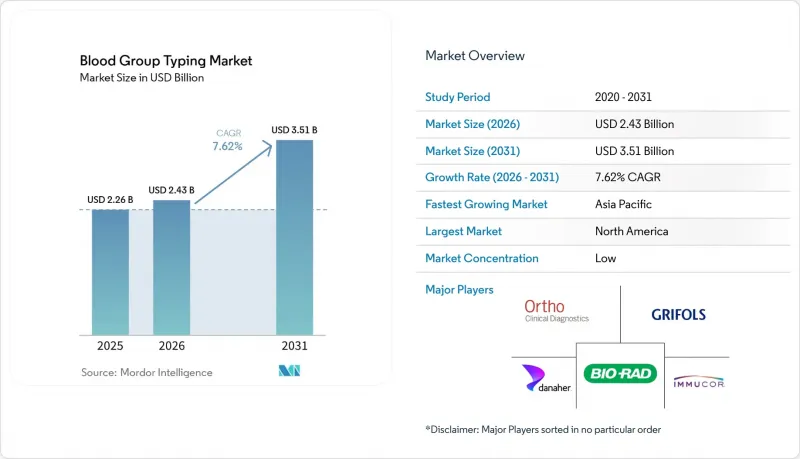
본 보고서는 제품별(기기, 소모품, 서비스), 방법별(혈청학 검사 기반, PCR 기반 및 마이크로어레이, 기타), 검사 유형별(ABO 혈액형 검사, 항체 스크리닝, 기타), 최종 사용자별(병원, 기타), 지역별(북미, 유럽, 아시아태평양, 중동 및 아프리카, 남미)로 분류되어 있습니다. 시장 전망은 금액(달러) 기준으로 제시되어 있습니다.
세계의 혈액형 판정 시장 동향 및 인사이트
전 세계 수혈 건수 증가
복잡한 심혈관 질환, 외상 및 종양학적 치료가 보편화됨에 따라 전 세계의 수혈량은 계속 증가하고 있습니다. 수혈이 이루어질 때마다 여러 차례의 적합성 검사가 필요하기 때문에 시술 건수가 조금만 증가해도 시약과 기기에 대한 수요는 크게 늘어납니다. 현재 응급의료 현장에서는 5분 이내에 ABO·Rh 혈액형 검사를 처리할 수 있는 현장 진단 분석 장비가 요구되고 있으며, 이러한 기능은 미국과 일본의 대규모 병원에서는 이미 필수적인 것으로 인식되고 있습니다. 따라서 3차 의료기관과 지역 외상 네트워크 모두에서 수작업으로 진행되던 시험관 검사를 대체하는 자동화된 워크플로가 도입되고 있습니다.
만성 질환 및 혈액 질환의 유병률 증가
사라세미아, 겸상적혈구증 및 혈액암에 대한 장기적인 수혈 지원으로 인해, 일상 진료는 기본적인 ABO-Rh 적합성 검사에서 확장된 항원 표현형 검사로 변화하고 있습니다. 한 번의 측정으로 여러 혈액형 유전자좌를 판독하는 분자 검사는 특히 여러 차례 수혈을 받는 소아 환자에게 심각한 위험이 되는 동종면역 반응을 억제합니다. 또한, 종양학 프로토콜에서도 화학요법 주기 중 수혈 반응을 완화하기 위해 예방적 혈액형 검사가 점차 도입되고 있습니다.
저소득 지역의 의료 인프라 부족
전력 공급의 불안정성, 콜드체인 역량 부족, 그리고 유지보수 기술자 부족으로 인해 아프리카와 남아시아의 농촌 지역에 위치한 상당수의 의료시설에서 신뢰할 수 있는 혈액형 검사가 어려워지고 있습니다. 설비 투자에 대한 장벽으로 인해 차세대 염기서열 분석(NGS) 및 중급 수준의 자동 혈청학 시스템 도입이 지연되고 있어, 많은 의료 기관은 민감도가 낮은 수동 슬라이드 검사나 신속 카드 검사에 의존할 수밖에 없는 상황입니다.
부문별 분석
2025년 기준으로 소모품은 혈액형 검사 시장의 47.86%를 차지했으며, 이는 일상적인 젤 카드 검사나 마이크로플레이트 검사에서 시약이 빈번하게 사용된다는 점을 반영하고 있습니다. 한편, 서비스 부문은 검사 기관들이 NGS 기반 항원 패널 및 희귀 항체 동정을 외부에 위탁하는 경향이 강해지고 있어, 2031년까지 연평균 성장률(CAGR) 10.3%를 나타낼 것으로 전망됩니다. 이러한 외부 위탁 추세에 따라 전문 참조 서비스 제공업체를 대상으로 한 혈액형 분석 시장 규모가 확대되고 있으며, 이들 중 다수는 구독 계약을 통해 물류, 염기서열 분석 및 해석 보고서를 일괄적으로 제공합니다. 기기 분야는 시약 사용을 최적화하고, 병원의 LIS 플랫폼과 직접 연동되는 AI 탑재 분석기로의 업그레이드에 힘입어 한 자릿수 중반대의 성장세를 유지하고 있습니다.
검사실 관리자들은 외부 위탁을 채택하는 주된 이유로 NGS의 자본 집약적 특성을 꼽고 있습니다. 한편, 자동 분석 장치가 미량 반응 패드의 사용 효율을 높여감에 따라 시약 공급업체들은 가격 압박에 직면하고 있습니다. 그럼에도 불구하고, 총 검사 건수 증가로 인해 젤 카드, 완충액 및 대조군 혈청이 안정적인 수익원으로 자리 잡고 있습니다. 장비 제조업체는 96웰에서 384웰 형식으로 확장 가능한 모듈식 설계를 통해 차별화를 꾀하며, 변동하는 계절적 수요에 맞추어 처리 능력을 조정하고 있습니다.
2025년에는 PCR 및 마이크로어레이 플랫폼이 해당 부문 매출의 36.78%를 차지했으나, NGS는 타의 추종을 불허하는 광범위한 항원 커버리지를 반영하여 연평균 성장률(CAGR) 12.21%로 성장할 것으로 전망됩니다. NGS 시약을 이용한 혈액형 판별 시장 규모는 여전히 기존의 혈청학 시약보다 작지만, 참조 센터에서의 급속한 보급으로 인해 그 격차는 점차 좁혀지고 있습니다. 멀티로커스 시퀀싱을 통해 한 번의 검사로 Rh, Kell, Kidd, Duffy의 변이형을 확인할 수 있으며, 이를 통해 장기간 수혈을 받고 있는 환자에 대한 정밀 매칭 방침이 뒷받침되고 있습니다.
혈청학적 검사는 당일 내 ABO-Rh 검사에서 여전히 최전선의 주력으로 자리 잡고 있지만, 임상 의사들은 현재 복잡한 표현형 판정 시 NGS를 통한 확인이 필수적이라고 보고 있습니다. 마이크로플루이딕스 기술과 횡류 카세트는 필요한 교육이 최소한으로 충분하기 때문에 자원이 제한된 환경이나 긴급 상황에서 여전히 일정한 위상을 유지하고 있습니다. 따라서 하이브리드 방식의 워크플로가 일반화되고 있습니다. 즉, 슬라이드 또는 컬럼 응집 검사를 통해 즉각적인 적합성을 확인한 뒤, 1일 후에 얻어진 NGS 데이터를 활용하여 상세한 적합성 판정을 정밀하게 분석하는 것입니다.
지역별 분석
북미는 엄격한 규제 감독, 높은 의료비 지출, 그리고 완전 자동화된 면역혈액학을 우선시하는 성숙한 병원 네트워크 덕분에 2025년에는 매출의 33.12%를 차지했습니다. 2025년 FDA의 승인을 받은 혈청학 및 분자진단을 통합한 워크스테이션은 젤 카드 처리와 리플렉스 NGS, AI 기반 판정을 융합한 기술에 대한 해당 지역의 높은 수요를 보여주고 있습니다. 노동 시장의 긴축으로 인해 장비 교체 주기가 더욱 빨라지고 있으며, 검사실에서는 수작업에 소요되는 시간이 적은 ‘워크어웨이형"분석 장치로의 전환이 진행되고 있습니다.
아시아태평양은 2031년까지 연평균 성장률(CAGR) 8.68%를 기록하며 가장 높은 성장률을 보일 것으로 전망됩니다. 인도, 인도네시아, 베트남에서 전국적인 헌혈이 확대됨에 따라 공공 및 민간 검사 채널 모두에 대량의 검체가 유입되고 있는 반면, 중국에서는 각 성의 센터에서 자동화된 시약 대여 프로그램이 신속하게 추진되고 있습니다. 일본에서는 암 및 이식 의료 분야에서 분자 유형 분석이 급속히 보급됨에 따라, 1인당 검사 보급률이 가장 높은 수준에 이르렀습니다. 한국과 중국의 현지 제조업체들은 중저가 기기 시장에 진출해 있으며, 가격 및 사후 서비스 측면에서 유럽과 미국의 기존 제조업체들에 비해 한계가 있습니다.
유럽에서는 한 자릿수 중반대의 꾸준한 성장세를 유지하고 있습니다. EU의 의료기기 규제가 조화됨에 따라 엄격한 성능 검증이 의무화되었으나, 독일, 프랑스, 북유럽 국가들의 보험 급여 제도는 시료량과 폐기물을 줄여주는 고성능 분석 장비의 도입을 뒷받침하고 있습니다. 한편, 중동 및 아프리카에서는 진척 상황에 차이가 나타나고 있습니다. 만안협력회의(GCC) 회원국에서는 3차 의료기관을 대상으로 최상위급 장비가 수입되고 있는 반면, 사하라 이남 아프리카의 많은 의료시설에서는 전력 공급이 불안정하여 수작업에 의한 슬라이드 검사에 의존하고 있습니다. 남미에서는 브라질의 혈액 감시 제도 개혁에 따라 여러 주에 서비스를 제공하는 중앙 검사 거점에 자금이 투입되면서 그 기세가 더욱 거세지고 있습니다.
기타 혜택 :
- 엑셀 형식 시장 예측(ME) 시트
- 3개월간의 애널리스트 지원
자주 묻는 질문
목차
제1장 서론
제2장 조사 방법
제3장 주요 요약
제4장 시장 구도
제5장 시장 규모 및 성장 예측
제6장 경쟁 구도
제7장 시장 기회 및 향후 전망
KTH 26.07.08According to Mordor Intelligence, blood typing market size in 2026 is estimated at USD 2.43 billion, growing from 2025 value of USD 2.26 billion with 2031 projections showing USD 3.51 billion, growing at 7.62% CAGR over 2026-2031.
This report is Segmented by Product (Instruments, Consumables, and Services), Technique (Serology Assay-Based, PCR-Based & Microarray, and More), Test Type (ABO Blood Tests, Antibody Screening, and More), End User (Hospitals, and More), Geography (North America, Europe, Asia-Pacific, The Middle East and Africa, and South America). The Market Forecasts are Provided in Terms of Value (USD).
Global Blood Group Typing Market Trends and Insights
Growth in Global Blood Transfusion Procedures
Worldwide transfusion volumes continue to climb as complex cardiovascular, trauma, and oncological interventions become commonplace. Each transfusion episode triggers multiple compatibility checks, so even marginal increases in procedure counts magnify reagent and instrument demand. Emergency medicine now requires point-of-care analyzers that can process ABO-Rh typing in under five minutes, a capability that high-volume hospitals in the United States and Japan already view as essential. Automated workflows are therefore replacing manual tube testing in both tertiary centers and regional trauma networks.
Rising Prevalence of Chronic and Hematological Disorders
Long-term transfusion support for thalassemia, sickle cell disease, and hematologic cancers is reshaping routine practice from basic ABO-Rh matching to extended antigen phenotyping. Molecular assays that read multiple blood group loci in a single run limit alloimmunization, a risk especially acute in multi-transfused pediatric patients. Oncology protocols are also adopting prophylactic typing to offset transfusion reactions during chemotherapy cycles.
Limited Healthcare Infrastructure in Low-Income Regions
Inconsistent electricity, inadequate cold chain capacity, and scarce maintenance expertise hamper reliable blood typing in a sizable share of African and rural South Asian facilities. Cap-ex hurdles slow adoption of NGS and even mid-tier automated serology systems, compelling many centers to rely on manual slide or rapid card tests with lower sensitivity.
Other drivers and restraints analyzed in the detailed report include:
- Expansion of National Blood Donation Programs
- Technological Advancements in Automated Blood Typing Systems
- Shortage of Skilled Laboratory Personnel
For complete list of drivers and restraints, kindly check the Table Of Contents.
Segment Analysis
Consumables accounted for 47.86% of blood typing market share in 2025, reflecting the high frequency of reagents used for routine gel card and microplate testing. The services category, however, is projected to post a 10.3% CAGR to 2031 as laboratories increasingly outsource NGS-based antigen panels and rare antibody identification. That outsourcing trend enlarges the blood typing market size for specialized reference providers, many of which package logistics, sequencing, and interpretive reports under subscription agreements. Instruments maintain mid-single-digit growth, driven by upgrades to AI-enabled analyzers that optimize reagent use and interface directly with hospital LIS platforms.
Laboratory managers cite the capital-intensive nature of NGS as the main reason for send-out adoption. Meanwhile, reagent suppliers face price pressure as automated analyzers become more frugal with micro-volume reaction pads. Despite that, rising total test volumes secure stable revenue streams for gel cards, buffers, and control sera. Instrument manufacturers differentiate through modular designs that expand from 96 to 384 well formats, aligning capacity with fluctuating seasonal demand.
PCR and microarray platforms delivered 36.78% of segment revenue in 2025, yet NGS is forecast to climb at a 12.21% CAGR, reflecting unrivaled depth of antigen coverage. The blood typing market size for NGS reagents is still below traditional serology reagents, but rapid uptake in reference centers is narrowing the gap. Multi-locus sequencing resolves Rh, Kell, Kidd, and Duffy variants in a single assay, which supports precision-matching policies for chronically transfused patients.
While serology remains the frontline workhorse for same-day ABO-Rh testing, clinicians now consider NGS confirmation indispensable for complex phenotyping. Microfluidics and lateral-flow cassettes keep a foothold in resource-constrained or emergency settings due to minimal training requirements. Hybrid workflows are therefore common: a slide or column agglutination test confirms immediate compatibility, with NGS data arriving a day later to refine extended match decisions.
Complete Report Scope:
- By Product
- Instruments
- Automated Systems
- Semi-Automated Systems
- Manual Readers & Centrifuges
- Consumables
- Reagent Red Cells & Antisera
- Gel Cards & Microplates
- Molecular Assay Kits & Panels
- Services
- Instruments
- By Technique
- Serology Assay-Based
- PCR-Based & Microarray
- Massively Parallel / NGS
- Lateral-Flow & Microfluidic
- By Test Type
- ABO Blood Tests
- Antibody Screening
- Cross-Matching Tests
- HLA Typing
- Antigen Typing (Kidd, Duffy, Etc.)
- By End User
- Hospitals
- Blood Banks
- Other End Users
- Geography
- North America
- United States
- Canada
- Mexico
- Europe
- Germany
- United Kingdom
- France
- Italy
- Spain
- Rest of Europe
- Asia-Pacific
- China
- Japan
- India
- Australia
- South Korea
- Rest of Asia-Pacific
- Middle East & Africa
- GCC
- South Africa
- Rest of Middle East & Africa
- South America
- Brazil
- Argentina
- Rest of South America
- North America
Geography Analysis
North America controlled 33.12% of revenue in 2025 thanks to stringent regulatory oversight, high healthcare spending, and a mature hospital network that prioritizes fully automated immunohematology. FDA clearances in 2025 for integrated serology-molecular workstations illustrate the region's appetite for technology that merges gel card processing with reflex NGS and AI-based interpretation. A tight labor market further accelerates instrument replacement cycles, as labs gravitate to walk-away analyzers that need fewer hands-on minutes.
Asia-Pacific is forecast to post the highest 8.68% CAGR through 2031. National blood donation expansion across India, Indonesia, and Vietnam is pouring large sample volumes into both public and private testing channels, while China is fast-tracking automated reagent rental programs in provincial centers. Japan holds the highest per-capita test penetration, driven by rapid uptake of molecular typing for oncology and transplantation. Local manufacturers in South Korea and China are entering the mid-range instrument tier, challenging Western incumbents on price and after-sales service.
Europe maintains steady mid-single-digit growth. Harmonized EU medical device regulations impose rigorous performance verification, yet reimbursement frameworks in Germany, France, and the Nordics support adoption of high-spec analyzers that reduce sample volume and waste. Meanwhile, the Middle East and Africa display uneven progress. Gulf Cooperation Council countries import top-end instruments for tertiary hospitals, whereas many sub-Saharan facilities rely on manual slide testing due to power instability. South America gains momentum as Brazil's hemovigilance reforms channel capital into centralized testing hubs that serve multiple states.
- Bio-Rad Laboratories
- Grifols
- Ortho Clinical Diagnostics
- Danaher Corp. (Beckman Coulter)
- Immucor Inc. (Werfen)
- Thermo Fisher Scientific
- Mesa Laboratories (Agena Bioscience)
- Merck
- Quotient Ltd.
- DIAGAST
- AXO Science
- Abbott Laboratories
- Roche
- Siemens Healthineers
- Beckton Dickinson
- Terumo Blood & Cell Technologies
- Fujirebio
- Tulip Diagnostics
Additional Benefits:
- The market estimate (ME) sheet in Excel format
- 3 months of analyst support
TABLE OF CONTENTS
1 Introduction
- 1.1 Study Assumptions & Market Definition
- 1.2 Scope of the Study
2 Research Methodology
3 Executive Summary
4 Market Landscape
- 4.1 Market Overview
- 4.2 Market Drivers
- 4.2.1 Growth in Global Blood Transfusion Procedures
- 4.2.2 Rising Prevalence of Chronic and Hematological Disorders
- 4.2.3 Expansion of National Blood Donation Programs
- 4.2.4 Technological Advancements in Automated Blood Typing Systems
- 4.2.5 Increasing Adoption of Molecular Diagnostics in Transfusion Medicine
- 4.2.6 Government Initiatives for Maternal and Neonatal Health
- 4.3 Market Restraints
- 4.3.1 Limited Healthcare Infrastructure in Low-Income Regions
- 4.3.2 Shortage of Skilled Laboratory Personnel
- 4.3.3 High Cost of Advanced Typing Technologies
- 4.3.4 Stringent Regulatory and Compliance Requirements
- 4.4 Regulatory Landscape
- 4.5 Porter's Five Forces Analysis
- 4.5.1 Threat Of New Entrants
- 4.5.2 Bargaining Power Of Suppliers
- 4.5.3 Bargaining Power Of Buyers/Consumers
- 4.5.4 Threat Of Substitutes
- 4.5.5 Intensity Of Competitive Rivalry
5 Market Size & Growth Forecasts (Value, USD)
- 5.1 By Product
- 5.1.1 Instruments
- 5.1.1.1 Automated Systems
- 5.1.1.2 Semi-Automated Systems
- 5.1.1.3 Manual Readers & Centrifuges
- 5.1.2 Consumables
- 5.1.2.1 Reagent Red Cells & Antisera
- 5.1.2.2 Gel Cards & Microplates
- 5.1.2.3 Molecular Assay Kits & Panels
- 5.1.3 Services
- 5.1.1 Instruments
- 5.2 By Technique
- 5.2.1 Serology Assay-Based
- 5.2.2 PCR-Based & Microarray
- 5.2.3 Massively Parallel / NGS
- 5.2.4 Lateral-Flow & Microfluidic
- 5.3 By Test Type
- 5.3.1 ABO Blood Tests
- 5.3.2 Antibody Screening
- 5.3.3 Cross-Matching Tests
- 5.3.4 HLA Typing
- 5.3.5 Antigen Typing (Kidd, Duffy, Etc.)
- 5.4 By End User
- 5.4.1 Hospitals
- 5.4.2 Blood Banks
- 5.4.3 Other End Users
- 5.5 Geography
- 5.5.1 North America
- 5.5.1.1 United States
- 5.5.1.2 Canada
- 5.5.1.3 Mexico
- 5.5.2 Europe
- 5.5.2.1 Germany
- 5.5.2.2 United Kingdom
- 5.5.2.3 France
- 5.5.2.4 Italy
- 5.5.2.5 Spain
- 5.5.2.6 Rest of Europe
- 5.5.3 Asia-Pacific
- 5.5.3.1 China
- 5.5.3.2 Japan
- 5.5.3.3 India
- 5.5.3.4 Australia
- 5.5.3.5 South Korea
- 5.5.3.6 Rest of Asia-Pacific
- 5.5.4 Middle East & Africa
- 5.5.4.1 GCC
- 5.5.4.2 South Africa
- 5.5.4.3 Rest of Middle East & Africa
- 5.5.5 South America
- 5.5.5.1 Brazil
- 5.5.5.2 Argentina
- 5.5.5.3 Rest of South America
- 5.5.1 North America
6 Competitive Landscape
- 6.1 Market Concentration
- 6.2 Market Share Analysis
- 6.3 Company Profiles (includes Global level Overview, Market level overview, Core Business Segments, Financials, Headcount, Key Information, Market Rank, Market Share, Products and Services, and analysis of Recent Developments)
- 6.3.1 Bio-Rad Laboratories Inc.
- 6.3.2 Grifols S.A.
- 6.3.3 Ortho Clinical Diagnostics
- 6.3.4 Danaher Corp. (Beckman Coulter)
- 6.3.5 Immucor Inc. (Werfen)
- 6.3.6 Thermo Fisher Scientific
- 6.3.7 Mesa Laboratories (Agena Bioscience)
- 6.3.8 Merck KGaA (Sigma-Aldrich)
- 6.3.9 Quotient Ltd.
- 6.3.10 DIAGAST
- 6.3.11 AXO Science
- 6.3.12 Abbott Laboratories
- 6.3.13 Roche Diagnostics
- 6.3.14 Siemens Healthineers
- 6.3.15 Becton, Dickinson & Co.
- 6.3.16 Terumo Blood & Cell Technologies
- 6.3.17 Fujirebio
- 6.3.18 Tulip Diagnostics
7 Market Opportunities & Future Outlook
- 7.1 White-Space & Unmet-Need Assessment