|
시장보고서
상품코드
2073525
멀미 치료 : 시장 점유율 분석, 업계 동향 및 통계, 성장 예측(2026-2031년)Motion Sickness Treatment - Market Share Analysis, Industry Trends & Statistics, Growth Forecasts (2026 - 2031) |
||||||
 Mordor Intelligence
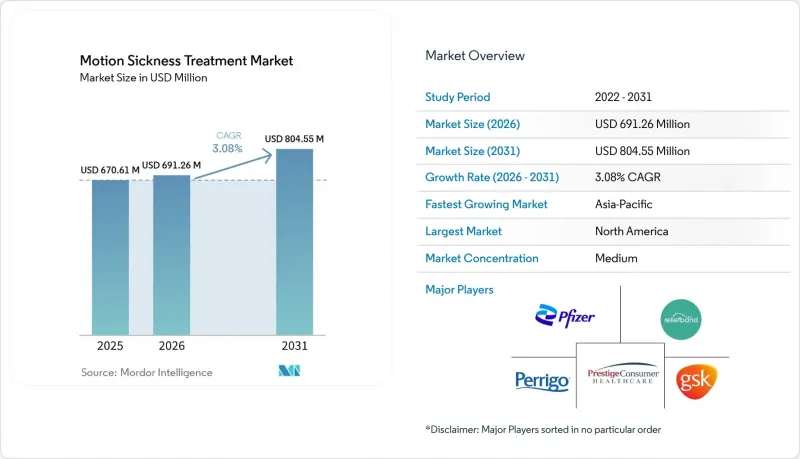
Mordor Intelligence에 의하면, 2026년 멀미 치료 시장 규모는 6억 9,126만 달러에 달할 것으로 예상되고, 2025년 6억 7,061만 달러에서 확대해, 2031년에는 8억 455만 달러에 이를 것으로 예측됩니다.
2026년부터 2031년까지의 연평균 성장률(CAGR)은 3.08%를 나타낼 것으로 전망됩니다.
본 보고서는 치료 유형(항콜린제, 1세대 항히스타민제 등), 유통 채널(소매 약국, 병원 약국 등), 제형(경구용 정제/씹어 먹는 정제 등) 및 지역(북미, 유럽, 아시아태평양, 중동 및 아프리카, 남미)별로 분류되어 있습니다. 시장 전망은 금액(달러) 기준으로 제시되어 있습니다.
세계의 멀미 치료 시장 동향 및 인사이트
전 세계 여객 이동 및 관광의 확대
아시아태평양의 여행객 수는 2025년 초에 2019년 이전 수준을 넘어섰으며, 크루즈선 및 자동차 승객들 사이에서 예방 요법 이용이 지속적으로 확대되고 있습니다. 일본의 각 제약사는 여행객의 평균 연령이 높아지고 있음을 인식하고, 고령 관광객을 대상으로 한 속용정을 출시하여 이에 대응했습니다. 크루즈선에서는 선내 의약품 재고를 확충하여 멀미로 인한 불편함을 "임의 지출"이 아니라 '필수적인 인프라'로 규정하고 있습니다. 항공사들은 현재 제조업체와 제휴하여 어메니티 키트에 패치 샘플을 동봉하고 있으며, 장거리 비행 중의 습관적인 사용을 장려하고 있습니다. 여행 수요의 회복과 멀미 치료 시장 간의 이러한 구조적 연동 덕분에, 계절을 불문하고 판매량이 안정적으로 유지되고 있습니다.
소비자의 인식 제고와 자가치료 실천
소비자 대상 직접 브랜딩 및 소셜 미디어를 통한 정보 전달로 인해, 일반의약품을 이용한 치료가 보편화되었습니다. 2024년에 실시된 ‘ "드라마민" 75주년 기념 캠페인에서는 기내 구토 봉투 사용 감소 현상을 기념함으로써, 해당 브랜드를 대중문화에 뿌리내리게 했습니다. 수많은 여행 블로그에서는 개인별 복용량에 대한 팁을 소개하고 있으며, 모바일 앱에서는 여행 일정 데이터를 바탕으로 알약 복용 시기를 추천하고 있습니다. 약국에 따르면, 쇼핑객들이 항히스타민제 외에도 천연 생강이 함유된 씹어 먹는 정제를 구매하게 되면서 1인당 구매 금액이 증가하고 있다고 합니다. 이러한 행동은 보다 광범위한 자기 관리 추세와 부합하며, 멀미 치료 업계의 판매량 증가를 가속화하고 있습니다.
기존 약리학적 약물의 부작용 및 안전성 문제
2025년 6월, FDA는 사망 사례 1건을 포함한 13건의 심각한 고체온증 사례를 접수한 후, 스코폴라민 패치에 대한 경고를 강화하도록 의무화했습니다. 병원 감사 결과, 경피 흡수형 스코폴라민 제제의 사용이 고령자의 섬망 및 폐렴 발병률 증가와 관련이 있는 것으로 밝혀졌습니다. 현재, 처방 의사들은 크루즈나 우주 관광 비행 시 작용 시간이 짧은 항히스타민제를 선호하여 처방하고 있습니다. 소송 위험이 높아짐에 따라, 패치를 배포하고 있는 크루즈 회사의 보험료가 상승하고 있습니다. 이러한 엄격한 감시로 인해, 멀미 치료 시장의 주력인 항콜린제 부문의 판매량이 억제되고 있습니다.
부문별 분석
2025년, 항콜린제는 멀미 치료 시장의 46.24%를 차지했으며, 72시간 동안 효과가 지속되는 것으로 평가받는 스코폴라민 패치가 그 중심을 이루었습니다. 그러나 최근 과열 증상에 대한 경고로 인해 크루즈 선사 및 소아과 의사들 사이에서 수요가 감소하고 있습니다. 1세대 항히스타민제는 유명 브랜드를 통해 여전히 입지를 유지하고 있지만, 낮 동안의 졸음으로 인해 소비자들은 진정 작용이 없는 제품을 선호하는 추세입니다. 뉴로키닌-1 수용체 길항제는 신경전달물질을 억제하는 것이 아니라 전정 신호를 조절하는 파이프라인 자산 덕분에 연평균 성장률(CAGR) 5.26%를 기록하며 가장 빠른 성장세를 보이고 있습니다. 소비자들이 효능과 안전성을 모두 고려하는 가운데, 허브 요법과 신경 조절 기기도 인기를 얻고 있습니다.
뉴로키닌-1 길항제를 이용한 멀미 치료 시장 규모는 2026년 8,337만 달러에서 2031년까지 1억 768만 달러로 확대될 것으로 전망됩니다. 웨어러블 기기는 기존의 의약품 범주에는 포함되지 않지만, 현재는 임산부나 화학요법을 받고 있는 환자를 대상으로 보험 적용 목록에 포함되어 있습니다. 규제 당국이 항콜린제의 첨부문서를 더욱 엄격하게 관리하는 가운데, 각 제약사는 시장 점유율을 유지하기 위해 저용량 항히스타민제와 생강 추출물을 조합한 복합제로 전략을 전환하고 있습니다.
지역별 분석
북미는 프리미엄 가격 책정, FDA의 적극적인 승인 절차, 그리고 처방약에 대한 폭넓은 보험 적용에 힘입어 2025년 전 세계 매출의 42.01%를 차지했습니다. 이 혁신적인 기기 기업은 실리콘밸리의 자금을 활용해 전정 기능용 헤드셋의 상용화를 추진하고 있으며, 미국의 크루즈선 운영사는 객실 미니바에 자사 브랜드의 일반의약품을 상시 비치하고 있습니다. 캐나다도 비슷한 추세를 보이고 있으며, 멕시코의 해안 휴양지에서는 관광객을 대상으로 한 일반의약품(OTC) 판매가 성장의 주축이 되고 있습니다.
유럽은 식물 유래 치료제를 승인하고 합성 의약품의 표시 규제를 강화하는 EMA(유럽의약품청)의 통일된 규정에 힘입어, 멀미 치료 시장에서 2위를 차지하고 있습니다. 독일과 영국은 뇌졸중 후 전정 기능 재활을 위한 디지털 치료제에 투자하고 있으며, 이를 통해 간접적으로 소비자의 수용을 촉진하고 있습니다. 스칸디나비아와 지중해를 횡단하는 페리 노선은 계절적 수요의 예측 가능한 급증을 초래하고 있어, 항만 내 약국들은 재고를 확충하고 있습니다.
아시아태평양은 4.22%라는 지역별 최고 연평균 성장률(CAGR)을 기록하고 있습니다. 일본에서는 고령자에게 편리한 입안에서 녹는 필름 제형이 선구적으로 개발되었으며, 지역 제조업체는 공휴일에 이를 기차표와 세트로 판매하고 있습니다. 중국 기업들은 문화적 취향에 맞추어 스코폴라민 유도체와 생강을 배합한, 서양과 전통을 융합한 제품을 개발하고 있습니다. 싱가포르와 호주에서 시작된 크루즈 수요의 확대가 시장 내 입지를 더욱 강화하고 있습니다. 가처분 소득 증가와 전자상거래 물류망의 확대가 맞물리면서, 이 지역의 멀미 치료 시장이 전반적으로 확대되고 있습니다.
기타 혜택 :
- 엑셀 형식 시장 예측(ME) 시트
- 3개월간의 애널리스트 지원
자주 묻는 질문
목차
제1장 서론
제2장 조사 방법
제3장 주요 요약
제4장 시장 구도
제5장 시장 규모 및 성장 예측
제6장 경쟁 구도
제7장 시장 기회 및 향후 전망
KTH 26.07.07According to Mordor Intelligence, motion sickness treatment market size in 2026 is estimated at USD 691.26 million, growing from 2025 value of USD 670.61 million with 2031 projections showing USD 804.55 million, growing at 3.08% CAGR over 2026-2031.
This report is Segmented by Treatment Type (Anticholinergics, First-Generation Antihistamines, and More), Distribution Channel (Retail Pharmacies, Hospital Pharmacies, and More), Dosage Form (Oral Tablets/Chews, and More), and Geography (North America, Europe, Asia-Pacific, Middle East & Africa, South America). The Market Forecasts are Provided in Terms of Value (USD).
Global Motion Sickness Treatment Market Trends and Insights
Expansion of Global Passenger Mobility and Tourism
Asia-Pacific travel volumes surpassed pre-2019 levels in early 2025, driving sustained consumption of preventive therapies among cruise and automotive passengers. Japanese drug makers responded with rapid-dissolving tablets tailored for elderly tourists, acknowledging the rising average age of travelers. Cruises have enlarged on-board pharmacy inventories, treating motion discomfort as essential infrastructure rather than discretionary spending. Airlines now partner with manufacturers to include sample patches in amenity kits, reinforcing habitual use during long-haul flights. This structural linkage between travel recovery and the motion sickness treatment market underpins volume stability across seasons.
Rising Consumer Awareness and Self-Medication Practices
Direct-to-consumer branding and social media outreach have normalised over-the-counter therapies. Dramamine's 75th-anniversary campaign in 2024 celebrated the decline of airline emesis bags, embedding the brand in popular culture. Widespread travel blogs promote personalised dosing tips, and mobile apps recommend timing for tablet intake based on itinerary data. Pharmacies report higher basket values as shoppers add natural ginger chews alongside antihistamines. These behaviours align with broader self-care trends and accelerate unit sales in the motion sickness treatment industry.
Adverse Side-Effects and Safety Concerns of Existing Pharmacological Agents
In June 2025 the FDA required augmented warnings on scopolamine patches after 13 severe hyperthermia cases, including one death. Hospital audits linked transdermal scopolamine to higher delirium and pneumonia rates among seniors. Prescribers now favour shorter-acting antihistamines for cruises and space tourism flights. Litigation risk has widened insurance premiums for cruise lines that distribute patches. This scrutiny suppresses volumes in the core anticholinergic segment of the motion sickness treatment market.
Other drivers and restraints analyzed in the detailed report include:
- Technological Innovations in Drug Delivery and Wearable Therapeutics
- Proliferation of Virtual and Augmented Reality Applications
- Increasing Adoption of Low-Cost Traditional or Herbal Alternatives
For complete list of drivers and restraints, kindly check the Table Of Contents.
Segment Analysis
Anticholinergics captured 46.24% of the motion sickness treatment market in 2025, anchored by scopolamine patches valued for 72-hour protection. Recent hyperthermia alerts, however, have dented demand among cruise operators and pediatricians. First-generation antihistamines maintain relevance through well-known brands, though daytime drowsiness prompts consumers to explore non-sedating variants. Neurokinin-1 receptor antagonists show the quickest rise, posting a 5.26% CAGR thanks to pipeline assets that modulate vestibular signalling rather than neurotransmitter suppression. Herbal remedies and neuromodulation devices gather momentum as consumers weigh efficacy alongside safety.
The motion sickness treatment market size for neurokinin-1 antagonists is forecast to climb from USD 83.37 million in 2026 to USD 107.68 million by 2031. Wearable devices, while outside traditional drug categories, now sit within payer formularies for pregnant users and chemotherapy patients. As regulatory bodies tighten labels on anticholinergics, manufacturers pivot toward combination packs pairing low-dose antihistamines with ginger extracts to defend share.
Complete Report Scope:
- By Treatment Type
- Anticholinergics (Scopolamine, Etc.)
- First-Generation Antihistamines (Dimenhydrinate, Meclizine, Etc.)
- Second-Generation / Non-Sedating Antihistamines
- Neurokinin-1 Receptor Antagonists (Tradipitant, VLY-686)
- Herbal & Nutraceuticals (Ginger, Peppermint, Etc.)
- Neuromodulation & Wearable Devices
- By Distribution Channel
- Retail Pharmacies
- Hospital Pharmacies
- Online Pharmacies
- Travel Retail (Airports, Cruise-Ships)
- Hypermarkets & Convenience Stores
- By Dosage Form
- Oral Tablets / Chews
- Transdermal Patches
- Nasal Sprays & Gels
- Injectables / Infusions
- Wearable Neuromodulation Devices
- Geography
- North America
- United States
- Canada
- Mexico
- Europe
- Germany
- United Kingdom
- France
- Italy
- Spain
- Rest of Europe
- Asia-Pacific
- China
- Japan
- India
- Australia
- South Korea
- Rest of Asia-Pacific
- Middle East & Africa
- GCC
- South Africa
- Rest of Middle East & Africa
- South America
- Brazil
- Argentina
- Rest of South America
- North America
Geography Analysis
North America contributed 42.01% of global revenue in 2025, supported by premium pricing, active FDA pathways, and strong insurance coverage for prescription therapies. Device innovators leverage Silicon Valley capital to commercialise vestibular headsets, and U.S. cruise operators stock branded OTC packets in cabin minibars. Canada follows similar patterns, while Mexico's coastal resorts drive OTC sales to tourists.
Europe ranks second in the motion sickness treatment market, aided by harmonised EMA rules that validate botanical options and tighten synthetic drug labelling. Germany and the United Kingdom invest in digital therapeutics for post-stroke vestibular rehab, indirectly advancing consumer acceptance. Ferry routes across Scandinavia and the Mediterranean create predictable spikes in seasonal demand, prompting pharmacies at ports to expand inventories.
Asia-Pacific posts the fastest regional CAGR at 4.22%. Japan pioneers age-friendly melt-in-mouth films, and local manufacturers bundle them with train tickets during national holidays. Chinese firms develop Western-traditional hybrids, blending scopolamine derivatives with ginger to suit cultural preferences. Cruise growth from Singapore and Australia amplifies exposure. Rising disposable incomes and broader e-commerce logistics collectively enlarge the motion sickness treatment market in the region.
- Prestige Consumer Healthcare
- Perrigo Company
- GlaxoSmithKline
- Pfizer
- Baxter
- Johnson & Johnson (McNeil)
- DM Pharma
- Lupin
- Reliefband Technologies
- Wellspring Pharmaceutical Corp.
- Caleb Pharmaceuticals
- Myungmoon Pharm Co., Ltd.
- Vanda Pharmaceuticals
- Bausch + Lomb Corp.
- Sun Pharmaceuticals Industries
- Dr. Reddy's Laboratories
- Abbott Laboratories
- Yunnan Baiyao Group Co., Ltd.
- Church & Dwight Co., Inc. (Gravol)
- CVS Health Corp.
Additional Benefits:
- The market estimate (ME) sheet in Excel format
- 3 months of analyst support
TABLE OF CONTENTS
1 Introduction
- 1.1 Study Assumptions & Market Definition
- 1.2 Scope Of The Study
2 Research Methodology
3 Executive Summary
4 Market Landscape
- 4.1 Market Overview
- 4.2 Market Drivers
- 4.2.1 Expansion of Global Passenger Mobility And Tourism
- 4.2.2 Rising Consumer Awareness and Self-Medication Practices
- 4.2.3 Technological Innovations in Drug Delivery and Wearable Therapeutics
- 4.2.4 Proliferation of Virtual and Augmented Reality Applications
- 4.2.5 Growth of E-Commerce and Over-The-Counter Pharmacy Distribution
- 4.2.6 Strategic Investments by Aerospace And Defense Sectors
- 4.3 Market Restraints
- 4.3.1 Adverse Side-Effects and Safety Concerns of Existing Pharmacological Agents
- 4.3.2 Increasing Adoption of Low-Cost Traditional or Herbal Alternatives
- 4.3.3 Intensifying Generic Competition and Price Erosion
- 4.3.4 Regulatory Restrictions on Medication Use in Safety-Critical Occupations
- 4.4 Regulatory Landscape
- 4.5 Porter's Five Forces Analysis
- 4.5.1 Threat Of New Entrants
- 4.5.2 Bargaining Power Of Buyers / Consumers
- 4.5.3 Bargaining Power Of Suppliers
- 4.5.4 Threat Of Substitute Products
- 4.5.5 Intensity Of Competitive Rivalry
5 Market Size & Growth Forecasts (Value, USD)
- 5.1 By Treatment Type
- 5.1.1 Anticholinergics (Scopolamine, Etc.)
- 5.1.2 First-Generation Antihistamines (Dimenhydrinate, Meclizine, Etc.)
- 5.1.3 Second-Generation / Non-Sedating Antihistamines
- 5.1.4 Neurokinin-1 Receptor Antagonists (Tradipitant, VLY-686)
- 5.1.5 Herbal & Nutraceuticals (Ginger, Peppermint, Etc.)
- 5.1.6 Neuromodulation & Wearable Devices
- 5.2 By Distribution Channel
- 5.2.1 Retail Pharmacies
- 5.2.2 Hospital Pharmacies
- 5.2.3 Online Pharmacies
- 5.2.4 Travel Retail (Airports, Cruise-Ships)
- 5.2.5 Hypermarkets & Convenience Stores
- 5.3 By Dosage Form
- 5.3.1 Oral Tablets / Chews
- 5.3.2 Transdermal Patches
- 5.3.3 Nasal Sprays & Gels
- 5.3.4 Injectables / Infusions
- 5.3.5 Wearable Neuromodulation Devices
- 5.4 Geography
- 5.4.1 North America
- 5.4.1.1 United States
- 5.4.1.2 Canada
- 5.4.1.3 Mexico
- 5.4.2 Europe
- 5.4.2.1 Germany
- 5.4.2.2 United Kingdom
- 5.4.2.3 France
- 5.4.2.4 Italy
- 5.4.2.5 Spain
- 5.4.2.6 Rest of Europe
- 5.4.3 Asia-Pacific
- 5.4.3.1 China
- 5.4.3.2 Japan
- 5.4.3.3 India
- 5.4.3.4 Australia
- 5.4.3.5 South Korea
- 5.4.3.6 Rest of Asia-Pacific
- 5.4.4 Middle East & Africa
- 5.4.4.1 GCC
- 5.4.4.2 South Africa
- 5.4.4.3 Rest of Middle East & Africa
- 5.4.5 South America
- 5.4.5.1 Brazil
- 5.4.5.2 Argentina
- 5.4.5.3 Rest of South America
- 5.4.1 North America
6 Competitive Landscape
- 6.1 Market Concentration
- 6.2 Market Share Analysis
- 6.3 Company Profiles (includes Global level Overview, Market level overview, Core Business Segments, Financials, Headcount, Key Information, Market Rank, Market Share, Products and Services, and analysis of Recent Developments)
- 6.3.1 Prestige Consumer Healthcare Inc.
- 6.3.2 Perrigo Company Plc
- 6.3.3 GlaxoSmithKline Plc
- 6.3.4 Pfizer Inc.
- 6.3.5 Baxter International Inc.
- 6.3.6 Johnson & Johnson (McNeil)
- 6.3.7 DM Pharma
- 6.3.8 Lupin Limited
- 6.3.9 Reliefband Technologies, Inc.
- 6.3.10 Wellspring Pharmaceutical Corp.
- 6.3.11 Caleb Pharmaceuticals Inc.
- 6.3.12 Myungmoon Pharm Co., Ltd.
- 6.3.13 Vanda Pharmaceuticals Inc.
- 6.3.14 Bausch + Lomb Corp.
- 6.3.15 Sun Pharmaceutical Industries Ltd.
- 6.3.16 Dr. Reddy's Laboratories Ltd.
- 6.3.17 Abbott Laboratories
- 6.3.18 Yunnan Baiyao Group Co., Ltd.
- 6.3.19 Church & Dwight Co., Inc. (Gravol)
- 6.3.20 CVS Health Corp.
7 Market Opportunities & Future Outlook
- 7.1 White-Space & Unmet-Need Assessment