

|
시장보고서
상품코드
2073548
신원 분석 시장 : 점유율 분석, 업계 동향과 통계, 성장 예측(2026-2031년)Identity Analytics - Market Share Analysis, Industry Trends & Statistics, Growth Forecasts (2026 - 2031) |
||||||
 Mordor Intelligence
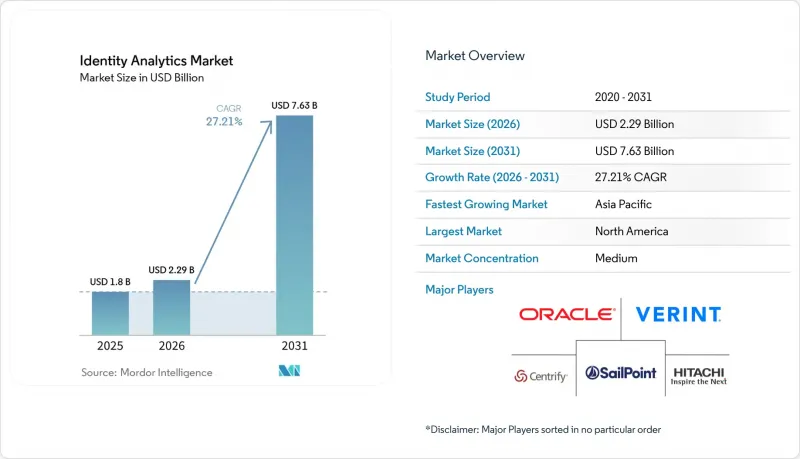
Mordor Intelligence에 의하면, 신원 분석 시장 규모는 2025년 18억 달러에서 2026년에는 22억 9,000만 달러로 확대되어 2026년부터 2031년까지 CAGR 27.21%로 성장을 지속하여, 2031년에는 76억 3,000만 달러에 이를 것으로 예측됩니다.
본 보고서는 구성 요소 유형(솔루션, 서비스), 배포 모델(On-Premise, 클라우드), 기업 규모(중소기업, 대기업), 최종 사용 산업(정보기술·통신, 은행, 금융서비스 및 보험(BFSI), 기타) 및 지역별로 분류되어 있습니다. 시장 전망은 금액(달러) 기준으로 제시되어 있습니다.
전 세계 신원 분석 시장 동향과 인사이트
딥페이크를 악용한 신원 도용 공격의 급증
딥페이크를 이용한 사칭은 2024년에 3,000% 급증했으며, 현재 전 세계 사기 미수 건수의 6.5%를 차지하고 있습니다. 미국 국토안보부에 따르면, 위조 신분증은 신분증 사기 사건 전체의 85%를 차지하고 있습니다. 생성형 AI 도구의 보급으로 인해, 위협 행위자들은 정적인 생체 인증 절차를 우회할 수 있게 되었으며, 기업들은 행동, 기기, 암호화 신호를 융합한 다층적 분석을 도입할 수밖에 없게 되었습니다. AI 생성 컨텐츠를 실시간으로 감지할 수 있는 업체가 실증 실험에서 우위를 점하고 있으며, 딥페이크 대책은 경쟁 입찰에서 주요 평가 기준으로 빠르게 자리 잡고 있습니다. 이러한 위협의 시급성으로 인해, 신원 분석에 대한 투자는 단순한 선택적 지출에서 이사회 차원의 위험 완화 조치로 그 위상이 격상되었습니다.
제로 트러스트 및 머신 ID 거버넌스의 의무화
대통령령 제14144호는 미국 연방 기관에 2025년 12월까지 피싱에 강한 인증 방식을 도입할 것을 의무화하고 있으며, 이는 기업 내 제로 트러스트의 보다 광범위한 도입을 촉진하고 있습니다. 시스템 간 ID의 수는 이미 인간 계정 수를 넘어섰으며, 관리되지 않는 서비스의 인증 정보는 클라우드 워크로드를 횡방향 이동 공격에 노출시키고 있습니다. IBM의 HashiCorp 기술 통합은 수백만 개의 API 키와 인증서를 감지, 분류, 관리하는 통합 아이덴티티 패브릭으로의 전환을 의미합니다. 규정 준수 기한은 시간 제약이 따르는 조달 주기로 이어지며, 조직은 거버넌스 정책이 통합된 분석 플랫폼을 우선적으로 도입해야 하는 상황에 직면해 있습니다. 그 결과 발생하는 수요 증가는 공공 부문과 민간 부문 모두에 미치며, 신원 분석 시장의 성장은 수년에 걸친 예산 로드맵에 반영되어 있습니다.
페타바이트 규모의 실시간 분석에서 높은 TCO
페타바이트급 ID 데이터를 처리할 경우, 대기업의 경우 연간 인프라 지출이 1,000만 달러를 초과할 가능성이 있으며, 보안 사고 발생 시 예상치 못한 쿼리 급증은 비용 변동성을 더욱 악화시킵니다. 고객이 지속적인 처리량으로 스트리밍 로그를 수집하는 경우, 클라우드 과금 모델에서는 가격 예측 가능성이 부족한 경우가 많습니다. 따라서 중견 기업들은 고도화된 분석 시스템의 도입을 연기하거나 텔레메트리 데이터의 보관 기간을 제한하는 등, 가시성을 희생하면서 예산의 확실성을 확보하고 있습니다. 임차인들 간에 컴퓨팅 리소스 비용을 분담하는 매니지드 SaaS 모델이 점차 보급되고 있지만, 이익률은 여전히 클라우드 이그레스 요금이나 GPU 임대 요금의 영향을 받기 쉬운 상황입니다. 비용 관리 도구가 충분히 발전하기 전까지는 예산에 제약이 있는 구매자에게 있어 조달 주기가 길어질 가능성이 있습니다.
부문별 분석
이 솔루션은 2025년에 62.40%의 매출 점유율을 유지하며, 거버넌스, 리스크 스코어링, 오케스트레이션을 제공하는 통합 플랫폼을 통해 신원 분석 시장을 뒷받침하고 있습니다. 한편, 서비스 매출은 연평균 성장률(CAGR) 33.17%로 증가하고 있으며, 이는 전환 로드맵, 규제 준수, 모델 최적화 과정에서 기업들이 공급업체의 전문 지식에 의존하고 있음을 반영합니다. 신원 분석 시장 규모에서 해당 서비스가 차지하는 비중은 2031년까지 35억 4,000만 달러를 넘어설 것으로 예상되며, 플랫폼의 기능을 운영 성과로 전환하는 과정에서 전문 컨설팅 기업이 수행하는 역할의 중요성이 부각되고 있습니다. 신원 관리 분야에 특화된 데이터 사이언스자의 만성적인 부족 현상 또한 서비스 수요를 더욱 부추기고 있으며, 조직들은 SailPoint와 같은 벤더가 제공하는 ‘성공 가속 패키지”를 도입할 수밖에 없는 상황입니다.
프로페셔널 서비스는 도입 후 발생하는 과제, 예를 들어 모델의 지속적인 미세 조정이나 공격 대상 영역의 재평가 등에도 대응하고 있습니다. 경영진이 위험 저감에 대한 증거를 요구하는 가운데, 서비스 팀은 부정 지표에 대한 벤치마킹을 수행하고, 감지 임계값을 정교화하며, 시정 워크플로를 구축합니다. 이러한 라이프사이클 전반에 걸친 지원을 통해 일회성 프로젝트가 지속적인 수익으로 전환됩니다. 한편, 솔루션 분야는 모듈식 마이크로서비스로 진화하고 있으며, 기업은 필요에 따라 분석 기능을 활성화하고, 실제로 사용한 용량만큼만 비용을 지불할 수 있게 되었습니다. 패키지 소프트웨어와 탄탄한 지원이 결합된 서비스의 시너지 효과 덕분에, 풀스택 제공업체는 신원 분석 시장 전체에서 더 큰 시장 점유율을 확보할 수 있는 입지에 있습니다.
클라우드 도입은 2025년 매출의 70.30%를 차지해, 예측 기간 동안 30.62%의 성장률이 예상됩니다. 이는 기업의 레거시 시스템 현대화 노력 등이 한 원인이 되고 있습니다. 수요를 뒷받침하고 있는 요인은 유연한 컴퓨팅, API 우선 통합, 그리고 내장형 고가용성입니다. 그러나 많은 조직에서는 수년에 걸쳐 전환을 진행하는 동안 On-Premise와 SaaS 디렉터리를 병행하여 운영하는 하이브리드 환경을 유지하고 있습니다. 이 공존 단계에서는 양쪽 환경 모두에서 데이터를 수집하고 실시간으로 상관 분석을 수행해야 하므로, 분석 워크로드가 증가합니다. 따라서 클라우드 플랫폼에서는 커넥터의 폭넓은 적용 범위와 레거시 속성 구조를 해석하는 정책 조정 엔진이 중요하게 여겨지고 있습니다.
신원 분석 시장 점유율은 사용량 기반 가격 책정으로 결정적으로 전환되고 있으며, AIG와 같은 보험사들은 현재 클라우드 플랫폼을 통해 지속적인 모니터링을 입증한 고객에게 보험료 할인을 적용하고 있습니다. 이전 로드맵은 마이크로소프트가 공개한 Entra ID 플레이북 및 참조 아키텍처를 기반으로 하며, 이 자료들은 업계에서 사실상 표준으로 자리 잡은 구현 패턴을 제시하고 있습니다. On-Premise와 클라우드를 병행하여 사용하는 기간 동안 총 소유 비용(TCO)이 증가할 가능성이 있지만, On-Premise 하드웨어의 교체 주기가 필요 없어지면 장기적인 경제성 측면에서는 클라우드 모델이 유리해집니다. 사용량에 따라 세밀하게 요금을 부과하거나, 테넌트 간 데이터 분리를 제공하는 벤더는 특히 데이터 소재지 규제의 대상이 되는 다국적 기업을 대상으로 한 조달 경쟁에서 유리한 입지를 점하고 있습니다.
지역별 분석
북미는 2025년에도 41.60%의 매출 점유율을 유지했습니다. 이는 대통령령 14144호의 의무화와 분석 업체들이 밀집해 있는 환경을 바탕으로 한 것입니다. 연방 정부의 기한 설정이 단기적인 지출 급증을 주도하는 한편, 미국 기업들은 정교한 ID 관리 체계에 기반한 유리한 사이버 보험의 경제적 이점을 활용하고 있습니다. 캐나다의 디지털 인증 프레임워크와 멕시코의 급성장하는 핀테크 생태계가 점진적인 성장에 기여하며, 이 지역의 리더십을 강화하고 있습니다. NIST SP-800-63 지침 준수는 플랫폼 업그레이드를 더욱 촉진하고, 북미를 제로 트러스트 성숙도의 기준 시장으로 자리매김하고 있습니다.
유럽도 이에 뒤를 따르고 있습니다. 2027년까지 상호 운용 가능한 지갑 솔루션을 의무화하는 “유럽 디지털 신분증 규정”가 그 원동력이 되고 있습니다. 영국에는 이미 270개의 디지털 ID 관련 기업이 있으며, 연간 20억 5,000만 달러의 수익을 창출하고 있습니다. 독일과 프랑스는 “프라이버시 바이 디자인”를 중시하고 있으며, 벤더에게 분석 워크플로우에 동의 관리 및 정책 버전 관리를 포함하도록 의무화하고 있습니다. 데이터 주권 조항 및 국경을 넘는 데이터 전송에 관한 규정에 따라, 지역 데이터센터와 사용 중인 데이터에 대한 암호화 기능에 대한 수요가 증가하고 있습니다. 그 결과, 클라우드 제공업체들은 현지화된 처리를 지원하고 경쟁의 공정성을 유지하기 위해 유럽 내 가용성 영역을 확대되고 있습니다.
아시아태평양은 2031년까지 연평균 성장률(CAGR)이 32.86%를 나타낼 것으로 예측되며, 가장 빠르게 성장하고 있는 지역입니다. 인도네시아의 12억 달러 규모의 디지털 전환 파트너십, 호주의 ‘2024년 디지털 ID법”와 같은 정부 주도의 전자 신분증(eID) 제도를 통해, 대규모 분석이 필요한 필수 검증 단계가 확립되어 있습니다. 인도의 “Aadhaar”의 성공과 중국에서 이루어지는 방대한 양의 디지털 거래는 주변국들에게 모범 사례가 되어, 아세안 전역에서의 도입을 촉진하고 있습니다. 해당 지역의 5G 인프라 투자와 모바일 결제 서비스의 보급은 클라우드 기반 분석 성능이 필요한 고속 ID 텔레메트리 데이터를 생성하고 있습니다. 언어에 구애받지 않는 인터페이스나 지역 내에서 호스팅되는 데이터 옵션을 제공하는 업체들은 국경을 초월한 디지털 상거래의 확대에 따라 시장 점유율을 확대할 유리한 위치에 있습니다.
기타 혜택:
- 엑셀 형식 시장 예측(ME) 시트
- 3개월간의 애널리스트 지원
자주 묻는 질문
목차
제1장 서론
제2장 조사 방법
제3장 주요 요약
제4장 시장 구도
제5장 시장 규모와 성장 예측
제6장 경쟁 구도
제7장 시장 기회와 향후 전망
JHS 26.07.09According to Mordor Intelligence, the identity analytics market size is expected to grow from USD 1.8 billion in 2025 to USD 2.29 billion in 2026 and is forecast to reach USD 7.63 billion by 2031 at 27.21% CAGR over 2026-2031.
This report is Segmented by Component Type (Solutions, Services), Deployment Model (On-Premises, Cloud), Enterprise Size (Small & Medium Enterprises, Large Enterprises), End-User Industry (Information Technology & Telecommunication, BFSI and Others), and Geography. The Market Forecasts are Provided in Terms of Value (USD).
Global Identity Analytics Market Trends and Insights
Surge in Deep-fake-driven Identity Attacks
Deepfake-enabled impersonation skyrocketed 3,000% in 2024, now representing 6.5% of global fraud attempts. Synthetic identities account for 85% of total identity fraud cases, according to the U.S. Department of Homeland Security. The democratization of generative-AI tooling means threat actors can bypass static biometric checks, compelling enterprises to deploy multilayered analytics that fuse behavioural, device and cryptographic signals. Vendors able to detect AI-generated content in real time are winning proof-of-concept trials, and deepfake mitigation is rapidly becoming a core evaluation criterion in competitive tenders. The urgency of this threat elevates identity analytics investments from discretionary spending to board-level risk mitigation.
Zero-Trust and Machine-Identity Governance Mandates
Executive Order 14144 requires U.S. federal agencies to implement phishing-resistant authentication by December 2025, catalysing broader enterprise zero-trust adoption. Machine-to-machine identities already outnumber human accounts, and unmanaged service credentials expose cloud workloads to lateral-movement attacks. IBM's integration of HashiCorp technology illustrates a shift toward unified identity fabrics that discover, classify and govern millions of API keys and certificates. Compliance deadlines translate into time-boxed procurement cycles, pushing organizations to favour analytics platforms that ship with embedded governance policies. The resulting demand uplift spans public and private sectors, embedding identity analytics market growth into multi-year budget roadmaps.
High TCO of Real-time Analytics at Petabyte Scale
Processing petabyte-level identity data can push annual infrastructure outlays above USD 10 million for large enterprises, and unexpected query spikes during security incidents aggravate cost volatility. Cloud billing models often lack price predictability when customers ingest streaming logs at sustained throughput. Mid-size organizations therefore delay advanced analytics deployments or limit telemetry retention windows, trading visibility for budget certainty. Managed SaaS models that amortize compute across tenants are gaining traction, but margins remain sensitive to cloud egress and GPU leasing rates. Until cost-management tooling matures, procurement cycles may lengthen for budget-constrained buyers.
Other drivers and restraints analyzed in the detailed report include:
- Migration to Cloud-native Identity Fabric
- Gen-AI-based Fraud-detection Performance Gains
- Shortage of Identity-centric Data-science Talent
For complete list of drivers and restraints, kindly check the Table Of Contents.
Segment Analysis
Solutions retained a 62.40% revenue share in 2025, anchoring the identity analytics market with integrated platforms that deliver governance, risk scoring and orchestration. Yet services revenue is advancing at a 33.17% CAGR, reflecting enterprises' dependence on vendor expertise for migration roadmaps, regulatory alignment and model optimization. The services contribution to the identity analytics market size is forecast to surpass USD 3.54 billion by 2031, underscoring professional consultancies' role in translating platform capabilities into operational outcomes. Ongoing shortages of identity-centric data scientists further fuel services demand, compelling organizations to engage success-acceleration packages from vendors like SailPoint.
Professional services also address post-implementation challenges such as continuous model tuning and attack-surface reassessment. As executive leadership demands evidence of risk reduction, service teams benchmark fraud metrics, refine detection thresholds and structure remediation workflows. This lifecycle support converts one-time projects into recurring revenue. Conversely, the solutions segment is evolving toward modular micro-services, allowing enterprises to activate analytics functions on demand and pay only for utilized capacity. The interplay between packaged software and high-touch services positions full-stack providers to capture larger wallet share across the identity analytics market.
Cloud deployments represented 70.30% of 2025 revenue and are projected to grow at 30.62% over the forecast horizon, driven in part by enterprise legacy modernization initiatives. Demand is fuelled by elastic compute, API-first integration and built-in high availability. Many organizations, however, operate hybrid estates during multiyear transitions, with parallel on-premises and SaaS directories. This coexistence phase elevates analytics workloads because data must be collected across both environments and correlated in real time. Cloud platforms therefore emphasize connector breadth and policy reconciliation engines that interpret legacy attribute structures.
Identity analytics market share is shifting decisively toward consumption-based pricing, and insurers such as AIG now link premium discounts to customers that evidence continuous monitoring via cloud platforms. Migration roadmaps are informed by Microsoft's published Entra ID playbooks and reference architectures, setting de-facto industry implementation patterns. While total cost of ownership can rise during dual-running periods, long-term economics favour cloud models once on-premises hardware refresh cycles are avoided. Vendors offering granular usage billing and cross-tenant data isolation are positioned to win procurement rounds, especially within multinational enterprises subject to data-residency regulations.
Complete Report Scope:
- By Component Type
- Solutions
- Services
- By Deployment Model
- On-Premise
- Cloud
- By Enterprise Size
- Small and Medium Enterprises
- Large Enterprises
- By End-user Industry
- Information Technology and Telecommunication
- Banking, Financial Services and Insurance (BFSI)
- Government and Public Sector
- Retail and Consumer
- Healthcare and Life Sciences
- Manufacturing, Energy and Utilities
- By Geography
- North America
- United States
- Canada
- Mexico
- Europe
- United Kingdom
- Germany
- France
- Italy
- Rest of Europe
- Asia-Pacific
- China
- Japan
- India
- South Korea
- Rest of Asia-Pacific
- Middle East
- Israel
- Saudi Arabia
- United Arab Emirates
- Turkey
- Rest of Middle East
- Africa
- South Africa
- Egypt
- Rest of Africa
- South America
- Brazil
- Argentina
- Rest of South America
- North America
Geography Analysis
North America retained a 41.60% revenue share in 2025, buoyed by the Executive Order 14144 mandate and a dense concentration of analytics vendors. Federal deadlines drive near-term spending spikes, while U.S. enterprises leverage favourable cyber-insurance economics tied to advanced identity postures. Canada's digital credential framework and Mexico's burgeoning fintech ecosystem contribute incremental growth, reinforcing regional leadership. Compliance alignment with NIST SP-800-63 guidelines further stimulates platform upgrades and positions North America as the reference market for zero-trust maturity.
Europe follows closely, propelled by the European Digital Identity Regulation that requires interoperable wallet solutions by 2027. The United Kingdom already hosts 270 digital-identity companies, generating USD 2.05 billion in annual revenue. Germany and France emphasize privacy-by-design, obliging vendors to embed consent orchestration and policy versioning into analytics workflows. Data-sovereignty clauses and cross-border transfer rules drive demand for regional data centers and encryption-in-use capabilities. As a result, cloud providers expand European availability zones to accommodate localized processing and maintain competitive parity.
Asia-Pacific represents the fastest-growing region with a 32.86% CAGR forecast through 2031. Government-backed eID schemes, such as Indonesia's USD 1.2 billion digital-transformation partnership and Australia's Digital ID Act 2024, establish mandatory verification layers that require analytics at scale. India's Aadhaar success and China's vast volume of digital transactions provide proof points for neighbouring economies, catalysing uptake across ASEAN. The region's investment in 5G infrastructure and mobile-money adoption creates high-velocity identity telemetry that demands cloud-based analytic performance. Vendors offering language-agnostic interfaces and regionally hosted data options are well placed to gain share as cross-border digital-commerce expands.
- Okta Inc.
- Microsoft Corporation
- Oracle Corporation
- International Business Machines Corporation
- SailPoint Technologies Holdings Inc.
- Ping Identity Holding Corp.
- CyberArk Software Ltd.
- Saviynt Inc.
- Thales Group (Thales Digital Identity and Security)
- HID Global Corporation
- Idemia Group SAS
- Verint Systems Inc.
- LogRhythm Inc.
- Securonix Inc.
- Gurucul Solutions LLC
- MicroStrategy Incorporated
- One Identity LLC
- ForgeRock Inc.
- Centrify Corporation
- Transmit Security Ltd.
- Eviden (an Atos business)
Additional Benefits:
- The market estimate (ME) sheet in Excel format
- 3 months of analyst support
TABLE OF CONTENTS
1 INTRODUCTION
- 1.1 Study Assumptions and Market Definition
- 1.2 Scope of the Study
2 RESEARCH METHODOLOGY
3 EXECUTIVE SUMMARY
4 MARKET LANDSCAPE
- 4.1 Market Overview
- 4.2 Market Drivers
- 4.2.1 Surge in deep-fake-driven identity attacks
- 4.2.2 Zero-Trust and machine-identity governance mandates
- 4.2.3 Migration to cloud-native identity fabric
- 4.2.4 Gen-AI-based fraud-detection performance gains
- 4.2.5 Cyber-insurance premium discounts tied to analytics
- 4.2.6 Government-backed eID program roll-outs
- 4.3 Market Restraints
- 4.3.1 High TCO of real-time analytics at petabyte scale
- 4.3.2 Shortage of identity-centric data-science talent
- 4.3.3 Inter-operability gaps across legacy IAM stacks
- 4.3.4 Privacy-by-design regulatory hurdles for UEBA
- 4.4 Value / Supply-Chain Analysis
- 4.5 Regulatory Landscape
- 4.6 Technological Outlook
- 4.7 Porter's Five Forces Analysis
- 4.7.1 Threat of New Entrants
- 4.7.2 Bargaining Power of Buyers
- 4.7.3 Bargaining Power of Suppliers
- 4.7.4 Threat of Substitutes
- 4.7.5 Intensity of Competitive Rivalry
- 4.8 Investment Analysis
5 MARKET SIZE AND GROWTH FORECASTS (VALUE)
- 5.1 By Component Type
- 5.1.1 Solutions
- 5.1.2 Services
- 5.2 By Deployment Model
- 5.2.1 On-Premise
- 5.2.2 Cloud
- 5.3 By Enterprise Size
- 5.3.1 Small and Medium Enterprises
- 5.3.2 Large Enterprises
- 5.4 By End-user Industry
- 5.4.1 Information Technology and Telecommunication
- 5.4.2 Banking, Financial Services and Insurance (BFSI)
- 5.4.3 Government and Public Sector
- 5.4.4 Retail and Consumer
- 5.4.5 Healthcare and Life Sciences
- 5.4.6 Manufacturing, Energy and Utilities
- 5.5 By Geography
- 5.5.1 North America
- 5.5.1.1 United States
- 5.5.1.2 Canada
- 5.5.1.3 Mexico
- 5.5.2 Europe
- 5.5.2.1 United Kingdom
- 5.5.2.2 Germany
- 5.5.2.3 France
- 5.5.2.4 Italy
- 5.5.2.5 Rest of Europe
- 5.5.3 Asia-Pacific
- 5.5.3.1 China
- 5.5.3.2 Japan
- 5.5.3.3 India
- 5.5.3.4 South Korea
- 5.5.3.5 Rest of Asia-Pacific
- 5.5.4 Middle East
- 5.5.4.1 Israel
- 5.5.4.2 Saudi Arabia
- 5.5.4.3 United Arab Emirates
- 5.5.4.4 Turkey
- 5.5.4.5 Rest of Middle East
- 5.5.5 Africa
- 5.5.5.1 South Africa
- 5.5.5.2 Egypt
- 5.5.5.3 Rest of Africa
- 5.5.6 South America
- 5.5.6.1 Brazil
- 5.5.6.2 Argentina
- 5.5.6.3 Rest of South America
- 5.5.1 North America
6 COMPETITIVE LANDSCAPE
- 6.1 Market Concentration
- 6.2 Strategic Moves
- 6.3 Market Share Analysis
- 6.4 Company Profiles (includes Global Overview, Market Overview, Core Segments, Financials, Strategic Information, Market Rank/Share, Products and Services, Recent Developments)
- 6.4.1 Okta Inc.
- 6.4.2 Microsoft Corporation
- 6.4.3 Oracle Corporation
- 6.4.4 International Business Machines Corporation
- 6.4.5 SailPoint Technologies Holdings Inc.
- 6.4.6 Ping Identity Holding Corp.
- 6.4.7 CyberArk Software Ltd.
- 6.4.8 Saviynt Inc.
- 6.4.9 Thales Group (Thales Digital Identity and Security)
- 6.4.10 HID Global Corporation
- 6.4.11 Idemia Group SAS
- 6.4.12 Verint Systems Inc.
- 6.4.13 LogRhythm Inc.
- 6.4.14 Securonix Inc.
- 6.4.15 Gurucul Solutions LLC
- 6.4.16 MicroStrategy Incorporated
- 6.4.17 One Identity LLC
- 6.4.18 ForgeRock Inc.
- 6.4.19 Centrify Corporation
- 6.4.20 Transmit Security Ltd.
- 6.4.21 Eviden (an Atos business)
7 MARKET OPPORTUNITIES AND FUTURE OUTLOOK
- 7.1 White-Space and Unmet-Need Assessment


