|
시장보고서
상품코드
2073630
프랑스의 조력발전 시장 : 점유율 분석, 업계 동향과 통계, 성장 예측(2026-2031년)France Tidal Power - Market Share Analysis, Industry Trends & Statistics, Growth Forecasts (2026 - 2031) |
||||||
 Mordor Intelligence
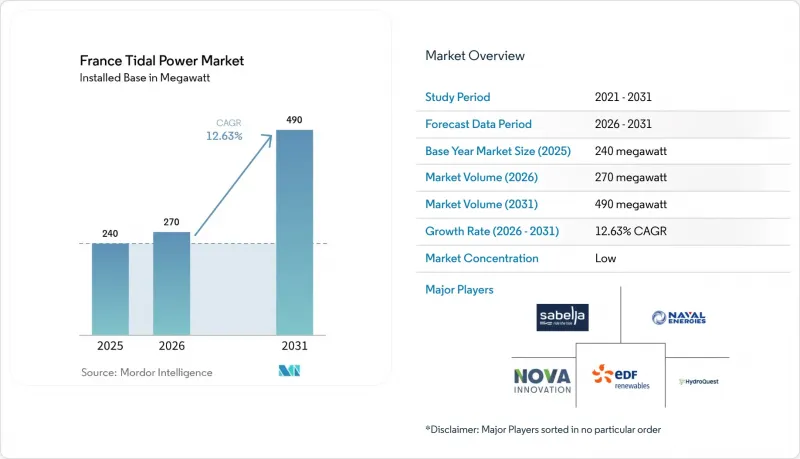
Mordor Intelligence에 의하면, 프랑스 조력발전 시장 규모(설치용량 기반)는 2025년 240 메가와트에서 2026년에는 270 메가와트로 확대되어 2026년부터 2031년까지 CAGR 12.63%로 성장을 지속하여, 2031년에는 490 메가와트에 이를 것으로 예측됩니다.
본 보고서는 발전 방식(조석 댐, 부유식 조석 발전 플랫폼, 조류 발전, 동적 조석 발전), 에너지 변환 장치(횡축 터빈, 종축 터빈, 기타), 용도(발전, 해수 담수화, 선박 추진 등), 최종 사용자(유틸리티·독립발전사업자(IPP), 산업, 상업), 지역(프랑스)별로 분류되어 있습니다. 시장 전망은 발전량(MW) 단위로 제시되어 있습니다.
프랑스 조력 발전 시장 동향과 인사이트
정부가 주도하는 조력 발전 연구 개발 자금의 안정적인 확보
프랑스는 오랫동안 공공 지원을 통해 조력 발전 시장을 구축해 왔습니다. 이러한 지원은 단일 장비를 이용한 시험에서 시작해, 실제 운용 조건 하에서 설치, 유지보수 및 수익 모델을 검증할 수 있는 대규모 어레이로 단계적으로 확대되어 왔습니다. NH1 프로젝트만 해도 EU 혁신 기금으로부터 3,130만 유로(3,410만 달러)의 자금을 지원받았으며, 이 지원은 “프랑스 2030”계획에 따른 지원과 맞물려, 세계 최초의 상용 시범 프로젝트에 대한 부담을 줄이는 동시에, 금융 기관에 더 강력한 공공 정책 신호를 보내고 있습니다. 또한, 이 프로젝트는 비용 절감 방안에 대해 유럽투자은행으로부터 독립적인 검증을 받았습니다. 이 점은 중요합니다. 왜냐하면 프랑스 조력 발전 시장의 향후 프로젝트는 터빈 설계뿐만 아니라, 발전 비용 절감 방안이 투자자들에게 얼마나 신뢰할 수 있는지에 따라서도 평가받게 될 것이기 때문입니다. 공적 자금은 더 광범위한 이익도 가져다주고 있습니다. 라즈 블랑샤르에서 수집된 환경 데이터와 운영 데이터는 후속 시설에서도 재사용이 가능하기 때문에 이를 통해 중복되는 조사 작업을 줄일 수 있고, 새로운 개발마다 필요한 학습 주기를 단축할 수 있기 때문입니다. 프랑스의 조력 발전 시장에서 이는 중요한 의미를 지닙니다. 초기 프로젝트에는 막대한 정보 수집 부담이 따르기 때문에 재사용 가능한 데이터 세트가 늘어날수록 다음 프로젝트의 인허가 취득이나 자금 조달이 수월해지기 때문입니다. 장기적으로 볼 때, 이러한 접근 방식을 통해 국가의 지원은 단순한 자본 지원에서 업계 전반의 위험 프로파일을 개선하는 공유 지식 기반으로 변화해 나갈 것입니다.
라즈 블랑샤르 및 팡폴-브레하트에서의 향후 상업 규모 프로젝트
프랑스 조력 발전 시장에서 단기적으로 가장 큰 성장 요인은 라즈 블랑샤르의 시제품 단계에서 상용화 전 발전소 단계로의 전환과, 파임폴-브레하가 인증된 부지로서 계속해서 수행할 역할입니다. FloWatt사의 17MW 발전소 프로젝트는 CMN사의 쉘부르 공장에서 6기의 HQ 2.8 터빈이 제조되고 있으며, 프랑스 정부의 7,500만 유로(8,180만 달러) 지원과 20년간의 고정가격임베디드제도(FIT)에 힘입어 순조롭게 진행되고 있습니다. 가동 개시는 2028년을 목표로 하고 있습니다. NH1사도 이와 마찬가지로 광범위한 개발 구역에 12MW를 추가로 확보했으며, 이 프로젝트 역시 2028년 가동을 목표로 하고 있습니다. 이로 인해 프랑스의 조력 발전 시장은 시범 터빈의 데이터뿐만 아니라 실제 발전소의 실적을 바탕으로 평가받게 될 것입니다. 이러한 프로젝트들은 총 출력(메가와트) 이상의 의미를 지니고 있습니다. 왜냐하면 국내 제조업체, 해저 설비 공급업체, 해양 서비스 기업을 대상으로, 향후 발전소의 단위 비용 절감을 뒷받침할 수 있는 반복적으로 실행 가능한 업무 패키지를 제공하고 있기 때문입니다. 판포르-브레하트는 개발업체들이 더 대규모 프로젝트로 진출하기 전에, 프랑스의 해양 환경에서 출력 특성과 운전 거동을 검증할 수 있는 계통 연계 사이트를 제공함으로써 이러한 전환을 지속적으로 강화하고 있습니다. 그 결과, 프랑스의 조력 발전 시장은 단순히 개별적인 공학 실험의 집합체라기보다는 시험, 제조, 도입의 각 단계가 유기적으로 연계된 파이프라인과 같은 양상을 띠기 시작했습니다.
높은 수준의 균등화 발전 원가(LCOE)와 해상 풍력 발전의 비교
현재 진행 중인 조력 발전 프로젝트에서는 도입 초기 단계의 위험 요인과 제한된 설치 용량을 반영한 지원 체계가 여전히 필요하기 때문에 높은 발전 비용이 프랑스 조력 발전 시장의 주요 걸림돌이 되고 있습니다. 제공된 자료에 따르면, 현재 조력 발전의 LCOE(균등화 발전 원가)는 1MWh당 150-350유로(1MWh당 163-381달러) 범위이며, 이 수준은 보다 성숙한 해상 재생에너지 기술에서 기대되는 비용 기준을 여전히 크게 상회하고 있습니다. Tethys Engineering 및 ORE Catapult를 통해 인용된 독립적인 연구에 따르면, 실질적인 비용 절감은 누적 설치 용량에 따라 달라지며, 2030년까지 1MWh당 비용을 116유로 미만으로 낮추기 위해서는 프랑스 내에서 최소 783MW를 설치해야 하는 것으로 나타났습니다. 이 기준치가 중요한 이유는 현재의 250 MW라는 정책 목표가 프랑스 조력 발전 시장을 뒷받침하고 있지만, 제조 분야의 학습 효과나 공급망의 규모의 경제가 충분히 발휘될 수 있는 수준에는 아직 도달하지 못했기 때문입니다. FloWatt의 고정가격임베디드제도(FIT)의 운영 방식은 정책 입안자들이 이 문제를 인식하고 있으며, 업계가 규모를 확대해 나가는 동안 초기 시설들을 직접적인 경쟁으로부터 보호하려 하고 있음을 시사합니다. 더 많은 메가와트 용량이 설치·가동되기 전까지는 비용이 어떤 프로젝트가 먼저 진행될지, 민간 자본이 이 분야에 어느 정도의 속도로 진입할지를 계속해서 좌우할 것입니다.
부문별 분석
2025년 기준으로 조력 댐식 발전은 설치 용량의 42.3%를 차지하며, 프랑스의 조력 발전 시장에서 가장 큰 비중을 차지하는 발전 방식이 되었습니다. 이는 프랑스에 여전히 기존의 둑식 인프라가 기반으로서 남아 있기 때문입니다. 이러한 기반을 바탕으로, 해당 부문은 향후 프로젝트 유입이 가장 활발하다는 이유 때문이 아니라, 기존 자산에 기반한 우위를 유지하고 있습니다. 조력 발전은 댐식 발전에 이어 두 번째 순위를 차지했으나, 라즈 블랑샤르(Raz Blanchard)의 파이프라인을 통해 가장 뚜렷한 상업적 성장세를 보이고 있는 프랑스 조력 발전 산업의 한 분야입니다. 프랑스에서 동적 조력 발전은 여전히 구상 단계에 머물러 있으며, 현재의 발전 용량 구성상 실질적인 도입 실적은 없습니다. 부유식 조력 발전 플랫폼 시장은 2031년까지 연평균 성장률(CAGR) 19.4%로 확대될 것으로 예상되며, 이 부문에서 가장 두드러진 성장을 보이는 분야입니다. 그 매력은 해저 고정식 설계로는 도입, 유지 또는 규모 확대가 어려운 수심이 깊고 해류가 빠른 해역에서도 운용할 수 있다는 점에 있습니다. 이는 수심이나 운전 조건에 따라 기존 기초 구조의 실용화가 제한될 가능성이 있는 라즈 블랑샤르와 같은 입지에서는 중요한 요소가 됩니다. 그 결과, 부유식 시스템은 틈새 공학 아이디어에서 출발해 프랑스 조력 발전 시장의 진정한 성장 동력으로 자리매김하고 있습니다.
이 움직임의 두 번째 측면은 순수하게 기술적인 측면이라기보다는 운영 측면과 관련된 것입니다. 부유식 시스템은 바다로 예인하기 전에 육상에서 조립 및 점검이 가능하기 때문에 작업자가 혹독한 해양 환경에서 보내는 시간을 단축할 수 있기 때문입니다. 이는 맑은 날씨가 지속되는 기간이 짧고 선박 운항 비용이 높은 고에너지 수로에서 중요한 의미를 지닙니다. 왜냐하면, 해상 작업 범위가 좁아지는 것만으로도 프로젝트의 경제성이 눈에 띄게 달라지기 때문입니다. EEL Energy사는 2026년까지 1MW급 생체 모방형 조력 발전기의 해상 실증 시험을 목표로 하고 있으며, 시장이 대형 어레이 개발업체를 중심으로 통합되어 가는 상황에서도 새로운 플랫폼 방식이 여전히 이 분야에 진입하고 있음을 보여주고 있습니다. 또한 France Energies Marines사도 조류 프로그램을 통해 라즈 블랑샤르(Raz Blanchard) 지역의 유체역학 및 환경에 관한 연구를 강조하고 있으며, 이러한 데이터는 향후 플랫폼 배치를 위한 어레이 배치 결정에 도움이 될 것입니다. 실용적인 관점에서 볼 때, 부유식 부문은 단순히 새로운 설비 범주를 추가하는 것뿐만 아니라, 프랑스 조력 발전 시장에서 설치 장소에 대한 접근성을 확대하는 것입니다. 또한, 일부 작업은 본격적인 해상 중량물 인양 작업이 아닌 예인 방식의 인양 작업으로 처리할 수 있으므로, 개발자에게는 유지보수 전략의 유연성이 높아집니다. 설치 장소로의 접근 범위 확대와 해상 설치 기간 단축이라는 이러한 조합이야말로, 보다 성숙한 댐식 발전 부문에 비해 이 분야의 성장 전망이 더욱 견고한 이유를 설명해 줍니다. 또한, 이는 향후 설비 용량의 증대가 기존 인프라보다는 오히려 설치 및 유지보수의 용이성에 따라 좌우될 것임을 시사합니다.
수평축 터빈은 2025년 설치 용량의 61.5%를 차지하고 있으며, 2031년까지 연평균 성장률(CAGR) 17.4%로 성장할 것으로 전망됩니다. 이를 통해 프랑스 조력 발전 시장에서 컨버터 방식 중 최대 규모이자 가장 빠르게 성장하고 있는 기업으로서 독보적인 입지를 확립하고 있습니다. 이러한 우위는 기술적 성숙도, 금융 기관들의 폭넓은 인지도, 그리고 현재 상업 운전을 향해 진행 중인 프랑스의 주요 프로젝트와의 직접적인 연계가 어우러져 실현된 것입니다. NH1 프로젝트는 정격 출력 3MW, 로터 직경 24미터의 Proteus AR3000 터빈을 핵심으로 구축되었으며, 이 프로젝트의 비용 계획은 유럽투자은행(EIB)의 심사 절차를 통해 독립적인 검증을 받았습니다. 이로 인해, 프랑스의 조력 발전 시장이 단순한 참신함보다는 은행 대출의 확실성과 표준화를 더욱 중시하기 시작한 현재, 수평축 터빈 부문에 있어 강력한 참고 사례가 되고 있습니다. 또한, 이 범주에는 대규모 프로젝트에서 성숙도가 낮은 대안보다 이러한 터빈을 통해 보다 체계적인 성능 검증 데이터를 수집할 수 있다는 장점도 있습니다. 상업화 초기 단계 시장에서 이는 중요한 요소입니다. 왜냐하면 개발자들은 보험사, 공공 자금 지원 기관, 금융 기관을 모두 동시에 만족시킬 수 있는 기술이 필요하기 때문입니다. 현재로서는 수평축 터빈이 그 요건에 가장 근접해 있습니다. 따라서 수평축 터빈의 지속적인 규모 확대는 향후 프로젝트 전반에 적용될 공급망 및 자금 조달 기준 모두에 영향을 미칠 것으로 보입니다.
수직축 터빈도 여전히 중요한 역할을 하고 있습니다. 그 주된 이유는 HydroQuest사의 설계가 FloWatt 발전소의 기반이 되고 있으며, 이미 팜폴-브레하(Paimpol-Brehat)에서 가혹한 운전 조건 하에서 시험이 진행되고 있기 때문입니다. FloWatt사는 시험 현장에서 2년에 걸친 운영을 통해 완전한 가동률을 달성했다고 보고했으며, 시장 점유율은 수평축 터빈보다 낮지만 수직축 개념에 실질적인 운영 실적을 입증하고 있습니다. 생체 모방 시스템을 포함한 기타 조력 발전 변환기는 설치 규모 면에서는 여전히 소규모이지만, 프랑스 조력 발전 산업의 혁신 기반을 확대하는 데 중요한 역할을 하고 있습니다. EEL Energy의 막식 장치 개발은 개발자들이 물 흐름 포집, 내구성 또는 유지보수의 용이성 측면에서 잠재적인 이점을 발견하고 있는 분야에서 여전히 대체 아키텍처가 모색되고 있음을 보여줍니다. 그렇긴 하지만, 인증 기준과 투자자들의 기대는 여전히 보다 탄탄한 시험 실적과 명확한 가동 실적을 갖춘 발전 설비로 쏠리고 있습니다. 따라서 단기적으로는 이미 입지를 다진 터빈 시리즈를 중심으로 시장이 전개될 것으로 보입니다. 장기적으로는 대체형 발전 장치가 대규모 어레이의 첫 물결이라기보다는 특수한 용도나 까다로운 설치 조건에서 그 진가를 발휘할 가능성이 있습니다. 현재까지의 증거를 종합해 볼 때, 현재 예측 기간 동안 프랑스 조력 발전 시장의 표준 설계는 여전히 수평축형 터빈이라는 결론에 이릅니다.
기타 혜택:
- 엑셀 형식 시장 예측(ME) 시트
- 3개월간의 애널리스트 지원
자주 묻는 질문
목차
제1장 서론
제2장 조사 방법
제3장 주요 요약
제4장 시장 구도
제5장 시장 규모와 성장 예측
제6장 경쟁 구도
제7장 시장 기회와 향후 전망
JHS 26.07.07According to Mordor Intelligence, the france tidal power market size in terms of installed base is expected to grow from 240 megawatt in 2025 to 270 megawatt in 2026 and is forecast to reach 490 megawatt by 2031 at 12.63% CAGR over 2026-2031.
This report is Segmented by Generation Method (Tidal Barrage, Floating Tidal Platform, Tidal Stream, Dynamic Tidal Power), Energy Converters (Horizontal Axis Turbine, Vertical Axis Turbine, Other), Application (Power Generation, Desalination, Marine Propulsion, and More), End-User (Utilities and IPPs, Industrial, Commercial), and Geography (France). The Market Forecasts are Provided in Terms of Volume (MW).
France Tidal Power Market Trends and Insights
Robust State-Backed Tidal R&D Funding
France has spent years building the France tidal power market through public support that moved step by step from isolated device trials toward larger arrays that can test installation, maintenance, and revenue models under real operating conditions. The NH1 project alone received EUR 31.3 million, or USD 34.1 million, from the EU Innovation Fund, and that support sits alongside France 2030 backing, which lowers the burden on a first-of-a-kind commercial pilot and gives lenders a stronger public policy signal.The same project also received independent validation from the European Investment Bank on its cost reduction path, which matters because future projects in the France tidal power market will be judged not only on turbine design but also on how credible their path to lower power costs looks to investors. Public funding is also creating a wider benefit because environmental and operating data gathered at Raz Blanchard can be reused by later arrays, which reduces duplicated study work and shortens the learning cycle for each new development. This matters in the France tidal power market because early projects carry a high information burden, and every dataset that becomes reusable makes the next project easier to permit and finance. Over time, this approach turns state support from simple capital aid into a shared knowledge base that improves the sector's overall risk profile.
Forthcoming Commercial-Scale Projects at Raz Blanchard and Paimpol-Brehat
The strongest near-term growth driver in the France tidal power market is the move from prototypes to pre-commercial arrays at Raz Blanchard and the continued role of Paimpol-Brehat as a qualification site. FloWatt's 17 MW farm is progressing with 6 HQ 2.8 turbines being built at CMN's Cherbourg facility, backed by EUR 75 million, or USD 81.8 million, in French government support and a 20-year feed-in tariff, while commissioning is targeted for 2028. NH1 adds another 12 MW at the same broad development corridor and is also targeted for operation in 2028, which means the France tidal power market will soon be assessed on real array performance rather than only on pilot turbine data. These projects matter beyond their megawatt totals because they are giving domestic manufacturers, subsea suppliers, and marine service companies repeatable work packages that can support lower unit costs on future arrays. Paimpol-Brehat continues to strengthen this transition because it offers a grid-connected site where developers can validate power curves and operating behavior under French marine conditions before moving into larger projects. As a result, the France tidal power market is starting to look less like a collection of isolated engineering experiments and more like a pipeline with linked testing, manufacturing, and deployment stages.
High Levelised Cost Versus Offshore Wind
High power cost remains the main brake on the France tidal power market because current tidal projects still need support structures that reflect early-stage deployment risk and limited installed volume. The supplied material places current tidal LCOE in a EUR 150 to EUR 350 per MWh range, or USD 163 to USD 381 per MWh, and that level is still well above the cost base expected from more mature offshore renewable technologies. Independent work referenced through Tethys Engineering and ORE Catapult showed that meaningful cost reduction depends on cumulative deployment, with at least 783 MW in France needed to push the cost path below EUR 116 per MWh by 2030. That threshold is important because the current 250 MW policy target helps the France tidal power market, but it is still below the level at which stronger manufacturing learning and supply chain scale effects would be expected to show fully. FloWatt's feed-in tariff structure suggests policymakers recognize this issue and are protecting early arrays from direct cost competition while the sector builds volume. Until more megawatts are installed and operated, cost will continue to shape which projects move first and how quickly private capital becomes comfortable with the sector.
Other drivers and restraints analyzed in the detailed report include:
- Coastal Grid-Congestion Relief Opportunities
- Maritime Cluster Decarbonisation Mandates
- Lengthy Environmental Approval Cycles
For complete list of drivers and restraints, kindly check the Table Of Contents.
Segment Analysis
Tidal barrage accounted for 42.3% of installed capacity in 2025, which made it the largest power generation method in the France tidal power market because France still carries a legacy base of barrage infrastructure. That installed base gives the segment a lead that is rooted in existing assets rather than in the strongest future project flow. Tidal stream generation ranked behind barrage, but it is a part of the France tidal power industry that is receiving the clearest commercial momentum from the Raz Blanchard pipeline. Dynamic tidal power remained at a conceptual stage in France, with no meaningful installed position in the current capacity mix. Floating tidal power platforms are forecast to expand at 19.4% CAGR through 2031, which makes them the strongest growth pocket within this split. Their appeal comes from the ability to work in deeper and faster-flowing waters where bottom-fixed designs are harder to deploy, maintain, or scale. This matters at sites such as Raz Blanchard, where water depth and operating conditions can limit the practical use of conventional foundations. As a result, floating systems are moving from a niche engineering idea toward a real growth lever for the France tidal power market.
The second part of the story is operational rather than purely technical, because floating systems can be assembled and checked onshore before tow-out, which reduces the time crews need to spend in harsh marine conditions. That matters in high-energy channels where weather windows are short and vessel costs are high, since a smaller offshore work scope can visibly change project economics. EEL Energy is targeting in-situ marine testing for its 1 MW biomimetic tidal generator by 2026, which shows that new platform approaches are still entering the field even as the market begins to consolidate around larger array developers. France Energies Marines has also highlighted hydrodynamic and environmental research at Raz Blanchard through its tidal stream programs, and those data will support better array layout decisions for future platform deployments. In practical terms, the floating segment expands site accessibility for the France tidal power market rather than simply adding another device category. It also gives developers more flexibility on maintenance strategy because some interventions can be done with tow-back procedures instead of full offshore heavy-lift work. That combination of broader site access and shorter marine installation windows explains why the growth outlook is stronger here than in the more mature barrage segment. It also suggests that future capacity additions will be shaped more by deployability and serviceability than by installed legacy infrastructure.
Horizontal axis turbines held 61.5% of installed capacity in 2025 and are also projected to grow at 17.4% CAGR through 2031, which gives them a rare position as both the largest and the fastest-growing converter type in the France tidal power market size. That lead reflects a mix of technical maturity, wider lender familiarity, and direct alignment with flagship French projects that are now moving toward commercial operation. The NH1 project is built around Proteus AR3000 turbines rated at 3 MW each with a 24-meter rotor diameter, and the project's cost pathway received independent validation through the European Investment Bank process. This gives the horizontal axis category a strong reference point at a time when the France tidal power market is starting to value bankability and standardization more heavily than novelty alone. The category also benefits from the fact that larger projects can source more structured performance evidence from these machines than from less mature alternatives. In an early commercial market, that matters because developers need technologies that can satisfy insurers, public funders, and debt providers at the same time. For now, horizontal-axis turbines sit closest to that requirement set. Their continued scale-up should therefore shape both the supply chain and the financing standards applied across future projects.
Vertical axis turbines still retain a meaningful role, largely because HydroQuest's design is the basis of the FloWatt farm and has already been tested at Paimpol-Brehat under demanding operating conditions. FloWatt reported full availability over a 2-year campaign at the test site, which gives the vertical axis concept a practical operating credential, even though its market position is smaller than that of horizontal axis turbines. Other tidal energy converters, including biomimetic systems, remain small in installed terms but still matter because they expand the innovation base of the France tidal power industry. EEL Energy's work on a membrane-based device shows that alternative architectures are still being pursued where developers see potential gains in flow capture, durability, or maintenance handling. Even so, qualification standards and investor expectations continue to favor converters with stronger testing histories and clearer operating records. This is why the near-term market will likely stay centered on the more established turbine families. Over time, alternative converters may find room in specialized applications or difficult site conditions rather than in the first wave of larger arrays. The balance of evidence still points to horizontal axis machines as the reference design for the France tidal power market over the current forecast period.
Complete Report Scope:
- By Power Generation Method
- Tidal Barrage
- Floating Tidal Power Platform
- Tidal Stream Generation
- Dynamic Tidal Power
- By Tidal Energy Converters
- Horizontal Axis Turbine
- Vertical Axis Turbine
- Other Tidal Energy Converters
- By Application
- Power Generation
- Desalination
- Marine Propulsion
- Data & Telecom Platforms
- By End-User
- Utilities and IPPs
- Industrial
- Commercial
List of Companies Covered in this Report:
- Sabella SAS
- HydroQuest SAS
- EEL Energy
- Guinard Energies Nouvelles
- Naval Energies
- Nova Innovation Ltd
- SIMEC Atlantis Energy Ltd
- Orbital Marine Power Ltd
- Minesto AB
- Andritz Hydro GmbH
- Voith Hydro GmbH & Co. KG
- EDF Renewables
- ENGIE SA
- GE Vernova (ex-Alstom Ocean Energy)
- Tocardo BV
- Verdant Power Inc.
- HydroWing Ltd
- Seaturns SAS
- Blue Shark Power System
- Hydrokinetic Energy Corp.
Additional Benefits:
- The market estimate (ME) sheet in Excel format
- 3 months of analyst support
TABLE OF CONTENTS
1 Introduction
- 1.1 Study Assumptions & Market Definition
- 1.2 Scope of the Study
2 Research Methodology
3 Executive Summary
4 Market Landscape
- 4.1 Market Overview
- 4.2 Installed Capacity & Forecast (MW)
- 4.3 Market Drivers
- 4.3.1 Robust state-backed tidal R&D funding
- 4.3.2 Forthcoming commercial-scale projects (Raz Blanchard, Paimpol-Brehat)
- 4.3.3 Coastal grid-congestion relief opportunities
- 4.3.4 Maritime cluster decarbonisation mandates
- 4.4 Market Restraints
- 4.4.1 High levelised cost versus offshore wind
- 4.4.2 Lengthy environmental approval cycles
- 4.4.3 Limited bankable track record deterring financiers
- 4.4.4 Mining of rare-earth magnets facing NGO opposition
- 4.5 Supply-Chain Analysis
- 4.6 Regulatory Landscape
- 4.7 Technological Outlook
- 4.8 PESTLE Analysis
- 4.9 Porter's Five Forces
- 4.9.1 Threat of New Entrants
- 4.9.2 Bargaining Power of Suppliers
- 4.9.3 Bargaining Power of Buyers
- 4.9.4 Threat of Substitutes
- 4.9.5 Competitive Rivalry
5 Market Size & Growth Forecasts
- 5.1 By Power Generation Method
- 5.1.1 Tidal Barrage
- 5.1.2 Floating Tidal Power Platform
- 5.1.3 Tidal Stream Generation
- 5.1.4 Dynamic Tidal Power
- 5.2 By Tidal Energy Converters
- 5.2.1 Horizontal Axis Turbine
- 5.2.2 Vertical Axis Turbine
- 5.2.3 Other Tidal Energy Converters
- 5.3 By Application
- 5.3.1 Power Generation
- 5.3.2 Desalination
- 5.3.3 Marine Propulsion
- 5.3.4 Data & Telecom Platforms
- 5.4 By End-User
- 5.4.1 Utilities and IPPs
- 5.4.2 Industrial
- 5.4.3 Commercial
6 Competitive Landscape
- 6.1 Market Concentration
- 6.2 Strategic Moves
- 6.3 Market Share Analysis
- 6.4 Company Profiles {(includes Global level Overview, Market level overview, Core Segments, Financials as available, Strategic Information, Market Rank/Share for key companies, Products & Services, and Recent Developments)}
- 6.4.1 Sabella SAS
- 6.4.2 HydroQuest SAS
- 6.4.3 EEL Energy
- 6.4.4 Guinard Energies Nouvelles
- 6.4.5 Naval Energies
- 6.4.6 Nova Innovation Ltd
- 6.4.7 SIMEC Atlantis Energy Ltd
- 6.4.8 Orbital Marine Power Ltd
- 6.4.9 Minesto AB
- 6.4.10 Andritz Hydro GmbH
- 6.4.11 Voith Hydro GmbH & Co. KG
- 6.4.12 EDF Renewables
- 6.4.13 ENGIE SA
- 6.4.14 GE Vernova (ex-Alstom Ocean Energy)
- 6.4.15 Tocardo BV
- 6.4.16 Verdant Power Inc.
- 6.4.17 HydroWing Ltd
- 6.4.18 Seaturns SAS
- 6.4.19 Blue Shark Power System
- 6.4.20 Hydrokinetic Energy Corp.
7 Market Opportunities & Future Outlook
- 7.1 White-space & Unmet-Need Assessment