
|
시장보고서
상품코드
2073634
콜라겐 펩타이드 시장 : 점유율 분석, 업계 동향과 통계, 성장 예측(2026-2031년)Collagen Peptides - Market Share Analysis, Industry Trends & Statistics, Growth Forecasts (2026 - 2031) |
||||||
 Mordor Intelligence
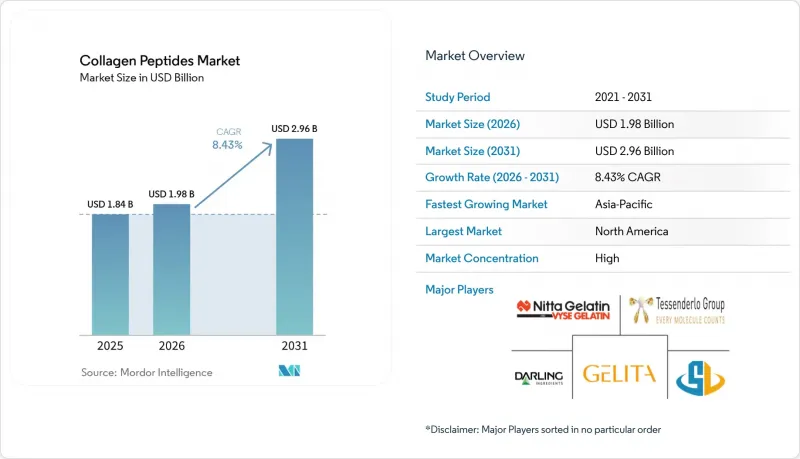
Mordor Intelligence에 의하면, 세계의 콜라겐 펩타이드 시장 규모는 2025년에 18억 4,000만 달러로 평가되었고 2026년 19억 8,000만 달러에서 2031년까지 29억 6,000만 달러에 이를 것으로 예측되며, 예측 기간(2026-2031년) CAGR은 8.43%를 나타낼 전망입니다.
본 보고서는 제품 유형(소, 돼지, 가금류, 어류), 원료(뼈, 가죽·모피), 분자량(1-3킬로달톤(kDa), 3-5킬로달톤(kDa), 기타), 용도(식품 및 음료, 의약품, 기타), 지역(북미, 유럽, 아시아태평양, 남미, 중동 및 아프리카)별로 분류되어 있습니다. 시장 전망은 금액(달러) 기준으로 제시되어 있습니다.
세계 콜라겐 펩타이드 시장 동향과 인사이트
맞춤형 영양 및 표적형 콜라겐 보충제의 부상
세계 영양보조식품 시장은 범용적이고 광범위한 용도로 사용되는 제형에서 특정 생리 기능에 대해 임상적으로 입증된 효과를 제공하도록 정밀하게 설계된 영양 솔루션으로 전환되고 있으며, 콜라겐 펩타이드가 이러한 진화 과정에서 매우 중요한 역할을 하고 있습니다. 러셀로사가 “Vitafoods Europe 2024”에서 “Nextida” 플랫폼을 발표한 것은 맞춤형 영양에 대한 관심이 높아지고 있음을 보여주는 좋은 예이며, 콜라겐 펩타이드를 단순한 기초 단백질 제품에서 특정 생물학적 요구를 겨냥한 생리활성 성분 포트폴리오로 변모시키고 있습니다. “몸을 위한 GPS”라고 불리는 이 플랫폼은 엄격한 세포 모델 시험을 통해 정밀한 생물학적 신호로 작용하며, 신체의 균형 회복을 이끌어내는 최적의 펩타이드 조성을 규명합니다. Vitafoods Europe 2025에서 러셀로사는 식후 혈당 관리에 도움을 주는 과학적으로 입증된 혁신적인 제품 ‘Nextida GC”를 선보였습니다. 한편, 인공지능과 생명공학의 발전으로 정밀한 콜라겐 펩타이드 조성의 개발이 가속화되고 있으며, 인간과 동등한 수준의 작용기전에 특화된 콜라겐 단편을 만들어낼 수 있게 되었습니다.
스포츠 영양 제품 분야에서 콜라겐 펩타이드의 상업화 확대
운동선수 및 활동적인 소비자를 타겟으로 하는 콜라겐 펩타이드의 주요 판매 채널인 스포츠 영양 카테고리는 전 세계적으로 강력한 성장세를 보이고 있습니다. Mordor Intelligence에 따르면, 2025년 전 세계 스포츠 영양 시장 규모는 358억 70만 달러로 평가되었고, 이는 콜라겐 펩타이드 배합에 있어 큰 기회가 되고 있습니다. 각 영양제 브랜드들은 계속해서 확대되는 소비자층의 변화하는 요구에 부응하기 위해, 회복에 특화된 제품, 관절 건강 지원 제제, 그리고 다기능 액티브 영양 제품에 콜라겐 펩타이드를 점점 더 적극적으로 배합하고 있습니다. 신체 활동 참여가 급증하고 있는 가운데, 스포츠 회복용 보충제에 대한 수요가 빠르게 늘어나고 있습니다. 스포츠 및 피트니스 산업 협회(SFIA)의 “2025년 Top Line 참가 후기”에 따르면, 2024년에는 미국인의 80%가 적극적으로 신체 활동을 했으며, 그 수는 2억 4,710만 명에 달했습니다. 이는 2019년과 비교해 2,540만 명 증가한 수치입니다. 이처럼 계속 늘어나는 피트니스 애호가 및 운동선수층은 회복용 영양 솔루션에 있어 거대한 시장을 형성하고 있으며, 그 속에서 콜라겐 펩타이드가 주요 성분으로 자리 잡고 있습니다.
동물 유래 성분, 추적성 및 표시에 관한 엄격한 규제
콜라겐 펩타이드 시장의 성장은 동물 유래 원료, 추적성 및 표시 요건에 관한 엄격한 규제로 인해 저해되고 있습니다. 소 가죽, 돼지 가죽, 가금류 연골, 생선 비늘, 뼈, 힘줄 등의 원료에서 추출된 콜라겐 펩타이드가 특히 유럽, 미국, 영국과 같은 주요 시장에서 엄격한 식품 안전, 수의학 및 위생 기준의 적용을 받고 있습니다. 윤리적 조달과 소비자 안전을 확보하기 위해 마련된 이러한 규제로 인해 인증 비용이 상승하고, 승인까지 걸리는 기간이 길어지며, 무역 장벽이 높아지고 있습니다. 유럽집행위원회가 유럽으로 수입되는 동물 유래 제품에 부과하고 있는 엄격한 위생 인증 요건이 보여주듯이, 제조업체들은 복잡한 수입 및 추적성 규정을 준수하는 데 있어 큰 어려움에 직면해 있습니다. 2026년 4월, 유럽연합(EU)이 국경 검사를 의무화하는 제품 목록을 확대함에 따라 상황은 더욱 심각해졌으며, 콜라겐 펩타이드 수출업체들은 선적 지연을 피하기 위해 상세한 조달 기록을 유지하지 않을 수 없게 되었습니다.
부문별 분석
소 유래 콜라겐 펩타이드가 2025년까지 전 세계 콜라겐 펩타이드 시장 전체 매출의 46.23%를 차지하며, 계속해서 시장을 주도할 것으로 예측됩니다. 이러한 확고한 입지는 광범위한 접근성, 뛰어난 가성비, 그리고 식품 및 음료, 영양 보충제, 퍼스널케어 등 다양한 산업 분야에 걸친 폭넓은 용도 덕분입니다. 또한, 소 유래 콜라겐은 풍부한 아미노산 구성과 뛰어난 기능성을 갖추고 있어 제조업체와 소비자 모두로부터 지지를 받고 있습니다. 다양한 제형에 대한 높은 적응성도 시장에서 그 입지를 더욱 공고히 하고 있습니다. 이러한 요인들이 복합적으로 작용하여, 소 유래 콜라겐 펩타이드가 업계에서 선호되는 선택지가 되고 있습니다.
어류 유래 콜라겐 펩타이드 시장은 2026년부터 2031년까지의 예측 기간 동안 연평균 성장률(CAGR) 11.79%를 나타낼 것으로 예측되며, 가장 빠르게 성장하는 제품 부문이 될 것으로 전망됩니다. 해양 유래 원료에 대한 소비자 수요가 증가함에 따라, 이것이 성장의 주요 원동력이 되고 있습니다. 또한, 클린 라벨 제품 및 지속 가능한 방식으로 조달된 제품에 대한 수요가 증가함에 따라, 어류 유래 콜라겐의 인기가 높아지면서 이러한 수요 증가를 뒷받침하고 있습니다. 뛰어난 생체 이용률로 알려진 어류 유래 콜라겐은 “내면에서 아름다움을 가꾸다”보충제, 기능성 식품, 스킨케어 제품 분야에서 점점 더 많이 활용되고 있습니다. 이러한 추세는 건강과 지속가능성을 추구하는 소비자의 기호에 부응하는 데 있어, 어류 유래 콜라겐의 역할이 확대되고 있음을 여실히 보여주고 있습니다.
가죽 및 모피는 세계 콜라겐 펩타이드 시장에서 여전히 가장 큰 원료 부문이며, 2025년에는 시장 총매출의 71.68%를 차지할 것으로 전망됩니다. 이러한 선도적인 지위는 주로 육류 가공 산업을 통해 원자재를 폭넓게 조달할 수 있기 때문이며, 이를 통해 안정적이고 비용 효율적인 공급이 보장되고 있습니다. 가죽과 모피는 콜라겐 수율이 높기 때문에 대규모 생산에서 선호되는 선택지입니다. 확립된 공급망을 바탕으로 식품, 영양보충제, 화장품 등 다양한 용도로 사용하기에 적합합니다. 이러한 원료에 대한 안정적인 수요는 콜라겐 펩타이드에 대한 증가하는 수요를 충족시키는 데 있어 이 원료들이 수행하는 중요한 역할을 입증하고 있습니다.
뼈는 2031년까지의 연평균 성장률(CAGR)이 9.64%에 달하고, 가장 빠르게 성장하는 원자재 부문 중 하나가 될 것으로 예측됩니다. 이러한 성장은 제품별 접근 방식을 효과적으로 활용하고, 밸류체인 전반에 걸쳐 지속가능성을 증진하려는 노력을 강화함으로써 이끌리고 있습니다. 원재료 폐기물 감축에 주력하는 것이 뼈 유래 콜라겐 펩타이드의 채택을 더욱 촉진하고 있습니다. 추출 공정의 기술적 발전으로 인해 뼈에서 콜라겐을 추출하기가 쉬워졌으며, 대체 원료로서의 매력이 높아지고 있습니다. 또한, 지속 가능하고 친환경적인 콜라겐 원료에 대한 수요가 증가함에 따라 다양한 최종 이용 산업에서 뼈 유래 콜라겐 펩타이드의 활용이 확대될 것으로 예측됩니다.
지역별 분석
북미는 계속해서 전 세계 콜라겐 펩타이드 시장을 독점하고 있으며, 2025년에는 총 매출의 34.14%를 차지할 것으로 전망됩니다. 이 지역이 주도적인 위치를 차지하고 있는 것은 확고히 자리 잡은 영양보조식품 산업, 웰니스 제품에 대한 소비자들의 높은 지출, 그리고 관절과 뼈, 전신 건강 개선을 목적으로 한 콜라겐 사용 확대 덕분입니다. 미국, 캐나다, 멕시코가 주요 기여국으로 꼽히며, 의료 종사자와 소비자들 사이에서 콜라겐의 건강 효능에 대한 인식이 높아지고 있는 것이 그 원동력이 되고 있습니다. 또한, 첨단 제조 시설의 확충과 견고한 유통 네트워크의 존재 역시 해당 지역 시장 성장을 뒷받침하고 있습니다. 예방 의료와 맞춤형 영양의 보급 추세 또한 콜라겐 펩타이드 수요를 유지하는 데 있어 매우 중요한 역할을 하고 있습니다.
아시아태평양은 2031년까지 연평균 성장률(CAGR)이 10.94%를 나타낼 것으로 예측되며, 콜라겐 펩타이드 시장에서 가장 빠른 성장이 예상됩니다. 이러한 성장은 건강에 대한 인식이 높아진 데다, “내면에서 우러나는 아름다움”제품에 대한 수요의 급증과 기능성 식품 및 영양 보충제의 소비 확대에 힘입어 성장하고 있습니다. 중국, 일본, 인도 등 주요 시장은 대규모이며 지속적으로 확대되는 소비자층, 가처분 소득 증가, 그리고 콜라겐 펩타이드 생산에 대한 막대한 투자에 힘입어 지역 시장의 성장을 주도하고 있습니다. 또한, 해당 지역에서 혁신적인 제품 개발에 주력하고 있으며, 전통적인 식생활에 콜라겐을 도입함으로써 시장의 잠재력이 높아지고 있습니다. 특히 일본과 한국에서 해양 유래 콜라겐의 인기가 높아지고 있는 점도 이러한 성장에 기여하고 있습니다.
유럽은 클린 라벨 제품, 기능성 식품, 영양 강화 식품에 대한 강력한 수요에 힘입어 세계 콜라겐 펩타이드 시장에서 큰 점유율을 차지하고 있습니다. 이 지역의 소비자들은 원재료의 투명성, 지속가능성, 그리고 고품질의 영양을 점점 더 중요하게 여기고 있으며, 이것이 콜라겐 함유 제품의 보급 확대로 이어지고 있습니다. 독일, 프랑스, 영국 등의 국가들은 활발한 연구개발 활동과 건강 및 웰니스에 대한 관심 증가에 힘입어 주요 시장으로 자리매김하고 있습니다. 한편, 남미, 중동 및 아프리카는 콜라겐의 건강 효능에 대한 인식이 높아지고, 건강기능식품 소비가 확대되며, 소 유래 원료의 확보가 용이해진 것을 배경으로 유망한 시장으로 부상하고 있습니다. 할랄 인증을 받은 콜라겐 제품의 도입은 해당 지역에서 시장 기회를 더욱 확대되고 있습니다.
기타 혜택:
- 엑셀 형식 시장 예측(ME) 시트
- 3개월간의 애널리스트 지원
자주 묻는 질문
목차
제1장 서론
제2장 조사 방법
제3장 주요 요약
제4장 시장 구도
제5장 시장 규모와 성장 예측
제6장 경쟁 구도
제7장 시장 기회와 향후 전망
JHS 26.07.09According to Mordor Intelligence, the global collagen peptides market size was valued at USD 1.84 billion in 2025 and estimated to grow from USD 1.98 billion in 2026 to reach USD 2.96 billion by 2031, at a CAGR of 8.43% during the forecast period (2026-2031).
This report is Segmented by Product Type (Bovine, Porcine, Poultry, and Fish), Source (Bones and Hides and Skin), Molecular Weight (1-3 Kilodaltons (kDa), 3-5 Kilodaltons (kDa), and More), Application (Food and Beverages, Pharmaceuticals and More), and Geography (North America, Europe, Asia-Pacific, South America, Middle East and Africa). The Market Forecasts are Provided in Terms of Value (USD).
Global Collagen Peptides Market Trends and Insights
Rise of personalized nutrition and targeted collagen supplementation
The global dietary supplement market is shifting from generic, broad-spectrum formulations to precision-engineered nutritional solutions designed to deliver clinically validated results for specific physiological functions, with collagen peptides playing a pivotal role in this evolution. Rousselot's launch of the Nextida platform at Vitafoods Europe 2024 exemplifies the growing emphasis on personalized nutrition, transforming collagen peptides from a basic protein commodity into a portfolio of bioactive compositions targeting specific biological needs. This platform, described as a "GPS for the body," uses rigorous cellular model testing to identify optimal peptide compositions that act as precise biological signals, guiding the body toward balance restoration. At Vitafoods Europe 2025, Rousselot showcased its science-backed innovation, Nextida GC, to support post-meal glucose management. Meanwhile, advancements in artificial intelligence and bioengineering are accelerating the development of precision collagen peptide compositions, enabling the creation of human-identical, mechanism-specific collagen fragments.
Growing commercialization of collagen peptides in sports nutrition products
The sports nutrition category, a key commercial channel for collagen peptides targeting athletic and active consumers, is witnessing robust global growth. According to Mordor Intelligence, the global sports nutrition market was valued at USD 35,800.7 million in 2025, offering a significant opportunity for collagen peptide inclusion. Supplement brands are increasingly incorporating collagen peptides into recovery-specific SKUs, joint-support formulations, and multi-benefit active nutrition products to cater to the evolving needs of this expanding consumer base. The demand for sports recovery supplementation is accelerating, driven by a surge in participation in physical activity. According to the Sports and Fitness Industry Association's (SFIA) 2025 Topline Participation Report, 80% of Americans were actively engaged in physical activities in 2024, representing 247.1 million individuals, an increase of 25.4 million active participants since 2019. This growing pool of fitness enthusiasts and athletes represents a substantial market for recovery nutrition solutions, where collagen peptides are becoming a key ingredient.
Stringent regulations related to animal-derived ingredients, traceability, and labeling
The growth of the collagen peptide market is being hindered by stringent regulations surrounding animal-based ingredients, traceability, and labeling requirements. Collagen peptides, derived from sources such as bovine hides, porcine skin, poultry cartilage, fish scales, bones, and tendons, are subject to rigorous food safety, veterinary, and hygiene standards, particularly in key markets like Europe, the United States, and the United Kingdom. These regulations, aimed at ensuring ethical sourcing and consumer safety, have led to higher certification costs, longer approval timelines, and increased trade barriers. Manufacturers face significant challenges navigating complex import and traceability rules, as evidenced by the European Commission's strict health certification requirements for animal-based products entering Europe. The situation intensified in April 2026 when the European Union expanded the list of products requiring mandatory border checks, compelling collagen peptide exporters to maintain detailed sourcing records to avoid shipment delays.
Other drivers and restraints analyzed in the detailed report include:
- Rising consumer focus on preventive healthcare and healthy aging
- Mainstreaming of "food as medicine" philosophy and functional food culture
- Adoption of alternative functional ingredients for joint health, bone support, and beauty applications
For complete list of drivers and restraints, kindly check the Table Of Contents.
Segment Analysis
Bovine collagen peptides are expected to maintain their dominance in the global collagen peptides market, accounting for 46.23% of total market revenue by 2025. This strong position is attributed to their widespread availability, cost-effectiveness, and versatile applications across industries such as food and beverage, nutraceuticals, and personal care. Additionally, bovine-derived collagen is favored for its rich amino acid profile and high functionality, appealing to both manufacturers and consumers. Its adaptability in various formulations further strengthens its market presence. These factors collectively make bovine collagen peptides a preferred choice in the industry.
Fish collagen peptides are anticipated to be the fastest-growing product segment, with a projected CAGR of 11.79% over the forecast period of 2026-2031. The growing consumer demand for marine-sourced ingredients is a key driver of this growth. Furthermore, the rising demand for clean-label and sustainably sourced products aligns with the growing popularity of fish collagen. Known for its superior bioavailability, fish collagen is increasingly utilized in beauty-from-within supplements, functional foods, and skincare products. This trend highlights the expanding role of fish collagen in meeting consumer preferences for health and sustainability.
Hides and skins remain the largest raw material segment in the global collagen peptides market, accounting for 71.68% of total market revenue in 2025. This leadership is primarily due to their widespread availability from the meat processing industry, which ensures a steady and cost-effective supply. Hides and skins offer a high collagen yield, making them a preferred choice for large-scale production. Their established supply chains further enhance their suitability for use in various applications, including food, nutraceuticals, and cosmetics. The consistent demand for these raw materials underscores their critical role in meeting the growing demand for collagen peptides.
Bones are expected to be one of the fastest-growing raw material categories, with a CAGR of 9.64% through 2031. This growth is driven by increasing efforts to utilize by-products effectively, thereby promoting sustainability across the value chain. The focus on reducing raw material waste has further encouraged the adoption of bone-derived collagen peptides. Technological advancements in extraction processes have also made it easier to harness collagen from bones, enhancing their appeal as an alternative source. Moreover, the rising demand for sustainable, eco-friendly collagen sources is expected to drive the use of bone-based collagen peptides across diverse end-use industries.
Complete Report Scope:
- By Product Type
- Bovine
- Porcine
- Fish
- Poultry
- By Source
- Bones
- Hides and Skins
- By Molecular Weight
- Less than 1 kilodalton (kDa)
- 1-3 kilodaltons (kDa)
- 3-5 kilodaltons (kDa)
- Greater than 5 kilodaltons (kDa)
- By Application
- Pharmaceuticals
- Dietary Supplements
- Food and Beverages
- Other Applications
- By Geography
- North America
- United States
- Canada
- Mexico
- Rest of North America
- Europe
- Germany
- United Kingdom
- Italy
- France
- Spain
- Netherlands
- Rest of Europe
- Asia-Pacific
- China
- Japan
- India
- Australia
- Rest of Asia-Pacific
- South America
- Middle East and Africa
- North America
Geography Analysis
North America continues to dominate the global collagen peptides market, accounting for 34.14% of total revenue in 2025. The region's leadership is attributed to its well-established dietary supplement industry, high consumer expenditure on wellness products, and the increasing use of collagen to improve joint, bone, and overall health. The United States, Canada, and Mexico are key contributors, driven by growing awareness among healthcare professionals and consumers about collagen's health benefits. Additionally, the availability of advanced manufacturing facilities and a strong distribution network further supports market growth in the region. The rising trend of preventive healthcare and personalized nutrition also plays a pivotal role in sustaining demand for collagen peptides.
The Asia-Pacific region is anticipated to be the fastest-growing market for collagen peptides, with a projected CAGR of 10.94% through 2031. This growth is fueled by increasing health consciousness, a surge in demand for beauty-from-within products, and the rising consumption of functional foods and dietary supplements. Major markets such as China, Japan, and India are driving regional expansion, supported by a large and growing consumer base, rising disposable incomes, and significant investments in collagen peptide production. Furthermore, the region's focus on innovative product development and the incorporation of collagen in traditional diets are boosting its market potential. The increasing popularity of marine-sourced collagen, particularly in Japan and South Korea, is also contributing to this growth.
Europe holds a substantial share of the global collagen peptides market, driven by strong demand for clean-label, functional, and fortified food products. Consumers in the region are increasingly prioritizing ingredient transparency, sustainability, and premium-quality nutrition, which has led to higher adoption of collagen-based products. Countries like Germany, France, and the United Kingdom are key markets, supported by robust research and development activities and a growing focus on health and wellness. Meanwhile, South America and the Middle East and Africa are emerging as promising markets, benefiting from increasing awareness of collagen's health benefits, expanding supplement consumption, and the availability of bovine raw materials. The introduction of halal-certified collagen products is further enhancing market opportunities in these regions.
- GELITA AG
- Darling Ingredients
- Nitta Gelatin Inc.
- Amicogen, Inc.
- Thai Union Group PCL
- Nippi, Inc.
- Titan Biotech Ltd.
- Hangzhou Nutrition Biotechnology Co., Ltd
- Weishardt Group.
- Tessenderlo Group NV
- Athos Collagen Pvt. Ltd.
- Shandong Hengxin Biotech Co., Ltd
- Baotou Dongbao Bio-Tech Co., Ltd.
- Fujian Funingpu Biotechnology Co., Ltd
- Sichuan Raybo Biotechnology Co., Ltd
- Shandong JiRuITe (JRT) Gelatin Co., Ltd
Additional Benefits:
- The market estimate (ME) sheet in Excel format
- 3 months of analyst support
TABLE OF CONTENTS
1 INTRODUCTION
- 1.1 Study Assumptions and Market Definition
- 1.2 Scope of the Study
2 RESEARCH METHODOLOGY
3 EXECUTIVE SUMMARY
4 MARKET LANDSCAPE
- 4.1 Market Overview
- 4.2 Market Drivers
- 4.2.1 Rise of personalized nutrition and targeted collagen supplementation
- 4.2.2 Growing commercialization of collagen peptides in sports nutrition products
- 4.2.3 Increasing popularity of beauty-from-within and nutricosmetics
- 4.2.4 Rising consumer focus on preventive healthcare and healthy aging
- 4.2.5 Mainstreaming of "food as medicine" philosophy and functional food culture
- 4.2.6 Increasing adoption in pharmaceutical and medical nutrition applications
- 4.3 Market Restraints
- 4.3.1 Stringent regulations related to animal-derived ingredients, traceability, and labeling
- 4.3.2 High production and hydrolysis costs associated with manufacturing specialized collagen peptides
- 4.3.3 Adoption of alternative functional ingredients for joint health, bone support, and beauty applications
- 4.3.4 Fluctuations in the availability and pricing of bovine, porcine, and marine raw materials
- 4.4 Supply Chain Analysis
- 4.5 Regulatory Outlook
- 4.6 Raw Material Analysis
- 4.7 Porter's Five Forces
- 4.7.1 Threat of New Entrants
- 4.7.2 Bargaining Power of Buyers
- 4.7.3 Bargaining Power of Suppliers
- 4.7.4 Threat of Substitute Products
- 4.7.5 Intensity of Competitive Rivalry
5 MARKET SIZE AND GROWTH FORECASTS (VALUE AND VOLUME)
- 5.1 By Product Type
- 5.1.1 Bovine
- 5.1.2 Porcine
- 5.1.3 Fish
- 5.1.4 Poultry
- 5.2 By Source
- 5.2.1 Bones
- 5.2.2 Hides and Skins
- 5.3 By Molecular Weight
- 5.3.1 Less than 1 kilodalton (kDa)
- 5.3.2 1-3 kilodaltons (kDa)
- 5.3.3 3-5 kilodaltons (kDa)
- 5.3.4 Greater than 5 kilodaltons (kDa)
- 5.4 By Application
- 5.4.1 Pharmaceuticals
- 5.4.2 Dietary Supplements
- 5.4.3 Food and Beverages
- 5.4.4 Other Applications
- 5.5 By Geography
- 5.5.1 North America
- 5.5.1.1 United States
- 5.5.1.2 Canada
- 5.5.1.3 Mexico
- 5.5.1.4 Rest of North America
- 5.5.2 Europe
- 5.5.2.1 Germany
- 5.5.2.2 United Kingdom
- 5.5.2.3 Italy
- 5.5.2.4 France
- 5.5.2.5 Spain
- 5.5.2.6 Netherlands
- 5.5.2.7 Rest of Europe
- 5.5.3 Asia-Pacific
- 5.5.3.1 China
- 5.5.3.2 Japan
- 5.5.3.3 India
- 5.5.3.4 Australia
- 5.5.3.5 Rest of Asia-Pacific
- 5.5.4 South America
- 5.5.5 Middle East and Africa
- 5.5.1 North America
6 COMPETITIVE LANDSCAPE
- 6.1 Market Concentration
- 6.2 Strategies Adopted by Leading Players
- 6.3 Market Share Analysis
- 6.4 Company Profiles (includes Global-level Overview, Market-level Overview, Core Segments, Financials (if available), Strategic Information, Market Rank/Share, Products and Services, Recent Developments)
- 6.4.1 GELITA AG
- 6.4.2 Darling Ingredients
- 6.4.3 Nitta Gelatin Inc.
- 6.4.4 Amicogen, Inc.
- 6.4.5 Thai Union Group PCL
- 6.4.6 Nippi, Inc.
- 6.4.7 Titan Biotech Ltd.
- 6.4.8 Hangzhou Nutrition Biotechnology Co., Ltd
- 6.4.9 Weishardt Group.
- 6.4.10 Tessenderlo Group NV
- 6.4.11 Athos Collagen Pvt. Ltd.
- 6.4.12 Shandong Hengxin Biotech Co., Ltd
- 6.4.13 Baotou Dongbao Bio-Tech Co., Ltd.
- 6.4.14 Fujian Funingpu Biotechnology Co., Ltd
- 6.4.15 Sichuan Raybo Biotechnology Co., Ltd
- 6.4.16 Shandong JiRuiTe (JRT) Gelatin Co., Ltd