
|
시장보고서
상품코드
2073650
치과 시뮬레이터 시장 : 점유율 분석, 업계 동향과 통계, 성장 예측(2026-2031년)Dental Simulator - Market Share Analysis, Industry Trends & Statistics, Growth Forecasts (2026 - 2031) |
||||||
 Mordor Intelligence
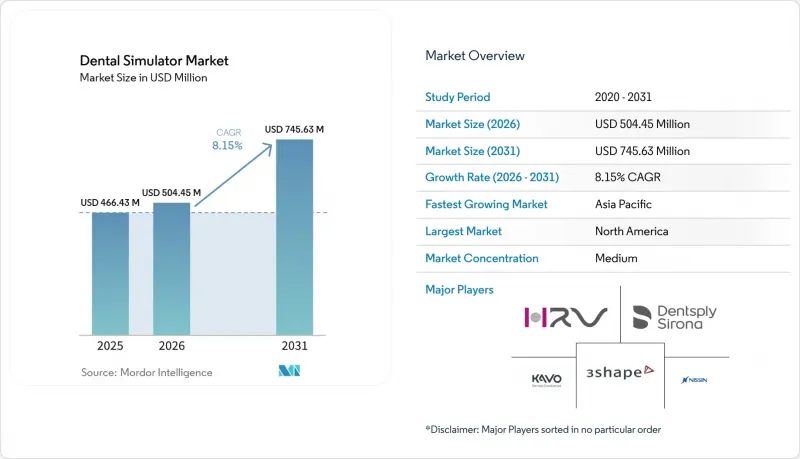
Mordor Intelligence에 의하면, 2026년 치과 시뮬레이터 시장 규모는 5억 445만 달러로 추정되고 있어 2025년 4억 6,643만 달러에서 확대해, 2031년에는 7억 4,563만 달러에 이를 것으로 예측됩니다.
2026년부터 2031년까지 연평균 성장률(CAGR) 8.15%로 성장할 것으로 전망됩니다.
본 보고서는 구성 요소(하드웨어, 소프트웨어(On-Premise, 클라우드 기반)), 기술(가상현실(VR), 증강현실(AR) 등), 용도(치과 연수 및 교육, 치료 계획 등), 최종 사용자(치과대학, 병원 등), 지역(북미, 유럽, 아시아태평양 등)별로 분류되어 있습니다. 시장 전망은 금액(달러) 기준으로 제시되어 있습니다.
세계 치과 시뮬레이터 시장 동향 및 인사이트
VR/AR 및 햅틱 피드백 기술의 혁신적 발전
교육 기관에서는 조직의 저항감을 재현하는 햅틱 장치의 도입이 확대되고 있어, 학생들은 환자에게 위험을 초래하지 않으면서 미세 운동 기술을 연마할 수 있게 되었습니다. 2024년에 156개 치과대학을 대상으로 실시된 다국적 조사에 따르면, VR 시뮬레이터를 통해 최초로 훈련을 받은 그룹은 손재주 점수가 높고 불안 수준이 낮은 것으로 보고되었습니다.(1) VR 및 AI를 지원하는 시뮬레이션 소프트웨어의 도입 확대는 실시간 기술 평가, 치료 계획 수립, 몰입형 임상 연수 경험을 향상시킴으로써 치과 교육을 혁신하고 있습니다. 몰입형 시스템은 숙달에 이르기까지 필요한 실습 시간을 단축하고, 임상 실습의 의자 시간을 확보함으로써 더 많은 학생을 수용할 수 있게 해줍니다. 그 결과, 하드웨어 정가를 상쇄하고 도입 주기를 단축시키는 설득력 있는 투자 회수 사례가 나타나고 있습니다. 각 벤더사는 이에 부응하여 포스 피드백의 정밀도를 높이고 동작 라이브러리를 확충함으로써, 보다 광범위한 교육 과정을 다룰 수 있도록 지원하고 있습니다. 비용이 낮아짐에 따라 소규모 프로그램도 조기 도입 학교에 포함되면서, 전 세계적으로 도입 기반이 확대되고 있습니다.
치과 교육 프로그램 및 학생 정원 확대
구강 보건 인력 부족 문제를 해결하기 위해 각국 정부는 특히 중국, 인도, 동남아시아에서 새로운 치과대학의 인가를 승인하거나 정원 상한선을 상향 조정하고 있습니다. 미국 상원의 2025년도 세출 법안에는 역량 기반 학습 환경과 연계된 치의대생 대상 보조금에 대한 추가 자금이 포함되어 있습니다. 학생 수 증가로 인해 실습 진료소의 부담이 더욱 커지면서, 시뮬레이션실은 더 이상 사치품이 아니라 필수 불가결한 시설이 되었습니다. 인증 기관은 현재 객관적인 성과 데이터를 요구하고 있으며, 각 교육 기관은 디지털 로그북과 분석 대시보드를 도입해야 하는 상황에 놓여 있습니다. 교원 채용을 위한 예산에는 현대적인 실습실 구축을 요구하는 요청 사항이 점점 더 많이 반영되고 있으며, 이는 하드웨어의 안정적인 공급과 그에 따른 소프트웨어 구독 수요를 뒷받침하고 있습니다.
막대한 설비 투자와 유지비
최고급 VR·햅틱 장비는 대당 15만-30만 달러가 들며, 여기에 구매 가격의 20%에 달하는 연간 유지보수 계약 비용이 추가됩니다. 2024년 조사에서 도입에 있어 두 번째로 큰 장벽으로 ‘자금상의 제약”이 꼽혔으며, 응답자의 28%가 이를 지적했습니다. 소규모 프로그램의 경우, 자금 조달이나 보조금 확보에 어려움을 겪고 있어 장비 교체가 지연되고 있습니다. 총 비용에는 공조 설비 개보수, IT 지원 데스크, 강사 재교육 등도 포함되기 때문에 표면상의 수치보다 2배의 비용이 소요됩니다. 현재 공급업체들은 리스 모델이나 사용량에 따른 요금 체계를 제공하고 있지만, 여전히 높은 초기 비용에 놀라게 되어 단기적인 수요 증가세가 주춤하고 있습니다.
부문별 분석
2025년에는 하드웨어가 매출의 63.72%를 차지하고, 이는 물리적 시뮬레이터가 여전히 시뮬레이션을 활용한 교육 과정의 관문임을 뒷받침하고 있습니다. 교육 기관은 먼저 멀티스테이션 햅틱 실험실에 보조금을 배정하고, 그 후 사용자 경험을 풍부하게 해주는 소프트웨어 라이선스를 추가하고 있습니다. 일단 도입되면 동일한 시뮬레이터로 새로운 모듈을 지원할 수 있기 때문에 점진적인 성장은 SaaS 쪽으로 쏠리는 경향이 있습니다. 2031년까지 소프트웨어의 연평균 성장률(CAGR)은 10.05%로, 하드웨어를 상회하고 있습니다. 이는 클라우드 대시보드와 AI 스코어링 엔진이 한계 비용이 낮아 더 폭넓은 사용자층을 확보할 수 있기 때문입니다. 팬데믹으로 인한 혼란 속에서 원격 접속 기능의 중요성이 부각되면서, 각 교육 기관은 보안이 강화된 VPN이나 웹 기반 뷰어에 대한 예산을 편성하기 시작했습니다. 벤더는 조치 항목을 추가하는 업데이트를 자주 제공하고 있으며, 이를 통해 초기 하드웨어 투자만으로도 추가적인 설비 투자 없이 최신 상태를 유지할 수 있게 되었습니다. 인터넷 대역폭이 제한적이거나, 데이터 개인정보 보호법에 따라 클라우드 스토리지 이용이 제한되는 경우, On-Premise형 솔루션이 여전히 채택되고 있습니다. 그러나 여러 캠퍼스를 보유한 교육 기관에서는 IT 지원을 효율화하기 위해 통합된 플랫폼을 선호하는 경향이 강해지고 있습니다. 서버, 센서, 분석 계층 간의 상호작용으로 인해 조달 팀은 개별 품목이 아닌 총비용 기반의 번들 계약을 협상하게 되었으며, 이에 따라 치과 시뮬레이터 시장의 판매 주기가 재편되고 있습니다.
또한, 2세대 시뮬레이터는 모듈식 컨트롤러가 새로운 핸드피스 및 영상 처리 주변 기기에 대응할 수 있도록 설계되어 있어, 하드웨어 교체 주기를 연장하고 있습니다. 확장을 계획 중인 학교에서는 전기 배선을 다시 설치할 필요 없이 10석에서 40석까지 확장할 수 있는 확장성 있는 랙 설계가 선호되고 있습니다. 리퍼브 제품이 유통 시장에 나오면서 저소득 국가로의 지리적 보급 범위도 확대되고 있습니다. 이러한 연쇄적인 효과로 인해, 성숙한 캠퍼스가 소프트웨어 주도의 가치 창출로 전환되는 과정에서도 기초적인 수요는 유지되고 있습니다. 그 결과, 하드웨어는 여전히 가장 큰 비용 항목이지만, 가치 창출은 꾸준히 예측 분석 분야로 이동하고 있습니다.
초기 비용이 적게 든다는 장점이 있습니다. 핸드피스의 각도 조절 및 기본적인 인체공학 지도를 효과적으로 할 수 있어, 많은 프로그램에서 초기 실습 과정으로 활용되고 있습니다. 그러나 가상현실(VR) 분야는 연평균 성장률(CAGR) 10.42%로 성장하고 있으며, 몰입감이 높은 현실적인 경험으로의 패러다임 전환을 시사하고 있습니다. 2024년 핀란드의 연구에 따르면, VR을 우선적으로 도입한 학생 그룹은 손재주를 측정하는 지표에서 동년배보다 우수한 성적을 보였으며, 스트레스 감소 효과도 보고되었습니다. VR이 연조직의 피드백과 실시간 출혈 시나리오를 시뮬레이션하는 능력은 임상 현장의 복잡성을 더욱 충실하게 재현하여, 실제 환자에게 적용하기까지의 기간을 단축합니다. 증강현실(AR) 오버레이는 물리적 티포돈트에 동적인 가이드를 추가하여, 촉각적인 친숙함과 디지털 단서를 융합합니다. 혼합현실(MR) 솔루션은 비록 틈새 분야이긴 하지만, 복잡한 수술 절차를 시뮬레이션할 때 실시간 CBCT 영상을 통합하고 있습니다. GPU 가격 하락과 광학 트래킹 지연 개선에 힘입어, VR 기기는 얼리 어답터들의 연구실을 넘어 주류인 교실 환경으로 보급되며, 치과 시뮬레이터 시장 전체에서 핵심적인 인프라로서의 입지를 확고히 하고 있습니다.
개방형 플랫폼 아키텍처 덕분에 타사 개발자들이 임플란트학이나 현미경 하 치내 치료와 같은 전문 모듈을 제공할 수 있게 되어 이용률이 향상되고 있습니다. 시선 추적 센서가 시선의 움직임을 기록함으로써, AI 튜터가 인체공학에 기반한 자세를 지도할 수 있게 됩니다. 이러한 미세한 혁신이 프리미엄 시스템을 차별화하고, 더 높은 가격대를 정당화하는 요인이 되고 있습니다. 기계식 훈련 기구도 진화를 거듭하며, 힘 센서나 디지털 채점 기능이 점점 더 많이 탑재됨에 따라 기존 카테고리 간의 경계가 모호해지고 있습니다. 그럼에도 불구하고, 교육 기관의 투자는 VR 쪽으로 쏠리고 있습니다. 왜냐하면 VR은 훈련, 평가, 피드백을 하나의 환경에 통합하여 측정 가능한 능력 향상을 가져오기 때문입니다.
지역별 분석
북미는 2025년 매출의 38.45%를 차지하고 있으며, 그 원동력은 재정이 탄탄한 미국의 치과대학들입니다. 이 대학들은 예측 가능한 보조금 주기에 맞추어 기존의 기계식 장비를 교체하고 있습니다. 소아치과와 관련된 연방 정부의 보조금은 역량 기반의 성과를 명확히 제시하고 있으며, 프로그램을 다양한 지표가 포함된 VR 플랫폼으로 유도하고 있습니다. 캐나다의 공립 대학들도 이에 발맞추고 있으며, 멕시코의 사립 학교들은 학생 모집에서 차별화 요소로 시뮬레이터를 활용하고 있습니다. 보스턴, 샌프란시스코, 토론토의 벤처 캐피털 생태계는 하드웨어 제조업체와 원활하게 협력하는 AI 기업을 지원하며, 해당 지역의 생태계 성숙을 가속화하고 있습니다.
아시아태평양은 2031년까지 10.61%라는 가장 높은 연평균 성장률(CAGR)을 보일 것으로 전망됩니다. 중국은 국가 구강 보건 목표를 달성하기 위해 매년 새로운 치과 프로그램을 추가하고 있으며, 많은 경우 마네킹을 완전히 생략하고 VR을 최우선으로 하는 실습실을 도입하고 있습니다. 인도의 사립 대학들은 시뮬레이터 이용 시간을 내세워 학생 유치 경쟁을 벌이고 있는 반면, 정부의 보조금 덕분에 수입된 시뮬레이터 장비에 부과되는 관세가 상쇄되고 있습니다. 일본과 한국은 혼합현실(MR) 용도 분야를 선도하고 있으며, 시뮬레이터와 로봇 환자 마네킹을 결합하여 종합적인 OSCE(임상 실기 시험)를 실시했습니다. 호주는 원격 학습 기능을 활용하여 외딴 지역의 캠퍼스를 지원하고 있으며, 이는 치과 시뮬레이터 시장에서 지리적 격차를 해소하는 데 소프트웨어가 수행하는 역할을 여실히 보여주고 있습니다.
유럽에서는 지속가능성을 위한 강력한 규제 추진의 혜택을 누리고 있으며, 일회용 플라스틱을 배제하는 디지털 플랫폼이 선호되고 있습니다. 독일의 엔지니어링 업계는 정밀한 햅틱 부품을 공급하고 있으며, 영국에서는 AI 모듈이 국가 치과 교육 커리큘럼 기준에 포함되어 있습니다. 북유럽 국가들은 시뮬레이터 도입을 측정 가능한 배출 감축 조치로 간주하는 탄소 회계 체계를 선도적으로 도입하고 있습니다. 남유럽의 교육 기관에서는 재정 긴축 정책으로 인해 도입 속도가 더딘 편이지만, 디지털 교육에 배정된 EU의 개발 자금이 그 격차의 일부를 메우고 있습니다.
중동 및 아프리카는 아직 개발도상국이지만, 미래가 밝을 것으로 기대되고 있습니다. 만안 지역 국가들의 대학들은 최상급 시뮬레이터를 유학생 유치의 핵심 요소로 삼고 있는 반면, 남아프리카공화국의 공교육 시스템에서는 저비용 마네킹과 VR을 결합한 하이브리드형 시뮬레이터의 시범 도입이 진행되고 있습니다. 남미에서는 VR 도입이 꾸준히 진행되고 있으며, 브라질의 대학에서는 전문 분야의 학위 과정에 VR이 통합되어 있을 뿐만 아니라, 칠레에서는 민관 파트너십을 통해 지방에서의 진료 활동 참여를 조건으로 기술 업그레이드에 대한 지원이 이루어지고 있습니다.
기타 혜택:
- 엑셀 형식 시장 예측(ME) 시트
- 3개월간의 애널리스트 지원
자주 묻는 질문
목차
제1장 서론
제2장 조사 방법
제3장 주요 요약
제4장 시장 구도
제5장 시장 규모와 성장 예측
제6장 경쟁 구도
제7장 시장 기회와 향후 전망
JHS 26.07.07According to Mordor Intelligence, dental simulator market size in 2026 is estimated at USD 504.45 million, growing from 2025 value of USD 466.43 million with 2031 projections showing USD 745.63 million, growing at 8.15% CAGR over 2026-2031.
This report is Segmented by Component (Hardware, Software [On-Premise, Cloud-Based]), Technology (Virtual Reality (VR), Augmented Reality (AR), and More), Application (Dental Training and Education, Treatment Planning, and More), End User (Dental Schools, Hospitals, and More), and Geography (North America, Europe, Asia-Pacific, and More). The Market Forecasts are Provided in Terms of Value (USD).
Global Dental Simulator Market Trends and Insights
Rising VR/AR & haptic-feedback innovations
Institutions increasingly deploy haptic devices that replicate tissue resistance, allowing students to refine fine-motor skills without patient risk. A 2024 multi-country study of 156 dental schools reported higher manual-dexterity scores and lower anxiety among cohorts trained first on VR simulators.[1] The growing adoption of VR- and AI-enabled Simulation Software is transforming dental education by improving real-time skill assessment, treatment planning, and immersive clinical training experiences. Immersive systems also compress practice hours needed to reach competency, freeing pre-clinical chair time for larger intakes. The result is a compelling payback story that offsets hardware sticker prices and drives procurement cycles. Vendors respond by upgrading force-feedback fidelity and expanding procedure libraries, supporting wider curriculum coverage. As costs fall, smaller programs join early adopters, broadening the installed base worldwide.
Expansion of dental education programs & seats
Governments tackling oral-health workforce shortages authorize new schools and raise seat caps, especially across China, India, and Southeast Asia. The U.S. Senate's 2025 appropriations bill further funds pre-doctoral grants tied to competency-based learning environments. More seats intensify pressure on physical clinics, making simulation suites a necessity rather than a luxury. Accreditation boards now expect objective performance data, pushing institutions to integrate digital logbooks and analytics dashboards. Capital earmarks for faculty recruitment increasingly bundle requests for modern training labs, reinforcing steady hardware pipelines and subsequent software subscriptions.
High capital & maintenance outlay
Top-tier VR-haptic rigs cost USD 150,000-300,000 each, plus annual service contracts reaching 20% of purchase price. A 2024 survey ranked financial limitation as the second-largest barrier to adoption, cited by 28% of respondents. Smaller programs struggle to secure loans or grants, delaying fleet upgrades. Total cost also includes HVAC retrofits, IT support desks, and instructor retraining, doubling headline figures. Vendors now offer lease models and usage-based pricing, but up-front sticker shock still slows near-term demand.
Other drivers and restraints analyzed in the detailed report include:
- Demand for minimally-invasive, simulation-based skill assessment
- AI-driven performance analytics integration
- Sparse reimbursement / institutional funding pathways
For complete list of drivers and restraints, kindly check the Table Of Contents.
Segment Analysis
Hardware captured 63.72% revenue in 2025, underscoring that physical rigs remain the entry ticket to simulation-enabled curricula. Institutions allocate grant funds first to multi-station haptic labs, then layer software licences that enrich user experience. Once installed, the same rig can support new modules, so incremental growth skews toward SaaS. Software's 10.05% CAGR through 2031 outpaces hardware because cloud dashboards and AI scoring engines carry lower marginal cost and tap wider cohorts. Remote-access capability gained relevance during pandemic disruptions, prompting schools to budget for secure VPNs and web-based viewers. Vendors ship frequent updates that add procedures, ensuring that earlier hardware investments stay current without repeat capital outlays. On-premises solutions persist where internet bandwidth is limited or data privacy laws restrict cloud storage. Yet multi-campus institutions increasingly favour centralised platforms to streamline IT support. The interplay between servers, sensors, and analytic layers means procurement teams now negotiate total-cost bundles rather than piecemeal items, reshaping the sales cycle of the dental simulator market.
Second-generation rigs also prolong the hardware replacement cycle, as modular controllers accept new handpieces and imaging peripherals. Schools planning expansions prefer scalable rack designs that grow from 10 to 40 seats without rewiring electrical grids. Refurbished units hit secondary markets, widening geographic reach into lower-income countries. The cascading effect sustains baseline demand even as mature campuses transition to software-led value creation. Consequently, hardware remains the largest line item, yet value capture steadily migrates toward the predictive-analytics layer.
lower initial costs. They excel at teaching hand-piece angulation and basic ergonomics, so many programs use them as first-step practice. However, the virtual reality segment expands at 10.42% CAGR, signalling a paradigm shift toward immersive fidelity. A 2024 Finnish study showed VR-first cohorts outperforming peers on manual-dexterity metrics and reporting reduced stress. VR's ability to simulate soft-tissue feedback and real-time bleeding scenarios better mirrors clinical complexity, shortening transition time to live patients. Augmented-reality overlays add dynamic guides to physical typodonts, blending tactile familiarity with digital cues. Mixed-reality suites, though niche, integrate live CBCT images into procedural rehearsal for complex surgeries. As GPU prices drop and optic-tracking latency improves, VR units move beyond early adopter labs into mainstream classroom layouts, solidifying their role as core infrastructure across the dental simulator market.
Open-platform architectures enable third-party developers to push specialty modules such as implantology or microscopic endodontics, increasing utilisation rates. Eye-tracking sensors log gaze patterns, allowing AI tutors to coach ergonomic positioning. These micro-innovations differentiate premium systems and justify higher pricing tiers. Mechanical rigs evolve too, increasingly embedding force sensors and digital scoring, blurring categorical lines. Still, institutional spending tilts toward VR because it packages training, assessment, and feedback in one environment, yielding measurable competency gains.
Complete Report Scope:
- By Component
- Hardware
- Software
- On-premise
- Cloud-based
- By Technology
- Virtual Reality (VR)
- Augmented Reality (AR)
- Mechanical Simulators
- Others
- By Application
- Dental Training and Education
- Treatment Planning
- Patient Communication and Motivation
- By End User
- Dental Schools
- Hospitals
- Dental Clinics
- Academic & Research Institutes
- Geography
- North America
- United States
- Canada
- Mexico
- Europe
- Germany
- United Kingdom
- France
- Italy
- Spain
- Rest of Europe
- Asia-Pacific
- China
- Japan
- India
- Australia
- South Korea
- Rest of Asia-Pacific
- Middle East and Africa
- GCC
- South Africa
- Rest of Middle East and Africa
- South America
- Brazil
- Argentina
- Rest of South America
- North America
Geography Analysis
North America commands 38.45% of 2025 revenue, anchored by well-funded U.S. dental schools that replace legacy mechanical units on predictable grant cycles. Federal grants tied to pediatric dentistry specify competency-based outcomes, nudging programs toward metrics-rich VR platforms. Canada's public universities follow suit, and Mexican private schools view simulators as differentiators in student recruitment. Venture capital ecosystems in Boston, San Francisco, and Toronto back AI firms that plug seamlessly into hardware makers, accelerating regional ecosystem maturity.
Asia-Pacific posts the fastest 10.61% CAGR through 2031. China adds new dental programs each year to meet national oral-health targets, often skipping manikins entirely in favour of VR-first labs. India's private colleges compete for student fees by advertising simulator seat-hours, while government subsidies offset customs duties on imported rigs. Japan and South Korea lead in mixed-reality applications, pairing simulators with robotic patient mannequins for comprehensive OSCE exams. Australia leverages distance-learning features to service remote campuses, highlighting software's role in bridging geographic gaps across the dental simulator market.
Europe benefits from a robust regulatory push toward sustainability, favouring digital platforms that eliminate single-use plastics. Germany's engineering sector supplies precision haptic components, while the UK integrates AI modules into national dental curriculum standards. Nordic countries pioneer carbon-accounting frameworks that treat simulator adoption as a measurable emissions-reduction action. Southern European schools upgrade more slowly due to fiscal austerity, yet EU development funds earmarked for digital education close part of the gap.
The Middle East and Africa remain nascent but promising. Gulf universities position top-tier simulators as magnets for international students, whereas South Africa's public system pilots low-cost manikin-VR hybrids. South America shows steady adoption; Brazilian universities incorporate VR in specialty diplomas, while Chile's public-private partnerships subsidize technology upgrades in exchange for rural service commitments.
- Dentsply Sirona
- NISSIN DENTAL PRODUCTS
- KaVo Dental (Envista)
- 3 Shape
- HRV Simulation
- VOXEL-MAN
- Tangshan UMG Medical Instrument Co. Ltd
- PreVu Software LLC
- frasaco GmbH
- J. Morita Corp.
- Simodont by MOOG
- Virtamed AG
- Kilgore International
- Promethean Dental Systems
- ClaroNav Inc.
- Dental EZ Group
- Laerdal Medical - Dental Sim
- Surgical Science Sweden
- Pacific Dental Services (education labs)
Additional Benefits:
- The market estimate (ME) sheet in Excel format
- 3 months of analyst support
TABLE OF CONTENTS
1 Introduction
- 1.1 Study Assumptions & Market Definition
- 1.2 Scope of the Study
2 Research Methodology
3 Executive Summary
4 Market Landscape
- 4.1 Market Drivers
- 4.1.1 Rising VR/AR & haptic-feedback innovations
- 4.1.2 Expansion of dental education programs & seats
- 4.1.3 Demand for minimally-invasive, simulation-based skill assessment
- 4.1.4 AI-driven performance analytics integration (under-radar)
- 4.1.5 Synergy with low-cost 3-D-printed anatomical models (under-radar)
- 4.1.6 Sustainability push to curb plastic typodont waste (under-radar)
- 4.2 Market Restraints
- 4.2.1 High capital & maintenance outlay
- 4.2.2 Sparse reimbursement / institutional funding pathways
- 4.2.3 Validation & accreditation hurdles for new simulators
- 4.2.4 Faculty digital-pedagogy skill gap (under-radar)
- 4.3 Value / Supply-Chain Analysis
- 4.4 Regulatory Landscape
- 4.5 Technological Outlook
- 4.6 Porter's Five Forces Analysis
- 4.6.1 Threat of New Entrants
- 4.6.2 Bargaining Power of Buyers/Consumers
- 4.6.3 Bargaining Power of Suppliers
- 4.6.4 Threat of Substitute Products
- 4.6.5 Intensity of Competitive Rivalry
5 Market Size & Growth Forecasts (Value)
- 5.1 By Component
- 5.1.1 Hardware
- 5.1.2 Software
- 5.1.2.1 On-premise
- 5.1.2.2 Cloud-based
- 5.2 By Technology
- 5.2.1 Virtual Reality (VR)
- 5.2.2 Augmented Reality (AR)
- 5.2.3 Mechanical Simulators
- 5.2.4 Others
- 5.3 By Application
- 5.3.1 Dental Training and Education
- 5.3.2 Treatment Planning
- 5.3.3 Patient Communication and Motivation
- 5.4 By End User
- 5.4.1 Dental Schools
- 5.4.2 Hospitals
- 5.4.3 Dental Clinics
- 5.4.4 Academic & Research Institutes
- 5.5 Geography
- 5.5.1 North America
- 5.5.1.1 United States
- 5.5.1.2 Canada
- 5.5.1.3 Mexico
- 5.5.2 Europe
- 5.5.2.1 Germany
- 5.5.2.2 United Kingdom
- 5.5.2.3 France
- 5.5.2.4 Italy
- 5.5.2.5 Spain
- 5.5.2.6 Rest of Europe
- 5.5.3 Asia-Pacific
- 5.5.3.1 China
- 5.5.3.2 Japan
- 5.5.3.3 India
- 5.5.3.4 Australia
- 5.5.3.5 South Korea
- 5.5.3.6 Rest of Asia-Pacific
- 5.5.4 Middle East and Africa
- 5.5.4.1 GCC
- 5.5.4.2 South Africa
- 5.5.4.3 Rest of Middle East and Africa
- 5.5.5 South America
- 5.5.5.1 Brazil
- 5.5.5.2 Argentina
- 5.5.5.3 Rest of South America
- 5.5.1 North America
6 Competitive Landscape
- 6.1 Market Share Analysis
- 6.2 Company Profiles (includes Global level Overview, Market level overview, Core Segments, Financials as available, Strategic Information, Market Rank/Share for key companies, Products & Services, and Recent Developments)
- 6.2.1 Dentsply Sirona Inc.
- 6.2.2 Nissin Dental Products Inc.
- 6.2.3 KaVo Dental (Envista)
- 6.2.4 3Shape A/S
- 6.2.5 HRV Simulation
- 6.2.6 VOXEL-MAN
- 6.2.7 Tangshan UMG Medical Instrument Co. Ltd
- 6.2.8 PreVu Software LLC
- 6.2.9 frasaco GmbH
- 6.2.10 J. Morita Corp.
- 6.2.11 Simodont by MOOG
- 6.2.12 Virtamed AG
- 6.2.13 Kilgore International
- 6.2.14 Promethean Dental Systems
- 6.2.15 ClaroNav Inc.
- 6.2.16 Dental EZ Group
- 6.2.17 Laerdal Medical - Dental Sim
- 6.2.18 Surgical Science Sweden AB
- 6.2.19 Pacific Dental Services (education labs)
7 Market Opportunities & Future Outlook
- 7.1 White-space & Unmet-Need Assessment