

|
시장보고서
상품코드
2073651
배터리 제조용 혼합 장비 시장 : 점유율 분석, 업계 동향과 통계, 성장 예측(2026-2031년)Mixing Equipment For Battery Manufacturing - Market Share Analysis, Industry Trends & Statistics, Growth Forecasts (2026 - 2031) |
||||||
 Mordor Intelligence
Mordor Intelligence에 의하면, 배터리 제조용 혼합 장비 시장 규모는 2025년 22억 8,000만 달러에서 2026년에는 27억 6,000만 달러로 확대되어 2026년부터 2031년까지 CAGR 21.1%로 성장을 지속하여, 2031년에는 71억 9,000만 달러에 이를 것으로 예측됩니다.
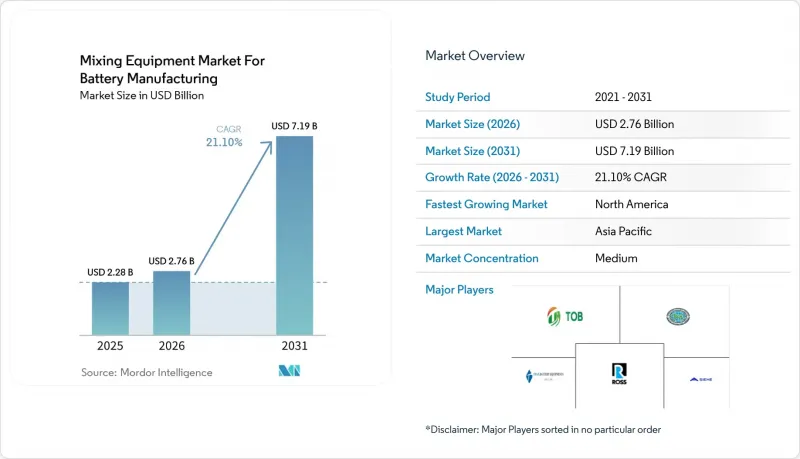
본 보고서는 믹서 유형(행성식 믹서 등), 정격 용량(200L 미만 등), 배터리 화학 조성(LFP 등), 최종 용도(전기 승용차 등) 및 지역(북미, 유럽, 아시아태평양, 중동 및 아프리카, 남미)별로 분류되어 있습니다. 시장 전망은 금액(달러) 기준으로 제시되어 있습니다.
배터리 제조용 혼합 장비 시장 인사이트 및 동향
IRA(인플레이션 감축법)의 지원을 받은 기가팩토리 건설이 설비 조달 체계를 재편하고 있습니다.
배터리 제조용 혼합 장비 시장은 인플레이션 억제법(IRA)에 따른 미국의 배터리 공장 건설 계획의 혜택을 받고 있습니다. 지금까지 23개의 배터리 공장이 발표되었으며, 계획 투자액은 520억 달러, 연간 생산 능력은 490GWh에 달할 전망입니다. 이러한 프로젝트들은 집중적인 장비 구매 주기를 초래하고 있습니다. 왜냐하면 모든 새로운 셀 공장에서 코팅 공정 전에 슬러리 제조 설비가 필요하며, 이를 통해 후공정 라인 인증을 진행할 수 있기 때문입니다. 가장 큰 수요는 대용량 행성식 및 인라인식 시스템에 집중되어 있으며, 특히 생산 규모 확대에 대응하기 위해 1,000-5,000리터 규모의 유닛이나 5,000리터를 초과하는 플랫폼이 필요한 사업자에서 두드러집니다. 이러한 움직임은 미국의 배터리 정책과 미국 내 기계 설비 수주 현황 사이에 격차가 있음을 여실히 드러내고 있습니다. 찰스 로스 앤 선(Charles Ross & Son)사에 따르면, 미국에 위치한 배터리 프로젝트에서 국내 공급업체들은 아시아의 턴키 경쟁사들에게 신규 수주의 일부를 빼앗기고 있다고 합니다. 이 문제는 배터리 제조용 혼합 장비 시장에서 중요한 의미를 지닙니다. 왜냐하면 수주량은 급격히 증가할 가능성이 있는 반면, 국내 설비를 통한 수익 증가는 더 완만해질 우려가 있기 때문입니다. 엔비전 AESC의 사우스캐롤라이나주 프로젝트는 그 규모가 얼마나 큰지를 여실히 보여주고 있습니다. BMW와 제휴한 단일 공장만 해도 30억 달러, 연간 30GWh의 생산 능력이 계획되어 있으며, 이것만으로도 업스트림 공정의 믹서에 대한 상당한 수요를 창출하기에 충분한 규모이기 때문입니다.
고니켈 양극재용 슬러리의 균일성이 고성능 설비에 대한 수요를 창출하고 있습니다.
또한, 니켈 함량이 높은 양극재의 경우 안정적인 고품질 슬러리를 제조하기 어렵다는 점도 배터리 제조용 혼합 장비 시장의 확장을 뒷받침하고 있습니다. 수계 NMC811 전극에 대한 조사에 따르면, 리튬의 용출로 인해 슬러리의 pH가 12 부근까지 상승할 가능성이 있는 것으로 나타났습니다. 이로 인해 알루미늄 집전극의 부식 위험이 높아지므로, 신속한 공정 제어가 더욱 중요해집니다. 이러한 운전 조건에서는 표준 혼합 구성보다 비활성 취급, 보다 엄격한 온도 제어 및 신뢰성이 높은 진공 탈기 기능을 갖춘 장치가 적합합니다. Pengyi사의 배터리 슬러리 공정 지침서에서는 최신 듀얼 플래네터리 시스템이 건식 및 습식 충전, 고점도 처리, 진공 탈기를 하나의 공정 순서로 통합하고 있다는 점도 강조되고 있으며, 이것이 구매자가 검증된 시스템에 높은 가격을 지불하는 이유 중 하나가 되고 있습니다. 2026년에 보고된 프라운호퍼 IPA의 연구에 따르면, LFP 양극 슬러리에 고압 습식 제트 밀링을 적용함으로써 평균 입자 직경이 39% 감소하고, 공정 에너지가 42% 절감되며, 1C 용량이 12.8% 향상된 것으로 밝혀졌으며, 이는 성숙한 화학 조성에서도 더 우수한 슬러리 제조 장치의 도입이 효과적임을 입증하고 있습니다. 유럽에서 수처리 및 용제 관련 규정 준수가 점점 더 중요해짐에 따라, 2026년 이후에도 배터리 제조용 혼합 장비 시장에서는 프리미엄 시스템이 계속해서 선호될 전망입니다.
막대한 설비 투자와 리드타임이 중견 셀 제조업체의 발목을 잡고 있습니다.
배터리 제조용 혼합 장비 시장은 여전히 뚜렷한 보급 한계에 직면해 있습니다. 이는 맞춤형 고점도 시스템이 고가일 뿐만 아니라, 소규모 배터리 프로젝트의 경우 납기 기간이 너무 긴 경우가 많기 때문입니다. Pengyi사의 공정 노트에 따르면, 비용이 상승하는 이유는 첨단 배터리 슬러리 믹서가 광범위한 점도 범위에 대응하고, 진공 탈기, 정밀한 충전 순서, 그리고 내부 청결한 마감을 하나의 설계로 실현해야 하기 때문입니다. NETZSCH사 역시 기가팩토리급 설비를 공정 성능을 중시하는 관점에서 포지셔닝하고 있으며, 이는 최상위급 시스템이 단순한 표준 용기가 아니라 엔지니어링 자산이라는 견해를 뒷받침합니다. 신규 진출기업이 니켈 함량이 높은 제품이나 전고체 전지용 특수 시스템을 필요로 하는 경우, 이러한 추가적인 설계 요건으로 인해 조달 일정이 길어지고, 더 단순한 대체품과의 비용 격차가 확대됩니다. 그 결과, 배터리 제조용 혼합 장비 시장에서는 대형 제조업체가 중소규모 사업자보다 더 쉽게 최고 성능의 시스템을 확보할 수 있는 상황이 조성되고 있습니다. 이러한 추세로 인해, 공정상의 차별화를 통해 고성능 기계가 유리한 경우에도 많은 중견 구매자들은 저비용 수입 장비에 의존할 수밖에 없는 상황에 처해 있습니다.
부문별 분석
2025년, 플래네터리 믹서는 배터리 제조용 혼합 장비 시장 점유율의 34.8%를 차지했으며, 양극 및 음극 슬러리 제조에 있어 여전히 가장 많이 선택되는 장비인 만큼, 믹서 유형별 순위에서 1위를 유지했습니다. 그 지위는 단순히 기존의 관습에 기인한 것이 아니라, 프로세스의 유연성에서 비롯된 것입니다. 최신 듀얼 플래네터리 설계는 극도로 높은 점도에 대응할 수 있고, 진공 탈기 기능을 갖추고 있으며, 동일한 용기 내에서 단계적인 드라이-투-? 충진이 가능하기 때문입니다. 이 능력은 배터리 제조용 혼합 장비 시장에서 중요한 의미를 지닙니다. 왜냐하면 제조업체는 배합, 고형분 함량, 생산 규모를 변경할 때 공정상의 타협을 최소화할 수 있기 때문입니다. 또한 NETZSCH사는 자사의 PMH 플랫폼이 기가팩토리 규모에서 혼합 시간을 단축하고 장비 대수를 줄일 수 있다고 보고하고 있습니다. 이는 일관성과 플랜트 효율성이 모두 중요시되는 대형 플라네터리 시스템에 대한 지속적인 수요를 뒷받침하는 것입니다. 이 부문은 LFP 및 NMC 생산과도 계속해서 밀접한 관련이 있으며, 구매자들은 여전히 코팅 전 점도 제어 및 탈기 처리에 있어 검증된 기법을 중요하게 여기고 있습니다.
가장 빠르게 성장하고 있는 하위 부문은 고체 상태의 저전단 행성식 혼합으로, 더 많은 고체 배터리 프로젝트가 실험실 단계에서 설비 발주 단계로 전환됨에 따라 2031년까지 연평균 성장률(CAGR) 24.6%로 확대될 것으로 전망됩니다. 이러한 성장률은 황화물 및 건식 공정 시스템이 많은 습식 슬러리 라인보다 더 신중한 취급, 우수한 밀폐성, 그리고 더 엄격한 환경 제어를 필요로 하기 때문에 서로 다른 일련의 공정 요건을 반영하고 있습니다. SIEHE Group이 2026년에 킬로톤 규모의 고체 상태 황화물 생산 라인 공급 시장에 진출한 것은 유서 깊은 장비 제조업체들조차 이 틈새 시장을 단순한 실험적 확장이 아닌 진정한 상업적 기회로 인식하기 시작했음을 보여줍니다. 또한, 배터리 제조용 혼합 장비 업계에서는 플랜트의 설치 면적이나 연속 처리가 중요한 상황에서 인라인 분산 플랫폼에 대한 수요가 증가하고 있으며, Ystral사의 Batt-TDS 시스템은 검증된 시험을 통해 장기적인 사이클 성능이 향상되었습니다는 점에서 주목을 받고 있습니다. 듀얼 샤프트 분산기나 연속 인라인 믹서는 여전히 이용 사례가 제한적이지만, 설치 면적 축소, 처리 속도 향상, 혹은 중간 점도 배합에 대한 적응을 추구하는 제조업체들에게 그 중요성이 커지고 있습니다. 따라서 배터리 제조용 혼합 장비 시장은 행성식 시스템을 핵심으로 삼으면서, 더욱 전문화된 믹서 형태로 그 영역을 넓혀가고 있습니다.
2025년에는 1,000-5,000 L 용량대가 매출의 41.2%를 차지했습니다. 이는 파일럿 규모의 작업과 최대 규모의 기가팩토리 건설 중간 단계에 해당하는 공장의 가동 기반을 반영한 것입니다. 이 용량 대역은 모든 공장에 지나치게 대형 설비를 요구하지 않으면서도 실용적인 규모로 코팅 공정에 원료를 공급할 수 있기 때문에 현재의 상용 배터리 생산에 가장 적합합니다. 또한 생산자 입장에서는 처리 능력, 용기 이용률, 유지보수의 용이성, 그리고 설비 투자 비용 사이에서 실용적인 균형을 이룰 수 있습니다. 배터리 제조용 혼합 장비 시장에서 이 중규모 부문은 재현성 있는 생산량을 필요로 하면서도 화학 조성 및 라인 구성에 있어 유연성을 추구하는 시설에게 가장 일반적인 선택지가 되고 있습니다. 따라서 이 부문은 가동을 시작한 많은 셀 제조 공장에서 여전히 핵심적인 도입 기반으로 자리 잡고 있습니다.
5,000리터 초과 부문은 배터리 제조용 혼합 장비 시장에서 가장 빠르게 성장하고 있는 분야로, 대규모 배터리 공장이 업스트림 공정의 처리 능력 병목 현상 해소를 모색함에 따라 2031년까지 연평균 성장률(CAGR)이 25.3%를 나타낼 것으로 전망됩니다. 이러한 시스템 도입의 이점이 가장 두드러지는 경우는 생산 라인의 경제성이 대량 생산, 노동 집약도 감소, 그리고 동일 공장 내 병렬 믹서 유닛의 감축에 달려 있는 경우입니다. 로디게사는 배터리 생산 목표의 상향에 따라 더 대형 믹서 구성에 대한 수요가 증가하고 있음을 이미 지적한 바 있으며, 이는 상업적 조달 측면에서 더 큰 유효 용기로의 전환을 뒷받침하는 것입니다. 한편, 200리터 미만의 시스템은 대규모 설비 투자를 진행하기 전의 화학 조성 개발, 공정 검증 및 소량 생산에 대한 적합성 평가에서 여전히 중요한 역할을 하고 있습니다. 유럽의 BATMACHINE 프로젝트 및 연구 분야의 노력은 새로운 배합을 실제 생산 조건에서 시험해야 할 경우 소형 시스템이 여전히 전략적 가치를 지닌다는 점을 보여주고 있습니다. 200-1,000 L 범위는 특히 기가팩토리 규모로 아직 가동을 시작하지 않은 지역의 배터리 제조업체들에게 있어 실험실과 초기 생산을 연결하는 가교 역할을 하고 있습니다. 따라서 배터리 제조용 혼합 장비 업계는 광범위한 용량 범위를 아우르고 있지만, 수요가 가장 빠르게 증가하고 있는 분야는 연간 생산 능력이 매우 크고, 더 엄격한 자본 효율성이 요구되는 공장이 설계되는 분야입니다.
지역별 분석
2025년, 아시아태평양은 배터리 제조용 혼합 장비 시장 점유율의 63.4%를 차지했으며, 셀 생산 규모, 공급업체의 충실도, 그리고 신속한 상용화 실행력을 모두 갖추고 있어, 이 지역은 계속해서 세계 수요의 중심지로서의 입지를 공고히 했습니다. 중국은 확립된 배터리 생산 기반과 상업용 플랜트 전반에 도입된 슬러리 제조 시스템의 탄탄한 구성을 바탕으로 그 중심적인 위상을 유지하고 있습니다. 더 넓은 아시아태평양의 배터리 제조용 혼합 장비 시장은 베트남, 인도네시아, 태국에서의 신규 생산 능력 확충에 힘입어 성장하고 있습니다. 이들 국가에서는 배터리 및 소재 관련 프로젝트가 투자 계획 단계에서 공장 건설 단계로 넘어가고 있습니다. 인도네시아 바탕 특별경제구역(SEZ)의 LFP 생산 및 연구 역량에 대한 투자는 동남아시아가 단순히 정책적 관심을 끌고 있을 뿐만 아니라, 배터리 공정 장비에 대한 실질적인 수요를 창출하고 있음을 보여주는 한 예입니다. 일본과 한국은 첨단 배터리 프로그램을 위한 프리미엄 전용 시스템 분야에서 공급업체들이 보다 적극적으로 활동하고 있기 때문에 각기 다른 강점을 가지고 있습니다.
북미는 배터리 제조용 혼합 장비 시장에서 가장 빠르게 성장하고 있는 지역 블록으로, 2031년까지 연평균 성장률(CAGR)이 26.4%를 나타낼 것으로 전망됩니다. 이러한 기세는 IRA(인플레이션 억제법) 시행 이후의 배터리 공장 건설 계획과 밀접한 관련이 있으며, 프로젝트가 계획대로 건설 단계까지 진행된다면 향후 수년에 걸쳐 설비 수주를 뒷받침하기에 충분한 규모를 갖추고 있습니다. 찰스 로스 앤드 손(Charles Ross & Son)사는 이 지역에 믹서 및 관련 제어 장치의 국내 생산 거점을 제공하고 있지만, 아시아의 경쟁사들에게 수주를 빼앗기고 있다는 이 회사의 지적을 통해, 북미의 성장이 반드시 북미의 설비 공급업체에만 국한되는 것은 아니라는 점을 알 수 있습니다. 캐나다는 광물 자원 및 가공 분야에 대한 투자를 통해 간접적으로 혜택을 보고 있는 반면, 멕시코는 전기차 조립 및 지역 무역 규칙과 연계된 니어쇼어링 기회에 여전히 의존하고 있습니다.
유럽은 규제, 자금 조달, 공정 기준이 공장 수와 마찬가지로 구매자의 의사 결정에 영향을 미치고 있기 때문에 배터리 제조용 혼합 장비 시장에서 여전히 전략적으로 중요한 지역입니다. 독일, 이탈리아, 프랑스 및 북유럽 국가들에서는 프라운호퍼 관련 연구와 LFP 생산을 위한 이탈리아의 연속 혼합 설비 등, 이 지역에서 가장 활발하게 진행되고 있는 배터리 제조 및 연구 프로그램 중 일부가 전개되고 있습니다. 또한, 유럽집행위원회가 2025년에 선정한 전략적 원자재 프로젝트 역시 배터리 제조에 대한 투자 결정을 뒷받침하는 광범위한 미드스트림 인프라 구축을 촉진하고 있습니다. 이러한 정책적 배경으로 인해, 단순히 초기 비용이 낮다는 점뿐만 아니라 클린룸 대응 능력, 공정 품질, 현지 지원 체계를 입증할 수 있는 공급업체가 유리해집니다. 남미, 중동 및 아프리카는 현재로서는 여전히 규모가 훨씬 작지만, 시범 프로젝트나 초기 단계의 프로젝트를 통해 볼 때, 향후 수요는 연구 개발 및 소규모 상업 생산 라인에서 시작되어 이후 본격적인 플랜트 조달로 전환될 것임을 시사하고 있습니다.
기타 혜택:
- 엑셀 형식 시장 예측(ME) 시트
- 3개월간의 애널리스트 지원
자주 묻는 질문
목차
제1장 서론
제2장 조사 방법
제3장 주요 요약
제4장 시장 구도
제5장 시장 규모와 성장 예측
제6장 경쟁 구도
제7장 시장 기회와 향후 전망
JHS 26.07.09According to Mordor Intelligence, the battery mixing equipment market size is expected to grow from USD 2.28 billion in 2025 to USD 2.76 billion in 2026 and is forecast to reach USD 7.19 billion by 2031 at 21.1% CAGR over 2026-2031.
This report is Segmented by Mixer Type (Planetary Mixers, and More), Capacity Rating (Less Than 200L, and More), Battery Chemistry (LFP, and More), End-Use Application (Electric Passenger Vehicles, and More), and Geography (North America, Europe, Asia-Pacific, Middle East and Africa, South America). The Market Forecasts are Provided in Terms of Value (USD).
Insights and Trends of Mixing Equipment Market For Battery Manufacturing
IRA-Driven Giga-Factory Build-Outs Reshape Equipment Procurement
The battery mixing equipment market is benefiting from the U.S. battery plant pipeline that followed the Inflation Reduction Act, with 23 announced cell factories tied to USD 52 billion in planned investment and 490 GWh of annual capacity. Those projects create concentrated equipment buying cycles because every new cell plant requires slurry preparation assets before coating, and downstream line qualification can move ahead. The largest pull is landing in high-capacity planetary and inline systems, especially where operators need 1,000-5,000 L units or more than 5,000 L platforms to support scaled output. This wave is also exposing a gap between U.S. battery policy and U.S. machinery capture, since Charles Ross & Son said domestic suppliers have lost some new orders to Asian turnkey competitors in U.S.-sited battery projects. That issue matters in the battery mixing equipment market because order flow may rise quickly while domestic equipment value capture grows more slowly. Envision AESC's South Carolina project shows the scale involved, because a single plant tied to BMW was planned at USD 3 billion and 30 GWh per year, which is large enough to create a meaningful upstream mixer requirement on its own.
Slurry Uniformity For High-Ni Cathodes Creates Premium Equipment Demand
The battery mixing equipment market is also being pushed higher by the difficulty of preparing stable, high-quality slurry for nickel-rich cathodes. Research on water-based NMC811 electrodes showed that lithium leaching can drive slurry pH toward 12, which raises corrosion risk at the aluminum current collector and makes fast process control more important. That operating window favors equipment with inert handling, tighter thermal control, and reliable vacuum deaeration rather than standard mixing configurations. Pengyi's battery slurry process guidance also highlights how modern dual planetary systems combine dry and wet charging, high-viscosity handling, and vacuum deaeration in one process sequence, which helps explain why buyers pay more for validated systems. Fraunhofer IPA work reported in 2026 found that high-pressure wet jet milling of LFP cathode slurry reduced average particle size by 39%, cut process energy by 42%, and improved 1C capacity by 12.8%, which supports the case for better slurry preparation hardware even in mature chemistries. The battery mixing equipment market is likely to keep favoring premium systems from 2026 onward as aqueous processing and solvent-related compliance become more important in Europe.
High Capex And Lead-Times Constrain Mid-Tier Cell Producers
The battery mixing equipment market still faces a clear adoption limit because custom high-viscosity systems are expensive and often take too long to arrive for smaller battery projects. Pengyi's process notes show why costs rise, since advanced battery slurry mixers must handle wide viscosity ranges, vacuum deaeration, precise charging sequences, and clean internal finishes in one design. NETZSCH also positions its gigafactory-grade equipment around process performance, which supports the view that top-tier systems are engineered assets rather than standard vessels. When new entrants need specialized systems for nickel-rich or solid-state work, those extra design requirements lengthen procurement schedules and widen the cost gap with simpler alternatives. The result is a battery mixing equipment market where tier-1 producers can secure the most capable systems more easily than smaller operators. That pattern leaves many mid-tier buyers dependent on lower-cost imported equipment, even when process differentiation would favor a better machine.
Other drivers and restraints analyzed in the detailed report include:
- Mainstream EV Penetration Accelerates Inline And Large-Format Mixer Adoption
- Solid-State Battery Industrialization Creates A Specialized Mixer Sub-Market
- Export Licensing Complexity Disrupts Global Equipment Sourcing
For complete list of drivers and restraints, kindly check the Table Of Contents.
Segment Analysis
Planetary mixers held 34.8% of the battery mixing equipment market share in 2025, which kept them in the lead across mixer types because they remain the default option for both anode and cathode slurry preparation. Their position comes from process flexibility rather than simple legacy use, since modern dual planetary designs can manage very high viscosities, support vacuum deaeration, and allow staged dry-to-wet charging in the same vessel. That ability matters in the battery mixing equipment market because manufacturers need fewer process compromises when switching between formulations, solids loading levels, and production scales. NETZSCH also reported that its PMH platform can shorten mixing time and reduce unit counts at gigafactory scale, which supports continued demand for large planetary systems where consistency and plant efficiency matter together. The category also remains well aligned with LFP and NMC production, where buyers still value a proven route to viscosity control and air removal before coating.
The fastest-growing sub-segment is solid-state low-shear planetary mixing, which is projected to advance at 24.6% CAGR through 2031 as more solid-state programs move from laboratory work into equipment ordering. That growth rate reflects a different set of process needs, because sulfide and dry-process systems require gentler handling, better sealing, and tighter environmental control than many wet-slurry lines. SIEHE Group's 2026 move into kiloton-scale solid-state sulfide production line supply shows that even established equipment makers now view this niche as a real commercial opportunity rather than an experimental extension. The battery mixing equipment industry is also seeing more room for inline dispersion platforms where plant footprint and continuous processing matter, and Ystral's Batt-TDS system has gained attention for improved long-term cycling performance in validated tests. Dual-shaft dispersers and continuous inline mixers still serve narrower use cases, but they are becoming more relevant where producers want a smaller footprint, faster flow, or a better fit for medium-viscosity formulations. The battery mixing equipment market is, therefore, keeping planetary systems at the center while still widening into more specialized mixer formats.
The 1,000-5,000 L range accounted for 41.2% of revenue in 2025, which reflects the operating base of plants that sit between pilot-scale work and the largest gigafactory builds. This capacity band fits well with current commercial battery production because it can feed coating operations at a meaningful scale without forcing every plant into the most extreme equipment size. It also gives producers a practical balance between throughput, vessel utilization, maintenance access, and capital cost. In the battery mixing equipment market, this middle band has become the most common answer for facilities that need repeatable output but still want flexibility across chemistries and line configurations. That is why this segment remains the core installed base for many commissioned cell plants.
The more than 5,000 L segment is the fastest-growing part of the battery mixing equipment market size, with 25.3% CAGR projected through 2031 as larger battery plants try to remove upstream throughput bottlenecks. The case for these systems is strongest where line economics depend on high volume output, lower labor intensity, and fewer parallel mixer units across the same plant. Lodige has already pointed to the demand for larger mixer configurations as battery production targets rise, which supports the move toward higher usable vessel volume in commercial procurement. At the other end, sub-200 L systems remain important for chemistry development, process validation, and small-batch qualification before larger capital commitments are made. The BATMACHINE project and research line work in Europe show how smaller systems still carry strategic value when new formulations must be tested under realistic production conditions. The 200-1,000 L range fills the bridge role between laboratory and early production, especially for regional cell makers that are not yet operating at gigafactory scale. The battery mixing equipment industry, therefore, spans a wide capacity curve, but demand is rising fastest where plants are designed for very large annual output and tighter capital efficiency.
Complete Report Scope:
- By Mixer Type
- Planetary Mixers
- Dual-shaft Dispersers
- High-speed Stirring Wet Mixers
- Dry Powder Ribbon Blenders
- Continuous Inline Mixers
- By Capacity Rating
- Less Than 200 L
- 200 - 1 000 L
- 1 000 - 5 000 L
- Greater Than 5 000 L
- By Battery Chemistry Served
- LFP
- NMC-811 & Higher Ni
- Solid-State / Sulfide
- Others (LTO, Na-ion)
- By End-use Application
- Electric Passenger Vehicles
- Commercial EV & Off-highway
- Consumer Electronics
- Stationary Energy Storage
- R&D / Pilot Lines
- By Geography
- North America
- United States
- Canada
- Mexico
- Europe
- Germany
- France
- United Kingdom
- Italy
- Spain
- Nordic Countries
- Turkey
- Russia
- Rest of Europe
- Asia-Pacific
- China
- India
- Japan
- South Korea
- Australia
- Indonesia
- Thailand
- Vietnam
- Rest of Asia-Pacific
- Middle East and Africa
- Saudi Arabia
- United Arab Emirates
- South Africa
- Nigeria
- Egypt
- Rest of Middle East and Africa
- South America
- Brazil
- Argentina
- Colombia
- Rest of South America
- North America
Geography Analysis
Asia-Pacific accounted for 63.4% of the battery mixing equipment market share in 2025, which kept the region as the clear center of global demand because it combines cell manufacturing scale, supplier depth, and faster commercial execution. China remains the core of that position, supported by its entrenched battery production base and its strong installed mix of slurry preparation systems across commercial plants. The battery mixing equipment market in the wider Asia-Pacific is also being lifted by new capacity additions in Vietnam, Indonesia, and Thailand, where battery and material projects are moving from investment plans into plant development. Indonesia's Batang SEZ investment in LFP output and research capacity is one example of how Southeast Asia is adding practical demand for upstream battery process equipment rather than only attracting policy attention. Japan and South Korea add a different strength, because their suppliers are more active in premium, application-specific systems for advanced battery programs.
North America is the fastest-growing regional block in the battery mixing equipment market, with 26.4% CAGR projected through 2031. That momentum is tied to the post-IRA battery plant pipeline, which is large enough to support several years of equipment orders if projects continue through planned construction phases. Charles Ross & Son gives the region a domestic manufacturing base for mixers and related controls, but its comments on losing orders to Asian competitors also show that North American growth does not automatically stay within North American equipment suppliers. Canada benefits more indirectly through mineral and processing investments, while Mexico remains linked to nearshoring opportunities tied to EV assembly and regional trade rules.
Europe remains a strategically important part of the battery mixing equipment market because regulation, funding, and process standards are shaping buyer decisions as much as plant count. Germany, Italy, France, and the Nordic countries host several of the region's most active battery manufacturing and research programs, including Fraunhofer-linked work and Italian continuous mixing installations for LFP production. The European Commission's strategic raw materials project selection in 2025 also supports the wider midstream base that feeds battery manufacturing investment decisions. That policy backdrop favors suppliers able to prove cleanroom readiness, process quality, and local support rather than low upfront cost alone. South America, the Middle East, and Africa remain much smaller today, though pilot and early-stage projects suggest that future demand will begin with R&D and small commercial lines before moving into full-scale plant procurement.
List of Companies Covered in this Report:
- Charles Ross & Son Company
- IKA-Werke GmbH
- SIEHE Group
- Xiamen TMAX Battery Equipment
- MIXACO Maschinenbau
- Xiangtan TOB New Energy
- NETZSCH-Feinmahltechnik
- Buhler Group
- Sharples Centrifugation / Andritz
- Ekato Group
- Ystral gmbh
- PRIMIX Corporation
- INOUE MFG., INC.
- TIPCO Engineering
- Jiangyin Fine Chemical Machinery
- Tonghui Machinery
- OnGoal Technology
- Jongia Mixing Technology
- Processall
- SCM Group HK
- Silverson Machines
Additional Benefits:
- The market estimate (ME) sheet in Excel format
- 3 months of analyst support
TABLE OF CONTENTS
1 Introduction
- 1.1 Study Assumptions & Market Definition
- 1.2 Scope of the Study
2 Research Methodology
3 Executive Summary
4 Market Landscape
- 4.1 Market Overview
- 4.2 Market Drivers
- 4.2.1 Surge in global giga-factory build-outs post-Inflation Reduction Act
- 4.2.2 Rapid capacity additions by tier-2 battery makers in Southeast Asia
- 4.2.3 Pressing need for slurry-uniformity to enable next-gen high-Ni cathodes
- 4.2.4 Re-shoring incentives for critical battery equipment in the EU
- 4.2.5 Mainstream EV penetration lifting demand for large-scale inline mixers
- 4.2.6 Emergence of solid-state R&D lines requiring low-shear planetary mixers
- 4.3 Market Restraints
- 4.3.1 High capex & long lead-times for custom high-viscosity mixers
- 4.3.2 Volatility in Li, Ni and solvent prices squeezing OEM cash-flows
- 4.3.3 Scarcity of skilled process engineers for electrode-slurry optimization
- 4.3.4 Complex export-license regimes for high-energy-density battery tech
- 4.4 Supply-Chain Analysis
- 4.5 Regulatory Landscape
- 4.6 Technological Outlook
- 4.7 Porter's Five Forces
- 4.7.1 Bargaining Power of Suppliers
- 4.7.2 Bargaining Power of Buyers
- 4.7.3 Threat of New Entrants
- 4.7.4 Threat of Substitutes
- 4.7.5 Intensity of Competitive Rivalry
- 4.8 Recent Trends & Developments
5 Market Size & Growth Forecasts
- 5.1 By Mixer Type
- 5.1.1 Planetary Mixers
- 5.1.2 Dual-shaft Dispersers
- 5.1.3 High-speed Stirring Wet Mixers
- 5.1.4 Dry Powder Ribbon Blenders
- 5.1.5 Continuous Inline Mixers
- 5.2 By Capacity Rating
- 5.2.1 Less Than 200 L
- 5.2.2 200 - 1 000 L
- 5.2.3 1 000 - 5 000 L
- 5.2.4 Greater Than 5 000 L
- 5.3 By Battery Chemistry Served
- 5.3.1 LFP
- 5.3.2 NMC-811 & Higher Ni
- 5.3.3 Solid-State / Sulfide
- 5.3.4 Others (LTO, Na-ion)
- 5.4 By End-use Application
- 5.4.1 Electric Passenger Vehicles
- 5.4.2 Commercial EV & Off-highway
- 5.4.3 Consumer Electronics
- 5.4.4 Stationary Energy Storage
- 5.4.5 R&D / Pilot Lines
- 5.5 By Geography
- 5.5.1 North America
- 5.5.1.1 United States
- 5.5.1.2 Canada
- 5.5.1.3 Mexico
- 5.5.2 Europe
- 5.5.2.1 Germany
- 5.5.2.2 France
- 5.5.2.3 United Kingdom
- 5.5.2.4 Italy
- 5.5.2.5 Spain
- 5.5.2.6 Nordic Countries
- 5.5.2.7 Turkey
- 5.5.2.8 Russia
- 5.5.2.9 Rest of Europe
- 5.5.3 Asia-Pacific
- 5.5.3.1 China
- 5.5.3.2 India
- 5.5.3.3 Japan
- 5.5.3.4 South Korea
- 5.5.3.5 Australia
- 5.5.3.6 Indonesia
- 5.5.3.7 Thailand
- 5.5.3.8 Vietnam
- 5.5.3.9 Rest of Asia-Pacific
- 5.5.4 Middle East and Africa
- 5.5.4.1 Saudi Arabia
- 5.5.4.2 United Arab Emirates
- 5.5.4.3 South Africa
- 5.5.4.4 Nigeria
- 5.5.4.5 Egypt
- 5.5.4.6 Rest of Middle East and Africa
- 5.5.5 South America
- 5.5.5.1 Brazil
- 5.5.5.2 Argentina
- 5.5.5.3 Colombia
- 5.5.5.4 Rest of South America
- 5.5.1 North America
6 Competitive Landscape
- 6.1 Market Concentration
- 6.2 Strategic Moves
- 6.3 Market Share Analysis
- 6.4 Company Profiles (includes Global level Overview, Market level overview, Core Segments, Financials as available, Strategic Information, Products & Services, Recent Developments)
- 6.4.1 Charles Ross & Son Company
- 6.4.2 IKA-Werke GmbH
- 6.4.3 SIEHE Group
- 6.4.4 Xiamen TMAX Battery Equipment
- 6.4.5 MIXACO Maschinenbau
- 6.4.6 Xiangtan TOB New Energy
- 6.4.7 NETZSCH-Feinmahltechnik
- 6.4.8 Buhler Group
- 6.4.9 Sharples Centrifugation / Andritz
- 6.4.10 Ekato Group
- 6.4.11 Ystral gmbh
- 6.4.12 PRIMIX Corporation
- 6.4.13 INOUE MFG., INC.
- 6.4.14 TIPCO Engineering
- 6.4.15 Jiangyin Fine Chemical Machinery
- 6.4.16 Tonghui Machinery
- 6.4.17 OnGoal Technology
- 6.4.18 Jongia Mixing Technology
- 6.4.19 Processall
- 6.4.20 SCM Group HK
- 6.4.21 Silverson Machines
7 Market Opportunities & Future Outlook
- 7.1 White-space & Unmet-Need Assessment


