

|
시장보고서
상품코드
2073658
독일의 HVAC 시장 : 점유율 분석, 업계 동향과 통계, 성장 예측(2026-2031년)Germany HVAC - Market Share Analysis, Industry Trends & Statistics, Growth Forecasts (2026 - 2031) |
||||||
 Mordor Intelligence
Mordor Intelligence에 의하면, 독일 HVAC 시장 규모는 2025년에 44억 8,000만 달러로 평가되었고 2026년 47억 4,000만 달러에서 2031년까지 62억 7,000만 달러에 이를 것으로 예측되며, 예측 기간(2026-2031년) CAGR은 5.75%를 나타낼 전망입니다.
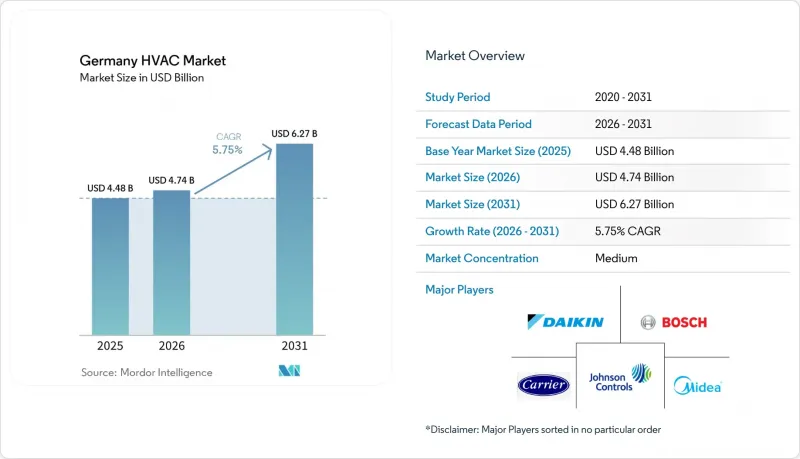
본 보고서는 구성 요소(HVAC 장비, HVAC 서비스), 최종 사용 산업(주거, 상업, 산업, 공공·기관), 도입 형태(신축, 개보수) 및 지역(북부, 남부, 동부, 서부, 중부)별로 분류되어 있습니다. 시장 전망치는 금액(달러)으로 표시되어 있습니다.
독일 HVAC 시장 동향과 인사이트
건축물 에너지법에 따른 전기화 추진
2024년에 시행된 “건축물 에너지법”에 따라, 모든 신규 난방 시스템에서 에너지의 최소 65%를 재생에너지로 조달해야 할 의무가 부과되었습니다. 이 조치의 시행으로 독일에서는 히트펌프로의 급속한 전환이 진행되어, 2024년에는 신규 주택 프로젝트 10건 중 7건 가까이에서 히트펌프가 채택되었습니다. 또한, 이 규제로 인해 예측 가능한 개보수 수요의 파이프라인도 형성되었습니다. 화석 연료 시스템은 경제적 수명이 다할 때까지 가동될 수 있지만, 2045년까지 규정을 준수하는 대체 시스템으로 교체해야 하기 때문입니다. 1만 개가 넘는 지자체가 네트워크로 연결된 히트펌프와 저온 지역 열공급망을 우선시하는 지역 열공급 계획 수립을 추진하고 있습니다. 이러한 조치들이 맞물려 독일의 전체 HVAC 시장에서 지속적인 수요가 확보되고 있습니다.
신축 주택 부문에서의 히트 펌프 보급
2024년 이후, 시스템 총비용이 전년 대비 12% 감소한 반면, 가스 가격은 높은 수준을 유지함에 따라 히트펌프 보급률이 급증했습니다. 초기 투자 비용이 적고 설치 장소 선정이 용이하기 때문에 신규 설치의 78%를 공기원형 히트펌프가 차지하고 있지만, 소음에 민감한 프로젝트나 공간적 제약이 있는 프로젝트에서는 지열 이용형 모델이 채택되고 있습니다. 이러한 전환에 따라, 히트 펌프의 효율을 극대화하는 축열 시스템, 스마트 온도 조절기, 그리고 건물 외피 개보수 분야도 함께 성장하고 있습니다. 시공 업체는 냉매 취급, 시운전, 디지털 제어 분야의 전문성을 심화하며 독일 HVAC 시장의 서비스 지향성을 강화하고 있습니다.
숙련된 설치 기술자 부족
2024년에는 약 6만 건의 HVAC 관련 채용 공고가 채워지지 않았으며, 견습 제도 등록자 수는 5년 동안 23% 감소했습니다. 열펌프 도입에는 전기 배선, 냉매 관리, 디지털 시운전과 관련된 추가적인 기술이 요구되기 때문에 주택 및 소규모 상업 프로젝트에서 병목 현상이 발생하고 있습니다. 연수 센터가 도시 지역에 집중되어 있기 때문에 지방 지역은 그 영향을 가장 심각하게 받고 있습니다. 이러한 격차를 해소하기 위해 다이킨 등 제조업체들은 대규모 연수 캠퍼스를 개설하고, 서비스가 미치지 않는 지역을 순회하는 이동식 아카데미를 운영했습니다.
부문별 분석
2025년 독일의 HVAC 기기 시장 규모는 32억 1,000만 달러로, 총 매출의 71.75%를 차지했습니다. 소비자들이 규제 준수와 장기적인 비용 절감을 추구한 결과, 히트펌프만으로도 연간 판매 대수가 34% 이상 증가했습니다. 한편, 보일러는 “건축물 에너지법”로 인해 가스 이용의 전망이 불투명해지면서 28% 감소했습니다. 가변 냉매 유량(VRF) 시스템은 구역별 온도 제어가 가능하기 때문에 사무실이나 소매 시설에서 시장 점유율을 확대했습니다.
서비스 매출은 예상 연평균 성장률(CAGR) 7.02%를 기록하며 가장 높은 성장세를 보였습니다. 복잡한 시운전, 원격 모니터링, 예측 유지보수가 지출을 주도하고 있으며, 이러한 비용은 수명 주기 전반에 걸쳐 종종 초기 설비 비용을 초과합니다. 상업용 빌딩의 에너지 관리 프로젝트 평균 비용은 45,000-6만 5,000유로(48,000-6만 9,000달러)로, 일반적인 예방 정비 계약 비용의 약 3배에 해당합니다. 히트 펌프의 보급이 확대됨에 따라, 전문적인 누출 검사 및 F가스 규제 준수 여부에 대한 점검이 지속적인 수익원으로 자리 잡으며, 독일 HVAC 시장의 서비스 분야를 한층 더 심화시키고 있습니다.
기타 혜택:
- 엑셀 형식 시장 예측(ME) 시트
- 3개월간의 애널리스트 지원
자주 묻는 질문
목차
제1장 서론
제2장 조사 방법
제3장 주요 요약
제4장 시장 구도
제5장 시장 규모와 성장 예측
제6장 경쟁 구도
제7장 시장 기회와 향후 전망
JHS 26.07.09According to Mordor Intelligence, the germany HVAC market size was valued at USD 4.48 billion in 2025 and estimated to grow from USD 4.74 billion in 2026 to reach USD 6.27 billion by 2031, at a CAGR of 5.75% during the forecast period (2026-2031).
This report is Segmented by Component (HVAC Equipment, HVAC Services), End-User Industry (Residential, Commercial, Industrial, Public and Institutional), Implementation Type (New Construction, Retrofit), and Geography (North, South, East, West, Central). The Market Forecasts are Provided in Terms of Value (USD).
Germany HVAC Market Trends and Insights
Building Energy Act Electrification Push
The Building Energy Act took effect in 2024, obligating every new heating system to source at least 65% of its energy from renewables. Enforcement triggered a rapid shift toward heat pumps in Germany, which powered nearly seven in ten new residential projects in 2024. The rule also created a predictable retrofit pipeline because fossil-fuel systems may operate until their economic end of life, but must be replaced with compliant alternatives by 2045. More than 10,000 municipalities are drafting local heat plans that favor networked heat pumps and low-temperature district grids. Together, these measures lock in sustained demand across the Germany HVAC market.
Heat Pump Uptake in New-Build Residential Segment
Heat pump penetration skyrocketed after 2024 as total system cost dropped 12% year over year while gas prices stayed elevated. Air-source units claim 78% of new installations because of their lower capex and easier siting, whereas ground-source models serve noise-sensitive or space-constrained projects. The transition fuels parallel growth in thermal storage, smart thermostats, and envelope upgrades that maximize heat-pump efficiency. Contractors deepen specialization in refrigerant handling, commissioning, and digital controls, reinforcing the service orientation of the Germany HVAC market.
Skilled Installer Shortage
Roughly 60,000 HVAC positions were vacant in 2024, and apprenticeship enrollment fell 23% in five years. Heat pumps demand additional competencies in electrical wiring, refrigerant management, and digital commissioning, creating bottlenecks in residential and small-commercial projects. Rural districts feel the pinch most acutely because training centers cluster in urban areas. To bridge the gap, manufacturers such as Daikin opened large training campuses and rolled out mobile academies that travel to underserved regions.
Other drivers and restraints analyzed in the detailed report include:
- Smart HVAC and Building-Automation Retrofits
- Corporate Net-Zero Commitments Boosting Commercial Upgrades
- Supply-Chain Volatility for Key Components
For complete list of drivers and restraints, kindly check the Table Of Contents.
Segment Analysis
Germany HVAC market size for equipment stood at USD 3.21 billion in 2025, equal to 71.75% of total revenue. Heat pumps alone added more than 34% annual unit growth as consumers chased compliance and long-term savings. Boilers slipped 28% because gas options face an uncertain future under the Building Energy Act. Variable refrigerant flow systems won a greater share in offices and retail centers owing to zone-specific temperature control.
Service income recorded the highest trajectory at a 7.02% forecast CAGR. Complex commissioning, remote monitoring, and predictive maintenance drive spending that frequently exceeds original equipment cost over the life cycle. Energy-management projects in commercial buildings average EUR 45,000 to 65,000 (USD 48,000 to 69,000), roughly triple a standard preventive-maintenance contract. As heat-pump density grows, specialized leak testing and F-gas compliance checks become recurring revenue streams, further deepening the service dimension of the Germany HVAC market.
Complete Report Scope:
- By Component
- HVAC Equipment
- Heating Equipment
- Heat Pumps
- Boilers
- Radiators
- Cooling Equipment
- Air Conditioners
- Chillers
- Variable Refrigerant Flow Systems
- Ventilation Equipment
- Air Handling Units
- Energy Recovery Ventilators
- Heating Equipment
- HVAC Services
- Installation
- Maintenance and Repair
- Energy Management and Building Automation
- HVAC Equipment
- By End-User Industry
- Residential
- Commercial
- Industrial
- Public and Institutional
- By Implementation Type
- New Construction
- Retrofit
- By Region
- North
- South
- East
- West
- Central
List of Companies Covered in this Report:
- Carrier Corporation
- Robert Bosch GmbH
- Midea Group Co. Ltd
- Johnson Controls International PLC
- Daikin Industries Ltd
- Systemair AB
- LG Electronics Inc.
- Mitsubishi Electric Hydronics And IT Cooling Systems S.p.A.
- FlaktGroup Holding GmbH
- Danfoss A/S
- Vaillant Group
- Viessmann Climate Solutions SE
- Stiebel Eltron GmbH & Co. KG
- NIBE Industrier AB
- BDR Thermea Group B.V.
- Panasonic Holdings Corporation
- Trane Technologies plc
- Fujitsu General Limited
- Gree Electric Appliances Inc. of Zhuhai
Additional Benefits:
- The market estimate (ME) sheet in Excel format
- 3 months of analyst support
TABLE OF CONTENTS
1 INTRODUCTION
- 1.1 Study Assumptions and Market Definition
- 1.2 Scope of the Study
2 RESEARCH METHODOLOGY
3 EXECUTIVE SUMMARY
4 MARKET LANDSCAPE
- 4.1 Market Overview
- 4.2 Market Drivers
- 4.2.1 Increased Construction and Retrofit Activity to Aid Demand
- 4.2.2 Electrification Push via Building Energy Act (GEG) Targets
- 4.2.3 Rapid Uptake of Heat Pumps in New-Build Residential Segment
- 4.2.4 Growth of Smart HVAC and Building Automation Retrofits
- 4.2.5 Surge in Climate-Resilient Cooling Demand During Heatwaves
- 4.2.6 Corporate Net-Zero Commitments Boosting Commercial HVAC Upgrades
- 4.3 Market Restraints
- 4.3.1 High Initial Cost of Energy Efficient Systems
- 4.3.2 Shortage of Skilled HVAC Installers and Technicians
- 4.3.3 Policy Uncertainty Around Subsidy Continuity and GEG Timelines
- 4.3.4 Supply Chain Volatility for Key Components (Compressors, Electronics)
- 4.4 Industry Value Chain Analysis
- 4.5 Porter's Five Forces Analysis
- 4.5.1 Bargaining Power of Suppliers
- 4.5.2 Bargaining Power of Consumers
- 4.5.3 Threat of New Entrants
- 4.5.4 Threat of Substitute Products
- 4.5.5 Intensity of Competitive Rivalry
- 4.6 Regulatory Landscape
- 4.7 Technological Outlook
- 4.8 Impact of Macroeconomic Factors
5 MARKET SIZE AND GROWTH FORECASTS (VALUE)
- 5.1 By Component
- 5.1.1 HVAC Equipment
- 5.1.1.1 Heating Equipment
- 5.1.1.1.1 Heat Pumps
- 5.1.1.1.2 Boilers
- 5.1.1.1.3 Radiators
- 5.1.1.2 Cooling Equipment
- 5.1.1.2.1 Air Conditioners
- 5.1.1.2.2 Chillers
- 5.1.1.2.3 Variable Refrigerant Flow Systems
- 5.1.1.3 Ventilation Equipment
- 5.1.1.3.1 Air Handling Units
- 5.1.1.3.2 Energy Recovery Ventilators
- 5.1.1.1 Heating Equipment
- 5.1.2 HVAC Services
- 5.1.2.1 Installation
- 5.1.2.2 Maintenance and Repair
- 5.1.2.3 Energy Management and Building Automation
- 5.1.1 HVAC Equipment
- 5.2 By End-User Industry
- 5.2.1 Residential
- 5.2.2 Commercial
- 5.2.3 Industrial
- 5.2.4 Public and Institutional
- 5.3 By Implementation Type
- 5.3.1 New Construction
- 5.3.2 Retrofit
- 5.4 By Region
- 5.4.1 North
- 5.4.2 South
- 5.4.3 East
- 5.4.4 West
- 5.4.5 Central
6 COMPETITIVE LANDSCAPE
- 6.1 Market Concentration
- 6.2 Strategic Moves
- 6.3 Market Share Analysis
- 6.4 Company Profiles (includes Global level Overview, Market level Overview, Core Segments, Financials as available, Strategic Information, Market Rank/Share for key companies, Products and Services, and Recent Developments)
- 6.4.1 Carrier Corporation
- 6.4.2 Robert Bosch GmbH
- 6.4.3 Midea Group Co. Ltd
- 6.4.4 Johnson Controls International PLC
- 6.4.5 Daikin Industries Ltd
- 6.4.6 Systemair AB
- 6.4.7 LG Electronics Inc.
- 6.4.8 Mitsubishi Electric Hydronics And IT Cooling Systems S.p.A.
- 6.4.9 FlaktGroup Holding GmbH
- 6.4.10 Danfoss A/S
- 6.4.11 Vaillant Group
- 6.4.12 Viessmann Climate Solutions SE
- 6.4.13 Stiebel Eltron GmbH & Co. KG
- 6.4.14 NIBE Industrier AB
- 6.4.15 BDR Thermea Group B.V.
- 6.4.16 Panasonic Holdings Corporation
- 6.4.17 Trane Technologies plc
- 6.4.18 Fujitsu General Limited
- 6.4.19 Gree Electric Appliances Inc. of Zhuhai
7 MARKET OPPORTUNITIES AND FUTURE OUTLOOK
- 7.1 White-Space and Unmet-Need Assessment


