

|
시장보고서
상품코드
2097059
자동차용 안티락 브레이크 시스템 및 전자 안정성 제어 : 시장 점유율 분석, 업계 동향과 통계, 성장 예측(2026-2031년)Automotive Anti-Lock Braking System and Electronic Stability Control - Market Share Analysis, Industry Trends & Statistics, Growth Forecasts (2026 - 2031) |
||||||
 Mordor Intelligence
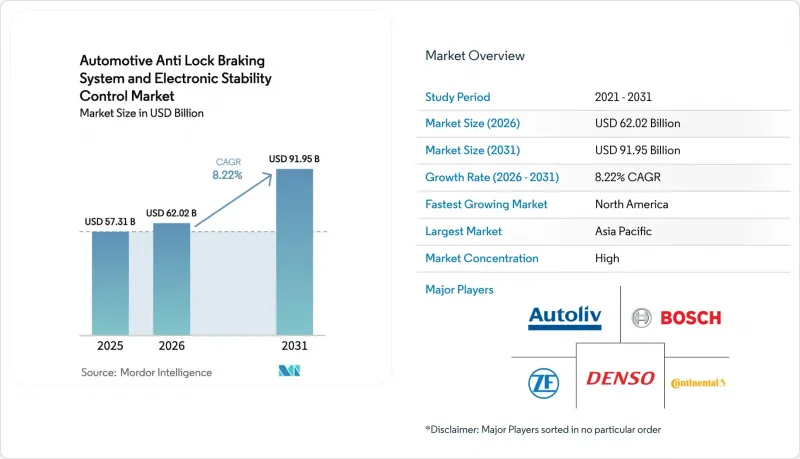
Mordor Intelligence에 의하면, 자동차용 안티락 브레이크 시스템(ABS) 및 전자 안정성 제어(ESC) 시장 규모는 2025년에 573억 1,000만 달러로 평가되었고, 2026년 620억 2,000만 달러에서 2031년까지 919억 5,000만 달러에 이를 것으로 예측되며, 예측 기간 CAGR은 8.22%로 전망됩니다(2026년-2031년).

본 보고서는 차량 유형별(이륜차 등), 구성품별(전자 제어 장치(ECU) 등), ABS 유형별(4채널 등), 기술별(유압식 ABS 등), 최종 사용자별(OEM 순정 장비 등) 및 지역별로 분류되어 있습니다. 시장 전망은 금액(달러) 및 수량(대)으로 제시되어 있습니다.
전 세계 자동차용 잠김 방지 브레이크 시스템 및 전자식 차체 안정성 제어 시장 동향과 인사이트
전 세계 ABS 도입을 촉진하는 안전 규제
이륜차용 유엔 규정 R78, 미국의 FMVSS-122, 인도의 AIS-150과 같은 엄격한 규제로 인해 신차에 대한 ABS 장착률은 100%에 가까워지고 있습니다. 2029년까지 자동 긴급 제동을 의무화하는 미국 국가도로교통안전국(NHTSA)의 규정에 따라, ABS는 규제 준수를 달성하기 위한 핵심 요소가 되고 있습니다. 유럽에서는 이미 배기량 125cc를 초과하는 스쿠터에 이륜차용 ABS 장착이 의무화되어 있으며, 이륜차 의존도가 높은 아세안(ASEAN) 국가들에도 영향을 미치고 있습니다. 인도도 이러한 추세를 따르며, 공급업체들에게 비용 최적화된 싱글 채널 솔루션 제공을 촉구하고 있습니다. 유엔 아시아태평양경제사회위원회(UN ESCAP)는 이륜차용 ABS를 통해 사망자 수를 31% 줄일 수 있을 것으로 추정하고 있으며(unescap.org), 이는 규제 당국의 확신을 더욱 공고히 하고 있습니다.
전 세계 자동차 생산 증가가 ABS 시장 확대를 견인
팬데믹 이후 제조업 회복은 아시아태평양에서 가장 두드러졌으며, 중국에서는 생산 능력이 완전히 회복되었고, 인도의 이륜차 생산 대수는 2024년에 사상 최고치를 기록했습니다. 생산 대수 증가는 특히 ABS가 옵션 사양에서 기본 사양으로 전환되고 있는 상황에서 ABS 수요 증가와 직결됩니다. 보쉬(Bosch)사는 첨단 ABS가 이륜차 사고의 40%를 예방할 수 있다고 지적하고 있으며, 이 통계는 소비자와 정책 입안자들의 공감을 불러일으키고 있습니다.
가격에 민감한 시장에서 보급을 가로막는 비용의 장벽
인도, 인도네시아, 브라질에서는 몇 달러 차이로 구매 결정이 좌우되는 저가형 오토바이나 보급형 자동차에서 ABS의 가격 프리미엄이 여전히 과제로 남아 있습니다. OEM의 이익률은 평균 7.2%인 반면, 공급업체의 이익률은 5.5% 전후에 그치고 있어 ABS 비용을 흡수할 여지는 제한적입니다. 따라서 Tier 1 공급업체들은 실현 가능한 가격대를 달성하기 위해 유압 유닛을 재설계하여 밸브의 복잡성을 해소하고, 공통 ECU를 채택하며, 생산의 현지화를 추진하고 있습니다.
부문 분석
2025년, 승용차는 자동차용 안티록 브레이크 시스템(ABS) 시장의 주축이 되었으며, 유럽, 중국, 북미에서의 장착 의무화로 인해 매출의 46.85%를 차지했습니다. 안정적인 승용차 수요와 점점 고도화되는 운전 보조 패키지가 맞물려 견실한 수익 기반이 확보되고 있습니다. 이 부문은 ADAS의 보급에 따라 성장할 전망이지만, 그 속도는 이륜차보다 완만합니다. 승용차용 자동차 잠김 방지 브레이크 시스템(ABS) 시장 규모는 OEM의 브레이크 제어와 차선 유지 기능, 적응형 크루즈 컨트롤 기능의 통합에 힘입어 연평균 성장률(CAGR) 7.98%로 확대될 것으로 예측됩니다.
전기 이륜차는 연평균 성장률(CAGR) 15.05%라는 더 빠른 속도로 시장을 주도하고 있습니다. 인도와 유럽에서는 배기량 125cc 이상의 오토바이에 ABS 장착이 의무화되어 있어, 승용차용 솔루션보다 경량이며 저비용인 단일 채널 아키텍처의 보급을 촉진하고 있습니다. 중국과 동남아시아에서 인기 있는 전기 스쿠터의 경우 회생 제동이 선호되고 있어, 공급업체들은 ABS 알고리즘과 에너지 회수 로직을 융합해야 할 필요성에 직면해 있습니다. 보쉬는 2026년까지 라이더 지원 기능이 일반 시장에 보급될 것으로 예측하며, 이륜차 분야의 능동 안전에 대한 지역별 수요가 높음을 부각시키고 있습니다.
2025년에도 전자 제어 장치(ECU)는 매출의 33.20%를 차지하며 여전히 최대의 부품 부문으로 자리매김했습니다. 이 점유율은 계산 처리 수요 증가에 힘입어 상승한 것입니다. 현재 AI 펌웨어가 차륜 속도 데이터, 노면 마찰 계수, 차량 하중을 실시간으로 분석하여 예측 제동을 가능하게 하고 있습니다. 이 기능 덕분에 ECU의 연평균 성장률(CAGR)은 11.95%로 예측되며, 다른 부품을 크게 앞지르고 있습니다. 휠 속도 센서는 이륜차나 대형 트럭의 진동을 견딜 수 있는 솔리드 스테이트 설계의 이점을 누리며, 매출액 기준으로 두 번째로 큰 규모를 차지하고 있습니다.
유압 제어 장치(HCU)의 경우, 1kg의 무게 증가가 주행 거리에 직접적인 영향을 미치는 배터리 전기자동차(BEV)를 위해 경량화와 효율화를 목표로 한 재설계가 진행되고 있습니다. 밸브 및 액추에이터의 경우, 경량 알루미늄 하우징의 채택과 메카트로닉스의 발전을 활용하여 응답 시간을 단축하고 있습니다. AI가 중앙 도메인 컨트롤러로 전환되는 가운데, ECU 공급업체들은 사이버 보안 규정 준수를 유지하기 위한 무선 업데이트(OTA) 기능을 제공함으로써 대응하고 있으며, 이를 통해 소프트웨어 정의 브레이크의 주요 제약 요인 중 하나를 완화하고 있습니다.
지역별 분석
아시아태평양은 중국의 생산 규모와 인도의 규제 강화에 힘입어 36.10%의 시장 점유율로 자동차용 안티록 브레이크 시스템(ABS) 시장을 선도하고 있습니다. 인도에서는 이륜차에 대한 ABS 장착 의무화가 대폭 확대되고 있으며, 공급업체들은 수입 관세를 회피하기 위해 현지에서 ECU 공장을 설립하고 있습니다. 중국에서는 승용차에 대해 ABS와 전자식 안정성 제어(ESC)를 함께 의무화하고 있으며, 국내 1차 공급업체들이 다국적 기업과 어깨를 나란히 하는 체제를 유지하고 있습니다. 일본 및 한국의 OEM 각사는 ABS를 독자적인 하이브리드 시스템에 통합하여 해당 지역에서의 기술적 리더십을 더욱 강화하고 있습니다.
북미는 2031년까지 13.28%라는 가장 높은 연평균 성장률(CAGR)로 확대되고 있으며, 미국에서는 향후 도입될 자동 긴급 제동(AEB) 규제로 인해 수요가 증가할 전망이고, 캐나다에서는 FMVSS 기준 준수가 진행되고 있습니다. 보험사가 다중 보험 계약에 대한 할인을 제공하는 지역에서는 상용차 차량군의 사후 장착 도입이 탄력을 받고 있습니다. 수출 시장을 위한 멕시코 조립 공장에서는 미국 및 EU의 형식 인증 요건을 충족하기 위해 ABS를 기본 사양으로 장착하고 있습니다. 중동 및 아프리카, 남미와 같이 규모는 작지만 성장세가 두드러진 시장에서는 브라질이 모든 신형 오토바이에 ABS 장착을 의무화하고 있으며, 사우디아라비아는 첨단 안전 패키지를 채택한 차량군에 대해 우대 조치를 시행하고 있습니다.
유럽도 이에 발맞추어 모든 신차에 ABS 탑재를 의무화하고 있으며, 이는 보다 광범위한 AEB 검증 체계에 포함되는 EU 일반 안전 규정에 의해 뒷받침되고 있습니다. 독일은 여전히 이 지역의 혁신 중심지이며, 각 공급업체들은 노면 마찰 매핑을 개선하기 위해 ABS 기반의 급제동 데이터를 시험적으로 활용하고 있습니다. Gapwaves사는 AEB에 필요한 추가 레이더 센서가 중복성을 확보하기 위해 ABS 신호를 보완한다고 지적하고 있습니다. 동유럽의 조립 공장에서는 엔트리 레벨 차종으로도 채택을 확대하여 통일된 안전 기준을 확보하고 있습니다.
기타 혜택:
- 엑셀 형식 시장 예측(ME) 시트
- 3개월간의 애널리스트 지원
자주 묻는 질문
목차
제1장 서론
제2장 조사 방법
제3장 주요 요약
제4장 시장 구도
제5장 시장 규모와 성장 예측
제6장 경쟁 구도
제7장 시장 기회와 향후 전망
KTH 26.08.06According to Mordor Intelligence, the automotive anti-Lock braking system and Electronic Stability Control Market size was valued at USD 57.31 billion in 2025 and estimated to grow from USD 62.02 billion in 2026 to reach USD 91.95 billion by 2031, at a CAGR of 8.22% during the forecast period (2026-2031).
This report is Segmented by Vehicle Type (Two-Wheelers, and More), Component (Electronic Control Unit (ECU), and More), ABS Type (4-Channel, and More), Technology (Hydraulic ABS, and More), End User (OEM-Fitment, and More) and Geography. The Market Forecasts are Provided in Terms of Value (USD) and Volume (Units).
Global Automotive Anti-Lock Braking System and Electronic Stability Control Market Trends and Insights
Mandatory Safety Regulations Driving Global ABS Adoption
Stringent policies such as UN R78 for motorcycles, FMVSS-122 in the United States, and AIS-150 in India are pushing ABS fitment toward 100% in new vehicles. The U.S. National Highway Traffic Safety Administration's rule requiring automatic emergency braking by 2029 makes ABS core to achieving compliance. Europe already enforces motorcycle ABS on scooters above 125 cc, influencing ASEAN nations that rely heavily on two-wheelers. India mirrored this trend, compelling suppliers to release cost-optimized single-channel solutions. UN ESCAP estimates that motorcycle ABS can cut fatalities by 31% unescap.org, reinforcing regulators' confidence.
Rising Global Vehicle Production Expanding ABS Market Footprint
Post-pandemic manufacturing recovery is most pronounced in Asia Pacific, where China returned to full-scale capacity and India's two-wheeler output set new highs in 2024. Increased unit volumes translate directly into greater ABS demand, especially as ABS migrates from optional to standard equipment. Bosch notes that advanced ABS can prevent 40% of two-wheeler crashes, a statistic resonating with consumers and policymakers.
Cost Barriers Limiting Penetration in Price-Sensitive Markets
ABS price premiums remain challenging for low-cost motorcycles and entry-level cars in India, Indonesia, and Brazil, where a few USD can sway purchase decisions. OEM margins average 7.2%, while suppliers hover near 5.5%, limiting room to absorb ABS costs. Tier-1 vendors therefore re-engineer hydraulic units to remove valving complexity, adopt shared ECUs, and localize production to achieve viable price points.
Other drivers and restraints analyzed in the detailed report include:
- Growing Insurance Incentives for Active-Safety Equipped Vehicles
- Electrification Platforms Transforming ABS Architecture
- Semiconductor Supply Constraints Impacting Production Capacity
For complete list of drivers and restraints, kindly check the Table Of Contents.
Segment Analysis
Passenger cars anchored the automotive anti-lock braking system market in 2025, delivering 46.85% revenue thanks to mandatory fitment in Europe, China, and North America. Stable car demand, paired with increasingly sophisticated driver assistance packages, ensures a consistent revenue base. The segment will grow in tandem with ADAS penetration, though at a slower pace than two-wheelers. The automotive anti-lock braking system market size for passenger cars is projected to expand at 7.98% CAGR, supported by OEM integration of brake control with lane-keeping and adaptive cruise functions.
Electric two-wheelers inject faster momentum at 15.05% CAGR. Mandates in India and Europe require ABS on motorcycles above 125 cc, propelling single-channel architectures that weigh and cost less than four-wheel solutions. Electric scooters popular in China and Southeast Asia favor regenerative braking, forcing suppliers to fuse ABS algorithms with energy-recovery logic. Bosch forecasts mass-market rider assistance deployment by 2026, underscoring regional appetite for active safety on two-wheelers.
Electronic control units remained the largest component segment in 2025 at 33.20% revenue, a share lifted by rising computational needs. AI firmware now interprets wheel-speed data, road friction coefficients, and vehicle load in real time, enabling predictive braking. This functionality drives a 11.95% CAGR outlook for ECUs, well ahead of other components. Wheel-speed sensors follow in value, benefiting from solid-state designs that withstand vibration on two-wheelers and heavy trucks.
Hydraulic control units face weight and efficiency redesigns for battery electric vehicles, where every kilogram impacts range. Valves and actuators exploit lightweight aluminum housings and advances in mechatronics to cut response times. As AI moves onto central domain controllers, ECU suppliers adapt by offering over-the-air update capabilities to maintain cyber compliance, mitigating one of the key restraints on software-defined braking.
Complete Report Scope:
- By Vehicle Type
- Two-Wheelers
- Passenger Cars
- Light Commercial Vehicles
- Medium and Heavy Commercial Vehicles
- By Component
- Electronic Control Unit (ECU)
- Hydraulic Control Unit
- Wheel Speed Sensors
- Valves & Actuators
- By ABS Type
- 4-Channel
- 3-Channel
- Single-Channel (Motorcycle)
- By Technology
- Hydraulic ABS
- Electric ABS
- Pneumatic ABS
- By End User
- OEM-Fitment
- Aftermarket Retrofit
- By Geography
- North America
- United States
- Canada
- Rest of North America
- South America
- Brazil
- Argentina
- Rest of South America
- Europe
- Germany
- United Kingdom
- France
- Spain
- Russia
- Rest of Europe
- Asia Pacific
- China
- Japan
- India
- South Korea
- Rest of Asia Pacific
- Middle East and Africa
- Turkey
- Saudi Arabia
- United Arab Emirates
- South Africa
- Rest of Middle East and Africa
- North America
Geography Analysis
Asia Pacific leads the automotive anti-lock braking system market with 36.10% market share, propelled by China's production scale and India's regulatory surge. India's ABS mandate on motorcycles is growing significantly, with suppliers establishing local ECU plants to avoid import tariffs. China pairs ABS with compulsory electronic stability control on passenger cars, keeping domestic tier-1 suppliers in lockstep with multinational competitors. Japanese and South Korean OEMs integrate ABS with proprietary hybrid systems, sharpening regional technology leadership.
North America expands at highest CAGR at 13.28% by 2031, with U.S. demand buoyed by upcoming AEB rules and Canada aligning with FMVSS standards. Commercial fleet retrofits gain traction where insurers offer multiline discounts. Mexico's assembly plants, serving export markets, pre-install ABS to satisfy both U.S. and EU homologation. Smaller yet growing markets in the Middle East, Africa, and South America witness Brazil mandating ABS on all new motorcycles, and Saudi Arabia incentivizing fleets that adopt advanced safety packages.
Europe follows, underpinned by the EU General Safety Regulation that obliges ABS on all new vehicles and positions it within broader AEB validation. Germany remains the region's innovation hub, with suppliers piloting ABS-based harsh-brake data to improve road-friction mapping. Gapwaves notes that extra radar sensors required for AEB complement ABS signals for redundancy. Eastern European assembly plants extend adoption to entry-level cars, ensuring uniform safety standards.
- Robert Bosch GmbH
- Continental AG
- ZF Friedrichshafen AG
- DENSO Corporation
- Mando Corporation
- Hyundai Mobis Co., Ltd.
- Hitachi Astemo, Ltd.
- Brembo S.p.A.
- Knorr-Bremse AG
- WABCO (ZF CVCS)
- Haldex AB
- Nissin Kogyo Co., Ltd.
- ADVICS Co., Ltd.
- Aptiv PLC
- Delphi Technologies (BorgWarner)
- Veoneer Holding LLC
- Autoliv Inc.
- BWI Group
- Maruichi Machine
- Federal-Mogul Motorparts
Additional Benefits:
- The market estimate (ME) sheet in Excel format
- 3 months of analyst support
TABLE OF CONTENTS
1 Introduction
- 1.1 Study Assumptions & Market Definition
- 1.2 Scope of the Study
2 Research Methodology
3 Executive Summary
4 Market Landscape
- 4.1 Market Overview
- 4.2 Market Drivers
- 4.2.1 Mandatory safety regulations (UN R78, FMVSS-122, AIS-150)
- 4.2.2 Rising global passenger-car & 2-wheeler production rebounding post-COVID
- 4.2.3 Growing insurance incentives for active-safety equipped vehicles
- 4.2.4 Electrification platforms requiring brake-by-wire integration
- 4.2.5 Rapid retrofit demand in used-vehicle fleets for telematics-based UBI
- 4.2.6 Tier-1 suppliers bundling ABS with ADAS domain controllers
- 4.3 Market Restraints
- 4.3.1 High BOM cost for low-end 2-wheelers & emerging-market cars
- 4.3.2 Integration complexity with legacy hydraulic architectures
- 4.3.3 Semiconductor supply-chain constraints post-2023
- 4.3.4 Cyber-security certification delays for software-defined braking
- 4.4 Value/Supply-Chain Analysis
- 4.5 Regulatory Landscape
- 4.6 Technological Outlook
- 4.7 Porter's Five Forces
- 4.7.1 Threat of New Entrants
- 4.7.2 Bargaining Power of Buyers
- 4.7.3 Bargaining Power of Suppliers
- 4.7.4 Threat of Substitutes
- 4.7.5 Competitive Rivalry
5 Market Size & Growth Forecasts (Value (USD) and Volume (Units))
- 5.1 By Vehicle Type
- 5.1.1 Two-Wheelers
- 5.1.2 Passenger Cars
- 5.1.3 Light Commercial Vehicles
- 5.1.4 Medium and Heavy Commercial Vehicles
- 5.2 By Component
- 5.2.1 Electronic Control Unit (ECU)
- 5.2.2 Hydraulic Control Unit
- 5.2.3 Wheel Speed Sensors
- 5.2.4 Valves & Actuators
- 5.3 By ABS Type
- 5.3.1 4-Channel
- 5.3.2 3-Channel
- 5.3.3 Single-Channel (Motorcycle)
- 5.4 By Technology
- 5.4.1 Hydraulic ABS
- 5.4.2 Electric ABS
- 5.4.3 Pneumatic ABS
- 5.5 By End User
- 5.5.1 OEM-Fitment
- 5.5.2 Aftermarket Retrofit
- 5.6 By Geography
- 5.6.1 North America
- 5.6.1.1 United States
- 5.6.1.2 Canada
- 5.6.1.3 Rest of North America
- 5.6.2 South America
- 5.6.2.1 Brazil
- 5.6.2.2 Argentina
- 5.6.2.3 Rest of South America
- 5.6.3 Europe
- 5.6.3.1 Germany
- 5.6.3.2 United Kingdom
- 5.6.3.3 France
- 5.6.3.4 Spain
- 5.6.3.5 Russia
- 5.6.3.6 Rest of Europe
- 5.6.4 Asia Pacific
- 5.6.4.1 China
- 5.6.4.2 Japan
- 5.6.4.3 India
- 5.6.4.4 South Korea
- 5.6.4.5 Rest of Asia Pacific
- 5.6.5 Middle East and Africa
- 5.6.5.1 Turkey
- 5.6.5.2 Saudi Arabia
- 5.6.5.3 United Arab Emirates
- 5.6.5.4 South Africa
- 5.6.5.5 Rest of Middle East and Africa
- 5.6.1 North America
6 Competitive Landscape
- 6.1 Market Concentration
- 6.2 Strategic Moves
- 6.3 Market Share Analysis
- 6.4 Company Profiles
- 6.4.1 Robert Bosch GmbH
- 6.4.2 Continental AG
- 6.4.3 ZF Friedrichshafen AG
- 6.4.4 DENSO Corporation
- 6.4.5 Mando Corporation
- 6.4.6 Hyundai Mobis Co., Ltd.
- 6.4.7 Hitachi Astemo, Ltd.
- 6.4.8 Brembo S.p.A.
- 6.4.9 Knorr-Bremse AG
- 6.4.10 WABCO (ZF CVCS)
- 6.4.11 Haldex AB
- 6.4.12 Nissin Kogyo Co., Ltd.
- 6.4.13 ADVICS Co., Ltd.
- 6.4.14 Aptiv PLC
- 6.4.15 Delphi Technologies (BorgWarner)
- 6.4.16 Veoneer Holding LLC
- 6.4.17 Autoliv Inc.
- 6.4.18 BWI Group
- 6.4.19 Maruichi Machine
- 6.4.20 Federal-Mogul Motorparts
7 Market Opportunities & Future Outlook
- 7.1 White-space & unmet-need assessment


