

|
시장보고서
상품코드
2097074
피부과 치료제 : 시장 점유율 분석, 업계 동향 및 통계, 성장 예측(2026-2031년)Dermatological Therapeutics - Market Share Analysis, Industry Trends & Statistics, Growth Forecasts (2026 - 2031) |
||||||
 Mordor Intelligence
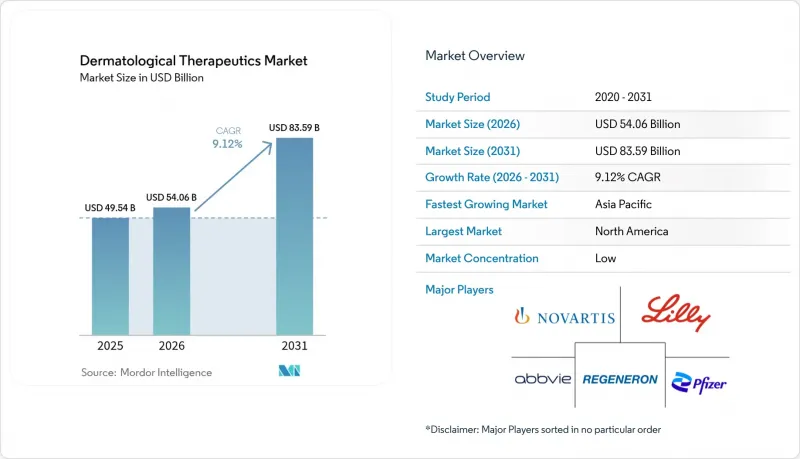
Mordor Intelligence에 의하면, 피부과 치료제 시장 규모는 2025년 495억 4,000만 달러로 평가되었습니다. 2026년에는 540억 6,000만 달러로 확대되어 2031년까지 835억 9,000만 달러에 이를 것으로 예측되며, 2026년부터 2031년에 걸쳐 CAGR 9.12%로 성장할 전망입니다.

본 보고서는 질환별(여드름, 건선 등), 약물 분류별(외용 코르티코스테로이드, 레티노이드 등), 투여 경로별(외용, 경구 등), 유통 채널별(병원 약국, 소매 약국 및 드럭스토어 등), 치료법별(처방약, 일반의약품), 지역별로 분류되어 있습니다. 시장 전망은 금액(달러) 기준으로 제시되어 있습니다.
세계의 피부과 치료제 시장 동향 및 인사이트
만성 피부 질환 유병률 상승
도시 지역의 대기 오염, 가공 식품 섭취, 그리고 진단 지연이 복합적으로 작용하여 2019년부터 2024년에 걸쳐 중국 및 인도의 도시 지역에서 아토피 피부염 유병률이 2배로 증가했습니다. 미국에서는 2020년부터 2025년에 걸쳐 건선 발병률이 18% 상승했으며, 미국 질병통제예방센터(CDC)는 이러한 증가를 대사증후군의 동반 질환 및 팬데믹 기간 중 의료 서비스 공백과 연관 짓고 있습니다. 미국피부과학회(AAD)가 진행한 인식 제고 캠페인에서는 1만 2,000명의 1차 진료 의사들을 대상으로 화농성 땀샘염 진단에 관한 교육이 실시되었으며, 그 결과 확정 진단 사례가 40% 급증했습니다. 진단 범위가 확대됨에 따라, 특히 전문 의료 체계가 질환의 부담을 감당해 나가고 있는 지역에서 1차 선택인 국소 요법 및 2차 선택인 생물학적 제제의 적용 대상이 되는 환자층이 확대되고 있습니다.
생물학적 제제 및 표적 치료의 급속한 보급
2025년, 피부과에서 생물학적 제제의 처방 건수는 전년 대비 31% 증가하여 종양학 및 류마티스학 분야의 보급률을 상회했습니다. FDA가 사춘기 아토피 피부염 및 화농성 땀샘염에 대한 우파다시티닙을 승인함에 따라, 미국 내 230만 명의 환자가 이 약물을 이용할 수 있게 되었습니다. 유럽의약품청(EMA)이 원형 탈모증에 대한 바리시티닙의 승인을 결정하고, 독일 연방합동위원회가 보험 적용을 지지함에 따라 탈모증 치료 분야에서 최초의 경구 치료 경로가 확립되었습니다. 보험사들은 엄격한 단계별 치료 순서를 폐지하고, 중등도 질환에 대해서는 생물학적 제제를 직접 투여하는 방향으로 전환하고 있으며, 미국의 많은 민간 보험 플랜에서 치료 시작까지의 기간이 18개월에서 6개월로 단축되었습니다. 바이오시밀러의 진입으로 아달리무브의 연간 비용이 4만 5,000달러에서 2만 8,000달러로 하락하면서 채택이 가속화되고 있습니다.
바이오의약품의 높은 비용과 보험 급여 장벽
피부과 분야의 생물학적 제제에 의한 연간 치료비는 3만 5,000-6만 5,000달러에 달하며, 본인 부담이 주를 이루는 중소득 국가에서는 환자의 68%에게 감당하기 어려운 금액입니다. 2025년, 미국의 보험사들은 생물학적 제제 청구의 89%에 사전 승인 규제를 적용했으며, 그 결과 승인까지의 평균 지연 기간은 14일, 최초 신청 기각률은 22%에 달했습니다. NICE(영국 국립의료기술평가기구)는 듀필루맙의 적용 대상을 중증 습진 사례로 한정함에 따라, 중등도 환자의 약 40%가 대상에서 제외되었습니다. 인도산 아달리무맙 바이오시밀러는 경구용 면역억제제의 3배에 달하는 가격을 유지하고 있어, 도시 지역의 3차 의료기관 이외에서는 보급률이 여전히 낮은 상태입니다. 2025년, 제약사들이 바이오시밀러에 의한 시장 잠식을 예상하고 규정을 엄격화한 결과, 업계의 본인부담금 지원 프로그램 혜택을 받은 대상 미국 환자는 고작 18%에 그쳤습니다.
부문 분석
화농성 땀샘염은 가장 빠르게 성장하는 적응증으로, 2031년까지 연평균 성장률(CAGR) 14.25%로 확대되고 있습니다. 한편, 여드름은 2025년 매출의 27.55%를 계속 차지했습니다. 코센틱스는 2024년에 중등도에서 중증 사례에 대한 FDA 승인을 획득했으며, 휴미라의 적응증 확대로 인해 사춘기 환자들도 치료에 접근할 수 있게 되어, 미국 내 180만 명의 환자에 대한 보험 적용이 실현되었습니다. 건선과 아토피 피부염은 합쳐서 바이오의약품 판매량을 가장 크게 견인하고 있으며, 2025년까지 북미의 중등도에서 중증 아토피 피부염 환자 중 22%가 듀필마브로 치료받았습니다. 바리시티닙 승인 이후 원형 탈모증 진단 건수가 증가하고 있으며, 이는 치료법의 획기적인 발전이 진단에 대한 관심을 높이는 한 예가 되고 있습니다.
시장의 양극화가 두드러집니다. 판매량은 많지만 이익률이 낮은 여드름 치료제와, 판매량은 적지만 이익률이 높고 고가대의 생물학적 제제에 의존하는 틈새 시장인 땀샘염이 경쟁하고 있습니다. 땀샘염을 대상으로 한 피부과 치료제 시장 규모는 현재로서는 작지만, 개발 파이프라인에 있는 IL-17 및 TNF 억제제가 성숙해짐에 따라 수익 측면에서의 영향력이 비약적으로 높아질 것으로 전망됩니다. 로사 및 지루성 피부염 분야는 여전히 제네릭 의약품이 주류를 이루고 있지만, 마이크로바이옴을 표적으로 한 후보 약물이 현재 2상 임상시험 단계에 있어, 향후 고부가가치 하위 부문이 형성될 가능성을 시사하고 있습니다. 이러한 다양성은 혁신에 대한 동기를 유지하는 한편, 피부과 치료제 시장에서 지불 주체의 예측을 복잡하게 만들고 있습니다.
PDE-4, JAK, TYK2 경로를 표적으로 하는 저분자 억제제는 연평균 성장률(CAGR) 15.75%로 성장할 전망이며, 생물학적 제제나 외용 코르티코스테로이드를 능가하는 추세를 보이고 있습니다. 리트레시티닙은 2024년 원형 탈모증 적응증으로 FDA 승인을 획득했으며, 주요 임상시험에서 두피 모발 재생률 40%를 달성했습니다. 룩솔리티닙 크림은 백반증으로 적응증을 확대하여, 두 번째 적응증을 획득한 최초의 외용 JAK 억제제가 되었습니다. 데우클라바시티닙은 일반 건선에 대한 승인을 획득했으며, 건선성 관절염에 대한 승인을 기다리고 있는 상황입니다. 이 약이 승인되면, 최대 매출액은 2억 달러 증가할 가능성이 있습니다.
외용 코르티코스테로이드는 2025년에도 피부과 치료제 시장에서 25.53%의 점유율을 유지했으며, 이는 가이드라인 내 확고한 입지와 저렴한 비용을 반영한 것입니다. 그러나 첨가제 공급 차질로 인해 제조 위험이 높아지면서 이익에 대한 압박은 커지고 있습니다. 레티노이드 수요는 새로운 안드로겐 수용체 길항제인 클라스코테론에 힘입어 처방량의 14%라는 안정적인 수준을 유지하고 있습니다. 칼시뉴린 억제제는 JAK 억제제가 중등도 아토피 피부염 처방에서 점유율을 확보함에 따라 시장 점유율이 하락하고 있습니다. 바이오의약품 매출은 2027년부터 2029년에 걸쳐 특허 만료에 직면하고 있어, 피부과 치료제 시장에서의 수익 지속성 측면에서는 저분자 의약품이 중심적인 역할을 하게 될 것입니다.
지역별 분석
북미는 바이오의약품의 높은 보급률과 유리한 보험 환급 제도에 힘입어 2025년 매출의 38.23%를 차지했습니다. 메디케어 파트 D는 전문 의약품 부문에서 14종의 피부과용 바이오의약품을 보장하며, 본인 부담금이 8,000달러를 초과할 경우 고액 의료비 보호를 제공합니다. 캐나다에서는 2024년에 듀필루맙과 우스테키누맙이 주 정부 보험 제도에 추가되어, 120만 명의 환자가 보조금을 지원받는 형태로 약물에 접근할 수 있게 되었습니다. 멕시코에서는 2024년부터 2025년에 걸쳐 6개의 바이오시밀러가 승인되었으며, 오리지널 의약품 가격이 35% 인하되었습니다. 의료 인력 부족은 여전히 지속되고 있으며, 미국 의과대학 협회(AAMC)는 2030년까지 3,200명의 피부과 전문의가 부족할 것으로 예측했습니다. 원격 피부과 진료는 2023년부터 2025년에 걸쳐 52% 증가했으나, 보험 급여의 균일성은 각 주의 메디케이드 프로그램에 따라 다릅니다.
아시아태평양은 규제 조화와 소득 증가에 힘입어 2031년까지 연평균 성장률(CAGR)이 10.12%에 달하며 가장 빠르게 성장하는 지역입니다. 중국은 2024년부터 2025년에 걸쳐, 오리지널 제품보다 60% 저렴한 가격으로 책정된 국내 바이오시밀러를 포함한 14종의 피부과용 생물학적 제제를 승인했습니다. 일본은 탄탄한 시판 후 조사를 활용하여 2024년에 5종의 JAK 억제제에 대해 신속 승인을 실시했습니다. 인도는 2025년에 바이오시밀러 심사 기간을 18개월에서 10개월로 단축하며 수출 의지를 확고히 했습니다. 한국과 호주에서는 의료 관광 인프라를 바탕으로 2025년 미용 피부과 분야의 매출이 21억 달러를 기록했습니다. 동남아시아 일부 지역에서는 본인 부담금이 여전히 70%를 초과하고 있어, 이것이 바이오의약품의 보급을 제한하고 있습니다.
유럽에서는 엄격한 가격 규제가 있는 반면, 폭넓은 접근성이 보장되고 있습니다. 독일은 2024년 듀필루맙의 보험 적용 대상을 청소년으로 확대하여 34만 명의 피보험자를 대상으로 했습니다. NICE는 2024년부터 2025년에 걸쳐 4개의 생물학적 제제를 평가하여, 그중 3개를 승인하고 1개는 중증 사례로 한정하여 승인했습니다. 프랑스와 이탈리아는 2025년에 바이오시밀러로의 전환을 의무화하여, 12개월 이내에 42%의 시장 점유율을 달성했습니다. 중동 시장은 부상하고 있으며, GCC 국가들은 피부과 센터에 12억 달러를 투자하고 있습니다. 남미에서는 2024년부터 2025년에 걸쳐 Anvisa가 7개의 바이오시밀러를 승인했으나, 유통량의 65%는 공공 조달이 차지했습니다.
기타 혜택 :
- 엑셀 형식 시장 예측(ME) 시트
- 3개월간의 애널리스트 지원
자주 묻는 질문
목차
제1장 서론
제2장 조사 방법
제3장 주요 요약
제4장 시장 구도
제5장 시장 규모 및 성장 예측
제6장 경쟁 구도
제7장 시장 기회 및 향후 전망
KTH 26.08.05According to Mordor Intelligence, the dermatological therapeutics market size is projected to increase from USD 49.54 billion in 2025 to USD 54.06 billion in 2026, and reach USD 83.59 billion by 2031, growing at a CAGR of 9.12% from 2026 to 2031.
This report is Segmented by Disease (Acne Vulgaris, Psoriasis, and More), Drug Class (Topical Corticosteroids, Retinoids, and More), Route of Administration (Topical, Oral, and More), Distribution Channel (Hospital Pharmacies, Retail Pharmacies & Drugstores and More), Therapy Type (Prescription Drugs, Over-The-Counter Drugs), and Geography. The Market Forecasts are Provided in Terms of Value (USD).
Global Dermatological Therapeutics Market Trends and Insights
Rising Prevalence of Chronic Dermatological Diseases
Urban air pollution, processed-food consumption, and delayed diagnosis combined to double atopic-dermatitis prevalence in Chinese and Indian cities between 2019 and 2024. Psoriasis incidence climbed 18% in the United States over 2020-2025, with the Centers for Disease Control and Prevention linking the increase to metabolic-syndrome comorbidities and pandemic-era care gaps. An American Academy of Dermatology campaign trained 12,000 primary-care doctors to detect hidradenitis suppurativa, producing a 40% surge in confirmed cases. Greater diagnostic reach is enlarging the patient pool for both first-line topicals and second-line biologics, especially in regions where specialty capacity is catching up to disease burden.
Rapid Uptake of Biologics & Targeted Therapies
Biologic prescriptions for dermatology rose 31% year over year in 2025, surpassing uptake rates in oncology and rheumatology. FDA approvals of upadacitinib for adolescent atopic dermatitis and for hidradenitis suppurativa broadened access for 2.3 million U.S. patients. The European Medicines Agency cleared baricitinib for alopecia areata, and Germany's Federal Joint Committee backed reimbursement, creating the first oral pathway in hair-loss care. Payers are abandoning rigid step-therapy sequences and moving toward direct biologic initiation for moderate disease, trimming time to treatment from 18 months to 6 months within many U.S. commercial plans. Biosimilar entry is accelerating adoption by lowering annual adalimumab costs to USD 28,000 from USD 45,000.
High Cost & Reimbursement Hurdles for Biologics
Annual dermatology biologic regimens cost USD 35,000-65,000, a figure beyond reach for 68% of patients in middle-income economies dominated by out-of-pocket payment. U.S. insurers placed prior-authorization controls on 89% of biologic claims in 2025, generating 14-day average approval lags and 22% first-cycle denials. NICE limited dupilumab coverage to severe eczema cases, excluding about 40% of moderate patients. Indian biosimilar adalimumab remains triple the price of oral immunosuppressants, keeping uptake low outside urban tertiary centers. Industry copay-assistance programs assisted only 18% of eligible U.S. patients in 2025 as manufacturers tightened rules in anticipation of biosimilar erosion.
Other drivers and restraints analyzed in the detailed report include:
- Growing Aesthetic Consciousness & Disposable Income
- AI-Driven Teledermatology Boosting Treatment Adherence
- Patent Cliffs & Biosimilar Price Erosion
For complete list of drivers and restraints, kindly check the Table Of Contents.
Segment Analysis
Hidradenitis suppurativa is the fastest-growing indication, advancing at a 14.25% CAGR through 2031, even though acne vulgaris retained 27.55% of 2025 revenue. Cosentyx secured FDA approval for moderate-to-severe cases in 2024, and Humira label expansions opened adolescent access, unlocking reimbursement for 1.8 million U.S. patients. Psoriasis and atopic dermatitis together drive the highest biologic volumes, with dupilumab covering 22% of moderate-to-severe atopic-dermatitis patients in North America by 2025. Alopecia areata diagnoses climbed after baricitinib's approval, illustrating how therapeutic breakthroughs stimulate diagnostic vigilance.
Market bifurcation is evident: high-volume, low-margin acne competes alongside hidradenitis, a low-volume yet high-margin niche that relies on premium biologics. The dermatological therapeutics market size for hidradenitis is small today but poised for outsized revenue influence as pipeline IL-17 and TNF inhibitors mature. Rosacea and seborrheic dermatitis remain dominated by generics, but microbiome-directed candidates are now in Phase II, hinting at future high-value subsegments. Such heterogeneity sustains innovation incentives while complicating payer forecasting within the dermatological therapeutics market.
Small-molecule inhibitors across PDE-4, JAK, and TYK2 pathways are on track to grow at a 15.75% CAGR, surpassing biologics and topical corticosteroids. Ritlecitinib gained FDA approval for alopecia areata in 2024 and delivered 40% scalp-hair regrowth in pivotal studies. Ruxolitinib cream expanded into vitiligo, representing the first topical JAK inhibitor to secure a second indication. Deucravacitinib achieved plaque-psoriasis approval and awaits psoriatic-arthritis clearance, which could add USD 2 billion in peak sales.
Topical corticosteroids retained a 25.53% dermatological therapeutics market share in 2025, reflecting entrenched guideline placement and low cost. Yet profit pressure is intensifying because excipient disruptions raise manufacturing risk. Retinoid demand remains steady at 14% of prescriptions, buoyed by new androgen-receptor antagonist clascoterone. Calcineurin inhibitors lose share as JAKs capture moderate-atopic-dermatitis scripts. Biologic revenue faces 2027-2029 patent cliffs, making small molecules central to revenue continuity within the dermatological therapeutics market.
Complete Report Scope:
- By Disease
- Acne Vulgaris
- Psoriasis
- Atopic Dermatitis / Eczema
- Alopecia Areata
- Hidradenitis Suppurativa
- Seborrheic Dermatitis
- Rosacea
- Others
- By Drug Class
- Topical Corticosteroids
- Retinoids
- Anti-infectives (Antibiotics & Antifungals)
- Calcineurin Inhibitors
- Biologics & Biosimilars
- Small-molecule Inhibitors (PDE-4, JAK, TYK2)
- Others
- By Route of Administration
- Topical
- Oral
- Injectable
- Transdermal Patches
- Others
- By Distribution Channel
- Hospital Pharmacies
- Retail Pharmacies & Drugstores
- Dermatology & Aesthetic Clinics
- Online Pharmacies
- By Therapy Type
- Prescription Drugs
- Over-the-Counter (OTC) Drugs
- By Geography
- North America
- United States
- Canada
- Mexico
- Europe
- Germany
- United Kingdom
- France
- Italy
- Spain
- Rest of Europe
- Asia-Pacific
- China
- India
- Japan
- Australia
- South Korea
- Rest of Asia-Pacific
- Middle East and Africa
- GCC
- South Africa
- Rest of Middle East and Africa
- South America
- Brazil
- Argentina
- Rest of South America
- North America
Geography Analysis
North America generated 38.23% of 2025 revenue, driven by high biologic penetration and favorable reimbursement. Medicare Part D covers 14 dermatology biologics under specialty tiers, offering catastrophic-cost protection after USD 8,000 in out-of-pocket spending. Canada added dupilumab and ustekinumab to provincial plans in 2024, giving 1.2 million additional patients subsidized access. Mexico's approval of six biosimilars during 2024-2025 cut originator pricing by 35%. Workforce shortages persist, and the Association of American Medical Colleges forecasts a deficit of 3,200 dermatologists by 2030. Teledermatology rose 52% over 2023-2025 but reimbursement parity varies by state Medicaid program.
Asia-Pacific is the fastest-growing region at 10.12% CAGR through 2031, propelled by regulatory harmonization and income gains. China approved 14 dermatology biologics in 2024-2025, including local biosimilars priced 60% below originators. Japan granted accelerated clearance to five JAK inhibitors in 2024, leveraging robust post-marketing surveillance. India streamlined biosimilar reviews from 18 months to 10 months in 2025, cementing export ambitions. South Korea and Australia recorded USD 2.1 billion in aesthetic-dermatology sales during 2025, backed by medical-tourism infrastructure. Out-of-pocket expenses still exceed 70% in parts of Southeast Asia, limiting biologic penetration.
Europe presents stringent price controls yet broad access. Germany extended dupilumab reimbursement to adolescents in 2024, covering 340,000 insured lives. NICE evaluated four biologics in 2024-2025, approving three and restricting one to severe cases. France and Italy mandated biosimilar substitution in 2025 and achieved 42% market share within 12 months. The Middle East is emerging, with GCC nations investing USD 1.2 billion in dermatology centers. South America saw Anvisa green-light seven biosimilars over 2024-2025, but public procurement dominates 65% of distribution.
- Abbvie
- Almirall S.A.
- Amgen
- Arcutis Biotherapeutics
- Bausch Health
- Bayer
- Boehringer Ingelheim
- Bristol-Myers Squibb
- Dermavant Sciences
- Eli Lilly and Company
- Galderma
- Glenmark Pharmaceuticals
- Incyte
- Johnson & Johnson
- Leo Pharma
- Merck
- Novartis
- Pfizer
- Regeneron Pharmaceuticals
- Sanofi
- Sun Pharmaceuticals Industries
- Teva Pharmaceutical Industries
- UCB
- Viatris
Additional Benefits:
- The market estimate (ME) sheet in Excel format
- 3 months of analyst support
TABLE OF CONTENTS
1 Introduction
- 1.1 Study Assumptions & Market Definition
- 1.2 Scope of the Study
2 Research Methodology
3 Executive Summary
4 Market Landscape
- 4.1 Market Overview
- 4.2 Market Drivers
- 4.2.1 Rising prevalence of chronic dermatological diseases
- 4.2.2 Rapid uptake of biologics & targeted therapies
- 4.2.3 Growing aesthetic consciousness & disposable income
- 4.2.4 AI-driven teledermatology boosting treatment adherence
- 4.2.5 Microbiome-modulating topicals gaining regulatory traction
- 4.2.6 GLP-1 weight-loss boom creating new skin-repair demand
- 4.3 Market Restraints
- 4.3.1 High cost & reimbursement hurdles for biologics
- 4.3.2 Patent cliffs & biosimilar price erosion
- 4.3.3 Global dermatologist workforce shortage
- 4.3.4 Critical excipient shortages disrupting topical supply chains
- 4.4 Supply-Chain Analysis
- 4.5 Regulatory Landscape
- 4.6 Technological Outlook
- 4.7 Porter's Five Forces
- 4.7.1 Bargaining Power of Buyers
- 4.7.2 Bargaining Power of Suppliers
- 4.7.3 Threat of New Entrants
- 4.7.4 Threat of Substitutes
- 4.7.5 Intensity of Competitive Rivalry
5 Market Size & Growth Forecasts (Value, USD)
- 5.1 By Disease
- 5.1.1 Acne Vulgaris
- 5.1.2 Psoriasis
- 5.1.3 Atopic Dermatitis / Eczema
- 5.1.4 Alopecia Areata
- 5.1.5 Hidradenitis Suppurativa
- 5.1.6 Seborrheic Dermatitis
- 5.1.7 Rosacea
- 5.1.8 Others
- 5.2 By Drug Class
- 5.2.1 Topical Corticosteroids
- 5.2.2 Retinoids
- 5.2.3 Anti-infectives (Antibiotics & Antifungals)
- 5.2.4 Calcineurin Inhibitors
- 5.2.5 Biologics & Biosimilars
- 5.2.6 Small-molecule Inhibitors (PDE-4, JAK, TYK2)
- 5.2.7 Others
- 5.3 By Route of Administration
- 5.3.1 Topical
- 5.3.2 Oral
- 5.3.3 Injectable
- 5.3.4 Transdermal Patches
- 5.3.5 Others
- 5.4 By Distribution Channel
- 5.4.1 Hospital Pharmacies
- 5.4.2 Retail Pharmacies & Drugstores
- 5.4.3 Dermatology & Aesthetic Clinics
- 5.4.4 Online Pharmacies
- 5.5 By Therapy Type
- 5.5.1 Prescription Drugs
- 5.5.2 Over-the-Counter (OTC) Drugs
- 5.6 By Geography
- 5.6.1 North America
- 5.6.1.1 United States
- 5.6.1.2 Canada
- 5.6.1.3 Mexico
- 5.6.2 Europe
- 5.6.2.1 Germany
- 5.6.2.2 United Kingdom
- 5.6.2.3 France
- 5.6.2.4 Italy
- 5.6.2.5 Spain
- 5.6.2.6 Rest of Europe
- 5.6.3 Asia-Pacific
- 5.6.3.1 China
- 5.6.3.2 India
- 5.6.3.3 Japan
- 5.6.3.4 Australia
- 5.6.3.5 South Korea
- 5.6.3.6 Rest of Asia-Pacific
- 5.6.4 Middle East and Africa
- 5.6.4.1 GCC
- 5.6.4.2 South Africa
- 5.6.4.3 Rest of Middle East and Africa
- 5.6.5 South America
- 5.6.5.1 Brazil
- 5.6.5.2 Argentina
- 5.6.5.3 Rest of South America
- 5.6.1 North America
6 Competitive Landscape
- 6.1 Market Concentration
- 6.2 Market Share Analysis
- 6.3 Company Profiles (includes Global level Overview, Market level overview, Core Segments, Financials as available, Strategic Information, Market Rank/Share for key companies, Products & Services, and Recent Developments)
- 6.3.1 AbbVie Inc.
- 6.3.2 Almirall S.A.
- 6.3.3 Amgen Inc.
- 6.3.4 Arcutis Biotherapeutics
- 6.3.5 Bausch Health Companies Inc.
- 6.3.6 Bayer AG
- 6.3.7 Boehringer Ingelheim
- 6.3.8 Bristol-Myers Squibb
- 6.3.9 Dermavant Sciences
- 6.3.10 Eli Lilly and Company
- 6.3.11 Galderma S.A.
- 6.3.12 Glenmark Pharmaceuticals Ltd.
- 6.3.13 Incyte Corporation
- 6.3.14 Johnson & Johnson Services Inc.
- 6.3.15 LEO Pharma A/S
- 6.3.16 Merck & Co. Inc.
- 6.3.17 Novartis AG
- 6.3.18 Pfizer Inc.
- 6.3.19 Regeneron Pharmaceuticals Inc.
- 6.3.20 Sanofi
- 6.3.21 Sun Pharmaceutical Industries Ltd.
- 6.3.22 Teva Pharmaceutical Industries Ltd.
- 6.3.23 UCB S.A.
- 6.3.24 Viatris Inc.
7 Market Opportunities & Future Outlook
- 7.1 White-space & Unmet-need Assessment


