

|
시장보고서
상품코드
2097090
금융 서비스 업계 고급 인증 : 시장 점유율 분석, 업계 동향과 통계, 성장 예측(2026-2031년)Advanced Authentication In Financial Services Industry - Market Share Analysis, Industry Trends & Statistics, Growth Forecasts (2026 - 2031) |
||||||
 Mordor Intelligence
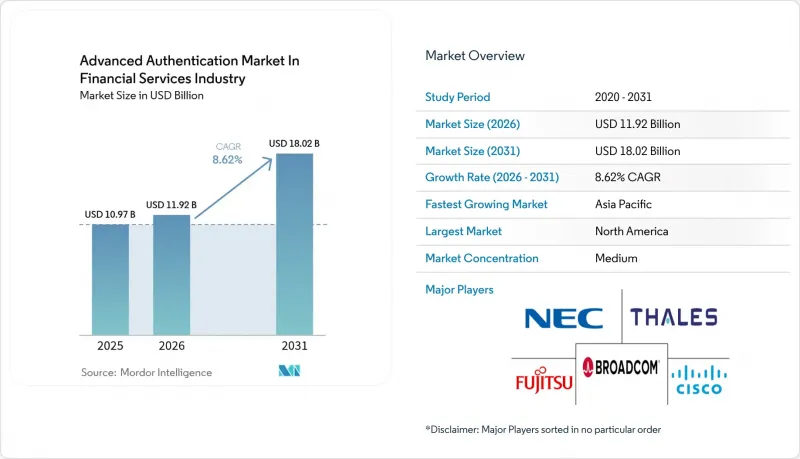
Mordor Intelligence에 의하면, 금융 서비스 업계 고급 인증 시장 규모는 2025년에 109억 7,000만 달러로 평가되었고, 2026년 119억 2,000만 달러에서 2031년까지 180억 2,000만 달러에 이를 것으로 예측되며, 예측 기간(2026-2031년) CAGR은 8.62%를 나타낼 전망입니다.
본 보고서는 인증 방식(스마트 카드, 생체 인증, 모바일 스마트 크레덴셜 등), 구성 요소(하드웨어, 소프트웨어, 서비스), 배포 유형(On-Premise 및 클라우드), 최종 사용자용도(소매 은행, 기업 및 투자 은행 업무 등), 그리고 지역별로 분류되어 있습니다. 시장 전망은 금액(달러) 단위로 제시되어 있습니다.
금융 서비스 산업의 고급 인증 시장에 대한 인사이트 및 동향
디지털 뱅킹 및 모바일 거래의 보급
성숙 시장에서 모바일 보급률은 2024년까지 소매 고객의 75%를 넘어설 것으로 예상되며, 북미 및 유럽에서는 지점 외 거래 전체의 60% 이상을 모바일 앱이 차지하고 있습니다. 이러한 급증으로 인해 은행들은 의사 결정 시간을 200밀리초 미만으로 단축할 수밖에 없게 되었으며, 백그라운드에서 원활하게 인증을 수행하는 생체 인증 및 행동 인증 기법에 대한 투자로 전환하고 있습니다. 2024년 상반기, 미국의 실시간 결제 처리액은 전년 동기 대비 47% 증가했으며, 다단계 송금 프로세스 전반에 걸쳐 지속적인 신원 확인이 요구되게 되었습니다. 규제 당국이 2024년 사고 보고서에서 지적한 딥페이크 공격의 300% 급증에 대응하기 위해, 생체 감지 기능이 모바일 소프트웨어 개발 키트(SDK)에 통합되고 있습니다. 동시에, 결제 카드 산업 데이터 보안 표준(PCI DSS) 버전 4.0에서는 30달러를 초과하는 모든 비대면 카드 거래에 다단계 인증이 의무화됨에 따라, 일회용 비밀번호에서 기기에 기본 탑재된 센서를 활용하는 생체 인증으로의 전환이 가속화되고 있습니다. 이러한 요인들이 맞물리면서 금융 서비스 업계의 고도화된 인증 시장 거래 규모는 분기마다 20퍼센트포인트 이상 증가하고 있으며, 이는 공급업체의 수익 확대를 뒷받침하고 있습니다.
강력한 고객 인증에 관한 규제 요건의 급증
유럽은행감독청(EBA)은 2024년, 저위험 거래의 면제 상한액을 100유로로 상향 조정하는 동시에, 부정 감지 엔진의 정확도를 99.5% 이상으로 유지할 것을 의무화했습니다. 이에 따라 세션당 2,000개 이상의 매개변수를 추적하는 행동 분석 기술의 도입이 촉진되고 있습니다. 2024년 10월, 인도 중앙은행은 5,000루피를 초과하는 모든 디지털 결제에 대해 추가 인증 요소를 의무화했습니다. 이 규정에 따라 인도 내 소매 거래의 78%에서 정적 비밀번호가 폐지될 예정입니다. 싱가포르 금융관리청은 2024년 3월 기술 위험 관리 프레임워크를 개정하고 고액 송금에 대한 위험 적응형 조치를 도입함에 따라, 위협 인텔리전스 피드를 통합할 수 있는 클라우드 플랫폼이 우위를 점하게 되었습니다. PCI DSS v4.0에서는 SMS를 통한 일회용 비밀번호가 특권 액세스에 부적합한 것으로 분류됨에 따라, 미국 은행들은 FIDO2 키 도입을 추진하고 있습니다. 이러한 중복되는 규제 요건들이 맞물려 신원 확인 기능에 대한 규제 최저 기준을 높임으로써, 금융 서비스 업계에서 고급 인증 시장에 대한 수요를 높이고 있습니다.
높은 도입 비용과 레거시 시스템과의 호환성 문제
2015년 이전에 도입된 핵심 시스템에는 네이티브 생체 인증 API가 탑재되어 있지 않아 미들웨어 계층을 사용해야만 하며, 이로 인해 비용이 최대 60%까지 증가할 가능성이 있습니다. 2024년에 120개 지역 은행을 대상으로 실시한 설문조사에서 67%가 통합의 복잡성을 가장 큰 장벽으로 꼽았으며, 은행당 추정 비용은 200만 달러에서 800만 달러에 달하는 것으로 나타났습니다. 메인프레임 커넥터는 지연을 유발하여 99.9%의 가용성을 요구하는 연방금융기관검사위원회(FFIEC)의 가동 시간 규정을 위반하게 됩니다. OTP 토큰이 예정보다 일찍 폐지될 경우, 더 이상 사용되지 않는 하드웨어 자산 비용은 사용자 1인당 12달러가 소요됩니다. 이러한 부담으로 인해 금융 서비스 업계의 고급 인증 시장 단기 성장 전망은 1퍼센트 포인트 가까이 하향 조정되었습니다.
부문 분석
2025년, 고급 인증 시장에서 생체 인증은 45.41%의 시장 점유율을 차지했습니다. 이는 모바일 로그인 시 지문 및 얼굴 인증의 보급을 반영한 것입니다. 대조적으로, 행동 생체 인증은 정적 템플릿으로는 감지할 수 없는 세션의 이상 징후를 식별할 수 있기 때문에 금융 서비스 업계의 고급 인증 시장 내에서 가장 높은 성장률인 연평균 성장률(CAGR) 11.12%를 나타낼 것으로 예측됩니다. 일회용 비밀번호(OTP) 토큰은 송금 승인 절차에서 여전히 확고히 자리 잡고 있지만, 피싱 공격에 강한 패스키가 보급됨에 따라 그 입지가 위협받고 있습니다. 보안 요소(Secure Element)에 내장된 모바일 스마트 자격 증명은 2024년에 450억 건 이상의 거래를 처리한 Apple Pay와 같은 전자 지갑의 부상을 타고 있습니다.
성장의 원동력은 로그인 시 지문 인증과 세션 전반에 걸친 지속적인 행동 모니터링을 결합한 다중 모드 전략에 달려 있습니다. 유연한 인증 방식에 대한 수요가 증가함에 따라 탈레스(Thales)는 2024년에 생체 인증 센서 출하량을 전년 대비 34% 증가시켰습니다. FIDO 얼라이언스의 데이터에 따르면, 이미 60억 대의 기기에 인증 기능이 내장되어 있어 은행이 하드웨어를 우편으로 발송할 필요가 없어졌습니다. 이러한 요인들이 결합되어 이 부문에서 금융 서비스 산업의 고도화된 인증 시장 매출 상한선을 끌어올리고 있습니다.
2025년에는 스마트 카드 리더기, 센서, OTP 생성기를 주력으로 하여 하드웨어가 매출의 44.35%를 차지했습니다. 그러나 클라우드 마이크로서비스를 통해 은행이 지연 요건을 충족하면서도 탄력적으로 확장할 수 있게 됨에 따라, 소프트웨어는 연평균 성장률(CAGR) 10.25%로 성장하며 금융 서비스 업계의 고도화된 인증 시장에서 매출 점유율을 확대해 나갈 전망입니다. 한편, 벤더들이 도입을 가속화하기 위해 통합 및 컨설팅 서비스를 구독 모델에 통합하는 움직임이 확대되면서, 이러한 서비스들은 가격 측면에서 압박을 받고 있습니다.
현재 금융 기관의 68%가 하이브리드 클라우드를 운영하고 있으며, 이를 통해 ‘인증 서비스(Authentication as a Service)’로의 길이 열리고 있습니다. Okta는 2024 회계연도에 1조 2,000억 건의 인증 이벤트를 처리하며 해당 소프트웨어의 높은 처리 능력을 입증했습니다. 하드웨어 보안 모듈(HSM)은 '신뢰의 근원(Root of Trust)' 기능에서 여전히 존재감을 유지하고 있지만, 정책 엔진이 소프트웨어로 전환됨에 따라 그 역할은 축소되고 있습니다. 이러한 변화가 금융 서비스 업계의 고급 인증 시장 확대를 더욱 견인하고 있습니다.
지역별 분석
연방금융기관검사위원회(FFIEC)가 SMS 코드를 고위험 거래에 부적합하다고 분류함에 따라, 북미는 2025년 매출의 36.85%를 차지했습니다. 아시아태평양은 5,000 루피를 초과하는 결제에 추가 인증 요소를 의무화하는 인도 중앙은행의 규정과 적응형 인증을 추진하는 싱가포르의 규제로 인해 연평균 성장률(CAGR) 11.09%를 나타낼 것으로 전망됩니다.
아시아태평양은 2024년에 가장 빠른 매출 성장률을 기록했습니다. 이는 스마트폰을 통한 금융 거래의 68%를 차지하는 ‘모바일 퍼스트’ 은행 아키텍처에 힘입은 것으로, 북미의 52%에 비해 높은 비율을 보입니다. 인도 중앙은행의 지침만으로도 2030년까지 14억 명 이상의 모바일 가입자를 대상으로할 것으로 예상되며, 은행들이 기기 신호 및 행동 신호를 통합 리스크 엔진에 반영함에 따라 금융 서비스 업계의 고도화된 인증 시장이 확대될 것입니다. 중국의 4대 은행은 2024년 시범 지점에서 손바닥 정맥 인증 솔루션을 도입하여 해당 지역의 알고리즘 다양성을 높였습니다.
유럽에서는 PSD2 준수 프로그램이 성숙해짐에 따라 꾸준하지만 완만한 성장을 기록했습니다. 그러나 100유로 미만 거래에 대해서는 위험 분석 면제를 허용하는 유럽은행감독청(EBA)의 2024년 개정안에 따라 행동 생체 인식의 활용 확대가 촉진되어, 전자상거래 결제 프로세스에서의 마찰이 완화되고 있습니다. 북유럽의 발행 기관들은 현재 전화 뱅킹을 위한 음성 생체 인식의 시범 도입을 진행 중이며, 이는 멀티채널 전략에 새로운 요소를 더하고 있습니다.
북미의 성장은 실시간 결제와 지점 현대화에 중점을 두고 있습니다. 미국의 신용협동조합은 무인 지점을 지원하기 위해 FIDO2 키를 채택하고 있는 반면, 캐나다 은행들은 웨어러블 기기에 하드웨어 인증 기능을 통합하고 있습니다. 지역 차원의 고도화된 인증 시장 규모는 2031년까지 66억 4,000만 달러에 달하고, 전 세계 수요의 36.85%를 차지할 것으로 예측되며, 이는 금융 서비스 산업 내 고도화된 인증 시장의 전략적 중요성을 부각시키고 있습니다.
기타 혜택:
- 엑셀 형식 시장 예측(ME) 시트
- 3개월간의 애널리스트 지원
자주 묻는 질문
목차
제1장 서론
제2장 조사 방법
제3장 주요 요약
제4장 시장 구도
제5장 시장 규모와 성장 예측
제6장 경쟁 구도
제7장 시장 기회와 향후 전망
KTH 26.08.06According to Mordor Intelligence, the advanced authentication market size in the financial services industry was valued at USD 10.97 billion in 2025 and estimated to grow from USD 11.92 billion in 2026 to reach USD 18.02 billion by 2031, at a CAGR of 8.62% during the forecast period (2026-2031).
This report is Segmented by Authentication Type (Smartcards, Biometrics, Mobile Smart Credentials, and More), Component (Hardware, Software, and Services), Deployment Mode (On-Premise and Cloud), End-User Application (Retail Banking, Corporate and Investment Banking, and More), and Geography. The Market Forecasts are Provided in Value (USD).
Insights and Trends of Advanced Authentication Market In Financial Services Industry
Proliferation of Digital Banking and Mobile Transactions
Mobile penetration is expected to surpass 75% of retail clients in mature markets by 2024, and mobile apps now account for more than 60% of all non-branch transactions in North America and Europe. The surge compels banks to compress decision windows below 200 milliseconds, shifting investment toward biometric and behavioral methods that authenticate silently in the background. U.S. real-time payment volumes advanced 47% year over year in H1-2024, prompting demand for continuous identity assurance throughout multi-step transfers. Liveness detection is being embedded inside mobile software development kits to counter the 300% spike in deepfake attacks that regulators highlighted in 2024 incident reports. At the same time, the Payment Card Industry Data Security Standard version 4.0 requires multi-factor authentication for every card-not-present purchase exceeding USD 30, accelerating the replacement of one-time passwords with biometrics that utilize device-native sensors. Collectively, these factors add more than twenty percentage points of volume to the advanced authentication market in the financial services industry each quarter, fuelling vendor revenue expansion.
Surge in Regulatory Mandates for Strong Customer Authentication
The European Banking Authority expanded low-risk transaction exemptions to EUR 100 in 2024, while simultaneously requiring fraud-detection engines to achieve 99.5% accuracy, prompting the adoption of behavioral analytics that track over 2,000 parameters per session. In October 2024, the Reserve Bank of India mandated an additional factor for every digital payment above INR 5,000, a rule that eliminates static passwords for 78% of retail transactions in the country. Singapore's Monetary Authority revised its Technology Risk Management framework in March 2024, introducing risk-adaptive measures for high-value transfers, thereby favoring cloud platforms capable of ingesting threat intelligence feeds. PCI DSS v4.0 now classifies SMS one-time passwords as inadequate for privileged access, prompting U.S. banks to adopt FIDO2 keys. Collectively, these overlapping mandates lift demand for the advanced authentication market in the financial services industry by raising the regulatory floor for identity verification capabilities.
High Implementation Costs and Legacy Compatibility Challenges
Core systems deployed before 2015 lack native biometric application programming interfaces, which forces the use of middleware layers that can inflate costs by up to 60%. A 2024 survey of 120 community banks found that 67% cited integration complexity as the top barrier, with estimated spending ranging from USD 2 million to USD 8 million per institution. Mainframe connectors introduce latency that conflicts with Federal Financial Institutions Examination Council (FFIEC) uptime rules, which require 99.9% availability. Stranded hardware assets cost USD 12 per user when OTP tokens are decommissioned ahead of schedule. These burdens shave nearly one percentage point off the projected growth of the advanced authentication market in the financial services industry in the near term.
Other drivers and restraints analyzed in the detailed report include:
- Escalating Cybersecurity Threats and Fraud Losses
- Growing Integration of Behavioral Biometrics in Risk-Based Platforms
- Data-Privacy Concerns over Biometric Storage and Usage
For complete list of drivers and restraints, kindly check the Table Of Contents.
Segment Analysis
Biometrics commanded a 45.41% market share in the advanced authentication market in 2025, reflecting the widespread use of fingerprint and facial scans during mobile logins. In contrast, behavioral biometrics is projected to post an 11.12% CAGR, the fastest growth rate within the advanced authentication market in the financial services industry, as it uncovers session anomalies that static templates miss. One-time password tokens remain entrenched in wire-approval flows but are being supplanted as phishing-resistant passkeys proliferate. Mobile smart credentials, anchored in secure elements, are riding the rise of wallets like Apple Pay, which processed more than 45 billion transactions in 2024.
Growth dynamics hinge on multi-modal strategies that combine fingerprint verification at entry with continuous behavioral monitoring throughout the session. Thales shipped 34% more biometric sensors in 2024 amid demand for flexible modality choices. FIDO Alliance data show 6 billion devices already contain embedded authenticators, obviating the need for banks to mail hardware. Together, these factors raise the revenue ceiling for the advanced authentication market in the financial services industry across this segment.
Hardware supplied 44.35% of revenue in 2025, anchored by smartcard readers, sensors, and OTP generators. Yet, software will grow at a 10.25% CAGR, expanding its revenue share of the advanced authentication market in the financial services industry as cloud microservices enable banks to scale elastically while meeting latency requirements. Integration and consulting services face fee pressure as vendors fold them into subscription models for faster adoption.
Sixty-eight percent of financial institutions now operate hybrid clouds, clearing the path for authentication as a service. Okta processed 1.2 trillion authentication events in fiscal 2024, showing the software's volume capacity. Hardware security modules persist for root-of-trust functions but play a narrower role as policy engines migrate to software. This shift drives another phase of expansion in the advanced authentication market in the financial services industry.
Complete Report Scope:
- By Authentication Type
- Smartcards
- Biometrics (fingerprint, facial, iris, voice)
- Mobile Smart Credentials
- One-Time Password Tokens
- Behavioral Biometrics
- By Component
- Hardware
- Software
- Services
- By Deployment Mode
- On-Premise
- Cloud
- By End-User Application
- Retail Banking
- Corporate and Investment Banking
- Payment Cards and Digital Payments
- Insurance
- Wealth Management and FinTech Platforms
- Other End-User Applications
- By Geography
- North America
- United States
- Canada
- Mexico
- South America
- Brazil
- Argentina
- Rest of South America
- Europe
- Germany
- United Kingdom
- France
- Italy
- Spain
- Russia
- Rest of Europe
- Asia-Pacific
- China
- Japan
- India
- South Korea
- Australia
- Rest of Asia-Pacific
- Middle East and Africa
- Middle East
- Saudi Arabia
- United Arab Emirates
- Turkey
- Rest of Middle East
- Africa
- South Africa
- Nigeria
- Egypt
- Rest of Africa
- Middle East
- North America
Geography Analysis
North America captured 36.85% of 2025 revenue after the Federal Financial Institutions Examination Council classified SMS codes as insufficient for high-risk actions. The Asia-Pacific is poised for an 11.09% CAGR due to the Reserve Bank of India's rules, which apply an extra factor for payments above INR 5,000, and Singapore's regulations promoting adaptive authentication.
The Asia-Pacific region produced the fastest revenue growth during 2024, driven by mobile-first banking architectures that account for 68% of financial transactions on smartphones, compared with 52% in North America. Reserve Bank of India directives alone will govern more than 1.4 billion mobile subscribers by 2030, expanding the advanced authentication market in the financial services industry as banks integrate device and behavioral signals into unified risk engines. China's big four banks adopted palm-vein solutions in 2024 pilot branches, boosting regional algorithm diversity.
Europe recorded steady but slower gains as PSD2 compliance programs matured. Yet, the European Banking Authority's 2024 update, which allows transaction-risk analysis exemptions below EUR 100, encourages the broader use of behavioral biometrics and reduces friction in e-commerce checkouts. Nordic issuers are now testing voice biometrics for telephone banking, adding another inherent factor to their multi-channel strategies.
North America's growth centers on real-time payments and branch modernization. U.S. credit unions have adopted FIDO2 keys to support cashierless branches, while Canadian banks are embedding hardware attestation in wearable devices. The advanced authentication market size at the regional level is projected to reach USD 6.64 billion by 2031, accounting for 36.85% of global demand, underscoring its strategic significance within the advanced authentication market in the financial services industry.
- Thales Group
- NEC Corporation
- Broadcom Inc.
- Fujitsu Limited
- Cisco Systems Inc. (Duo Security LLC)
- Okta Inc.
- HID Global Corporation (Assa Abloy AB)
- Ping Identity Holding Corp.
- RSA Security LLC
- Daon Inc.
- BioCatch Ltd.
- Validsoft Ltd.
- ForgeRock Inc.
- PistolStar Inc.
- SecurEnvoy Ltd.
- Micro Focus International plc (NetIQ)
- Yubico AB
- Lumidigm Inc.
Additional Benefits:
- The market estimate (ME) sheet in Excel format
- 3 months of analyst support
TABLE OF CONTENTS
1 INTRODUCTION
- 1.1 Study Assumptions and Market Definition
- 1.2 Scope of the Study
2 RESEARCH METHODOLOGY
3 EXECUTIVE SUMMARY
4 MARKET LANDSCAPE
- 4.1 Market Overview
- 4.2 Market Drivers
- 4.2.1 Proliferation of digital banking and mobile transactions
- 4.2.2 Surge in regulatory mandates for strong customer authentication
- 4.2.3 Escalating cybersecurity threats and fraud losses
- 4.2.4 Growing integration of behavioral biometrics in risk-based platforms
- 4.2.5 Adoption of decentralized identity frameworks and self-sovereign wallets
- 4.2.6 Rise of passwordless FIDO2 in ATM and branch journeys
- 4.3 Market Restraints
- 4.3.1 High implementation costs and legacy compatibility challenges
- 4.3.2 Data-privacy concerns over biometric storage and usage
- 4.3.3 Transaction-latency sensitivity in high-frequency trading
- 4.3.4 Vendor lock-in risk from proprietary authentication ecosystems
- 4.4 Industry Value Chain Analysis
- 4.5 Regulatory Landscape
- 4.6 Technological Outlook
- 4.7 Porter's Five Forces Analysis
- 4.7.1 Threat of New Entrants
- 4.7.2 Bargaining Power of Buyers/Consumers
- 4.7.3 Bargaining Power of Suppliers
- 4.7.4 Threat of Substitute Products
- 4.7.5 Intensity of Competitive Rivalry
- 4.8 Impact of Macroeconomic Factors
- 4.9 Investment Analysis
5 MARKET SIZE AND GROWTH FORECASTS (VALUE)
- 5.1 By Authentication Type
- 5.1.1 Smartcards
- 5.1.2 Biometrics (fingerprint, facial, iris, voice)
- 5.1.3 Mobile Smart Credentials
- 5.1.4 One-Time Password Tokens
- 5.1.5 Behavioral Biometrics
- 5.2 By Component
- 5.2.1 Hardware
- 5.2.2 Software
- 5.2.3 Services
- 5.3 By Deployment Mode
- 5.3.1 On-Premise
- 5.3.2 Cloud
- 5.4 By End-User Application
- 5.4.1 Retail Banking
- 5.4.2 Corporate and Investment Banking
- 5.4.3 Payment Cards and Digital Payments
- 5.4.4 Insurance
- 5.4.5 Wealth Management and FinTech Platforms
- 5.4.6 Other End-User Applications
- 5.5 By Geography
- 5.5.1 North America
- 5.5.1.1 United States
- 5.5.1.2 Canada
- 5.5.1.3 Mexico
- 5.5.2 South America
- 5.5.2.1 Brazil
- 5.5.2.2 Argentina
- 5.5.2.3 Rest of South America
- 5.5.3 Europe
- 5.5.3.1 Germany
- 5.5.3.2 United Kingdom
- 5.5.3.3 France
- 5.5.3.4 Italy
- 5.5.3.5 Spain
- 5.5.3.6 Russia
- 5.5.3.7 Rest of Europe
- 5.5.4 Asia-Pacific
- 5.5.4.1 China
- 5.5.4.2 Japan
- 5.5.4.3 India
- 5.5.4.4 South Korea
- 5.5.4.5 Australia
- 5.5.4.6 Rest of Asia-Pacific
- 5.5.5 Middle East and Africa
- 5.5.5.1 Middle East
- 5.5.5.1.1 Saudi Arabia
- 5.5.5.1.2 United Arab Emirates
- 5.5.5.1.3 Turkey
- 5.5.5.1.4 Rest of Middle East
- 5.5.5.2 Africa
- 5.5.5.2.1 South Africa
- 5.5.5.2.2 Nigeria
- 5.5.5.2.3 Egypt
- 5.5.5.2.4 Rest of Africa
- 5.5.5.1 Middle East
- 5.5.1 North America
6 COMPETITIVE LANDSCAPE
- 6.1 Market Concentration
- 6.2 Strategic Moves
- 6.3 Market Share Analysis
- 6.4 Company Profiles (includes Global level Overview, Market level overview, Core Segments, Financials as available, Strategic Information, Market Rank/Share for key companies, Products and Services, and Recent Developments)
- 6.4.1 Thales Group
- 6.4.2 NEC Corporation
- 6.4.3 Broadcom Inc.
- 6.4.4 Fujitsu Limited
- 6.4.5 Cisco Systems Inc. (Duo Security LLC)
- 6.4.6 Okta Inc.
- 6.4.7 HID Global Corporation (Assa Abloy AB)
- 6.4.8 Ping Identity Holding Corp.
- 6.4.9 RSA Security LLC
- 6.4.10 Daon Inc.
- 6.4.11 BioCatch Ltd.
- 6.4.12 Validsoft Ltd.
- 6.4.13 ForgeRock Inc.
- 6.4.14 PistolStar Inc.
- 6.4.15 SecurEnvoy Ltd.
- 6.4.16 Micro Focus International plc (NetIQ)
- 6.4.17 Yubico AB
- 6.4.18 Lumidigm Inc.
7 MARKET OPPORTUNITIES AND FUTURE OUTLOOK
- 7.1 White-space and Unmet-need Assessment


