

|
시장보고서
상품코드
2097094
암 단일클론항체 : 시장 점유율 분석, 업계 동향 및 통계, 성장 예측(2026-2031년)Cancer Monoclonal Antibodies - Market Share Analysis, Industry Trends & Statistics, Growth Forecasts (2026 - 2031) |
||||||
 Mordor Intelligence
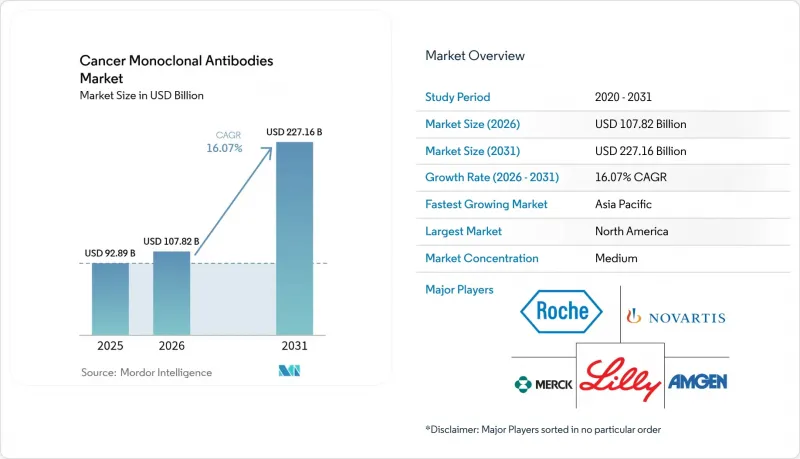
Mordor Intelligence에 의하면, 암 단일클론항체 시장 규모는 2025년 928억 9,000만 달러로 평가되었습니다. 2026년에는 1,078억 2,000만 달러로 확대되어 2026년부터 2031년에 걸쳐 CAGR 16.07%로 성장을 지속하여, 2031년에는 2,271억 6,000만 달러에 이를 것으로 예측됩니다.
본 보고서에서는 업계를 '항체의 유래(마우스 유래, 키메라형 등)', '단일클론항체 치료제(베바시주맙, 트라스투주맙 등)', '암 적응증(유방암 등)', '유통 채널(병원 약국 등)', '지역(북미, 유럽, 아시아태평양, 중동 및 아프리카, 남미)' 항목별로 분류하고 있습니다. 시장 전망은 금액(달러) 기준으로 제시되어 있습니다.
세계의 암 단일클론항체 시장 동향 및 인사이트
세계 암 발병률 상승
암 환자 수는 2022년 2,000만 건에서 2050년에는 3,500만 건으로 증가할 것으로 예측되며, 이는 77%의 급증에 해당하여 폐암, 유방암, 대장암 환자층을 확대시킬 것입니다. 선진국의 고령화와 신흥 경제국의 라이프스타일 변화로 인해 표적 생물학적 제제에 대한 수요가 증가하고 있습니다. 암 단일클론항체 시장은 단일클론항체가 정밀 종양학 프로토콜에 따른 종양 특이적 작용을 발휘한다는 점에서 혜택을 받고 있습니다. 저·중소득 국가에서는 환자 수가 가장 빠르게 증가하고 있어 접근성 문제가 발생하고 있는 반면, 비용이 최적화된 바이오시밀러에게는 미개척 시장이 열리고 있습니다. 이러한 인구 동향의 급증으로 인해, 현재 예측 기간을 훨씬 넘어 매출 성장이 지속될 것으로 전망됩니다.
종양학 분야에 대한 연구개발비 배분 증가
종양학 분야는 바이오의약품 연구개발 예산에서 가장 큰 비중을 차지하고 있으며, 현재 종양학 임상시험의 35%가 항체-약물 복합체(ADC) 또는 다중 특이성 화합물과 관련되어 있습니다. 개발 생산성 향상과 블록버스터급 인수?브리스톨-마이어스 스퀴브사의 58억 달러 규모 미라티 인수, 일라이 릴리의 14억 달러 규모 포인트 바이오파마 인수?가 후기 개발 단계의 파이프라인을 강화하고 있습니다. 자본 유입은 활발한 제휴 활동을 촉진하고, 기술적 노하우를 제공하며, 혁신의 위험을 완화함으로써 암 치료용 단일클론항체 시장에서 ‘퍼스트-인-클래스’ 신약이 지속적으로 출시될 수 있도록 하고 있습니다.
엄격한 규제 및 안전성 모니터링
규제 당국은 바이스페시픽 항체 및 ADC(항체-약물 복합체)에 대해 통합된 안전성 데이터를 요구하고 있으며, 소아 대상 임상시험 규정 및 비교 유효성 평가가 추가됨에 따라 개발 기간과 비용이 증가하고 있습니다. 유럽에서의 공동 임상 평가를 통해 증거 기준은 더욱 높아지고 있습니다. 중소기업은 자원 부족에 직면해 있으며, 규제 대응 인프라를 갖춘 대기업과의 라이선싱 계약이나 M&A로 내몰리고 있습니다.
부문 분석
휴머니화 항체는 2025년 매출의 50.62%를 차지하며, 블록버스터급 암 치료 요법에서 확고한 입지를 입증했습니다. 암 단일클론항체 시장에서는 현재 완전 인간형 항체의 채택이 가속화되고 있으며, 뛰어난 안전성과 병용 요법에서의 사용 확대를 배경으로 2031년까지 연평균 성장률(CAGR)이 18.59%를 나타낼 것으로 전망됩니다. 제조 공정의 간편성과 규제 측면에서의 우위 덕분에, 완전 인간형 항체는 예측 기간 동안 틈새 시장에서 주류 시장으로 전환될 전망입니다.
파이프라인 플랫폼에서는 트랜스제닉 마우스와 파지 디스플레이를 활용하여, 기존에는 치료가 어려웠던 표적을 다루는 다양한 완전 인간형 후보 물질을 창출하고 있습니다. 면역원성이 감소함에 따라 재치료 위험이 낮아지고, 삶의 질(QOL)도 향상됩니다. 비용이 낮아짐에 따라 보험사들은 조기 치료에 대한 자금 지원에 더욱 적극적으로 나서고 있으며, 이러한 추세를 뒷받침하고 있습니다. 신속한 승인 절차가 장점이 되는 특수한 상황을 제외하면, 마우스 유래 및 키메라형 제제는 시장 점유율이 하락하고 있습니다. 완전 인간형 후보 약물로 신속하게 전환하는 기업은 암 단일클론항체 시장에서 경쟁사를 앞설 가능성이 높다고 볼 수 있습니다.
트라스투주맙은 의료진의 깊은 이해와 HER2 양성 유방암에 대한 확고한 근거 덕분에 2025년 암 단일클론항체 시장에서 16.72%의 점유율을 차지했습니다. 그러나 ADC 및 이중 특이성 항체를 중심으로 한 혁신의 물결이 ‘기타’ 부문을 견인하고 있으며, 해당 부문은 연평균 20.61%의 성장률을 보이고 있습니다. HER2 저발현 질환에 대한 트라스투주맙-델크스테칸 등의 신규 승인으로 인해 더 폭넓은 환자층이 혜택을 보고 있습니다. 에프코리타맙 바이스푸는 여포성 림프종에서 82%의 반응률을 보여 이중 특이성 항체의 유효성을 입증함과 동시에, 기존의 단일 표적 제제에 대한 관심을 돌리고 있습니다.
항체와 체크포인트 억제제, 저분자 약물의 전략적 병용을 통해 반응의 깊이가 향상되면서 차세대 약물의 수익 기반이 확대되고 있습니다. 바이오시밀러의 부상으로 트라스투주맙의 가치는 하락하고 있으나, 판매량은 증가하고 있어 해당 부문의 수익을 뒷받침하고 있습니다. 그 결과, 새로운 기전을 가진 약물이 시장 점유율을 서서히 확대하는 한편, 확립된 브랜드는 라이프사이클 관리를 통해 존재감을 유지하는 등, 다양화된 치료법 구도가 형성되고 있습니다.
지역별 분석
북미는 견실한 임상시험 생태계와 유리한 지불자 정책에 힘입어 2025년에는 전 세계 매출의 41.78%를 차지하며 선두 자리를 유지했습니다. 실제 임상 데이터(Real-World Evidence) 요건이 주목받는 가운데, 생명과학 기업들은 가치 기반 계약을 뒷받침하는 종단적 환자 등록 시스템 구축을 추진하고 있습니다. 펨브롤리주맙의 피하 투여 승인은 의료기관의 부담을 줄이고 원격 종양학의 도입을 지원하는 환자 중심의 투여 방식에 대한 해당 지역의 노력을 상징합니다.
아시아태평양은 2031년까지 연평균 성장률(CAGR) 18.92%라는 가장 높은 성장률을 기록하고 있으며, 이는 암 치료 예산 확대, 인구 고령화, 그리고 규제 당국이 뒷받침하는 신속 승인 절차를 반영한 것입니다. 중국의 Akeso사가 개발한 이보네시맙은 진행까지의 기간에서 키트루다를 능가하는 성과를 보여, 국내에서의 신뢰를 높이는 동시에 현지 항체 플랫폼에 대한 자본 유치를 이끌고 있습니다(cnn.com). 민간 건강보험의 보급으로 치료비 부담이 완화되는 한편, 민관 파트너십을 통해 주요 도시권 근교에 바이오 제조 단지에 대한 자금 지원이 이루어지고 있습니다.
유럽에서는 승인 절차를 효율화하면서 예산을 관리하는 공동 임상 평가를 통해 균형 잡힌 접근성을 실현하고자 하고 있습니다. 림보셀타맙을 포함한 획기적인 항체에 대한 조건부 판매 승인은 미충족 의료 수요가 높은 과제를 해결하는 유연성을 보여주고 있습니다. 바이오시밀러의 높은 보급률이 가격에 압박을 가하고 있지만, 공급량 증가로 치료의 지속성이 확보되며 차세대 의약품 개발을 위한 자금이 마련되고 있습니다.
중동 및 아프리카 및 남미에서는 각국 정부가 보편적 의료 보장(UHC) 청사진에서 암 치료를 우선 과제로 삼고 있어, 추가적인 성장이 예상됩니다. 수입 주기를 단축하는 충전·포장 공장에 대한 외국인 직접 투자가 유입되고 있습니다. 유연한 가격 책정 및 환자 지원 프로그램을 통해 경제적 부담의 장벽이 완화되어, 재정 건전성을 훼손하지 않으면서 치료의 보급 범위가 확대되고 있습니다. 이러한 움직임들이 맞물려 암 단일클론항체 시장의 지리적 범위가 확대되고 있습니다.
기타 혜택 :
- 엑셀 형식 시장 예측(ME) 시트
- 3개월간의 애널리스트 지원
자주 묻는 질문
목차
제1장 서론
제2장 조사 방법
제3장 주요 요약
제4장 시장 구도
제5장 시장 규모 및 성장 예측
제6장 경쟁 구도
제7장 시장 기회 및 향후 전망
KTH 26.08.05According to Mordor Intelligence, the cancer monoclonal antibodies market size is expected to grow from USD 92.89 billion in 2025 to USD 107.82 billion in 2026 and is forecast to reach USD 227.16 billion by 2031 at 16.07% CAGR over 2026-2031.
This report Segments the Industry Into by Source of Antibody (Murine, Chimeric, and More), Monoclonal Antibody Therapy (Bevacizumab, Trastuzumab, and More), Cancer Application (Breast Cancer, and More), Distribution Channel (Hospital Pharmacies, and More), and Geography (North America, Europe, Asia-Pacific, Middle East and Africa, South America). The Market Forecasts are Provided in Terms of Value (USD).
Global Cancer Monoclonal Antibodies Market Trends and Insights
Rising Global Cancer Incidence
Cancer incidence climbs from 20 million cases in 2022 to a projected 35 million in 2050, a 77% jump that expands patient pools across lung, breast, and colorectal cancers. Aging populations in developed regions and lifestyle changes in emerging economies intensify demand for targeted biologics. The cancer monoclonal antibodies market benefits as monoclonal antibodies deliver tumor-specific action that aligns with precision oncology protocols. Low- and middle-income countries witness the fastest case growth, creating access challenges yet opening underserved markets for cost-optimized biosimilars. This demographic surge sustains top-line growth well beyond current forecast windows.
Increasing Allocation to Oncology R&D
Oncology commands the highest share of biopharmaceutical R&D budgets, and 35% of oncology trials now involve antibody-drug conjugates or multispecific constructs. Improved development productivity and blockbuster acquisitions, Bristol Myers Squibb's USD 5.8 billion Mirati buyout, Eli Lilly's USD 1.4 billion Point Biopharma deal strengthen late-stage pipelines. Capital flows foster robust partnership activity that injects technical know-how and de-risks innovation, allowing the cancer monoclonal antibodies market to secure continual first-in-class launches.
Stringent Regulatory and Safety Monitoring
Agencies demand integrated safety data for bispecifics and ADCs, adding pediatric study rules and comparative-effectiveness reviews that stretch timelines and cost outlays. European joint clinical assessments further raise evidence thresholds. Small companies face resource gaps, nudging them into licensing deals or M&A with larger players that possess the regulatory infrastructure.
Other drivers and restraints analyzed in the detailed report include:
- Proven Clinical Success of Humanized and Fully-Human mAbs
- Emergence of Bispecific Antibodies and Antibody-Drug Conjugates
- Manufacturing Bottlenecks in Bioreactor and Raw Material Supply
For complete list of drivers and restraints, kindly check the Table Of Contents.
Segment Analysis
Humanized antibodies delivered 50.62% of 2025 revenue, underscoring their heritage in blockbuster oncology regimens. The cancer monoclonal antibodies market now witnesses accelerated uptake of fully-human antibodies, which post a 18.59% CAGR through 2031 on the back of superior safety and rising use in combination protocols. Manufacturing process simplicity and favorable regulatory profiles position fully-human constructs to migrate from niche to mainstream over the forecast period.
Pipeline platforms leverage transgenic mice and phage display to generate diversified fully-human candidates that tackle traditionally hard targets. Lower immunogenicity cuts retreatment risk and improves quality-of-life scores. As costs fall, payers gain comfort funding earlier-line use, reinforcing trajectory. Murine and chimeric formats lose ground except in specialized settings where rapid clearance confers benefit. Firms pivoting rapidly to fully-human candidates are likely to outpace rivals in the cancer monoclonal antibodies market.
Trastuzumab held 16.72% of cancer monoclonal antibodies market share in 2025 owing to deep physician familiarity and robust evidence in HER2-positive breast cancer. However, an innovation wave centered on ADCs and bispecifics fuels the "Others" bucket, which grows 20.61% annually. New approvals, such as trastuzumab deruxtecan for HER2-low disease, extend benefit to broader patient subsets. Epcoritamab-bysp posted an 82% response rate in follicular lymphoma, proving bispecific potency and drawing attention away from older single-target constructs.
Strategic layering of antibodies with checkpoint inhibitors or small molecules enhances depth of response, widening the revenue base for next-generation agents. Biosimilar erosion trims trastuzumab value but drives volume, cushioning segment revenue. The end result is a diversified therapy mix in which novel mechanisms progressively tilt market share yet established brands conserve relevance through life-cycle management.
Complete Report Scope:
- By Source of Antibody
- Murine
- Chimeric
- Humanized
- Fully-Human
- By Monoclonal Antibody Therapy
- Bevacizumab
- Trastuzumab
- Rituximab
- Cetuximab
- Daratumumab
- Others
- By Cancer Application
- Breast Cancer
- Blood Cancer
- Colorectal Cancer
- Lung Cancer
- Liver & GI Cancer
- Other Solid Tumour
- By Distribution Channel
- Hospital Pharmacies
- Retail Pharmacies
- Online Pharmacies
- By Geography
- North America
- United States
- Canada
- Mexico
- Europe
- Germany
- United Kingdom
- France
- Italy
- Spain
- Rest of Europe
- Asia-Pacific
- China
- Japan
- India
- Australia
- South Korea
- Rest of Asia-Pacific
- Middle East & Africa
- GCC
- South Africa
- Rest of Middle East & Africa
- South America
- Brazil
- Argentina
- Rest of South America
- North America
Geography Analysis
North America maintains first place with 41.78% of global revenue in 2025, helped by robust clinical-trial ecosystems and favorable payer policies. Real-world evidence requirements gain traction, prompting life-science firms to set up longitudinal patient registries that support value-based contracts. Subcutaneous pembrolizumab approval exemplifies the region's push for patient-centric dosing that trims facility burden and supports tele-oncology rollouts.
Asia-Pacific records the fastest growth at 18.92% CAGR to 2031, reflecting bigger oncology budgets, demographic aging, and regulator-backed accelerated pathways. China's Akeso produced ivonescimab, which outperformed Keytruda in time-to-progression, strengthening domestic confidence and luring capital into local antibody platforms cnn.com. Commercial health insurance penetration widens affordability, while public-private partnerships finance biomanufacturing parks near major urban centers.
Europe pursues balanced access through joint clinical assessments that streamline approvals yet guard budgets. Conditional marketing authorizations for breakthrough antibodies, including linvoseltamab, showcase agility in addressing high unmet need. High biosimilar uptake pressures prices, but volume increases maintain therapy availability and free funds for next-generation constructs.
Middle East & Africa and South America add incremental upside as governments prioritize oncology in universal-health-coverage blueprints. Foreign direct investment flows into fill-and-finish plants that shorten import cycles. Flexible pricing and patient-assistance programs mitigate affordability barriers, expanding therapy reach without compromising fiscal prudence. Collectively, these moves broaden the geographic footprint of the cancer monoclonal antibodies market.
- Roche
- Merck
- Bristol-Myers Squibb
- Amgen
- Novartis
- Johnson & Johnson
- AstraZeneca
- Eli Lilly and Company
- Pfizer
- GlaxoSmithKline
- Regeneron Pharmaceuticals
- Abbvie
- Seagen
- Daiichi Sankyo Co. Ltd
- Sanofi
- Genmab
- BeiGene
- Spectrum Pharmaceuticals
- Mitsubishi Tanabe Pharma
- Wuxi Biologics
Additional Benefits:
- The market estimate (ME) sheet in Excel format
- 3 months of analyst support
TABLE OF CONTENTS
1 Introduction
- 1.1 Study Assumptions & Market Definition
- 1.2 Scope of the Study
2 Research Methodology
3 Executive Summary
4 Market Landscape
- 4.1 Market Overview
- 4.2 Market Drivers
- 4.2.1 Rising Global Cancer Incidence
- 4.2.2 Increasing Allocation to Oncology R&D
- 4.2.3 Proven Clinical Success of Humanized and Fully Human mAbs
- 4.2.4 Emergence of Bispecific Antibodies and Antibody-Drug Conjugates (ADCs)
- 4.2.5 Adoption of AI-Driven Antibody Engineering
- 4.2.6 Shift Toward Value-Based Oncology Care Models
- 4.3 Market Restraints
- 4.3.1 Stringent Regulatory and Safety Monitoring
- 4.3.2 High Clinical Attrition Rates and Lengthy Development Cycles
- 4.3.3 Manufacturing Bottlenecks in Bioreactor and Raw Material Supply
- 4.3.4 Growing Competition from Advanced Modalities
- 4.4 Regulatory Landscape
- 4.5 Porter's Five Forces Analysis
- 4.5.1 Threat of New Entrants
- 4.5.2 Bargaining Power of Buyers
- 4.5.3 Bargaining Power of Suppliers
- 4.5.4 Threat of Substitutes
- 4.5.5 Intensity of Competitive Rivalry
5 Market Size & Growth Forecasts (Value in USD)
- 5.1 By Source of Antibody
- 5.1.1 Murine
- 5.1.2 Chimeric
- 5.1.3 Humanized
- 5.1.4 Fully-Human
- 5.2 By Monoclonal Antibody Therapy
- 5.2.1 Bevacizumab
- 5.2.2 Trastuzumab
- 5.2.3 Rituximab
- 5.2.4 Cetuximab
- 5.2.5 Daratumumab
- 5.2.6 Others
- 5.3 By Cancer Application
- 5.3.1 Breast Cancer
- 5.3.2 Blood Cancer
- 5.3.3 Colorectal Cancer
- 5.3.4 Lung Cancer
- 5.3.5 Liver & GI Cancer
- 5.3.6 Other Solid Tumour
- 5.4 By Distribution Channel
- 5.4.1 Hospital Pharmacies
- 5.4.2 Retail Pharmacies
- 5.4.3 Online Pharmacies
- 5.5 By Geography
- 5.5.1 North America
- 5.5.1.1 United States
- 5.5.1.2 Canada
- 5.5.1.3 Mexico
- 5.5.2 Europe
- 5.5.2.1 Germany
- 5.5.2.2 United Kingdom
- 5.5.2.3 France
- 5.5.2.4 Italy
- 5.5.2.5 Spain
- 5.5.2.6 Rest of Europe
- 5.5.3 Asia-Pacific
- 5.5.3.1 China
- 5.5.3.2 Japan
- 5.5.3.3 India
- 5.5.3.4 Australia
- 5.5.3.5 South Korea
- 5.5.3.6 Rest of Asia-Pacific
- 5.5.4 Middle East & Africa
- 5.5.4.1 GCC
- 5.5.4.2 South Africa
- 5.5.4.3 Rest of Middle East & Africa
- 5.5.5 South America
- 5.5.5.1 Brazil
- 5.5.5.2 Argentina
- 5.5.5.3 Rest of South America
- 5.5.1 North America
6 Competitive Landscape
- 6.1 Market Concentration
- 6.2 Market Share Analysis
- 6.3 Company Profiles (includes Global level Overview, Market level overview, Core Segments, Financials as available, Strategic Information, Market Rank/Share for key companies, Products & Services, and Recent Developments)
- 6.3.1 F. Hoffmann-La Roche Ltd
- 6.3.2 Merck & Co., Inc.
- 6.3.3 Bristol Myers Squibb Co.
- 6.3.4 Amgen Inc.
- 6.3.5 Novartis AG
- 6.3.6 Johnson & Johnson
- 6.3.7 AstraZeneca
- 6.3.8 Eli Lilly and Company
- 6.3.9 Pfizer Inc.
- 6.3.10 GlaxoSmithKline PLC
- 6.3.11 Regeneron Pharmaceuticals
- 6.3.12 AbbVie Inc.
- 6.3.13 Seagen Inc.
- 6.3.14 Daiichi Sankyo Co. Ltd
- 6.3.15 Sanofi SA
- 6.3.16 Genmab A/S
- 6.3.17 BeiGene Ltd
- 6.3.18 Spectrum Pharmaceuticals Inc.
- 6.3.19 Mitsubishi Tanabe Pharma
- 6.3.20 WuXi Biologics
7 Market Opportunities & Future Outlook
- 7.1 White-space & Unmet-need Assessment


