

|
시장보고서
상품코드
2097102
산업용 코팅 : 시장 점유율 분석, 업계 동향과 통계, 성장 예측(2026-2031년)Industrial Coatings - Market Share Analysis, Industry Trends & Statistics, Growth Forecasts (2026 - 2031) |
||||||
 Mordor Intelligence
Mordor Intelligence에 의하면, 산업용 코팅 시장 규모는 2025년 419억 7,000만 달러에서 2026년에는 433억 7,000만 달러로 확대되고, 2026-2031년 CAGR 3.35%로 성장을 지속하여 2031년에는 511억 4,000만 달러에 이를 것으로 예측됩니다.
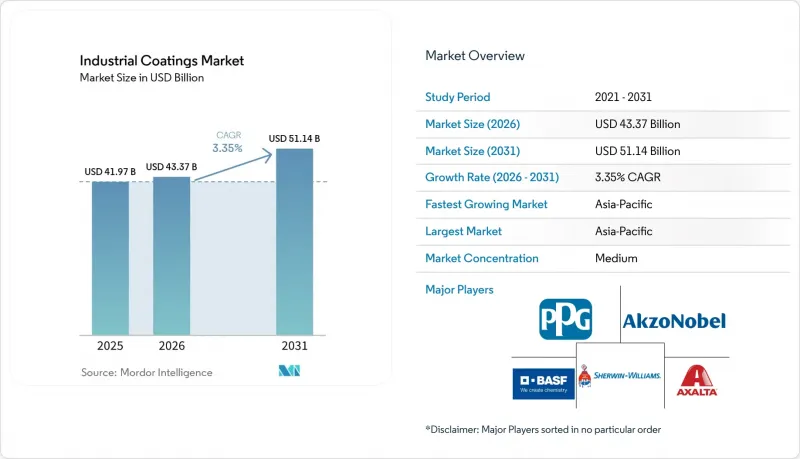
본 보고서는 수지 유형(에폭시, 폴리우레탄, 아크릴, 폴리에스테르, 기타 수지), 기술(용제형, 수성, 분체 등), 최종 이용 산업(일반 공업용 및 보호용 코팅), 기판(금속 및 콘크리트), 지역(아시아태평양, 북미, 유럽, 남미, 중동 및 아프리카)별로 분류되어 있습니다. 시장 전망은 금액(달러) 기준으로 제시되어 있습니다.
전 세계 산업용 코팅 시장 동향 및 인사이트
노후화된 석유 및 가스 자산에 대한 보호용 도료 수요 급증
유지보수 지연으로 인해 북해 및 멕시코만 해상 플랫폼의 약 40%가 당초 부식 방지 수명을 초과하여 계속 가동되고 있어, 대규모 재도장 프로그램이 시행되고 있습니다. 쉘(Shell)은 2025년, 영국의 15개 플랫폼을 유지보수 주기를 25년으로 연장하는 3층 구조의 유리 플레이크 에폭시 도료로 개보수하기 위해 12억 달러를 투자했습니다. 토탈에너지스는 황화수소 및 염화물에 의한 부식에 노출된 서아프리카 해저 파이프라인에 8억 달러를 배정했습니다. 중동의 석유화학 단지에서는 개정된 API 653의 건전성 규정을 충족하기 위해 저장 탱크에 고두께 폴리우레탄 내벽 시공이 동시에 진행되고 있습니다. 이 수십억 달러 규모의 수주 잔고로 인해 자산 소유자들이 초기 비용 절감보다 수명 주기 경제성을 우선시하게 되면서, 산업용 코팅 시장은 안정적인 상승 궤도를 유지하고 있습니다. 기반이 되는 인프라는 자본 집약적이며 안전성이 극히 중요하기 때문에 사양 변경은 신중하게 이루어지고 있으며, 이로 인해 공급업체의 수익 전망은 향후 10년 동안 확보되어 있습니다.
아시아태평양의 급속한 산업 확장이 일반 산업용 코팅 수요를 견인하고 있습니다.
중국이 2025년을 목표로 시행한 1,400억 달러 규모의 인프라 부양책은 양쯔강 유역 전역에 걸친 고속철도, 지하철 연장, 대형 강철 교량 건설에 자금을 지원했으며, 이들 모두 다층 에폭시 또는 폴리우레탄으로 된 보호 코팅이 필요합니다. 인도의 생산 연계형 인센티브 프로그램은 220억 달러 규모의 신규 공장 투자를 확보했으며, 구자라트주와 타밀나두주에서만 자동 스프레이 부스에 약 18만 메트르톤의 도료가 소비되고 있습니다. 베트남은 제조 거점 이전지로 주목받고 있으며, 이 나라의 클린룸을 갖춘 전자기기 공장에서는 IEC 61340에 따라 시험된 정전기 방지 에폭시 바닥재가 지정되어 있습니다. 인도네시아에서는 니켈 제련소 붐에 따라 600°C의 용광로 내부 환경을 견딜 수 있는 실리콘 필름이 요구되고 있습니다. 이 모든 요소를 종합해 보면, 이 지역은 제조 부가가치 1달러당 다른 어느 지역보다 많은 도료를 소비하고 있으며, 이는 예측 기간 동안 산업용 코팅 시장을 견인할 구조적 우위를 보여줍니다.
용제계 시스템에 대한 VOC 및 PFAS 규제 강화
유럽연합(EU)의 규제안에서는 화학 반응기나 반도체 제조 장비에 사용되는 불소 수지 필름에 포함된 퍼플루오로알킬 물질 및 폴리플루오로알킬 물질의 단계적 폐지가 요구되고 있으며, 이에 따라 배합 제조업체들은 실적이 적은 실록산계나 세라믹계로 전환해야 하는 상황에 직면해 있습니다. 캘리포니아주는 VOC 상한치 250 g/L를 산업용 유지보수 분야로도 확대하여, 속건성 알키드 수지의 경우 비용이 많이 드는 배합 변경이나 시장 철수를 강요받고 있습니다. 이러한 규제에 대응하기 위해 연구 개발 및 공장 설비 갱신에 리터당 0.30-0.50달러의 추가 비용이 발생하여, 세계 규모를 갖추지 못한 중견 공급업체들을 압박하고 있습니다. 중국 환경부는 2027년까지 VOC 규제치를 EU 기준과 일치시킬 계획을 시사하고 있으며, 이로 인해 국내 용제 생산 능력의 4분의 1이 도태될 가능성이 있습니다. 이러한 규제는 종합적으로 저배출 화학물질의 도입을 가속화하는 한편, 이행 기간 동안 산업용 코팅 시장 전체의 성장을 억제하게 될 것입니다.
부문 분석
에폭시 수지는 고성장 틈새 시장에서 점유율이 소폭 하락했음에도 불구하고, 2025년 산업용 코팅 시장 규모의 30.85%를 계속 차지했습니다. 이는 블라스팅 처리된 강재에 대한 강력한 접착력이 요구되는 선박, 파이프라인 및 중량 구조물 공사에 힘입은 결과입니다. 아크릴 에멀전은 드럼에서 직접 사용하더라도 캘리포니아주의 VOC 상한치인 250 g/L를 준수하기 때문에 재도장 및 경공업 분야에서 점유율을 서서히 확대했습니다. 주로 분말 형태의 폴리에스테르 수지는 가전제품의 외장이나 사무용 가구에서 여전히 필수적이며, 이 부문은 현재 유럽에서 제로 배출 크레딧을 획득하고 있습니다. 에폭시 프라이머와 폴리우레탄 탑코트를 결합한 하이브리드 배합은 접착 강도와 내후성이 뛰어난 광택을 동시에 제공하기 때문에 계속해서 증가 추세를 보이고 있습니다. 2026-2031년 폴리우레탄 수요는 연평균 성장률(CAGR) 5.08%로 증가했습니다. 이는 항공우주, 풍력 터빈 및 고내구성 인프라 소유주들이 뛰어난 굴곡 균열 저항성과 자외선 내성을 이유로 2액형 도료를 지정했기 때문입니다.
각 공급업체들은 기계적 안정성을 유지하면서 재생 가능 탄소의 비율을 높이기 위해, 피마자유 및 팜 커널 폴리올의 함유율을 확대되고 있습니다. 한편, PFAS 금지 조치가 임박해 있고 고객의 주저로 인해 프로젝트 검토가 둔화되면서 불소 수지의 출하량은 보합세를 보였습니다. 비닐 에스테르, 알키드, 노보락 계열의 화학제품은 여전히 틈새 시장인 부식 방지 용도나 속건성 용도로만 제한되어 있습니다. 전반적으로 수지의 다양화는 원자재 가격 변동에 따른 충격을 완화하는 동시에, 에폭시 수지의 신뢰성을 훼손하지 않으면서 대상 산업용 코팅 시장의 확대에 기여하고 있습니다.
2025년 매출에서 용제계 제품이 차지하는 비중은 36.91%였으나, 보호 코팅 배합에서 수성 제품이 비말 구역 침지 및 120°C의 온도 사이클을 견딜 수 있음이 입증됨에 따라 그 성장 추세는 하락세를 보이고 있습니다. 분체 도료는 97-99%의 전착 효율과 유해 대기 오염 물질에 대한 허가 절차가 불필요해진 점에 힘입어 휠, 라디에이터, 선반, 소형 트랙터 분야에서 급속히 성장했습니다. LED 어레이의 도입으로 열 부하와 램프 교체 빈도가 감소함에 따라, 자외선 경화형 제품 라인은 틈새 시장에서 주류로 전환되었습니다. 이러한 변화들이 맞물리면서, 산업용 코팅 시장은 생산량을 유지하면서도 배출량 감축, 경화 시간 단축, 그리고 에너지 소비량 감축을 향해 나아가고 있습니다. 수성 도료 시장 규모는 새로운 VOC 규제에 따라 북미 및 유럽의 공장들이 용제형 알키드 수지에서 아크릴 분산액으로 전환함에 따라, 2031년까지 연평균 4.91%의 성장이 예상됩니다.
각 공급업체들은 디지털 컬러 매칭 및 근적외선 경화용 첨가제를 제품 라인업에 포함시키고 있으며, 이를 통해 도장 위탁 업체들은 도장 횟수를 줄이면서도 정확한 색상을 구현할 수 있게 되었습니다. 자동차 차체에서는 여전히 전착 도장이 주류를 이루고 있지만, 차세대 양이온계 전착욕에는 현재 바이오 유래의 공용매나 불소 무함유 계면활성제가 채택되고 있습니다. 열분사 금속 피복 및 고고형분 노보락 에폭시는 단일 공정으로 200μm의 도막을 형성함으로써, 해외에서의 유지 관리 비용을 상쇄할 수 있는 틈새 시장에서 확고한 입지를 유지하고 있습니다. 규제 당국의 감시가 엄격해지는 가운데, 기술 구성은 수성 및 분체 도장으로 더욱 전환될 것이며, 이는 산업용 코팅 시장 전반에 확산되고 있는 지속가능성 노력을 뒷받침할 것입니다.
지역별 분석
아시아태평양은 2025년 51.16%의 점유율로 산업용 코팅 시장을 주도할 전망이며, 중국, 인도, 베트남, 인도네시아가 운송, 에너지, 제조업에 대한 구조적 지출을 뒷받침하는 가운데 연평균 성장률(CAGR) 4.35%로 성장을 이어갈 것으로 예측됩니다. 중국의 야심 찬 ‘2025년 경기 부양책’은 고속철도 간선 노선과 양쯔강에 건설되는 새로운 교량에 자금을 투입하고 있습니다. 이러한 프로젝트에서는 매년 대량의 에폭시 수지 및 폴리우레탄이 소비될 것으로 예측됩니다. 한편, 인센티브 프로그램에 힘입은 인도의 외국인 직접 투자(FDI) 이니셔티브로 인해 구자라트주와 타밀나두주에서 수성 도료 라인 도입이 가속화되고 있습니다. 이러한 발전으로 자동차 차체 및 가정용 가전제품과 관련된 사이클 타임과 배출량이 모두 현저히 감소했습니다.
북미 및 유럽에서는 재고 수준이 안정화된 점과 엄격한 환경 규제의 영향으로 성장이 완만하게 그쳤습니다. 미국에서는 산업용 유지보수 필름에 대한 VOC(휘발성 유기 화합물) 규제치가 설정됨에 따라 아크릴 에멀션 연구 개발에 대한 투자가 증가하고, 용제 증기 회수를 위한 설비 투자 수요가 높아졌습니다. 2025년, 독일에서는 UV-LED 도장 라인이 도입되어 BMW 및 폭스바겐 시설에서 에너지 절감이 실현되었습니다. 그러나 EU의 PFAS 금지안은 고성능 불소수지 분야에 불확실성을 드리우고 있으며, 일부 화학 처리 공정의 도입에 차질이 발생하고 있습니다.
아시아 이외의 지역에서는 남미, 중동 및 아프리카의 신흥 지역이 가장 큰 성장 기회를 품고 있습니다. 브라질에서는 해당 국가의 습도가 높은 열대 기후에 맞추어 조정된 아크릴계 실러 및 폴리우레탄계 탑코트를 사용한 고속도로 포장 재포장 공사 입찰이 시작되었습니다. 사우디아라비아에서는 수자원 관련 이니셔티브의 일환으로 염화물 부하를 해결하기 위해 콘크리트 저수지에 에폭시 개질 시멘트계 라이닝이 지정되었습니다. 남아프리카공화국의 트랜스넷(Transnet)사는 ISO 12944 C5-M 규격에 부합하는 에폭시 수지를 채택하고, 해안 철도 자산의 개보수에 자금을 배정했습니다. 동시에 나이지리아의 단고트 정유시설에서는 2024년부터 2025년에 걸친 플랜트 시운전 과정에서 보호 필름이 사용되었습니다. 이러한 노력은 수익원의 다각화를 도모할 뿐만 아니라, 산업용 코팅 시장을 지역적 혼란으로부터 보호하는 역할도 하고 있습니다.
기타 혜택:
- 엑셀 형식 시장 예측(ME) 시트
- 3개월간의 애널리스트 지원
자주 묻는 질문
목차
제1장 서론
제2장 조사 방법
제3장 주요 요약
제4장 시장 구도
제5장 시장 규모와 성장 예측
제6장 경쟁 구도
제7장 시장 기회와 향후 전망
KTH 26.08.06According to Mordor Intelligence, the industrial coatings market size is expected to grow from USD 41.97 billion in 2025 to USD 43.37 billion in 2026 and is forecast to reach USD 51.14 billion by 2031 at a 3.35% CAGR over 2026-2031.
This report is Segmented by Resin Type (Epoxy, Polyurethane, Acrylic, Polyester, and Other Resins), Technology (Solvent-Borne, Water-Borne, Powder, and More), End-Use Industry (General Industrial and Protective Coatings), Substrate (Metal and Concrete), and Geography (Asia-Pacific, North America, Europe, South America, and Middle East and Africa). Market Forecasts are Provided in Terms of Value (USD).
Global Industrial Coatings Market Trends and Insights
Surge in Protective-Coatings Demand for Aging Oil and Gas Assets
Deferred upkeep left roughly 40% of offshore platforms in the North Sea and Gulf of Mexico running past their original corrosion-protection lifespans, triggering large-scale recoating programs. Shell dedicated USD 1.2 billion in 2025 to upgrade 15 U.K. platforms with three-coat glass-flake epoxies that stretch service intervals to 25 years. TotalEnergies allocated USD 800 million for West African subsea pipelines exposed to hydrogen sulfide and chloride attack. Middle-East petrochemical complexes are simultaneously lining storage tanks with high-build polyurethane to satisfy updated API 653 integrity provisions. This multi-billion-dollar backlog keeps the industrial coatings market on a stable upward track as asset owners now prioritize lifecycle economics over first-cost savings. Because the underlying infrastructure is capital-intensive and safety-critical, specification shifts are deliberate, extending revenue visibility for suppliers through the next decade.
Rapid APAC Industrial Expansion Fueling General-Industrial Volumes
China's 2025 infrastructure stimulus of USD 140 billion funded high-speed rail, metro extensions, and large steel bridges across the Yangtze basin, each requiring multi-layer epoxy or polyurethane defenses. India's production-linked incentive program secured USD 22 billion in fresh factory spending, with automated spray booths in Gujarat and Tamil Nadu alone consuming an estimated 180,000 metric tons of coatings. Vietnam has become a manufacturing relocation hotspot, where cleanroom electronics plants specify anti-static epoxy floors tested to IEC 61340. Indonesia's nickel-smelter boom demands silicone films able to resist 600°C furnace conditions. Taken together, the region applies more kilograms of coating per USD of manufacturing value added than any other geography, illustrating a structural edge that lifts the industrial coatings market throughout the forecast horizon.
Tightening VOC and PFAS Regulations on Solvent-Borne Systems
A draft European Union restriction seeks to phase out per- and polyfluoroalkyl substances in fluoropolymer films used in chemical reactors and semiconductor tools, pushing formulators toward less proven siloxane or ceramic routes. California extended its 250 g/L VOC ceiling to industrial maintenance categories, forcing fast-dry alkyds either into costly reformulations or retirement. Compliance adds USD 0.30-0.50 per liter in R&D and plant retooling, squeezing mid-tier suppliers without global scale. China's environment ministry signaled a plan to harmonize VOC limits with EU norms by 2027, potentially sidelining one-quarter of domestic solvent capacity. Collectively, these curbs temper overall industrial coatings market growth during the transition, even as they accelerate uptake of low-emission chemistries.
Other drivers and restraints analyzed in the detailed report include:
- Environmental Mandates Accelerating Water-Borne and Powder Uptake
- UV-LED Instant-Cure Lines Adopted by OEM Factories
- Titanium-Dioxide and Epoxy-Resin Price Volatility
For complete list of drivers and restraints, kindly check the Table Of Contents.
Segment Analysis
Epoxy, despite sliding marginally in high-growth niches, still accounted for 30.85% of the industrial coatings market size in 2025, supported by marine, pipeline, and heavy-duty structural jobs that require tenacious adhesion on blasted steel. Acrylic emulsions built incremental share in refinish and light-industrial tasks because they comply with California's 250 g/L VOC ceiling straight from the drum. Polyester resins, largely in powder form, stayed essential to appliance shells and office furniture, a segment now capturing zero-emission credits in Europe. Hybrid formulations blending epoxy primers with polyurethane topcoats continue to rise because they marry bond strength with weather-fast gloss. Polyurethane demand climbed at a 5.08% CAGR between 2026 and 2031 as aerospace, wind-turbine, and high-durability infrastructure owners specified two-component films for their superior flex-crack resistance and UV holdout.
Suppliers are widening castor oil or palm kernel polyol content to raise renewable carbon share while maintaining mechanical stability. Fluoropolymer volumes flattened as pending PFAS bans and customer hesitancy slowed project validation. Vinyl ester, alkyd, and novolac chemistries remained confined to niche corrosion or fast-drying roles. Altogether, resin diversification both cushions raw-material shocks and broadens the addressable industrial coatings market without sacrificing core epoxy reliability.
Solvent-borne products captured 36.91% of 2025 revenue; their trajectory tilts down as protective-coatings formulations prove water-borne options can now survive splash-zone immersion and 120°C cycling. Powder coatings grew briskly in wheels, radiators, shelving, and small tractors, buoyed by 97-99% transfer efficiency and elimination of hazardous-air-pollutant permitting. Ultraviolet-curable lines progressed from boutique to mainstream once LED arrays reduced heat load and lamp changeouts. Collectively, these shifts push the industrial coatings market toward lower emissions, shorter cure times, and reduced energy footprints while preserving throughput. Water-borne chemistries advanced 4.91% annually through 2031, lifted by North American and European plant upgrades that swapped solvent alkyds for acrylic dispersions under new VOC laws.
Suppliers are layering digital color-match and near-infrared cure additives into their offerings, letting job shops hit exact shades with fewer coats. Electro-deposition remains dominant for automotive bodies, yet next-gen cationic baths now include bio-based co-solvents and F-free surfactants. Thermal-spray metalizing and high-solid novolac epoxies keep niche footholds where 200-μm films in one pass pay for themselves in offshore upkeep costs. As regulatory scrutiny heightens, the technology mix will continue to tip toward water and powder, reinforcing sustainability narratives that echo across the broader industrial coatings market.
Complete Report Scope:
- By Resin Type
- Epoxy
- Polyurethane
- Acrylic
- Polyester
- Other Resins (Alkyd, Fluoropolymer, and Vinyl Ester)
- By Technology
- Solvent-borne
- Water-borne
- Powder
- UV Technology
- By End-use Industry
- General Industrial
- Protective Coatings
- Oil and Gas
- Mining
- Power
- Infrastructure
- Other Protective Coatings
- By Substrate
- Metal
- Concrete
- By Geography
- Asia-Pacific
- China
- India
- Japan
- South Korea
- ASEAN
- Australia
- New Zealand
- Rest of Asia-Pacific
- North America
- United States
- Canada
- Mexico
- Europe
- Germany
- United Kingdom
- France
- Italy
- Russia
- Nordics
- Rest of Europe
- South America
- Brazil
- Argentina
- Chile
- Rest of South America
- Middle East and Africa
- Saudi Arabia
- United Arab Emirates
- Turkey
- South Africa
- Nigeria
- Rest of Middle-East and Africa
- Asia-Pacific
Geography Analysis
Asia-Pacific dominated the industrial coatings market in 2025 with a 51.16% share and is set to pace forward at a 4.35% CAGR as China, India, Vietnam, and Indonesia underpin structural spending on transport, energy, and manufacturing. China's ambitious 2025 stimulus is channeling funds into high-speed rail spines and new bridges over the Yangtze. These projects are projected to consume significant amounts of epoxy and polyurethane annually. Meanwhile, India's foreign direct investment (FDI) initiative, bolstered by an incentive program, has accelerated the installation of water-borne lines in Gujarat and Tamil Nadu. This advancement has notably reduced both the cycle time and emissions associated with automotive shells and consumer appliances.
In North America and Europe, growth was modest, constrained by mature stock levels and stringent environmental regulations. The U.S. set a VOC limit for industrial maintenance films, leading to increased investments in acrylic-emulsion R&D and heightened capital needs for solvent vapor recovery. In 2025, Germany introduced UV-LED paint lines, achieving energy savings at BMW and Volkswagen facilities. However, the EU's proposal to ban PFAS has cast a shadow of uncertainty over high-performance fluoropolymer sectors, causing delays in some chemical processing rollouts.
Outside of Asia, emerging regions in South America, the Middle East, and Africa present the most significant growth opportunities. Brazil has initiated a tender for highway resurfacing, utilizing acrylic sealers and polyurethane tops tailored for the country's humid tropical cycles. In Saudi Arabia, a water initiative has specified epoxy-modified cementitious linings for concrete reservoirs, addressing chloride loads. South Africa's Transnet has allocated funds for refurbishing coastal rail assets, employing ISO 12944 C5-M epoxies. Concurrently, Nigeria's Dangote refinery utilized protective films during its 2024-25 plant commissioning. Collectively, these endeavors not only diversify revenue streams but also shield the industrial coatings market from regional disruptions.
- 3M
- AkzoNobel N.V.
- Arkema
- Asian Paints
- Axalta Coating Systems
- BASF
- Beckers Group
- Chugoku Marine Paints Ltd.
- Daikin Industries Ltd.
- Hempel A/S
- Henkel AG & Co. KGaA
- Jotun
- Kansai Paint Co., Ltd.
- Nippon Paint Holdings Co., Ltd.
- OC Oerlikon Management AG
- PPG Industries, Inc.
- RPM International Inc.
- Rust-Oleum Corporation
- Sika AG
- The Sherwin-Williams Company
- Tikkurila
- Wacker Chemie AG
Additional Benefits:
- The market estimate (ME) sheet in Excel format
- 3 months of analyst support
TABLE OF CONTENTS
1 Introduction
- 1.1 Study Assumptions & Market Definition
- 1.2 Scope of the Study
2 Research Methodology
3 Executive Summary
4 Market Landscape
- 4.1 Market Overview
- 4.2 Market Drivers
- 4.2.1 Surge in protective-coatings demand for aging oil and gas assets
- 4.2.2 Rapid APAC industrial expansion fueling general-industrial volumes
- 4.2.3 Environmental mandates accelerating water-borne and powder uptake
- 4.2.4 UV-LED instant-cure lines adopted by OEM factories
- 4.2.5 Data-driven predictive-maintenance coatings with embedded sensors
- 4.3 Market Restraints
- 4.3.1 Tightening VOC + PFAS regulations on solvent-borne systems
- 4.3.2 Titanium-dioxide and epoxy-resin price volatility
- 4.3.3 Global shortage of micronized-aluminum pigments for metallic finishes
- 4.4 Value Chain Analysis
- 4.5 Regulatory Outlook
- 4.6 Porter's Five Forces
- 4.6.1 Bargaining Power of Suppliers
- 4.6.2 Bargaining Power of Buyers
- 4.6.3 Threat of New Entrants
- 4.6.4 Threat of Substitutes
- 4.6.5 Degree of Competition
5 Market Size & Growth Forecasts (Value)
- 5.1 By Resin Type
- 5.1.1 Epoxy
- 5.1.2 Polyurethane
- 5.1.3 Acrylic
- 5.1.4 Polyester
- 5.1.5 Other Resins (Alkyd, Fluoropolymer, and Vinyl Ester)
- 5.2 By Technology
- 5.2.1 Solvent-borne
- 5.2.2 Water-borne
- 5.2.3 Powder
- 5.2.4 UV Technology
- 5.3 By End-use Industry
- 5.3.1 General Industrial
- 5.3.2 Protective Coatings
- 5.3.2.1 Oil and Gas
- 5.3.2.2 Mining
- 5.3.2.3 Power
- 5.3.2.4 Infrastructure
- 5.3.2.5 Other Protective Coatings
- 5.4 By Substrate
- 5.4.1 Metal
- 5.4.2 Concrete
- 5.5 By Geography
- 5.5.1 Asia-Pacific
- 5.5.1.1 China
- 5.5.1.2 India
- 5.5.1.3 Japan
- 5.5.1.4 South Korea
- 5.5.1.5 ASEAN
- 5.5.1.6 Australia
- 5.5.1.7 New Zealand
- 5.5.1.8 Rest of Asia-Pacific
- 5.5.2 North America
- 5.5.2.1 United States
- 5.5.2.2 Canada
- 5.5.2.3 Mexico
- 5.5.3 Europe
- 5.5.3.1 Germany
- 5.5.3.2 United Kingdom
- 5.5.3.3 France
- 5.5.3.4 Italy
- 5.5.3.5 Russia
- 5.5.3.6 Nordics
- 5.5.3.7 Rest of Europe
- 5.5.4 South America
- 5.5.4.1 Brazil
- 5.5.4.2 Argentina
- 5.5.4.3 Chile
- 5.5.4.4 Rest of South America
- 5.5.5 Middle East and Africa
- 5.5.5.1 Saudi Arabia
- 5.5.5.2 United Arab Emirates
- 5.5.5.3 Turkey
- 5.5.5.4 South Africa
- 5.5.5.5 Nigeria
- 5.5.5.6 Rest of Middle-East and Africa
- 5.5.1 Asia-Pacific
6 Competitive Landscape
- 6.1 Market Concentration
- 6.2 Strategic Moves (M&A, JVs, Capacity Expansions)
- 6.3 Market Share Analysis
- 6.4 Company Profiles {(includes Global level Overview, Market level overview, Core Segments, Financials as available, Strategic Information, Market Rank/Share for key companies, Products & Services, and Recent Developments)}
- 6.4.1 3M
- 6.4.2 AkzoNobel N.V.
- 6.4.3 Arkema
- 6.4.4 Asian Paints
- 6.4.5 Axalta Coating Systems
- 6.4.6 BASF
- 6.4.7 Beckers Group
- 6.4.8 Chugoku Marine Paints Ltd.
- 6.4.9 Daikin Industries Ltd.
- 6.4.10 Hempel A/S
- 6.4.11 Henkel AG & Co. KGaA
- 6.4.12 Jotun
- 6.4.13 Kansai Paint Co., Ltd.
- 6.4.14 Nippon Paint Holdings Co., Ltd.
- 6.4.15 OC Oerlikon Management AG
- 6.4.16 PPG Industries, Inc.
- 6.4.17 RPM International Inc.
- 6.4.18 Rust-Oleum Corporation
- 6.4.19 Sika AG
- 6.4.20 The Sherwin-Williams Company
- 6.4.21 Tikkurila
- 6.4.22 Wacker Chemie AG
7 Market Opportunities & Future Outlook
- 7.1 Technological Advancements in Coating Formulations
- 7.2 White-space & Unmet-need Assessment


