

|
시장보고서
상품코드
2097108
궤양성 대장염 : 시장 점유율 분석, 업계 동향 및 통계, 성장 예측(2026-2031년)Ulcerative Colitis - Market Share Analysis, Industry Trends & Statistics, Growth Forecasts (2026 - 2031) |
||||||
 Mordor Intelligence
Mordor Intelligence에 의하면, 궤양성 대장염 시장 규모는 2025년 105억 6,000만 달러로 평가되었습니다. 2026년에는 110억 2,000만 달러로 확대되어 2026년부터 2031년에 걸쳐 CAGR 4.31%로 성장을 지속하여, 2031년에는 135억 9,000만 달러에 이를 것으로 예측됩니다.
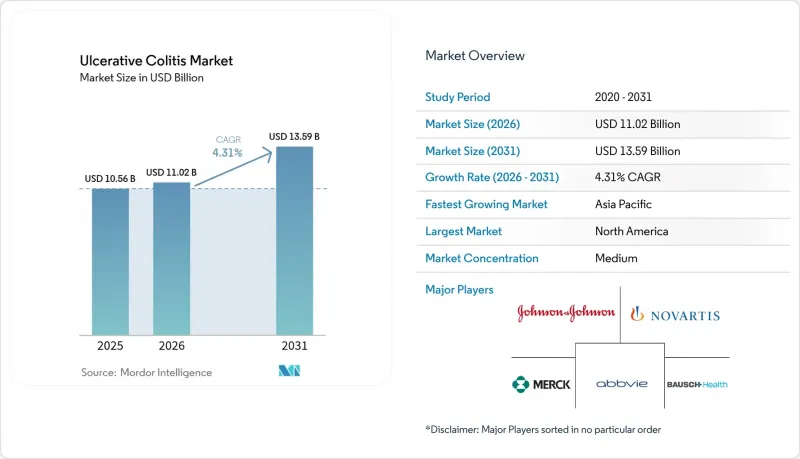
본 보고서는 약물 유형(아미노살리실산계 약물, 면역억제제, 항-TNF 생물학적 제제 등), 질환 유형(궤양성 직장염, 직장-S자 결장염, 좌측 대장염 등), 투여 경로(경구, 비경구, 직장), 유통 채널(병원 약국 등), 지역(북미, 유럽 등)별로 분류되어 있습니다. 시장 전망은 금액(달러)으로 표시되어 있습니다.
세계의 궤양성 대장염 시장 동향 및 인사이트
첨단 생물학적 제제 및 저분자 의약품의 지속적인 출시
트렘피아, 스카이라지, 옴보 등 IL-23 길항제는 출시 후 12개월 이내에 진행성 전신성 궤양성 대장염 처방 점유율의 10%를 차지하며, 임상의들이 작용기전의 다양화를 수용하고 있음을 보여줍니다. 벨시피티는 S1P 조절제로서 최초로 FDA 승인을 획득했으며, 12주 관해율이 위약군의 11%에 비해 26%에 달하고, 1일 1회 경구 투여 제제의 상업적 매력을 한층 더 높였습니다. 다케다 제약은 일본 공장에서 ‘엔티비오’의 생산량을 3배로 확대하며, 수요 증가를 예상하고 생산 능력 확보에 박차를 가하는 제약사들의 움직임을 보여주었습니다. 존슨앤드존슨은 경구용 약물 ‘이코트로킨라’의 2b상 임상시험에서 63.5%의 임상 반응률을 보고하며, 파이프라인의 탄탄함을 강조했습니다. 이러한 신약의 출시는 치료의 한계를 높이고, 치료 기간을 단축하며, 그동안 충분한 치료를 받지 못했던 환자들을 유치함으로써 궤양성 대장염 시장을 확대할 것입니다.
전 세계 UC의 발병률 및 유병률 상승
아시아태평양에서는 식생활의 서유럽화와 도시 지역의 스트레스 요인 증가에 따라 지난 20년간 발병률이 6배로 증가했으며, 그동안 유병률이 낮았던 국가들도 서유럽 시장과 동등한 수준에 가까워지고 있습니다. 인구 증가와 조기 진단으로 인해 대상 환자 수는 증가하는 한편, 평생 관리가 필요함에 따라 치료 기간도 장기화되고 있습니다. Apple Watch나 Fitbit 등의 웨어러블 기기는 증상 악화를 미연에 감지할 수 있어 의사의 조기 개입을 가능하게 하고, 중증화로 인한 입원 위험을 줄여줍니다. 보험사들은 이러한 역학적 및 기술적 동향을 주시하며 비용 억제 전략을 세밀하게 조정하고 있지만, 환자 수 증가는 여전히 생물학적 제제의 처방량 증가로 이어지고 있습니다. 따라서 유병률의 상승은 처방량 확대 기회와 의료 자원에 대한 부담을 모두 증가시켜, 궤양성 대장염 시장의 중기적 성장을 뒷받침하고 있습니다.
도입을 제한하는 중대한 이상반응 및 안전성 관련 경고
ORAL Surveillance 연구에서는 JAK 억제제와 중대한 심혈관 사건 및 악성 종양 증가 사이의 연관성이 밝혀졌으며, 이에 따라 FDA는 동 계열 약물을 항-TNF 요법에 반응하지 않은 사례로만 제한하도록 지시했고, EMA도 고위험 환자에 대한 주의를 환기했습니다. 업데이트된 지침에서는 위험-이익 평가, 감염증 선별 검사 및 용량 개별화가 강조되고 있으며, 이로 인해 의사의 업무 부담이 증가하여 도입 초기 단계에서의 보급이 둔화되고 있습니다. EULAR의 데이터에 따르면, 생물학적 DMARD와 비교했을 때 각화세포종양을 제외하고는 암 발생률에 광범위한 급증은 보이지 않지만, 규제 당국은 계속해서 경계를 늦추지 않고 있습니다. 그 결과, 임상적 편의성이라는 장점이 있음에도 불구하고, 약물감시의 강화로 인해 단기적인 처방 건수는 억제되고 있습니다.
부문 분석
항-TNF 생물학적 제제는 확고한 근거 기반과 의사의 익숙함에 힘입어 2025년에는 37.88%의 점유율로 선두를 유지했습니다. 그러나 바이오시밀러의 부상과 안전성을 중시하는 치료 단계로의 전환에 따라 성장의 초점은 JAK 억제제로 이동하고 있으며, 2031년까지의 연평균 성장률(CAGR)은 13.68%로 예측됩니다. 우파다시티닙은 작용 발현이 빠르고 지속적인 관해를 얻을 수 있는 반면, 토파시티닙은 박스 경고가 있음에도 불구하고 일정한 입지를 유지하고 있습니다. 궤양성 대장염 분야의 JAK 억제제 시장 규모는 재택 치료를 원하는 환자와 지불자 모두에게 경구 투여의 편의성이 매력적이기 때문에 급격히 확대될 것으로 예측됩니다.
IL-23 길항제는 차별화된 효능을 발휘하여 1년 이내에 전신 치료로의 채택률이 10%를 나타낼 것으로 예측되며, 투여 빈도가 낮아 삶의 질 향상에 기여합니다. S1P 조절제는 퍼스트-인-클래스(First-in-Class) 림프구 유출 억제 작용을 통해 경구 치료의 선택지를 넓혀줍니다. 항인테그린제인 베드리즈맙은 장 선택성의 매력을 지속하고 있지만, 칼시뉴린 억제제는 여전히 틈새 시장의 구제제로 머물러 있습니다. 약제 분류별 다양화는 궤양성 대장염 업계가 정밀 의학으로 전환되고 있음을 보여주며, 바이오마커에 기반한 약물 선택을 통해 치료 반응을 보이는 환자군을 선별함으로써 환자 1인당 평생 가치를 극대화하고 있습니다.
전대장염은 2025년 매출의 30.10%를 차지했으며, 이는 대장의 광범위한 병변을 반영한 것으로, 초기 생물학적 제제의 용량 증량이나 병용 요법을 정당화하는 근거가 됩니다. 전 대장염을 대상으로 하는 궤양성 대장염 시장 규모는 생물학적 제제의 적극적인 도입을 권장하는 진료 지침의 변경에 따라 꾸준히 확대될 것입니다.
급성 중증 대장염은 임상적으로 드물지만, 갱신된 응급 치료 알고리즘에서 대장 절제술을 피하기 위해 고용량 스테로이드, 인플릭시맙, 사이클로스포린, 신흥 JAK 억제제가 채택되고 있어 8.41%라는 가장 높은 연평균 성장률(CAGR)을 보이고 있습니다. 급성 중증 사례를 대상으로 한 임상시험 설계에 관한 국제적인 델파이법에 의한 합의는 신약 개발을 가속화하고 전문 병원에 대한 수요를 촉진하고 있습니다. 질환의 임상 양상이 다양하기 때문에 각 표현형에 최적의 작용기전이 적용될 수 있도록 기업들이 포트폴리오의 폭을 넓히는 이유가 부각되고 있습니다.
지역별 분석
북미는 생물학적 제제의 조기 도입, 풍부한 전문의 밀도, 그리고 2025년 이후 환자 연간 비용을 2,000달러까지 낮추는 종합적인 상환 상한선 덕분에 2025년 전 세계 매출의 43.25%를 계속 차지했습니다. 미국의 소화기내과 의사들은 ‘엔티비오’, ‘심포니’, 그리고 인플릭시맙 바이오시밀러에 대해 단기적인 처방량 증가를 예상하고 있으며, 경쟁 제품 간의 교체가 지속될 것으로 보이지만 치료를 받는 환자층은 확대될 전망입니다. FDA의 소아용 지침은 임상시험 확대를 뒷받침하고 있으며, 향후 적응증 확대와 궤양성 대장염 시장의 지속적인 성장이 기대됩니다.
아시아태평양에서는 경제 발전, 의료비 증가, 그리고 염증성 장질환(IBD)에 대한 인식 제고 캠페인에 힘입어 유병률이 상승하고 있으며, 2031년까지 연평균 성장률(CAGR)은 7.23%를 기록할 전망입니다. 중국의 연령 조정 유병률은 현재 10만 명당 2.1로, 상승 추세를 보이고 있습니다. 보험사의 우선순위 설정에 있어서는 생물학적 제제로의 전환에 앞서 비용 대비 효과가 높은 5-아미노살리실산 계열 치료법이 여전히 우선시되고 있습니다. 각 지역 정부는 생물학적 제제에 대한 접근성을 확대하기 위해 수량 기준 조달에 대한 협상을 진행 중이며, 한편 도시 지역에서는 민간 보험사가 급증하여 중산층의 부담 경감에 기여하고 있습니다. 이러한 호재에 힘입어 궤양성 대장염 시장의 판매 수량과 매출액 모두 상승세를 보이고 있습니다.
유럽에서는 HTA(의료기술평가)의 면밀한 검토와 바이오시밀러의 급속한 도입이 진행되는 가운데, 안정적이면서도 완만한 성장이 나타나고 있습니다. EMA(유럽의약품청)는 2024년에 우스테키누맙의 바이오시밀러 4개 품목을 승인하여 접근성 확대에 기여하는 할인 풀이 강화되었으나, 그 반면 절대적인 매출액은 압박을 받고 있습니다. NICE(영국 국립의료기술평가기구)에 의한 에트라시모드의 평가가 현재 진행 중인데, 이는 국내 도입에 앞서 비교 유효성에 관한 엄격한 기준이 마련되어 있음을 보여줍니다. 이러한 압박이 있음에도 불구하고, EU 시장은 작용기전의 다양성을 수용하고 있으며, 궤양성 대장염 시장에 대해 소폭이지만 예측 가능한 성장을 가져오는 균형 잡힌 시장 상황을 유지하고 있습니다.
기타 혜택 :
- 엑셀 형식 시장 예측(ME) 시트
- 3개월간의 애널리스트 지원
자주 묻는 질문
목차
제1장 서론
제2장 조사 방법
제3장 주요 요약
제4장 시장 구도
제5장 시장 규모 및 성장 예측
제6장 경쟁 구도
제7장 시장 기회 및 향후 전망
KTH 26.08.05According to Mordor Intelligence, the ulcerative colitis market size is expected to grow from USD 10.56 billion in 2025 to USD 11.02 billion in 2026 and is forecast to reach USD 13.59 billion by 2031 at 4.31% CAGR over 2026-2031.
This report is Segmented by Drug Type (Aminosalicylates, Immunosuppressants, Anti-TNF Biologics, and More), Disease Type (Ulcerative Proctitis, Proctosigmoiditis, Left-Sided Colitis, and More), Route of Administration (Oral, Parenteral, and Rectal), Distribution Channel (Hospital Pharmacies and More), and Geography (North America, Europe, and More). The Market Forecasts are Provided in Terms of Value (USD).
Global Ulcerative Colitis Market Trends and Insights
Continuous Launch of Advanced Biologics & Small-Molecule Drugs
IL-23 antagonists such as Tremfya, Skyrizi, and Omvoh captured 10% of advanced systemic prescriptions within 12 months, signalling clinician openness to mechanism diversification. Velsipity became the first S1P modulator to gain FDA approval, reaching 26% 12-week remission versus 11% for placebo, and reinforcing the commercial appeal of once-daily oral solutions. Takeda tripled Entyvio output at its Japanese plant, demonstrating manufacturers' race to secure capacity ahead of expected demand growth. Johnson & Johnson reported 63.5% clinical response in Phase 2b testing of oral icotrokinra, underlining the strong pipeline depth. Collectively, these launches raise therapeutic ceilings, shorten treatment sequences, and enlarge the ulcerative colitis market by attracting previously undertreated patients.
Rising Global Incidence & Prevalence of UC
Asia-Pacific incidence multiplied sixfold over two decades as dietary Westernization and urban stressors emerged, pushing previously low-burden countries toward parity with Western markets. Population growth and earlier diagnosis swell the addressable pool even as life-long management lengthens treatment duration. Wearables such as Apple Watch and Fitbit can pre-emptively flag flares, enabling earlier physician intervention and reducing severe hospitalization risk. Payers monitor these epidemiologic and technology trends to refine cost-containment strategies, yet higher caseloads still translate to incremental biologic volumes. Rising prevalence therefore enlarges both volume opportunity and healthcare resource stress, sustaining medium-term expansion of the ulcerative colitis market.
Serious Adverse Events & Safety Warnings Limiting Uptake
The ORAL Surveillance study linked JAK inhibitors with elevated major adverse cardiac events and malignancies, triggering FDA directives to reserve the class for anti-TNF failures and prompting EMA caution in higher-risk patients. Updated guidelines emphasize risk-benefit assessment, infection screening, and dose tailoring, increasing physician workload and slowing initial uptake. EULAR data show no broad cancer spike versus biologic DMARDs except keratinocyte tumors, but regulators remain vigilant. Heightened pharmacovigilance therefore tempers near-term prescriptions despite clinical convenience advantages.
Other drivers and restraints analyzed in the detailed report include:
- Expansion of Patient-Assistance & Reimbursement Programs
- Growing Use of Tele-Health & Remote Monitoring in IBD Care
- Loss of Exclusivity for Blockbuster Biologics Driving Price Erosion
For complete list of drivers and restraints, kindly check the Table Of Contents.
Segment Analysis
Anti-TNF biologics preserved leadership with 37.88% share in 2025, underpinned by a robust evidence base and physician familiarity. Yet biosimilar pressure and safety-driven laddering redirect growth to JAK inhibitors, which post a 13.68% CAGR through 2031. Upadacitinib shows rapid onset and durable remission, while tofacitinib retains a foothold despite boxed warnings. The ulcerative colitis market size for JAK inhibitors is projected to rise sharply as oral convenience appeals to both patients and payers seeking home-based regimens.
IL-23 antagonists deliver differentiated efficacy, enabling 10% advanced systemic uptake inside a year, and their less frequent dosing targets quality-of-life advantages. S1P modulators introduce a first-in-class lymphocyte egress blockade, widening oral options. Anti-integrin vedolizumab sustains gut-selective appeal, while calcineurin inhibitors remain niche rescue agents. Drug-class diversification illustrates the ulcerative colitis industry pivot to precision medicine, where biomarker-guided selection narrows responder cohorts and maximizes lifetime value per patient.
Pancolitis secured 30.10% of 2025 revenue, reflecting its extensive colonic involvement that justifies early biologic escalation and combination therapy. The ulcerative colitis market size for pancolitis will expand steadily with guideline shifts endorsing proactive biologic initiation.
Fulminant colitis, though clinically uncommon, shows the fastest 8.41% CAGR as updated rescue algorithms employ high-dose steroids, infliximab, cyclosporine, and emergent JAK inhibitors to defer colectomy. International Delphi consensus on acute severe trial design accelerates new asset development, fostering specialized hospital demand. Heterogeneous disease presentation underscores why companies package portfolio breadth, ensuring each phenotype meets an optimized mechanism.
Complete Report Scope:
- By Drug Type
- Aminosalicylates
- Corticosteroids
- Immunosuppressants
- Anti-TNF Biologics
- Anti-Integrin Biologics
- JAK Inhibitors
- S1P Receptor Modulators
- Calcineurin Inhibitors
- Other Drug Types
- By Disease Type
- Ulcerative Proctitis
- Proctosigmoiditis
- Left-sided Colitis
- Pancolitis / Universal Colitis
- Fulminant Colitis
- By Route of Administration
- Oral
- Parenteral
- Rectal
- By Distribution Channel
- Hospital Pharmacies
- Retail Pharmacies
- Online Pharmacies
- Geography
- North America
- United States
- Canada
- Mexico
- Europe
- Germany
- United Kingdom
- France
- Italy
- Spain
- Rest of Europe
- Asia-Pacific
- China
- Japan
- India
- South Korea
- Australia
- Rest of Asia-Pacific
- Middle East and Africa
- GCC
- South Africa
- Rest of Middle East and Africa
- South America
- Brazil
- Argentina
- Rest of South America
- North America
Geography Analysis
North America retained 43.25% of global revenue in 2025 due to early biologic adoption, rich specialist density, and comprehensive reimbursement ceilings that drop annual patient costs to USD 2,000 from 2025. US gastroenterologists expect near-term volume growth for Entyvio, Simponi, and infliximab biosimilars, sustaining competitive churn yet enlarging treated patient pools. FDA pediatric guidance encourages expanded trials, promising future label extensions and continued ulcerative colitis market expansion.
Asia-Pacific records a 7.23% CAGR through 2031 as incidence rises alongside economic development, healthcare spending, and IBD awareness campaigns. China's age-standardized incidence now ranks at 2.1 per 100,000 and rising, with payer prioritization still favoring cost-effective 5-aminosalicylate pathways before biologic escalation. Regional governments negotiate volume-based procurements to widen biologic access, while private insurers proliferate in urban centers, enhancing affordability for mid-income populations. These tailwinds lift both volume and value within the ulcerative colitis market.
Europe posts stable yet moderated growth amid HTA scrutiny and rapid biosimilar rollout. EMA approved four ustekinumab biosimilars in 2024, strengthening discount pools that widen access but squeeze absolute revenue. NICE's ongoing etrasimod appraisal underscores strict comparative-effectiveness thresholds before national uptake. Despite pressure, EU markets embrace mechanism diversity, maintaining a balanced landscape that offers predictable albeit modest expansion for the ulcerative colitis market.
- Abbvie
- Bausch Health
- Janssen Biotech (Johnson & Johnson)
- Merck
- Takeda Pharmaceuticals
- Teva Pharmaceutical Industries
- Pfizer
- Eli Lilly and Company
- Novartis
- Bristol-Myers Squibb
- Mitsubishi Tanabe Pharma Corp.
- Sun Pharmaceuticals Industries
- Gilead Sciences
- Celltrion Healthcare Co., Ltd.
- Roche
- Boehringer Ingelheim Intl. GmbH
- Ferring Pharmaceuticals
- Sandoz Group
- Amgen
- Seres Therapeutics
- Vedanta Biosciences Inc.
Additional Benefits:
- The market estimate (ME) sheet in Excel format
- 3 months of analyst support
TABLE OF CONTENTS
1 Introduction
- 1.1 Study Assumptions & Market Definition
- 1.2 Scope of the Study
2 Research Methodology
3 Executive Summary
4 Market Landscape
- 4.1 Market Overview
- 4.2 Market Drivers
- 4.2.1 Rising Global Incidence & Prevalence of UC
- 4.2.2 Continuous Launch of Advanced Biologics & Small-Molecule Drugs
- 4.2.3 Expansion of Patient-Assistance & Reimbursement Programs
- 4.2.4 Growing Use of Tele-Health & Remote Monitoring In IBD Care
- 4.2.5 Rapid Progress In Microbiome-Based Therapeutics (E.G., Lbps, FMT)
- 4.3 Market Restraints
- 4.3.1 Serious Adverse Events & Safety Warnings Limiting Uptake
- 4.3.2 High Treatment Costs In Emerging Economies
- 4.3.3 Loss Of Exclusivity For Blockbuster Biologics Driving Price Erosion
- 4.4 Porter's Five Forces
- 4.4.1 Bargaining Power of Buyers
- 4.4.2 Bargaining Power of Suppliers
- 4.4.3 Threat of New Entrants
- 4.4.4 Threat of Substitutes
- 4.4.5 Intensity of Competitive Rivalry
5 Market Size & Growth Forecasts (Value, USD)
- 5.1 By Drug Type
- 5.1.1 Aminosalicylates
- 5.1.2 Corticosteroids
- 5.1.3 Immunosuppressants
- 5.1.4 Anti-TNF Biologics
- 5.1.5 Anti-Integrin Biologics
- 5.1.6 JAK Inhibitors
- 5.1.7 S1P Receptor Modulators
- 5.1.8 Calcineurin Inhibitors
- 5.1.9 Other Drug Types
- 5.2 By Disease Type
- 5.2.1 Ulcerative Proctitis
- 5.2.2 Proctosigmoiditis
- 5.2.3 Left-sided Colitis
- 5.2.4 Pancolitis / Universal Colitis
- 5.2.5 Fulminant Colitis
- 5.3 By Route of Administration
- 5.3.1 Oral
- 5.3.2 Parenteral
- 5.3.3 Rectal
- 5.4 By Distribution Channel
- 5.4.1 Hospital Pharmacies
- 5.4.2 Retail Pharmacies
- 5.4.3 Online Pharmacies
- 5.5 Geography
- 5.5.1 North America
- 5.5.1.1 United States
- 5.5.1.2 Canada
- 5.5.1.3 Mexico
- 5.5.2 Europe
- 5.5.2.1 Germany
- 5.5.2.2 United Kingdom
- 5.5.2.3 France
- 5.5.2.4 Italy
- 5.5.2.5 Spain
- 5.5.2.6 Rest of Europe
- 5.5.3 Asia-Pacific
- 5.5.3.1 China
- 5.5.3.2 Japan
- 5.5.3.3 India
- 5.5.3.4 South Korea
- 5.5.3.5 Australia
- 5.5.3.6 Rest of Asia-Pacific
- 5.5.4 Middle East and Africa
- 5.5.4.1 GCC
- 5.5.4.2 South Africa
- 5.5.4.3 Rest of Middle East and Africa
- 5.5.5 South America
- 5.5.5.1 Brazil
- 5.5.5.2 Argentina
- 5.5.5.3 Rest of South America
- 5.5.1 North America
6 Competitive Landscape
- 6.1 Market Concentration
- 6.2 Market Share Analysis
- 6.3 Company Profiles (includes Global level Overview, Market level overview, Core Segments, Financials as available, Strategic Information, Market Rank/Share for key companies, Products & Services, and Recent Developments)
- 6.3.1 AbbVie Inc.
- 6.3.2 Bausch Health Companies Inc.
- 6.3.3 Janssen Biotech (Johnson & Johnson)
- 6.3.4 Merck & Co., Inc.
- 6.3.5 Takeda Pharmaceutical Company Ltd.
- 6.3.6 Teva Pharmaceutical Industries Ltd.
- 6.3.7 Pfizer Inc.
- 6.3.8 Eli Lilly and Company
- 6.3.9 Novartis AG
- 6.3.10 Bristol Myers Squibb
- 6.3.11 Mitsubishi Tanabe Pharma Corp.
- 6.3.12 Sun Pharmaceutical Industries Ltd.
- 6.3.13 Gilead Sciences Inc.
- 6.3.14 Celltrion Healthcare Co., Ltd.
- 6.3.15 Roche Holding AG
- 6.3.16 Boehringer Ingelheim Intl. GmbH
- 6.3.17 Ferring Pharmaceuticals
- 6.3.18 Sandoz International GmbH
- 6.3.19 Amgen Inc.
- 6.3.20 Seres Therapeutics
- 6.3.21 Vedanta Biosciences Inc.
7 Market Opportunities & Future Outlook
- 7.1 White-space & Unmet-need Assessment


