

|
시장보고서
상품코드
2097135
헬스케어 업계 RFID : 시장 점유율 분석, 업계 동향과 통계, 성장 예측(2026-2031년)RFID in Healthcare Industry - Market Share Analysis, Industry Trends & Statistics, Growth Forecasts (2026 - 2031) |
||||||
 Mordor Intelligence
Mordor Intelligence에 의하면, 헬스케어 업계 RFID 시장 규모는 2025년에 186억 3,000만 달러로 평가되었고, 2026년 219억 달러에서 2031년까지 491억 2,000만 달러에 이를 것으로 예측되며, 예측 기간(2026-2031년) CAGR은 17.55%를 나타낼 전망입니다.
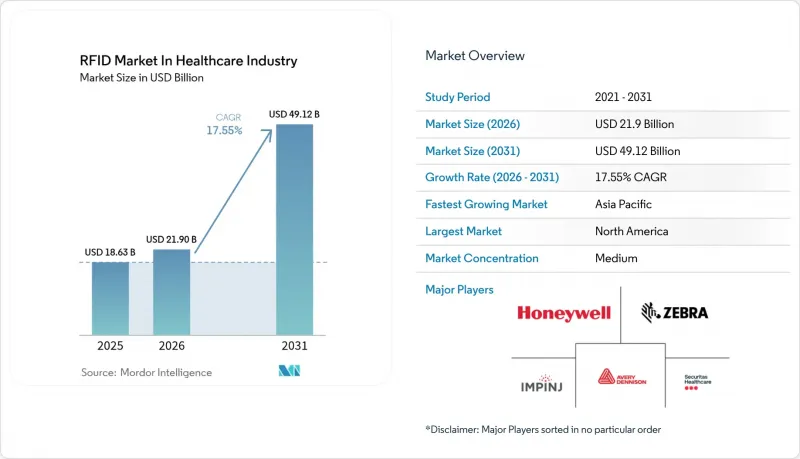
본 보고서는 구성 요소별(태그 및 라벨, 리더/안테나 등), 태그 주파수별(LF, HF/NFC, UHF/RAIN 등), 용도별(자산 추적, 환자 및 직원 추적 등), 최종 사용자별(병원, 제약 회사 등), 지역별(북미, 유럽, 아시아태평양, 남미 등)로 분류되어 있습니다. 시장 전망은 금액(달러) 기준으로 제시되어 있습니다.
의료 산업 내 RFID 시장 동향과 전망
위조품 억제를 위한 RFID를 활용한 의약품 진위 확인
FDA의 '의약품 공급망 보안법'에 따른 일련번호 부여의 주요 단계에 따라, 제조업체, 재포장업체 및 유통업체는 2025년까지 단계적으로 전자 제품 데이터를 교환해야 할 의무가 있습니다. 2차원 바코드는 대량 처리가 필요한 검증 라인의 부하를 감당할 수 없기 때문에 병원 및 도매업체는 RFID 도입을 서둘러야 하는 상황입니다. Oracle과 에이버리 데니슨은 최근 EPC 태그와 클라우드 분석을 결합하여 재고 부족을 자동화하는 통합 보충 플랫폼을 출시했습니다. 이는 공급업체가 규정 준수 및 효율성을 단일 워크플로우로 통합하고 있음을 반영합니다. 유럽의 의료 시스템도 유사한 과제에 직면해 있으며, 위조 의약품으로 인한 연간 손실은 102억 유로(110억 달러)에 달할 전망입니다. 이는 단순한 규제 준수를 넘어 구체적인 ROI(투자 수익률)의 근거가 되고 있습니다. 여전히 병목 현상을 일으키는 요인은 데이터의 무결성입니다. 의약품 SKU의 최대 절반은 여전히 완전한 전자제품코드정보서비스(EPCIS) 속성이 부족하며, 레거시 ERP 데이터와 일련번호가 부여된 식별자를 대조할 수 있는 미들웨어가 필요합니다.
온도에 민감한 생물학적 제제를 위한 자동화된 콜드체인 규정 준수
온도 편차는 전 세계적으로 연간 약 350억 달러에 달하는 의약품 폐기의 원인이 되고 있으며, 물류 사업자들은 임계값을 초과하기 전에 경보를 발령하는 온도 감지형 RFID 태그의 도입을 서두르고 있습니다. 최근 태그에는 각 생물학적 제제의 안정성 범위에 맞추어 융점을 조정할 수 있는 이온 액체 상변화 물질이 내장되어 있어, 하나의 라벨로 인슐린부터 CAR-T 치료에 이르기까지 광범위한 이용 사례에 대응할 수 있습니다. 팬데믹 기간 중 백신 접종 전개로 인해 RAIN RFID와 BLE 비콘을 결합한 하이브리드 아키텍처의 유효성이 입증되었습니다. 이를 통해 컨테이너가 허브를 통과할 때, 관리 이력(체인 오브 카스투디)용 펌웨어가 측정값을 동기화할 수 있게 되었습니다. 바이오의약품이 파이프라인에서 점점 더 큰 비중을 차지할 것으로 예상되는 가운데, 대서양 양안의 규제 당국은 현재 모든 노드에서 온도 기록을 의무화하고 있으며, RFID는 ‘있으면 편리한 것’에서 필수적인 인프라로 변모하고 있습니다.
UHF RFID와 MRI/CT 영상 진단실 간의 간섭
시설 전체에 걸친 가시화를 목표로 하는 병원에서는 860-960 MHz 대역의 태그와 영상 진단 장비 간에 전자기 간섭 문제에 직면하고 있습니다. 자기실 인근 리더기의 전원을 차단하는 구역 기반 아키텍처는 미들웨어 계층을 늘려 도입 비용을 상승시킵니다. 대안이 되는 HF 태그는 위험을 줄여주지만, 판독 거리가 줄어들기 때문에 대규모 보관 구역에서의 유용성은 제한적입니다. 일관된 규제 지침의 부재로 인해 조달 일정이 복잡해지고 있으며, 많은 방사선과에서는 공급업체의 문서가 정비될 때까지 도입을 연기할 수밖에 없는 상황입니다.
부문 분석
2025년, 헬스케어 업계의 RFID 시장 점유율 중 46.65%를 ‘태그 및 라벨’이 차지했습니다. 이는 모든 도입이 물품에 부착된 물리적 식별자에서 시작되기 때문입니다. 그러나 ‘소프트웨어 및 분석’ 부문이 연평균 성장률(CAGR) 18.42%로 성장을 주도하고 있으며, 이는 원시 태그 판독 데이터를 실용적인 대시보드로 변환하는 플랫폼으로의 전환이 진행되고 있음을 보여줍니다. Oracle의 클라우드 네이티브 미들웨어는 엣지 리더 위에 위치하며, 재고 수준이 떨어지는 순간 재고 보충 주문을 촉발함으로써 하드웨어가 아닌 데이터를 수익화하고 있습니다. 리더와 안테나는 여전히 필수적이지만, 단가 하락과 멀티 프로토콜 지원 기기로 인한 수명 주기 연장에 따라 그 성장률은 둔화되고 있습니다. 서비스 분야는 컨설팅 성격이 강화되고 있으며, 도입이 정착될 수 있도록 워크플로우 재설계, 사이버 보안 강화, 변경 관리 순서 정리를 통해 병원을 지원하고 있습니다. 이러한 요소들이 결합되면서, 왜 소프트웨어가 현재 헬스케어 업계의 RFID 시장에서 중심이 되고 있는지가 명확해집니다.
투자는 수요의 급증 예측, 이용 현황의 이상 감지, 예측 유지보수 알림 전송을 수행하는 인공지능(AI) 모듈로 전환되고 있습니다. 이러한 기능들은 총 소유 비용(TCO)에 대한 논의를 한층 더 활성화시키며, 투자 회수 기간이 3년 이내로 단축된다는 점을 재무 위원회에 설득하는 요인이 되고 있습니다. 벤더 선정에 있어서는 전자 차트, 기업 자원 계획(ERP), 생의학 공학 티켓 관리 시스템을 단일 환경으로 통합하는 개방형 API를 갖춘 플랫폼이 주목받고 있으며, 데이터 사일로를 유발하지 않으면서도 ‘베스트 오브 브リ?ド(Best-of-Breed)’ 방식의 유연성을 지원하고 있습니다.
헬스케어 업계에서 UHF/RAIN을 도입한 RFID 시장 규모는 2025년에 정점을 기록했습니다. 이는 이러한 태그가 표준 수동형 포털을 통해 여러 방에 있는 수백 개의 품목을 읽을 수 있기 때문입니다. RAIN 얼라이언스가 2023년에 448억 개의 칩 출하를 기록함에 따라 규모의 경제가 가속화되고 있습니다. 마이크로파 태그는 아직 발전 단계에 있지만, 수술 전후 관리 팀이 메스나 드릴 비트의 위치를 센티미터 단위로 정확하게 파악해야 하기 때문에 연평균 성장률(CAGR) 19.02%라는 가장 빠른 성장 궤적을 기록했습니다. HF/NFC 태그는 단거리 보안이 부가가치를 제공하는 약품 카트와 같은 접근 제어 환경에서 사용되고 있습니다. LF는 액체나 금속 차폐물을 통해 통신해야 하는 투석기나 임플란트에서 계속 사용되고 있지만, 그 양은 여전히 틈새 시장 수준에 머물러 있습니다.
병원에서는 여러 주파수를 읽을 수 있는 하이브리드형 리더기로의 전환이 진행되고 있으며, 새로운 임상 이용 사례가 실현될 때에도 자산이 유휴화되는 것을 방지하고 있습니다. 조달 담당자들은 구역별 위험도에 따라 출력 전력을 조정할 수 있는 안테나를 선호하며, 이를 통해 영상 진단실 인근에서의 간섭 우려가 해소되고 있습니다. 그 결과, UHF가 여전히 핵심을 이루는 한편, 마이크로파 및 HF가 고정밀도나 개인정보 보호가 요구되는 시나리오에서 중요한 위치를 확립하고 있는 상황이 만들어지고 있습니다.
지역별 분석
북미는 규제 측면의 지원과 성숙한 인프라 도입에 힘입어 2025년에는 매출 점유율 40.75%를 차지하며 헬스케어 업계의 RFID 시장을 주도하고 있습니다. 이 지역의 헬스케어 시장은 역동적이고 혁신 주도형이며, 미국이 그 도입의 최전선에 서 있습니다. 이 지역은 규제적 압력, 기술의 성숙도, 그리고 안전성과 효율성에 대한 임상적 수요의 혜택을 받고 있습니다. 또한 비용 및 통합과 같은 과제는 여전히 남아 있지만, 스마트하고 데이터 기반의 헬스케어로의 전환 기회 덕분에 RFID는 미래 헬스케어 인프라의 초석이 되고 있습니다.
아시아태평양은 헬스케어의 확대와 디지털 전환에 힘입어 예측 기간 동안 연평균 성장률(CAGR) 18.25%를 기록하며 가장 빠르게 성장하는 지역으로 부상하고 있습니다. 유럽은 규제 주도형 성장에 힘입어 견고한 입지를 유지하고 있는 반면, 라틴아메리카 및 중동 및 아프리카(MEA) 지역은 인프라 및 경제적 과제가 있음에도 불구하고 새로운 기회를 제시하고 있습니다. 모든 지역에서 RFID는 환자 안전, 재고 효율성 및 운영 회복력을 실현하기 위한 핵심 요소로 점점 더 인식되고 있습니다.
유럽의 헬스케어 부문에서는 엄격한 추적성 요건, 위조 의약품 지침(FMD) 준수, 그리고 약국 자동화를 향한 강력한 추진력을 배경으로 RFID 기술이 적극적으로 도입되고 있습니다. 병원에서는 장비 분실을 줄이고 업무 효율을 높이기 위해 자산 관리에 RFID를 도입하는 움직임이 점점 더 확산되고 있습니다. 남미에서는 브라질과 칠레 등 여러 국가가 공급망 현대화 및 혈액은행의 디지털화를 추진하고 있으며, 이는 꾸준한 성장으로 이어지고 있습니다. 그러나 예산 제약으로 인해 병원에서의 대규모 도입은 차질을 빚고 있습니다. 중동 및 아프리카에서는 걸프협력회의(GCC) 지역의 스마트 병원 투자, RFID를 활용한 환자 추적에 대한 수요 증가, 그리고 정부 주도의 의약품 진위 확인 이니셔티브를 배경으로 RFID 도입이 급증하고 있습니다. 아프리카 전체적으로는 인프라 격차로 인한 과제에 직면해 있지만, 특히 환자 수가 많은 공공시설에서 RFID 도입이 현저히 증가하고 있습니다.
기타 혜택:
- 엑셀 형식 시장 예측(ME) 시트
- 3개월간의 애널리스트 지원
자주 묻는 질문
목차
제1장 서론
제2장 조사 방법
제3장 주요 요약
제4장 시장 구도
제5장 시장 규모와 성장 예측
제6장 경쟁 구도
제7장 시장 기회와 향후 전망
KTH 26.08.06According to Mordor Intelligence, the RFID market size in healthcare industry was valued at USD 18.63 billion in 2025 and estimated to grow from USD 21.9 billion in 2026 to reach USD 49.12 billion by 2031, at a CAGR of 17.55% during the forecast period (2026-2031).
This report is Segmented by Component (Tags and Labels, Readers/Antenna and More), Tag Frequency (LF, HF/NFC, UHF/RAIN, and More), Application (Asset Tracking, Patient and Staff Tracking, and More), End User (Hospitals, Pharmaceutical Manufacturers, and More), and Geography (North America, Europe, Asia Pacific, South America, and More). The Market Forecasts are Provided in Terms of Value (USD).
Insights and Trends of RFID Market in Healthcare Industry
RFID-enabled Drug Authentication to Curb Counterfeits
Serialization milestones under the FDA Drug Supply Chain Security Act now compel manufacturers, repackagers, and distributors to exchange electronic product data by staggered deadlines in 2025, driving hospitals and wholesalers toward RFID because 2D barcodes strain high-volume verification lines. Oracle and Avery Dennison recently launched an integrated replenishment platform that marries EPC tags with cloud analytics to automate stockouts, reflecting how solution vendors are packaging compliance and efficiency in a single workflow. European health systems face a parallel imperative, with falsified medicines costing EUR 10.2 billion (USD 11.0 billion) annually, adding a tangible ROI argument that transcends mere regulatory checkbox. The bottleneck remains data completeness; up to half of drug SKUs still lack full Electronic Product Code Information Services (EPCIS) attributes, demanding middleware that can reconcile legacy ERP feeds with serialized identifiers.
Automated Cold-Chain Compliance for Temperature-Sensitive Biologics
Temperature excursions account for an estimated USD 35 billion in annual drug wastage worldwide, pushing logistics providers to embed temperature-sensing RFID tags that trigger alerts before thresholds are breached. Recent tags incorporate ionic-liquid phase-change materials whose melting points can be tuned to the stability band of each biologic, allowing one label to span use cases from insulin to CAR-T therapies. The vaccine rollout during the pandemic validated hybrid architectures that pair RAIN RFID with BLE beacons, enabling chain-of-custody firmware to sync readings as containers pass hubs With biologics forecast to command a rising share of pipelines, regulators on both sides of the Atlantic now require temperature documentation across every node, converting RFID from nice-to-have to essential infrastructure.
Interference of UHF RFID with MRI/CT Imaging Suites
Hospitals aiming for wall-to-wall visibility face electromagnetic conflict between 860-960 MHz tags and imaging hardware. Zone-based architectures that power-down readers near magnet rooms add layers of middleware and raise commissioning costs. Alternative HF tags mitigate risk but sacrifice read distance, limiting their utility in large holding bays. Lack of cohesive regulatory guidance complicates procurement timelines, prompting many radiology departments to postpone rollouts until supplier documentation matures.
Other drivers and restraints analyzed in the detailed report include:
- Rapid Adoption of UHF Tags in Real-Time Location Systems
- AI-powered Inventory Optimisation in Operating Rooms
- Capital-Intensive Retrofit of Legacy Pharmacy Dispensing Cabinets
For complete list of drivers and restraints, kindly check the Table Of Contents.
Segment Analysis
Tags and Labels captured 46.65% of the RFID Market in healthcare industry share in 2025 because every deployment starts with a physical identifier anchored to an item. However, Software and Analytics is pacing the segment with an 18.42% CAGR, signaling a shift toward platforms that interpret raw tag reads into actionable dashboards. Oracle's cloud-native middleware sits atop edge readers, triggering replenishment orders the moment par levels dip, thereby monetizing data rather than hardware. Readers and antennas remain indispensable, yet their growth rate is moderating as unit prices fall and multi-protocol devices stretch lifecycle utility. The Services slice is becoming consultative, guiding hospitals through workflow redesign, cybersecurity hardening, and change-management sequencing that ensure adoption sticks. Collectively, this mix illustrates why software is now the gravitational center of the RFID Market in healthcare industry .
Investment is tilting to artificial-intelligence modules that forecast demand spikes, flag utilization anomalies, and push predictive maintenance reminders. Those features elevate total cost-of-ownership arguments, persuading finance committees that payback periods sit well inside three years. Vendor selection gravitates toward platforms boasting open APIs that bind to electronic health records, enterprise resource planning, and biomedical engineering ticketing systems in one environment, supporting best-of-breed freedom without data silos.
The RFID Market in healthcare industry size for UHF/RAIN implementations stood highest in 2025 because those tags read hundreds of items across multiple rooms through standard passive portals. Economies of scale are accelerating as the RAIN Alliance tracked 44.8 billion chip shipments in 2023. Microwave tags, although nascent, recorded the swiftest trajectory at 19.02% CAGR as perioperative teams require centimeter-level pinpointing of scalpels and drill bits. HF/NFC tags occupy controlled-access environments like medication carts where short-range security adds value. LF continues in dialyzers and implants that must communicate through fluid or metal shielding, though volume remains niche.
Hospitals are converging on hybrid readers able to interrogate multiple frequencies, safeguarding against stranded assets when new clinical use cases materialize. Procurement teams favor antennas that adapt power output in response to zone risk, resolving interference concerns near imaging suites. The net effect is a portfolio where UHF remains backbone but microwave and HF carve premium footholds for precision and privacy scenarios.
Complete Report Scope:
- By Component
- Tags and Labels
- Readers / Antennas
- Middleware / Edge Servers
- Software and Analytics
- Services
- By Tag Frequency
- LF (125-134 kHz)
- HF / NFC (13.56 MHz)
- UHF / RAIN (860-960 MHz)
- Microwave (2.45 GHz)
- By Application
- Asset Tracking
- Patient and Staff Tracking
- Pharmaceutical and Supply-chain Tracking
- Blood and Specimen Monitoring
- Surgical Instrument Visibility
- Biometric and Access Control
- By End User
- Hospitals
- Pharmaceutical Manufacturers
- Clinics and Outpatient Centers
- Research Labs and Biobanks
- Contract Logistics and 3PL for Healthcare
- By Geography
- North America
- United States
- Canada
- Mexico
- South America
- Brazil
- Argentina
- Colombia
- Rest of South America
- Europe
- Germany
- United Kingdom
- France
- Italy
- Spain
- Nordics
- Rest of Europe
- Asia Pacific
- China
- Japan
- India
- Australia
- South Korea
- ASEAN
- Rest of Asia Pacific
- Middle East and Africa
- Middle East
- Gulf Cooperation Council (GCC)
- Turkey
- Rest of Middle East
- Africa
- South Africa
- Nigeria
- Kenya
- Rest of Africa
- Middle East
- North America
Geography Analysis
North America is leading the RFID market in the healthcare industry, with a 40.75% revenue share in 2025, driven by the adoption of regulatory support and mature infrastructure. The healthcare market in the region is dynamic and innovation-driven, with the U.S. at the forefront of adoption. The region benefits from regulatory pressure, technological maturity, and clinical demand for safety and efficiency. Furthermore, challenges such as cost and integration persist; however, the opportunities for smart, data-driven healthcare make RFID a cornerstone of future medical infrastructure.
The Asia-Pacific region emerges as the fastest-growing region, registering an 18.25% CAGR during the forecast period, driven by healthcare expansion and digital transformation. Europe maintains a robust position with regulatory-driven growth, whereas Latin America and MEA present emerging opportunities despite infrastructural and economic challenges. Across all regions, RFID is increasingly recognized as a critical enabler of patient safety, inventory efficiency, and operational resilience.
Europe's healthcare sector is embracing RFID technology, propelled by stringent traceability mandates, compliance with the Falsified Medicines Directive (FMD), and a robust push towards pharmacy automation. Hospitals are increasingly adopting RFID for asset management, aiming to reduce equipment losses and improve operational efficiency. In South America, countries such as Brazil and Chile are modernizing their supply chains and digitizing blood banks, leading to steady growth. However, budget constraints hinder large-scale deployments in hospitals. The Middle East and Africa see a surge in RFID adoption, driven by investments in smart hospitals in the Gulf Cooperation Council (GCC) region, a growing demand for RFID-based patient tracking, and government-backed initiatives for medicine authentication. While Africa as a whole faces challenges due to infrastructure gaps, there's a notable uptick in RFID adoption, especially in high-volume public facilities.
- Zebra Technologies Corp.
- Impinj Inc.
- Avery Dennison Corp.
- Honeywell International Inc.
- Alien Technology LLC
- Securitas Healthcare
- GAO RFID Inc.
- CCL Industries Inc.
- S3Edge Inc.
- Terso Solutions Inc.
- Biolog-id SA
- RF Technologies Inc.
- STid Groupe
- Spacecode Technologies SA
- Identiv Inc.
- Nedap N.V.
- Tageos SAS
- Denso Wave Inc.
- Jadak (A Novanta Company)
- SML Group Ltd.
- Xerafy Ltd.
- Invengo Technology Pte Ltd.
- Turck Vilant Systems
- MetraTec GmbH
Additional Benefits:
- The market estimate (ME) sheet in Excel format
- 3 months of analyst support
TABLE OF CONTENTS
1 INTRODUCTION
- 1.1 Study Assumptions and Market Definition
- 1.2 Scope of the Study
2 RESEARCH METHODOLOGY
3 EXECUTIVE SUMMARY
4 MARKET LANDSCAPE
- 4.1 Market Overview
- 4.2 Market Drivers
- 4.2.1 RFID-enabled Drug Authentication to Curb Counterfeits
- 4.2.2 Automated Cold-Chain Compliance for Temperature-Sensitive Biologics
- 4.2.3 Rapid Adoption of UHF Tags in Real-time Location Systems (RTLS)
- 4.2.4 AI-powered Inventory Optimisation in Operating Rooms
- 4.2.5 Mandated Unique Device Identification (UDI) Roll-outs
- 4.2.6 Enhanced Patient Safety Through Automated Medication Verification
- 4.3 Market Restraints
- 4.3.1 Interference of UHF RFID with MRI/CT Imaging Suites
- 4.3.2 Capital-intensive Retrofit of Legacy Pharmacy Dispensing Cabinets
- 4.3.3 Data-privacy Concerns in Patient-wearable Tags (EU GDPR)
- 4.3.4 Competing BLE/Ultra-wideband RTLS Platforms
- 4.4 Industry Value Chain Analysis
- 4.5 Regulatory Outlook
- 4.5.1 US FDA DSCSA Milestones
- 4.5.2 EU FMD Safety Features
- 4.5.3 China NMPA Medical-device Coding
- 4.6 Technological Outlook
- 4.6.1 HF vs UHF vs RAIN Standards
- 4.6.2 Cloud-native RFID Middleware
- 4.7 Porter's Five Forces
- 4.7.1 Bargaining Power of Suppliers
- 4.7.2 Bargaining Power of Buyers
- 4.7.3 Threat of New Entrants
- 4.7.4 Threat of Substitute Products
- 4.7.5 Intensity of Competitive Rivalry
5 MARKET SIZE AND GROWTH FORECASTS (VALUE)
- 5.1 By Component
- 5.1.1 Tags and Labels
- 5.1.2 Readers / Antennas
- 5.1.3 Middleware / Edge Servers
- 5.1.4 Software and Analytics
- 5.1.5 Services
- 5.2 By Tag Frequency
- 5.2.1 LF (125-134 kHz)
- 5.2.2 HF / NFC (13.56 MHz)
- 5.2.3 UHF / RAIN (860-960 MHz)
- 5.2.4 Microwave (2.45 GHz)
- 5.3 By Application
- 5.3.1 Asset Tracking
- 5.3.2 Patient and Staff Tracking
- 5.3.3 Pharmaceutical and Supply-chain Tracking
- 5.3.4 Blood and Specimen Monitoring
- 5.3.5 Surgical Instrument Visibility
- 5.3.6 Biometric and Access Control
- 5.4 By End User
- 5.4.1 Hospitals
- 5.4.2 Pharmaceutical Manufacturers
- 5.4.3 Clinics and Outpatient Centers
- 5.4.4 Research Labs and Biobanks
- 5.4.5 Contract Logistics and 3PL for Healthcare
- 5.5 By Geography
- 5.5.1 North America
- 5.5.1.1 United States
- 5.5.1.2 Canada
- 5.5.1.3 Mexico
- 5.5.2 South America
- 5.5.2.1 Brazil
- 5.5.2.2 Argentina
- 5.5.2.3 Colombia
- 5.5.2.4 Rest of South America
- 5.5.3 Europe
- 5.5.3.1 Germany
- 5.5.3.2 United Kingdom
- 5.5.3.3 France
- 5.5.3.4 Italy
- 5.5.3.5 Spain
- 5.5.3.6 Nordics
- 5.5.3.7 Rest of Europe
- 5.5.4 Asia Pacific
- 5.5.4.1 China
- 5.5.4.2 Japan
- 5.5.4.3 India
- 5.5.4.4 Australia
- 5.5.4.5 South Korea
- 5.5.4.6 ASEAN
- 5.5.4.7 Rest of Asia Pacific
- 5.5.5 Middle East and Africa
- 5.5.5.1 Middle East
- 5.5.5.1.1 Gulf Cooperation Council (GCC)
- 5.5.5.1.2 Turkey
- 5.5.5.1.3 Rest of Middle East
- 5.5.5.2 Africa
- 5.5.5.2.1 South Africa
- 5.5.5.2.2 Nigeria
- 5.5.5.2.3 Kenya
- 5.5.5.2.4 Rest of Africa
- 5.5.5.1 Middle East
- 5.5.1 North America
6 COMPETITIVE LANDSCAPE
- 6.1 Market Concentration
- 6.2 Strategic Moves
- 6.3 Market Share Analysis
- 6.4 Company Profiles (includes Global level Overview, Market level overview, Core Segments, Financials as available, Strategic Information, Market Rank/Share for key companies, Products and Services, and Recent Developments)
- 6.4.1 Zebra Technologies Corp.
- 6.4.2 Impinj Inc.
- 6.4.3 Avery Dennison Corp.
- 6.4.4 Honeywell International Inc.
- 6.4.5 Alien Technology LLC
- 6.4.6 Securitas Healthcare
- 6.4.7 GAO RFID Inc.
- 6.4.8 CCL Industries Inc.
- 6.4.9 S3Edge Inc.
- 6.4.10 Terso Solutions Inc.
- 6.4.11 Biolog-id SA
- 6.4.12 RF Technologies Inc.
- 6.4.13 STid Groupe
- 6.4.14 Spacecode Technologies SA
- 6.4.15 Identiv Inc.
- 6.4.16 Nedap N.V.
- 6.4.17 Tageos SAS
- 6.4.18 Denso Wave Inc.
- 6.4.19 Jadak (A Novanta Company)
- 6.4.20 SML Group Ltd.
- 6.4.21 Xerafy Ltd.
- 6.4.22 Invengo Technology Pte Ltd.
- 6.4.23 Turck Vilant Systems
- 6.4.24 MetraTec GmbH
7 MARKET OPPORTUNITIES AND FUTURE OUTLOOK
- 7.1 White-space and Unmet-need Assessment


