

|
시장보고서
상품코드
2097136
아토피 피부염 : 시장 점유율 분석, 업계 동향 및 통계, 성장 예측(2026-2031년)Atopic Dermatitis - Market Share Analysis, Industry Trends & Statistics, Growth Forecasts (2026 - 2031) |
||||||
 Mordor Intelligence
Mordor Intelligence에 의하면, 아토피 피부염 시장 규모는 2025년에 193억 8,000만 달러로 평가되었습니다. 2026년에 211억 5,000만 달러에 달하고, 2031년까지 332억 9,000만 달러에 이를 것으로 예측되며, 2026년부터 2031년에 걸쳐 CAGR 9.5%로 성장할 전망입니다.
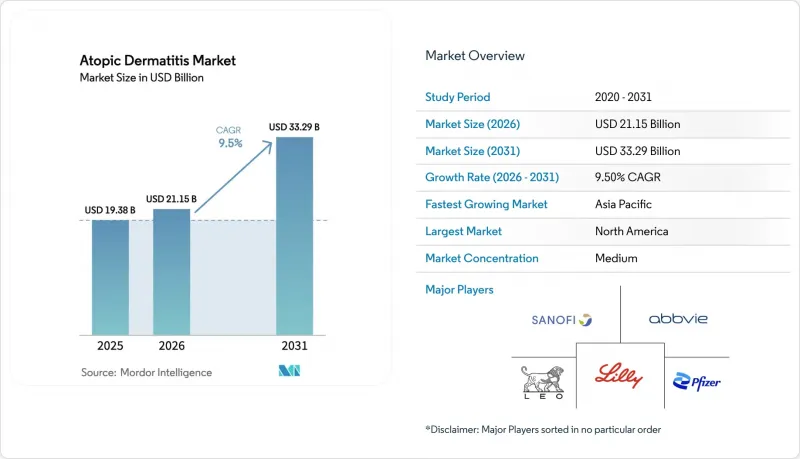
본 보고서는 약물 분류별(코르티코스테로이드 등), 투여 경로별(외용, 경구, 주사), 환자 연령대별(소아 : 0-17세, 성인 : 18세 이상), 유통 채널별(병원, 소매, 온라인/원격 피부과), 지역별(북미, 유럽, 아시아태평양, 중동 및 아프리카, 남미)별로 분류되어 있습니다. 시장 전망은 금액(달러)으로 제시되어 있습니다.
세계의 아토피 피부염 시장 동향 및 인사이트
소아 및 성인 인구에서 전 세계 질병 부담 증가
2025년까지 선진국에서 소아 유병률은 15-20%, 성인 유병률은 7-10%로 상승했습니다. 한편, 신흥 경제국에서는 도시화와 생후 초기 미생물 노출 감소와 관련하여 더 급속한 유병률 상승이 기록되고 있습니다. 환자층의 확대는 유지 요법과 증상 악화 관리 모두에 대한 수요를 뒷받침하고 있으며, 이로 인해 경기 순환의 영향을 덜 받게 됩니다. 소아기에 발병한 사례는 성인기까지 지속되는 경우가 많으며, 생물학적 제제로 증상이 조절된 후에도 평생 치료가 필요하기 때문에 치료제 전환 비용이 높아집니다. 아시아태평양에서는 급속한 도시로의 인구 이동 및 대기질 악화와 관련이 있는 것으로 여겨지며, 유병률 증가가 가장 두드러집니다. 보험사들은 사후 대응적인 응급 치료에서 예방적인 유지 요법으로 전환하고 있으며, 장시간 작용형 주사제를 선호하고 있습니다. 따라서 이러한 인구 동향의 호재에 힘입어 2031년까지 판매량과 가격 모두의 성장이 뒷받침되고 있습니다.
퍼스트-인-클래스 생물학적 제제 및 JAK 억제제의 승인 가속화
규제 당국은 2024년 1월부터 2025년 9월 사이에 8건의 주요 승인 또는 적응증 확대를 단행했으며, 이는 지난 5년간의 속도보다 3배 빠른 수준입니다. FDA는 2024년 9월, 중등도에서 중증 질환을 가진 성인을 위한 치료제로 레브리키즈마브를 승인했습니다. 애브비는 2024년 5월, 우파다시티닙의 미국 내 사춘기 환자 대상 적응증 확대를 획득하여 대상 환자 수를 100만 명 이상 확대했습니다. 일본 PMDA는 2024년 3월, 소아를 대상으로 한 아브로시티닙을 승인하며, JAK1 선택성이 청소년층에게도 적합함을 확인했습니다. FDA, EMA, PMDA 간의 심사 절차 조화를 통해 전 세계 시장 출시까지의 기간이 단축되고, 후기 개발 단계에서의 자본 집약도가 낮아짐에 따라 중소 바이오테크 기업들이 새로운 작용기전을 가진 약물을 3상 임상시험 단계로 추진하는 데 힘이 되고 있습니다.
고액의 연간 치료비가 신규 전신성 약물에 대한 환자의 접근을 제한하고 있습니다.
2025년 미국의 도매 구입 가격은 듀필마브가 4만 달러를 초과했고, 우파다시티닙 및 아브로시티닙은 3만 5,000-3만 8,000달러였습니다. 지원 프로그램을 통해 민간 보험 가입자의 부담은 경감되지만, 반리베이트 규정에 따라 메디케어 수급자는 대상에서 제외되어 고령층에게는 지원의 공백이 발생하고 있습니다. 인도에서는 1만 2,000달러로 책정된 듀필마브의 바이오시밀러조차 여전히 소득 중앙값의 수 배에 해당하기 때문에 그 이용은 도시 지역의 엘리트 계층으로 제한되고 있습니다. 단계적 치료의 의무화로 인해 6-12개월의 지연이 발생하여 병세가 악화될 우려가 있습니다. 게다가 콜드체인 물류로 인해 주사제 가격이 더욱 치솟고 있습니다. 2028년 이후 바이오시밀러의 등장으로 비용은 억제될 것으로 예상되지만, 새로운 생물학적 제제에 대한 독점권은 2030년까지 지속될 전망입니다.
부문 분석
2025년에는 코르티코스테로이드가 매출의 34.8%를 차지했으나, IL-4, IL-13, JAK 억제제는 2031년까지 연평균 11.2%의 성장률을 보일 것으로 예측되며, 이는 아토피 피부염 시장 전체의 연평균 성장률(CAGR)의 거의 2배에 해당합니다. 듀필루맙 단독으로 2024년에는 116억 달러의 매출을 기록했으며, 그중 약 60%가 아토피 피부염 분야에서 비롯된 것이었습니다. 소아 및 신흥 시장에서의 적용 범위가 확대되면, 아토피 피부염용 바이오의약품 시장 규모는 급격히 확대될 것으로 예측됩니다. 칼시뉴린 억제제나 PDE4 외용제는 중견적인 위치를 차지하고 있지만, 룩솔리티닙 크림과 같은 새로운 치료 옵션은 가려움증 완화 효과가 빠르다는 점에서 지지를 넓혀가고 있습니다. 2028년부터 2029년에 걸쳐 특허가 만료됨에 따라 바이오시밀러의 진입 여지가 생기겠지만, 항체 제조가 복잡하기 때문에 진출기업은 극소수에 그칠 것으로 보입니다.
처방 권한은 피부과 전문의 쪽으로 점차 이동하고 있으며, 알레르기 전문의나 1차 진료 의사는 바이오의약품에 대한 평가를 조기에 피부과 전문의에게 의뢰하는 경향이 있습니다. 일라이 릴리사의 레브리키즈맙은 도입기 이후 투여 간격이월1회라는 점이 특징이며, 격주 투여에 따른 복약 순응도 부담을 경감시켜 아토피 피부염 시장에서 더 큰 점유율을 확보할 가능성이 있습니다. 보습제는 여전히 기초적인 치료법이지만, 수익은 낮은 수준에 머물러 있습니다. 항균제 적정 사용 프로그램에 따라 항균제 사용은 제한되고 있습니다. 전반적으로, 생물학적 제제와 JAK 억제제가 아토피 피부염 시장의 수익 분포를 재편하고 있습니다.
2025년에는 외용제가 매출의 61.2%를 차지했으나, 3개월이 지나면 실제 복약 순응도는 50% 미만으로 떨어집니다. 주사제는 투여 부담을 줄여주는월1회 또는 격주 투여 방식의 생물학적 제제에 힘입어 연평균 10.5%의 속도로 성장하고 있습니다. 2028년 이후 바이오시밀러의 진입으로 비용 장벽이 낮아짐에 따라, 아토피 피부염 시장에서 주사제 시장 규모는 확대될 것으로 예측됩니다. 경구용 JAK 억제제는 1일 1회 투여라는 편의성을 제공하지만, 박스 경고에 대한 거부감에 직면해 있습니다. Arcutis사의 1일 1회 투여 로플루미라스트 제형은 의사의 높은 채택률에 힘입어 2024년 3분기에 4,500만 달러의 매출을 달성했습니다. Leon Pharma사의 델고시티닙 크림은 2024년에 FDA의 패스트트랙 지정을 획득했으며, 이는 스테로이드 사용을 줄일 수 있는 외용제의 필요성이 규제 당국에 의해 인정받고 있음을 보여줍니다. 향후, 탄탄한 환자 지원 프로그램으로 뒷받침되는 주사제는 아토피 피부염 시장에서 점유율을 지속적으로 확대할 것으로 전망됩니다.
지역별 분석
북미는 광범위한 보험 적용과 생물학적 제제의 조기 도입에 힘입어 2025년 매출의 41.30%를 차지했습니다. 메디케어 파트 D에서는 듀필루맙이 보험 적용 대상이며, 민간 보험 플랜에서는 일반적으로 외용제 치료가 한 번 실패한 후에 생물학적 제제가 승인됩니다. 캐나다에서는 2024년 중반에 트랄로키누맙이 주 정부 처방약 목록에 추가되면서 치료 선택지가 다양해졌습니다. 적격한 중등도에서 중증 환자에서의 보급률이 40%에 가까워짐에 따라 성장은 둔화되고 있지만, 2028년 이후 바이오시밀러의 진입으로 비용 장벽이 낮아져 시장 규모가 다시 확대될 가능성이 있습니다. 또한, 미국의 원격 피부과 진료 인프라는 생물학적 제제의 지속적인 사용을 촉진하고 안정적인 처방전 갱신 주기를 만들어 아토피 피부염 시장을 안정화시키고 있습니다.
아시아태평양은 2031년까지 연평균 성장률(CAGR) 10.9%를 나타낼 것으로 예측됩니다. 2024년 12월 중국이 트랄로키누맙을 보험 적용 목록에 추가한 것과 인도에서 듀필맙의 바이오시밀러가 40% 할인된 가격으로 출시된 것이 이러한 성장세를 뒷받침하고 있습니다. 일본에서는 외용 요법에 저항성을 보이는 증례에 대해 생물학적 제제에 대한 보조가 이루어지고 있지만, 병원에서 투여하는 것이 주류이기 때문에 치료에 접근하는 데 시간이 걸립니다. 한국은 2025년, 실제 치료 성과를 바탕으로 지급액을 결정하는 데이터 연계형 위험 분담 계약을 체결했습니다. 호주의 의료 급여 제도에서는 2025년에 레브리키즈맙이 2차 선택 치료제로 지정되었습니다. 대기 오염이나 식생활 변화와 같은 환경적 요인으로 인해 유병률은 계속 상승하고 있으며, 이것이 수요를 뒷받침하고 있습니다.
유럽에서는 완만한 확대세가 나타나고 있습니다. 독일에서는 외용 스테로이드와 광선 요법 모두 효과가 없음이 문서로 입증된 경우에만 생물학적 제제의 보험 적용이 이루어지는데, 이로 인해 도입까지의 기간이 최대 12개월까지 연장될 가능성이 있습니다. 영국 NICE 기준에 따르면 중증 환자에게만 처방이 제한되어 있어 처방량이 억제되고 있습니다. 프랑스와 이탈리아에서는 병원 내 생물학적 제제 사용에 중점을 두고 있어 편의성이 떨어지고 있습니다. 남미에서는 아직 시장이 발전 단계에 있습니다. 브라질의 민간 보험사는 2024년에 듀필마브의 보험 적용을 시작했으나, 공적 보험 제도에서는 생물학적 제제가 채택되지 않아 양극화된 시장 양상을 보이고 있습니다. 걸프 국가들에서는 가치 기반 생물학적 제제 계약이 시범적으로 도입되고 있습니다. 전반적으로, 지불 주체의 정책에 따른 지역 간 차이가 시장 침투의 불균형을 초래하고 있지만, 아시아태평양의 성장세가 유럽의 완만한 확대를 상쇄하며 아토피 피부염 시장의 세계 성장을 뒷받침하고 있습니다.
기타 혜택 :
- 엑셀 형식 시장 예측(ME) 시트
- 3개월간의 애널리스트 지원
자주 묻는 질문
목차
제1장 서론
제2장 조사 방법
제3장 주요 요약
제4장 시장 구도
제5장 시장 규모 및 성장 예측
제6장 경쟁 구도
제7장 시장 기회 및 향후 전망
KTH 26.08.05According to Mordor Intelligence, the atopic dermatitis market size is projected to be USD 19.38 billion in 2025, USD 21.15 billion in 2026, and reach USD 33.29 billion by 2031, growing at a CAGR of 9.5% from 2026 to 2031.
This report is Segmented by Drug Class (Corticosteroids, and More), Route of Administration (Topical, Oral, and Injectable), Patient Age Group (Pediatric 0-17 Yrs and Adult 18+ Yrs), Distribution Channel (Hospital, Retail, and Online/Tele-Dermatology), and Geography (North America, Europe, Asia-Pacific, MEA, and South America). Market Forecasts are Provided in Value (USD).
Global Atopic Dermatitis Market Trends and Insights
Rising Global Disease Burden Across Pediatric and Adult Populations
Prevalence climbed to 15-20% among children and 7-10% among adults in industrialized nations by 2025, while emerging economies recorded a faster incidence linked to urbanization and diminished early-life microbial exposure. The expanding patient pool sustains demand for both maintenance therapy and flare management, which reduces exposure to economic cycles. Pediatric onset frequently persists into adulthood, creating lifetime treatment trajectories that raise switching costs once a biologic achieves control. The Asia-Pacific region shows the steepest incidence curve, likely tied to rapid urban migration and air quality degradation. Payers are moving from reactive rescue therapy toward proactive maintenance, favoring long-acting injectables. The demographic tailwind therefore supports both volume and price growth through 2031.
Accelerated Regulatory Approvals of First-In-Class Biologics And JAK Inhibitors
Regulators issued eight key approvals or label expansions between January 2024 and September 2025, tripling the pace of the prior five-year period. The FDA cleared lebrikizumab in September 2024 for the treatment of adults with moderate to severe disease. AbbVie gained U.S. adolescent labeling for upadacitinib in May 2024, enlarging its eligible population by over one million patients. Japan's PMDA approved abrocitinib for pediatrics in March 2024, confirming JAK1 selectivity as appropriate for younger cohorts. Harmonized review procedures across FDA, EMA, and PMDA shortened global rollout timelines and reduced late-stage capital intensity, which encourages smaller biotechs to push novel mechanisms into Phase III.
High Annual Therapy Costs Limiting Patient Access to Novel Systemic Agents
Wholesale acquisition costs exceeded USD 40,000 for dupilumab and USD 35,000-38,000 for upadacitinib and abrocitinib in the United States during 2025. Assistance programs lower costs for commercial plans but exclude Medicare beneficiaries under anti-kickback rules, leaving gaps for older adults. In India, biosimilar dupilumab priced at USD 12,000 still represents several times the median income, limiting uptake to urban elites. Step-therapy mandates impose 6-12 month delays and may worsen disease. Cold-chain logistics further inflate injectable prices. Biosimilars after 2028 are expected to compress costs, but exclusivity for newer biologics will persist until 2030.
Other drivers and restraints analyzed in the detailed report include:
- Expansion of Universal Healthcare and Private Insurance Coverage in Emerging Markets
- AI-Enabled Decision Support Improving Early Diagnosis And Personalized Treatment
- Ongoing Safety and Label Restriction Concerns for JAK Inhibitors
For complete list of drivers and restraints, kindly check the Table Of Contents.
Segment Analysis
Corticosteroids retained 34.8% of the revenue in 2025, yet IL-4, IL-13, and JAK inhibitors are forecast to grow at 11.2% annually through 2031, nearly double the broader atopic dermatitis market's CAGR. Dupilumab alone generated USD 11.6 billion in sales in 2024, of which roughly 60% came from atopic dermatitis. The atopic dermatitis market size for biologics is projected to expand sharply once pediatric and emerging-market coverage deepen. Calcineurin inhibitors and PDE4 topicals occupy mid-tier positions, but newer options, such as ruxolitinib cream, are gaining traction due to their faster itch relief. Patent expiries between 2028 and 2029 will open the space for biosimilars; however, complex antibody manufacturing will limit the field to a handful of entrants.
Broader prescribing authority is sliding toward dermatologists, with allergists and primary-care doctors referring sooner for biologic evaluation. Eli Lilly's lebrikizumab differs in its monthly dosing regimen after the loading phase, addressing adherence fatigue associated with every-other-week regimens and potentially capturing a larger share of the atopic dermatitis market. Emollients remain foundational but low-revenue. Stewardship programs constrain antibiotic use. Collectively, biologics and JAK inhibitors reshape revenue distribution in the atopic dermatitis market.
Topicals accounted for 61.2% of revenue in 2025, yet real-world adherence falls below 50% beyond three months. Injectables are expanding at a rate of 10.5% annually, driven by monthly or bi-weekly biologics that reduce the dosing burden. The atopic dermatitis market size for injectables is expected to grow as biosimilar entry after 2028 reduces cost barriers. Oral JAK inhibitors offer once-daily convenience but face boxed-warning resistance. Arcutis's once-daily roflumilast foam achieved USD 45 million in 3Q-2024 revenue, driven by strong physician adoption. Leon Pharma's delgocitinib cream secured FDA Fast Track status in 2024, indicating regulatory acknowledgment of the need for steroid-sparing topicals. Over time, injectables backed by robust patient support programs should continue to gain allocation within the atopic dermatitis market.
Complete Report Scope:
- By Drug Class
- Corticosteroids
- Emollients / Moisturizers
- IL-4, IL-13 & JAK (PDE4) Inhibitors
- Calcineurin Inhibitors
- Antibiotics & Antiseptics
- Other Drug Classes
- By Route Of Administration
- Topical
- Oral
- Injectable / Parenteral
- By Patient Age Group
- Pediatric (0-17 Yrs)
- Adult (18+ Yrs)
- By Distribution Channel
- Hospital Pharmacies
- Retail Pharmacies & Drug Stores
- Online Pharmacies & Tele-Dermatology Platforms
- Geography
- North America
- United States
- Canada
- Mexico
- Europe
- Germany
- United Kingdom
- France
- Italy
- Spain
- Rest Of Europe
- Asia-Pacific
- China
- Japan
- India
- South Korea
- Australia
- Rest Of Asia-Pacific
- Middle-East And Africa
- GCC
- South Africa
- Rest Of Middle East And Africa
- South America
- Brazil
- Argentina
- Rest Of South America
- North America
Geography Analysis
North America generated 41.30% of the 2025 revenue, bolstered by broad insurance coverage and early adoption of biologics. Medicare Part D reimburses dupilumab, and commercial plans usually approve biologics after one topical failure. Canada added tralokinumab to provincial formularies in mid-2024, diversifying options. Growth is moderating as penetration nears 40% of eligible moderate-to-severe patients, yet biosimilar entry after 2028 may reopen the pool by reducing cost barriers. The United States tele-dermatology infrastructure also amplifies biologic persistence, fostering steady refill cycles that stabilize the atopic dermatitis market.
Asia-Pacific is projected to grow at a 10.9% CAGR through 2031. China's December 2024 inclusion of tralokinumab in the reimbursement list and India's biosimilar dupilumab launch at a 40% discount underpin momentum. Japan subsidizes biologics for topical-refractory cases, though hospital-based administration slows access. South Korea signed data-linked risk-sharing agreements in 2025 that tie payment to real-world outcomes. Australia's benefits scheme listed lebrikizumab in 2025 as a second-line treatment. Environmental drivers, such as air pollution and dietary changes, continue to elevate the prevalence, reinforcing demand.
Europe shows moderate expansion. Germany reimburses biologics only after a documented failure of both topical steroids and phototherapy, which can extend lead times by up to 12 months. NICE criteria in the United Kingdom restrict prescribing to high-severity cases, suppressing volume. France and Italy focus on the biological use in hospital settings, which reduces convenience. South America remains nascent. Brazil's private insurers began covering dupilumab in 2024, but public plans did not adopt biologics, resulting in a two-tier market. Gulf states test value-based biologic contracts. Overall, regional divergences in payer policy drive uneven penetration; however, momentum in the Asia-Pacific region compensates for slower European ramp-ups, sustaining global expansion of the atopic dermatitis market.
- Abbvie
- Amgen
- Arcutis Biotherapeutics
- Bausch Health
- Bristol-Myers Squibb
- Cara Therapeutics
- Dermavant Sciences Inc.
- Eli Lilly and Company
- Evelo Biosciences
- Galderma
- GlaxoSmithKline
- Incyte Corp.
- Kyowa Kirin Co. Ltd.
- Leo Pharma
- Novartis
- Pfizer
- Regeneron Pharmaceuticals
- Sanofi
Additional Benefits:
- The market estimate (ME) sheet in Excel format
- 3 months of analyst support
TABLE OF CONTENTS
1 Introduction
- 1.1 Study Assumptions & Market Definition
- 1.2 Scope of the Study
2 Research Methodology
3 Executive Summary
4 Market Landscape
- 4.1 Market Overview
- 4.2 Market Drivers
- 4.2.1 Rising Global Disease Burden Across Pediatric and Adult Populations
- 4.2.2 Accelerated Regulatory Approvals of First-In-Class Biologics and JAK Inhibitors
- 4.2.3 Expansion of Universal Healthcare And Private Insurance Coverage in Emerging Markets
- 4.2.4 AI-Enabled Decision Support Improving Early Diagnosis and Personalized Treatment
- 4.2.5 Advancements in Skin Microbiome-Modulating Therapeutics
- 4.2.6 Consumer Shift Toward Steroid-Sparing Regimens and Clean-Label Topicals
- 4.3 Market Restraints
- 4.3.1 High Annual Therapy Costs Limiting Patient Access to Novel Systemic Agents
- 4.3.2 Ongoing Safety and Label Restriction Concerns for JAK Inhibitors
- 4.3.3 Suboptimal Long-Term Adherence to Injectable Biologics in Real-World Settings
- 4.3.4 Cold-Chain and Bioprocess Capacity Constraints Increasing Supply Risk
- 4.4 Value / Supply-Chain Analysis
- 4.5 Regulatory Outlook
- 4.6 Clinical Pipeline Analysis
- 4.7 Porter's Five Forces Analysis
- 4.7.1 Threat Of New Entrants
- 4.7.2 Bargaining Power Of Buyers
- 4.7.3 Bargaining Power Of Suppliers
- 4.7.4 Threat Of Substitutes
- 4.7.5 Competitive Rivalry
5 Market Size & Growth Forecasts (Value, USD)
- 5.1 By Drug Class
- 5.1.1 Corticosteroids
- 5.1.2 Emollients / Moisturizers
- 5.1.3 IL-4, IL-13 & JAK (PDE4) Inhibitors
- 5.1.4 Calcineurin Inhibitors
- 5.1.5 Antibiotics & Antiseptics
- 5.1.6 Other Drug Classes
- 5.2 By Route Of Administration
- 5.2.1 Topical
- 5.2.2 Oral
- 5.2.3 Injectable / Parenteral
- 5.3 By Patient Age Group
- 5.3.1 Pediatric (0-17 Yrs)
- 5.3.2 Adult (18+ Yrs)
- 5.4 By Distribution Channel
- 5.4.1 Hospital Pharmacies
- 5.4.2 Retail Pharmacies & Drug Stores
- 5.4.3 Online Pharmacies & Tele-Dermatology Platforms
- 5.5 Geography
- 5.5.1 North America
- 5.5.1.1 United States
- 5.5.1.2 Canada
- 5.5.1.3 Mexico
- 5.5.2 Europe
- 5.5.2.1 Germany
- 5.5.2.2 United Kingdom
- 5.5.2.3 France
- 5.5.2.4 Italy
- 5.5.2.5 Spain
- 5.5.2.6 Rest Of Europe
- 5.5.3 Asia-Pacific
- 5.5.3.1 China
- 5.5.3.2 Japan
- 5.5.3.3 India
- 5.5.3.4 South Korea
- 5.5.3.5 Australia
- 5.5.3.6 Rest Of Asia-Pacific
- 5.5.4 Middle-East And Africa
- 5.5.4.1 GCC
- 5.5.4.2 South Africa
- 5.5.4.3 Rest Of Middle East And Africa
- 5.5.5 South America
- 5.5.5.1 Brazil
- 5.5.5.2 Argentina
- 5.5.5.3 Rest Of South America
- 5.5.1 North America
6 Competitive Landscape
- 6.1 Market Concentration
- 6.2 Market Share Analysis
- 6.3 Company Profiles (Includes Global Level Overview, Market Level Overview, Core Business Segments, Financials, Headcount, Key Information, Market Rank, Market Share, Products And Services, And Analysis Of Recent Developments)
- 6.3.1 AbbVie Inc.
- 6.3.2 Amgen Inc.
- 6.3.3 Arcutis Biotherapeutics
- 6.3.4 Bausch Health Companies Inc.
- 6.3.5 Bristol Myers Squibb Co.
- 6.3.6 Cara Therapeutics
- 6.3.7 Dermavant Sciences Inc.
- 6.3.8 Eli Lilly & Co.
- 6.3.9 Evelo Biosciences
- 6.3.10 Galderma SA
- 6.3.11 GSK Plc
- 6.3.12 Incyte Corp.
- 6.3.13 Kyowa Kirin Co. Ltd.
- 6.3.14 Leo Pharma A/S
- 6.3.15 Novartis AG
- 6.3.16 Pfizer Inc.
- 6.3.17 Regeneron Pharmaceuticals Inc.
- 6.3.18 Sanofi
7 Market Opportunities & Future Outlook
- 7.1 White-Space & Unmet-Need Assessment


