

|
시장보고서
상품코드
2097139
헬리콥터 엔진 : 시장 점유율 분석, 업계 동향 및 통계, 성장 예측(2026-2031년)Helicopter Engines - Market Share Analysis, Industry Trends & Statistics, Growth Forecasts (2026 - 2031) |
||||||
 Mordor Intelligence
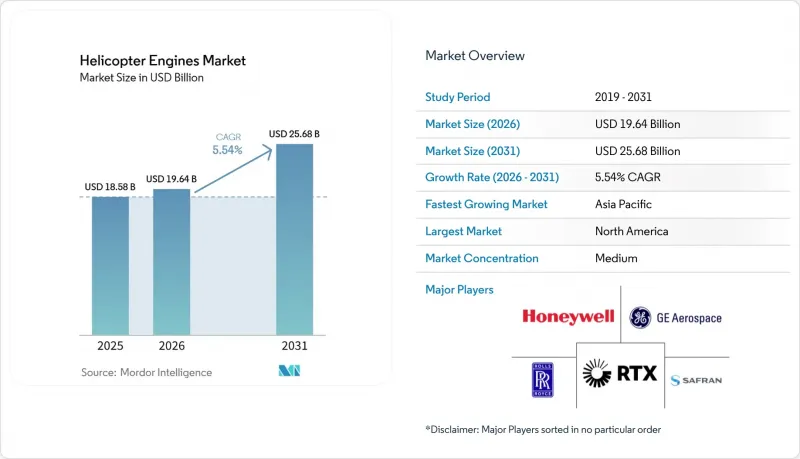
Mordor Intelligence에 의하면, 헬리콥터용 엔진 시장 규모는 2025년 185억 8,000만 달러로 평가되었습니다. 2026년에는 196억 4,000만 달러로 확대되어 2026년부터 2031년에 걸쳐 CAGR 5.54%로 성장을 지속하여, 2031년에는 256억 8,000만 달러에 이를 것으로 예측됩니다.
본 보고서는 용도별(상용 헬리콥터 및 군용 헬리콥터), 엔진 유형별(피스톤 엔진 및 터빈 엔진), 출력 등급별(1,000 Shp 이하, 1,001-2,000 Shp, 2,000 Shp 이상), 헬리콥터 유형별(경량 헬리콥터, 중형 헬리콥터, 대형 헬리콥터), 지역(북미, 유럽, 기타)별로 분류되어 있습니다. 시장 전망은 금액(달러) 기준으로 제시되어 있습니다.
세계의 헬리콥터 엔진 시장 동향 및 인사이트
기체 수 증가와 군사 현대화의 기세
기체 수 증가와 군사 현대화의 기세는 산발적인 구매 대신 기체군 전체를 아우르는 계획적인 조달을 수행하는 예측 가능한 다년간 규모의 국방 예산에 힘입고 있습니다. 2024년 6월 47억 달러 규모의 아파치 수주 및 2024년 9월 4억 3,300만 달러 규모의 블랙호크 수주는 GE T700 및 향후 T901의 생산 라인을 보장하는 것이며, 숙련된 인력, 제조 설비, 공급망 네트워크를 향후 10년 동안 유지하게 될 것입니다. 호주의 28억 달러 규모 블랙호크 조달, 일본의 UH-2 도입, 그리고 한국의 KUH-1 슬리온 생산은 아시아태평양이 실험적인 아키텍처보다 실적이 입증된 동력 장치를 선호하는 경향을 여실히 보여주고 있습니다. HAL사의 샤크티 파생형 엔진을 탑재한 인도의 경다목적 헬기(LUH) 및 경전투 헬기(LCH)는 해당 지역의 터빈 수요를 더욱 확대시킬 것으로 예측됩니다.
석유 및 가스 분야의 해양 회수 작업이 중량물 운반용 엔진 수요를 끌어올리고 있습니다.
멕시코만, 브라질의 프레솔트층, 그리고 중동 해역에서의 해양 탐사 재개에 따라, 200해리 이상의 구간에서 승무원과 화물을 수송할 수 있는 슈퍼 미디엄 및 헤비 리프트 헬리콥터에 대한 수요가 다시 높아지고 있습니다. 2024년 기어박스 부족으로 27대의 시코르스키 S-92가 운항 중단되었을 때, 각 운영사들은 2,000 shp 사프란 아네토 엔진을 탑재한 레오나르도 AW189나 에어버스 H175 등의 대체 기종을 급히 확보함에 따라, 가용 기수가 부족해져 리스 요금이 상승했습니다. BOEM 보고서에 따르면, 운항사들은 현재 좌석 마일당 비용을 절감하기 위해 더 넓은 객실을 선호하는 경향을 보이고 있는 반면, 사우디 아람코와 ADNOC는 플랫폼으로의 셔틀 임무를 위해 AW189 기단을 확대되고 있습니다. 가동률 상승으로 정비 능력이 한계에 달하면서, 엔진 1대당 정비 방문 시 발생하는 애프터마켓 수익이 증가하고 있습니다.
신형 엔진의 연구 개발 및 인증 비용 급등
최신 터보샤프트 프로그램에 진입하기 위한 장벽이 비약적으로 높아지면서 신규 시장 진출기업을 가로막는 한편, 이미 입지를 다진 대형 기업 그룹에 혁신이 집중되는 결과를 낳고 있습니다. GE의 T901 엔진은 2024년 7월 첫 양산기 납품에 이르기까지, 수십 대의 내구성 시험 장비와 고고도 결빙 시험을 포함해 10년 동안 10억 달러 이상의 비용이 소요되었습니다. FAA 및 EASA의 파트 33 프로토콜에서는 수천 시간에 달하는 가혹한 사이클 시험이 의무화되어 있어, 설계에 사소한 변경을 가하는 것만으로도 인증 절차를 처음부터 다시 진행해야 하므로 일정에 수 분기의 지연이 발생합니다. 니켈 기반 초합금 및 단결정 터빈 블레이드의 재료 가격 급등으로 인해 예산이 부풀어 오르고 있어, 각 OEM 업체들은 규제 장벽을 넘지 못할 가능성이 있는 고위험 제로베이스 설계 대신 단계적인 블록 업그레이드로 방향을 전환하고 있습니다.
부문 분석
군용 헬리콥터 프로그램은 2025년 엔진 수요의 65.45%를 차지했으며, 경기 변동의 영향을 쉽게 받는 민간 시장의 사이클로부터 전반적인 수익을 보호하고 있습니다. 아파치, 블랙호크, 치누크를 위한 미 육군의 다년간 생산 계약은 2030년대에 걸쳐 GE의 T700 및 향후 도입될 T901 생산 라인을 뒷받침하며, 주요 주조품, 단조품, 디지털 제어 부품에 대한 안정적인 수요를 보장하고 있습니다. 호주의 블랙호크 40대 발주에 더해, 일본의 UH-2 및 한국의 KUH-1 ‘슬리온’의 꾸준한 조달로 인해 T700 파생형 엔진의 수주는 지속적으로 유입되고 있습니다. 아시아태평양의 성장세는 인도의 LCH 및 LUH 프로그램과 중국의 Z-20 양산으로 더욱 강화되고 있으며, 지역적으로 분산된 견실한 군사 분야 수주 잔고가 확립되어 있습니다.
현재 생산량은 국방 예산에 의해 뒷받침되고 있지만, 민간 수요는 연평균 8.25%의 복합 성장률을 보일 것으로 예측되며, 2026년부터 2031년에 걸쳐 헬리콥터 엔진 시장 규모에 대한 기여도가 매년 35억 달러씩 점진적으로 증가할 것으로 전망됩니다. 인증 절차는 크게 다릅니다. 군용 엔진은 FAA 및 EASA 파트 33의 민간 기준을 상회하는 탄도 내성 시험, 모래 흡입 시험, 극한 기후 시험을 거칩니다. 따라서 기체 관리 담당자들은 병력 수송기, 공격기, 훈련기를 아우르는 표준 엔진 제품군을 채택하는 경향이 있으며, 이를 통해 부품 재고를 줄이고 현장 정비를 간소화하고 있습니다. 이와 동시에, 해양 물류 및 HEMS(항공 의료 서비스) 임무에 복귀하는 민간 사업자들이 미뤄두었던 구매를 재개하고 있습니다. 그러나 2020년대 중반까지는 군용기 편대가 도입된 기체의 가치 측면에서 여전히 지배적인 위치를 차지할 것으로 보입니다.
터빈 엔진은 2025년 출하 대수의 86.71%를 차지했으며, 뛰어난 출력 대 중량비, FADEC에 의한 신뢰성, 그리고 고온·고지대에서의 성능을 바탕으로 연평균 7.98%의 성장이 전망됩니다. 전 세계 유틸리티 항공기 함대의 핵심을 이루는 GE의 T700 제품군은 인도 대수가 2만 대를 돌파한 반면, 사프란(Safran)사의 ‘아리엘(Ariel)’ 및 ‘아리우스(Arius)’ 시리즈는 경량 민간 임무 분야에서 도입 대수가 3만 5,000대를 넘어섰습니다. 롤스로이스의 M250 및 RTX의 PT6C/PT6T는 중출력 등급에 걸쳐 있으며, 모듈식 핫 섹션 업그레이드를 통해 운용 수명을 연장하고 있습니다. 각 OEM 업체들은 예측 유지보수용 게이트웨이를 신형 기체에 탑재하여 진동 및 터빈 가스 온도를 실시간으로 모니터링할 수 있게 했습니다. 이를 통해 점검 주기가 연장되었으며, 민간 및 군용 운영자 모두에서 애프터마켓 고객 충성도가 강화되고 있습니다.
피스톤 엔진은 현재 주로 로빈슨사의 R22/R44 훈련기, 키트 헬리콥터, 그리고 규제가 비교적 완화된 특수한 실험기 등에 남아 있습니다. 항공 가솔린 가격의 급등, 정기 정비 인건비 상승, 배기가스 규제 강화로 인해, 입수가 용이한 제트 A 연료를 사용하고 탑엔드 오버홀 빈도가 적은 터보샤프트 엔진에 비해 그 경제적 매력은 떨어지고 있습니다. 규제 당국이 탄소 강도 목표 달성을 촉구하는 가운데, 피스톤 엔진 시장 점유율은 2031년까지 10% 미만으로 떨어질 것으로 예측됩니다. GE의 차세대 3,000 shp T901은 기존 T700 코어에 비해 25%의 연료 절감과 50%의 출력 향상을 약속하며, 성능 격차를 더욱 벌리고 장기적인 터빈 엔진의 우위를 확고히 하는 터빈 기술 혁신의 전형적인 사례입니다.
지역별 분석
북미는 2025년에도 34.50%의 점유율을 유지했습니다. 이는 미 육군의 ‘아파치’, ‘블랙호크’, ‘치누크’를 위한 수십억 달러 규모의 재제조 및 신규 제조 프로그램에 힘입은 것으로, 이를 통해 적어도 2035년까지는 T700 및 향후 출시될 T901의 생산이 보장됩니다. 멕시코만 연안에서의 자원 회수로 인해 슈퍼 미디엄급에 대한 수요가 더욱 증가하고 있으며, 각 운영사는 200해리에 이르는 승무원 이동을 최적화하기 위해 아네토(Aneto) 사의 엔진을 탑재한 AW189 및 H175 모델을 채택하고 있습니다. 북미의 기체군은 예측 유지보수의 조기 도입 사례이기도 합니다. eFAST 및 IntelligentEngine 포털의 광범위한 도입으로 예정에 없던 엔진 탈거가 감소하고, 고수익률의 OEM 서비스 계약이 확대되면서 디지털 애프터마켓 수익 창출에 있어 이 지역의 선도적 역할이 더욱 강화되고 있습니다.
연평균 성장률(CAGR) 7.80%를 기록하는 아시아태평양에서는 대규모 국산 프로그램과 급속히 성장하는 민간 용도가 융합되고 있습니다. 중국의 WZ-16 엔진을 탑재한 Z-20 다목적 헬리콥터의 월간 생산 대수는 증가 추세를 보이고 있는 반면, 인도의 HAL 샤크티 엔진은 LUH 및 LCH 시리즈를 뒷받침하고 있으며, 2030년까지 수백 대의 납품을 달성할 계획입니다. 호주의 블랙호크 도입과 일본의 UH-2 조달을 통해 서유럽산 엔진 시장 침투가 유지되며, 이 지역 내 자급자족 추세와의 균형을 이루고 있습니다. 동남아시아의 신흥 HEMS(의료용 헬리콥터) 기단에 더해, 인도네시아와 말레이시아에서의 해양 활동 확대가 민간 분야의 비즈니스 기회를 넓히고 있습니다. ICAO(국제민간항공기구)에 준거한 소음 및 배기가스 규제의 통합이 진행되는 가운데, 현지 OEM 각사는 효율성 향상을 요구받고 있으며, 디지털 제어를 통한 저연비 터빈이 더욱 주목받고 있습니다.
유럽은 세계 평균 성장률을 따라가고 있으며, 그 원동력은 에어버스 헬리콥터스의 2024년 361대 인도와 다목적 능력을 우선시하는 NATO 예산 확대입니다. 북해의 에너지 기업들은 가혹하고 장거리의 환경에서 좌석 마일당 비용을 억제하기 위해, 기존의 중형 기종에서 H175나 AW189와 같은 초대형 기종으로의 전환을 추진하고 있습니다. EASA는 소음 및 배기가스 규제를 지속적으로 강화하고 있으며, FADEC을 탑재한 저소음 엔진의 도입이 가속화되고 있습니다. 국산 추진 시스템의 개발은 여전히 소규모에 그치고 있으며, 유럽 국가 대부분은 사프란(Safran)사의 ‘마키라(Makira)’, 롤스로이스(Rolls-Royce)사의 ‘M250’, 혹은 GE의 합작 사업을 통해 생산된 유닛에 의존하고 있습니다. 그러나 ‘클린 스카이(Clean Sky)’ 프로그램 하에서 진행 중인 공동 연구 개발에서는 장기적인 기체 교체 전략의 지침이 될 수 있는 하이브리드 전기식 실증기가 검토되고 있습니다.
기타 혜택 :
- 엑셀 형식 시장 예측(ME) 시트
- 3개월간의 애널리스트 지원
자주 묻는 질문
목차
제1장 서론
제2장 조사 방법
제3장 주요 요약
제4장 시장 구도
제5장 시장 규모 및 성장 예측
제6장 경쟁 구도
제7장 시장 기회 및 향후 전망
KTH 26.08.05According to Mordor Intelligence, the helicopter engines market size is expected to grow from USD 18.58 billion in 2025 to USD 19.64 billion in 2026 and is forecasted to reach USD 25.68 billion by 2031 at a 5.54% CAGR over 2026-2031.
This report is Segmented by Application (Commercial Helicopters and Military Helicopters), Engine Type (Piston Engines and Turbine Engines), Power Class (Up To 1, 000 Shp, 1, 001 To 2, 000 Shp, and Above 2, 000 Shp), Helicopter Type (Light Helicopters, Medium Helicopters, and Heavy Helicopters), and Geography (North America, Europe, and More). The Market Forecasts are Provided in Terms of Value (USD).
Global Helicopter Engines Market Trends and Insights
Fleet Expansion and Military-Modernization Momentum
Fleet expansion and military modernization momentum rest on predictable multi-year defense budgets that replace sporadic buys with programmatic procurements covering entire fleets. The June 2024 USD 4.7 billion Apache award and September 2024 USD 433 million Black Hawk order guarantee GE T700 and future T901 production lines, sustaining skilled labor, tooling, and supplier networks for another decade. Australia's USD 2.80 billion Black Hawk acquisition, Japan's UH-2 induction, and South Korea's KUH-1 Surion production illustrate the Asia-Pacific region's preference for proven powerplants over experimental architectures. India's Light Utility Helicopter (LUH) and Light Combat Helicopter (LCH), powered by HAL's Shakti derivative, are expected to deepen the region's turbine demand.
Oil-and-Gas Offshore Recovery Lifting Heavy-Lift Engine Demand
Reviving offshore exploration in the Gulf of Mexico, Brazil's pre-salt cluster, and Middle Eastern waters has reignited demand for super-medium and heavy-lift helicopters that can haul crews and cargo over 200-nautical-mile sectors. When gearbox shortages grounded 27 Sikorsky S-92s in 2024, operators scrambled for substitutes equipped with 2,000 shp Safran Aneto engines, such as the Leonardo AW189 and Airbus H175, thereby tightening availability and boosting lease rates. BOEM reports indicate that operators are now favoring larger cabins to reduce seat-mile costs, while Saudi Aramco and ADNOC have expanded their AW189 fleets for platform shuttle missions. Higher utilization squeezes maintenance capacity, raising aftermarket revenue per engine visit.
Escalating R&D and Certification Costs for New Engines
The financial barrier to entry for modern turboshaft programs has soared, deterring challengers and concentrating innovation among established conglomerates. GE's T901 required more than USD 1 billion over ten years, including dozens of endurance rigs and high-altitude icing campaigns, before its first production delivery in July 2024. FAA and EASA Part 33 protocols require thousands of hours of cyclic abuse, and any design tweak restarts the certification process, adding quarters to schedules. Material inflation for nickel-based superalloys and single-crystal turbine blades magnifies budgets, steering OEMs toward incremental block upgrades rather than riskier clean-sheet designs that may never clear regulatory hurdles.
Other drivers and restraints analyzed in the detailed report include:
- EMS/SAR Helicopter Proliferation in Emerging Economies
- Predictive-Maintenance Adoption Boosting Engine-Aftermarket Value
- Procurement Volatility from Defense and Oil-Price Cycles
For complete list of drivers and restraints, kindly check the Table Of Contents.
Segment Analysis
Military helicopter programs delivered 65.45% of the 2025 engine demand, shielding overall revenue from the more cyclical commercial cycle. Multi-year US Army production contracts for Apaches, Black Hawks, and Chinooks anchor GE's T700 and forthcoming T901 lines through the 2030s, guaranteeing stable pull for critical castings, forgings, and digital-control components. Australia's 40-unit Black Hawk order, together with steady procurement of Japan's UH-2 and South Korea's KUH-1 Surion, keeps derivative T700 variants in continuous flow. Asia-Pacific momentum is reinforced by India's LCH and LUH programs, as well as China's serial production of the Z-20, establishing a robust, regionally diversified military backlog.
Although defense budgets underwrite today's volumes, commercial demand is projected to compound at an annual rate of 8.25%, gradually increasing its contribution to the helicopter engines market size by USD 3.5 billion between 2026 and 2031. Certification paths differ sharply: military engines undergo ballistic-tolerance, sand-ingestion, and extreme-climate tests that exceed the FAA and EASA Part 33 civil baselines. Fleet managers, therefore, tend to gravitate toward standard engine families that span troop transport, attack, and training aircraft, thereby reducing parts inventories and simplifying field-level maintenance. In parallel, commercial operators returning to offshore logistics and HEMS missions are unlocking deferred purchases; however, military fleets will still dominate the installed-base value through mid-decade.
Turbines controlled 86.71% of 2025 shipments and will grow 7.98% per year, propelled by superior power-to-weight ratios, FADEC-enabled reliability, and hot-and-high performance. GE's T700 family, the backbone of global utility fleets, surpasses 20,000 deliveries, while Safran's Arriel and Arrius series exceed 35,000 installed units across light civil missions. Rolls-Royce's M250 and RTX's PT6C/PT6T span mid-power classes, offering modular hot-section upgrades that extend time-on-wing. OEMs embed predictive-maintenance gateways into new models, enabling real-time surveillance of vibration and turbine gas temperature, which lengthens inspection cycles and strengthens aftermarket lock-in across both civil and military operators.
Piston engines now persist mainly in Robinson R22/R44 trainers, kit helicopters, and specialized experimental craft, which face lighter regulatory scrutiny. Rising avgas prices, higher scheduled-maintenance labor, and tightening emissions mandates reduce their economic appeal versus turboshaft alternatives that burn widely available jet-A and require fewer top-end overhauls. As regulators press carbon intensity targets, piston market share is forecast to contract below 10% by 2031. GE's next-generation 3,000 shp T901, promising 25% fuel savings and 50% added power over legacy T700 cores, typifies turbine innovation that further widens the performance gap and cements long-run turbine primacy.
Complete Report Scope:
- By Application
- Commercial Helicopters
- Military Helicopters
- By Engine Type
- Piston Engines
- Turbine Engines
- By Power Class
- Up to 1,000 shp
- 1,001 to 2,000 shp
- Above 2,000 shp
- By Helicopter Type
- Light Helicopters
- Medium Helicopters
- Heavy Helicopters
- By Geography
- North America
- United States
- Canada
- Mexico
- Europe
- United Kingdom
- France
- Germany
- Italy
- Russia
- Rest of Europe
- Asia-Pacific
- China
- India
- Japan
- South Korea
- Australia
- Rest of Asia-Pacific
- South America
- Brazil
- Rest of South America
- Middle East and Africa
- Middle East
- Saudi Arabia
- United Arab Emirates
- Rest of Middle East
- Africa
- South Africa
- Rest of Africa
- Middle East
- North America
Geography Analysis
North America maintained a 34.50% share in 2025, anchored by the US Army's multibillion-dollar remanufacture and new-build programs for Apaches, Black Hawks, and Chinooks, which guarantee T700 and upcoming T901 production through at least 2035. Gulf of Mexico offshore recovery further lifts super-medium demand, with operators adopting Aneto-powered AW189 and H175 models to optimize 200-nautical-mile crew transfers. North American fleets are also early adopters of predictive maintenance; the widespread installation of eFAST and IntelligentEngine portals reduces unscheduled removals and expands high-margin OEM service contracts, reinforcing the region's role as a bellwether for digital aftermarket monetization.
Posting a 7.80% CAGR, the Asia-Pacific region combines large-scale indigenous programs with rapidly growing civil applications. China's WZ-16-powered Z-20 utility line is ramping up its monthly outputs, while India's HAL Shakti engine underpins the LUH and LCH series, with plans to reach several hundred deliveries by 2030. Australia's adoption of Black Hawks and Japan's UH-2 procurement sustain Western engine penetration, balancing regional self-reliance drives. Nascent HEMS fleets in Southeast Asia, along with growing offshore activity in Indonesia and Malaysia, widen civil opportunities. Converging ICAO-aligned noise and emissions rules compel local OEMs to enhance efficiency, placing an additional spotlight on digitally controlled, lower-specific-fuel turbines.
Europe tracks the global average growth rate, propelled by Airbus Helicopters' 361 deliveries in 2024 and expanded NATO budgets that prioritize multi-role capability. North Sea energy firms are switching from legacy mediums to H175 and AW189 super-mediums to contain seat-mile costs in harsher, longer-distance environments. EASA continues to tighten acoustic and emissions limits, accelerating the uptake of FADEC-equipped, quieter engines. Indigenous propulsion development remains modest; most European nations rely on Safran Makila, Rolls-Royce M250, or GE joint-venture units. However, collaborative R&D under Clean Sky is examining hybrid-electric demonstrators that could inform longer-term fleet refresh strategies.
- Rolls-Royce Holdings plc
- Safran SA
- General Electric Company
- RTX Corporation
- Honeywell International Inc.
- Hindustan Aeronautics Limited
- MTU Aero Engines AG
- Aero Engine Corporation of China
- IHI Corporation
- Kawasaki Heavy Industries, Ltd.
- Mitsubishi Heavy Industries, Ltd.
- MOTOR SICH JSC
- PBS Group
- Hill Helicopters Limited
Additional Benefits:
- The market estimate (ME) sheet in Excel format
- 3 months of analyst support
TABLE OF CONTENTS
1 INTRODUCTION
- 1.1 Study Assumptions and Market Definition
- 1.2 Scope of the Study
2 RESEARCH METHODOLOGY
3 EXECUTIVE SUMMARY
4 MARKET LANDSCAPE
- 4.1 Market Overview
- 4.2 Market Drivers
- 4.2.1 Fleet expansion and military modernization momentum
- 4.2.2 Oil-and-gas offshore recovery lifting heavy-lift engine demand
- 4.2.3 EMS/SAR helicopter proliferation in emerging economies
- 4.2.4 Predictive maintenance adoption boosting engine-aftermarket value
- 4.2.5 Hybrid-electric turboshaft R&D linked to Future Vertical Lift (FVL)
- 4.2.6 Local content mandates spurring indigenous engine programs
- 4.3 Market Restraints
- 4.3.1 Escalating R&D and certification costs for new engines
- 4.3.2 Procurement volatility from defense and oil-price cycles
- 4.3.3 Global MRO-talent shortage extending shop-visit TAT
- 4.3.4 Urban noise limits accelerating shift to eVTOL platforms
- 4.4 Value Chain Analysis
- 4.5 Regulatory Landscape
- 4.6 Technological Outlook
- 4.7 Porter's Five Forces Analysis
- 4.7.1 Bargaining Power of Suppliers
- 4.7.2 Bargaining Power of Consumers
- 4.7.3 Threat of New Entrants
- 4.7.4 Threat of Substitute Products
- 4.7.5 Intensity of Competitive Rivalry
5 MARKET SIZE AND GROWTH FORECASTS (VALUE)
- 5.1 By Application
- 5.1.1 Commercial Helicopters
- 5.1.2 Military Helicopters
- 5.2 By Engine Type
- 5.2.1 Piston Engines
- 5.2.2 Turbine Engines
- 5.3 By Power Class
- 5.3.1 Up to 1,000 shp
- 5.3.2 1,001 to 2,000 shp
- 5.3.3 Above 2,000 shp
- 5.4 By Helicopter Type
- 5.4.1 Light Helicopters
- 5.4.2 Medium Helicopters
- 5.4.3 Heavy Helicopters
- 5.5 By Geography
- 5.5.1 North America
- 5.5.1.1 United States
- 5.5.1.2 Canada
- 5.5.1.3 Mexico
- 5.5.2 Europe
- 5.5.2.1 United Kingdom
- 5.5.2.2 France
- 5.5.2.3 Germany
- 5.5.2.4 Italy
- 5.5.2.5 Russia
- 5.5.2.6 Rest of Europe
- 5.5.3 Asia-Pacific
- 5.5.3.1 China
- 5.5.3.2 India
- 5.5.3.3 Japan
- 5.5.3.4 South Korea
- 5.5.3.5 Australia
- 5.5.3.6 Rest of Asia-Pacific
- 5.5.4 South America
- 5.5.4.1 Brazil
- 5.5.4.2 Rest of South America
- 5.5.5 Middle East and Africa
- 5.5.5.1 Middle East
- 5.5.5.1.1 Saudi Arabia
- 5.5.5.1.2 United Arab Emirates
- 5.5.5.1.3 Rest of Middle East
- 5.5.5.2 Africa
- 5.5.5.2.1 South Africa
- 5.5.5.2.2 Rest of Africa
- 5.5.5.1 Middle East
- 5.5.1 North America
6 COMPETITIVE LANDSCAPE
- 6.1 Market Concentration
- 6.2 Strategic Moves
- 6.3 Market Share Analysis
- 6.4 Company Profiles (includes Global level Overview, Market level overview, Core Segments, Financials as available, Strategic Information, Market Rank/Share for key companies, Products and Services, and Recent Developments)
- 6.4.1 Rolls-Royce Holdings plc
- 6.4.2 Safran SA
- 6.4.3 General Electric Company
- 6.4.4 RTX Corporation
- 6.4.5 Honeywell International Inc.
- 6.4.6 Hindustan Aeronautics Limited
- 6.4.7 MTU Aero Engines AG
- 6.4.8 Aero Engine Corporation of China
- 6.4.9 IHI Corporation
- 6.4.10 Kawasaki Heavy Industries, Ltd.
- 6.4.11 Mitsubishi Heavy Industries, Ltd.
- 6.4.12 MOTOR SICH JSC
- 6.4.13 PBS Group
- 6.4.14 Hill Helicopters Limited
7 MARKET OPPORTUNITIES AND FUTURE OUTLOOK
- 7.1 White-space and Unmet-Need Assessment


