

|
시장보고서
상품코드
2097144
전기 산악자전거 : 시장 점유율 분석, 업계 동향과 통계, 성장 예측(2026-2031년)E-Mountain Bike - Market Share Analysis, Industry Trends & Statistics, Growth Forecasts (2026 - 2031) |
||||||
 Mordor Intelligence
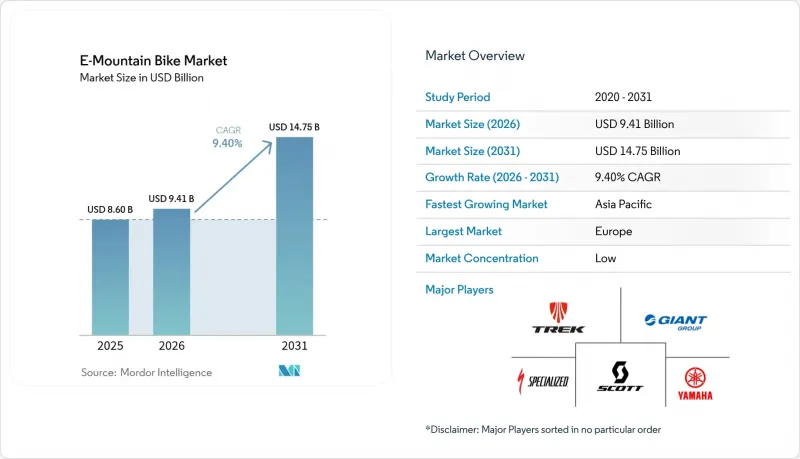
Mordor Intelligence에 의하면, 2026년 전기 산악자전거 시장 규모는 94억 1,000만 달러로 추정되고 있어 2025년 86억 달러에서 2031년에는 147억 5,000만 달러에 이를 것으로 예측됩니다.
2026년부터 2031년까지 연평균 성장률(CAGR) 9.4%를 기록할 것으로 전망됩니다.
본 보고서는 추진 방식(페달 어시스트, 스로틀 어시스트 등), 용도(레저, 어드벤처 등), 배터리 유형(리튬 이온, 리튬 폴리머 등), 출력(250W 이하 등), 프레임 재질(알루미늄, 탄소섬유 등), 유통 채널 및 지역별로 분류되어 있습니다. 시장 전망은 금액(달러) 및 수량(대수)으로 제시되어 있습니다.
전 세계 전동 산악자전거 시장 동향 및 인사이트
경량이며 대용량의 리튬 이온 배터리 기술 발전
에너지 밀도가 현재 300 Wh/kg를 초과하고 팩의 질량이 감소함에 따라, 라이더는 조작성을 저해하지 않으면서 더 먼 거리까지 오르막을 주행할 수 있습니다. 급속 충전 시 90분 만에 75%까지 충전이 가능하며, 이는 신속한 회전율을 중시하는 렌탈 사업에 있어 매우 중요합니다. 예측형 배터리 관리 소프트웨어는 경사도와 페달 회전수를 고려함으로써 기존 모델에 비해 주행 거리를 15-20% 연장합니다. 이 기술로 인해 마케팅 지표가 와트시(Wh)에서 ‘1회 충전당 수직 거리(미터)’로 전환되어, 초보자도 친숙하게 느낄 수 있는 지표가 되었습니다. 대용량화로 인해, 과거에는 엘리트 운동선수들만이 누릴 수 있었던 며칠간의 산장 순례 여행도 가능해졌습니다. 이러한 화학 기술의 진화가 프리미엄 가격 책정의 근거가 되어 이용 사례를 확대되고 있습니다.
어드벤처 스포츠와 생태 관광의 인기 상승
어드벤처 관광은 지속가능성 목표와 아드레날린을 자극하는 매력을 융합하여, 과거 가파른 고산 트레일을 피하던 소비자들에게 E-MTB를 ‘입문용 제품’으로 변화시키고 있습니다. E-MTB 대여 서비스를 도입한 고산 리조트에서는 여름철 방문객 수가 증가하며, 스키 시즌 이외의 새로운 수익원이 창출되고 있습니다. 고령화가 진행되는 계층에게는 경관을 해치지 않으면서 체력을 아낄 수 있는 페달 어시스트 기능이 환영받고 있습니다. 각국의 관광청은 현재 하이킹이나 스키와 함께 E-MTB 순환 코스를 강조하고 있으며, 자전거를 단순한 부속품이 아닌 핵심 인프라로 재정의하고 있습니다. 장비, 숙박, 리프트 이용을 세트로 묶은 가이드 동반 패키지 투어는 1인당 평균 소비액을 끌어올리고 있습니다. 이러한 시너지 효과로 인해 수요의 탄력성이 높아져, 장기적인 이용객 수 증가가 뒷받침되고 있습니다.
기존 MTB에 비해 높은 초기 비용
기존 MTB에 비해 가격이 비싸기 때문에 특히 소비자 신용 보급률이 낮은 경제권에서는 대중적인 보급이 저해되고 있습니다. 카본 프레임을 채택한 플래그십 모델은 대개 고가이며, 금융 옵션이 늘어나고 있음에도 불구하고 소유자는 부유층 애호가로 한정되어 있습니다. 각 제조업체는 현재 소유 기간 전체에 걸쳐 비용의 일부를 분산시키는 모듈식 업그레이드 플랜을 제공합니다. 셔틀버스 연료비나 리프트권 절약 효과를 강조하는 총소유비용(TCO) 계산 도구가 주목을 받고 있지만, 가격을 최우선으로 여기는 구매자를 설득하기에는 아직 미치지 못하고 있습니다. 보조금으로 인해 그 격차는 완화되고 있지만, 그럼에도 불구하고 ‘높은 가격에 대한 부담’은 당분간 전동 산악자전거 시장의 성장을 저해하는 요인으로 작용하고 있습니다.
부문 분석
2025년, 페달 어시스트 방식은 전동 산악자전거 시장 점유율의 71.62%를 차지하며, 해당 시장의 기반으로서의 입지를 확고히 했습니다. 케이던스 감지형 컨트롤러는 아날로그 라이딩의 리드미컬한 감각을 유지하며, 트레일 커뮤니티에서 사회적 수용을 얻는 동시에 모터 작동에 라이더의 입력이 필요하다는 규제 당국의 요건도 충족하고 있습니다. 현재 많은 프리미엄 모델에서는 멀티 센서를 통한 토크 측정값과 출력을 매끄럽게 조절하는 예측 알고리즘을 결합하여, 초기 기종에서 볼 수 있었던 ‘온-오프’와 같은 감각을 해소하고 있습니다. 이 부문의 강점은 스로틀 사용을 종종 금지하는 싱글 트랙 이용 규정과의 호환성에 있으며, 폭넓은 법적 적용성을 확보하고 있다는 점에 있습니다.
대조적으로, 페달 어시스트와 스로틀을 겸비한 듀얼 모드 시스템은 특히 바이크 파크로 이동하는 셔틀 이용이나 어댑티브 사이클링 프로그램에서 다양한 지형을 주행하거나 오르막길에서 짐을 운반하는 라이더들에게 어필하며, 연평균 성장률(CAGR) 10.05%로 성장하고 있습니다. 각 브랜드는 가격대를 교묘하게 세분화하고 있습니다. 주류 어드벤처 애호가를 위한 엔트리 레벨 페달 어시스트 자전거, 스릴을 추구하는 사용자를 위한 듀얼 모드 플래그십 모델, 그리고 실용적인 용도를 위한 스로틀 전용 모델 등이 있습니다. 펌웨어의 고도화가 진행됨에 따라, 각 제조업체는 소유자가 특정 장소에 따라 어시스트 모드를 전환할 수 있도록 무선(OTA)을 통한 기능 해제를 구상하고 있습니다. 이 전략을 통해 전동 산악자전거 시장 내 사용자의 참여도가 깊어지고, 업그레이드 주기가 연장될 것으로 기대됩니다.
2025년, 레저 및 어드벤처 라이더는 E-MTB 시장 점유율의 46.78%를 차지할 것으로 예상되며, 주행 거리 확대와 신체적 부담 경감을 중시하는 첫 구매 소비자들에게 이 부문이 ‘감정적 매력’으로서의 역할을 하고 있음이 드러났습니다. 전형적인 소유자 프로파일은 과도한 훈련 없이 고산 루트에서 더 긴 거리를 주행하고자 하는 숙련된 사이클리스트에게 치우쳐 있습니다. 한편, 소셜 미디어를 주로 이용하는 젊은 세대 사이에서는 험준한 내리막길에서 역동적인 영상을 촬영하기 위해 E-MTB를 활용하는 경향이 강해지고 있습니다. 출시 초기에는 규모가 작았으나, 관광지 운영 사업자가 가이드 투어, 셔틀 패스, 숙박 시설을 패키지화한 ‘턴키형 체험’을 제공함에 따라 관광 대여 시장은 연평균 성장률(CAGR) 10.92%로 확대되고 있습니다.
리조트 시설의 대여 차량은 기존 자전거 대여에 비해 일일 수익이 높고, 비수기의 가동률도 향상시키고 있어, 막대한 설비 투자가 필요한 재고 관리의 사업 타당성이 입증되고 있습니다. 경기 형식도 정착되어 가고 있으며, 공인 단체가 e-엔듀로 전용 시리즈를 도입함으로써 이 부문의 정당성이 인정받고, 부품 제조업체들이 레이스용 모터 맵을 출시하는 계기가 되고 있습니다. 통근 용도는 여전히 틈새 시장이지만, 트레일 출발점과 교외 교통망이 교차하는 지역에서는 평일 통근과 주말 오프로드 탐방을 전환해 사용할 수 있는 다목적 자전거를 활용함으로써 완만한 성장이 예상됩니다.
지역별 분석
2025년, 유럽은 전동 산악자전거 시장에서 42.87%의 점유율을 차지하며 시장을 주도했습니다. 이는 촘촘한 트레일 네트워크, 지원적인 보험 제도, 그리고 전 연령층에 걸친 e-모빌리티에 대한 문화적 수용에 힘입은 결과입니다. 독일은 진단 및 부품 공급에 뛰어난 딜러 네트워크의 지원을 받아 2024년에 205만 대의 전기 자전거를 판매하며 여전히 유럽의 중심적인 위치를 차지하고 있습니다. 프랑스와 이탈리아가 그 뒤를 이어, 알프스나 해안 지역에서 전기 산악자전거(E-MTB) 가이드 서비스를 촉진하는 관광 경제를 활용하고 있습니다. 2025년에 시행된 EU의 배터리 조달 관련 규제로 인해 조달처가 지역 셀 제조업체로 편중되면서 공급망 재편이 점진적으로 진행되고 있으며, 이로 인해 전기 산악자전거 시장에서 유럽의 주도적 지위가 강화되고 있습니다.
아시아태평양은 2031년까지 연평균 성장률(CAGR)이 10.32%로 가장 빠르게 성장하고 있는 지역이며, 이러한 성장 궤도는 중국의 제조 규모와 급성장하는 중산층 수요에 힘입고 있습니다. 국내 브랜드들은 광범위한 전자상거래를 통해 축적된 소비자 직배송 물류 인프라를 활용하여, 연결 기능을 희생하지 않으면서도 가격 면에서 전 세계 기존 기업들보다 낮은 가격을 제시하고 있습니다. 일본 기업들은 속도 제한이 엄격한 좁은 트레일 시스템에 최적화된 소형 250W 모터 개발을 추진하는 한편, 한국공급업체들은 2027년 출시를 예정하고 있는 고체 배터리 시범 생산 라인에 투자하고 있습니다. 인도의 고지대 휴양지에서는 가파른 경사면을 오르는 관광객을 수송하기 위한 휴양지용 차량 도입이 시작되고 있으며, 이 지역이 기존의 자전거 보급 단계를 건너뛰고 직접 전동 산악자전거 시장에 진입할 잠재력을 보여주고 있습니다.
북미는 판매 대수에서 큰 비중을 차지하고 있지만, 연방 정부 관할 토지에 대한 접근이 단절되어 있어 싱글 트랙의 보급이 정체되어 있습니다. 미국에서는 2024년에 다수의 전기 자전거가 수입되어 전년 대비 견조한 성장세를 보였으나, 정책의 불확실성으로 인해 그중 극히 일부만이 전기 산악자전거였습니다. 캘리포니아주와 콜로라도주의 리베이트 프로그램에서는 현재 최대 1,500달러의 환급이 이루어지고 있어, 소매업체를 통한 예약 주문이 급증하고 있습니다. 캐나다에서는 브리티시컬럼비아주와 퀘벡주에서 유사한 추세가 관찰되고 있으며, 주 정부의 인센티브와 잘 정비된 트레일 네트워크가 어우러져 평균을 상회하는 보급률을 달성하고 있습니다.
기타 혜택:
- 엑셀 형식 시장 예측(ME) 시트
- 3개월간의 애널리스트 지원
자주 묻는 질문
목차
제1장 서론
제2장 조사 방법
제3장 주요 요약
제4장 시장 구도
제5장 시장 규모와 성장 예측
제6장 경쟁 구도
제7장 시장 기회와 향후 전망
KTH 26.08.06According to Mordor Intelligence, e-Mountain bike market size in 2026 is estimated at USD 9.41 billion, growing from 2025 value of USD 8.60 billion with 2031 projections showing USD 14.75 billion, growing at 9.4% CAGR over 2026-2031.
This report is Segmented by Propulsion Type (Pedal-Assisted, Throttle-Assisted, and More), Application (Leisure and Adventure, and More), Battery Type (Lithium-Ion, Lithium-Polymer, and More), Power Output (Less Than/Equals 250 W, and More), Frame Material (Aluminum, Carbon Fiber, and More), Distribution Channel, and Geography. The Market Forecasts are Provided in Terms of Value (USD) and Volume (Units).
Global E-Mountain Bike Market Trends and Insights
Advancements in Lightweight High-Capacity Li-ion Batteries
Energy densities now exceed 300 Wh/kg while pack mass falls, letting riders climb farther without handling compromises. Fast-charge routines reach 75% in 90 minutes, critical for rental fleets that rely on quick turnover. Predictive battery-management software factors gradient and cadence to stretch range by 15-20% versus prior models. The technology reshapes marketing from watt-hours to "vertical meters per charge," a user-friendly metric that resonates with newcomers. Higher capacities unlock multi-day hut trips once reserved for elite athletes. This chemistry evolution underpins premium pricing and broadens use cases.
Rising Popularity of Adventure Sports and Eco-Tourism
Adventure tourism blends sustainability goals with adrenaline appeal, turning e-MTBs into gateway products for consumers who once avoided steep alpine trails. Alpine resorts that added e-MTB rentals recorded summer visitation rises, creating new revenue streams outside ski season . Aging populations welcome pedal assistance that preserves stamina without sacrificing scenery. National tourism boards now highlight e-MTB loops alongside hiking and skiing, repositioning the bike as core infrastructure rather than an accessory. Guided package deals that bundle equipment, lodging, and lift transport lift the average guest's spend. These synergies elevate demand elasticity and reinforce long-run volume growth.
High Upfront Cost vs. Conventional MTBs
High premiums over analog bikes deter mass adoption, especially in economies where consumer credit penetration is low. Carbon-framed flagships often come with a cost, restricting ownership to affluent enthusiasts despite rising financing options. Manufacturers now offer modular upgrade paths that defer part of the spend across ownership's life cycle. Total cost-of-ownership calculators highlighting savings on shuttle fuel and lift passes are gaining traction but have yet to sway price-first buyers. Subsidies ease the gap, yet sticker shock remains a near-term brake on the E-Mountain Bike market.
Other drivers and restraints analyzed in the detailed report include:
- Government Incentives and Subsidies for E-Mobility
- Subscription-Based Ownership Models Lowering Upfront Cost
- Land-Access Rules Limiting E-Bike Trail Entry
For complete list of drivers and restraints, kindly check the Table Of Contents.
Segment Analysis
Pedal-assisted configurations secured 71.62% of the E-Mountain Bike market share in 2025, entrenching them as the cornerstone of the E-Mountain Bike market. Their cadence-sensing controllers preserve the rhythmic feel of analog riding, earning social acceptance in trail communities and satisfying regulators that demand rider input for motor activation. Many premium models now blend multi-sensor torque readings with predictive algorithms that taper power seamlessly, eliminating the "on-off" sensation earlier units displayed. The segment's strength stems from compatibility with single-track access rules that often bar throttle use, ensuring broad legal applicability.
By contrast, dual-mode systems offering pedal assist and throttle are moving at a 10.05% CAGR by appealing to riders who traverse mixed terrain or transport cargo uphill, particularly in bike-park shuttling and adaptive cycling programs. Brands are segmenting price tiers cleverly: entry-level pedal-assist bikes for mainstream adventurers, dual-mode flagships for thrill seekers, and throttle-only variants for utility scenarios. As firmware sophistication advances, manufacturers envision over-the-air unlocks that let owners switch assistance modes for specific venues, a tactic expected to deepen engagement and extend upgrade cycles within the E-Mountain Bike market.
Leisure and adventure riders accounted for 46.78% of the E-Mountain Bike market share in 2025, evidencing the segment's role as the emotional magnet for first-time buyers who value expanded range and reduced physical strain. Typical owner profiles skew toward experienced cyclists wanting longer mileage on alpine routes without exhaustive conditioning. Yet, younger social-media-driven cohorts increasingly use e-MTBs to film dynamic content on gnarly descents. Though smaller at inception, tourism rentals are expanding at 10.92% CAGR as destination operators bundle guided tours, shuttle passes, and accommodations into turnkey experiences.
Resort fleets report higher daily earnings versus analog bike rentals while stretching shoulder-season occupancy, validating the business case for high-capex inventory. Sports-racing formats are solidifying with sanctioning bodies introducing dedicated e-enduro series, legitimizing the segment, and inspiring component makers to release race-oriented motor maps. Commuter usage remains niche but is predicted to climb modestly where trailheads intersect suburban transport grids, leveraging mixed-purpose bikes that toggle between weekday commuting and weekend off-road exploration.
Complete Report Scope:
- By Propulsion Type
- Pedal-Assisted
- Throttle-Assisted
- Dual-Mode (Pedal + Throttle)
- By Application
- Leisure and Adventure
- Commuting
- Sports / Racing
- Tourism Rental
- By Battery Type
- Lithium-ion
- Lithium-Polymer
- Others (Lead-acid, Solid-state)
- By Power Output
- Less than/Equals 250 W
- 250-500 W
- Above 500 W
- By Frame Material
- Aluminum
- Carbon Fiber
- Steel and Others
- By Distribution Channel
- OEM Dealerships
- Specialty Bike Stores
- Online Retail
- Subscription and Leasing Platforms
- By Geography
- North America
- United States
- Canada
- Rest of North America
- South America
- Brazil
- Argentina
- Rest of South America
- Europe
- Germany
- United Kingdom
- Italy
- Switzerland
- France
- Spain
- Rest of Europe
- Asia-Pacific
- China
- Japan
- South Korea
- India
- Australia
- Rest of Asia-Pacific
- Middle East and Africa
- United Arab Emirates
- Saudi Arabia
- Turkey
- Egypt
- South Africa
- Rest of Middle East and Africa
- North America
Geography Analysis
Europe led the E-Mountain Bike market with 42.87% of the E-Mountain Bike market share in 2025, powered by dense trail networks, supportive insurance regimes, and cultural acceptance of e-mobility across all age brackets. Germany remains the continent's anchor with 2.05 million e-bike sales in 2024, buttressed by a dealer network skilled in diagnostics and spares. France and Italy follow, leveraging tourism economies that promote e-MTB guiding services in Alpine and coastal regions. EU battery sourcing mandates enacted in 2025 skew procurement toward regional cell makers, subtly recentering supply chains and reinforcing Europe's leadership position in the E-Mountain Bike market.
Asia-Pacific is the fastest-growing territory at a 10.32% CAGR through 2031, a trajectory fueled by China's manufacturing scale and a burgeoning aspirational middle class. Domestic brands capitalize on direct-to-consumer logistics infrastructure honed in broader e-commerce, undercutting global incumbents on price without sacrificing connectivity features. Japanese firms refine compact 250 W motors optimized for tight trail systems with stricter speed caps, while Korean suppliers invest in solid-state battery pilot lines slated for 2027 release. India's hill-station tourism districts begin adopting resort fleets to move visitors up steep gradients, illustrating the region's potential to leapfrog legacy cycling adoption and move directly into the E-Mountain Bike market.
North America contributes significant volume yet contends with federal land-access fragmentation that stalls wider single-track penetration. The United States imported a significant number of e-bikes in 2024, reflecting a positive year-on-year growth, though only a fraction were e-MTBs owing to policy uncertainty. California and Colorado rebate programs now reimburse up to USD 1,500, triggering spikes in retailer preorders. Canada mirrors trends in British Columbia and Quebec, where provincial incentives dovetail with well-maintained trail networks to foster above-average adoption.
- Giant Manufacturing Co. Ltd
- Pivot Cycles
- Scott Sports SA
- Trek Bicycle Corporation
- CUBE GmbH & Co. KG
- Yamaha Motor Co. Ltd
- Pedego Electric Bikes
- BH Bikes
- Specialized Bicycle Components, Inc.
- Haibike
- Merida Industry Co. Ltd
- Santa Cruz Bicycles
- Rocky Mountain Bicycles
- Cannondale (Dorel Sports)
- Bulls Bikes
- Commencal
- Kona Bicycle Company
- Orbea S. Coop.
Additional Benefits:
- The market estimate (ME) sheet in Excel format
- 3 months of analyst support
TABLE OF CONTENTS
1 Introduction
- 1.1 Study Assumptions & Market Definition
- 1.2 Scope of the Study
2 Research Methodology
3 Executive Summary
4 Market Landscape
- 4.1 Market Overview
- 4.2 Market Drivers
- 4.2.1 Advancements in Lightweight High-Capacity Li-ion Batteries
- 4.2.2 Rising Popularity of Adventure Sports and Eco-Tourism
- 4.2.3 Government Incentives and Subsidies for E-Mobility
- 4.2.4 Subscription-Based Ownership Models Lowering Upfront Cost
- 4.2.5 Integration of IoT and Smart Connectivity for Trail Riding
- 4.2.6 Resort Bike-Share Fleets Deploying E-MTBs
- 4.3 Market Restraints
- 4.3.1 High Upfront Cost vs. Conventional MTBs
- 4.3.2 Land-Access Rules Limiting E-Bike Trail Entry
- 4.3.3 Range Anxiety on Steep Terrain
- 4.3.4 Battery Derating in Cold, High-Altitude Rides
- 4.4 Value / Supply-Chain Analysis
- 4.5 Regulatory Landscape
- 4.6 Technological Outlook
- 4.7 Porter's Five Forces
- 4.7.1 Threat of New Entrants
- 4.7.2 Bargaining Power of Buyers
- 4.7.3 Bargaining Power of Suppliers
- 4.7.4 Threat of Substitutes
- 4.7.5 Competitive Rivalry
5 Market Size & Growth Forecasts (Value (USD) and Volume (Units))
- 5.1 By Propulsion Type
- 5.1.1 Pedal-Assisted
- 5.1.2 Throttle-Assisted
- 5.1.3 Dual-Mode (Pedal + Throttle)
- 5.2 By Application
- 5.2.1 Leisure and Adventure
- 5.2.2 Commuting
- 5.2.3 Sports / Racing
- 5.2.4 Tourism Rental
- 5.3 By Battery Type
- 5.3.1 Lithium-ion
- 5.3.2 Lithium-Polymer
- 5.3.3 Others (Lead-acid, Solid-state)
- 5.4 By Power Output
- 5.4.1 Less than/Equals 250 W
- 5.4.2 250-500 W
- 5.4.3 Above 500 W
- 5.5 By Frame Material
- 5.5.1 Aluminum
- 5.5.2 Carbon Fiber
- 5.5.3 Steel and Others
- 5.6 By Distribution Channel
- 5.6.1 OEM Dealerships
- 5.6.2 Specialty Bike Stores
- 5.6.3 Online Retail
- 5.6.4 Subscription and Leasing Platforms
- 5.7 By Geography
- 5.7.1 North America
- 5.7.1.1 United States
- 5.7.1.2 Canada
- 5.7.1.3 Rest of North America
- 5.7.2 South America
- 5.7.2.1 Brazil
- 5.7.2.2 Argentina
- 5.7.2.3 Rest of South America
- 5.7.3 Europe
- 5.7.3.1 Germany
- 5.7.3.2 United Kingdom
- 5.7.3.3 Italy
- 5.7.3.4 Switzerland
- 5.7.3.5 France
- 5.7.3.6 Spain
- 5.7.3.7 Rest of Europe
- 5.7.4 Asia-Pacific
- 5.7.4.1 China
- 5.7.4.2 Japan
- 5.7.4.3 South Korea
- 5.7.4.4 India
- 5.7.4.5 Australia
- 5.7.4.6 Rest of Asia-Pacific
- 5.7.5 Middle East and Africa
- 5.7.5.1 United Arab Emirates
- 5.7.5.2 Saudi Arabia
- 5.7.5.3 Turkey
- 5.7.5.4 Egypt
- 5.7.5.5 South Africa
- 5.7.5.6 Rest of Middle East and Africa
- 5.7.1 North America
6 Competitive Landscape
- 6.1 Market Concentration
- 6.2 Strategic Moves
- 6.3 Market Share Analysis
- 6.4 Company Profiles (Includes Global Level Overview, Market Level Overview, Core Segments, Financials as Available, Strategic Information, Market Rank/Share for Key Companies, Products and Services, SWOT Analysis, and Recent Developments)
- 6.4.1 Giant Manufacturing Co. Ltd
- 6.4.2 Pivot Cycles
- 6.4.3 Scott Sports SA
- 6.4.4 Trek Bicycle Corporation
- 6.4.5 CUBE GmbH & Co. KG
- 6.4.6 Yamaha Motor Co. Ltd
- 6.4.7 Pedego Electric Bikes
- 6.4.8 BH Bikes
- 6.4.9 Specialized Bicycle Components, Inc.
- 6.4.10 Haibike
- 6.4.11 Merida Industry Co. Ltd
- 6.4.12 Santa Cruz Bicycles
- 6.4.13 Rocky Mountain Bicycles
- 6.4.14 Cannondale (Dorel Sports)
- 6.4.15 Bulls Bikes
- 6.4.16 Commencal
- 6.4.17 Kona Bicycle Company
- 6.4.18 Orbea S. Coop.
7 Market Opportunities & Future Outlook
- 7.1 White-space & Unmet-Need Assessment


