

|
시장보고서
상품코드
2097154
항공 업계 5G : 시장 점유율 분석, 업계 동향과 통계, 성장 예측(2026-2031년)5G in Aviation - Market Share Analysis, Industry Trends & Statistics, Growth Forecasts (2026 - 2031) |
||||||
 Mordor Intelligence
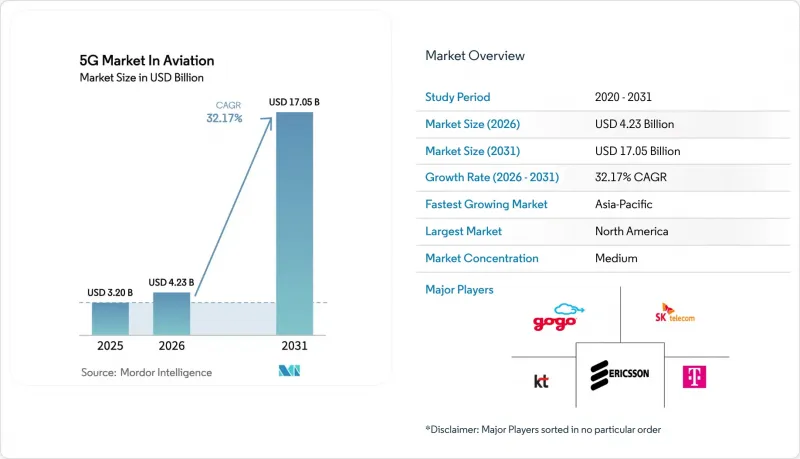
Mordor Intelligence에 의하면, 항공 업계 5G 시장 규모는 2025년 32억 달러에서 2026년에는 42억 3,000만 달러로 확대되고, 2026-2031년 CAGR 32.17%로 성장을 지속하여 2031년에는 170억 5,000만 달러에 이를 것으로 예측됩니다.
본 보고서는 연결 유형(지상 간 통신, 항공기와 지상 간 통신 등), 제공 형태(하드웨어, 소프트웨어 등), 용도(여객 경험, 공항 운영 등), 구축 모델(공공 5G 네트워크, 사설 5G 네트워크 등), 이해관계자(항공사, 공항 등), 지역별로 분류되어 있습니다. 시장 전망은 금액(달러) 기준으로 제시되어 있습니다.
전 세계 항공 산업의 5G 시장 동향 및 인사이트
IFEC 수요 증가
현재 승객의 77%가 항공편 예약 시 결정 요인으로 기내 Wi-Fi를 꼽고 있으며, 연결성은 핵심 서비스 기준이 되었습니다. 카타르항공이 2024년에 도입한 ‘스타링크’ 기내 Wi-Fi는 최대 500 Mbit/s의 통신 속도를 실현하여, 기내와 지상의 경험 간 기술 격차를 좁혔습니다. 2025년에 도입될 예정인 Gogo사의 항공기 전용 5G 네트워크는 비즈니스 제트기에서 평균 25 Mbps의 안정적인 통신 속도와 최대 75-80 Mbps의 버스트 속도를 보장하며, 기내 엔터테인먼트와 실시간 협업의 방식을 혁신할 것으로 기대되고 있습니다.
공항의 디지털 전환 프로그램
공항에서는 파편화된 레거시 시스템에서 수천 개의 센서, 카메라, 휴대용 단말기를 연동하는 통합형 5G 플랫폼으로의 전환이 진행되고 있습니다. 프랑크푸르트 공항의 전용 네트워크는 금속 기체로 인해 발생하는 통신 사각지대를 줄이고, 안전한 POS(판매 시점 정보 관리), 수하물 자동 추적, 실시간 영상 분석을 지원함으로써 수하물 처리 오류와 통신 지연을 줄이고 있습니다.
전용 5G 네트워크 구축에 드는 고액의 설비 투자
공항 전역에 걸친 5G 도입에는 내환경형 무선 기기, 광섬유 백홀, 주파수 대역 사용료 등을 포함해 300만-1,000만 달러의 지출이 필요한 경우가 적지 않습니다. 그러나 새로운 모델도 등장하고 있습니다. 브라질을 거점으로 하는 Atech사는 'ATC-as-a-service'를 제공하고 있으며, 이를 통해 항공 교통 관제 서비스 제공업체는 막대한 초기 투자 없이도 첨단 교통 관리 도구를 활용할 수 있어, 기존 프로젝트에 비해 40%의 비용 절감을 실현하고 있습니다.
부문 분석
2025년, 항공 업계 내 5G 시장 규모의 45.40%를 항공기와 지상 간의 통신이 차지했습니다. 이는 확립된 타워 인프라와 승객 서비스 분야의 시급한 수요가 호재로 작용했기 때문입니다. 한편, 항공기 간 연결은 연평균 성장률(CAGR) 43.2%로 급속히 확대되고 있습니다. 항공기 간 직접적인 데이터 교환을 통해 지상 중계가 불필요해져 충돌 회피 메시지의 지연 시간을 65% 줄일 수 있을 뿐만 아니라, 연료 효율이 뛰어난 편대 비행이 가능해집니다. EchoStar가 튀르키예의 AJet 및 델타항공과 체결한 위성과 5G를 결합한 하이브리드 계약은 노선에 구애받지 않는 지속적인 커버리지에 대한 상업적 수요가 높음을 보여줍니다.
메쉬 네트워크로의 전환은 허브 앤 스포크(hub-and-spoke)형 트래픽 흐름을 동적인 피어 링크로 대체하는 획기적인 설계 전환을 의미합니다. SESAR의 '5G-AirSky' 시험에서는 12밀리초 미만의 지연 시간이 기록되어, 안전상 중요한 메시징에 대응할 준비가 되어 있음을 입증했습니다.
무선 계획, 구축, 운영 관리를 포괄하는 서비스 계약은 2025년 항공 업계 5G 시장 점유율의 37.80%를 차지했습니다. 그러나 항공사들이 하드웨어 교체보다 가상 업그레이드를 선호하는 경향이 있어, 소프트웨어 매출은 2031년까지 연평균 성장률(CAGR) 33.4%를 기록할 전망입니다. Gogo사의 5G 프로토콜 스택 에뮬레이션을 통해 엔지니어는 기내 도입 전에 알고리즘을 미세 조정할 수 있어, 자본을 절약하면서 기능 출시를 가속화할 수 있습니다.
엣지 컴퓨팅 및 네트워크 슬라이싱 도구를 통해 물리적 네트워크의 중복을 초래하지 않으면서 항공 교통 데이터, 화물 추적 또는 승객용 스트리밍을 위한 전용 레인을 구축할 수 있게 됩니다. 유로컨트롤의 ‘2024년 CNS 진화 계획’에 따르면, 클라우드 기반 서비스 및 AI를 활용한 자동화를 도입하는 조기 도입 기업에 대해 15-20%의 효율 향상이 예상됩니다.
지역별 분석
2025년, 북미는 항공 업계의 5G 시장을 주도하며 36.40%의 점유율(11억 6,000만 달러 상당)을 차지했습니다. FAA(미국 연방항공청)는 2025년 공항 기술 조사에 4,340만 달러를 배정하여 통합형 5G 테스트베드에 대한 공공 부문의 노력을 강화했습니다. 상업적 측면에서도 마찬가지로 강력한 성장세를 보였으며, Gogo사가 계획 중인 항공기 전용 전국 5G 네트워크에서는 250개 이상의 기지국을 업그레이드하고, 면허가 필요한 대역과 면허가 필요 없는 대역을 결합하여 내결함성이 높은 기내 통신 구역을 구현할 예정입니다.
아시아태평양은 국가 차원의 5G 구축과 데이터센터용량 확대에 힘입어 전체 연평균 성장률(CAGR) 32.17%에 달하는 성장세를 보이고 있습니다. 중국의 인프라 구축과 홍콩 국제공항의 사설 네트워크 도입 사례는 이 지역을 연결된 지상 서비스 차량 및 동적 자원 배분을 위한 실험장으로 자리매김하고 있습니다. GSMA의 예측에 따르면, 2030년까지 5G는 지역 경제에 1,300억 달러를 투입하게 될 것이며, 항공 업계도 그 중 중요한 비중을 차지할 전망입니다.
유럽은 협력적인 연구 개발과 규제 조화를 통해 혁신의 거점으로서의 지위를 확립하고 있습니다. 영국의 ‘5G 혁신 지역’ 프로그램은 공항에서의 실증 실험을 추진하고 있는 반면, 유럽항공안전청(EASA)의 ‘연구 의제 2025’에서는 5G 구축에 필수적인 항공교통관리(ATM) 지상 장비의 성능 지표 및 주파수 대역 공존 체계를 우선 과제로 삼고 있습니다.
기타 혜택:
- 엑셀 형식 시장 예측(ME) 시트
- 3개월간의 애널리스트 지원
자주 묻는 질문
목차
제1장 서론
제2장 조사 방법
제3장 주요 요약
제4장 시장 구도
제5장 시장 규모와 성장 예측
제6장 경쟁 구도
제7장 시장 기회와 향후 전망
KTH 26.08.06According to Mordor Intelligence, the 5G market size In Aviation Industry is expected to grow from USD 3.20 billion in 2025 to USD 4.23 billion in 2026 and is forecast to reach USD 17.05 billion by 2031 at 32.17% CAGR over 2026-2031.
This report is Segmented by Connectivity Type (Ground-To-Ground Communication, Air-To-Ground Communication, and More), Offering (Hardware, Software, and More), Application (Passenger Experience, Airport Operations, and More), Deployment Model (Public 5G Networks, Private 5G Networks, and More), Stakeholder (Airlines, Airports, and More) and Geography. The Market Forecasts are Provided in Terms of Value (USD).
Global 5G in Aviation Market Trends and Insights
Proliferation of IFEC demand
Seventy-seven percent of passengers now rank onboard Wi-Fi as a deciding factor when booking flights, turning connectivity into a core service benchmark. Qatar Airways' 2024 launch of Starlink inflight Wi-Fi delivered peak speeds of 500 Mbit/s, narrowing the technology gap between cabin and ground experiences. Gogo's aviation-specific 5G network, due in 2025, promises consistent 25 Mbps average speeds for business jets, rising to 75-80 Mbps bursts, reshaping cabin entertainment and real-time collaboration.
Airport digital-transformation programs
Airports are shifting from fragmented legacy systems to unified 5G platforms that link thousands of sensors, cameras, and handheld terminals. Frankfurt Airport's private network reduces blind spots caused by metal airframes and supports secure point-of-sale, automated baggage tracking, and real-time video analytics, cutting mishandled-bag incidents and communication latency.
High CAPEX for private 5G network build-out
Airport-wide 5G installations often call for USD 3-10 million outlays, covering ruggedized radios, fiber backhaul, and spectrum-access fees. Alternative models are emerging: Brazil-based Atech offers "ATC-as-a-service," letting navigation service providers tap advanced traffic-management tools without heavy upfront spend, achieving 40% cost savings over traditional projects.
Other drivers and restraints analyzed in the detailed report include:
- Rapid expansion of aviation IoT sensors and edge computing
- National 5G spectrum auctions and aviation testbeds
- Aviation-grade cybersecurity and safety certification hurdles
For complete list of drivers and restraints, kindly check the Table Of Contents.
Segment Analysis
Air-to-ground links commanded 45.40% of the 5G in Aviation Market industry size in 2025, benefiting from established tower infrastructure and immediate passenger-service needs. Air-to-air connectivity, however, is accelerating at a 43.2% CAGR. Direct aircraft-to-aircraft data exchange eliminates ground relays, shaving latency by 65% for collision-avoidance messages and enabling fuel-optimized formation flying. EchoStar's hybrid satellite-5G contracts with Turkish AJet and Delta Airlines show commercial appetite for continuous, route-agnostic coverage.
Moving toward mesh networks marks a profound design shift, replacing hub-and-spoke traffic flows with dynamic peer links. SESAR's 5G-AirSky trials recorded sub-12-millisecond delays, validating readiness for safety-critical messaging
Service contracts spanning radio-planning, rollout, and managed operations held 37.80% of the 5G in Aviation Market industry share in 2025. Yet, software revenues are set for a 33.4% CAGR through 2031 as airlines favor virtual upgrades over hardware swaps. Gogo's 5G protocol-stack emulation lets engineers fine-tune algorithms before airborne installation, preserving capital and accelerating feature releases.
Edge computing and network-slicing tools allow bespoke lanes for air-traffic data, cargo tracking, or passenger streaming without physical network duplication. Eurocontrol's 2024 CNS Evolution Plan projects 15-20% efficiency gains for early adopters that embrace cloud-delivered services and AI-assisted automation.
Complete Report Scope:
- By Connectivity Type
- Ground-to-Ground Communication
- Air-to-Ground Communication
- Air-to-Air Communication
- By Offering
- Hardware
- Software
- Services
- By Application
- Passenger Experience
- In-flight Wi-Fi
- AR/VR Entertainment
- Airport Operations
- Baggage and Cargo Tracking
- Smart Security and Border Control
- Flight Operations
- Real-time Flight Tracking
- Predictive Maintenance Telemetry
- Drone and Urban Air Mobility Operations
- Passenger Experience
- By Deployment Model
- Public 5G Networks
- Private 5G Networks
- Hybrid Networks
- By Stakeholder
- Airlines
- Airports
- MRO Providers
- ANSPs
- OEMs
- Passengers
- By Geography
- North America
- United States
- Canada
- Mexico
- South America
- Brazil
- Argentina
- Rest of South America
- Europe
- Germany
- United Kingdom
- France
- Italy
- Spain
- Russia
- Rest of Europe
- Asia-Pacific
- China
- India
- Japan
- South Korea
- ASEAN
- Rest of Asia Pacific
- Middle East and Africa
- Middle East
- Saudi Arabia
- United Arab Emirates
- Turkey
- Rest of Middle East
- Africa
- South Africa
- Nigeria
- Rest of Africa
- Middle East
- North America
Geography Analysis
North America led the 5G in Aviation Market industry with 36.40% share in 2025, equivalent to USD 1.16 billion. The FAA earmarked USD 43.4 million in 2025 for airport-technology research, reinforcing public-sector commitment to integrated 5G testbeds. Commercial momentum is equally strong: Gogo's planned nationwide aviation-only 5G network will upgrade more than 250 towers and blend licensed and unlicensed spectrum for resilient in-flight coverage.
Asia Pacific is matching the broader 32.17% CAGR, buoyed by national-scale 5G deployments and rising data-center capacity. China's build-out and Hong Kong International Airport's private network showcase position the region as a laboratory for connected ground-service vehicles and dynamic resource allocation. GSMA forecasts 5G will inject USD 130 billion into the regional economy by 2030, with aviation capturing a meaningful share.
Europe positions itself as an innovation hub through coordinated R&D and regulatory alignment. The UK's 5G Innovation Regions program seeds airport pilots, while EASA's Research Agenda 2025 prioritizes performance metrics for ATM ground equipment and spectrum coexistence frameworks vital to 5G deployment.
- Telefonaktiebolaget LM Ericsson
- Nokia Corporation
- Huawei Technologies Co. Ltd
- Deutsche Telekom AG
- SK Telecom Co. Ltd
- KT Corporation
- Gogo LLC
- SmartSky Networks LLC
- AeroMobile Communications Ltd
- Inseego Corp.
- Telia Company AB
- Verizon Communications Inc.
- AT&T Inc.
- ZTE Corporation
- Qualcomm Technologies Inc.
- Panasonic Avionics Corporation
- Thales Group
- Collins Aerospace
- Intelsat S.A.
- Eutelsat Group
Additional Benefits:
- The market estimate (ME) sheet in Excel format
- 3 months of analyst support
TABLE OF CONTENTS
1 INTRODUCTION
- 1.1 Study Assumptions and Market Definition
- 1.2 Scope of the Study
2 RESEARCH METHODOLOGY
3 EXECUTIVE SUMMARY
4 MARKET LANDSCAPE
- 4.1 Market Overview
- 4.2 Market Drivers
- 4.2.1 Proliferation of IFEC (In-flight Entertainment and Connectivity) demand
- 4.2.2 Airport digital-transformation programs
- 4.2.3 Rapid expansion of aviation IoT sensors and edge computing
- 4.2.4 National 5G spectrum auctions and aviation testbeds
- 4.2.5 5G-enabled Advanced Air Mobility corridors
- 4.2.6 Real-time 8K cabin analytics for ancillary-revenue upselling
- 4.3 Market Restraints
- 4.3.1 High CAPEX for private 5G network build-out
- 4.3.2 Aviation-grade cybersecurity and safety certification hurdles
- 4.3.3 Interference risks with radio-altimeters in mmWave bands
- 4.3.4 Limited 5G device refresh cycles in legacy aircraft fleets
- 4.4 Industry Value Chain Analysis
- 4.5 Regulatory Landscape
- 4.6 Technological Outlook
- 4.7 Porter's Five Forces Analysis
- 4.7.1 Bargaining Power of Suppliers
- 4.7.2 Bargaining Power of Consumers
- 4.7.3 Threat of New Entrants
- 4.7.4 Intensity of Competitive Rivalry
- 4.7.5 Threat of Substitutes
- 4.8 5G in Aviation Use Cases
- 4.9 Investment Analysis
5 MARKET SIZE AND GROWTH FORECASTS (VALUE)
- 5.1 By Connectivity Type
- 5.1.1 Ground-to-Ground Communication
- 5.1.2 Air-to-Ground Communication
- 5.1.3 Air-to-Air Communication
- 5.2 By Offering
- 5.2.1 Hardware
- 5.2.2 Software
- 5.2.3 Services
- 5.3 By Application
- 5.3.1 Passenger Experience
- 5.3.1.1 In-flight Wi-Fi
- 5.3.1.2 AR/VR Entertainment
- 5.3.2 Airport Operations
- 5.3.2.1 Baggage and Cargo Tracking
- 5.3.2.2 Smart Security and Border Control
- 5.3.3 Flight Operations
- 5.3.3.1 Real-time Flight Tracking
- 5.3.3.2 Predictive Maintenance Telemetry
- 5.3.4 Drone and Urban Air Mobility Operations
- 5.3.1 Passenger Experience
- 5.4 By Deployment Model
- 5.4.1 Public 5G Networks
- 5.4.2 Private 5G Networks
- 5.4.3 Hybrid Networks
- 5.5 By Stakeholder
- 5.5.1 Airlines
- 5.5.2 Airports
- 5.5.3 MRO Providers
- 5.5.4 ANSPs
- 5.5.5 OEMs
- 5.5.6 Passengers
- 5.6 By Geography
- 5.6.1 North America
- 5.6.1.1 United States
- 5.6.1.2 Canada
- 5.6.1.3 Mexico
- 5.6.2 South America
- 5.6.2.1 Brazil
- 5.6.2.2 Argentina
- 5.6.2.3 Rest of South America
- 5.6.3 Europe
- 5.6.3.1 Germany
- 5.6.3.2 United Kingdom
- 5.6.3.3 France
- 5.6.3.4 Italy
- 5.6.3.5 Spain
- 5.6.3.6 Russia
- 5.6.3.7 Rest of Europe
- 5.6.4 Asia-Pacific
- 5.6.4.1 China
- 5.6.4.2 India
- 5.6.4.3 Japan
- 5.6.4.4 South Korea
- 5.6.4.5 ASEAN
- 5.6.4.6 Rest of Asia Pacific
- 5.6.5 Middle East and Africa
- 5.6.5.1 Middle East
- 5.6.5.1.1 Saudi Arabia
- 5.6.5.1.2 United Arab Emirates
- 5.6.5.1.3 Turkey
- 5.6.5.1.4 Rest of Middle East
- 5.6.5.2 Africa
- 5.6.5.2.1 South Africa
- 5.6.5.2.2 Nigeria
- 5.6.5.2.3 Rest of Africa
- 5.6.5.1 Middle East
- 5.6.1 North America
6 COMPETITIVE LANDSCAPE
- 6.1 Market Concentration
- 6.2 Strategic Moves
- 6.3 Market Share Analysis
- 6.4 Company Profiles (includes Global level Overview, Market level overview, Core Segments, Financials as available, Strategic Information, Market Rank/Share for key companies, Products and Services, and Recent Developments)
- 6.4.1 Telefonaktiebolaget LM Ericsson
- 6.4.2 Nokia Corporation
- 6.4.3 Huawei Technologies Co. Ltd
- 6.4.4 Deutsche Telekom AG
- 6.4.5 SK Telecom Co. Ltd
- 6.4.6 KT Corporation
- 6.4.7 Gogo LLC
- 6.4.8 SmartSky Networks LLC
- 6.4.9 AeroMobile Communications Ltd
- 6.4.10 Inseego Corp.
- 6.4.11 Telia Company AB
- 6.4.12 Verizon Communications Inc.
- 6.4.13 AT&T Inc.
- 6.4.14 ZTE Corporation
- 6.4.15 Qualcomm Technologies Inc.
- 6.4.16 Panasonic Avionics Corporation
- 6.4.17 Thales Group
- 6.4.18 Collins Aerospace
- 6.4.19 Intelsat S.A.
- 6.4.20 Eutelsat Group
7 MARKET OPPORTUNITIES AND FUTURE OUTLOOK
- 7.1 White-space and Unmet-need Assessment


