

|
시장보고서
상품코드
2097156
이산화탄소 인큐베이터 : 시장 점유율 분석, 업계 동향 및 통계, 성장 예측(2025-2030년)Carbon Dioxide Incubators - Market Share Analysis, Industry Trends & Statistics, Growth Forecasts (2025 - 2030) |
||||||
 Mordor Intelligence
Mordor Intelligence에 의하면, 이산화탄소 인큐베이터 시장은 2024년에 8억 836만 달러 규모로 평가되었고, 2030년까지 10억 6,151만 달러에 이르며, CAGR 5.6%로 성장할 것으로 예측됩니다.
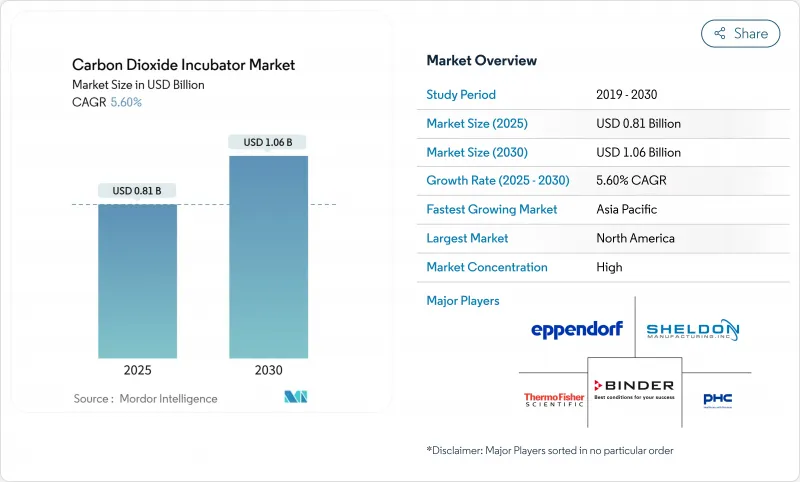
본 보고서는 제품 유형별(수냉식 CO₂ 인큐베이터, 공냉식 CO₂ 인큐베이터 등), 용량별(100리터 미만, 100-200리터, 100리터 이상), 용도별(제약·바이오기술 기업, 수탁 개발·제조 기관(CDMO)), 지역별(북미, 유럽 등)로 분류되어 있습니다. 시장 전망은 금액(달러) 기준으로 제시되어 있습니다.
세계의 이산화탄소 인큐베이터 시장 동향 및 인사이트
세포 및 유전자 치료 공정 개발에 대한 수요 증가
종양학 및 희귀질환 분야의 치료 파이프라인이 확대됨에 따라, 엄격한 온도 및 가스 균일성을 보장하는 배양 환경에 대한 수요가 높아지고 있습니다. 살토리아스(Sartorius)는 2024년부터 2028년까지 바이오의약품 시장이 연평균 성장률(CAGR) 약 10%를 나타낼 것으로 예측하고 있으며, 세포 및 유전자 치료는 기존 바이오의약품을 능가하는 성장률을 보일 것으로 전망됩니다. 프로그램이 자가 유래에서 동종 유래 형태로 전환됨에 따라 배치 규모가 증가하여, 더 크고 오염이 없는 챔버의 조달이 촉진되고 있습니다. 각 제조업체들은 진화하는 GMP 수준의 문서화 요건을 충족하기 위해 추적성 소프트웨어를 도입하고 있습니다. 이에 따라 CO₂ 인큐베이터 시장은 개발 시설 및 상업 규모 시설 모두로부터 지속적인 수요를 얻고 있습니다.
전 세계 바이오의약품 연구개발비용의 급증
일부 자금 조달 측면에서 역풍이 불고 있음에도 불구하고, 전 세계 연구개발 파이프라인은 견조한 추세를 보이고 있으며, 주요 공급업체들은 계속해서 수십억 달러 규모의 매출을 기록하고 있습니다. 서모피셔는 2025년 1분기에 103억 6,000만 달러의 매출을 보고했으며, 이는 상업 연구소의 구매력이 지속되고 있음을 뒷받침합니다. 지출이 우선적으로 확대되고 있는 분야에는 자동화 플랫폼과 네트워크 연결형 기기가 포함되어 있으며, 이에 따라 실시간 성능 데이터를 전송하는 인큐베이터의 설계가 요구되고 있습니다. AI를 활용한 모니터링을 통해 수동 점검이 줄어들어, 연구소는 규정 준수를 유지하면서 처리 능력 목표를 달성할 수 있게 됩니다.
첨단 장비에 대한 고액의 초기 투자 및 유지 관리 비용
주요 모델에는 UV 살균, HEPA 필터, IoT 지원 센서가 통합되어 있어, 이로 인해 정가 및 서비스 계약 비용이 상승하고 있습니다. 바이오-래드(Bio-Rad)사는 2025년 1분기에 학술 기관의 장비 수요가 둔화되었다고 지적하며, 그 이유로 보조금 주기의 제한으로 인한 업그레이드 지연을 꼽았습니다. 또한, 2029년에 시행될 미국 에너지부(DOE)의 신규 규정에 따라 의무화되는 에너지 절약형 설계로의 변경도 제조 비용을 상승시키고 있습니다. 소규모 시설에서는 구매를 미루고 있어, 장비 교체 시기가 연기되고 있습니다.
부문 분석
수냉식 시스템은 문 개폐 시 민감한 배양물을 보호하는 탁월한 열관성으로 인해 2024년 CO₂ 인큐베이터 시장에서 45.45%의 점유율을 차지했습니다. 그러나 에너지 효율을 중시하는 조달 정책으로 인해 직접 가열식 유닛에 대한 선호도가 높아지고 있으며, 연구소들이 낮은 운영 비용과 간편한 유지보수를 우선시함에 따라 2030년까지 연평균 6.23%의 성장이 예상됩니다. 2029년부터 의무화될 예정인 미국의 새로운 에너지 절약 기준에 따라, 직접 가열 방식으로의 전환이 가속화될 전망입니다.
직화식 모델은 저장 탱크가 필요 없기 때문에 오염 경로와 가동 중단 시간을 줄여줍니다. 현재 각 공급업체들은 회복 시간을 단축하는 적응형 PID 제어 및 소형화된 ScAlN 기반 CO₂ 센서를 탑재하고 있습니다. 또한, 저산소 연구에 대한 수요 증가에 따라 3가지 가스 대응 모델에 대한 수요도 가속화되고 있습니다. 폭넓은 제품 라인업을 통해 공급업체는 액세서리 및 서비스 플랜의 업셀링이 가능해져, CO₂ 인큐베이터 시장의 성장 궤도를 더욱 공고히 하고 있습니다.
100L에서 200L 용량의 챔버는 2024년 매출의 41.23%를 차지하며, 시료 처리 능력과 실험실 공간 활용도의 경제성 사이에서 균형을 이룬 ‘스위트 스팟’임이 확인되었습니다. 이 부문은 인프라 제약으로 인해 대형 모델 도입이 제한된 기존 제약 시설의 개보수 수요로부터 혜택을 받고 있습니다. 한편, 100L 미만 기종은 연평균 성장률(CAGR) 6.89%로 가장 빠르게 확장되고 있는 틈새 시장을 차지하고 있으며, 국소적인 소량 배양 환경이 필요한 정밀 의학 및 현장 진단(Point-of-Care) 워크플로우의 보급을 반영하고 있습니다.
자동화의 진전에 따라 용량 선정은 모듈화 방향으로 나아가고 있습니다. ‘자율형 실험실’의 프로토타입을 통해, 여러 대의 소형 인큐베이터가 병렬로 가동되며 용량을 희생해 유연성을 확보하는 동시에 로봇 핸들러에 시료를 공급하는 구조가 드러났습니다. 그 결과, 100L 미만 CO₂ 인큐베이터 시장 규모는 기존의 학술 분야 수요에 그치지 않고 병원 및 진단 현장으로 확대될 가능성이 있습니다. 각 벤더사는 생산성과 설치 면적의 균형을 맞추는 적층 가능한 설계와 클라우드 대시보드를 통해 이에 대응하고 있습니다.
지역별 분석
북미는 2024년 매출의 38.89%를 차지했으며, 이는 탄탄한 바이오의약품 공급망, 자금력이 풍부한 대학, 그리고 에너지 효율이 높은 개조 기술의 조기 도입을 반영합니다. 교체 수요가 주류를 이루고 있으며, 구매자들은 구형 수냉식 유닛에서 향후 시행될 미국 에너지부(DOE) 기준을 충족하는 직접 가열식 모델로 전환하고 있습니다. 서비스 네트워크와 애프터마켓 부품의 가용성은 공급업체의 입지를 더욱 공고히 하고 있습니다.
유럽은 엄격한 오염 관리 규정과 지속가능성 관련 지침으로 인해 여전히 큰 시장 점유율을 유지하고 있습니다. 2024년 EU 에코디자인 규정에서는 내구성과 수리 가능성에 관한 기준이 의무화되어, 수명 주기 평가가 문서화된 프리미엄 모델로의 구매를 촉진하고 있습니다. 독일, 아일랜드, 스칸디나비아의 제약 클러스터가 지속적인 수요를 뒷받침하는 한편, 정부 보조금을 통해 에너지 추적을 위한 스마트 센서 도입이 촉진되고 있습니다.
아시아태평양은 중국, 인도, 동남아시아에서 바이오의약품 제조 및 불임 치료 클리닉이 확대됨에 따라 연평균 성장률(CAGR) 7.45%라는 가장 급격한 성장 궤도를 보이고 있습니다. 낮은 인건비로 인해 CDMO 시설이 유입되고 있으며, 이러한 시설에서는 인큐베이터를 대량으로 도입하고 있어 해당 지역에 서비스 센터를 둔 공급업체가 유리한 입지를 점하고 있습니다. 현지 규제가 유럽 및 미국의 GMP 기준에 점점 더 가까워지면서 일회용 내장재 및 첨단 오염 제거 기능의 도입이 가속화되고 있습니다. 이러한 동향들이 맞물려 신흥 경제권 전체의 이산화탄소 인큐베이터 시장 성장세를 뒷받침하고 있습니다.
기타 혜택 :
- 엑셀 형식 시장 예측(ME) 시트
- 3개월간의 애널리스트 지원
자주 묻는 질문
목차
제1장 서론
제2장 조사 방법
제3장 주요 요약
제4장 시장 구도
제5장 시장 규모 및 성장 예측
제6장 경쟁 구도
제7장 시장 기회 및 향후 전망
KTH 26.08.05According to Mordor Intelligence, the cO2 incubators market stands at USD 808.36 million in 2024 and is projected to reach USD 1,061.51 million by 2030, advancing at a 5.6% CAGR.
This report Segments Into by Product Type (Water Jacketed CO2 Incubators, Air Jacketed CO2 Incubators and More), by Capacity (less Than 100 L, 100-200 L and More), by Application (Pharmaceutical & Biotechnology Companies, Contract Development & Manufacturing Organisations (CDMOs)), and by Geography (North America, Europe and More). The Market Forecasts are Provided in Terms of Value (USD).
Global Carbon Dioxide Incubators Market Trends and Insights
Rising Demand for Cell & Gene-Therapy Process Development
Escalating therapy pipelines in oncology and rare diseases raise the need for incubation environments that guarantee tight temperature and gas uniformity. Sartorius projects biopharma growth near 10% CAGR for 2024-2028, with cell and gene therapies outpacing traditional biologics. As programs transition from autologous to allogeneic formats, batch sizes increase, driving procurement of larger, contamination-free chambers. Manufacturers embed traceability software to satisfy evolving GMP-level documentation. The CO2 incubators market thereby gains recurring demand from both development and commercial-scale facilities.
Surge in Biopharma R&D Expenditure Worldwide
Despite selective funding headwinds, global R&D pipelines remain robust, and major suppliers continue to post multibillion-dollar revenues. Thermo Fisher reported USD 10.36 billion in Q1 2025, underscoring sustained purchasing power among commercial labs. Higher spending priorities include automation platforms and connected equipment, prompting incubator designs that transmit real-time performance data. AI-enabled monitoring reduces manual checks, helping laboratories meet throughput goals while maintaining compliance.
High Capital & Maintenance Costs of Advanced Units
Leading models integrate UV sterilization, HEPA filtration, and IoT-ready sensors, raising list prices and service contracts. Bio-Rad cited softer instrument demand from academia in Q1 2025, linking slower upgrades to limited grant cycles. Energy-efficiency redesigns, required under new DOE rules effective 2029, also inflate manufacturing expenses. Smaller facilities defer purchases, stretching replacement timelines.
Other drivers and restraints analyzed in the detailed report include:
- Growing Global IVF Procedure Volumes
- Expansion of Cell-Based Vaccine Manufacturing
- Persistent Contamination-Risk Perception Among Labs
For complete list of drivers and restraints, kindly check the Table Of Contents.
Segment Analysis
Water-jacketed systems captured 45.45% of the CO2 incubators market in 2024 thanks to unmatched thermal inertia that protects sensitive cultures during door openings. Yet energy-focused procurement policies spur rising preference for direct-heat units, projected to grow 6.23% annually through 2030 as laboratories prioritize lower running costs and simpler upkeep. Upcoming U.S. energy-conservation standards, set for compliance in 2029, will likely speed conversion to direct-heat architecture .
Direct-heat models eliminate water reservoirs, reducing contamination vectors and downtime. Suppliers now integrate adaptive PID controls and miniaturized ScAlN-based CO2 sensors that improve recovery times. Tri-gas variants also register accelerating demand for hypoxic research. Portfolio breadth positions vendors to upsell accessories and service plans, reinforcing the CO2 incubators market growth path.
Chambers between 100 L and 200 L yielded 41.23% of 2024 revenue, confirming their sweet spot between sample throughput and lab-space economics. This segment benefits from retrofits in existing pharmaceutical suites, where infrastructure constraints limit adoption of larger formats. Units below 100 L, however, represent the fastest expanding niche at a 6.89% CAGR, reflecting the proliferation of precision-medicine and point-of-care workflows that require localized, small-batch culture environments.
Automation pushes capacity selection toward modularity. Self-driving laboratory prototypes reveal how multiple compact incubators can operate in parallel, trading volume for flexibility while feeding robotic handlers. As a result, the CO2 incubators market size for sub-100 L systems could widen beyond traditional academic demand into hospital and diagnostics settings. Vendors answer with stackable footprints and cloud dashboards that balance productivity and footprint.
Complete Report Scope:
- By Product Type
- Water-Jacketed CO2 Incubators
- Air-Jacketed CO2 Incubators
- Direct-Heat CO2 Incubators
- Multi-Gas (Tri-Gas) Incubator
- Portable / Benchtop Incubator
- Customized & Other Types
- By Capacity
- Less than 100 L
- 100 - 200 L
- More than 200 L
- By Application
- Cell & Tissue Culture
- Stem-Cell Research
- Cancer & Immunology Research
- In-Vitro Fertilisation (IVF)
- Microbiology & Diagnostics
- Other Emerging Applications
- By End User
- Pharmaceutical & Biotechnology Companies
- Contract Development & Manufacturing Organisations (CDMOs)
- Research & Academic Institutes
- Clinical & IVF Laboratories
- Food-Testing & Environmental Labs
- By Geography
- North America
- United States
- Canada
- Mexico
- South America
- Brazil
- Argentina
- Rest of South America
- Europe
- Germany
- United Kingdom
- France
- Italy
- Spain
- Russia
- Rest of Europe
- Asia-Pacific
- China
- Japan
- India
- South Korea
- Australia
- Rest of Asia-Pacific
- Middle East and Africa
- GCC
- South Africa
- Rest of Middle East and Africa
- North America
Geography Analysis
North America contributed 38.89% of 2024 revenue, reflecting deep biopharmaceutical supply chains, well-funded universities, and early adoption of energy-efficient retrofits. Replacement demand dominates, with buyers trading older water-jacketed units for direct-heat models that meet forthcoming DOE standards. Service networks and aftermarket parts availability further cement vendor positions.
Europe retains a sizable share through strict contamination-control rules and sustainability directives. The 2024 EU ecodesign regulation mandates durability and repairability criteria, nudging buyers toward premium models with documented lifecycle assessments. Pharmaceutical clusters in Germany, Ireland, and Scandinavia anchor recurring demand, while government grants encourage deployment of smart sensors for energy tracking.
Asia-Pacific shows the sharpest trajectory at 7.45% CAGR as China, India, and South-East Asia scale biologics manufacturing and fertility clinics. Lower labor costs attract CDMO facilities that install large fleets of incubators, favouring suppliers with regional service centers. Local regulations increasingly mirror Western GMP norms, accelerating adoption of single-use interiors and advanced decontamination functions. Combined, these dynamics reinforce the CO2 incubators market momentum across emerging economies.
- Thermo Fisher Scientific
- Eppendorf
- Panasonic Healthcare Co., Ltd. (PHC)
- Binder
- Sheldon Manufacturing Inc. (Shellab)
- NuAire Inc.
- Memmert
- LEEC
- Esco Micro Pte. Ltd.
- MMM Medcenter Einrichtungen GmbH
- Caron Products & Services Inc.
- Labogene ApS
- Heal Force Bio-Medical Co. Ltd.
- Benchmark Scientific
- Taicang Hou Waining Laboratory Equipment
- Thomas Scientific LLC
- Labocon Systems Ltd.
- SANYO Electric Biomedical Co. Ltd.
- Stericox Sterilizer & Autoclave
- BIOBASE Group
Additional Benefits:
- The market estimate (ME) sheet in Excel format
- 3 months of analyst support
TABLE OF CONTENTS
1 Introduction
- 1.1 Study Assumptions & Market Definition
- 1.2 Scope of the Study
2 Research Methodology
3 Executive Summary
4 Market Landscape
- 4.1 Market Overview
- 4.2 Market Drivers
- 4.2.1 Rising demand for cell & gene-therapy process development
- 4.2.2 Surge in biopharma R&D expenditure worldwide
- 4.2.3 Growing global IVF procedure volumes
- 4.2.4 Expansion of cell-based vaccine manufacturing
- 4.2.5 Shift toward automated micro-incubators for HT screening
- 4.2.6 Regulatory push for single-use, contamination-free chambers
- 4.3 Market Restraints
- 4.3.1 High capital & maintenance costs of advanced units
- 4.3.2 Persistent contamination-risk perception among labs
- 4.3.3 Stringent energy-efficiency directives for legacy models
- 4.3.4 Supply-chain dependence on specialty CO2 sensors
- 4.4 Supply-Chain Analysis
- 4.5 Regulatory Landscape
- 4.6 Technological Outlook
- 4.7 Porter's Five Forces Analysis
- 4.7.1 Threat of New Entrants
- 4.7.2 Bargaining Power of Suppliers
- 4.7.3 Bargaining Power of Buyers
- 4.7.4 Threat of Substitute Products
- 4.7.5 Intensity of Competitive Rivalry
5 Market Size & Growth Forecasts (Value - USD Million)
- 5.1 By Product Type
- 5.1.1 Water-Jacketed CO2 Incubators
- 5.1.2 Air-Jacketed CO2 Incubators
- 5.1.3 Direct-Heat CO2 Incubators
- 5.1.4 Multi-Gas (Tri-Gas) Incubator
- 5.1.5 Portable / Benchtop Incubator
- 5.1.6 Customized & Other Types
- 5.2 By Capacity
- 5.2.1 Less than 100 L
- 5.2.2 100 - 200 L
- 5.2.3 More than 200 L
- 5.3 By Application
- 5.3.1 Cell & Tissue Culture
- 5.3.2 Stem-Cell Research
- 5.3.3 Cancer & Immunology Research
- 5.3.4 In-Vitro Fertilisation (IVF)
- 5.3.5 Microbiology & Diagnostics
- 5.3.6 Other Emerging Applications
- 5.4 By End User
- 5.4.1 Pharmaceutical & Biotechnology Companies
- 5.4.2 Contract Development & Manufacturing Organisations (CDMOs)
- 5.4.3 Research & Academic Institutes
- 5.4.4 Clinical & IVF Laboratories
- 5.4.5 Food-Testing & Environmental Labs
- 5.5 By Geography
- 5.5.1 North America
- 5.5.1.1 United States
- 5.5.1.2 Canada
- 5.5.1.3 Mexico
- 5.5.2 South America
- 5.5.2.1 Brazil
- 5.5.2.2 Argentina
- 5.5.2.3 Rest of South America
- 5.5.3 Europe
- 5.5.3.1 Germany
- 5.5.3.2 United Kingdom
- 5.5.3.3 France
- 5.5.3.4 Italy
- 5.5.3.5 Spain
- 5.5.3.6 Russia
- 5.5.3.7 Rest of Europe
- 5.5.4 Asia-Pacific
- 5.5.4.1 China
- 5.5.4.2 Japan
- 5.5.4.3 India
- 5.5.4.4 South Korea
- 5.5.4.5 Australia
- 5.5.4.6 Rest of Asia-Pacific
- 5.5.5 Middle East and Africa
- 5.5.5.1 GCC
- 5.5.5.2 South Africa
- 5.5.5.3 Rest of Middle East and Africa
- 5.5.1 North America
6 Competitive Landscape
- 6.1 Market Concentration
- 6.2 Market Share Analysis
- 6.3 Company Profiles (includes Global-level Overview, Market-level Overview, Core Segments, Financials as available, Strategic Information, Market Rank/Share for key companies, Products & Services, and Recent Developments)
- 6.3.1 Thermo Fisher Scientific Inc.
- 6.3.2 Eppendorf SE
- 6.3.3 Panasonic Healthcare Co., Ltd. (PHC)
- 6.3.4 Binder GmbH
- 6.3.5 Sheldon Manufacturing Inc. (Shellab)
- 6.3.6 NuAire Inc.
- 6.3.7 Memmert GmbH + Co. KG
- 6.3.8 LEEC Ltd.
- 6.3.9 Esco Micro Pte. Ltd.
- 6.3.10 MMM Medcenter Einrichtungen GmbH
- 6.3.11 Caron Products & Services Inc.
- 6.3.12 Labogene ApS
- 6.3.13 Heal Force Bio-Medical Co. Ltd.
- 6.3.14 Benchmark Scientific Inc.
- 6.3.15 Taicang Hou Waining Laboratory Equipment
- 6.3.16 Thomas Scientific LLC
- 6.3.17 Labocon Systems Ltd.
- 6.3.18 SANYO Electric Biomedical Co. Ltd.
- 6.3.19 Stericox Sterilizer & Autoclave
- 6.3.20 BIOBASE Group
7 Market Opportunities & Future Outlook
- 7.1 White-space & Unmet-need Assessment


