|
시장보고서
상품코드
2097157
의료기기 세척 : 시장 점유율 분석, 업계 동향과 통계, 성장 예측(2026-2031년)Medical Device Cleaning - Market Share Analysis, Industry Trends & Statistics, Growth Forecasts (2026 - 2031) |
||||||
 Mordor Intelligence
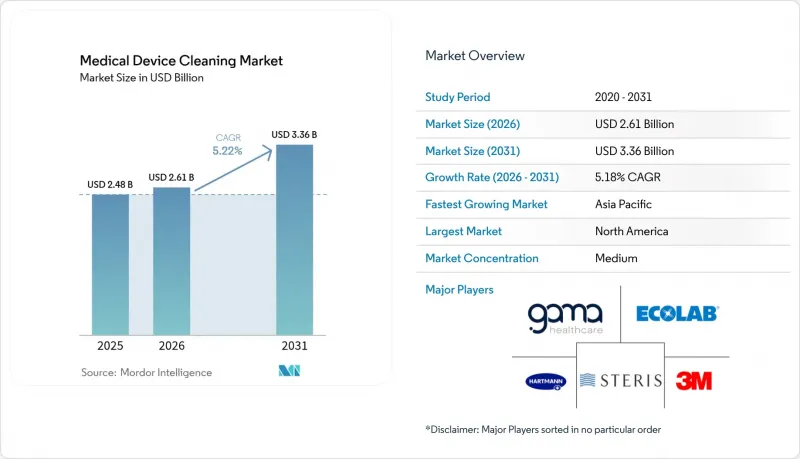
Mordor Intelligence에 의하면, 의료기기 세척 시장 규모는 2025년에 24억 8,000만 달러로 평가되었고, 2026년 26억 1,000만 달러에서 2031년까지 33억 6,000만 달러에 이를 것으로 예측되며, 예측 기간(2026-2031년) CAGR은 5.18%를 나타낼 전망입니다.
본 보고서는 제품 유형(효소계 세정제, 비효소계 세정제 등), 세정 공정(수동 세정, 자동 세정·소독기 등), 용도/기기 유형(수술 기구, 내시경 등), 최종 사용자(병원, 외래수술센터(ASC) 등), 지역(북미 등)별로 분류되어 있습니다. 본 보고서에서는 상기 각 부문 시장 규모(달러)를 제시하고 있습니다.
전 세계 의료기기 세척 시장 동향 및 인사이트
병원 내 감염(HAI) 증가
HAI는 미국의 의료비에 연간 약 250억-450억 달러의 추가 부담을 초래하고 있습니다. 2023년 CDC 데이터에 따르면, 의료기기와 관련된 일부 감염증은 두 자릿수 감소세를 보이고 있지만, 혈류 감염이나 내시경 관련 집단 감염이 여전히 발생하고 있어, 시설 측에는 세척 프로토콜 개선을 요구하는 압력이 계속되고 있습니다. 유럽의 감시 조사에 따르면, 28개 회원국 전체에서 HAI 유병률은 7.1%를 기록했으며, 이는 연간 430만 명의 환자가 영향을 받고 있는 것에 해당합니다. 카르바페넴 내성 클레브시엘라 뉴모니아에(Klebsiella pneumoniae)와 같은 다제내성균에 대해서는 접촉 시간 연장이나 보호성 생물막을 분해하는 다효소계 세정제가 필요합니다. 이러한 역학적 상황으로 인해 재현성이 있고 추적 가능한 세척 주기를 실현하는 검증된 세정제 및 자동 세척 소독기에 대한 수요가 가속화되고 있습니다.
엄격한 세계 재처리 규정(FDA, MDR, ISO 17664)
미국 FDA는 현재 기관지경 및 복강경 기구를 포함한 고위험 재사용 가능 의료기기에 대해 완전한 세척 검증 데이터 제출을 요구하고 있습니다. MDR 2017/745는 독립형 세척 시스템을 의료기기로 분류하며, 세척 라이프사이클 전반에 걸친 추적성을 보장하기 위해 고유 의료기기 식별 번호(UDI) 부여를 의무화하고 있습니다. ISO 17664는 제조업체가 사용되는 세정제의 유형, 온도, 접촉 시간을 정확하게 기술할 것을 요구하고 있으며, 이를 통해 병원은 의료기기 취급 설명서에 부합하는 브랜드 지정 세정제를 채택하도록 권장되고 있습니다. 특히 수술 건수가 많은 외과 센터에서는 조작자에 따른 편차를 줄여주는 자동 시스템이 규제 당국의 신뢰를 얻기 위한 바람직한 수단이 되고 있습니다.
자동 재처리 장치의 높은 설비 투자(Capex) 및 운영비(Opex)
최첨단 세척·소독 장치의 가격은 10만-30만 달러이지만, 연간 유지보수 계약비는 구매 가격의 8%-12%에 달할 전망입니다. 소규모 병원이나 외래수술센터(ASC)의 경우, 특히 인력 부족으로 운영 예산이 빠듯한 상황에서는 이러한 지출을 정당화하기 어려운 경우가 많습니다. 부품 가격 급등과 운임 할증으로 인해 많은 장비 제조업체에서 공급망 관련 비용이 매출의 20% 가까이까지 치솟고 있으며, 그 결과 구매자에게는 정가 상승으로 이어지고 있습니다. 이 문제를 해결하기 위해 각 공급업체는 세정제, 서비스, 분석 기능을 1회 주기당 요금으로 묶은 구독형 또는 리스 모델을 전개하고 있지만, 가격에 민감한 시장에서 이에 대한 수용은 여전히 제한적입니다.
부문 분석
고수준 소독제는 준중요 의료기기에 대해 입증된 포자 살균 효과를 발휘하기 때문에 2025년에는 의료기기 세척 시장의 37.10%를 차지했습니다. 한편, 효소계 세제는 다중 효소 혼합물이 복잡한 내강에 부착된 단백질, 지질, 탄수화물 오염물을 용해하기 때문에 해당 카테고리 내에서 가장 높은 연평균 성장률(CAGR) 6.63%를 나타낼 것으로 예측됩니다. 또한, 이산화염소 제제도 재료에 대한 부식성이 낮고 광범위한 효능을 지니고 있어 시장이 확대되고 있습니다. 반면, 비효소계 세제는 일상적인 트레이 세척에서 여전히 저비용의 주력 제품으로 자리 잡고 있습니다. 각 제조업체는 수질 변동에 관계없이 효능을 유지하고, 민감한 폴리머 재질 기구와의 호환성을 높이는 pH 중성 혼합 제품을 출시하고 있습니다.
의료기기 세척 시장에서 효소계 세제 시장 규모는 카르바페넴 내성균에 의해 형성된 강인한 바이오필름을 분해할 수 없는 기존의 알칼리성 세척제를 의료기관에서 단계적으로 폐지해 나감에 따라 꾸준히 확대될 것으로 예측됩니다. 특히, 기구의 내구성이 극히 중요한 안과, 정형외과 및 로봇 수술실에서의 도입이 두드러집니다. 사용하기 편리한 정량 펌프와 변색식 테스트 스트립을 통해 적절한 농도가 확보되어, 기술자의 교육 부담이 경감됩니다. 안과 수술의 경우, 독성 전안부 증후군에 대한 우려가 있으나, 최근 동료 심사를 거친 연구 결과에 따르면 철저한 헹굼을 통해 위험이 경감된다는 사실이 밝혀져, 외래수술센터(ASC)에서의 보다 광범위한 도입이 촉진되고 있습니다.
자동 세척 소독기는 2025년 매출에서 40.85%의 점유율을 차지할 것으로 예상되며, 이는 업계가 재현성이 높은 열적·화학적 매개변수에 신뢰를 두고 있음을 반영합니다. UV/오존/신기술은 시설들이 에틸렌옥사이드 공급 병목 현상을 피하기 위해 저온 처리법을 요구하는 가운데, 연평균 성장률(CAGR) 7.42%를 나타낼 것으로 예측됩니다. 222nm 원자외선(Far-UVC) 천장 설치형 장치는 현재 사람이 머무르는 공간에서도 연속 운전이 가능해져, 환자 치료 간 다운타임을 단축하고 있습니다. 플라즈마 및 기화 과산화수소 장치는 열에 민감한 플라스틱 제품에 대한 수요를 확보하고 있습니다.
인터넷에 연결된 장비가 ISO 17664에 규정된 주기에 따라 각 세척 로트를 검증함에 따라, 자동화 플랫폼과 관련된 의료기기 세척 시장 규모는 확대되고 있습니다. 한편, 자원이 제한된 환경에서는 여전히 수동 세척이 이루어지고 있지만, 감사 부적합으로 인해 불일치 위험이 부각됨에 따라 그 점유율은 감소 추세를 보이고 있습니다. 99%의 파괴 효율을 달성하는 새로운 덕트리스형 에틸렌옥사이드 스크러버 덕분에 배출 제한으로 인해 가동이 중단되었던 멸균 라인이 재가동되면서, 세척 소독기가 업스트림 공정의 주력 장비로 계속 자리매김할 것이 보장되고 있습니다.
지역별 분석
전략적 인수가 경쟁 구도를 재편하는 가운데, 의료기기 세척 시장은 적정한 수준의 통합이 진행되고 있습니다. STERIS, Getinge, Ecolab은 세척제, 세척·소독기, 서비스 계약에 이르는 폭넓은 제품 포트폴리오를 보유하고 있어 여전히 주요 공급업체로서의 지위를 유지하고 있습니다. 2024년 Medline이 Ecolab의 외과용 솔루션 사업을 9억 5,000만 달러에 인수함에 따라, 해당 기업의 소모품 라인업은 단숨에 확충되었으며 유럽 수술실 시장 진출도 확대되었습니다. 2025년 서모피셔가 솔벤텀의 정제·여과 부문을 41억 달러에 인수함에 따라, 이 회사는 검증 완료된 세정제 및 막식 세정 보조제 분야에 진출했습니다.
경쟁의 초점은 자동화, 센서 통합 및 규제 관련 문서에 있습니다. 게팅게(Getinge)는 작업자의 접촉을 30% 줄여주는 비전 가이드 방식의 로딩 로봇을 선보이고 있는 반면, 트리스텔(Tristel)은 38개국에 등록된 이산화염소 화학 기술을 활용하여 틈새 시장인 내시경용 와이프를 이용한 고수준 소독 솔루션을 제공합니다. 소나타 사이언티픽(Sonata Scientific)과 같은 소규모 혁신 기업들은 덕트리스형 에틸렌옥사이드(EtO) 분해 장치를 사용하여 배출 제어 틈새 시장을 공략하고 있으며, 멸균 능력에 대한 부담을 줄이고 있습니다. 스테리스(STERIS)의 매출에서 단일 고객이 10% 이상을 차지하는 경우는 없기 때문에 수요는 여전히 세분화되어 있으며, 로봇 수술 기구, 안과용 내시경, 또는 플라즈마 멸균용 액세서리를 다루는 전문적인 신규 진출기업들에게 진입의 여지가 있습니다.
고급 시장에서는 경쟁이 제한적이지만, 아시아의 중견 공급업체들은 기본적인 IoT 대시보드를 갖춘 세척·소독기를 출시하며 상위 시장 진출을 모색하고 있습니다. 따라서 세계 서비스 네트워크, 신속한 부품 공급, 그리고 운영자 대상 교육 패키지가 기존 기업들의 차별화 요소로 작용하고 있습니다. 병원 측이 검증 관련 서류 작성 및 보증 책임을 간소화하는 원스톱 조달을 선호하는 경향이 있어, 세제 제조업체와 장비 OEM 제조업체간의 제휴 관계는 더욱 긴밀해지고 있습니다.
기타 혜택:
- 엑셀 형식 시장 예측(ME) 시트
- 3개월간의 애널리스트 지원
자주 묻는 질문
목차
제1장 서론
제2장 조사 방법
제3장 주요 요약
제4장 시장 구도
제5장 시장 규모와 성장 예측
제6장 경쟁 구도
제7장 시장 기회와 향후 전망
KTH 26.08.06According to Mordor Intelligence, the medical device cleaning market size was valued at USD 2.48 billion in 2025 and estimated to grow from USD 2.61 billion in 2026 to reach USD 3.36 billion by 2031, at a CAGR of 5.18% during the forecast period (2026-2031).
This report is Segmented by Product Type (Enzymatic Detergents, Non-Enzymatic Detergents and More), by Cleaning Process (Manual Cleaning, Automated Washer-Disinfectors and More), by Application (Surgical Instruments, Endoscopes and More), by End User (Hospitals, Ambulatory Surgical Centers and More) and Geography (North America and More). The Report Offers the Value (in USD) for the Above Segments.
Global Medical Device Cleaning Market Trends and Insights
Rising Prevalence of Hospital-Acquired Infections (HAIs)
HAIs add an estimated USD 25 billion-USD 45 billion to U.S. healthcare costs yearly. Although 2023 CDC data show double-digit declines in several device-associated infections, persistent bloodstream and endoscope-linked outbreaks have kept pressure on facilities to upgrade cleaning protocols. European surveillance recorded 7.1% HAI prevalence across 28 member states, equal to 4.3 million affected patients each year . Multidrug-resistant organisms such as carbapenem-resistant Klebsiella pneumoniae require extended contact times and multi-enzyme detergents that break down protective biofilms. This epidemiological environment is accelerating demand for validated chemistries and automated washer-disinfectors that deliver repeatable, trackable cycles.
Stringent Global Reprocessing Regulations (FDA, MDR, ISO 17664)
The U.S. FDA now demands full cleaning validation data for high-risk reusable devices, including bronchoscopes and laparoscopic instruments. MDR 2017/745 classifies standalone cleaning systems as medical devices and mandates Unique Device Identification to guarantee traceability across the cleaning life-cycle. ISO 17664 requires manufacturers to describe exact detergent type, temperature and contact time, pushing hospitals toward branded chemistries aligned with device instructions. Automated systems that reduce operator variability have become the preferred route to regulatory confidence, particularly in high-volume surgical centers.
High Capex & Opex of Automated Reprocessors
State-of-the-art washer-disinfectors cost USD 100,000-USD 300,000, while annual service contracts add 8%-12% of purchase price. Smaller hospitals and ASCs often struggle to justify this outlay, especially when staffing shortages already stretch operating budgets. Component inflation and freight surcharges have pushed supply-chain expenses close to 20% of revenue for many equipment makers, translating into higher list prices for buyers. As a workaround, vendors are rolling out subscription and leasing models that bundle chemistry, service and analytics in a per-cycle fee, but acceptance in price-sensitive markets remains limited.
Other drivers and restraints analyzed in the detailed report include:
- Growth in Surgical & Endoscopic Procedure Volumes
- IoT-Enabled Washer-Disinfectors for Real-Time Compliance Analytics
- Rising Adoption of Disposable Single-Use Devices
For complete list of drivers and restraints, kindly check the Table Of Contents.
Segment Analysis
High-Level Disinfectants captured 37.10% of the medical device cleaning market in 2025 as they deliver proven sporicidal activity for semi-critical devices. Enzymatic Detergents, however, are forecast to record a 6.63% CAGR, the fastest within the category, because multi-enzyme blends dissolve protein, lipid and carbohydrate soils lodged in intricate lumens. Chlorine-dioxide formulations are also expanding due to broad-spectrum efficacy with lower material corrosion, while non-enzymatic detergents remain the low-cost staple for routine trays. Manufacturers are introducing pH-neutral blends that maintain potency across variable water quality, improving compatibility with delicate polymer-based instruments.
The medical device cleaning market size for Enzymatic Detergents is projected to advance steadily as facilities retire legacy alkaline agents that cannot break down resilient biofilms formed by carbapenem-resistant organisms. Uptake is particularly strong in ophthalmology, orthopedics and robotic surgery suites where instrument longevity is critical. User-friendly dosing pumps and color-changing test strips ensure correct concentration, reducing technician training burden. Despite ocular-procedure concerns over toxic anterior segment syndrome, recent peer-review findings indicate that thorough rinsing mitigates risk, supporting broader adoption in outpatient surgical centers.
Automated Washer-Disinfectors led the 2025 revenues with 40.85% share, reflecting industry confidence in repeatable thermal and chemical parameters. UV/Ozone/Emerging Technologies are expected to clock 7.42% CAGR as facilities seek low-temperature methods that sidestep ethylene oxide bottlenecks. Far-UVC 222 nm ceiling fixtures now operate continuously in occupied spaces, trimming downtime between cases. Plasma and vaporized-hydrogen-peroxide units are capturing demand for heat-sensitive plastics.
The medical device cleaning market size tied to automated platforms is expanding as internet-connected units verify each load against ISO 17664-specified cycles. Conversely, manual cleaning persists in low-resource environments but shows declining share as audit failures highlight variability risks. New ductless ethylene oxide scrubbers that achieve 99% destruction efficiency are reopening sterilization lines idled by emission limits, ensuring that washer-disinfectors remain the upstream workhorse.
Complete Report Scope:
- By Product Type
- Enzymatic Detergents
- Non-enzymatic Detergents
- High-Level Disinfectants
- Lubricants & Rust Inhibitors
- Other Cleaning Chemicals
- By Cleaning Process
- Manual Cleaning
- Automated Washer-Disinfectors
- Automated Endoscope Reprocessors (AERs)
- UV / Ozone / Emerging Technologies
- By Application / Device Type
- Surgical Instruments
- Endoscopes
- Dental Instruments
- Ultrasound & Probes
- Others
- By End-User
- Hospitals
- Ambulatory Surgical Centers
- Specialty Clinics & Dental Practices
- Diagnostic & Research Laboratories
- By Geography
- North America
- United States
- Canada
- Mexico
- Europe
- Germany
- France
- United Kingdom
- Italy
- Spain
- Rest of Europe
- Asia-Pacific
- China
- India
- Japan
- South Korea
- Australia
- Rest of Asia-Pacific
- South America
- Brazil
- Argentina
- Rest of South America
- Middle East and Africa
- GCC
- South Africa
- Rest of Middle East and Africa
- North America
Geography Analysis
The medical device cleaning market is moderately consolidated as strategic acquisitions reshape competitive dynamics. STERIS, Getinge and Ecolab remain the reference suppliers due to broad portfolios spanning chemistries, washer-disinfectors and service contracts. Medline's USD 950 million purchase of Ecolab's surgical solutions business in 2024 instantly broadened its consumables range and expanded access to European operating rooms. Thermo Fisher's USD 4.1 billion acquisition of Solventum's purification and filtration division in 2025 extends its reach into validated chemistries and membrane-based cleaning adjuncts.
Competition centers on automation, sensor integration and regulatory documentation. Getinge is rolling out vision-guided loading robots that cut operator touches by 30%, while Tristel leverages chlorine-dioxide chemistry registered in 38 countries to offer wipe-based high-level disinfection for niche scopes. Smaller innovators such as Sonata Scientific target emission-control niches with ductless EtO destruction units, easing pressure on sterilization capacity. Because no single customer accounts for more than 10% of STERIS revenue, demand remains fragmented and open to specialized entrants that address robotic instruments, ophthalmic scopes or plasma sterilization accessories.
Price competition is limited at the premium end, but mid-tier Asian suppliers are moving up-market with washer-disinfectors featuring basic IoT dashboards. Global service footprints, rapid part availability and operator training packages therefore differentiate incumbents. Partnerships between detergent formulators and equipment OEMs are tightening as hospitals prefer one-stop procurement that simplifies validation paperwork and warranty liability.
- STERIS
- Getinge
- Ecolab
- 3M
- Advanced Sterilization Products (Fortive)
- Cantel Medical (Steris subsidiary)
- Olympus
- Medivators Inc.
- Tristel
- Schulke & Mayr GmbH
- Ruhof
- Metrex Research
- Hartmann Group
- Belimed
- Oro Clean Chemie AG
- Medline Industries ReNewal
- Sklar Instruments
- Stryker Corporation (Renu)
- Johnson & Johnson (ASP Ethicon)
- Tuttnauer
Additional Benefits:
- The market estimate (ME) sheet in Excel format
- 3 months of analyst support
TABLE OF CONTENTS
1 Introduction
- 1.1 Study Assumptions & Market Definition
- 1.2 Scope of the Study
2 Research Methodology
3 Executive Summary
4 Market Landscape
- 4.1 Market Overview
- 4.2 Market Drivers
- 4.2.1 Rising prevalence of hospital-acquired infections (HAIs)
- 4.2.2 Stringent global reprocessing regulations (FDA, MDR, ISO-17664)
- 4.2.3 Growth in surgical & endoscopic procedure volumes
- 4.2.4 IoT-enabled washer-disinfectors for real-time compliance analytics
- 4.2.5 Shift to enzyme-based, low-temperature detergents extending device life
- 4.3 Market Restraints
- 4.3.1 High capex & opex of automated reprocessors
- 4.3.2 Rising adoption of disposable single-use devices
- 4.3.3 Supply-chain bottlenecks for specialty enzymes & surfactants
- 4.4 Value / Supply-Chain Analysis
- 4.5 Regulatory Landscape
- 4.6 Technological Outlook
- 4.7 Porter's Five Forces
- 4.7.1 Bargaining Power of Suppliers
- 4.7.2 Bargaining Power of Buyers
- 4.7.3 Threat of New Entrants
- 4.7.4 Threat of Substitutes
- 4.7.5 Competitive Rivalry
5 Market Size & Growth Forecasts
- 5.1 By Product Type
- 5.1.1 Enzymatic Detergents
- 5.1.2 Non-enzymatic Detergents
- 5.1.3 High-Level Disinfectants
- 5.1.4 Lubricants & Rust Inhibitors
- 5.1.5 Other Cleaning Chemicals
- 5.2 By Cleaning Process
- 5.2.1 Manual Cleaning
- 5.2.2 Automated Washer-Disinfectors
- 5.2.3 Automated Endoscope Reprocessors (AERs)
- 5.2.4 UV / Ozone / Emerging Technologies
- 5.3 By Application / Device Type
- 5.3.1 Surgical Instruments
- 5.3.2 Endoscopes
- 5.3.3 Dental Instruments
- 5.3.4 Ultrasound & Probes
- 5.3.5 Others
- 5.4 By End-User
- 5.4.1 Hospitals
- 5.4.2 Ambulatory Surgical Centers
- 5.4.3 Specialty Clinics & Dental Practices
- 5.4.4 Diagnostic & Research Laboratories
- 5.5 By Geography
- 5.5.1 North America
- 5.5.1.1 United States
- 5.5.1.2 Canada
- 5.5.1.3 Mexico
- 5.5.2 Europe
- 5.5.2.1 Germany
- 5.5.2.2 France
- 5.5.2.3 United Kingdom
- 5.5.2.4 Italy
- 5.5.2.5 Spain
- 5.5.2.6 Rest of Europe
- 5.5.3 Asia-Pacific
- 5.5.3.1 China
- 5.5.3.2 India
- 5.5.3.3 Japan
- 5.5.3.4 South Korea
- 5.5.3.5 Australia
- 5.5.3.6 Rest of Asia-Pacific
- 5.5.4 South America
- 5.5.4.1 Brazil
- 5.5.4.2 Argentina
- 5.5.4.3 Rest of South America
- 5.5.5 Middle East and Africa
- 5.5.5.1 GCC
- 5.5.5.2 South Africa
- 5.5.5.3 Rest of Middle East and Africa
- 5.5.1 North America
6 Competitive Landscape
- 6.1 Market Concentration
- 6.2 Market Share Analysis
- 6.3 Company Profiles (includes Global level Overview, Market level overview, Core Segments, Financials as available, Strategic Information, Market Rank/Share for key companies, Products & Services, and Recent Developments)
- 6.3.1 STERIS plc
- 6.3.2 Getinge AB
- 6.3.3 Ecolab Inc.
- 6.3.4 3M Company
- 6.3.5 Advanced Sterilization Products (Fortive)
- 6.3.6 Cantel Medical (Steris subsidiary)
- 6.3.7 Olympus Corporation
- 6.3.8 Medivators Inc.
- 6.3.9 Tristel plc
- 6.3.10 Schulke & Mayr GmbH
- 6.3.11 Ruhof Corporation
- 6.3.12 Metrex Research
- 6.3.13 Hartmann Group
- 6.3.14 Belimed AG
- 6.3.15 Oro Clean Chemie AG
- 6.3.16 Medline Industries ReNewal
- 6.3.17 Sklar Instruments
- 6.3.18 Stryker Corporation (Renu)
- 6.3.19 Johnson & Johnson (ASP Ethicon)
- 6.3.20 Tuttnauer
7 Market Opportunities & Future Outlook
- 7.1 White-space & Unmet-Need Assessment