

|
시장보고서
상품코드
2097162
가정용 혈압 측정기 : 시장 점유율 분석, 업계 동향과 통계, 성장 예측(2026-2031년)Home Blood Pressure Monitoring Devices - Market Share Analysis, Industry Trends & Statistics, Growth Forecasts (2026 - 2031) |
||||||
 Mordor Intelligence
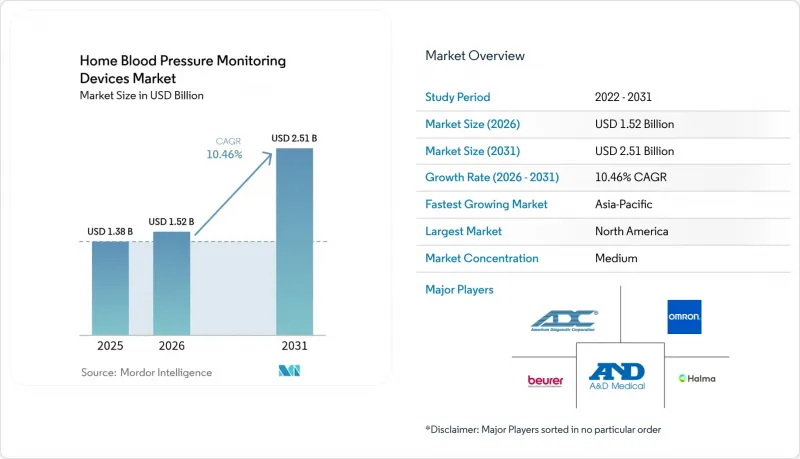
Mordor Intelligence에 의하면, 2026년 가정용 혈압 측정기 시장 규모는 15억 2,000만 달러로 추정되고 있어 2025년 13억 8,000만 달러에서 확대될 전망입니다.
또한, 2031년 예측치는 25억 1,000만 달러로, 2026년부터 2031년까지 연평균 성장률(CAGR) 10.46%를 기록할 것으로 전망됩니다.
본 보고서는 제품 유형별(상완식 혈압계, 손목식 혈압계 및 액세서리), 연결 방식별(비연결형 기기, 블루투스 지원 기기 등), 유통 채널별(병원 내 약국, 온라인 약국, 기타), 지역별(북미, 유럽, 아시아태평양, 중동 및 아프리카, 남미)로 분류되어 있습니다. 본 보고서에서는 상기 각 부문별 시장 규모(달러)를 제시하고 있습니다.
전 세계 가정용 혈압 측정기 시장 동향 및 인사이트
고혈압 유병률 증가와 고령화
현재 전 세계적으로 10억 명 이상이 고혈압을 앓고 있지만, 혈압 관리가 제대로 이루어지고 있는 비율은 고작 21%에 불과하며, WHO는 이러한 격차를 강조하고 있습니다. 가정에서 혈압을 측정하면 비용 부담을 대폭 줄일 수 있습니다. 일본의 경제 모델에 따르면, 백의 고혈압 치료를 피함으로써 93억 달러를 절감할 수 있을 것으로 예측됩니다. 검증은 여전히 병목 현상으로 남아 있으며, 시판 중인 측정기 중 15% 미만만이 정확도에 대한 근거를 공개하고 있습니다. 이러한 상황에 따라 규제 당국이 승인 절차를 엄격화하는 한편, 제조업체에게는 검증 강화에 대한 투자가 요구되고 있습니다.
블루투스 지원·앱 연동형 모니터의 급속한 보급
메디케어의 2025년 지급 일정에서는 경제적 인센티브가 강화되어, 초기 설정(CPT 99453)에는 19.73-22.25달러, 매월 기기 공급 및 모니터링(CPT 99454)에는 43.02-49.04달러, 치료 관리 서비스(CPT 99457)에 대해서는 각각 19.73-22.25달러, 43.02-49.04달러, 47.87-52.23달러가 배정되어 있습니다. 이러한 지급은 일상 진료에 커넥티드 기기를 도입하는 데 있어 사업적 타당성을 높여주고 있지만, 많은 의료 제공업체들은 여전히 업무 흐름 및 인력 배치의 제약을 대규모 도입의 장벽으로 꼽고 있습니다. 기술적 측면에서는 스마트폰을 이용한 광맥파 측정법에서 평균 절대 수축기 오차가 7.75 mmHg 가까이까지 개선되었으며, 이 기법이 아직 표준 혈압 측정 기술과 동등한 정확도에 도달하지는 못했지만 의미 있는 진전을 보이고 있습니다.
검증된 기기와 미검증 기기 간의 큰 비용 격차
MedM이 FDA 승인 제품 3,411건을 조사한 결과, 76.3%가 완전한 검증을 받지 않아 소비자가 미검증 기기에 노출되어 있는 실태가 밝혀졌습니다. 독일 고혈압 연맹의 시험에 따르면, 15년에 걸친 프로그램에서 평가 대상이 된 105개 모델 중 모든 정확도 기준을 충족한 것은 고작 47.6%에 그쳤습니다. 미국 의학협회(AMA)의 ‘검증된 기기 목록’은 이러한 인식의 격차를 해소하는 것을 목적으로 하고 있지만, 많은 구매자들은 여전히 가장 저렴한 혈압계를 무조건 선택하고 있습니다.
부문 분석
2025년, 가정용 혈압 측정기 시장 점유율의 71.96%를 디지털 상완식 측정기가 차지했습니다. 이는 독일 고혈압 연맹의 시험에서 55.7%의 검증 합격률과 오랜 기간에 걸친 임상적 권고에 힘입은 결과입니다. 손목형 혈압계는 여전히 고령층에게 인기가 있지만, 측정 위치의 오류로 인해 처방 의사의 신뢰도는 제한적입니다. 'Oscar 2'와 같은 휴대용 모델은 순환기 전문 분야에서 일정한 입지를 유지하고 있는 반면, 미국에서는 1,700만 명의 성인이 비표준 사이즈의 커프를 필요로 하고 있어 커프 등의 액세서리가 전략적인 주목을 받고 있습니다.
커프가 없는 웨어러블 기기는 Aktiia의 4,200만 달러 자금 조달로 대표되는 투자자들의 지원에 힘입어, 연평균 성장률(CAGR) 11.10%로 가장 빠르게 성장하는 틈새 시장입니다. FDA의 IEEE 1708-2014 표준에 대한 부분적 승인으로 규제 로드맵은 명확해졌지만, 제조업체들은 주류 시장으로의 확산을 위해 여전히 약물 반응의 정확성을 입증해야 합니다. Novosound사가 발표한 초음파 방식은 광학 센서의 드리프트를 극복하는 것을 목표로 하고 있으며, 임상적으로 실용 가능한 커프리스 솔루션을 둘러싼 치열한 경쟁을 여실히 보여주고 있습니다.
지역별 분석
북미는 2025년 가정용 혈압 측정기 시장 점유율의 38.42%를 차지하며 계속해서 주도적인 위치를 유지했습니다. 메디케어의 CPT 코드에 따르면, 교육에 대해 11.19달러, 보고에 대해 최대 15.16달러의 환급이 이루어지고 있으며, 이것이 수요의 기반이 되고 있습니다. 그러나 1,700만 명의 주민이 표준 커프를 사용할 수 없고, 흑인 성인의 약 12%가 이용 가능한 사이즈 범위를 벗어난다는 점 때문에 포용적인 설계를 요구하는 목소리가 높아지고 있습니다. 캐나다와 멕시코에서는 환급 제도가 정비됨에 따라 시장이 서서히 확대되고 있습니다.
유럽에서는 일관되게 한 자릿수 중반대의 성장이 나타나고 있습니다. 독일 고혈압 연맹의 조사에 따르면, 가정용 혈압계 중 절반 미만이 완전한 정확도를 갖추고 있는 것으로 밝혀졌으며, 소비자들이 공개된 검증 목록에 의존하고 있는 실태가 부각되고 있습니다. 영국에서는 현재 치과나 안과 진료 시 혈압 측정이 제공되고 있어, 예방 의료로의 전환이 반영되고 있습니다. 다만, 보험 환급 환경이 분절되어 있어 독일이나 북유럽 국가 등 시범 사업에 적극적인 시장을 제외하면 보급세가 여전히 더딘 실정입니다.
아시아태평양은 연평균 성장률(CAGR) 12.22%로 가장 빠르게 성장하고 있는 지역입니다. 중국 시장 규모, 한국의 기술 인프라, 그리고 새롭게 등장한 IoT 고혈압 관리 프로그램이 수요를 뒷받침하고 있습니다. 의사를 대상으로 한 조사에서는 환자의 인식 수준에 차이가 있는 것으로 드러났습니다. 재택 모니터링이 널리 알려져 있다고 답한 의사는 불과 3분의 1에 그쳤으며, 디지털 기술의 보급이 급증하고 있는 상황에서도 인식 제고 캠페인의 필요성이 시사되고 있습니다.
기타 혜택:
- 엑셀 형식 시장 예측(ME) 시트
- 3개월간의 애널리스트 지원
자주 묻는 질문
목차
제1장 서론
제2장 조사 방법
제3장 주요 요약
제4장 시장 구도
제5장 시장 규모와 성장 예측
제6장 경쟁 구도
제7장 시장 기회와 향후 전망
KTH 26.08.06According to Mordor Intelligence, the home blood pressure monitoring devices market size in 2026 is estimated at USD 1.52 billion, growing from the 2025 value of USD 1.38 billion, with 2031 projections showing USD 2.51 billion, growing at 10.46% CAGR over 2026-2031.
This report is Segmented by Product (Upper Arm Monitors, Wrist Monitors, and Accessories), Connectivity (Non-Connected Devices, Bluetooth-Enabled Devices, and More), Distribution Channel (Hospital Pharmacies, Online Pharmacies, and Others), and Geography (North America, Europe, Asia-Pacific, Middle East and Africa, and South America). The Report Offers the Value (in USD) for the Above Segments.
Global Home Blood Pressure Monitoring Devices Market Trends and Insights
Rising Hypertension Prevalence & Aging Population
Global hypertension now affects over 1 billion individuals, yet only 21% achieve control, a gap the WHO underscored. Home monitoring can materially curb cost burdens: economic modeling in Japan indicates USD 9.30 billion in savings by avoiding white-coat hypertension treatment. Validation remains a bottleneck-less than 15% of marketed devices publish accuracy evidence-inviting manufacturers to invest in rigor while regulators tighten approval pathways.
Rapid Uptake of Bluetooth-Enabled & App-Integrated Monitors
Medicare's 2025 payment schedule strengthens financial incentives, with USD 19.73-22.25 allotted for initial setup (CPT 99453), USD 43.02-49.04 for monthly device supply and monitoring (CPT 99454), and USD 47.87-52.23 for treatment management services (CPT 99457). These payments strengthen the business case for connected devices in routine care, yet many providers still cite workflow and staffing constraints as barriers to large-scale adoption. On the technology front, smartphone photoplethysmography is now achieving mean absolute systolic errors near 7.75 mmHg, signalling meaningful progress even though the method has not yet reached parity with standard blood-pressure measurement techniques.
High Cost Gap Between Validated vs Non-Validated Devices
A MedM review of 3,411 FDA-cleared products found 76.3% lacked complete validation, exposing consumers to unvetted devices. German Hypertension League testing showed only 47.6% of 105 evaluated models passed every accuracy criterion during a 15-year program. The American Medical Association's Validated Device Listing aims to bridge awareness, yet many buyers still default to the lowest-priced monitor.
Other drivers and restraints analyzed in the detailed report include:
- Expansion of Remote-Patient-Monitoring Reimbursement Programs
- Shift From Clinical to Home Diagnostics After COVID-19
- Accuracy Concerns Surrounding Wrist & Finger Models
For complete list of drivers and restraints, kindly check the Table Of Contents.
Segment Analysis
Digital upper-arm units secured 71.96% of home blood pressure monitoring devices market share in 2025, driven by their 55.7% validation pass rate in German league testing and long-standing clinical endorsement. Wrist monitors remain popular with seniors, though measurement-position errors limit prescriber confidence. Ambulatory models such as Oscar 2 keep a foothold in specialty cardiology, while accessories like cuffs gain strategic focus as 17 million U.S. adults require non-standard sizes.
Cuffless wearables represent the fastest-growing niche at an 11.10% CAGR, propelled by investor backing exemplified by Aktiia's USD 42 million raise. The FDA's partial recognition of IEEE 1708-2014 clarifies a regulatory roadmap, but manufacturers must still prove drug-response fidelity before mainstream uptake. Ultrasonic approaches unveiled by Novosound aim to overcome optical-sensor drift, underscoring a race for clinically viable cuff-free solutions.
Complete Report Scope:
- By Product Type
- Upper Arm Monitors
- Wrist Monitors
- Accessories
- By Connectivity
- Non-Connected Devices
- Bluetooth-Enabled Devices
- Wi-Fi-Enabled Devices
- Cellular/Remote Monitoring Enabled Devices
- Others
- By Distribution Channel
- Hospital Pharmacies
- Online Pharmacies
- Others
- By Geography
- North America
- United States
- Canada
- Mexico
- Europe
- Germany
- United Kingdom
- France
- Italy
- Spain
- Rest of Europe
- Asia-Pacific
- China
- Japan
- India
- Australia
- South Korea
- Rest of Asia-Pacific
- Middle East and Africa
- GCC
- South Africa
- Rest of Middle East and Africa
- South America
- Brazil
- Argentina
- Rest of South America
- North America
Geography Analysis
North America retained leadership with 38.42% of home blood pressure monitoring devices market share in 2025. Medicare's CPT codes reimburse USD 11.19 for training and up to USD 15.16 for reporting, anchoring demand. Yet 17 million residents cannot use standard cuffs, and nearly 12% of Black adults fall outside available sizes, prompting advocacy for inclusive designs. Canada and Mexico expand gradually as reimbursement pathways mature.
Europe shows consistent, mid-single-digit growth. Germany's Hypertension League finds fewer than half of home devices fully accurate, reinforcing consumer reliance on published validation lists. The UK now offers blood-pressure checks during dental or optician visits, reflecting a preventive-care pivot. Nonetheless, the fragmented reimbursement environment still tempers uptake outside pilot-friendly markets such as Germany and the Nordics.
Asia-Pacific is the fastest-growing region at a 12.22% CAGR. China's scale, Korea's tech infrastructure, and emerging IoT hypertension programs bolster demand. Physician surveys reveal a patient-awareness gap-only one-third say home monitoring is widely recognized-signaling the need for education campaigns even as digital adoption surges.
- A&D Medical
- AccuSure Medical
- American Diagnostic
- Beurer
- ChoiceMMed
- Contec Medical Systems
- Drive DeVilbiss Healthcare
- ForaCare
- GE Healthcare
- GP Electronics (HealthSense)
- Halma
- Hangzhou Hibest Medical Technology
- Koninklijke Philips
- Lepu Medical
- Medisana GmbH
- OMRON
- QIAGEN
- Rossmax
- Sejoy Group
- Spengler
- Welch Allyn
- Xiaomi Corporation
Additional Benefits:
- The market estimate (ME) sheet in Excel format
- 3 months of analyst support
TABLE OF CONTENTS
1 Introduction
- 1.1 Study Assumptions & Market Definition
- 1.2 Scope of the Study
2 Research Methodology
3 Executive Summary
4 Market Landscape
- 4.1 Market Overview
- 4.2 Market Drivers
- 4.2.1 Rising Hypertension Prevalence & Aging Population
- 4.2.2 Rapid Uptake of Bluetooth-Enabled & App-Integrated Monitors
- 4.2.3 Expansion of Remote-Patient-Monitoring (RPM) Reimbursement Programs
- 4.2.4 Shift From Clinical to Home Diagnostics After COVID-19
- 4.2.5 Insurer Incentives for Self-Measured BP Submission
- 4.2.6 Equity Mandates for Large-Cuff Inclusivity
- 4.3 Market Restraints
- 4.3.1 High Cost Gap Between Validated vs Non-validated Devices
- 4.3.2 Accuracy Concerns Surrounding Wrist & Finger Models
- 4.3.3 Cyber-security & Data-privacy Risks in Connected Devices
- 4.3.4 Semiconductor Supply-chain Disruptions Causing Stock-outs
- 4.4 Supply Chain Analysis
- 4.5 Regulatory Landscape
- 4.6 Technological Outlook
- 4.7 Porter's Five Forces Analysis
- 4.7.1 Threat of New Entrants
- 4.7.2 Bargaining Power of Suppliers
- 4.7.3 Bargaining Power of Buyers
- 4.7.4 Threat of Substitutes
- 4.7.5 Intensity of Competitive Rivalry
5 Market Size & Growth Forecasts (Value, USD)
- 5.1 By Product Type
- 5.1.1 Upper Arm Monitors
- 5.1.2 Wrist Monitors
- 5.1.3 Accessories
- 5.2 By Connectivity
- 5.2.1 Non-Connected Devices
- 5.2.2 Bluetooth-Enabled Devices
- 5.2.3 Wi-Fi-Enabled Devices
- 5.2.4 Cellular/Remote Monitoring Enabled Devices
- 5.2.5 Others
- 5.3 By Distribution Channel
- 5.3.1 Hospital Pharmacies
- 5.3.2 Online Pharmacies
- 5.3.3 Others
- 5.4 By Geography
- 5.4.1 North America
- 5.4.1.1 United States
- 5.4.1.2 Canada
- 5.4.1.3 Mexico
- 5.4.2 Europe
- 5.4.2.1 Germany
- 5.4.2.2 United Kingdom
- 5.4.2.3 France
- 5.4.2.4 Italy
- 5.4.2.5 Spain
- 5.4.2.6 Rest of Europe
- 5.4.3 Asia-Pacific
- 5.4.3.1 China
- 5.4.3.2 Japan
- 5.4.3.3 India
- 5.4.3.4 Australia
- 5.4.3.5 South Korea
- 5.4.3.6 Rest of Asia-Pacific
- 5.4.4 Middle East and Africa
- 5.4.4.1 GCC
- 5.4.4.2 South Africa
- 5.4.4.3 Rest of Middle East and Africa
- 5.4.5 South America
- 5.4.5.1 Brazil
- 5.4.5.2 Argentina
- 5.4.5.3 Rest of South America
- 5.4.1 North America
6 Competitive Landscape
- 6.1 Market Concentration
- 6.2 Market Share Analysis
- 6.3 Company Profiles (includes Global Level Overview, Market Level Overview, Core Segments, Financials as available, Strategic Information, Market Rank/Share, Products and Services, Recent Developments)
- 6.3.1 A&D Medical
- 6.3.2 AccuSure Medical
- 6.3.3 American Diagnostic Corporation
- 6.3.4 Beurer GmbH
- 6.3.5 ChoiceMMed
- 6.3.6 Contec Medical
- 6.3.7 Drive DeVilbiss Healthcare
- 6.3.8 ForaCare Inc.
- 6.3.9 GE Healthcare
- 6.3.10 GP Electronics (HealthSense)
- 6.3.11 Halma plc
- 6.3.12 Hangzhou Hibest Medical Technology
- 6.3.13 Koninklijke Philips N.V.
- 6.3.14 Lepu Medical Technology
- 6.3.15 Medisana GmbH
- 6.3.16 Omron Healthcare, Inc.
- 6.3.17 Qardio, Inc.
- 6.3.18 Rossmax International Ltd.
- 6.3.19 Sejoy Group
- 6.3.20 Spengler SAS
- 6.3.21 Welch Allyn, Inc.
- 6.3.22 Xiaomi Corporation
7 Market Opportunities & Future Outlook
- 7.1 White-Space and Unmet-Need Assessment


