|
시장보고서
상품코드
2097168
플라이 애시 : 시장 점유율 분석, 업계 동향 및 통계, 성장 예측(2026-2031년)Fly Ash - Market Share Analysis, Industry Trends & Statistics, Growth Forecasts (2026 - 2031) |
||||||
 Mordor Intelligence
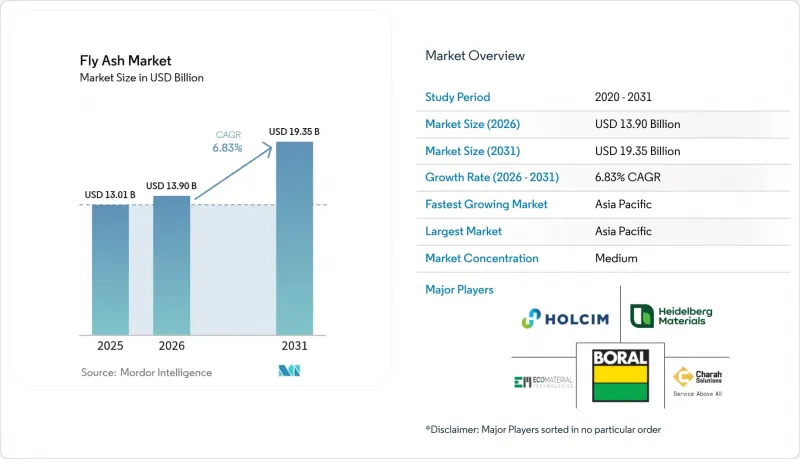
Mordor Intelligence에 의하면, 플라이 애시 시장 규모는 2025년에 130억 1,000만 달러로 평가되었습니다. 2026년 139억 달러에서 2031년까지 193억 5,000만 달러에 이를 것으로 예상되며, 예측 기간(2026-2031년) CAGR은 6.83%를 나타낼 전망입니다.
본 보고서는 유형(클래스 F, 클래스 C), 용도(포틀랜드 시멘트 및 콘크리트를 포함한 건설, 벽돌 및 블록, 도로 건설, 농업, 광업, 수처리, 세라믹 및 알루미나 추출을 포함한 기타 용도), 그리고 지역(아시아태평양, 북미, 유럽, 남미, 중동 및 아프리카)별로 분류되어 있습니다. 시장 전망은 금액(달러)으로 표시되어 있습니다.
세계의 플라이 애시 시장 동향 및 인사이트
미국, EU, 인도에서 급증하는 그린 시멘트 규제
각국 정부는 클링커 대체율 상한을 규정하는 조달 규정을 강화하고 있으며, 플라이 애시 시장에 대한 지속적인 수요는 일시적인 혜택이 아닌 구조적인 특징이 되고 있습니다. 아일랜드에서는 현재 모든 국비 지원 프로젝트에서 클링커의 30%를 대체해야 할 의무가 부과되고 있습니다. 프랑스의 RE2020 규정은 주택의 내재 탄소량 상한선을 단계적으로 낮추고 있으며, 규정을 준수하기 위해 플라이 애시 혼합이 장려되고 있습니다. 뉴욕주의 ‘Buy Clean Concrete’ 지침에서는 100만 달러를 초과하는 주 계약에 배출량 상한선이 부과되며, 레디믹스 콘크리트 공급업체에 대해 2025년부터 환경제품선언서(EPD) 공개가 의무화됩니다. 산타모니카시 조례 제2778호 등 지자체의 선례는 신축 건물의 시멘트 함유량에 상한을 설정함으로써 지역 차원의 움직임을 뒷받침하고 있습니다. 이러한 조치들은 전반적으로 최소 사용량 약속을 뒷받침하며, 공공 인프라 조달에 있어 배합 설계 기준을 재구축하고 있습니다.
공공 인프라 프로젝트에서 저탄소 지오폴리머 콘크리트의 급속한 보급
지오폴리머 콘크리트는 시험적 도입 단계에서 본격적인 시공 단계로 전환되고 있으며, 플라이 애시가 알칼리 활성화에 필요한 주요 알루미노규산염 골격을 제공합니다. 말레이시아 랑가트 강 교량에서는 초고성능 프리캐스트 부재의 유효성이 입증되어, 철골 구조와 비교하여 교량 전체 비용을 30% 절감하는 데 성공했습니다. 영국의 M25 우드포드 웨스트 고가교에서는 Cemfree 콘크리트가 채택되어, 불과 52 m³의 타설로 CO₂ 배출량을 77% 감축하고 9.4 t의 배출을 방지했습니다. 조사에 따르면, 플라이 애시 50%, 분쇄 고로 슬래그 40%, 실리카 10%를 포함한 혼합물은 시멘트 사용량을 대폭 줄이면서도 4,000-10,000 psi 범위의 압축 강도를 발휘하는 것으로 확인되었습니다. 지오폴리머계 콘크리트는 강도가 빠르게 발현되고 상온에서 경화되는 특성이 있어, 시공업체는 핵심 공정의 공사 기간을 단축할 수 있으며, 이는 플라이애쉬 시장에 대한 추가적인 수요를 창출하고 있습니다.
OECD 시장의 석탄 화력 발전 구성 변동
EPA의 2032년 준수 규정에 힘입어 발전소 폐쇄를 위한 적극적인 일정이 추진됨에 따라, 특히 탄소 포집 설비의 개조가 경제적으로 불가능한 발전소의 경우 플라이 애시의 향후 공급량이 감소하고 있습니다. 연간 5억 3,600만 달러에서 11억 달러에 달하는 규정 준수 비용이 폐쇄 일정을 가속화하고 있어, 플라이 애시 시장이 기존에 의존해 온 예측 가능한 공급량이 사라지고 있습니다. 유럽의 전력 회사들도 비슷한 추세를 보이고 있습니다. 독일의 갈탄 화력 발전소는 현재 가동 시간이 제한되어 있으며, 저탄소 건축 의무화가 강화되는 가운데 지역적 공급이逼迫하고 있습니다.
부문 분석
클래스 F는 2025년에 플라이 애시 시장 점유율의 61.58%를 유지했습니다. 이는 고실리카·알루미나 매트릭스가 유리석회와 반응하여 추가적인 C-S-H 겔을 형성함으로써 장기 내구성을 높이기 때문입니다. 성숙한 콘크리트 규격이 여전히 그 성능 실적을 참조하고 있기 때문에 클래스 F 판매와 관련된 플라이 애시 시장 규모는 한 자릿수 중반대의 성장을 기록할 것으로 예측됩니다. 조사에 따르면, 알칼리 농도를 2 M 미만으로 억제할 경우, 클래스 F를 기반으로 한 지오폴리머 혼합물은 상온 양생 시 40 MPa를 초과하는 압축 강도를 달성하여 프리캐스트 용도에서 새로운 가능성을 열어가고 있습니다.
그러나 성장세는 클래스 C로 이동하고 있습니다. 클래스 C의 자가 시멘트화 특성은 화학계 가속제를 사용하지 않고 경화 시간을 단축하고자 하는 레디믹스 콘크리트 사업자들에게 매력적입니다. 클래스 C의 연평균 성장률(CAGR)은 7.47%로 예측되며, 플라이 애시 시장에서 가장 빠르게 성장하는 분야입니다. 미국에서는 연간 22 Mt의 플라이 애시 중 43%가 현재 재활용되고 있으며, 중서부 지역 전력 회사들이 저유황 아비투멘탄으로의 전환을 추진함에 따라 클래스 C의 점유율이 확대되고 있습니다. 초기 강도의 우위성에 더해 알칼리 활성화제의 필요량이 적기 때문에 지오폴리머 생산업체의 경우 에너지 소비가 감소하여 2031년까지 이 부문의 매력이 더욱 높아질 것으로 전망됩니다.
지역별 분석
아시아태평양이 플라이 애시 시장의 70.55%를 차지하는 배경에는 확립된 석탄 발전 능력과 대규모 유틸리티 계획이 있습니다. 중국에서만 연간 600 Mt에서 800 Mt의 플라이 애시가 생산되고 있으며, 이 양은 중국이 독자적인 탈탄소화 일정을 추진하고 있는 상황에서도 지역의 대체 할당량을 충족하기에 충분한 양입니다. 인도에서는 발전소 반경 300 km 이내에서 플라이 애시의 100% 활용을 의무화하는 규제로 인해 전력 회사와 시멘트 공장 간의 순환형 공급 루프가 확립되어 있으며, 석탄 화력 발전소 폐지가 논의되고 있음에도 불구하고 수요의 예측 가능성이 확고해졌습니다.
북미에서는 규제상의 역풍이 어떻게 공급 기회로 전환될 수 있는지가 보여지고 있습니다. 조지아 파워(Georgia Power)는 에코 머티리얼 테크놀로지스(Eco-Material Technologies)와 체결한 15년 계약을 바탕으로 8 Mt의 기존 재를 준설하고 있으며, 저수지 복원 작업을 진행하면서 콘크리트 원료 확보를 도모하고 있습니다. 미국 환경보호청(EPA)의 ‘레거시 CCR 지표 저수지 규정’도 이와 유사한 회수 사업을 촉진하고 있으며, 컨슈머스 에너지(Consumers Energy)는 J.H. 캠벨 사이트에서 선광용으로 6 Mt를 확보하고 있습니다. 뉴욕시의 철도 연결 터미널에서는 회수된 플라이 애시가 도심 건설 프로젝트에 공급되고 있으며, 석탄 화력 발전소 폐쇄가 진행되는 지역에서도 플라이 애시 시장의 회복력이 입증되고 있습니다.
유럽에서는 국내 재 생산량이 감소하고 있음에도 불구하고, 엄격한 내재 탄소(embodied carbon) 기준치로 인해 수요가 유지되고 있습니다. 아일랜드의 클링커 대체율 30% 의무화와 프랑스의 RE2020에 따른 기준선 감축이 맞물리면서, 저탄소 콘크리트를 시공하는 사업자에게 플라이 애시 시장은 여전히 중요한 위치를 차지하고 있습니다. 홀심(Holcim)의 알트코르히(Altkirch) 공장은 2024년에 플라이 애시 및 기타 폐기물 유래 재료를 혼합하여, 지역 순환 경제 목표에 부합하는 100% 재활용 클링커 생산을 달성했습니다. 남아프리카, 튀르키예, 그리고 점점 증가하고 있는 동남아시아에서의 수입이 공급 격차를 메우는 데 일조하고 있지만, 일부 EU 내륙 시장에서는 물류 추가 요금으로 인해 LC3(Liner Charge 3)와의 납품 비용 격차가 줄어들고 있습니다.
기타 혜택 :
- 엑셀 형식 시장 예측(ME) 시트
- 3개월간의 애널리스트 지원
자주 묻는 질문
목차
제1장 서론
제2장 조사 방법
제3장 주요 요약
제4장 시장 구도
제5장 시장 규모 및 성장 예측
제6장 경쟁 구도
제7장 시장 기회 및 향후 전망
KTH 26.08.05According to Mordor Intelligence, the fly ash market size was valued at USD 13.01 billion in 2025 and estimated to grow from USD 13.9 billion in 2026 to reach USD 19.35 billion by 2031, at a CAGR of 6.83% during the forecast period (2026-2031).
This report is Segmented by Type (Class F, Class C), Application (Construction Including Portland Cement and Concrete, Bricks and Blocks, Road Construction, Agriculture, Mining, Water Treatment, Other Applications Including Ceramics and Alumina Extraction), and Geography (Asia-Pacific, North America, Europe, South America, Middle East and Africa). The Market Forecasts are Provided in Terms of Value (USD).
Global Fly Ash Market Trends and Insights
Surging Green-Cement Mandates in the U.S., EU & India
Governments are tightening procurement rules that lock in clinker-replacement thresholds, making sustained demand for the fly ash market a structural feature rather than a cyclical benefit. Ireland now requires a 30% clinker substitute in all state-funded projects. France's RE2020 code progressively ratchets down embodied-carbon ceilings for housing, incentivising fly ash blends to remain compliant. New York State's Buy Clean Concrete guidance overlays emissions caps on state contracts above USD 1 million, forcing ready-mix suppliers to disclose EPDs from 2025. Municipal precedents such as Santa Monica's Ordinance #2778 add local momentum by capping cement content in new buildings. Collectively, these measures underpin minimum-volume commitments and are reshaping mix-design norms across public infrastructure procurement.
Rapid Adoption of Low-Carbon Geopolymer Concrete in Public Infrastructure Projects
Geopolymer concrete is pivoting from pilot trials to mainstream delivery schedules, and fly ash provides the primary aluminosilicate backbone for alkali activation. The Langat River Bridge in Malaysia validated ultra-high-performance precast elements that lowered overall bridge costs by 30% compared with steel options. The UK's M25 Woodford West Viaduct used Cemfree concrete, realising a 77% CO2 cut and preventing 9.4 t of emissions in just 52 m3 poured. Research confirms that blends containing 50% fly ash, 40% ground-granulated blast-furnace slag, and 10% silica deliver compressive strengths in the 4,000-10,000 psi band while slashing cement demand. Because geopolymer systems gain strength quickly and cure at ambient temperatures, contractors shorten critical-path timelines, creating further pull for the fly ash market.
Volatility in Coal-Fired Generation Mix Across OECD Markets
Aggressive timelines for plant closures-prodded by the EPA's 2032-compliance rule-are shrinking forward ash supply, especially where units cannot economically retrofit carbon capture. Compliance costs between USD 536 million and USD 1.1 billion annually are accelerating retirement schedules, removing predictable tonnage streams that the fly ash market historically depended upon. European utilities are on a similar glide path; Germany's lignite plants now operate under restricted hours, tightening regional supply even as low-carbon construction mandates intensify.
Other drivers and restraints analyzed in the detailed report include:
- Expansion of Coal-Based Captive-Power Plants in ASEAN Industrial Zones
- Carbon-Credit Monetisation for High-Volume Fly-Ash Users
- Logistics Bottlenecks for Bulk Powder Handling in Land-Locked Regions
For complete list of drivers and restraints, kindly check the Table Of Contents.
Segment Analysis
Class F retained 61.58% of fly ash market share in 2025, owing to its high silica-alumina matrix that reacts with free lime to form additional C-S-H gels, thereby boosting long-term durability. The fly ash market size linked to Class F sales is expected to post mid-single-digit growth as mature concrete codes still reference its performance pedigree. Research indicates that when alkali concentrations are kept below 2 M, Class F-based geopolymer mixes attain compressive strengths above 40 MPa at ambient curing, opening new territory in precast applications.
Momentum is shifting, however, toward Class C, whose self-cementing nature appeals to ready-mix operators eager to shorten set time without chemical accelerators. Class C's 7.47% CAGR projection positions it as the fastest-expanding slice of the fly ash market. In the United States, 43% of the 22 Mt generated annually is now recycled, with Class C taking a rising share as Midwestern utilities transition to low-sulfur sub-bituminous coal. Early-strength advantages, coupled with a lower alkali activator requirement, translate into reduced embodied energy for geopolymer producers, reinforcing the segment's attractiveness through 2031.
Complete Report Scope:
- By Type
- Class F
- Class C
- By Application
- Construction
- Portland Cement and Concrete
- Bricks and Blocks
- Road Construction
- Agriculture
- Mining
- Water Treatment
- Other Applications (Ceramics, Alumina Extraction)
- Construction
- By Geography
- Asia-Pacific
- China
- India
- Japan
- South Korea
- ASEAN
- Rest of Asia-Pacific
- North America
- United States
- Canada
- Mexico
- Europe
- Germany
- United Kingdom
- Italy
- France
- Russia
- Rest of Europe
- South America
- Brazil
- Argentina
- Rest of South America
- Middle East and Africa
- Saudi Arabia
- South Africa
- Rest of Middle East and Africa
- Asia-Pacific
Geography Analysis
Asia-Pacific's 70.55% slice of the fly ash market stems from entrenched coal capacity and large-scale public works pipelines. China alone produces between 600 Mt and 800 Mt of ash annually, a volume sufficient to satisfy regional substitution quotas even as it pursues its own decarbonisation schedule. India's mandate requiring 100% ash utilisation within a 300 km radius of generation points enforces a circular supply loop between utilities and cement plants, cementing predictable demand despite coal-retirement chatter.
North America illustrates how regulatory headwinds can be turned into supply opportunities. Georgia Power is dredging 8 Mt of legacy ash under a 15-year contract with Eco Material Technologies, ensuring concrete-grade feedstock while remediating impoundments. The EPA's Legacy CCR Surface Impoundments rule triggers similar harvest plays, with Consumers Energy earmarking 6 Mt from the J.H. Campbell site for beneficiation. Rail-linked terminals in New York City now distribute harvested ash into urban construction programs, proving the resilience of the fly ash market even in coal-retirement regions.
Europe maintains demand through stringent embodied-carbon thresholds despite dwindling domestic ash output. Ireland's 30% clinker-replacement edict and France's RE2020 baseline contraction collectively keep the fly ash market relevant for low-carbon concrete builders. Holcim's Altkirch plant achieved 100% recycled clinker production in 2024, using a mix of fly ash and other waste-sourced materials that comply with the region's circularity goals. Imports from South Africa, Turkey, and, increasingly, Southeast Asia help bridge the supply gap, though logistics surcharges elevate delivered-cost parity versus LC3 in some inland EU markets.
- Ashtech
- Boral
- Cement Australia Pty Limited
- Cemex SAB de CV
- Charah Solutions, Inc.
- Eco Material Technologies
- Heidelberg Materials
- Holcim
- Salt River Materials Group
- Separation Technologies LLC
- Suyog Suppliers
- Titan America
Additional Benefits:
- The market estimate (ME) sheet in Excel format
- 3 months of analyst support
TABLE OF CONTENTS
1 Introduction
- 1.1 Study Assumptions & Market Definition
- 1.2 Scope of the Study
2 Research Methodology
3 Executive Summary
4 Market Landscape
- 4.1 Market Overview
- 4.2 Market Drivers
- 4.2.1 Surging green-cement mandates in the U.S., EU & India
- 4.2.2 Rapid adoption of low-carbon geopolymer concrete in public infrastructure projects
- 4.2.3 Expansion of coal-based captive-power plants in ASEAN industrial zones
- 4.2.4 Carbon-credit monetisation for high-volume fly-ash users
- 4.2.5 Breakthrough flash-calcination technology lowering logistics cost
- 4.3 Market Restraints
- 4.3.1 Volatility in coal-fired generation mix across OECD markets
- 4.3.2 Logistics bottlenecks for bulk powder handling in land-locked regions
- 4.3.3 Emerging clinker-free calcium-silicate cements reducing fly-ash demand
- 4.4 Value Chain Analysis
- 4.5 Porter's Five Forces
- 4.5.1 Bargaining Power of Suppliers
- 4.5.2 Bargaining Power of Buyers
- 4.5.3 Threat of New Entrants
- 4.5.4 Threat of Substitutes
- 4.5.5 Degree of Competition
5 Market Size & Growth Forecasts (Value)
- 5.1 By Type
- 5.1.1 Class F
- 5.1.2 Class C
- 5.2 By Application
- 5.2.1 Construction
- 5.2.1.1 Portland Cement and Concrete
- 5.2.1.2 Bricks and Blocks
- 5.2.1.3 Road Construction
- 5.2.2 Agriculture
- 5.2.3 Mining
- 5.2.4 Water Treatment
- 5.2.5 Other Applications (Ceramics, Alumina Extraction)
- 5.2.1 Construction
- 5.3 By Geography
- 5.3.1 Asia-Pacific
- 5.3.1.1 China
- 5.3.1.2 India
- 5.3.1.3 Japan
- 5.3.1.4 South Korea
- 5.3.1.5 ASEAN
- 5.3.1.6 Rest of Asia-Pacific
- 5.3.2 North America
- 5.3.2.1 United States
- 5.3.2.2 Canada
- 5.3.2.3 Mexico
- 5.3.3 Europe
- 5.3.3.1 Germany
- 5.3.3.2 United Kingdom
- 5.3.3.3 Italy
- 5.3.3.4 France
- 5.3.3.5 Russia
- 5.3.3.6 Rest of Europe
- 5.3.4 South America
- 5.3.4.1 Brazil
- 5.3.4.2 Argentina
- 5.3.4.3 Rest of South America
- 5.3.5 Middle East and Africa
- 5.3.5.1 Saudi Arabia
- 5.3.5.2 South Africa
- 5.3.5.3 Rest of Middle East and Africa
- 5.3.1 Asia-Pacific
6 Competitive Landscape
- 6.1 Market Concentration
- 6.2 Strategic Moves
- 6.3 Market Share Analysis
- 6.4 Company Profiles (includes Global level Overview, Market level overview, Core Segments, Financials as available, Strategic Information, Market Rank/Share, Products & Services, Recent Developments)
- 6.4.1 Ashtech
- 6.4.2 Boral
- 6.4.3 Cement Australia Pty Limited
- 6.4.4 Cemex SAB de CV
- 6.4.5 Charah Solutions, Inc.
- 6.4.6 Eco Material Technologies
- 6.4.7 Heidelberg Materials
- 6.4.8 Holcim
- 6.4.9 Salt River Materials Group
- 6.4.10 Separation Technologies LLC
- 6.4.11 Suyog Suppliers
- 6.4.12 Titan America
7 Market Opportunities & Future Outlook
- 7.1 White-space & Unmet-need Assessment