|
시장보고서
상품코드
2097178
장애인용 차량 : 시장 점유율 분석, 업계 동향 및 통계, 성장 예측(2026-2031년)Vehicles For Disabled - Market Share Analysis, Industry Trends & Statistics, Growth Forecasts (2026 - 2031) |
||||||
 Mordor Intelligence
Mordor Intelligence에 의하면, 2026년 장애인용 차량 시장 규모는 48억 1,000만 달러에 달할 것으로 추정되고 2025년 45억 3,000만 달러에서 확대해, 2031년에는 65억 달러에 이를 것으로 예측됩니다.
2026년부터 2031년까지 연평균 성장률(CAGR) 6.21%로 성장할 것으로 전망됩니다.
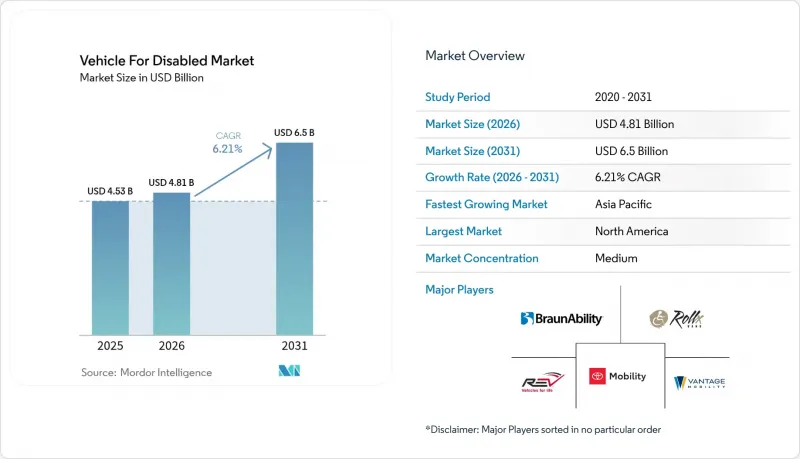
본 보고서는 차종(이륜차, 승용차, 상용차), 개조 유형(휠체어 대응 차량 등), 최종 사용자(개인 소비자, 재활센터 등), 유통 채널(OEM 판매 및 애프터마켓 개조), 그리고 지역별로 분류되어 있습니다. 시장 전망은 금액(달러) 기준으로 제시되어 있습니다.
세계의 장애인용 차량 시장 동향 및 인사이트
고령화와 평균 수명 연장에 따른 수요 가속화
세계적으로 수명이 연장됨에 따라 사회에서는 이동 수단과 자립이라는 개념이 재조명되고 있습니다. 고령자들은 신체적 어려움에 직면하는 경우가 많아, 기존의 교통수단으로는 대응하기 어려워지고 있습니다. 이러한 변화로 인해 고령자들이 일상생활에서 자립을 유지할 수 있도록 돕는 맞춤형 이동 솔루션에 대한 관심이 높아지고 있습니다. 동시에, 은퇴자층은 보다 종합적인 보험 적용 범위의 지원을 받아 경제 상황의 개선을 실감하고 있습니다. 이러한 진전으로 인해 차량 개조나 이동 보조 기구에 대한 접근이 용이해지고 있습니다. 의료 분야 또한 시설 입소 대신 자택에서의 생활을 가능하게 하는 ‘재택 고령화’를 우선시하는 방향으로 전환하고 있습니다. 이러한 틀 속에서 자가용은 단순한 편의성을 넘어 필수적인 생명선으로 진화하고 있습니다. 세계적 규모로 보면, 일부 국가들이 선도적인 역할을 수행하고 있으며, 공적 보험이 이동 관련 비용의 상당 부분을 부담하고 있습니다. 이러한 노력은 양질의 노년 생활에서 이동이 수행하는 지극히 중요한 역할에 대한 인식이 높아지고 있음을 보여주며, 다른 선진국들이 본받아야 할 잠재적인 청사진이 되고 있습니다.
공공 및 민간 차량의 휠체어 접근성에 관한 규제 요건
각국 정부는 대중교통 기관 및 민간 모빌리티 사업자 모두에게 규정 준수 기한을 엄격히 적용하고 있습니다. 2024년 ‘미국 장애인법(ADA)’ 개정에 따라, 미국의 교통 기관은 2027년까지 차량의 100%를 휠체어 접근이 가능하도록 해야 할 의무가 있습니다. EU에서는 지침 2019/882가 시행되고 있으며, 접근성 기준을 충족하지 못할 경우 벌금이 부과됩니다. 지방자치단체의 규제는 현재 라이드셰어 차량으로도 확대되고 있어, 사업자는 배리어프리 차량의 대수를 늘리거나 그렇지 않으면 벌금을 물게 됩니다. 세계 기준에 부합하고 관광 수입을 확보하기 위해 열심인, 고성장을 이루고 있는 아시아 국가들에서도 유사한 법규가 제정되고 있으며, 이러한 움직임들이 합쳐져 규정을 준수하는 차량에 대한 예측 가능한 수요를 창출하고 있습니다.
EV 스케이트보드 섀시의 배터리 배치가 플로어 드롭 개조를 제한
테슬라 ‘모델 X’ 등의 플랫폼에서는 실내 바닥 아래에 배터리 모듈이 배치되어 있어, 기존의 바닥 높이 낮추기 솔루션을 위한 물리적 공간을 확보할 수 없으며, 측면 승하차용 경사로나 실내 플랫폼의 단차 높이기만이 유일한 실용적인 대안입니다. 이러한 대응책은 헤드룸을 좁히거나 제조 시간을 늘릴 가능성이 있어, 전기차 아키텍처가 가진 장점의 일부를 상쇄해 버립니다. 개조 기업들은 맞춤형 키트에 대한 투자를 진행하고 있지만, 확장 가능한 솔루션이 주류가 되기 전까지는 이러한 일시적인 제약으로 인해 장애인용 차량 시장의 성장이 둔화되고 있습니다.
부문 분석
2025년 기준 장애인용 차량 시장 점유율의 62.12%를 승용차가 차지한 반면, 상용차는 2026년부터 2031년까지 연평균 성장률(CAGR) 7.05%로 성장할 전망입니다. 규제 시행 기한이 임박하고 차량 전동화에 대한 정부 보조금이 도입됨에 따라, 교통 기관 및 라이드셰어 사업자들은 규정을 준수하는 밴, 미니버스, 택시를 대규모로 구매하고 있습니다. 연방교통청(FTA)이 2027년까지 완전한 무장애 차량 도입을 의무화함에 따라 조달 주기가 가속화되었고, 제조업체들은 미리 설정된 솔루션을 제공할 수밖에 없는 상황입니다. 포드 등 상용차 제조업체들은 리프트나 고정 장치를 조립 라인에서 직접 장착함으로써 납기 기간을 단축하고 사후 개조 비용을 절감하고 있습니다. 개인 소유의 경우, 보험 혜택이나 융자 프로그램이 핸드 컨트롤, 회전 시트, 개인용 경사로에 대한 보장을 점점 더 확대하고 있어 승용차가 여전히 주류 선택지로 남아 있으며, 이로 인해 맞춤형 개조에 대한 수요가 유지되고 있습니다. 신흥 시장에서는 자동차 보유율이 여전히 낮은 혼잡한 도시 지역에서 비용 대비 효율적인 이동 수단을 제공하는 적응형 이륜차에 대한 관심이 일찍부터 높아지고 있습니다.
공장 출고 시 적용된 접근성 사양은 설치상의 문제를 줄이고 구조적 무결성을 유지함으로써, 수명 주기 비용을 중시하는 법인 구매자에게 재판매 가능성을 높여줍니다. 평평한 바닥을 갖춘 전기차(EV) 밴은 개조 과정을 더욱 간소화하여 환경 목표와 접근성 요건을 모두 충족시킵니다. 한편, 선진국의 고령화 사회에서는 차량에 대한 친숙함이 계속해서 중요시되고 있으며, 세단과 미니밴은 장애인용 자동차 시장에서 여전히 중요한 위치를 차지하고 있습니다. 이 두 가지 경향은 시장의 양극화를 여실히 드러내고 있습니다. 즉, 표준화된 대량 생산형 상용차와 다양한 장애 특성에 대응하는 맞춤형 승용차입니다.
2025년에는 휠체어 대응 차량이 44.62%로 최대 점유율을 차지했으나, 경사로 방식의 구성은 연평균 성장률(CAGR) 7.88%로 가장 빠르게 성장할 것으로 예측됩니다. 최신 BraunAbility 플랫폼에서는 자동화된 경량 알루미늄 슬로프를 통해 간병인의 부담이 경감되고, 전개 시간이 45초에서 8초로 단축되었습니다. 내장된 중량 센서가 램프의 조기 수납을 방지하여, ISO 10542 규격을 준수하면서 안전성을 높이고 있습니다. 리프트 장치는 병원 셔틀 등 고부하 용도에서는 여전히 주류를 이루고 있지만, 비용 문제나 유지보수 빈도 등의 요인으로 인해 개인용 사례에서는 경사로가 선호되는 경향이 있습니다. 핸드 컨트롤로의 개조는 수익 규모는 작지만 상지에 힘이 있는 운전자에게는 여전히 필수적이며, 기술 업그레이드에서는 햅틱 피드백과 이중화된 브레이크 회로에 중점을 두고 있습니다.
스마트 센서는 현재 유지보수 알림을 차량 관리자에게 전달하여 가동률을 높이는 동시에 총 소유 비용을 절감하고 있습니다. 스위블 시트 시스템은 탑승 시 도움이 필요한 휠체어를 사용하지 않는 고령 소비자들에게 지지를 받고 있으며, 평균 수명의 연장에 따라 이 계층은 확대되고 있습니다. 각 개조 카테고리에서 자동화와 커넥티비티의 융합을 통해 신뢰성이 향상되고 있습니다. 이를 통해 점점 더 엄격해지는 안전 기준 준수가 보장되며, 경사로(슬로프)는 장애인을 위한 자동차 시장에서 주류 솔루션으로서의 입지를 확립해 가고 있습니다.
지역별 분석
북미는 견고한 법적 체계, 재정적 여유가 있는 보험 제도, 그리고 충실한 자금 조달 채널 덕분에 2025년 장애인용 차량 시장 규모의 43.35%를 차지했습니다. 개정된 ADA(미국 장애인법)는 엄격한 준수를 의무화하고 있으며, 이에 따라 상업 사업자들은 차량 교체나 대규모 개조를 강요받고 있습니다. 재향군인부의 보조금과 민간 보험사의 적응 장비에 대한 정기적인 비용 보상을 통해 많은 최종 사용자에게 초기 비용 장벽이 최소화되고 있습니다. 인구 통계학적 동향도 추가적인 수요를 뒷받침하고 있으며, 북미 대륙의 고령층 인구는 2020년부터 2040년에 걸쳐 증가할 것으로 예측되어, 배리어프리 개인 교통 수단에 대한 안정적인 수요를 견인하고 있습니다. 캐나다 역시 유사한 안전 규제의 적용을 받고 있어 국경을 넘는 무역이 원활하게 이루어지고 있으며, 각 주의 건강보험 제도에서는 개조 비용의 상당 부분이 보장되는 경우가 많습니다.
아시아태평양은 가장 빠르게 성장하고 있으며, 2031년까지 연평균 성장률(CAGR) 8.31%로 성장할 전망입니다. 일본의 초고령화 사회가 시급한 수요를 창출하고 있으며, 국가의 요양보험 제도가 차량 개조 비용을 보조하고 있습니다. 한국은 2024년부터 대중교통 수단에서의 평등한 접근을 의무화하고 유럽 기준에 부합함으로써, 현지 자동차 제조업체들의 도입을 가속화하고 있습니다. 중국 교통운수부는 시내버스에 휠체어 접근성을 의무화하고 있으며, 이 정책은 대규모 지자체 입찰로 이어지고 있습니다. 인도의 장애인 권리 이행은 주로 대도시권에 한정되어 있으며, 1급 도시 이외 시장으로의 확산은 도로 인프라 정비 상황과 자금 조달 가능성에 좌우됩니다.
유럽에서는 ‘유럽 접근성 법’에 따라 안정적인 확대가 이루어지고 있습니다. 이 법은 회원국 간의 기술 기준을 통일하여 국경을 넘는 모빌리티 브랜드의 진입 장벽을 낮추고 있습니다. 독일의 엔지니어링 기술은 스티어 바이 와이어 시스템의 수출을 뒷받침하고 있는 반면, 스칸디나비아 국가들에서는 세수를 통한 사회보험을 통해 개조 비용이 충당되고 있습니다. 중동 및 아프리카에서는 아직 초기 단계이긴 하지만 수요가 점차 증가하고 있으며, 그 선두에는 스마트 시티 구상에 교통 접근성을 통합한 UAE의 연방 포용 전략이 있습니다. 남아프리카공화국의 장애인 권리 정책은 도시 지역에서의 구매를 촉진하고 있지만, 신용 시스템의 취약성과 서비스 네트워크의 제한으로 인해 농촌 지역에서의 보급이 저해되고 있습니다. 전반적으로 지리적 경향, 규제 확실성, 인구 고령화, 재정 능력 이 세 가지 요소가 복합적으로 작용하여 장애인용 차량 시장의 보급 속도를 결정하고 있음이 밝혀졌습니다.
기타 혜택 :
- 엑셀 형식 시장 예측(ME) 시트
- 3개월간의 애널리스트 지원
자주 묻는 질문
목차
제1장 서론
제2장 조사 방법
제3장 주요 요약
제4장 시장 구도
제5장 시장 규모 및 성장 예측
제6장 경쟁 구도
제7장 시장 기회 및 향후 전망
KTH 26.08.05According to Mordor Intelligence, vehicles for disabled market size in 2026 is estimated at USD 4.81 billion, growing from 2025 value of USD 4.53 billion with 2031 projections showing USD 6.5 billion, growing at 6.21% CAGR over 2026-2031.
This report is Segmented by Vehicle Type (Two-Wheeler, Passenger Cars, and Commercial Vehicles), Modification Type (Wheelchair Accessible Vehicles, and More), End User (Individual Consumers, Rehabilitation Centers, and More), Distribution Channel (OEM Sales and Aftermarket Conversions), and Geography. The Market Forecasts are Provided in Terms of Value (USD).
Global Vehicles For Disabled Market Trends and Insights
Accelerating Demand from Aging Populations and Longer Life Expectancy
Globally, as lifespans extend, societies are re-evaluating concepts of mobility and independence. Aging individuals often face physical challenges, making conventional transportation options less viable. This shift highlights a growing interest in adaptive mobility solutions, enabling older adults to maintain their daily autonomy. Concurrently, retirees are witnessing enhanced financial conditions, bolstered by more inclusive insurance coverage. Such advancements facilitate easier access to vehicle modifications and mobility aids. The healthcare sector is pivoting too, prioritizing 'aging in place'-enabling individuals to stay in their homes instead of transitioning to institutional care. Within this framework, personal vehicles evolve from mere conveniences to essential lifelines. On a global scale, certain nations are leading the way, with public insurance covering a significant chunk of mobility-related expenses. These initiatives underscore a growing acknowledgment of mobility's pivotal role in quality aging, presenting potential blueprints for other affluent nations to emulate.
Regulatory Mandates for Wheelchair Accessibility in Public and Private Fleets
Governments are tightening compliance clocks for both public transit and private mobility providers. The 2024 Americans with Disabilities Act amendments require U.S. transit agencies to achieve 100% wheelchair-accessible fleets by 2027. In the EU, Directive 2019/882 is being implemented, accompanied by financial penalties for accessibility lapses. Municipal regulations now extend to ride-hailing fleets, forcing operators to expand accessible vehicle pools or face fines. Similar statutes are emerging in high-growth Asian economies that are eager to align with global standards and secure tourism revenue, collectively creating predictable demand for compliant vehicles.
EV Skateboard Chassis Battery Placement Restricting Floor-Drop Conversions
Battery modules under the cabin floor in platforms such as the Tesla Model X eliminate physical space for traditional lowered-floor solutions, making side-entry ramps or raised interior platforms the only viable alternatives. These workarounds can reduce headroom or increase build hours, offsetting some of the EV architecture advantages. Conversion firms are investing in bespoke kits, but interim constraints shave growth off the Vehicles For Disabled Market until scalable solutions become mainstream.
Other drivers and restraints analyzed in the detailed report include:
- OEM Factory-Installed Accessibility Packages Gaining Model Coverage
- "One-Touch" Securement and Steer-By-Wire Tech Lowering Caregiver Burden
- Cyber-Secure Gateway Software Locks That Block Third-Party Retrofits
For complete list of drivers and restraints, kindly check the Table Of Contents.
Segment Analysis
Commercial vehicles generated momentum with a 7.05% CAGR forecast between 2026 and 2031, despite passenger cars retaining a 62.12% market share for vehicles for the disabled in 2025. Regulatory countdowns and public subsidies for fleet electrification prompt transit agencies and ride-share operators to purchase compliant vans, minibuses, and taxis on a large scale. The Federal Transit Administration's mandate for fully accessible fleets by 2027 accelerates procurement cycles, compelling manufacturers to deliver pre-configured solutions. Commercial OEMs, such as Ford, integrate lifts and securement directly on the assembly line, thereby compressing delivery timelines and reducing retrofit costs. Passenger cars remain the dominant choice for individual ownership because insurance benefits and financing programs increasingly cover hand controls, swivel seats, and personal ramps, thereby sustaining demand for tailored modifications. Emerging markets exhibit early interest in adaptive two-wheelers, offering cost-efficient mobility in congested urban corridors where car ownership remains low.
Factory-built accessibility trims installation defects and preserves structural integrity, increasing resale prospects for commercial buyers concerned with lifecycle cost. Flat-floor EV vans further simplify the conversion process, aligning environmental goals with accessibility requirements. Conversely, aging populations in developed economies continue to prioritize vehicle familiarity, keeping sedans and minivans relevant within the vehicle market for the disabled. This dual pathway highlights a market split: standardized, high-volume commercial builds and bespoke passenger vehicles catering to diverse disability profiles.
Wheelchair-accessible vehicles held the largest share at 44.62% in 2025; however, ramp-based configurations are expected to grow the fastest with an 7.88% CAGR. Automated lightweight aluminum ramps reduce caregiver strain and cut deployment times from 45 seconds to 8 seconds in the latest BraunAbility platforms. Integrated weight sensors prevent premature stowage, enhancing safety while meeting ISO 10542 standards. Lift mechanisms still dominate high-duty applications such as hospital shuttles, but face cost headwinds and maintenance schedules that favor ramps in personal use cases. Hand-control conversions, though a smaller revenue segment, remain vital for drivers with upper-limb strength, and technology upgrades are focusing on haptic feedback and redundant braking circuits.
Smart sensors now flag maintenance alerts to fleet managers, improving uptime and lowering the total cost of ownership. Swivel seat systems appeal to older consumers who require assistance with entering but do not use wheelchairs, a demographic that is expanding with rising life expectancy. The blend of automation and connectivity across modification categories enhances reliability. It ensures compliance with increasingly stringent safety codes, positioning ramps as a mainstream solution in the vehicle market for people with disabilities.
Complete Report Scope:
- By Vehicle Type
- Two-wheeler
- Passenger Cars
- Commercial Vehicles
- By Modification Type
- Wheelchair Accessible Vehicles
- Hand-Controlled Vehicles
- Ramp-Equipped Vehicles
- Lift-Equipped Vehicles
- Swivel Seat Systems
- By End User
- Individual Consumers
- Rehabilitation Centers
- Hospitals
- NGOs
- Government Agencies
- By Distribution Channel
- OEM Sales
- Aftermarket Conversions
- By Geography
- North America
- United States
- Canada
- Rest of North America
- South America
- Brazil
- Argentina
- Rest of South America
- Europe
- Germany
- United Kingdom
- France
- Italy
- Spain
- Rest of Europe
- Asia-Pacific
- China
- India
- Japan
- South Korea
- Rest of Asia-Pacific
- Middle East and Africa
- United Arab Emirates
- Saudi Arabia
- South Africa
- Turkey
- Rest of Middle East and Africa
- North America
Geography Analysis
North America commands a 43.35% share of the Vehicles For Disabled Market size in 2025, owing to strong legal frameworks, well-funded insurance systems, and robust financing channels. The amended ADA imposes strict compliance, prompting commercial operators to refresh or retrofit fleets at scale. Veteran Affairs grants and private insurers regularly reimburse adaptive equipment, minimizing up-front barriers for many end users. Demographic momentum adds further pull; the continent's senior cohort is forecast to increase between 2020 and 2040, driving steady demand for accessible personal transportation. Canada's inclusion under similar safety regulations eases cross-border trade, while provincial health plans often cover significant portions of conversion costs.
The Asia-Pacific region is the fastest-growing, advancing at an 8.31% CAGR through 2031. Japan's super-aged population drives immediate needs, and its national long-term care insurance subsidizes vehicle adaptations. South Korea made equal access in transportation mandatory in 2024, mirroring European standards and accelerating local OEM rollouts. China's Ministry of Transport requires urban buses to be wheelchair accessible, translating this policy into large municipal tenders. India's implementation of disability rights primarily extends to metros, and market penetration beyond tier-one cities is contingent upon road infrastructure upgrades and lending availability.
Europe posts stable expansion under the European Accessibility Act, which harmonizes technical norms across member states and lowers barriers for cross-border mobility brands. Germany's engineering expertise underpins exports of steer-by-wire systems, while Scandinavian nations fund conversion costs through tax-financed social insurance. The Middle East and Africa exhibit a nascent but rising demand, led by the UAE's federal inclusion strategy, which integrates transportation accessibility into its smart-city blueprint. South Africa's disability rights policy stimulates urban purchases, yet weaker credit systems and limited service networks hinder rural uptake. Collectively, geographic patterns reveal that regulatory certainty, demographic aging, and fiscal capacity collectively dictate the adoption pace in the market for vehicles for the disabled.
- BraunAbility
- Vantage Mobility LLC.
- REV Group
- Toyota Mobility (Toyota Motor Corp.)
- Rollx Vans
- Allied Mobility
- Gowrings Mobility Group
- MobilityWorks
- Sunrise Medical
- Invacare
- Pride Mobility
- Freedom Motors USA
- Ergomobility
- Autochair
- GM Coachwork
- Focaccia Group
Additional Benefits:
- The market estimate (ME) sheet in Excel format
- 3 months of analyst support
TABLE OF CONTENTS
1 Introduction
- 1.1 Study Assumptions and Market Definition
- 1.2 Scope of the Study
2 Research Methodology
3 Executive Summary
4 Market Landscape
- 4.1 Market Overview
- 4.2 Market Drivers
- 4.2.1 Accelerating Demand from Ageing Populations and Longer Life-Expectancy
- 4.2.2 Regulatory Mandates for Wheelchair Accessibility in Public and Private Fleets
- 4.2.3 OEM Factory-Installed Accessibility Packages Gaining Model Coverage
- 4.2.4 Growth of Electric Vans with Low Flat Floors Simplifying Conversions
- 4.2.5 "One-Touch" Securement and Steer-By-Wire Tech Lowering Caregiver Burden
- 4.2.6 Subsidized On-Demand Paratransit and Ride-Hailing Accessibility Quotas
- 4.3 Market Restraints
- 4.3.1 High Up-Front Conversion Costs and Limited Financing Options
- 4.3.2 Shortage of Certified Mobility-Conversion Technicians
- 4.3.3 EV Skateboard Chassis Battery Placement Restricting Floor-Drop Conversions
- 4.3.4 Cyber-Secure Gateway Software Locks That Block Third-Party Retrofits
- 4.4 Value / Supply-Chain Analysis
- 4.5 Regulatory Landscape
- 4.6 Technological Outlook
- 4.7 Porter's Five Forces
- 4.7.1 Threat of New Entrants
- 4.7.2 Bargaining Power of Suppliers
- 4.7.3 Bargaining Power of Buyers
- 4.7.4 Threat of Substitutes
- 4.7.5 Competitive Rivalry
- 4.8 Pricing Analysis
5 Market Size and Growth Forecasts (Value, USD)
- 5.1 By Vehicle Type
- 5.1.1 Two-wheeler
- 5.1.2 Passenger Cars
- 5.1.3 Commercial Vehicles
- 5.2 By Modification Type
- 5.2.1 Wheelchair Accessible Vehicles
- 5.2.2 Hand-Controlled Vehicles
- 5.2.3 Ramp-Equipped Vehicles
- 5.2.4 Lift-Equipped Vehicles
- 5.2.5 Swivel Seat Systems
- 5.3 By End User
- 5.3.1 Individual Consumers
- 5.3.2 Rehabilitation Centers
- 5.3.3 Hospitals
- 5.3.4 NGOs
- 5.3.5 Government Agencies
- 5.4 By Distribution Channel
- 5.4.1 OEM Sales
- 5.4.2 Aftermarket Conversions
- 5.5 By Geography
- 5.5.1 North America
- 5.5.1.1 United States
- 5.5.1.2 Canada
- 5.5.1.3 Rest of North America
- 5.5.2 South America
- 5.5.2.1 Brazil
- 5.5.2.2 Argentina
- 5.5.2.3 Rest of South America
- 5.5.3 Europe
- 5.5.3.1 Germany
- 5.5.3.2 United Kingdom
- 5.5.3.3 France
- 5.5.3.4 Italy
- 5.5.3.5 Spain
- 5.5.3.6 Rest of Europe
- 5.5.4 Asia-Pacific
- 5.5.4.1 China
- 5.5.4.2 India
- 5.5.4.3 Japan
- 5.5.4.4 South Korea
- 5.5.4.5 Rest of Asia-Pacific
- 5.5.5 Middle East and Africa
- 5.5.5.1 United Arab Emirates
- 5.5.5.2 Saudi Arabia
- 5.5.5.3 South Africa
- 5.5.5.4 Turkey
- 5.5.5.5 Rest of Middle East and Africa
- 5.5.1 North America
6 Competitive Landscape
- 6.1 Market Concentration
- 6.2 Strategic Moves
- 6.3 Market Share Analysis
- 6.4 Company Profiles (Includes Global level Overview, Market level overview, Core Segments, Financials as available, Strategic Information, Market Rank/Share, Products & Services, and Recent Developments)
- 6.4.1 BraunAbility
- 6.4.2 Vantage Mobility LLC.
- 6.4.3 REV Group
- 6.4.4 Toyota Mobility (Toyota Motor Corp.)
- 6.4.5 Rollx Vans
- 6.4.6 Allied Mobility
- 6.4.7 Gowrings Mobility Group
- 6.4.8 MobilityWorks
- 6.4.9 Sunrise Medical
- 6.4.10 Invacare
- 6.4.11 Pride Mobility
- 6.4.12 Freedom Motors USA
- 6.4.13 Ergomobility
- 6.4.14 Autochair
- 6.4.15 GM Coachwork
- 6.4.16 Focaccia Group