

|
시장보고서
상품코드
2097191
아메리카의 중구경 및 대구경 탄약 : 시장 점유율 분석, 업계 동향과 통계, 성장 예측(2026-2031년)Americas Medium and Large Caliber Ammunition - Market Share Analysis, Industry Trends & Statistics, Growth Forecasts (2026 - 2031) |
||||||
 Mordor Intelligence
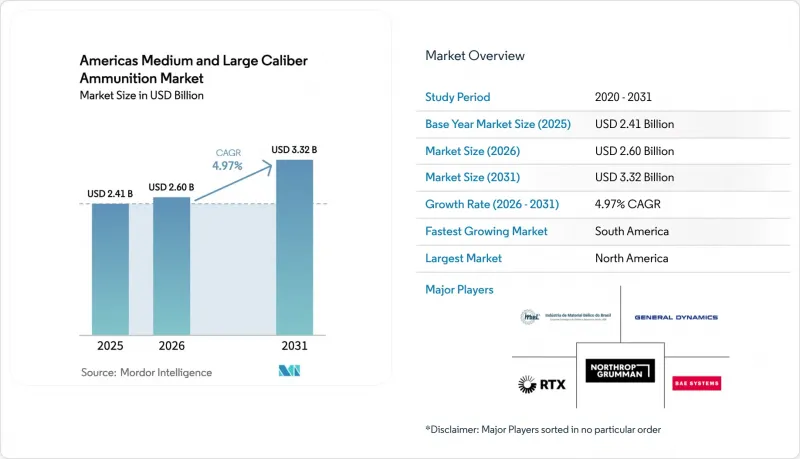
Mordor Intelligence에 의하면, 아메리카의 중구경 및 대구경 탄약 시장 규모는 2025년 24억 1,000만 달러에서 2026년에는 26억 달러로 확대되고, 2026-2031년 CAGR 4.97%로 성장을 지속하여 2031년에는 33억 2,000만 달러에 이를 것으로 예측됩니다.
본 보고서는 구경(중구경 및 대구경), 제품(소총탄, 포탄·박격포탄, 항공폭탄·수류탄), 유도 방식(유도식 및 비유도식), 최종 사용자(군 및 법 집행 기관), 플랫폼(육상, 해상, 항공), 지역(북미 및 남미)별로 분류되어 있습니다. 시장 전망은 금액(달러) 기준으로 제시되어 있습니다.
아메리카의 중구경 및 대구경 탄약 시장 동향과 인사이트
남미 및 북미 전역의 국방 예산 증가
2025년, 남미 및 북미 전체의 국방 예산은 9,120억 달러에 달했으며, 예산 배분에서 탄약에 대한 중점적인 투자가 이루어졌습니다. 미국은 탄약 예산을 21억 달러로 증액하고, 업계의 금형 설비 투자 및 생산 안정성을 지원하기 위해 다년 계약을 중시했습니다. 캐나다는 5억 5,300만 캐나다 달러(3억 9,818만 달러)를 배정하여, 북극권 작전을 위한 155mm 및 50mm 탄약의 대량 구매를 가능하게 했습니다. 브라질의 1,370억 레알(255억 8,000만 달러) 국방 예산에는 비살상 탄약으로의 전환을 위한 자금이 포함되어 있어, IMBEL사에 안정적인 다년간의 수익원을 제공했습니다. 멕시코는 국가경비대의 비축량을 강화하기 위해 1780억 멕시코 페소(약 99억 달러)를 배정했습니다. 이는 특히 기존 군사 예산이 제약받는 상황에서 국토안보 기관이 중구경 및 대구경 탄약 시장에 미치는 영향을 여실히 보여줍니다. 칠레는 국방 예산 총액을 유지하면서 조달 자금의 18%를 소모품에 배정하고, 특히 작전 준비 태세의 핵심 요소인 탄약에 중점을 두었습니다.
장갑차 및 포병 플랫폼의 현대화
장갑차 및 포병 플랫폼의 현대화 프로그램이 구경에 대한 수요의 다양화를 주도하고 있습니다. 미 육군의 M109A7 ‘팔라딘’은 현재 더 두꺼운 벽의 탄피가 필요한 비감응성 155mm 포탄을 채택하고 있는 반면, 캐나다의 LAV III에 XM913 50mm 포를 장착한 업그레이드는 새로운 구경 기준을 확립했습니다. 브라질의 ‘과라니’ 장갑병력수송차(APC)와 멕시코의 ‘DN-XI’ 보병전투차(IFV)는 각각 40mm 및 30mm 무기를 채택하여, 기존 주류였던 25mm 구경에서 전환했습니다. 미국 해병대의 ACV-30은 MK 310 프로그래머블 탄약을 채택하여, 이로 인해 차량 1대당 연간 소비량이 2배로 증가했습니다. 미 육군의 ERCA 포는 155mm 포의 사거리를 70킬로미터로 연장했으며, 이로 인해 강재의 결정립 구조에 대한 보다 엄격한 관리가 필요해졌습니다. 이러한 현대화 노력으로 인해 2031년까지 북미 및 남미의 중구경 및 대구경 탄약 시장에서 SKU 목록이 지속적으로 갱신될 것으로 예상되며, 개조 공사는 공급망 전체에 영향을 미칠 것입니다.
엄격한 수출 관리 및 ITAR 준수에 따른 비용
수출 규제 및 ITAR(국제무기거래규정) 준수는 탄약 수출에 막대한 비용을 부과하고 있습니다. ITAR 신고는 품목당 1,200-1,800달러의 추가 비용이 소요되며, 승인까지의 기간을 연장할 뿐만 아니라 운송 비용을 12-15% 증가시킵니다. 평균 127일에 달하는 대기 기간은 소규모 미국 공급업체들이 단기 납기 주문을 수주하는 것을 주저하게 만드는 요인이 되고 있습니다. 멕시코는 2,100만 달러 규모의 수류탄 구매에 230만 달러의 규정 준수 비용을 부담하게 되자, 한국이나 이스라엘 등 ITAR 적용 대상이 아닌 공급업체를 우선적으로 선택하게 되었습니다. 브라질의 IMBEL사는 미국의 추진제 성분에 관한 면제 조치 획득에 9개월의 지연이 발생하여 155mm 탄약의 생산 확대가 늦어졌습니다. 한편, 콜롬비아는 480만 달러로 예상되는 규정 준수 비용을 이유로 미국과의 합작 사업을 중단했습니다. 이러한 규제상의 과제는 유럽 및 남미 제조업체에 유리하게 작용하여, 북미 및 남미의 중구경 및 대구경 탄약 시장에서 미국 수출업체가 확보할 수 있는 시장 점유율을 축소시키고 있습니다.
부문 분석
2025년, 북미 및 남미의 중구경 및 대구경 탄약 시장에서 중구경 탄약이 주도적인 위치를 차지하며 63.89%의 점유율을 기록했습니다. 이러한 우위는 보병용 차량, 근접방어무기시스템(CIWS), 공격 헬리콥터에 20-40mm 포탄이 광범위하게 사용된 데 기인합니다. 그러나 ERCA 이니셔티브나 브라질의 ASTROS 로켓포 확장 계획과 같이 155mm 포탄을 중시하는 프로그램들에 힘입어, 대구경 탄약 수요는 연평균 성장률(CAGR) 5.21%로 확대될 것으로 예측됩니다. 대구경 포탄 시장 규모는 2026년 약 10억 달러에서 2031년까지 13억 달러로 확대될 것으로 예측됩니다. 2025년 7월 제너럴 다이내믹스(General Dynamics)가 체결한 120mm M1002 훈련용 탄약 관련 4억 6,500만 달러 규모의 계약 등 주목할 만한 계약들은 에이브럼스 전차 부대의 지속적인 수요를 여실히 보여주고 있으며, 한편, 노스롭사의 부시마스터 계약은 2028년까지 중구경 탄약 생산을 뒷받침하고 있습니다.
이 시장은 생산량과 살상력 사이의 전략적 균형에 직면해 있습니다. 중구경 탄약은 비용 대비 효율이 뛰어나며, 국경 경비, 해상 차단 작전, 도시 방어에 필수적인 속사 전술을 뒷받침합니다. 대조적으로, 대구경 탄약은 더 많은 화약량, 사거리 연장, 그리고 대등한 전력을 가진 적과의 전투 시나리오에서 뛰어난 성능을 제공합니다. 텍스트론(Textron)사의 XM204 120mm 탑 어택(Top Attack) 탄약과 같은 혁신적인 제품은 1만 2,000달러의 가격으로 능동 방어 시스템을 무력화할 수 있어, 포탄과 미사일의 경계를 모호하게 만들고 있습니다. 그러나 캐나다가 LAV III에 50mm 포를 채택한 사례에서 볼 수 있듯이, 동맹국의 비축량이 제한적이어서 독립적인 탄약 라인에 대한 자금 지원이 필요해진 등 병참상의 과제는 여전히 남아 있습니다. 이러한 차이는 SKU 표준화를 위한 노력을 복잡하게 만들고, 연합군 계획 담당자들에게는 재고 비용 증가로 이어지고 있습니다.
2025년에는 포탄과 박격포탄이 매출의 53.41%를 차지하며, 북미 및 남미의 중구경 및 대구경 탄약 시장의 기반으로서 입지를 확고히 했습니다. 미국의 155mm 포탄 월간 생산 목표인 7만 발은 비유도형의 단가가 1,050달러 전후로 유지된다고 가정할 경우, 2031년까지 연간 약 17억 달러의 매출을 창출할 가능성이 있습니다. 항공 폭탄 및 수류탄은 AH-1Z 바이퍼 및 A-10 기체 군에 힘입어 연평균 성장률(CAGR) 6.34%를 나타낼 것으로 예측됩니다. 이 기체들에는 재료비를 크게 늘리지 않으면서 평균 판매 가격을 끌어올릴 수 있는 프로그래밍 가능한 신관이 채택되어 있습니다. 8억 1,900만 달러 규모의 Amtec사 훈련용 수류탄 계약은 그동안 세분화되어 있던 이 하위 부문에서 규모의 경제 가능성을 보여주고 있으며, 저비용 복합재 케이스 제조에 능숙한 공급업체에게 전략적인 수익원을 창출하고 있습니다.
한때 틈새 제품으로 여겨졌던 박격포탄은 경보병 부대가 중포에 대한 의존에서 기동적인 화력으로 전환을 추진함에 따라 다시 주목받고 있습니다. 예를 들어, 오비탈 ATK사의 M821A3 비감응성 81mm 탄은 2025년 6월 해병대 배치를 완료했으며, 120mm 전차 탄약 소비량의 잠재적 감소를 완화할 수 있는 기준이 되는 재주문율을 확립했습니다. 127mm 로켓과 포신식 화포를 통합한 브라질의 ASTROS 시스템은 기존 포탄 생산에는 일반적으로 포함되지 않았던 GPS, 데이터 링크, 신관 설정 장치가 필요하기 때문에 새로운 전자기기 공급업체를 밸류체인에 유치하고 있습니다.
기타 혜택:
- 엑셀 형식 시장 예측(ME) 시트
- 3개월간의 애널리스트 지원
자주 묻는 질문
목차
제1장 서론
제2장 조사 방법
제3장 주요 요약
제4장 시장 구도
제5장 시장 규모와 성장 예측
제6장 경쟁 구도
제7장 시장 기회와 향후 전망
KTH 26.08.06According to Mordor Intelligence, the americas medium and large caliber ammunition market size is expected to grow from USD 2.41 billion in 2025 to USD 2.6 billion in 2026 and is forecasted to reach USD 3.32 billion by 2031 at a 4.97% CAGR over 2026-2031.
This report is Segmented by Caliber (Medium Caliber and Large Caliber), Product (Rounds, Artillery Shells and Mortars, and Aerial Bombs and Grenades), Guidance (Guided and Unguided), End-User (Military and Law Enforcement), Platform (Land, Naval, and Airborne), and Geography (North America and South America). The Market Forecasts are Provided in Terms of Value (USD).
Americas Medium and Large Caliber Ammunition Market Trends and Insights
Rising Defense Budgets Across the Americas
Defense budgets across the Americas reached USD 912 billion in 2025, with a significant focus on ammunition allocations. The US increased its ammunition budget to USD 2.1 billion, emphasizing multi-year contracts to support industry investments in tooling and production stability. Canada allocated CAD 553 million (USD 398.18 million), enabling bulk purchases of 155mm and 50mm rounds for Arctic operations. Brazil's BRL 137 billion (USD 25.58 billion) defense budget included funding for insensitive-munition conversions, providing IMBEL with a stable multi-year revenue stream. Mexico allocated MXN 178 billion (approximately USD 9.90 billion) to bolster National Guard inventories, demonstrating the influence of homeland-security agencies on the medium- and large-caliber ammunition market, particularly when conventional military budgets face constraints. Chile maintained its overall defense budget but redirected 18% of procurement funds to consumables, with a particular focus on ammunition as a critical component for operational readiness.
Modernization of Armored and Artillery Platforms
Modernization programs for armored and artillery platforms are driving diversification in demand for calibers. The US Army's M109A7 Paladin now uses insensitive 155mm rounds requiring thicker-walled cases, while Canada's LAV III upgrade to the XM913 50mm cannon has established a new caliber standard. Brazil's Guarani APC and Mexico's DN-XI IFV adopted 40mm and 30mm weapons, respectively, shifting away from the previously dominant 25mm calibers. The US Marine Corps' ACV-30 employs MK 310 programmable ammunition, which doubles the annual consumption per vehicle. The US Army's ERCA gun extends the 155mm range to 70 kilometers, necessitating stricter controls on steel grain structure. These modernization efforts are expected to continuously refresh SKU lists in the Americas medium and large caliber ammunition market through 2031, with retrofits impacting the entire supply chain.
Stringent Export Control and ITAR Compliance Costs
Export controls and ITAR compliance are imposing high costs on ammunition exports. ITAR filings add USD 1,200-1,800 per line item, extend approval timelines, and increase shipment costs by 12-15%. The average wait time of 127 days deters smaller US suppliers from pursuing quick-turn orders. Mexico incurred USD 2.3 million in compliance costs for a USD 21 million grenade purchase, leading to a preference for non-ITAR suppliers from South Korea and Israel. Brazil's IMBEL faced a nine-month delay in ramping up 155mm production due to US propellant ingredient waivers. At the same time, Colombia canceled a US joint venture over projected compliance costs of USD 4.8 million. These regulatory challenges benefit European and South American manufacturers, reducing the market share available to US exporters in the Americas medium and large caliber ammunition market.
Other drivers and restraints analyzed in the detailed report include:
- Geopolitical Tensions and Border-Security Operations
- Replacement of Aging Ammunition Stockpiles
- Volatility in Raw-Material Prices (Copper, Steel, Propellants)
For complete list of drivers and restraints, kindly check the Table Of Contents.
Segment Analysis
Medium rounds led the Americas medium and large caliber ammunition market in 2025, accounting for a 63.89% share. This dominance is attributed to the widespread use of 20-40mm guns on infantry vehicles, close-in weapon systems (CIWS), and attack helicopters. However, demand for large-caliber ammunition is expected to grow at a CAGR of 5.21%, driven by programs such as the ERCA initiative and Brazil's ASTROS rocket-artillery expansion, both of which emphasize 155mm shells. The market size for large-caliber projectiles is projected to increase from approximately USD 1 billion in 2026 to USD 1.3 billion by 2031. Notable contracts, such as General Dynamics' USD 465 million agreement in July 2025 for 120mm M1002 training rounds, highlight sustained demand from the Abrams fleet, while Northrop's Bushmaster contract supports medium-caliber production through 2028.
The market faces a strategic balance between volume and lethality. Medium calibers are cost-effective and support rapid-fire tactics essential for border patrol, naval interdiction, and urban defense. In contrast, large calibers offer higher payloads, extended range, and superior performance in peer warfare scenarios. Innovations like Textron's XM204 120mm top-attack round, priced at USD 12,000 and capable of defeating active-protection systems, blur the distinction between shells and missiles. However, logistical challenges persist, as seen in Canada's adoption of a 50mm cannon for its LAV III, which necessitated funding a standalone ammunition line due to limited allied stockpiles. These divergences complicate efforts to standardize SKUs, increasing inventory costs for coalition planners.
Artillery shells and mortars accounted for 53.41% of revenue in 2025, solidifying their position as the cornerstone of the Americas medium and large caliber ammunition market. US monthly production targets of 70,000 155mm shells could generate approximately USD 1.7 billion in annual revenue by 2031, assuming unit prices for unguided variants remain near USD 1,050. Aerial bombs and grenades are expected to grow at a CAGR of 6.34%, supported by the AH-1Z Viper and A-10 fleets, which utilize programmable fuzes that increase average selling prices without significantly raising material costs. The USD 819 million Amtec training-grenade contract demonstrated the potential for economies of scale in this previously fragmented sub-sector, creating a strategic revenue stream for suppliers adept at producing low-cost composite casings.
Mortar ammunition, once considered a niche product, has seen renewed interest as light-infantry units shift from relying on heavy artillery to adopting mobile firepower. For instance, Orbital ATK's M821A3 insensitive 81mm round completed fielding with the Marine Corps in June 2025, establishing a baseline reorder rate that mitigates potential declines in 120mm tank ammunition consumption. Brazil's ASTROS system, which integrates 127mm rockets and tube artillery, has attracted new electronics suppliers to the value chain, as these hybrid systems require GPS, data links, and fuse setters traditionally absent from conventional shell production.
Complete Report Scope:
- By Caliber
- Medium Caliber
- Large Caliber
- By Product
- Rounds
- Artillery Shells and Mortars
- Aerial Bombs and Grenades
- By Guidance
- Guided
- Unguided
- By End-User
- Military
- Law Enforcement
- By Platform
- Land
- Naval
- Airborne
- By Geography
- North America
- United States
- Canada
- Mexico
- South America
- Brazil
- Rest of South America
- North America
List of Companies Covered in this Report:
- General Dynamics Corporation
- BAE Systems plc
- CBC Global Ammunition
- Northrop Grumman Corporation
- Day & Zimmermann, Inc.
- Industria de Material Belico do Brasil
- Empresa Gerencial de Projetos Navais (EMGEPRON)
- Elbit Systems Ltd.
- Nammo AS
- Rheinmetall Denel Munition (Pty) Ltd. (Rheinmetall AG)
- Poongsan Corporation
- Day & Zimmermann(R)
- RTX Corporation
- Textron Inc.
Additional Benefits:
- The market estimate (ME) sheet in Excel format
- 3 months of analyst support
TABLE OF CONTENTS
1 INTRODUCTION
- 1.1 Study Assumptions and Market Definition
- 1.2 Scope of the Study
2 RESEARCH METHODOLOGY
3 EXECUTIVE SUMMARY
4 MARKET LANDSCAPE
- 4.1 Market Overview
- 4.2 Market Drivers
- 4.2.1 Rising defense budgets across the Americas
- 4.2.2 Modernization of armored and artillery platforms
- 4.2.3 Geopolitical tensions and border-security operations
- 4.2.4 Replacement of aging ammunition stockpiles
- 4.2.5 Surge in joint hemispheric training exercises
- 4.2.6 Growth of local ammunition manufacturing in South America
- 4.3 Market Restraints
- 4.3.1 Stringent export control and ITAR compliance costs
- 4.3.2 Volatility in raw-material prices (copper, steel, propellants)
- 4.3.3 Environmental regulations on lead and energetic materials
- 4.3.4 Shift toward precision-strike alternatives (loitering munitions)
- 4.4 Value Chain Analysis
- 4.5 Regulatory Landscape
- 4.6 Technological Outlook
- 4.7 Porter's Five Forces Analysis
- 4.7.1 Bargaining Power of Buyers
- 4.7.2 Bargaining Power of Suppliers
- 4.7.3 Threat of New Entrants
- 4.7.4 Threat of Substitutes
- 4.7.5 Competitive Rivalry
5 MARKET SIZE AND GROWTH FORECASTS (VALUE)
- 5.1 By Caliber
- 5.1.1 Medium Caliber
- 5.1.2 Large Caliber
- 5.2 By Product
- 5.2.1 Rounds
- 5.2.2 Artillery Shells and Mortars
- 5.2.3 Aerial Bombs and Grenades
- 5.3 By Guidance
- 5.3.1 Guided
- 5.3.2 Unguided
- 5.4 By End-User
- 5.4.1 Military
- 5.4.2 Law Enforcement
- 5.5 By Platform
- 5.5.1 Land
- 5.5.2 Naval
- 5.5.3 Airborne
- 5.6 By Geography
- 5.6.1 North America
- 5.6.1.1 United States
- 5.6.1.2 Canada
- 5.6.1.3 Mexico
- 5.6.2 South America
- 5.6.2.1 Brazil
- 5.6.2.2 Rest of South America
- 5.6.1 North America
6 COMPETITIVE LANDSCAPE
- 6.1 Market Concentration
- 6.2 Strategic Moves
- 6.3 Market Share Analysis
- 6.4 Company Profiles (includes Global level Overview, Market level overview, Core Segments, Financials as available, Strategic Information, Market Rank/Share for key companies, Products and Services, and Recent Developments)
- 6.4.1 General Dynamics Corporation
- 6.4.2 BAE Systems plc
- 6.4.3 CBC Global Ammunition
- 6.4.4 Northrop Grumman Corporation
- 6.4.5 Day & Zimmermann, Inc.
- 6.4.6 Industria de Material Belico do Brasil
- 6.4.7 Empresa Gerencial de Projetos Navais (EMGEPRON)
- 6.4.8 Elbit Systems Ltd.
- 6.4.9 Nammo AS
- 6.4.10 Rheinmetall Denel Munition (Pty) Ltd. (Rheinmetall AG)
- 6.4.11 Poongsan Corporation
- 6.4.12 Day & Zimmermann(R)
- 6.4.13 RTX Corporation
- 6.4.14 Textron Inc.
7 MARKET OPPORTUNITIES AND FUTURE OUTLOOK
- 7.1 White-space and Unmet-Need Assessment


