

|
시장보고서
상품코드
2097196
아시아태평양의 의약품 PET 포장 : 시장 점유율 분석, 업계 동향 및 통계, 성장 예측(2026-2031년)Asia-Pacific Pharmaceutical PET Packaging - Market Share Analysis, Industry Trends & Statistics, Growth Forecasts (2026 - 2031) |
||||||
 Mordor Intelligence
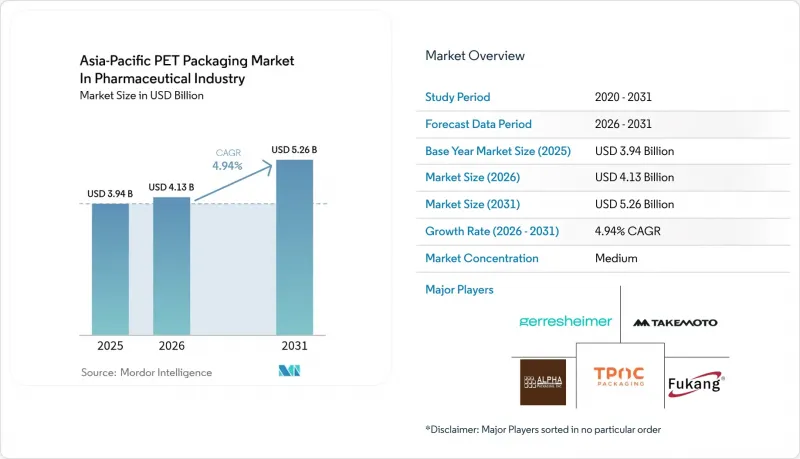
Mordor Intelligence에 의하면, 2026년 아시아태평양의 의약품 PET 포장 시장 규모는 41억 3,000만 달러에 달할 것으로 추정되고 2025년 39억 4,000만 달러에서 확대해, 2031년에는 52억 6,000만 달러에 이를 것으로 예측됩니다.
2026년부터 2031년까지 연평균 성장률(CAGR) 4.94%로 성장할 것으로 전망됩니다.
본 보고서는 제품 유형(정제용 병, 바이알 등), 색상(투명, 호박색, 기타 색상), 용량(50mL 미만, 51-100mL, 기타), 제조 기술(스트레치 블로우 성형, 사출 블로우 성형 등), 최종 사용자(제약 제조업체 등) 및 국가별로 분류되어 있습니다. 시장 전망은 금액(달러) 기준으로 제시되어 있습니다.
아시아태평양의 의약품 PET 포장 시장 동향 및 인사이트
아시아태평양의 의약품 생산 및 수출 확대
2024년, 중국과 인도는 전 세계 제네릭 의약품 생산량의 62%를 공급했으며, 수출 지향적 생산을 장려하는 보세 제조 구역으로 2차 및 3차 포장 업무가 집중되었습니다. 베트남의 의약품 생산이 14% 증가했으며, 태국 투자위원회(BOI)의 우대 조치 하에 인가된 공장에서는 각각 현장에 PET 병 블로우 성형 라인이 추가되어 운송 대기 시간과 재고 비용이 대폭 절감되었습니다. 다국적 기업들은 원료 조달 거점 근처에 충전 및 포장 공정을 집약하는 경향이 강해지고 있으며, 이로 인해 리드 타임이 수 주에서 수일로 단축되고 있습니다. 그러나 이러한 밀집된 집적은 위험을 증대시키는 요인이 되기도 합니다. 예를 들어, 한국에서 발생한 예기치 못한 PTA 가동 중단은 72시간 이내에 아시아의 여러 공급망에 혼란을 초래했습니다. 전반적으로 생산량 증가는 수지 처리량을 뒷받침하고, 컨버터의 미결 주문량을 확대하며, 아시아태평양 의약품 PET 포장 시장의 향후 5년간 성장 전망을 끌어올리고 있습니다.
경량화되고 내구성이 뛰어난 포장 솔루션으로의 전환
2020년부터 2024년에 걸쳐 제약사들은 프리폼의 신장 비율을 최적화하고 목 부분의 강도를 향상시킴으로써, 낙하 시험에서의 내구성을 저해하지 않으면서 병의 무게를 12% 줄였습니다. 운송 조건에 민감한 바이오의약품 화주 측에서는 1,000병당 500g의 경량화를 통해 인도에서 사하라 이남 아프리카로 운송하는 항공 화물 운임이 두 자릿수 비율로 감소했다는 보고가 있습니다. 지방으로의 배송에서 유리 파손률이 1.8%인 반면, PET의 파손률은 0.3% 미만이라는 사실이 보여주듯이, PET의 내충격성은 그 내구성의 매력을 뒷받침하고 있습니다. 일본 후생노동성 등 규제 당국은 현재, 차단 성능의 동등성이 입증될 경우 비멸균 경구용 고형 제제에 대해 더 얇은 벽 두께를 허용하고 있으며, 이를 통해 설계의 자유도가 확대되고 있습니다. 내구성과 경량화의 조합은 수익성을 높이고, 일반의약품 매장에서의 브랜드 이미지를 향상시키며, 아시아태평양 전체 PET 포장 시장의 채택을 가속화하고 있습니다.
플라스틱 폐기물 및 일회용 포장에 대한 규제 당국의 감시 강화
일본의 2024년 개정안에서는 2028년까지 의약품 PET 병에 재활용 소재 30% 사용을 의무화하고 있으며, 이를 위반할 경우 과태료가 단계적으로 인상됩니다. 한국에서는 위반한 생산 라인에 대해 최대 5,000만 원(3만 7,500달러)의 벌금이 부과되므로, 기업들은 장기적인 rPET 공급 계약 체결을 서두르고 있습니다. 중국의 확대 생산자 책임(EPR) 초안에서는 재정적 책임이 가공업체로도 확대되어, 지역 전체적으로 규정 준수 체제가 분열되어 있습니다. 식품용 rPET는 버진 수지에 비해 34% 높은 프리미엄 가격으로 거래되고 있어, 이익률을 압박하고 PET의 비용 우위를 좁히고 있습니다. 구매력이 제한된 중소 제약 기업들은 PET로의 전환을 늦출 가능성이 있으며, 그 결과 아시아태평양의 PET 포장 시장 성장세가 둔화될 우려가 있습니다.
부문 분석
시럽 병 부문은 2025년 매출의 34.32%를 차지하며, 넓은 입구, 표준화된 캡, 자외선 차단 기능이 필요한 경구용 액상 제제를 위한 아시아태평양의 의약품 PET 포장 시장 점유율의 기반을 형성했습니다. 이러한 우위는 특히 중국과 인도네시아에서 정부의 처방약 목록이 대용량 액상 제제의 처방을 권장하고 있어, 소아용 기침약 및 종합 비타민제의 판매량이 견조함을 반영하고 있습니다. 선두를 달리고는 있지만, 컨버터가 생산 라인의 최고 속도 한계에 도달하고 제네릭 의약품이 단일 투여 제형으로 전환됨에 따라 시럽 병에 대한 수요는 둔화되고 있습니다.
바이알은 시장 점유율은 작지만 연평균 성장률(CAGR) 6.12%로 성장하고 있으며, 이는 10-30밀리리터의 정밀 용기가 필요한 바이오의약품 파이프라인 및 바이오시밀러 출시와 연동되어 있습니다. 사출 블로우 성형을 통한 ±0.05mm의 목 마감 정밀도로 인해 주사기와의 호환성과 무균성이 확보되어, 바이알은 아시아태평양의 PET 포장 시장에서 프리미엄 가격 위치를 확립하고 있습니다. 정제용 및 점안약용 병은 꾸준하지만 성장 속도는 완만합니다. 한편, 팬데믹을 계기로 수요가 확대된 손 소독제 용기는 2019년 기준치를 상회하는 수준에서 안정세를 유지하며, 금형 교체 신속성을 전문으로 하는 틈새 가공 업체에 수요를 창출하고 있습니다.
호박색 병은 빛에 민감한 항생제나 비타민 복합제에게 필수적인 뛰어난 자외선 차단 성능 덕분에 2025년 매출의 45.98%를 차지했습니다. 이러한 점유율은 호박색을 표준으로 규정해 온 수십 년간의 약전 규격을 반영한 것입니다. 연평균 성장률(CAGR) 6.56%로 확대되고 있는 투명 병은 중국과 인도에서의 시리얼화 의무화에 힘입어 성장하고 있으며, 대비가 높은 바코드 스캔에는 투명한 측벽이 적합하다는 점이 그 배경에 있습니다. 머신 비전 검사 시스템을 도입한 제약 라인에서는 투명 병을 사용함으로써 처리 능력이 6-8% 향상되므로, 자외선 안정화 부형제가 필요함에도 불구하고 전환이 진행되고 있습니다.
아시아태평양의 PET 포장 시장에서 투명 용기 시장 규모는 충전 수준을 육안으로 확인할 수 있다는 점을 중시하는 전자상거래(EC) 채널에 대한 소비자의 신뢰에 힘입어 성장하고 있습니다. 또한, 일본의 규제 지침에 따라 빛에 민감하지 않은 의약품에 대한 투명 포장의 타당성이 더욱 인정받으면서 전환이 가속화되고 있습니다. 특수한 색상은 틈새 시장이지만, 두 자릿수의 가격 프리미엄을 얻을 수 있기 때문에 브랜드는 막대한 마케팅 비용을 들이지 않고도 OTC 제품의 차별화를 꾀할 수 있습니다.
기타 혜택 :
- 엑셀 형식 시장 예측(ME) 시트
- 3개월간의 애널리스트 지원
자주 묻는 질문
목차
제1장 서론
제2장 조사 방법
제3장 주요 요약
제4장 시장 구도
제5장 시장 규모 및 성장 예측
제6장 경쟁 구도
제7장 시장 기회 및 향후 전망
KTH 26.08.05According to Mordor Intelligence, the Asia-Pacific PET packaging market size in the pharmaceutical sector market size in 2026 is estimated at USD 4.13 billion, growing from 2025 value of USD 3.94 billion with 2031 projections showing USD 5.26 billion, growing at 4.94% CAGR over 2026-2031.
This report is Segmented by Product Type (Tablet Bottles, Vials, and More), Color (Transparent, Amber, Other Colors), Capacity (Below 50 ML, 51-100 ML, and More), Manufacturing Technology (Stretch Blow Molding, Injection Blow Molding, and More), End-Users (Pharmaceutical Manufacturers, and More), and Country. The Market Forecasts are Provided in Terms of Value (USD).
Asia-Pacific Pharmaceutical PET Packaging Market Trends and Insights
Growing Pharmaceutical Production and Exports in the Asia-Pacific
China and India supplied 62% of global generic-drug volumes in 2024, drawing secondary and tertiary packaging operations into bonded manufacturing zones that reward export-oriented output. Vietnam's 14% rise in pharmaceutical production and Thailand's green-lit plants under Board of Investment incentives have each added on-site PET bottle blow-molding lines, slashing transit buffers and inventory costs. Multinational firms are increasingly co-locating filling and packaging near ingredient sites, which reduces lead times from weeks to days. This tight clustering, however, magnifies risk; an unplanned PTA outage in South Korea disrupted several Asian supply chains within 72 hours. Overall, elevated output sustains resin throughput, expands converter order books, and lifts the Asia-Pacific PET packaging market's five-year growth outlook.
Shift Toward Lightweight Durable Packaging Solutions
Between 2020 and 2024, pharmaceutical companies cut bottle weight by 12% without losing drop-test integrity, thanks to refined preform stretch ratios and stronger neck finishes. Freight-sensitive biologics shippers report that trimming 500 g per 1,000 bottles lowers air-cargo fees on lanes from India to sub-Saharan Africa by double-digit percentages. PET's shatter resistance, evidenced by breakage rates below 0.3% versus 1.8% for glass during rural distribution, underpins its durability appeal. Regulatory bodies, such as Japan's Ministry of Health, now permit thinner walls for non-sterile oral solids once barrier equivalence is proven, thereby broadening the design envelope. The durability plus lightweight combination lifts profitability, improves brand perception in over-the-counter aisles, and drives faster adoption across the Asia-Pacific PET packaging market.
Intensifying Regulatory Scrutiny on Plastic Waste and Single-Use Packaging
Japan's draft 2024 amendments require 30% recycled content in pharmaceutical PET bottles by 2028, with non-compliance triggering escalating disposal levies. South Korea imposes fines up to KRW 50 million (USD 37,500) on delinquent lines, pushing firms to lock long-term rPET supply contracts. China's extended producer responsibility draft extends financial accountability to converters, fragmenting compliance regimes across the region. Food-grade rPET trades at a 34% premium over virgin resin, squeezing margins and narrowing PET's cost advantage. Smaller pharmaceutical players with limited purchasing power may delay PET migration, thereby slowing the growth momentum of the Asia-Pacific PET packaging market.
Other drivers and restraints analyzed in the detailed report include:
- Cost Efficiency and Versatility of PET Versus Glass Alternatives
- Surge in Online Pharmacy and Cold Chain Logistics Demanding Tamper-Evident PET Bottles
- Volatility in PET Resin Prices Due to Feedstock Fluctuations
For complete list of drivers and restraints, kindly check the Table Of Contents.
Segment Analysis
The syrup-bottle segment accounted for 34.32% of 2025 sales, anchoring the Asia-Pacific PET packaging market share for oral liquids that demand wide mouths, calibrated caps, and ultraviolet protection. This dominance reflects robust pediatric cough and multivitamin volumes, especially in China and Indonesia, where government formularies favor bulk liquid prescriptions. Despite its lead, syrup bottle uptake is moderating as converters reach high line-speed ceilings while generics pivot to unit-dose regimens.
Vials, although a smaller slice, are rising at a 6.12% CAGR, aligned with biologics pipelines and biosimilar launches, which require precision containers of 10-30 milliliters. Injection blow molding's +-0.05 millimeter neck-finish accuracy supports syringe compatibility and sterility, giving vials a premium price position within the Asia-Pacific PET packaging market. Tablet and dropper bottles offer steady but slower growth, while pandemic-fueled hand sanitizer formats have normalized at above-2019 baselines, supplying niche converters specializing in mold change agility.
Amber bottles secured 45.98% of 2025 revenue, thanks to their superior UV shielding, which is vital for photosensitive antibiotics and vitamin blends. This share embodies decades of pharmacopeial specifications that list amber as the default. Transparent bottles, advancing at a 6.56% CAGR, are driven by mandatory serialization in China and India, which favors clear sidewalls for high-contrast barcode scans. Pharmaceutical lines equipped with machine-vision inspection achieve 6-8% higher throughput with clear bottles, incentivizing changeovers despite the need for UV-stabilizing excipients.
The Asia-Pacific PET packaging market size for transparent formats is also boosted by consumer confidence in e-commerce channels that value visible fill levels. Regulatory guidance in Japan further legitimizes clear packaging for non-photosensitive drugs, accelerating migration. Specialty hues, although niche, fetch double-digit price premiums, allowing brands to differentiate OTC variants without incurring extensive marketing costs.
Complete Report Scope:
- By Product Type
- Tablet Bottles
- Syrup Bottles
- Vials
- Dropper Bottles
- Handwash and Hand Sanitizer Bottles
- Mouthwash Bottles
- Other Product Types
- By Color
- Transparent
- Amber
- Other Colors
- By Capacity
- Below 50 mL
- 51 mL-100 mL
- 101 mL-250 mL
- Above 250 mL
- By Manufacturing Technology
- Stretch Blow Molding
- Injection Blow Molding
- Extrusion Blow Molding
- Other Manufacturing Technologies
- By End-users
- Pharmaceutical Manufacturers
- Contract Manufacturing Organizations
- Other End-users
- By Country
- China
- India
- Japan
- South Korea
- Rest of Asia-Pacific
List of Companies Covered in this Report:
- Gerresheimer AG
- Alpha Packaging Holdings Inc.
- Takemoto Packaging Inc.
- TPAC Packaging India Private Limited
- Dongguan Fukang Plastic Products Co. Limited
- Ganesh PET Private Limited
- Senpet Polymers LLP
- AG Poly Packs Private Limited
- Ideal PET Industries
- Kang-Jia Plastic Company Limited
- Ningbo Zhongyue Packaging Material Co. Ltd
- Zibo Euro-Asia Packaging Co. Ltd
- K. K. Polymers (India) Private Limited
- Mitolo Family Farms Packaging (Asia) Pty Ltd
- Kyodo Plastic Co. Ltd
- Jiangsu Skypet Co. Ltd
- Polycone India Private Limited
- Taiyo Plastic Corporation
- Indian Packaging Products Private Limited
- Jash Packaging India Private Limited
Additional Benefits:
- The market estimate (ME) sheet in Excel format
- 3 months of analyst support
TABLE OF CONTENTS
1 INTRODUCTION
- 1.1 Study Assumptions and Market Definition
- 1.2 Scope of the Study
2 RESEARCH METHODOLOGY
3 EXECUTIVE SUMMARY
4 MARKET LANDSCAPE
- 4.1 Market Overview
- 4.2 Market Drivers
- 4.2.1 Growing Pharmaceutical Production and Exports in Asia-Pacific
- 4.2.2 Shift Toward Lightweight Durable Packaging Solutions
- 4.2.3 Cost Efficiency and Versatility of PET Versus Glass Alternatives
- 4.2.4 Surge in Online Pharmacy and Cold Chain Logistics Demanding Tamper Evident PET Bottles
- 4.2.5 Government-Led Healthcare Access Schemes Expanding Generic Drug Distribution
- 4.2.6 Adoption of Recycled PET (rPET) in Pharma Packaging Following Regional Circular Economy Targets
- 4.3 Market Restraints
- 4.3.1 Intensifying Regulatory Scrutiny on Plastic Waste and Single-Use Packaging
- 4.3.2 Volatility in PET Resin Prices Due to Feedstock Fluctuations
- 4.3.3 Low Heat Resistance Limiting PET Usage for Sterile Injectable Packaging
- 4.3.4 Consumer Perception Shift Toward Biodegradable Polymers in OTC Products
- 4.4 Industry Value Chain Analysis
- 4.5 Regulatory Landscape
- 4.6 Impact of Macroeconomic Factors on the Market
- 4.7 Technological Outlook
- 4.8 Porter's Five Forces Analysis
- 4.8.1 Bargaining Power of Suppliers
- 4.8.2 Bargaining Power of Consumers
- 4.8.3 Threat of New Entrants
- 4.8.4 Threat of Substitute Products
- 4.8.5 Intensity of Competitive Rivalry
5 MARKET SIZE AND GROWTH FORECASTS (VALUE)
- 5.1 By Product Type
- 5.1.1 Tablet Bottles
- 5.1.2 Syrup Bottles
- 5.1.3 Vials
- 5.1.4 Dropper Bottles
- 5.1.5 Handwash and Hand Sanitizer Bottles
- 5.1.6 Mouthwash Bottles
- 5.1.7 Other Product Types
- 5.2 By Color
- 5.2.1 Transparent
- 5.2.2 Amber
- 5.2.3 Other Colors
- 5.3 By Capacity
- 5.3.1 Below 50 mL
- 5.3.2 51 mL-100 mL
- 5.3.3 101 mL-250 mL
- 5.3.4 Above 250 mL
- 5.4 By Manufacturing Technology
- 5.4.1 Stretch Blow Molding
- 5.4.2 Injection Blow Molding
- 5.4.3 Extrusion Blow Molding
- 5.4.4 Other Manufacturing Technologies
- 5.5 By End-users
- 5.5.1 Pharmaceutical Manufacturers
- 5.5.2 Contract Manufacturing Organizations
- 5.5.3 Other End-users
- 5.6 By Country
- 5.6.1 China
- 5.6.2 India
- 5.6.3 Japan
- 5.6.4 South Korea
- 5.6.5 Rest of Asia-Pacific
6 COMPETITIVE LANDSCAPE
- 6.1 Market Concentration
- 6.2 Strategic Moves
- 6.3 Market Share Analysis
- 6.4 Company Profiles (includes Global level Overview, Market level overview, Core Segments, Financials as available, Strategic Information, Market Rank/Share for key companies, Products and Services, and Recent Developments)
- 6.4.1 Gerresheimer AG
- 6.4.2 Alpha Packaging Holdings Inc.
- 6.4.3 Takemoto Packaging Inc.
- 6.4.4 TPAC Packaging India Private Limited
- 6.4.5 Dongguan Fukang Plastic Products Co. Limited
- 6.4.6 Ganesh Pet Private Limited
- 6.4.7 Senpet Polymers LLP
- 6.4.8 AG Poly Packs Private Limited
- 6.4.9 Ideal PET Industries
- 6.4.10 Kang-Jia Plastic Company Limited
- 6.4.11 Ningbo Zhongyue Packaging Material Co. Ltd
- 6.4.12 Zibo Euro-Asia Packaging Co. Ltd
- 6.4.13 K. K. Polymers (India) Private Limited
- 6.4.14 Mitolo Family Farms Packaging (Asia) Pty Ltd
- 6.4.15 Kyodo Plastic Co. Ltd
- 6.4.16 Jiangsu Skypet Co. Ltd
- 6.4.17 Polycone India Private Limited
- 6.4.18 Taiyo Plastic Corporation
- 6.4.19 Indian Packaging Products Private Limited
- 6.4.20 Jash Packaging India Private Limited
7 MARKET OPPORTUNITIES AND FUTURE OUTLOOK
- 7.1 White-Space and Unmet-Need Assessment

(주말 및 공휴일 제외)


