
|
시장보고서
상품코드
2097201
이식형 루프 레코더 : 시장 점유율 분석, 업계 동향과 통계, 성장 예측(2026-2031년)Implantable Loop Recorders - Market Share Analysis, Industry Trends & Statistics, Growth Forecasts (2026 - 2031) |
||||||
 Mordor Intelligence
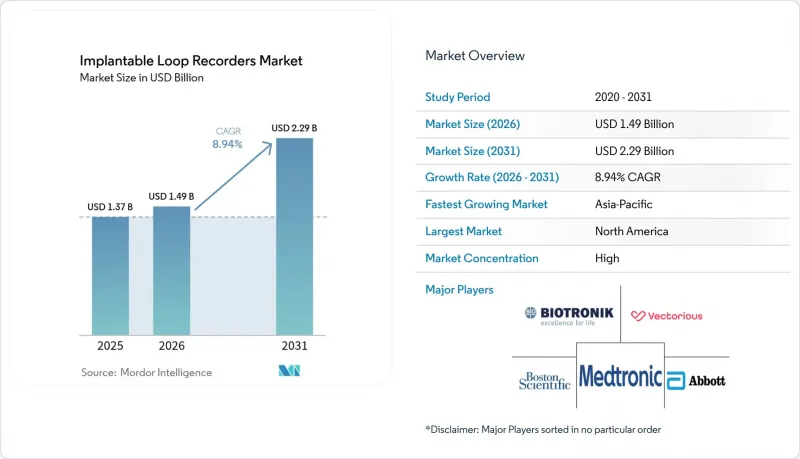
Mordor Intelligence에 의하면, 이식형 루프 레코더 시장 규모는 2025년 13억 7,000만 달러에서 2026년에는 14억 9,000만 달러로 확대되고, 2026-2031년 CAGR 8.94%로 성장을 지속하여 2031년에는 22억 9,000만 달러에 이를 것으로 예측됩니다.
본 보고서는 적응증(실신/전실신, 심방세동 감지, 원인 불명의 뇌졸중, 심계항진 및 기타 부정맥), 최종 사용자(병원, 심장 센터, 외래수술센터(ASC), 재택 및 원격 모니터링 프로그램), 지역(북미, 유럽, 아시아태평양, 중동 및 아프리카, 남미)별로 분류되어 있습니다. 시장 전망은 금액(달러) 기준으로 제시되어 있습니다.
전 세계 이식형 루프 레코더 시장 동향 및 인사이트
심방세동 및 원인 불명 뇌졸중 발생률 증가
선진 지역 전반에서 심방세동의 평생 위험이 24.2%에서 30.9%로 확대됨에 따라, 장기적인 심장 모니터링에 대한 수요가 증가하고 있습니다. 이식형 루프 레코더는 국내 등록 자료상 원인 불명 뇌졸중 사례의 19.5%에서 기존에 검출되지 않았던 심방세동을 감지하여, 항응고 요법을 통한 2차 예방의 조기 시행을 가능하게 하고 있습니다. 기존의 24시간 홀터 검사에서는 많은 발작성 사건을 놓치게 되지만, 이 기기를 삽입한 지 7.9개월 만에 검출 중앙값이 확인됨에 따라 지속적인 모니터링의 임상적 가치가 부각되고 있습니다. 그 결과, 신경과 전문의들은 재발을 억제하기 위해 퇴원 전에 뇌졸중 병동에서 레코더를 이식할 수 있도록 전기생리학자와의 협력을 더욱 강화하고 있습니다. 이러한 역학적 동향이 병원 및 외래 환경 모두에서 장기간 도입을 뒷받침하고 있습니다.
장기 휴대형 심박 리듬 모니터링에 대한 지지 확대
심장 모니터링 기간이 24시간에서 7일로 연장되면 진단 수율이 현저히 향상되고, 조기 심실 수축의 정량 정확도도 높아집니다. 현재 미국의 진료소에서 장기 모니터링 기기는 유선 심장 모니터의 40%를 차지하고 있으며, 모바일 원격 측정 기기가 추가로 20%를 차지하고 있어, 단기 홀터 검사가 크게 대체되고 있는 것으로 나타났습니다. 의사들은 증상이 거의 없는 환자에서 부정맥 검출률 향상을 중요하게 여기며, 이는 치료의 조기 시작과 예정에 없던 입원 감소로 이어집니다. 의료 시스템 측면에서도 중복 검사 감소와 진단까지의 기간 단축을 통해 경제적 이점이 입증되고 있습니다. 이러한 이점은 1회 시술로 이식을 완료하고 수년에 걸친 데이터 검토에 대해 보험금을 지급하는 보험사의 인센티브와 부합하며, 지속적인 모니터링 방식으로의 전환을 가속화하고 있습니다.
높은 기기 및 이식 비용
시술 비용은 여전히 큰 장벽으로 남아 있으며, 호주의 보상 기준에 따르면 이식 비용만 175.75 호주 달러(117.8 달러)로 정해져 있는 반면, AI 탑재 시스템의 기기 가격은 1만 1,329 달러 이상입니다. 미국의 의사 보수 기준에 따르면 2025년에 2.93%의 보수율 인하가 예상되며, 병원의 이익률이 압박을 받음에 따라 예산 측면의 부담은 더욱 커지고 있습니다. 많은 신흥 시장에서는 제한된 심장 질환 관련 예산이 기본적인 혈관 재건술에 배정되어 있어, 심혈관 질환 발생률이 증가하고 있음에도 불구하고 고성능 레코더를 도입할 여력은 제한적입니다. 각 벤더사는 리스 모델이나 성과 연동형 계약을 통해 가격 민감도에 대응하려 노력하고 있지만, 고소득 지역을 제외한 곳에서는 합리적인 가격이라는 과제가 여전히 도입 속도를 둔화시키고 있습니다.
부문 분석
2025년, 실신/전실신 관련 제품은 기존의 틸트 테이블 검사나 홀터 검사에 비해 진단 정확도가 높기 때문에 이식형 루프 레코더 시장 점유율의 45.98%를 차지했습니다. 원인 불명의 실신이 운전면허 유지나 직업적 안전을 위협하는 경우, 의사들은 지속적인 심박 리듬 기록을 골드 스탠다드로 간주합니다. 이식 데이터에 따르면, 실신 사례의 최대 33%에서 12개월 이내에 치료 가능한 부정맥이 밝혀져, 심박조율기나 절제술을 통한 중재가 가능해지며, 이는 재입원율 감소로 이어집니다. 고령화에 따라 신경심인성 사건의 발생률이 높아짐에 따라, 실신 치료에 적용되는 이식형 루프 레코더 시장 규모는 꾸준히 확대될 것으로 예측됩니다.
원인 불명의 뇌졸중 분야는 연평균 성장률(CAGR) 10.59%로 확대되고 있으며, 이식받은 환자의 28.2%가 3년 이내에 잠재성 심방세동을 발병한다는 설득력 있는 증거에 힘입어 다른 적응증을 능가하는 성장세를 보이고 있습니다. 뇌졸중 전문의들은 항응고 요법 결정을 신속히 내리기 위해 첫 입원 시 레코더를 이식하는 사례가 증가하고 있으며, 이러한 관행은 개정된 신경학 지침을 통해서도 뒷받침되고 있습니다. 보험사는 뇌졸중 재발 방지를 통한 비용 절감 효과를 인식하고 있으며, 이에 따라 보험 적용 범위 확대가 촉진되고 있습니다. 예측 기간 동안 뇌졸중이 주도하는 성장에 힘입어 총 이식 대수는 계속 증가할 것이며, 실신과 시장 점유율 격차는 점차 줄어들 것으로 전망됩니다.
뇌졸중 이외의 분야에서 심방세동의 검출은 여전히 큰 틈새 시장이며, 표면 심전도로는 확인할 수 없는 증상을 동반한 심계항진을 레코더가 특정하는 역할을 하고 있습니다. 또한, 폐정맥 격리술 후 모니터링에서도 수년에 걸친 데이터를 활용하여 절제술의 성공도를 평가했습니다. 심계항진 및 기타 부정맥 분야에서는 부피가 큰 체외형 기기 착용을 꺼리는 젊은 층에서 심실성 조기 수축이나 유전성 부정맥의 장기적인 기록이 가능해졌습니다는 점이 기여하고 있습니다. 전반적으로, 증거의 발전에 힘입어 모든 적응증이 호조를 유지하고 있으며, 제조업체 입장에서는 균형 잡힌 제품 포트폴리오에 대한 수요가 지속되고 있습니다.
지역별 분석
2025년, 북미는 전 세계 매출의 46.92%를 차지했습니다. 이는 실신, 뇌졸중, 심방세동 각 적응증에 대한 이식형 기기의 비용을 보상하는 메디케어의 전국 적용 결정(NCD)에 힘입은 결과입니다. 탄탄한 심혈관 의료 인프라, 일반 대중의 높은 인지도, 그리고 원격의료의 광범위한 수용이 판매 대수 성장을 뒷받침하고 있습니다. 구매 컨소시엄을 통한 일괄 가격 협상이 진행되고 있지만, 뇌졸중 예방 및 재입원 감소에 대한 성과를 보상하는 성과 연계형 지불 인센티브로 인해 이식형 루프 레코더 시장은 여전히 가치 중심의 경향을 보이고 있습니다.
유럽에서는 예방 심장학을 중시하는 국민건강보험 제도를 통해 꾸준한 확대가 이어지고 있습니다. 독일, 영국, 프랑스는 대규모 전기생리학 진료 체계와 MDR에 기반한 조화로운 의료기기 승인 제도를 통해 지역 수요의 중심이 되고 있습니다. 국가 간 협력을 통해 레지스트리 데이터가 공유되면서 근거 창출이 가속화되고, 치료 프로토콜의 표준화가 진행되고 있습니다. 남유럽 및 동유럽 국가에서는 보험 급여 제도의 균일화가 진행됨에 따라 이식형 레코더의 도입은 다소 완만한 속도로 진행되고 있지만, 인구 고령화에 따라 전반적인 보급률은 계속 상승하고 있습니다.
아시아태평양은 2031년까지 연평균 성장률(CAGR)이 10.62%로 가장 높은 성장 궤도를 보이고 있습니다. 중국과 일본의 도시 지역 병원에서는 비감염성 질환 관리를 우선시하는 국가 정책을 활용하여, 소형화된 레코더를 뇌졸중 치료실에 빠르게 도입하고 있습니다. 인도의 주요 도시에서는 민간 심혈관 의료 서비스를 찾는 중산층 소비자층 사이에서 도입이 확대되고 있습니다. 동남아시아의 일부 국가에서는 정부 보험 제도에 따른 보험 급여의 시범 도입이 시작되어, 임상 현장에서의 보다 광범위한 활용이 촉진되고 있습니다. 의료 재정이나 의사 분포에는 편차가 있지만, 막대한 환자 수와 심혈관 질환 유병률의 상승을 반영하여 지역 전체의 누적 수요는 급속히 확대되고 있습니다. 남미 및 중동 및 아프리카에서는 3차 의료기관이 기술 도입을 주도하는 초기 단계의 보급이 나타나고 있으나, 경제적·인프라적 제약으로 인해 단기적인 시장 점유율 확대는 제한되고 있습니다.
기타 혜택:
- 엑셀 형식 시장 예측(ME) 시트
- 3개월간의 애널리스트 지원
자주 묻는 질문
목차
제1장 서론
제2장 조사 방법
제3장 주요 요약
제4장 시장 구도
제5장 시장 규모와 성장 예측
제6장 경쟁 구도
제7장 시장 기회와 향후 전망
KTH 26.08.06According to Mordor Intelligence, the implantable loop recorder market size is expected to grow from USD 1.37 billion in 2025 to USD 1.49 billion in 2026 and is forecasted to reach USD 2.29 billion by 2031 at 8.94% CAGR over 2026-2031.
This report is Segmented by Indication (Syncope/Presyncope, Atrial Fibrillation Detection, Cryptogenic Stroke and Palpitations & Other Arrhythmias), End Users (Hospitals, Cardiac Centers, Ambulatory Surgical Centers Home-Based & Remote Monitoring Programs), and Geography (North America, Europe, Asia-Pacific, Middle-East and Africa, and South America). The Market Forecasts are Provided in Terms of Value (USD).
Global Implantable Loop Recorders Market Trends and Insights
Rising Incidence of Atrial Fibrillation & Cryptogenic Stroke
Expanding lifetime risk of atrial fibrillation from 24.2% to 30.9% across developed regions intensifies demand for prolonged cardiac surveillance. Implantable loop recorders detect previously hidden atrial fibrillation in 19.5% of cryptogenic stroke cases within national registries, enabling earlier secondary prevention through anticoagulation. Traditional 24-hour Holter studies miss many paroxysmal events, whereas median detection emerges 7.9 months after device insertion, underscoring the clinical value of continuous monitoring. As a result, neurologists increasingly collaborate with electrophysiologists to implant recorders in stroke units before discharge to curtail recurrent events. This epidemiological momentum underpins long-run adoption across both hospital and outpatient settings.
Growing Preference for Long-Term Ambulatory Rhythm Monitoring
Diagnostic yield rises markedly when cardiac surveillance extends from 24 hours to 7 days, amplifying premature ventricular contraction quantification accuracy. Extended monitoring devices now represent 40% of connected cardiac monitors in US clinics, while mobile telemetry contributes another 20%, indicating significant displacement of brief Holter studies. Physicians value higher arrhythmia detection in low-symptom patients, which translates into earlier therapy initiation and fewer unplanned admissions. Health systems also document economic benefits through reduced duplicate testing and shorter diagnostic journeys. These advantages align with payer incentives that reimburse single-procedure implant and multi-year data review, accelerating the transition toward continuous monitoring modalities.
High Device & Implantation Costs
Procedure fees remain a prominent barrier, with Australian reimbursement schedules listing AUD 175.75 (USD 117.8) for insertion alone, while device prices range from USD 11,329 upward for AI-enabled systems. Budget pressures intensify as US physician fee schedules project 2.93% rate cuts in 2025, squeezing hospital margins . Many emerging markets allocate scarce cardiac funds to basic revascularization, leaving limited capacity for premium recorders despite rising cardiovascular incidence. Vendors attempt to counter pricing sensitivity through leasing models and performance-based contracts but affordability hurdles still temper adoption pace outside high-income regions.
Other drivers and restraints analyzed in the detailed report include:
- Technological Advances in Miniaturization & Bluetooth Telemetry
- AI-Enabled Predictive Analytics for Asymptomatic Arrhythmia
- Data-Management Burden on Electrophysiology Clinics
For complete list of drivers and restraints, kindly check the Table Of Contents.
Segment Analysis
Syncope/Presyncope retained 45.98% of the implantable loop recorder market share in 2025, driven by its high diagnostic yield over conventional tilt-table or Holter tests. Physicians consider continuous rhythm capture the gold standard when unexplained fainting threatens driving privileges or occupational safety. Implant data reveal actionable arrhythmias in up to 33% of syncope cases within 12 months, enabling pacemaker or ablation interventions that cut readmissions. The implantable loop recorder market size for syncope applications is projected to advance steadily as aging populations raise incidence of neuro-cardiogenic events.
Cryptogenic Stroke is advancing at a 10.59% CAGR, outpacing other indications through compelling evidence that 28.2% of implanted patients experience covert atrial fibrillation within three years. Stroke specialists increasingly embed recorders during index admission to accelerate anticoagulation decisions, a practice supported by updated neurology guidelines. Payers acknowledge cost offsets from avoided recurrent strokes, facilitating broader coverage. Over the forecast horizon, stroke-led growth will continue to elevate total implant volumes, narrowing the share gap with syncope.
Atrial Fibrillation Detection outside the stroke setting remains a sizeable niche where recorders confirm symptomatic palpitations when surface ECG fails. Post-procedure monitoring after pulmonary vein isolation also leverages multi-year visibility to gauge ablation success. Palpitations & Other Arrhythmias benefit from extended capture of ventricular ectopy and inherited rhythm disorders in younger cohorts who reject bulky external devices. Collectively, evolving evidence keeps all indications in positive territory, sustaining balanced portfolio demand for manufacturers.
Complete Report Scope:
- By Indication
- Syncope/Presyncope
- Atrial Fibrillation Detection
- Cryptogenic Stroke
- Palpitations & Other Arrhythmias
- By End-User
- Hospitals
- Cardiac Centers & Clinics
- Ambulatory Surgical Centers (ASCs)
- Home-based & Remote Monitoring Programs
- By Region
- North America
- United States
- Canada
- Mexico
- Europe
- Germany
- United Kingdom
- France
- Italy
- Spain
- Rest of Europe
- Asia-Pacific
- China
- Japan
- India
- South Korea
- Australia
- Rest of Asia-Pacific
- South America
- Brazil
- Argentina
- Rest of South America
- Middle East and Africa
- GCC
- South Africa
- Rest of Middle East and Africa
- North America
Geography Analysis
North America accounted for 46.92% of worldwide revenue in 2025, supported by Medicare National Coverage Determinations that reimburse implants across syncope, stroke, and atrial fibrillation indications . Extensive cardiology infrastructure, high public awareness, and broad telehealth acceptance sustain volume growth. Purchasing consortia negotiate bulk pricing, but the implantable loop recorder market remains value-oriented due to outcome-based payment incentives that reward stroke avoidance and readmission reduction.
Europe maintains consistent expansion through universal healthcare systems that emphasize preventive cardiology. Germany, the United Kingdom, and France anchor regional demand with large electrophysiology capacities and harmonized device approvals under MDR. Cross-country initiatives share registry data, accelerating evidence generation and standardizing care protocols. Southern and Eastern European states adopt implantable recorders more gradually as reimbursement parity evolves, but overall penetration keeps rising alongside aging demographics.
Asia-Pacific shows the highest trajectory with a 10.62% CAGR through 2031. Urban hospitals in China and Japan rapidly integrate miniaturized recorders into stroke units, leveraging national policies that prioritize non-communicable disease management. India's tier-one cities display growing adoption among middle-class consumers seeking private cardiology services. Government insurance schemes in several Southeast Asian nations commence pilot reimbursements, encouraging broader clinical use. Despite heterogeneous health financing and physician distribution, cumulative regional demand scales quickly, reflecting large patient bases and escalating cardiovascular disease prevalence. South America and the Middle East & Africa observe early-stage uptake where tertiary centers spearhead technology introduction, yet economic and infrastructure constraints temper near-term share.
- Medtronic
- Abbott Laboratories
- BIOTRONIK
- Boston Scientific
- Angel Medical Systems
- iRhythm Technologies
- MicroPort
- Vectorious Medical
- LivaNova
- Koninklijke Philips
- Bardy Diagnostics
- Eko Devices
Additional Benefits:
- The market estimate (ME) sheet in Excel format
- 3 months of analyst support
TABLE OF CONTENTS
1 Introduction
- 1.1 Study Assumptions & Market Definition
- 1.2 Scope of the Study
2 Research Methodology
3 Executive Summary
4 Market Landscape
- 4.1 Market Overview
- 4.2 Market Drivers
- 4.2.1 Rising Incidence of Atrial Fibrillation & Cryptogenic Stroke
- 4.2.2 Growing Preference for Long-Term Ambulatory Rhythm Monitoring
- 4.2.3 Technological Advances in Miniaturization & Bluetooth Telemetry
- 4.2.4 Favorable Reimbursement Expansions in the US & EU
- 4.2.5 AI-Enabled Predictive Analytics for Asymptomatic Arrhythmia
- 4.2.6 CMS Bundled Stroke Payment Pushing Hospitals Toward IRLs
- 4.3 Market Restraints
- 4.3.1 High Device & Implantation Costs
- 4.3.2 Risk of Infection, Pocket Erosion & False-Positive Alerts
- 4.3.3 Data-Management Burden on Electrophysiology Clinics
- 4.3.4 Increasing Cybersecurity / Patient-Privacy Concerns
- 4.4 Value / Supply-Chain Analysis
- 4.5 Regulatory Landscape
- 4.6 Technological Outlook
- 4.7 Porter's Five Forces
- 4.7.1 Threat of New Entrants
- 4.7.2 Bargaining Power of Suppliers
- 4.7.3 Bargaining Power of Buyers
- 4.7.4 Threat of Substitutes
- 4.7.5 Competitive Rivalry
5 Market Size & Growth Forecasts (Value, USD)
- 5.1 By Indication
- 5.1.1 Syncope/Presyncope
- 5.1.2 Atrial Fibrillation Detection
- 5.1.3 Cryptogenic Stroke
- 5.1.4 Palpitations & Other Arrhythmias
- 5.2 By End-User
- 5.2.1 Hospitals
- 5.2.2 Cardiac Centers & Clinics
- 5.2.3 Ambulatory Surgical Centers (ASCs)
- 5.2.4 Home-based & Remote Monitoring Programs
- 5.3 By Region
- 5.3.1 North America
- 5.3.1.1 United States
- 5.3.1.2 Canada
- 5.3.1.3 Mexico
- 5.3.2 Europe
- 5.3.2.1 Germany
- 5.3.2.2 United Kingdom
- 5.3.2.3 France
- 5.3.2.4 Italy
- 5.3.2.5 Spain
- 5.3.2.6 Rest of Europe
- 5.3.3 Asia-Pacific
- 5.3.3.1 China
- 5.3.3.2 Japan
- 5.3.3.3 India
- 5.3.3.4 South Korea
- 5.3.3.5 Australia
- 5.3.3.6 Rest of Asia-Pacific
- 5.3.4 South America
- 5.3.4.1 Brazil
- 5.3.4.2 Argentina
- 5.3.4.3 Rest of South America
- 5.3.5 Middle East and Africa
- 5.3.5.1 GCC
- 5.3.5.2 South Africa
- 5.3.5.3 Rest of Middle East and Africa
- 5.3.1 North America
6 Competitive Landscape
- 6.1 Market Concentration
- 6.2 Competitive Benchmarking
- 6.3 Market Share Analysis
- 6.4 Company Profiles (includes Global level Overview, Market level overview, Core Segments, Financials as available, Strategic Information, Market Rank/Share for key companies, Products & Services, and Recent Developments)
- 6.4.1 Medtronic plc
- 6.4.2 Abbott Laboratories
- 6.4.3 Biotronik SE & Co. KG
- 6.4.4 Boston Scientific Corp.
- 6.4.5 Angel Medical Systems
- 6.4.6 iRhythm Technologies
- 6.4.7 MicroPort Scientific
- 6.4.8 Vectorious Medical
- 6.4.9 LivaNova PLC
- 6.4.10 Philips Healthcare
- 6.4.11 Bardy Diagnostics
- 6.4.12 Eko Devices
7 Market Opportunities & Future Outlook
- 7.1 White-space & Unmet-Need Assessment