

|
시장보고서
상품코드
2097214
불안장애 및 우울증 치료 : 시장 점유율 분석, 업계 동향과 통계, 성장 예측(2026-2031년)Anxiety Disorders and Depression Treatment - Market Share Analysis, Industry Trends & Statistics, Growth Forecasts (2026 - 2031) |
||||||
 Mordor Intelligence
Mordor Intelligence에 의하면, 불안장애 및 우울증 치료 시장 규모는 2025년 226억 5,000만 달러에서 2026년에는 238억 달러로 확대되고, 2026-2031년 CAGR 5.07%로 성장을 지속하여 2031년에는 304억 9,000만 달러에 이를 것으로 예측됩니다.
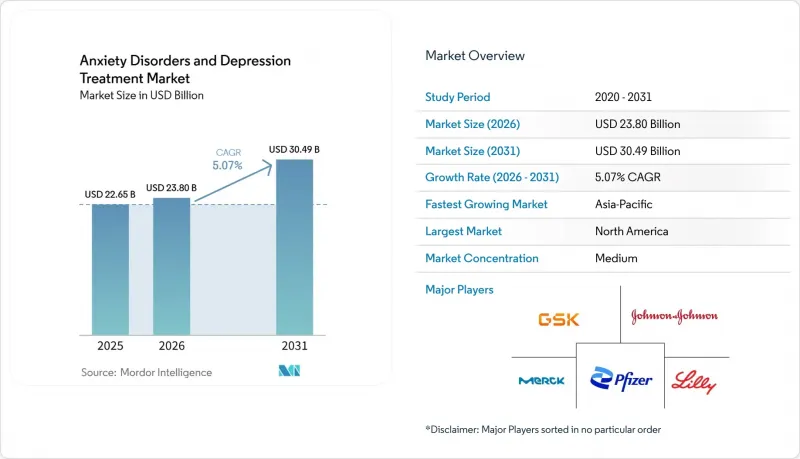
본 보고서에서는 업계를 약물 분류별(선택적 세로토닌 재흡수 억제제(SSRI), 세로토닌·노르에피네프린 재흡수 억제제(SNRI) 등), 적응증(대우울증 등), 치료법(약물 요법, 심리 요법 등), 지역(북미 등)별로 분류하고 있습니다. 시장 전망은 금액(달러) 기준으로 제시되어 있습니다.
전 세계 불안장애 및 우울증 치료 시장 동향과 인사이트
불안장애 및 우울증 유병률 증가
팬데믹 이후 정신 질환 진단 건수가 급증함에 따라 수요가 증가하고 있으며, 아시아 국가들의 정신 질환 DALY(장애 조정 생명년) 중 우울증이 37.2%, 불안장애가 21.5%를 차지하고 있습니다. 젊은 성인층은 디지털 중심의 중재 방식을 선호하고 있어, 기업들은 즉각적인 효과가 있으며 환자 개개인에 맞춘 치료 옵션을 제공해야 하는 압박을 받고 있습니다. 보험사들은 측정 가능한 치료 성과 향상을 중시하는 가치 기반 보상 체계로 전환하고 있으며, 제약사들은 현재의 SSRI를 뛰어넘는 지속성과 빠른 반응성을 입증해야 합니다.
정신 질환에 걸리기 쉬운 고령화 사회의 진전
고령화 사회에 따라 지연성 기분 장애나 다제 병용으로 인한 위험이 발생하고 있으며, 상호작용 프로파일이 더 깨끗한 약물에 대한 수요가 높아지고 있습니다. 최초의 경구용 선택적 5-HT1A 작용제인 게피론의 승인은 고령자에게 친화적인 작용기전을 가진 사업 기회를 부각시키고 있습니다. 인지 기능 저하의 조기 발견을 위한 디지털 모니터링 도구가 보급되면서, 재택 간호 모델을 강화하는 동시에 기존 정제를 둘러싼 하드웨어·소프트웨어 생태계를 활성화시키고 있습니다.
블록버스터 의약품의 특허 만료와 제네릭에 의한 시장 잠식
독점권의 소멸은 여전히 급격하여, 특허 만료 후 1년 이내에 제네릭 의약품이 처방전의 최대 90%를 차지하게 되었습니다. 브랜드 의약품 제조업체들은 제형 재설계나 Axsome사의 'Auvelity'와 관련된 합의와 같은 라이선싱 계약을 통해 방어를 도모하고 있지만, 브랜드 의약품이 명확한 차별화를 이루지 못하는 한 경제적으로 저렴한 대체품이 유리해집니다.
부문 분석
2025년에는 SSRI가 매출의 41.02%를 차지하며, 풍부한 안전성 실적을 바탕으로 불안장애 및 우울증 치료 시장을 지탱하고 있습니다. 한편, 비정형 항정신병제는 주요 우울 장애의 보조 요법으로 연평균 성장률(CAGR) 6.74%를 기록하며 성장하고 있습니다. 이러한 성장은 루마테페론의 적응증 확대 전망과 브렉피프라졸의 PTSD 적응증 승인에 기인합니다. 한편, ‘기타’ 범주에는 5-HT1A 작용제, 글루타메이트 조절제, 환각제 등이 포함되어 있으며, 투자자들 사이에서는 1차 선택 약물의 처방 동향을 바꿀 가능성을 지닌 미개척 분야로 간주되고 있습니다.
체중 증가, 성기능 장애, 진정 작용을 피할 수 있는 약물이 근로 연령층 사용자에게 선호됨에 따라 경쟁은 격화되고 있습니다. 각 제약사는 정밀 투여 키트와 복용 준수 상황을 실시간으로 추적하여 임상 의사가 부작용 프로파일을 확인할 수 있도록 알림을 제공하는 디지털 지원 앱을 함께 제공함으로써 이에 대응하고 있습니다. 보험사가 장기 처방전을 제한함에 따라 벤조디아제핀의 사용은 줄어들고 있으며, 이에 따라 비진정성 항불안제나 남용 위험이 낮은 GABA 양성 알로스테릭 조절제로 시장이 확대되고 있습니다.
주요 우울 장애는 2025년 매출의 38.22%를 차지하며, 불안장애 및 우울증 치료 시장을 주도하고 있습니다. 한편, PTSD는 6.89%의 연평균 성장률(CAGR)로 가장 빠르게 확대되고 있으며, 이는 FDA가 브렉스피프라졸과 셀트랄린의 병용 요법을 최초로 승인한 것과, 라이코스사의 최근 좌절에도 불구하고 MDMA 지원 요법에 대한 관심이 재점화되고 있는 점이 뒷받침하고 있습니다.
일반 시민의 생활과 재향군인의 건강 정책에서 트라우마에 대한 인식이 높아지고 있는 것이 환자층 확대로 이어지고 있습니다. 일반화된 불안장애 및 사회 불안장애의 진단 기준 확대 또한 환자 수 증가를 가져오고 있습니다. 한편, 강박장애는 여전히 치료가 미흡한 상태이므로, 신속한 증상 완화가 기대되는 글루타메이트계 화합물이나 비강 스프레이에 개발 파이프라인의 관심이 집중되고 있습니다.
지역별 분석
북미는 견조한 보험 적용, 새로운 치료법의 급속한 보급, 그리고 FDA의 우호적인 정책에 힘입어 2025년에는 매출의 37.20%를 차지하며 계속해서 주도적인 위치를 유지했습니다. 실로시빈 유사체에 대한 획기적 신약(Breakthrough) 지정 및 일반의약품(OTC) 전환 절차 등은 시장 출시 주기를 가속화하는 규제상의 유연성을 보여주고 있습니다. 미국의 가격 균등화법은 접근성을 확대하는 한편 이익률을 압박하고 있어, 기업들은 성과 기반 계약을 통해 가치를 지켜야만 하는 상황에 처해 있습니다. 아시아태평양은 2031년까지 연평균 성장률(CAGR) 7.76%를 기록하며 성장의 원동력이 될 전망입니다. 중국 국가약품감독관리국(NMPA)의 삼중 모노아민 재흡수 억제제 ‘Ruoxinlin’ 승인은 규제 현대화를 상징하는 사례입니다. 도시화, 소셜 미디어를 통한 인식 제고 활동, 그리고 고용주 주도의 웰니스 프로그램 덕분에 낙인은 완화되고 있지만, 가격에 민감한 계층에서는 제네릭 의약품이 선호되고 있습니다. 일본, 한국, 호주는 디지털 치료제 도입을 선도하고 있는 반면, 인도에서는 의료 서비스가 미치지 못하는 대규모 인구층이 저비용 SSRI의 판매량을 견인하고 있습니다. 유럽에서는 EMA(유럽의약품청)가 개정된 항우울제 지침을 통해 개별화된 평가 지표와 국경을 초월한 임상시험의 효율화가 촉진되어, 안정적인 한 자릿수 중반대의 성장률을 보이고 있습니다. 독일, 프랑스, 북유럽 국가들의 국민건강보험 제도 덕분에 비용 대비 효과 기준이 충족된다면 혁신적인 제품에 대한 수요가 유지될 것입니다. 남미, 중동 및 아프리카은 여전히 발전 단계에 있지만, 원격의료 인프라의 보급과 정부의 낙인 완화 캠페인이 정착되어 가고 있어 미래가 기대됩니다.
기타 혜택:
- 엑셀 형식 시장 예측(ME) 시트
- 3개월간의 애널리스트 지원
자주 묻는 질문
목차
제1장 서론
제2장 조사 방법
제3장 주요 요약
제4장 시장 구도
제5장 시장 규모와 성장 예측
제6장 경쟁 구도
제7장 시장 기회와 향후 전망
KTH 26.08.06According to Mordor Intelligence, the anxiety disorder and depression treatment market size is expected to grow from USD 22.65 billion in 2025 to USD 23.80 billion in 2026 and is forecast to reach USD 30.49 billion by 2031 at 5.07% CAGR over 2026-2031.
This report Segments the Industry Into by Drug Class (Selective Serotonin Reuptake Inhibitors (SSRIs), Serotonin-norepinephrine Reuptake Inhibitors (SNRIs) and More), by Indication (Major Depressive Disorder and More), by Therapy (Pharmacotherapy, Psychotherapy and More) and Geography (North America and More). The Market Forecasts are Provided in Terms of Value (USD).
Global Anxiety Disorders and Depression Treatment Market Trends and Insights
Rising Prevalence of Anxiety & Depression
A post-pandemic surge in mental-health diagnoses increases demand, with depressive disorders representing 37.2% and anxiety 21.5% of mental-health DALYs in Asian nations. Younger adults adopt digital-first interventions, pushing firms to offer rapid-onset and personalized options. Payers are shifting to value-based reimbursement frameworks that emphasize measurable outcome improvement, compelling manufacturers to prove durability and speed of response beyond today's SSRIs.
Growing Geriatric Population Prone to Mental Disorders
Ageing societies give rise to late-onset mood disorders and polypharmacy risks, intensifying need for drugs with cleaner interaction profiles. Gepirone's approval as the first oral selective 5-HT1A agonist highlights opportunities in elderly-friendly mechanisms. Digital monitoring tools are gaining traction for early detection of cognitive decline, reinforcing care-at-home models and stimulating hardware-software ecosystems around established pills.
Patent Expirations & Generic Erosion of Blockbusters
Exclusivity cliffs remain sharp, with generics seizing as much as 90% of prescriptions inside a year of expiry. Branded players seek defense through reformulations and license deals such as Axsome's settlement on Auvelity, yet economics favor cheaper substitutes unless brands deliver clear differentiation.
Other drivers and restraints analyzed in the detailed report include:
- Pipeline Approvals of Novel Antidepressant & Anxiolytic Agents
- Increased Awareness & Stigma Reduction Toward Mental Health
- Value-Based Pricing & Parity Laws Squeezing Margins
For complete list of drivers and restraints, kindly check the Table Of Contents.
Segment Analysis
SSRIs controlled 41.02% revenue in 2025, underpinning the Anxiety disorder and depression treatment market with extensive safety records. Atypical antipsychotics, however, climb at a 6.74% CAGR as adjunctive options in major depression. Expansion stems from lumateperone's broader label prospects and brexpiprazole's PTSD nod. Meanwhile, 5-HT1A agonists, glutamate modulators, and psychedelics populate the "others" bucket that investors view as white-space categories capable of altering first-line prescribing.
Competition intensifies as agents that avoid weight gain, sexual dysfunction, or sedation draw preference among working-age users. Manufacturers respond with precision-dose kits and co-packaged digital-support apps that track adherence in real time and flag side-effect profiles for clinician review. Benzodiazepine utilization contracts as payers restrict long-term scripts, opening space for non-sedating anxiolytics and GABA-positive allosteric modulators with safer abuse profiles.
Major depressive disorder generated 38.22% of 2025 revenue, reinforcing the Anxiety disorder and depression treatment market. PTSD, however, expands fastest at 6.89% CAGR, aided by FDA's first approval of brexpiprazole plus sertraline and renewed interest in MDMA-assisted therapy despite Lykos's recent setback.
Growing recognition of trauma across civilian life and veterans' health policies widen the patient pool. Expanded diagnostic criteria for generalized anxiety disorder and social anxiety also unlock incremental volume, while obsessive-compulsive disorder remains underserved, thereby attracting pipeline focus on glutamatergic compounds and nasal sprays that promise rapid relief.
Complete Report Scope:
- By Drug Class (Value)
- Selective Serotonin Reuptake Inhibitors (SSRIs)
- Serotonin-Norepinephrine Reuptake Inhibitors (SNRIs)
- Tricyclic Antidepressants (TCAs)
- Monoamine Oxidase Inhibitors (MAOIs)
- Atypical Antipsychotics
- Benzodiazepines
- Others
- By Indication (Value)
- Major Depressive Disorder
- Generalized Anxiety Disorder
- Panic Disorder
- Social Anxiety Disorder
- Obsessive-Compulsive Disorder
- Others
- By Therapy Type (Value)
- Pharmacotherapy
- Psychotherapy (e.g., CBT)
- Neuromodulation & Device-based Therapies
- Digital Therapeutics
- By End User (Value)
- Hospitals & Clinics
- Specialty Mental-Health Centers
- Homecare Settings
- Others
- By Geography (Value)
- North America
- United States
- Canada
- Mexico
- South America
- Brazil
- Argentina
- Rest of South America
- Europe
- Germany
- United Kingdom
- France
- Italy
- Spain
- Rest of Europe
- Asia-Pacific
- China
- Japan
- India
- South Korea
- Australia
- Rest of Asia-Pacific
- Middle East and Africa
- GCC
- South Africa
- Rest of Middle East and Africa
- North America
Geography Analysis
North America retained leadership with 37.20% revenue in 2025, underpinned by robust insurance coverage, rapid uptake of new modalities, and favorable FDA policies. Breakthrough designations for psilocybin analogs and the OTC switch pathway illustrate regulatory flexibility that accelerates launch cycles. U.S. parity laws expand access but compress margins, compelling firms to defend value through outcomes contracts.Asia-Pacific is set to be the growth engine with an 7.76% CAGR out to 2031. China's NMPA approval of Ruoxinlin, a triple monoamine reuptake inhibitor, exemplifies regulatory modernization. Urbanization, social-media campaigns, and employer-led wellness programs reduce stigma, while price-sensitive segments favor generics. Japan, South Korea, and Australia spearhead digital-therapeutic adoption, whereas India's large underserved population drives volume for low-cost SSRIs.Europe posts steady mid-single-digit gains as EMA's revised antidepressant guideline promotes personalized endpoints and cross-border trial efficiencies. Universal coverage across Germany, France, and the Nordics sustains demand for innovative products once cost-utility criteria are satisfied. South America and the Middle East & Africa remain nascent but promising as telehealth infrastructure spreads and government stigma-reduction campaigns take hold.
- Eli Lilly and Company
- Pfizer
- GlaxoSmithKline
- Johnson & Johnson
- AstraZeneca
- Lundbeck A/S
- Abbvie
- Takeda Pharmaceutical Co.
- Otsuka Pharmaceutical Co.
- Bausch Health
- Teva Pharmaceutical Industries
- Sun Pharma Industries Ltd.
- Novartis
- Merck
- Boehringer Ingelheim
- Alkermes plc
- Sage Therapeutics Inc.
- Biogen
- MindMed Inc.
- Compass Pathways plc
Additional Benefits:
- The market estimate (ME) sheet in Excel format
- 3 months of analyst support
TABLE OF CONTENTS
1 Introduction
- 1.1 Study Assumptions & Market Definition
- 1.2 Scope of the Study
2 Research Methodology
3 Executive Summary
4 Market Landscape
- 4.1 Market Overview
- 4.2 Market Drivers
- 4.2.1 Rising Prevalence of Anxiety & Depression
- 4.2.2 Growing Geriatric Population Prone to Mental Disorders
- 4.2.3 Pipeline Approvals of Novel Antidepressant & Anxiolytic Agents
- 4.2.4 Increased Awareness & Stigma Reduction Toward Mental Health
- 4.2.5 OTC Switch Momentum for Selected SSRIs
- 4.2.6 AI-Enabled Digital Therapeutics Boosting Adherence
- 4.3 Market Restraints
- 4.3.1 Patent Expirations & Generic Erosion of Blockbusters
- 4.3.2 Adverse Effects Limiting Long-Term Adherence
- 4.3.3 Psychedelic-Assisted Therapy Siphoning Demand
- 4.3.4 Value-Based Pricing & Parity Laws Squeezing Margins
- 4.4 Value / Supply-Chain Analysis
- 4.5 Regulatory Landscape
- 4.6 Technological Outlook
- 4.7 Porter's Five Forces
- 4.7.1 Threat of New Entrants
- 4.7.2 Bargaining Power of Suppliers
- 4.7.3 Bargaining Power of Buyers
- 4.7.4 Threat of Substitute Products
- 4.7.5 Competitive Rivalry
5 Market Size & Growth Forecasts
- 5.1 By Drug Class (Value)
- 5.1.1 Selective Serotonin Reuptake Inhibitors (SSRIs)
- 5.1.2 Serotonin-Norepinephrine Reuptake Inhibitors (SNRIs)
- 5.1.3 Tricyclic Antidepressants (TCAs)
- 5.1.4 Monoamine Oxidase Inhibitors (MAOIs)
- 5.1.5 Atypical Antipsychotics
- 5.1.6 Benzodiazepines
- 5.1.7 Others
- 5.2 By Indication (Value)
- 5.2.1 Major Depressive Disorder
- 5.2.2 Generalized Anxiety Disorder
- 5.2.3 Panic Disorder
- 5.2.4 Social Anxiety Disorder
- 5.2.5 Obsessive-Compulsive Disorder
- 5.2.6 Others
- 5.3 By Therapy Type (Value)
- 5.3.1 Pharmacotherapy
- 5.3.2 Psychotherapy (e.g., CBT)
- 5.3.3 Neuromodulation & Device-based Therapies
- 5.3.4 Digital Therapeutics
- 5.4 By End User (Value)
- 5.4.1 Hospitals & Clinics
- 5.4.2 Specialty Mental-Health Centers
- 5.4.3 Homecare Settings
- 5.4.4 Others
- 5.5 By Geography (Value)
- 5.5.1 North America
- 5.5.1.1 United States
- 5.5.1.2 Canada
- 5.5.1.3 Mexico
- 5.5.2 South America
- 5.5.2.1 Brazil
- 5.5.2.2 Argentina
- 5.5.2.3 Rest of South America
- 5.5.3 Europe
- 5.5.3.1 Germany
- 5.5.3.2 United Kingdom
- 5.5.3.3 France
- 5.5.3.4 Italy
- 5.5.3.5 Spain
- 5.5.3.6 Rest of Europe
- 5.5.4 Asia-Pacific
- 5.5.4.1 China
- 5.5.4.2 Japan
- 5.5.4.3 India
- 5.5.4.4 South Korea
- 5.5.4.5 Australia
- 5.5.4.6 Rest of Asia-Pacific
- 5.5.5 Middle East and Africa
- 5.5.5.1 GCC
- 5.5.5.2 South Africa
- 5.5.5.3 Rest of Middle East and Africa
- 5.5.1 North America
6 Competitive Landscape
- 6.1 Market Concentration
- 6.2 Market Share Analysis
- 6.3 Company Profiles (includes Global level Overview, Market level overview, Core Segments, Financials as available, Strategic Information, Market Rank/Share for key companies, Products & Services, and Recent Developments)
- 6.3.1 Eli Lilly and Company
- 6.3.2 Pfizer Inc.
- 6.3.3 GlaxoSmithKline plc
- 6.3.4 Johnson & Johnson (Janssen)
- 6.3.5 AstraZeneca plc
- 6.3.6 Lundbeck A/S
- 6.3.7 AbbVie (Allergan)
- 6.3.8 Takeda Pharmaceutical Co.
- 6.3.9 Otsuka Pharmaceutical Co.
- 6.3.10 Bausch Health Companies Inc.
- 6.3.11 Teva Pharmaceutical Industries Ltd.
- 6.3.12 Sun Pharma Industries Ltd.
- 6.3.13 Novartis AG
- 6.3.14 Merck & Co., Inc.
- 6.3.15 Boehringer Ingelheim GmbH
- 6.3.16 Alkermes plc
- 6.3.17 Sage Therapeutics Inc.
- 6.3.18 Biogen Inc.
- 6.3.19 MindMed Inc.
- 6.3.20 Compass Pathways plc
7 Market Opportunities & Future Outlook
- 7.1 White-space & Unmet-Need Assessment


