|
시장보고서
상품코드
2097216
암 등록 소프트웨어 : 시장 점유율 분석, 업계 동향 및 통계, 성장 예측(2026-2031년)Cancer Registry Software - Market Share Analysis, Industry Trends & Statistics, Growth Forecasts (2026 - 2031) |
||||||
 Mordor Intelligence
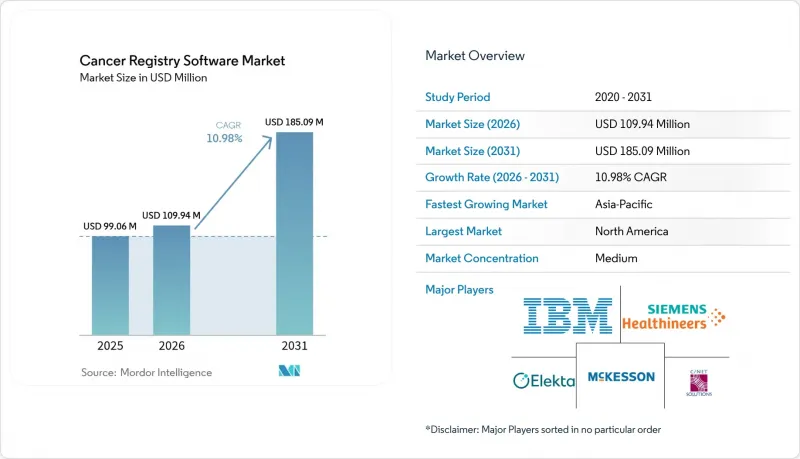
Mordor Intelligence에 의하면, 2026년 암 등록 소프트웨어 시장 규모는 1억 994만 달러에 달할 것으로 추정되고 2025년 9,906만 달러에서 확대해, 2031년에는 1억 8,509만 달러에 이를 것으로 예측됩니다.
2026년부터 2031년까지 연평균 성장률(CAGR) 10.98%로 성장할 것으로 전망됩니다.
본 보고서는 도입 모델(On-Premise 및 클라우드 기반), 데이터베이스 유형(상용 데이터베이스 및 퍼블릭 데이터베이스), 최종 용도(정부 및 제3자 기관, 민간 보험사, 병원 및 진료소, 기타), 지역(북미, 유럽, 아시아태평양, 기타)별로 분류되어 있습니다. 시장 전망은 금액(달러)으로 표시됩니다.
세계의 암 등록 소프트웨어 시장 동향 및 인사이트
암 유병률 증가
세계 암 발병률은 상승하고 있으며, 서태평양 지역의 사례 수는 2012년 450만 건에서 2025년까지 640만 건에 달할 것으로 예측됩니다. 이에 따라 의료 시스템에는 확장 가능한 등록 인프라의 도입이 요구되고 있습니다. 고령화에 따라 생존자 추적에 대한 요구는 특히 복잡해지고 있으며, 각 벤더들은 유전체 정보 및 바이오마커 입력에 대응하는 종단적 데이터 모델을 통합하고 있습니다. 인구 기반 등록 시스템에 대한 자금 지원이 새롭게 시작된 저·중소득 국가에서는 수요가 증가하고 있으며, 비용 대비 효과가 높은 모듈을 제공하는 클라우드 공급업체에게 비즈니스 기회가 창출되고 있습니다. 첨단 소프트웨어는 표적 치료나 다제 병용 요법을 기록하는 등, 맞춤형 의료의 워크플로우를 점점 더 지원하고 있습니다. 전반적으로, 환자 수 증가와 복잡한 치료 프로토콜이 암 등록 소프트웨어 시장에 대한 장기적인 수요를 뒷받침하고 있습니다.
암 데이터 보고에 관한 정부의 의무화 조치
CDC(미국 질병통제예방센터)는 사례 완전성을 95%로 하고, 사망 진단서만을 기반으로 한 사례를 3% 이하로 억제할 것을 의무화하고 있으며, 이에 따라 미국에서는 NAACCR 형식을 통한 전자 제출이 널리 보급되고 있습니다. 워싱턴주를 비롯한 일부 주에서는 현재 의료 제공업체에게 의료 정보 교환(HIE)을 통해 HL7 형식의 기록을 전송할 것을 의무화하고 있어, 실시간 모니터링이 가속화되고 있습니다. 유럽 각지에서도 유사한 지침이 제시되고 있는 한편, 아시아태평양 각국 정부는 국제 표준을 준수하기 위한 시범 등록 제도를 시작하고 있습니다. 각 벤더사는 자동화된 편집 검사 기능과 ICD-O-3 코딩 도구를 통합하여, 고객이 인력을 증원하지 않고도 규정을 준수할 수 있도록 지원하고 있습니다. 규제 당국이 ‘당연도 내 보고’를 중시하는 가운데, 클라우드 기반 분석 기능과 상호 운용성 기능은 필수적인 요소가 되었으며, 이것이 암 등록 소프트웨어 시장의 꾸준한 성장을 뒷받침하고 있습니다.
PHI와 관련된 개인정보 보호 및 보안 우려
2024년에는 의료 분야의 정보 유출 건수가 4,000만 건을 넘어섰으며, 극히 기밀성이 높은 유전체 데이터나 치료 데이터를 보유한 암 등록 시스템에 대한 감시가 강화되었습니다. 등록 시스템은 HIPAA를 준수하면서도 공중보건 보고를 신속하게 수행해야 하므로, 다단계 인증, 세밀한 역할 기반 접근 제어, 필드 수준 암호화의 도입이 요구되고 있습니다. 클라우드 벤더들은 SOC 2 및 HITRUST 감사를 받은 의료 전용 인스턴스를 제공하여 대응하고 있으나, 도입의 복잡성으로 인해 비용이 증가하고 도입 기간이 장기화되고 있습니다. 유럽에서의 도입에 있어서는 엄격한 GDPR(EU 개인정보보호규정) 데이터 이전 규정이 적용되기 때문에 국경을 초월한 임상시험 레지스트리의 운영이 복잡해지고 있습니다. 이러한 요인들로 인해 단기적인 도입이 억제되고 있으며, 암 등록 소프트웨어 시장의 잠재적 구매자들의 예산은 압박을 받고 있습니다.
부문 분석
클라우드 플랫폼은 공급업체의 유연한 스토리지 및 원격 사용자 접근에 대한 선호에 힘입어 2025년 매출의 60.62%를 차지했습니다. 이 점유율은 암 등록 소프트웨어 시장 규모에서 가장 큰 비중을 차지하고 있으며, 이 부문은 2031년까지 연평균 성장률(CAGR) 12.23%를 유지할 것으로 전망됩니다. 학술 의료 센터에서는 데이터 주권 측면에서 여전히 On-Premise를 선호하는 경향이 있지만, 이러한 기관들조차 AI 마이크로서비스를 활용하기 위해 하이브리드 아키텍처의 시범 도입을 추진하고 있습니다.
지속적인 소프트웨어 업데이트, 통합된 NLP 툴킷, 그리고 자동화된 품질 검사는 과거 IT 인력이 부족했던 지역 병원의 관심을 끌고 있습니다. 퍼블릭 클라우드의 보안 인증에는 현재 HITRUST, ISO 27001 및 FedRAMP의 각 레벨이 포함되어 있어 이사회 차원의 우려를 완화하고 있습니다. 이러한 이점들을 종합해 보면, 클라우드 도입이 현재 암 등록 소프트웨어 시장에서 가장 두드러진 특징이 된 이유를 설명할 수 있습니다.
지역별 분석
북미는 2025년 매출의 44.20%를 차지하며 암 등록 소프트웨어 시장을 주도했습니다. 이는 성숙한 IT 인프라와 각 주의 암 관련 법률에 따른 보고 의무를 반영한 결과입니다. CDC(미국 질병통제예방센터)는 46개 관할 구역에 대해 미국 인구의 97%를 포괄하는 등록 제도의 운영 자금을 지원하고 있으며, 캐나다에서는 NAACCR 기준을 준수하는 주 차원의 프로그램이 유지되고 있습니다. 지속적인 클라우드 전환과 전자적 사례 발견 노력은 이 지역의 우위를 더욱 공고히 하고 있습니다.
유럽은 두 번째로 큰 시장 규모를 차지하고 있으며, EU 차원의 데이터 공유 프로젝트 조화와 인구 기반 등록부에 대한 안정적인 자금 지원이 특징입니다. GDPR(EU 개인정보보호규정)(일반 데이터 보호 규정) 준수는 복잡성을 가중시키는 한편, 고도화된 암호화 및 동의 관리 모듈의 도입을 촉진하고 있으며, 독일, 프랑스, 북유럽 국가들에서 완만하지만 꾸준한 성장을 뒷받침하고 있습니다. 국경을 초월한 연구 협력을 통해 다국어 코딩 및 범유럽적 분석이 가능한 상호 운용성 솔루션에 대한 수요가 높아지고 있습니다.
아시아태평양은 2031년까지 11.74%라는 가장 높은 연평균 성장률(CAGR)을 나타낼 전망입니다. 중국, 인도, 호주에서는 아시아 코호트 컨소시엄(Asia Cohort Consortium)의 상호운용성 프레임워크를 지침으로 삼아, 증가하는 발병률에 대응하기 위해 등록 네트워크를 확대되고 있습니다. 각국 정부는 제한된 현지 IT 자원의 제약을 피할 수 있다는 점에서 클라우드 호스팅형 플랫폼에 자금을 투자하고 있습니다. 저대역폭 지원 모듈이나 다국어 인터페이스를 맞춤화하는 벤더들이 조기에 계약을 확보하고 있으며, 이 지역은 암 등록 소프트웨어 시장의 차세대 개척지로서의 입지를 확립해 가고 있습니다.
기타 혜택 :
- 엑셀 형식 시장 예측(ME) 시트
- 3개월간의 애널리스트 지원
자주 묻는 질문
목차
제1장 서론
제2장 조사 방법
제3장 주요 요약
제4장 시장 구도
제5장 시장 규모 및 성장 예측
제6장 경쟁 구도
제7장 시장 기회 및 향후 전망
KTH 26.08.05According to Mordor Intelligence, cancer registry software market size in 2026 is estimated at USD 109.94 million, growing from 2025 value of USD 99.06 million with 2031 projections showing USD 185.09 million, growing at 10.98% CAGR over 2026-2031.
This report is Segmented by Deployment Model (On-Premise, and Cloud-Based), Database Type (Commercial Database, and Public Database), End Use (Government and Third Party, Private Payers, Hospital and Medical Practice, and Others), and Geography (North America, Europe, Asia-Pacific, and More). The Market Forecasts are Provided in Terms of Value (USD).
Global Cancer Registry Software Market Trends and Insights
Increasing Prevalence of Cancer
Global oncology incidence is climbing, with Western Pacific cases expected to move from 4.5 million in 2012 to 6.4 million by 2025, pressuring health systems to adopt scalable registry infrastructure. Aging populations drive particularly complex survivorship tracking needs, prompting vendors to embed longitudinal data models that accept genomics and biomarker inputs. Demand rises in low- and middle-income countries where population-based registries are newly funded, creating openings for cloud providers that deliver cost-effective modules. Advanced software increasingly supports personalized-medicine workflows, documenting targeted therapies and multi-modal regimens. Collectively, higher caseloads and intricate treatment protocols sustain long-run demand for the Cancer registry software market.
Government Mandates for Cancer-Data Reporting
The CDC mandates 95% case completeness with no more than 3% death-certificate-only cases, driving universal adoption of NAACCR-formatted electronic submissions in the United States. Several states, such as Washington, now require providers to transmit HL7-formatted records through Health Information Exchanges, accelerating real-time surveillance. Similar directives emerge across Europe, while Asia-Pacific governments launch pilot registries to align with international standards. Vendors integrate automated edit checks and ICD-O-3 coding tools to help customers comply without adding staff. As regulators emphasize same-year reporting, cloud-hosted analytics and interoperability functions become indispensable, underpinning steady gains in the Cancer registry software market.
Privacy & Security Concerns Over PHI
Healthcare breaches climbed past 40 million records in 2024, elevating scrutiny of oncology registries that hold highly sensitive genomic and treatment data. Registries must comply with HIPAA yet still expedite public-health reporting, forcing adoption of multifactor authentication, granular role-based access, and field-level encryption. Cloud vendors respond with dedicated healthcare instances that undergo SOC 2 and HITRUST audits, but implementation complexity raises costs and elongates deployment timelines. European installations face stringent GDPR transfer rules, complicating cross-border clinical-trial registries. These factors temper near-term uptake, narrowing budgets for prospective Cancer registry software market buyers.
Other drivers and restraints analyzed in the detailed report include:
- Shift Toward Cloud Deployment for Cost & Accessibility
- AI-Driven Auto-Abstraction Cuts Registry Backlog
- High Implementation Cost for Smaller Providers
For complete list of drivers and restraints, kindly check the Table Of Contents.
Segment Analysis
Cloud platforms captured 60.62% of 2025 revenue, supported by providers' preference for elastic storage and remote user access. This share translates into the single largest slice of the Cancer registry software market size, and the segment will sustain a 12.23% CAGR through 2031. Academic health centers still favor on-premise for data-sovereignty reasons, but even these institutions pilot hybrid architectures to leverage AI micro-services.
Continuous software updates, integrated NLP toolkits, and automated quality checks attract community hospitals that once lacked IT talent. Public-cloud security certifications now encompass HITRUST, ISO 27001, and FedRAMP levels, easing board-level concerns. Taken together, these advantages explain why cloud adoption is now the most visible hallmark of the Cancer registry software market.
Complete Report Scope:
- By Deployment Model
- On-Premise
- Cloud-based
- By Database Type
- Commercial Database
- Public Database
- By End Use
- Government & Third-Party
- Private Payers
- Hospital & Medical Practice
- Others
- By Geography
- North America
- United States
- Canada
- Mexico
- Europe
- Germany
- United Kingdom
- France
- Italy
- Spain
- Rest of Europe
- Asia-pacific
- China
- Japan
- India
- Australia
- South Korea
- Rest of Asia-pacific
- Rest of the World
- North America
Geography Analysis
North America led the Cancer registry software market with 44.20% revenue in 2025, reflecting mature IT infrastructure and mandatory reporting under state cancer laws. The CDC funds 46 jurisdictions to operate registries that cover 97% of the U.S. population, and Canada maintains provincial programs aligned through NAACCR standards. Continued cloud migration and electronic case-finding reinforce regional dominance.
Europe forms the second-largest cluster, characterized by harmonized EU data-sharing projects and robust funding for population-based registries. GDPR compliance adds complexity but also drives adoption of advanced encryption and consent-management modules, spurring steady albeit moderate growth across Germany, France, and the Nordics. Cross-border research collaborations foster demand for interoperable solutions capable of multi-language coding and pan-European analytics.
Asia-Pacific posts the highest 11.74% CAGR through 2031. China, India, and Australia expand registry networks to counter rising incidence rates, guided by the Asia Cohort Consortium's interoperability frameworks. Governments channel capital into cloud-hosted platforms because they sidestep constrained local IT resources. Vendors tailoring low-bandwidth modules and multilingual interfaces secure early contracts, positioning the region as the next frontier for the Cancer registry software market.
- C/NET Solutions
- Conduent Inc
- Electronic Registry Systems Inc.
- Elekta
- himagine Solutions
- IBM
- Mckesson
- NeuralFrame Inc
- Onco Inc
- Ordinal Data Inc
- Rocky Mountain Biologicals
- Siemens Healthineers
- Azra AI
- Oncora Medical
- Oracle
- Dacima Software
- IARC (CanReg5)
- ImageTrend Inc
- CDC - Registry Plus
Additional Benefits:
- The market estimate (ME) sheet in Excel format
- 3 months of analyst support
TABLE OF CONTENTS
1 Introduction
- 1.1 Study Assumptions & Market Definition
- 1.2 Scope of the Study
2 Research Methodology
3 Executive Summary
4 Market Landscape
- 4.1 Market Overview
- 4.2 Market Drivers
- 4.2.1 Increasing Prevalence of Cancer
- 4.2.2 Government Mandates for Cancer-data Reporting
- 4.2.3 Shift toward Cloud Deployment for Cost & Accessibility
- 4.2.4 AI-driven Auto-abstraction Cuts Registry Backlog
- 4.2.5 Wearable-device Data Expands Registry Scope
- 4.2.6 Blockchain-enabled Cross-border Data Sharing
- 4.3 Market Restraints
- 4.3.1 Privacy & Security Concerns Over PHI
- 4.3.2 High Implementation Cost for Smaller Providers
- 4.3.3 Shortage of Certified Tumor Registrars
- 4.3.4 Inconsistent International Data Standards
- 4.4 Value / Supply-Chain Analysis
- 4.5 Regulatory Landscape
- 4.6 Technological Outlook
- 4.7 Porter's Five Forces Analysis
- 4.7.1 Threat of New Entrants
- 4.7.2 Bargaining Power of Buyers
- 4.7.3 Bargaining Power of Suppliers
- 4.7.4 Threat of Substitutes
- 4.7.5 Intensity of Rivalry
5 Market Size & Growth Forecasts (Value in USD)
- 5.1 By Deployment Model
- 5.1.1 On-Premise
- 5.1.2 Cloud-based
- 5.2 By Database Type
- 5.2.1 Commercial Database
- 5.2.2 Public Database
- 5.3 By End Use
- 5.3.1 Government & Third-Party
- 5.3.2 Private Payers
- 5.3.3 Hospital & Medical Practice
- 5.3.4 Others
- 5.4 By Geography
- 5.4.1 North America
- 5.4.1.1 United States
- 5.4.1.2 Canada
- 5.4.1.3 Mexico
- 5.4.2 Europe
- 5.4.2.1 Germany
- 5.4.2.2 United Kingdom
- 5.4.2.3 France
- 5.4.2.4 Italy
- 5.4.2.5 Spain
- 5.4.2.6 Rest of Europe
- 5.4.3 Asia-pacific
- 5.4.3.1 China
- 5.4.3.2 Japan
- 5.4.3.3 India
- 5.4.3.4 Australia
- 5.4.3.5 South Korea
- 5.4.3.6 Rest of Asia-pacific
- 5.4.4 Rest of the World
- 5.4.1 North America
6 Competitive Landscape
- 6.1 Market Concentration
- 6.2 Market Share Analysis
- 6.3 Company Profiles
- 6.3.1 C/NET Solutions
- 6.3.2 Conduent Inc
- 6.3.3 Electronic Registry Systems Inc.
- 6.3.4 Elekta AB
- 6.3.5 himagine Solutions
- 6.3.6 IBM Corporation
- 6.3.7 McKesson Corporation
- 6.3.8 NeuralFrame Inc
- 6.3.9 Onco Inc
- 6.3.10 Ordinal Data Inc
- 6.3.11 Rocky Mountain Cancer Data Systems
- 6.3.12 Siemens Healthineers
- 6.3.13 Azra AI
- 6.3.14 Oncora Medical
- 6.3.15 Oracle Cerner
- 6.3.16 Dacima Software
- 6.3.17 IARC (CanReg5)
- 6.3.18 ImageTrend Inc
- 6.3.19 CDC - Registry Plus
7 Market Opportunities & Future Outlook
- 7.1 White-space & Unmet-Need Assessment