

|
시장보고서
상품코드
2097228
항공 구급 서비스 : 시장 점유율 분석, 업계 동향과 통계, 성장 예측(2026-2031년)Air Ambulance Service - Market Share Analysis, Industry Trends & Statistics, Growth Forecasts (2026 - 2031) |
||||||
 Mordor Intelligence
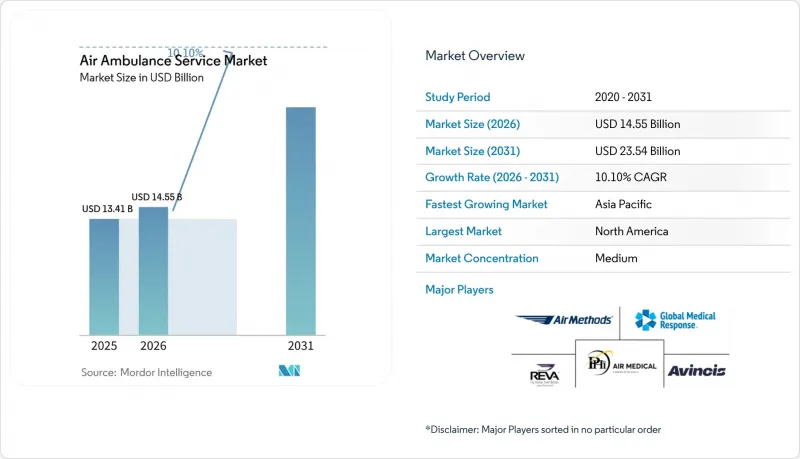
Mordor Intelligence에 의하면, 항공 구급 서비스 시장 규모는 2025년 134억 1,000만 달러에서 2026년에는 145억 5,000만 달러로 확대되고, 2026-2031년 CAGR 10.1%로 성장을 지속하여 2031년에는 235억 4,000만 달러에 이를 것으로 예측됩니다.
본 보고서는 서비스 사업자(병원 계열, 독립 계열, 정부 계열), 항공기 유형(고정익기 및 회전익기), 서비스 유형(국내 및 국제), 지역(북미, 유럽, 아시아태평양, 남미, 중동 및 아프리카)별로 분류되어 있습니다. 시장 전망은 금액(달러) 기준으로 제시되어 있습니다.
전 세계 항공 구급 서비스 시장 동향 및 인사이트
심혈관 질환 및 외상으로 인한 응급 이송 증가
헬리콥터를 이용한 응급 의료 서비스 출동 건수의 대부분은 심장 질환 및 외상 사례가 차지하고 있으며, 2023년에는 주로 이러한 질환을 앓는 환자 385,366명이 이송되었습니다. 지방 지역의 심정지 생존율은 도시 지역의 평균보다 30% 낮아, 이송 시간 단축이 매우 중요합니다. 항공 이송을 통해 지상 이송에 소요되는 60분을 15분으로 단축할 수 있어 치료 성과를 대폭 개선할 수 있습니다. 잉글랜드에서는 헬리콥터를 이용한 심정지 대응 시간의 중앙값이 19분인 반면, 지상 이송 부대의 경우 28분이었으며, 그 결과 자발적 순환 회복률이 향상되었습니다. 동료 심사를 거친 연구에 따르면, 외상 환자를 지상 이송 대신 항공 이송할 경우 사망률이 12% 감소하는 것으로 나타났습니다. 선진 지역의 고령화 진행에 따라 2031년까지 수요가 지속될 것으로 예측됩니다.
민간 의료보험 적용 범위 확대
2022년 1월에 시행된 ‘노 서프라이즈 법(No Surprises Act)’에 따라 차액 청구가 줄어들고 환자의 본인 부담금이 경감됨과 동시에, 보험 적용 대상인 항공 응급 이송 건수가 증가했습니다. 2024년에는 CMS(미국 의료보험·의료서비스 센터)가 ‘항공 응급 데이터 수집 프로그램’을 도입하여, 보험사 및 사업자에게 비용 투명성이 향상되었습니다. 유나이티드 헬스케어, 시그나, 앤섬, 블루크로스 블루쉴드 등의 대형 보험사는 현재 혈역학적 불안정이나 기도 확보 곤란 등의 상태를 대상으로, 비행 승인을 위한 명확한 임상 기준을 정하고 있습니다. 메디케어에 의한 농촌 지역 대상 50% 추가 지급은 변방 지역의 사업자 수익성을 더욱 뒷받침하고 있습니다. CMS-DOT 자문위원회에서 향후 마련될 기준에 따라, 보상액의 예측 가능성이 향상될 것으로 기대됩니다.
높은 운용·유지비
헬리콥터의 연간 운영 비용은 290만 달러에서 650만 달러 사이이며, 연료비는 총 운영 비용의 최대 35%를 차지합니다. 터빈 정비 비용은 50만 달러를 초과하기도 하며, 보험료 상승과 다인승무원 체제 도입으로 인해 비용은 더욱 증가하고 있습니다. 이용 빈도가 낮은 지방 거점은 규모의 경제를 실현하는 데 어려움을 겪고 있으며, 소규모 사업자는 통합이나 시장 철수를 검토할 수밖에 없는 상황에 처해 있습니다.
부문 분석
병원 시스템은 항공 응급 의료 서비스 시장에서 가장 빠르게 성장하는 부문으로, 연평균 성장률(CAGR)은 11.89%로 예측됩니다. 이러한 성장은 중증 환자를 자사의 중환자실로 직접 이송하여 이후 수익을 확보할 수 있는 능력에 힘입은 것입니다. 클리블랜드 클리닉과 아처(Archer)사의 eVTOL 프로젝트는 이러한 접근 방식의 좋은 사례입니다. 독립 사업자는 2025년에도 시장 점유율 46.53%를 유지할 것으로 예측되지만, 연료비 및 인건비 급등, 지불자와의 협상 등의 과제에 직면해 있습니다. 세계 메디컬 리스폰스(Global Medical Response)는 54억 달러 규모의 차입금 재조정을 통해, 병원이 운영하는 항공기 편대가 없는 의료 서비스가 부족한 농촌 지역으로 사업을 확장할 수 있게 되었습니다. 호주의 로열 플라잉 닥터 서비스(Royal Flying Doctor Service)와 같은 정부 운영 서비스는 납세자의 자금으로 서비스 격차를 해소하고 있으며, 상환액 변동의 영향을 덜 받는 체제를 갖추고 있습니다.
병원이 소유하는 체제에서는 부서 간 일정 관리, 데이터 공유, 보험사와의 종합적 지급 계약 협상이 원활하게 이루어지며, 그 결과 환자 1인당 이송 비용을 절감할 수 있습니다. 미국에 387개 거점을 둔 GMR과 같은 독립 사업자는 광범위한 지리적 서비스 범위를 제공하지만, 규제나 유가 변동의 영향을 받기 쉬운 경향이 있습니다. 에어 메소드(Air Method)사가 2023년에 실시한 사업 재편을 통해 10억 달러의 부채를 감축했으나, 이는 독립형 사업자가 직면한 재무적 과제를 여실히 드러내고 있습니다. 앞으로 병원이 기존 사업자에 소수 주주로 출자하는 하이브리드형 합작 사업이 재무적 안정성과 운영상의 전문 지식을 융합하여 항공 응급 의료 서비스 시장 경쟁 구도를 새롭게 바꿀 가능성이 있습니다.
지역별 분석
북미는 메디케어의 농촌 지역 대상 50% 추가 급여 및 지불자와의 정산을 간소화하는 ‘노 서프라이즈 법(No Surprise Law)’에 힘입어, 2025년에는 전 세계 매출의 38.9%를 차지할 것으로 예측됩니다. GMR은 50개 주 전역에 걸쳐 387개 거점으로 구성된 광범위한 네트워크에 더해, 53대의 신규 항공기 도입을 계획하고 있어 국내에서의 입지를 강화하고 있습니다. 캐나다에서는 Ornge와 같은 주 정부 프로그램을 통해 외딴 북부 지역에서의 서비스 제공이 보장되고 있습니다. 반면, 멕시코에서는 여전히 서비스가 미흡하여 규제상의 과제를 극복하려는 의지를 가진 신규 진출기업들에게 비즈니스 기회가 되고 있습니다.
아시아태평양은 중국과 인도의 헬리콥터 응급의료(EMS) 규제 완화를 원동력으로 삼아, 2031년까지 11.95%라는 가장 높은 연평균 성장률(CAGR)을 달성할 것으로 예측됩니다. 일본의 ‘닥터 헬리’ 제도는 민관 협력의 모범 사례가 되고 있습니다. 중동 및 아프리카에서는 사우디아라비아의 메카 플릿이 수요의 갑작스러운 급증에 대처하기 위한 정부의 표적 투자 사례로 꼽힙니다. 또한 두바이가 유라시아 의료 관광의 허브로 전략적으로 자리매김하고 있는 점은 해당 지역의 성장 가능성을 더욱 높이고 있습니다.
유럽에서는 52대의 헬리콥터를 보유한 독일의 DRF 네트워크와 같은 공공 자금 지원 HEMS 프로그램이 영국, 프랑스, 튀르키예, 남아프리카공화국의 자선 단체 운영과 공존하고 있으며, 이 모든 요소가 해당 지역 시장 형성에 기여하고 있습니다. 아프리카에서는 정정 불안과 낮은 보험 보급률이 시장 전체의 확장을 제한하고 있습니다. 그러나 광업, 석유, 사파리 관광 등의 분야에서는 집중 치료 이송 서비스가 필요한 틈새 기회가 존재합니다.
기타 혜택:
- 엑셀 형식 시장 예측(ME) 시트
- 3개월간의 애널리스트 지원
자주 묻는 질문
목차
제1장 서론
제2장 조사 방법
제3장 주요 요약
제4장 시장 구도
제5장 시장 규모와 성장 예측
제6장 경쟁 구도
제7장 시장 기회와 향후 전망
KTH 26.08.06According to Mordor Intelligence, the air ambulance service market size is expected to grow from USD 13.41 billion in 2025 to USD 14.55 billion in 2026 and is forecasted to reach USD 23.54 billion by 2031 at a 10.1% CAGR over 2026-2031.
This report is Segmented by Service Operator (Hospital-Based, Independent, and Government), Aircraft Type (Fixed-Wing and Rotary-Wing), Service Type (Domestic and International), and Geography (North America, Europe, Asia-Pacific, South America, and the Middle East and Africa). The Market Forecasts are Provided in Terms of Value (USD).
Global Air Ambulance Service Market Trends and Insights
Growing Prevalence of Cardiovascular and Trauma Emergencies
Cardiac and trauma cases account for the majority of helicopter emergency medical service missions, with 385,366 patients transported in 2023, primarily for these conditions. Survival rates for rural cardiac arrest are 30% lower than urban averages, making reduced transport times critical. Air transport can cut travel time from 60 minutes by ground to 15 minutes by air, significantly improving outcomes. In England, helicopters achieved a median cardiac arrest response time of 19 minutes, compared to 28 minutes for ground units, resulting in an increase in return-of-spontaneous-circulation rates. Peer-reviewed studies indicate a 12% reduction in mortality when trauma patients are transported by air instead of ground. Aging populations in developed regions are expected to sustain demand through 2031.
Expansion of Private Medical Insurance Coverage
The No Surprises Act, effective January 2022, reduced balance billing, lowering out-of-pocket costs for patients and enabling more covered air ambulance flights. In 2024, CMS introduced the Air Ambulance Data Collection program, enhancing cost transparency for payers and operators. Major insurers, including UnitedHealthcare, Cigna, Anthem, and Blue Cross Blue Shield, now provide clear clinical criteria for flight authorization, covering conditions such as hemodynamic instability and airway compromise. A 50% Medicare rural add-on payment further supports operator economics in frontier areas. Upcoming standards from the CMS-DOT advisory committee are expected to improve reimbursement predictability.
High Operating and Maintenance Costs
Annual helicopter operating costs range from USD 2.9 million to USD 6.5 million, with fuel expenses accounting for up to 35% of the total operating costs. Turbine overhauls can exceed USD 500,000, while rising insurance premiums and multi-crew staffing further increase costs. Low-volume rural bases struggle to achieve economies of scale, prompting smaller providers to consider consolidation or exit from the market.
Other drivers and restraints analyzed in the detailed report include:
- Government Subsidies for Rural Critical-care Access
- eVTOL Integration Accelerating Rapid Response Times
- Shortage of Trained Aero-medical Professionals
For complete list of drivers and restraints, kindly check the Table Of Contents.
Segment Analysis
Hospital systems represent the fastest-growing segment in the air ambulance service market, with an expected CAGR of 11.89%. This growth is driven by their ability to transport high-acuity cases directly to owned intensive-care units, ensuring downstream revenue. The Cleveland Clinic-Archer eVTOL project exemplifies this approach. Independent operators, while maintaining a projected 46.53% market share in 2025, face challenges such as rising fuel costs, labor expenses, and negotiations with payers. Global Medical Response's USD 5.4 billion refinancing positions it to expand into underserved rural areas where hospital-operated fleets are absent. Government-run services, such as Australia's Royal Flying Doctor Service, address service gaps with taxpayer funding, shielding them from fluctuations in reimbursement.
Hospital ownership facilitates cross-functional scheduling, data sharing, and the negotiation of bundled payment contracts with insurers, thereby reducing per-patient transport costs. Independent operators, such as GMR with its 387 US bases, offer extensive geographic coverage but are more vulnerable to regulatory and fuel price changes. Air Methods' 2023 restructuring, which reduced USD 1 billion in debt, highlights the financial challenges faced by standalone operators. Looking ahead, hybrid joint ventures where hospitals take minority stakes in established operators could combine financial stability with operational expertise, reshaping competition in the air ambulance service market.
Complete Report Scope:
- By Service Operator
- Hospital-based
- Independent
- Government
- By Aircraft Type
- Fixed-Wing
- Rotary-Wing
- By Service Type
- Domestic
- International
- By Geography
- North America
- United States
- Canada
- Mexico
- Europe
- United Kingdom
- France
- Germany
- Russia
- Rest of Europe
- Asia-Pacific
- China
- India
- Japan
- South Korea
- Australia
- Rest of Asia-Pacific
- South America
- Brazil
- Rest of South America
- Middle East and Africa
- Middle East
- Saudi Arabia
- United Arab Emirates
- Turkey
- Africa
- South Africa
- Egypt
- Middle East
- North America
Geography Analysis
North America is expected to generate 38.9% of global sales in 2025, supported by Medicare's 50% rural add-on and the No Surprises Act, which simplifies payer settlements. GMR's extensive network of 387 bases across all 50 states, combined with its commitment to acquiring 53 new aircraft, strengthens its domestic presence. In Canada, provincial programs like Ornge ensure coverage in remote northern regions. Mexico, however, remains underserved, presenting opportunities for new entrants willing to navigate regulatory challenges.
The Asia-Pacific region is projected to achieve the fastest CAGR of 11.95% through 2031, driven by the liberalization of helicopter EMS in China and India. Japan's Doctor Helicopter system serves as a model for public-private collaboration. In the Middle East and Africa, Saudi Arabia's Mecca fleet demonstrates targeted government investment to address episodic surges in demand. Dubai's strategic positioning as a hub for Eurasian medical tourism further enhances the region's growth potential.
In Europe, state-funded HEMS programs, such as Germany's DRF network with 52 helicopters, coexist with charity-funded operations in the UK, France, Turkey, and South Africa, all of which contribute to the regional landscape. In Africa, political instability and low insurance penetration limit the expansion of the broader market. However, niche opportunities exist in sectors such as mining, oil, and safari tourism, which require critical-care transport services.
- Air Methods Corporation
- Global Medical Response, Inc.
- Acadian Ambulance Service, Inc.
- PHI Health, LLC
- REVA Inc.
- Avincis Aviation Group, S.A.U.
- Accretion Aviation
- Air Charter Service Group
- Gulf Helicopters
- Vendana GmbH
- DRF Stiftung Luftrettung gemeinnutzige AG
- Life Flight Network
- Ornge
- Royal Flying Doctor Service
- Helijet
- US Air Ambulance
- FAI Aviation Group
- Yorkshire Air Ambulance (YAA)
- Medivic Aviation (Medivic Pharmaceutical Pvt. Ltd.)
Additional Benefits:
- The market estimate (ME) sheet in Excel format
- 3 months of analyst support
TABLE OF CONTENTS
1 INTRODUCTION
- 1.1 Study Assumptions and Market Definition
- 1.2 Scope of the Study
2 RESEARCH METHODOLOGY
3 EXECUTIVE SUMMARY
4 MARKET LANDSCAPE
- 4.1 Market Overview
- 4.2 Market Drivers
- 4.2.1 Growing prevalence of cardiovascular and trauma emergencies
- 4.2.2 Expansion of private medical insurance coverage
- 4.2.3 Government subsidies for rural critical-care access
- 4.2.4 eVTOL integration accelerating rapid response times
- 4.2.5 Cross-border tele-ICU network partnerships
- 4.2.6 AI-driven flight-route optimization reducing response time
- 4.3 Market Restraints
- 4.3.1 High operating and maintenance costs
- 4.3.2 Shortage of trained aero-medical professionals
- 4.3.3 Stringent aviation regulatory approvals
- 4.3.4 Spectrum congestion hampering in-flight telemedicine
- 4.4 Value Chain Analysis
- 4.5 Regulatory Landscape
- 4.6 Technological Outlook
- 4.7 Porter's Five Forces Analysis
- 4.7.1 Bargaining Power of Suppliers
- 4.7.2 Bargaining Power of Buyers/Consumers
- 4.7.3 Threat of New Entrants
- 4.7.4 Threat of Substitute Products
- 4.7.5 Intensity of Competitive Rivalry
5 MARKET SIZE AND GROWTH FORECASTS (VALUE)
- 5.1 By Service Operator
- 5.1.1 Hospital-based
- 5.1.2 Independent
- 5.1.3 Government
- 5.2 By Aircraft Type
- 5.2.1 Fixed-Wing
- 5.2.2 Rotary-Wing
- 5.3 By Service Type
- 5.3.1 Domestic
- 5.3.2 International
- 5.4 By Geography
- 5.4.1 North America
- 5.4.1.1 United States
- 5.4.1.2 Canada
- 5.4.1.3 Mexico
- 5.4.2 Europe
- 5.4.2.1 United Kingdom
- 5.4.2.2 France
- 5.4.2.3 Germany
- 5.4.2.4 Russia
- 5.4.2.5 Rest of Europe
- 5.4.3 Asia-Pacific
- 5.4.3.1 China
- 5.4.3.2 India
- 5.4.3.3 Japan
- 5.4.3.4 South Korea
- 5.4.3.5 Australia
- 5.4.3.6 Rest of Asia-Pacific
- 5.4.4 South America
- 5.4.4.1 Brazil
- 5.4.4.2 Rest of South America
- 5.4.5 Middle East and Africa
- 5.4.5.1 Middle East
- 5.4.5.1.1 Saudi Arabia
- 5.4.5.1.2 United Arab Emirates
- 5.4.5.1.3 Turkey
- 5.4.5.2 Africa
- 5.4.5.2.1 South Africa
- 5.4.5.2.2 Egypt
- 5.4.5.1 Middle East
- 5.4.1 North America
6 COMPETITIVE LANDSCAPE
- 6.1 Market Concentration
- 6.2 Strategic Moves
- 6.3 Market Share Analysis
- 6.4 Company Profiles (includes Global level Overview, Market level overview, Core Segments, Financials as available, Strategic Information, Market Rank/Share for key companies, Products and Services, and Recent Developments)
- 6.4.1 Air Methods Corporation
- 6.4.2 Global Medical Response, Inc.
- 6.4.3 Acadian Ambulance Service, Inc.
- 6.4.4 PHI Health, LLC
- 6.4.5 REVA Inc.
- 6.4.6 Avincis Aviation Group, S.A.U.
- 6.4.7 Accretion Aviation
- 6.4.8 Air Charter Service Group
- 6.4.9 Gulf Helicopters
- 6.4.10 Vendana GmbH
- 6.4.11 DRF Stiftung Luftrettung gemeinnutzige AG
- 6.4.12 Life Flight Network
- 6.4.13 Ornge
- 6.4.14 Royal Flying Doctor Service
- 6.4.15 Helijet
- 6.4.16 US Air Ambulance
- 6.4.17 FAI Aviation Group
- 6.4.18 Yorkshire Air Ambulance (YAA)
- 6.4.19 Medivic Aviation (Medivic Pharmaceutical Pvt. Ltd.)
7 MARKET OPPORTUNITIES AND FUTURE OUTLOOK
- 7.1 White-space and Unmet-Need Assessment


