

|
시장보고서
상품코드
2097250
사이클링 헬멧 : 시장 점유율 분석, 업계 동향 및 통계, 성장 예측(2026-2031년)Cycling Helmet - Market Share Analysis, Industry Trends & Statistics, Growth Forecasts (2026 - 2031) |
||||||
 Mordor Intelligence
Mordor Intelligence에 의하면, 사이클링 헬멧 시장 규모는 2025년 21억 8,000만 달러로 평가되었습니다. 2026년 23억 1,000만 달러에서 2031년까지 31억 6,000만 달러로 확대되어 2026년부터 2031년에 걸쳐 CAGR 6.46%를 나타낼 것으로 예측됩니다.
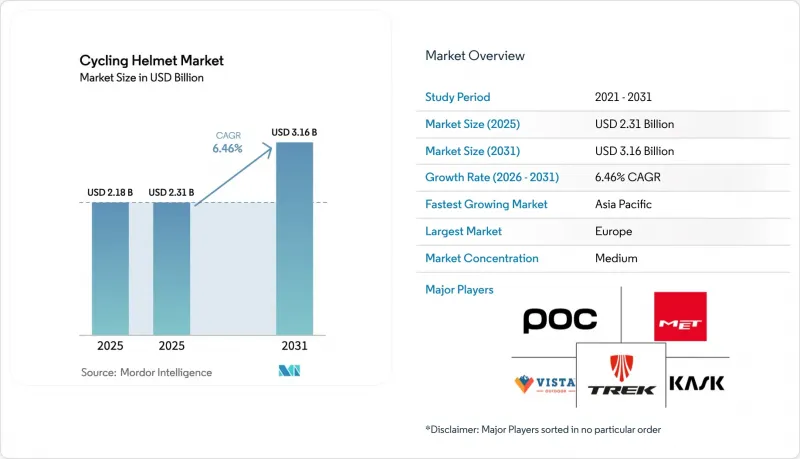
본 보고서는 제품 유형(로드/레크리에이션용 헬멧, 산악자전거(MTB)용 헬멧, 스포츠/어드벤처용 헬멧), 최종 사용자(어린이 및 성인), 카테고리(기존 헬멧 및 스마트 헬멧), 판매 채널(오프라인 매장 및 온라인 스토어), 그리고 지역별로 분류되어 있습니다. 시장 전망은 금액(달러) 기준으로 제시되어 있습니다.
세계의 사이클링 헬멧 시장 동향 및 인사이트
두부 외상 위험에 대한 안전 의식 고조
자전거 이용으로 인한 두부 외상과 장기적인 인지 기능 장애 간의 연관성을 보여주는 역학 데이터가 소비자의 인식을 형성하고 있습니다. 연구에 따르면, 헬멧은 충격의 성격에 따라 다르지만 두부 외상 위험을 크게 줄이는 것으로 나타났습니다. 또한, 릴리스 레이어 시스템이 탑재된 헬멧을 착용하는 스웨덴의 전기 자전거(e-bike) 이용자는 헬멧을 착용하지 않은 이용자에 비해 두부 외상 위험이 현저히 낮은 것으로 나타났습니다. 세계보건기구(WHO)에 따르면 매년 수백만 건의 도로 교통사고 사망이 발생하고 있으며, 그 대부분을 보행자와 자전거 이용자가 차지하고 있습니다. 공중보건 기관들은 이 데이터를 활용하여 헬멧 착용을 단순한 개인의 선택이 아닌 공중보건상의 개입 조치로 추진하고 있습니다. 버지니아 공과대학의 헬멧 안전 평가는 수백 가지 모델을 평가하여 점수를 부여하는 것으로, 업계 표준으로 널리 인정받고 있습니다. 이 평가는 실험실 결과를 소비자에게 실용적인 기준으로 전환한 성능 벤치마크를 제공함으로써, 소매점 진열 및 소비자의 구매 결정에 영향을 미치고 있습니다. 미국 소아과학회(AAP) 보고서에 따르면, 미국에서는 수백만 명의 어린이가 자전거를 타고 있으며, 최근 몇 년간 비치명적 부상이 상당수 기록되고 있습니다. 그러나 착용 의무화 법이 없어 헬멧 착용률은 여전히 미흡하며, 규제 조치 없이는 인식 제고만으로는 불충분하다는 점이 부각되고 있습니다. 스웨덴과 네덜란드에서는 보험사가 인증된 헬멧 착용자에 대한 보험료 할인을 시범적으로 도입하고 있습니다. 이러한 금전적 인센티브는 안전 의식과 경제적 행동의 변화를 연결함으로써 안전 의식 향상을 촉진합니다. 또한, 향후 보험 인수 모델을 이끌어갈 지침이 될 수 있는 보험 통계 데이터도 생성됩니다.
헬멧 착용을 의무화하는 정부 규제
주요 성장 시장에서는 규제에 따른 의무화로 인해 헬멧 착용이 ‘선택’에서 ‘의무’로 전환되고 있습니다. 예를 들어, 인도에서는 2026년 1월부터 시행된 규정에 따라 신차 이륜차 1대당 인도 표준국(BIS) 인증 헬멧 2개의 판매가 의무화됩니다. 이 정책으로 인해 인증 헬멧에 대한 수요가 대폭 확대되고, 제조 분야에서 많은 고용 기회가 창출될 것으로 예측됩니다. 또한, 이 규제는 보호 성능이 불충분한 비적합 헬멧이 저비용으로 생산되어 판매점을 통해 터무니없는 가격에 판매되는 위조 헬멧 시장에 대한 대책도 목적으로 하고 있습니다. 미국에서는 헬멧 착용에 관한 법률이 주마다 다르며, 일부 주에서는 주로 특정 연령 미만의 라이더를 대상으로 한 규제를 시행하고 있습니다. 2024년에 시행된 캘리포니아주 주의회 법안 제1774호는 17세 미만의 전기 자전거(e-bike) 이용자에게 헬멧 착용을 의무화하고 있지만, 이는 규제 접근 방식이 파편화되어 있어 집행상의 허점을 초래하고 있음을 반영합니다. 마찬가지로 호주도 2024년에 ‘소비자 제품 안전 기준’을 개정하여 적합 기준을 상향 조정했습니다. 네덜란드에서는 기존의 EN 1078 인증에 비해 더 엄격한 낙하 시험 요건을 부과하는 전기 자전거용 헬멧을 위한 NTA-8776 규격의 채택을 촉진하기 위한 노력이 진행되고 있습니다. 이러한 다양한 규제 체계는 다국적 브랜드에게는 규정 준수상의 과제가 되는 한편, 전 세계 경쟁사보다 효과적으로 현지 인증 절차를 진행할 수 있는 지역 전문 업체에게는 비즈니스 기회도 창출하고 있습니다. 인도에서는 도로운송·고속도로부(MoRTH)가 지난 회계연도 동안 헬멧 샘플 시험과 수색·압수 작전을 여러 차례 실시했습니다. 델리에서 진행된 이러한 작전 중 하나에서는 기준을 충족하지 않는 헬멧이 대량으로 압수되어, 규제 집행 노력이 강화되고 있음을 여실히 보여주었습니다.
고성능 헬멧의 높은 비용
다방향 충격 보호 시스템(MIPS), WaveCel, 릴리스 레이어 시스템 등의 회전 충격 흡수 기술은 부품 원가 상승으로 이어져, 결과적으로 소매 가격의 급등을 초래하고 있습니다. ABUS의 ‘GAMECHANGER 2.0 MIPS’나 MET의 ‘Trenta 3K Carbon’과 같은 플래그십 모델은 이러한 추세를 여실히 보여주고 있습니다. 이러한 가격 구조로 인해 시장은 양극화되고 있습니다. 유럽과 미국의 부유층은 첨단 안전 기능을 갖춘 헬멧을 선호하는 경향이 있는 반면, 아시아태평양이나 남미의 가격에 민감한 소비자들은 최소한의 인증 기준은 충족하지만 회전 충격 보호 기능이 없는 기본적인 발포 폴리스티렌 쉘을 선택하는 경우가 많습니다. 인도에서는 인도 표준국(BIS) 인증을 의무화하는 ‘헬멧 2개 착용 의무’ 정책으로 인해 엔트리 레벨 헬멧 가격이 소폭 상승할 것으로 예측됩니다. 이는 제조업체들이 잠김 방지 브레이크 시스템(ABS) 대응 및 프론트 디스크 업그레이드를 위해 생산 설비를 갱신해야 하기 때문입니다. 버지니아 공과대학으로부터 최고 수준의 안전 평가를 받은 캐니언의 ‘Deflectr’는 독자적인 지적 재산권을 통해 중가대에서도 프리미엄 성능을 실현할 수 있음을 보여주고 있습니다. 그러나 이 카테고리에서 이러한 제품은 여전히 예외적이며, 일반적이라고 할 수는 없습니다. 인도의 이해관계자들로부터 헬멧에 대한 상품 및 서비스세(GST) 인하가 제안되고 있으며, 이는 인증 헬멧의 보급을 가속화할 가능성이 있습니다. 하지만 신흥 시장의 재정적 제약으로 인해 이러한 조치를 시행할 정치적 실현 가능성은 제한적입니다. 또한 스마트 헬멧의 경우, 소비자들이 연결성의 이점과 배터리 수명 및 높은 교체 비용에 대한 우려를 저울질하는 경우가 많아 보급에 어려움이 있습니다.
부문 분석
도로용 및 레크리에이션용 헬멧은 2031년까지 연평균 7.91%의 성장률이 예상되며, 산악자전거용 헬멧의 성장률을 상회할 것으로 전망됩니다. 이는 산악자전거용 헬멧이 2025년 매출의 39.21%를 차지했음에도 불구하고 나타나는 현상입니다. 이러한 추세는 도시 통근자들이 트레일 주행에 특화된 충격 보호 기능보다 공기역학적 성능, 경량화, 통합된 연결성 등의 기능을 우선시하고 있기 때문입니다. 2025년 투르 드 프랑스 기간 중에 출시된 POC의 ‘Cytal Lite’는 프리미엄 로드 부문이 성능의 점진적인 향상에 주력하고 있음을 보여주는 좋은 예입니다. 마찬가지로, 자이언트의 2026년형 모델인 'Pursuit Multi-directional Impact Protection System(MIPS)' 및 'Rev Pro Multi-directional Impact Protection System' 헬멧은 고속 주행 시 공기 저항 감소를 중시하며, 버지니아 공과대학으로부터 5성급 안전 평가를 획득했습니다. 산악 자전거용 헬멧은 전체 카테고리에 비해 성장 속도는 완만하지만, 모듈식 혁신 기술이 도입되고 있습니다. 예를 들어, Leatt사의 'Enduro 3.0' 헬멧은 탈부착 가능한 턱 보호대를 갖춘 풀페이스 헬멧, 하프쉘, 또는 이어 커버가 부착된 오픈페이스 헬멧으로 기능하는 '3-in-1' 디자인을 채택하고 있습니다. 이 디자인은 다운힐 시의 보호 성능과 트레일 주행 시의 통기성 사이의 균형을 추구하는 수요에 부응하는 것입니다. 로드 바이크와 마운틴 바이크 디자인의 중간에 위치하는 어드벤처 헬멧은 바이저와의 호환성, 후두부 커버 범위 확대, 액션 카메라 및 조명 시스템용 장착 포인트와 같은 기능을 갖추고 있어 그래블 라이더나 바이크패킹 애호가들의 요구를 충족시킵니다.
캐니언이 2025년 12월에 출시한 'Deflectr' 헬멧에는 특허를 취득한 'Release Layer System'이 적용되었습니다. 이 시스템은 폴리카보네이트 베어링을 활용하여, 해당 시스템을 탑재하지 않은 헬멧에 비해 회전 속도를 대폭 저감합니다. 이 혁신적인 기술은 자전거 OEM 제조업체들이 수직 통합을 활용해 독자적인 안전 기술을 개발하고, ‘Multi-directional Impact Protection System’과 같은 라이선스 솔루션과 경쟁하고 있음을 여실히 보여줍니다.
2025년 매출액 중 성인용이 78.71%를 차지한 반면, 아동용 부문은 2031년까지 연평균 7.81%의 성장이 예상됩니다. 학교를 거점으로 한 배포 프로그램, 회전 충격 흡수 기술에 대한 학부모들의 투자 의지 고조, 그리고 청소년의 스포츠 참여율 상승이 2024년 6월 샬럿츠빌에서 실시된 헬멧 배포와 같은 노력을 뒷받침하고 있습니다. 노스캐롤라이나주에서는 교통부가 ‘Share the Road’ 번호판 판매 수익을 재원으로 삼아 사이클링 헬멧 보급 이니셔티브에 자금을 지원하고 있습니다. 마찬가지로, 미시간 대학교의 ‘팝업 세이프티 타운(Pop-up Safety Town)’에서는 무료 헬멧 배포와 현장 착용 지도 프로그램을 결합하고 있으며, 이는 지역 사회 건강 프로그램이 행동 변화라는 과제를 해결하기 위해 제품 교육과 배포를 어떻게 융합하고 있는지를 잘 보여줍니다. 세이프 트랜스포테이션 리서치 앤 에듀케이션 센터(SafeTREC)의 조사에 따르면, 헬멧 착용감과 유지 관리에 대한 적절한 교육이 없다면 무료 배포만으로는 불충분하다고 강조하고 있습니다. 이에 따라 각 브랜드는 사이즈 선택 도구, 가상 착용 옵션, 구매 후 지원 등의 기능을 소비자 직접 판매 전략에 통합하고 있습니다.
성인용 헬멧은 기본적인 발포 스티로폼 모델부터 전자 기기를 내장한 고급 카본 복합재 디자인에 이르기까지 폭넓은 가격대로 구입할 수 있습니다. 이러한 세분화는 다양한 이용 사례, 예산, 안전 기능을 반영하고 있습니다. 미국 소아과학회(American Academy of Pediatrics)에 따르면, 미국에서는 수백만 명의 어린이가 자전거를 타고 있으며, 2020년에는 비치명적 부상이 다수 보고되었습니다. 그러나 착용 의무화 법이 없기 때문에 헬멧 착용률은 여전히 낮은 수준입니다. 신흥 시장에서는 어린이들의 자전거 소유율이 놀라운 속도로 증가하고 있으며, 현지 인증 요건을 준수하면서도 인도 표준국(BIS) 등의 기준을 충족하고 합리적인 가격의 균형을 맞춘 제품을 제공할 수 있는 브랜드에게 비즈니스 기회가 열리고 있습니다.
지역별 분석
유럽은 세계 자전거 시장을 주도할 전망이며, 2025년 예상 매출의 37.21%를 차지했습니다. 이러한 주도적 입지는 네덜란드의 헬멧 착용 의무화, 독일과 프랑스의 선진적인 자전거 인프라, 그리고 2027년까지 수천 킬로미터에 달하는 새로운 자전거 도로 조성을 위한 유럽연합(EU)의 자금 지원 약속 등의 요인에 의해 뒷받침되고 있습니다. 그러나 이 지역에는 과제도 존재합니다. 그중 하나로, 팬데믹 기간 중 공급 과잉에 따른 재고 조정으로 인해 2024년 독일 자전거 시장이 위축될 것으로 예측됩니다. 2024년 독일에서는 수백만 대 규모의 자전거 판매가 기록되었으며, 그중 전기 자전거가 큰 비중을 차지했습니다. 마찬가지로 네덜란드에서도 수십만 대의 자전거가 판매되었으며, 전기 자전거가 시장 점유율의 거의 절반을 차지했습니다. 한편, 프랑스에서는 수십만 대의 전기 자전거를 포함한 수백만 대의 판매로 상당한 수익이 창출되었습니다. 2025년 11월 네덜란드의 자금 지원 약속이나 코펜하겐의 유사한 이니셔티브에 대한 예산 배정 등, 자전거 인프라에 대한 투자가 계속해서 시장 성장을 견인했습니다. 이러한 투자는 동료들의 영향이나 가시화 캠페인을 통해 헬멧 착용을 촉진하는 데에도 기여하고 있습니다. 또한, EN 1078 규격에 비해 더 엄격한 낙하 시험 기준을 요구하는 전동 자전거용 헬멧 규격 ‘NTA-8776’의 채택이 네덜란드 밖으로도 확산되고 있습니다. 이는 전동 자전거의 속도 향상에 따라 보호 성능 강화에 대한 수요가 높아지고 있음을 반영하며, 더 엄격한 규격에 적극적으로 대응하는 브랜드에게는 규정 준수 측면에서 우위를 점하게 해줍니다.
아시아태평양은 2031년까지 연평균 7.71%의 성장률을 기록하며 가장 빠르게 성장하는 부문이 될 것으로 예측됩니다. 이러한 성장은 2026년 1월 인도에서 시행될 예정인 ‘헬멧 2개 착용 의무’, 중국 내 전동 자전거 보급 확대, 그리고 안전 인증을 받은 장비에 대한 중산층의 소비 증가에 의해 주도되고 있습니다. 인도의 정책에 따르면, 새로운 이륜차를 구매할 때마다 인도 표준국(BIS) 인증 헬멧 2개를 착용해야 하며, 이로 인해 인증 헬멧의 연간 수요가 크게 증가하고 제조 분야의 고용이 대폭 창출될 뿐만 아니라, 소비자의 신뢰를 훼손해 온 위조품의 감축으로 이어질 것으로 예측됩니다. 도로운송·고속도로부는 지난 회계연도에 헬멧에 대한 광범위한 샘플 테스트와 여러 차례의 수색 및 압수 작전을 실시했습니다. 여기에는 델리에서 진행된, 규격 미달 헬멧을 대량으로 압수한 작전도 포함되어 있어 규제 집행이 더욱 엄격해질 것임을 시사합니다. 2025년 6월, 다수의 제조업체가 보호용 헬멧에 관한 인도 표준국(BIS)의 유효한 라이선스를 보유하고 있으며, 헬멧 착용 의무화가 수요를 견인함에 따라 그 수는 더욱 증가할 것으로 예측됩니다. 또한, 개발도상국 시장에서 어린이들의 자전거 보유율은 꾸준히 증가하고 있어, 인도 규격 4151 : 2015의 인증 요건을 준수하는 제품을 제공하는 브랜드에게는 새로운 비즈니스 기회가 열리고 있습니다. 이러한 규격은 충격 흡수성, 관통 저항성, 고정 시스템의 무결성, 난연성, 중량 제한, 주변 시야 및 바이저의 투명도를 규정하고 있습니다.
북미, 남미, 중동 및 아프리카가 나머지 전 세계 매출을 합쳐 차지하고 있습니다. 북미에서는 주 차원의 헬멧 착용 의무화 및 뉴욕시 교통국과 캘리포니아주의 ‘액티브 트랜스포테이션 프로그램(8주기)’을 통한 자금 지원 등, 도시 지역의 자전거 인프라에 대한 투자가 호재로 작용하고 있습니다. 미국에서는 주로 특정 연령 미만의 라이더를 대상으로 한 여러 주의 헬멧 법으로 인해 규제 체계가 분절되어 있어, 전국적인 통일된 도입이 제한되고 있습니다. 그러나 특정 연령 미만의 전기 자전거 이용자에게 헬멧 착용을 의무화하는 캘리포니아주 2024년 의회 법안 제1774호는 주 차원의 정책이 수요의 점진적 증가를 얼마나 촉진할 수 있는지를 보여주었습니다. 남미 및 중동 및 아프리카에서는 가격 문제, 법 집행의 미흡, 안전보다 편의성을 우선시하는 문화적 규범으로 인해 헬멧 보급률은 여전히 낮은 수준에 머물러 있습니다. 이러한 과제에도 불구하고, 도시화의 진전과 이륜차 보유 대수 증가로 인해 잠재적 수요가 발생하고 있습니다. 각 브랜드는 합리적인 가격의 제품 설계, 현지 생산, 그리고 지자체 안전 프로그램과의 제휴를 통해 이러한 수요에 대응할 수 있습니다. 세계보건기구(WHO)에 따르면, 매년 약 120만 명이 교통사고로 사망하고 있으며, 그중 보행자와 자전거 이용자가 4분의 1 이상을 차지합니다. 이는 도로 안전 인프라가 자동차 증가 속도를 따라가지 못하는 신흥 시장에서 보호 장비가 공중 보건적 관점에서 필요함을 여실히 보여줍니다.
기타 혜택 :
- 엑셀 형식 시장 예측(ME) 시트
- 3개월간의 애널리스트 지원
자주 묻는 질문
목차
제1장 서론
제2장 조사 방법
제3장 주요 요약
제4장 시장 구도
제5장 시장 규모 및 성장 예측
제6장 경쟁 구도
제7장 시장 기회 및 향후 전망
KTH 26.08.05According to Mordor Intelligence, the cycling helmet market size is projected to expand from USD 2.18 billion in 2025 and USD 2.31 billion in 2026 to USD 3.16 billion by 2031, registering a CAGR of 6.46% between 2026 to 2031.
This report is Segmented by Product Type (Road/Recreational Helmets, Mountain Bike (MTB) Helmets, and Sports/Adventure Helmets), End User (Kids and Adults), Category (Conventional Helmets and Smart Helmets), Distribution Channel (Offline Retail Stores and Online Retail Stores), and Geography. The Market Forecasts are Provided in Terms of Value (USD).
Global Cycling Helmet Market Trends and Insights
Rising safety awareness about head injury risks
Epidemiological data linking cycling head injuries to long-term cognitive impairment is shaping consumer perceptions. Research shows that helmets significantly reduce the risk of head injuries, depending on the nature of the impact. Furthermore, Swedish electric bike (e-bike) riders using helmets with Release Layer Systems face a notably lower risk of head injuries compared to those who do not wear helmets. According to the World Health Organization (WHO), millions of road deaths occur annually, with pedestrians and cyclists comprising a significant proportion . Public health agencies are using this data to promote helmet adoption as a public health intervention rather than merely an individual choice. Virginia Tech's helmet-safety ratings, which assess hundreds of models and assign scores, have become a recognized industry standard. These ratings influence retail placement and consumer purchasing decisions by providing a performance benchmark that translates laboratory findings into practical criteria for buyers. The American Academy of Pediatrics (AAP) has reported that millions of children ride bicycles in the United States, with a substantial number of non-fatal injuries recorded in recent years. However, helmet usage remains inadequate in the absence of mandatory laws, highlighting that awareness alone is insufficient without regulatory measures. In Sweden and the Netherlands, insurance companies are testing premium discounts for certified-helmet users. This financial incentive promotes safety awareness by linking it to economic behavior changes. Additionally, it generates actuarial data that could guide future underwriting models.
Government regulations mandating helmet use
Regulatory mandates are increasingly shifting helmet adoption from voluntary to mandatory in key growth markets. For example, India has introduced a regulation effective January 2026, requiring the sale of two Bureau of Indian Standards (BIS)-certified helmets with every new two-wheeler . This policy is anticipated to drive significant demand for certified helmets and generate substantial manufacturing employment opportunities. Additionally, it aims to combat the counterfeit helmet market, where non-compliant helmets, offering inadequate protection, are produced at low costs and sold at inflated prices through dealerships. In the United States, helmet laws differ by state, with several states enforcing regulations primarily for riders under specific age thresholds. California's Assembly Bill 1774, effective in 2024, mandates helmet use for electric bike (e-bike) riders under the age of 17, reflecting a fragmented regulatory approach that creates enforcement gaps. Similarly, Australia updated its Consumer Goods Safety Standard in 2024 to enhance compliance thresholds . In the Netherlands, efforts are underway to promote the adoption of the NTA-8776 standard for electric bike helmets, which imposes stricter drop-test requirements compared to the conventional EN 1078 certification. These diverse regulatory frameworks pose compliance challenges for multinational brands but also create opportunities for regional specialists who can navigate local certification processes more effectively than global competitors. In India, the Ministry of Road Transport and Highways (MoRTH) conducted multiple helmet-sample tests and search and seizure operations during the previous financial year. One such operation in Delhi resulted in the seizure of a significant number of non-compliant helmets, highlighting increased regulatory enforcement efforts.
High cost of advanced helmets
Rotational-impact technologies, including the Multi-directional Impact Protection System (MIPS), WaveCel, and Release Layer System, contribute to higher bill-of-materials costs, leading to retail price premiums. Flagship models such as the ABUS GAMECHANGER 2.0 MIPS and MET's Trenta 3K Carbon exemplify this trend. This pricing structure has resulted in a two-tier market. Affluent consumers in Europe and North America tend to prefer helmets with advanced safety features, while price-sensitive buyers in Asia-Pacific and South America often choose basic expanded polystyrene shells that meet minimum certification standards but lack rotational protection. In India, the two-helmet mandate, which requires Bureau of Indian Standards (BIS) certification, is anticipated to slightly increase entry-level helmet prices. This is due to manufacturers needing to retool for anti-lock braking system (ABS) compatibility and front-disc upgrades. Canyon's Deflectr, which holds Virginia Tech's top safety rating, demonstrates how proprietary intellectual property can deliver premium performance at mid-market price points. However, such offerings remain exceptions rather than the norm in the category. Proposals by Indian industry stakeholders to reduce the goods and services tax (GST) on helmets could potentially accelerate the adoption of certified helmets. However, fiscal constraints in emerging markets limit the political feasibility of implementing such measures. Additionally, smart helmets face adoption challenges as consumers often weigh the benefits of connectivity against concerns over battery life and higher replacement costs.
Other drivers and restraints analyzed in the detailed report include:
- Public campaigns promoting cycling safety
- Growth in cycling for fitness and recreation
- Comfort and fit issues for users
For complete list of drivers and restraints, kindly check the Table Of Contents.
Segment Analysis
Road and recreational helmets are projected to grow at an annual rate of 7.91% through 2031, surpassing the growth of mountain bike helmets, despite the latter accounting for 39.21% of 2025 revenue. This trend is driven by urban commuters prioritizing features such as aerodynamics, weight reduction, and integrated connectivity over trail-specific impact protection. POC's Cytal Lite, launched during the 2025 Tour de France, exemplifies the premium road segment's focus on incremental performance improvements. Similarly, Giant's 2026 Pursuit Multi-directional Impact Protection System (MIPS) and Rev Pro Multi-directional Impact Protection System helmets emphasize drag reduction at high speeds and have earned Virginia Tech's 5-star safety rating. While mountain bike helmets are growing at a slower pace than the overall category, they are incorporating modular innovations. For example, Leatt's Enduro 3.0 helmet offers a three-in-one design, functioning as a full-face helmet with a removable chin bar, a half-shell, or an open-face helmet with ear covers. This design addresses the need for a balance between downhill protection and trail ventilation. Adventure helmets, positioned between road and mountain bike designs, cater to gravel riders and bikepacking enthusiasts with features such as visor compatibility, extended rear coverage, and mounting points for action cameras and lighting systems.
Canyon's December 2025 release of the Deflectr helmet introduces a patented Release Layer System, which utilizes polycarbonate bearings to significantly reduce rotational velocity compared to helmets without this system. This innovation highlights how bicycle original equipment manufacturers are leveraging vertical integration to develop proprietary safety technologies, competing with licensed solutions such as the Multi-directional Impact Protection System.
Adults accounted for 78.71% of the revenue in 2025, while the kids' segment is projected to grow at an annual rate of 7.81% through 2031. School-based distribution programs, increased parental willingness to invest in rotational-impact technologies, and rising youth sports participation have driven initiatives such as Charlottesville's helmet distribution in June 2024. In North Carolina, the Department of Transportation funds its Bicycle Helmet Initiative through revenue generated from "Share the Road" license plates. Similarly, the University of Michigan's Pop-up Safety Town integrates free helmet distribution with hands-on fitting education, highlighting how community health programs are combining product training with distribution to address behavioral adoption challenges. Research from the Safe Transportation Research and Education Center (SafeTREC) emphasizes that free distribution alone is insufficient without proper education on fit and maintenance. This has led brands to incorporate features like sizing tools, virtual try-on options, and post-purchase support into their direct-to-consumer strategies.
Adult helmets are available across a wide price range, from basic expanded polystyrene models to premium carbon-composite designs with integrated electronics. This segmentation reflects varying use cases, budgets, and safety features. According to the American Academy of Pediatrics, millions of children in the United States ride bicycles, with a significant number of non-fatal injuries reported in 2020. However, helmet usage remains low in the absence of mandatory laws. In developing markets, bike ownership among children is increasing at a notable rate, creating opportunities for brands that can navigate local certification requirements and offer products balancing affordability with compliance to standards such as the Bureau of Indian Standards.
Complete Report Scope:
- By Product Type
- Road/Recreational Helmets
- Mountain Bike (MTB) Helmets
- Sports/Adventure Helmets
- By End User
- Kids
- Adult
- By Category
- Conventional Helmets
- Smart Helmets
- By Distribution Channel
- Offline Retail Stores
- Online Retail Stores
- By Geography
- North America
- United States
- Canada
- Mexico
- Rest of North America
- Europe
- Germany
- United Kingdom
- Italy
- France
- Spain
- Netherlands
- Poland
- Belgium
- Sweden
- Rest of Europe
- Asia-Pacific
- China
- India
- Japan
- Australia
- Indonesia
- South Korea
- Thailand
- Singapore
- Rest of Asia-Pacific
- South America
- Brazil
- Argentina
- Colombia
- Chile
- Peru
- Rest of South America
- Middle East and Africa
- South Africa
- Saudi Arabia
- United Arab Emirates
- Nigeria
- Egypt
- Morocco
- Turkey
- Rest of Middle East and Africa
- North America
Geography Analysis
Europe is set to lead the global cycling market, contributing 37.21% of the projected revenue in 2025. This leadership is supported by factors such as mandatory helmet regulations in the Netherlands, advanced cycling infrastructure in Germany and France, and the European Union's funding commitment through 2027 for developing thousands of kilometers of new cycle paths. However, the region faces challenges, including a contraction in Germany's bicycle market in 2024 due to inventory corrections following pandemic-era oversupply. In 2024, Germany recorded significant bicycle sales in the millions, with e-bikes accounting for a substantial share. Similarly, the Netherlands sold hundreds of thousands of bicycles, with e-bikes capturing nearly half of the market share, while France generated considerable revenue from millions of units sold, including hundreds of thousands of e-bikes. Investments in cycling infrastructure, such as the Netherlands' funding commitment in November 2025 and Copenhagen's budget allocation for similar initiatives, continue to drive market growth. These investments also promote helmet use through peer influence and visibility campaigns. Additionally, the adoption of the NTA-8776 standard for e-bike helmets, which requires higher drop-test thresholds compared to the EN 1078 standard, is expanding beyond the Netherlands. This reflects the growing need for enhanced protection due to higher e-bike speeds, offering a compliance advantage to brands that proactively meet the stricter standard.
The Asia-Pacific region is anticipated to be the fastest-growing segment, with an annual growth rate of 7.71% through 2031. This growth is driven by India's upcoming two-helmet mandate in January 2026, increasing e-bike adoption in China, and higher middle-class spending on safety-certified gear. India's policy mandates two Bureau of Indian Standards-certified helmets with every new two-wheeler purchase, which is expected to significantly boost annual demand for certified helmets, create substantial manufacturing jobs, and reduce counterfeit products that have eroded consumer trust. The Ministry of Road Transport and Highways conducted extensive helmet-sample tests and multiple search-and-seizure operations in the previous financial year, including a Delhi operation that confiscated a large number of non-compliant helmets, signaling stricter regulatory enforcement. As of June 2025, numerous manufacturers held valid Bureau of Indian Standards licenses for protective helmets, a number expected to rise as the two-helmet rule drives demand. Additionally, bike ownership among children in developing markets is steadily increasing, creating opportunities for brands to offer products that comply with Indian Standard 4151:2015 certification requirements. These standards cover impact absorption, penetration resistance, retention-system integrity, flame resistance, weight limits, peripheral vision, and visor clarity.
North America, South America, and the Middle East and Africa collectively account for the remaining global revenue. North America benefits from state-level helmet mandates and investments in urban cycling infrastructure, such as funding from New York City's Department of Transportation and California's Active Transportation Program Cycle 8. In the United States, helmet laws in several states, primarily targeting riders under a certain age, create a fragmented regulatory framework that limits uniform nationwide adoption. However, California's Assembly Bill 1774 for 2024, which mandates helmets for e-bike riders under a specific age, demonstrates how state-level policies can drive incremental demand. In South America and the Middle East and Africa, helmet adoption remains low due to affordability issues, weak enforcement, and cultural norms that prioritize convenience over safety. Despite these challenges, urbanization and rising two-wheeler ownership are generating latent demand. Brands can address this demand through affordable designs, local manufacturing, and partnerships with municipal safety programs. According to the World Health Organization, approximately 1.2 million road deaths occur annually, with pedestrians and cyclists accounting for over a quarter. This highlights the public health need for protective equipment in emerging markets, where road safety infrastructure has not kept pace with vehicle growth.
- Vista Outdoor Inc.
- POC Sports
- KASK S.p.A.
- Trek Bicycle Corp.
- MET Helmets
- Specialized Bicycle Components
- Giant Manufacturing Co. Ltd.
- Shunde Moon Helmet Co., Ltd.
- Shenzhen GUB Bike Trading Co., Ltd.
- Uvex Sports GmbH
- Nixeycles
- Lazer Sport
- Mavic SAS
- Limar Helmets
- Thousand Helmets
- Sena Technologies Inc.
- Canyon Bicycles GmbH
- Decathlon SA
- Lumen Labs Inc.
- ABUS August Bremicker Sohne KG
Additional Benefits:
- The market estimate (ME) sheet in Excel format
- 3 months of analyst support
TABLE OF CONTENTS
1 INTRODUCTION
- 1.1 Study Assumptions and Market Definition
- 1.2 Scope of the Study
2 RESEARCH METHODOLOGY
3 EXECUTIVE SUMMARY
4 MARKET LANDSCAPE
- 4.1 Market Overview
- 4.2 Market Drivers
- 4.2.1 Rising safety awareness about head injury risks
- 4.2.2 Government regulations mandating helmet use
- 4.2.3 Public campaigns promoting cycling safety
- 4.2.4 Growth in cycling for fitness and recreation
- 4.2.5 Urban mobility trends favoring sustainable transport
- 4.2.6 E-bike adoption requiring enhanced protection
- 4.3 Market Restraints
- 4.3.1 High cost of advanced helmets
- 4.3.2 Comfort and fit issues for users
- 4.3.3 Poor ventilation in hot climate
- 4.3.4 Counterfeit products undermining trust
- 4.4 Consumer Behaviour Analysis
- 4.5 Regulatory Outlook
- 4.6 Porter's Five Forces
- 4.6.1 Threat of New Entrants
- 4.6.2 Bargaining Power of Buyers
- 4.6.3 Bargaining Power of Suppliers
- 4.6.4 Threat of Substitute Products
- 4.6.5 Intensity of Competitive Rivalry
5 MARKET SIZE AND GROWTH FORECASTS (VALUE)
- 5.1 By Product Type
- 5.1.1 Road/Recreational Helmets
- 5.1.2 Mountain Bike (MTB) Helmets
- 5.1.3 Sports/Adventure Helmets
- 5.2 By End User
- 5.2.1 Kids
- 5.2.2 Adult
- 5.3 By Category
- 5.3.1 Conventional Helmets
- 5.3.2 Smart Helmets
- 5.4 By Distribution Channel
- 5.4.1 Offline Retail Stores
- 5.4.2 Online Retail Stores
- 5.5 By Geography
- 5.5.1 North America
- 5.5.1.1 United States
- 5.5.1.2 Canada
- 5.5.1.3 Mexico
- 5.5.1.4 Rest of North America
- 5.5.2 Europe
- 5.5.2.1 Germany
- 5.5.2.2 United Kingdom
- 5.5.2.3 Italy
- 5.5.2.4 France
- 5.5.2.5 Spain
- 5.5.2.6 Netherlands
- 5.5.2.7 Poland
- 5.5.2.8 Belgium
- 5.5.2.9 Sweden
- 5.5.2.10 Rest of Europe
- 5.5.3 Asia-Pacific
- 5.5.3.1 China
- 5.5.3.2 India
- 5.5.3.3 Japan
- 5.5.3.4 Australia
- 5.5.3.5 Indonesia
- 5.5.3.6 South Korea
- 5.5.3.7 Thailand
- 5.5.3.8 Singapore
- 5.5.3.9 Rest of Asia-Pacific
- 5.5.4 South America
- 5.5.4.1 Brazil
- 5.5.4.2 Argentina
- 5.5.4.3 Colombia
- 5.5.4.4 Chile
- 5.5.4.5 Peru
- 5.5.4.6 Rest of South America
- 5.5.5 Middle East and Africa
- 5.5.5.1 South Africa
- 5.5.5.2 Saudi Arabia
- 5.5.5.3 United Arab Emirates
- 5.5.5.4 Nigeria
- 5.5.5.5 Egypt
- 5.5.5.6 Morocco
- 5.5.5.7 Turkey
- 5.5.5.8 Rest of Middle East and Africa
- 5.5.1 North America
6 COMPETITIVE LANDSCAPE
- 6.1 Market Concentration
- 6.2 Strategic Moves
- 6.3 Market Ranking Analysis
- 6.4 Company Profiles (includes Global-level Overview, Market-level Overview, Core Segments, Financials (if available), Strategic Information, Market Rank/Share, Products and Services, Recent Developments)
- 6.4.1 Vista Outdoor Inc.
- 6.4.2 POC Sports
- 6.4.3 KASK S.p.A.
- 6.4.4 Trek Bicycle Corp.
- 6.4.5 MET Helmets
- 6.4.6 Specialized Bicycle Components
- 6.4.7 Giant Manufacturing Co. Ltd.
- 6.4.8 Shunde Moon Helmet Co., Ltd.
- 6.4.9 Shenzhen GUB Bike Trading Co., Ltd.
- 6.4.10 Uvex Sports GmbH
- 6.4.11 Nixeycles
- 6.4.12 Lazer Sport
- 6.4.13 Mavic SAS
- 6.4.14 Limar Helmets
- 6.4.15 Thousand Helmets
- 6.4.16 Sena Technologies Inc.
- 6.4.17 Canyon Bicycles GmbH
- 6.4.18 Decathlon SA
- 6.4.19 Lumen Labs Inc.
- 6.4.20 ABUS August Bremicker Sohne KG


