

|
시장보고서
상품코드
2097253
핵의학 장비 : 시장 점유율 분석, 업계 동향 및 통계, 성장 예측(2026-2031년)Nuclear Medicine Equipment - Market Share Analysis, Industry Trends & Statistics, Growth Forecasts (2026 - 2031) |
||||||
 Mordor Intelligence
Mordor Intelligence에 의하면, 핵의학 장비 시장 규모는 2025년에 67억 달러로 평가되었습니다. 2026년에 69억 7,000만 달러에 달하고, 2031년까지 83억 9,000만 달러에 이를 것으로 예측되며, 2026년부터 2031년에 걸쳐 CAGR 3.80%로 성장할 전망입니다.
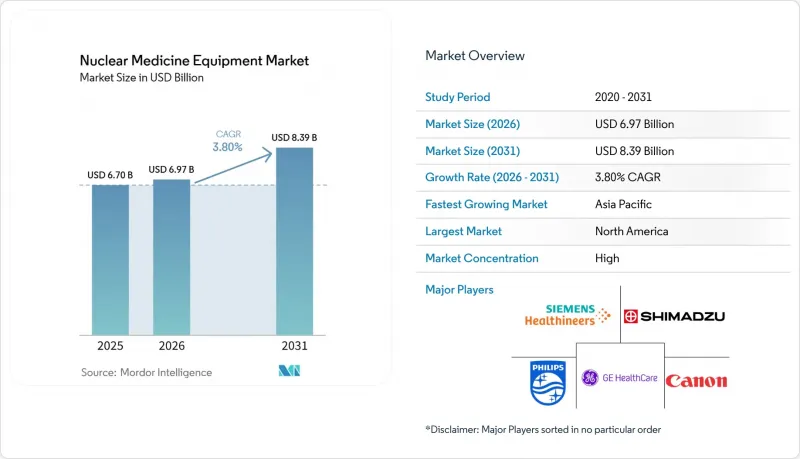
본 보고서는 제품 유형(SPECT 시스템, 하이브리드 SPECT/CT, PET 시스템 등), 검출기 기술(NaI 카메라, CZT 디지털 SPECT 등), 용도(종양학, 순환기학, 신경학 등), 최종 사용자(병원, 영상진단센터, 학술기관 등), 지역(북미, 유럽, 아시아태평양 등)별로 분류되어 있습니다. 시장 전망(금액, 달러).
세계의 핵의학 장비 시장 동향 및 인사이트
암 및 심혈관 질환 사례 증가로 인한 부담 가중
암 발생률은 2050년까지 47% 증가할 것으로 예측되며, 이에 따라 임상의들은 CT나 MR로는 감지할 수 없는 미세한 치료 반응을 추적할 수 있는 분자 기술로의 전환을 요구받고 있습니다. 2024년 FDA가 풀피리다즈 F-18을 승인함에 따라, 의료진은 더 높은 정확도와 더 낮은 동위원소 붕괴 위험으로 스트레스 PET 검사를 시행할 수 있게 되어, 핵의학 심장학의 적용 범위가 확대되고 있습니다. 고령화가 암과 관상동맥 질환을 모두 촉진하고 있기 때문에 병원에서는 종양학과 순환기학 분야 수요 증가에 대응하기 위해 추적자 재고를 확충하고 영상 진단 예약 슬롯을 추가하고 있습니다. PET를 이용한 관류 검사는 SPECT보다 비용은 더 들지만, 복잡한 관상동맥 질환에서 더 우수한 치료 성과를 얻을 수 있다는 증거가 축적됨에 따라 지지를 얻고 있습니다. 그 결과, 단기적인 거시경제 변동과 관계없이 검사 건수의 장기적인 증가세는 견조하게 유지되고 있으며, 이는 핵의학 장비 시장이 필수적인 서비스임을 입증하고 있습니다.
하이브리드 PET/CT 및 SPECT/CT 스캐너의 급속한 보급
하이브리드 스캐너는 한 번의 촬영으로 대사 데이터와 해부학적 데이터를 융합하므로, 위치 정렬 오차를 제거하고 환자의 검사 소요 시간을 절반으로 줄여줍니다. 2024년에 승인된 ‘Biograph Trinion PET/CT’는 239 ps의 비행 시간 성능을 실현하면서도 전력 소비를 46% 줄인 공랭식 검출기를 탑재하고 있어, 이러한 변화를 여실히 보여주고 있습니다. 의료 기관들은 스캔 속도 향상으로 인력을 증원하지 않고도 일일 검사 능력을 확대할 수 있다는 점을 전략적 이점으로 보고 있으며, 이는 인력 부족이 심각한 시장에서 매우 중요한 장점이 됩니다. 또한, 하이브리드 시스템은 복셀 수준의 해부학적 랜드마크와 추적자(트레이서)의 촬영을 동기화함으로써 보고서 작성을 간소화하고, 종양학 분야의 병기 분류 및 치료 모니터링에서 진단의 신뢰성을 높입니다. 'uEXPLORER'와 같은 긴 축 방향 시야(FOV) 설계 덕분에 60초 미만에 전신을 촬영할 수 있으며, 방사성 의약품 투여량을 80% 이상 절감합니다. 이러한 운영 및 임상적 이점으로 인해 하이브리드 플랫폼은 핵의학 장비 시장의 성장 동력이 되고 있습니다.
스캐너의 고액 도입 비용과 서비스 계약
최첨단 PET/CT의 가격은 200만-400만 달러에 달하며, 연간 서비스 요금은 구매 가격의 10%에 이르는 경우도 많아 소규모 병원의 예산을 압박하고 있습니다. 필요한 차폐 조치, 공조 설비 업그레이드, IT 인터페이스 구축으로 인해 프로젝트 비용은 2배로 늘어나 투자 수익률(ROI) 산정이 어려워지고 있습니다. 자금 조달 모델은 진화하고 있습니다. Positron사의 NeuSight PET-CT 임대 플랜은 초기 비용을 절감하는 한편, 의료 기관을 장기 서비스 계약에 묶어두게 됩니다. 복잡한 소프트웨어 스택은 정기적인 업데이트를 위해 벤더 엔지니어가 필요하며, 가동 중단에 따른 위약금이 이익률을 압박합니다. 이러한 현실이 중소득 국가에서의 보급을 지연시키고, 핵의학 장비 시장 전체의 성장을 억제하고 있습니다.
부문 분석
하이브리드 PET/CT 시스템은 임상의들이 정밀 진단을 우선시함에 따라 연평균 성장률(CAGR) 7.9%로 성장할 것으로 예측됩니다. 핵의학 장비 시장은 임상적 신뢰성을 높이는 동시에 워크플로우를 최적화하는 하이브리드 장치의 혜택을 받고 있습니다. AI를 활용한 프로토콜 선택 및 반복 재구성 같은 기술 발전으로 감도를 높이는 동시에 피폭 선량을 줄일 수 있어 수요가 더욱 증가하고 있습니다. 이와 병행하여 갑상선 및 센티넬 림프절 영상 촬영에서 평면 카메라의 사용은 안정적이지만, 3D 모달리티의 보급에 따라 그 점유율은 감소하고 있습니다.
예측 기간 동안 각 벤더는 모든 스캐너 등급에 디지털 검출기와 클라우드 기반 분석 기능을 통합해 나갈 것입니다. GE 헬스케어가 2025년에 풀피리다즈(Fullpyridaz) 호환 PET 프로토콜을 출시함에 따라, 중규모 병원들이 PET 스위트를 도입하기 시작하면서 고해상도 심장 영상용 핵의학 장비 시장 규모가 확대되고 있습니다. 장축 시야(Long-axial-FOV) PET/CT 시스템은 동적 추적자 검사나 전신 선량 측정 등의 활용 사례를 확대하여 새로운 연구 예산을 확보하는 동시에 수익 다각화를 촉진할 것입니다.
NaI 앵거 카메라는 2024년 출하 대수의 68.1%를 차지했으며, 이는 수십 년에 걸친 대규모 도입 실적과 저렴한 단가를 반영한 것입니다. 그러나 CZT 기술은 연평균 성장률(CAGR) 12.8%로 발전하고 있으며, 교체 주기를 점점 더 많이 차지하고 있습니다. 의료 기관이 CZT를 채택하는 이유는 높은 에너지 분해능 덕분에 듀얼 동위원소 프로토콜에서 중첩되는 동위원소를 구별하여 심장 진단을 향상시킬 수 있기 때문입니다. SiPM 기반 PET 검출기도 영상 품질을 향상시키는 피코초 단위의 타이밍 성능 덕분에 수주가 증가하고 있습니다. 비용 중심의 환경에서는 아날로그 PMT 구성이 여전히 주류를 이루며, 핵의학 장비 시장의 기본 판매량을 유지하는 데 기여하고 있습니다.
임상시험에서는 특히 카운트 감도가 치료 계획에 직접 반영되는 관상동맥 관류 검사에서 CZT의 우월성이 입증되었습니다. 반도체 비용의 하락과 여러 공급업체 간의 경쟁으로 인해 가격이 억제되면서 활용 범위가 확대되고 있습니다. CdTe 및 HgI2 기판에 대한 지속적인 연구 개발을 통해 해상도의 추가적인 향상이 기대됩니다. AI를 활용한 노이즈 제거 소프트웨어와의 통합을 통해 향후 시스템에서는 투여 선량을 줄이면서도 더욱 선명한 이미지를 제공할 수 있게 되어, 핵의학 장비 시장의 디지털화 전환이 확고해질 것입니다.
지역별 분석
북미는 CMS(미국 의료보험서비스센터)의 보상 제도 개혁 시행과 지속적인 연구 자금 투입으로 인해 장비 교체가 가속화되어, 2024년 매출의 34.7%를 차지했습니다. 미국의 의료 기관은 프로토콜 선택을 효율화하기 위해 AI 도구를 신속하게 도입하고 있는 반면, 캐나다의 병원들은 동위원소 생산 자립을 도모하기 위해 사이클로트론에 투자하고 있습니다. 멕시코에서는 의료 관광객을 유치하기 위해 대도시권의 영상 진단 장비를 업그레이드하고 있으며, 이것이 매출 증가에 기여하고 있습니다.
유럽은 시장 규모에서 2위를 차지하고 있으며, 독일의 대학병원 네트워크와 네덜란드의 동위원소 반응로가 핵심을 이루고 있습니다. 그러나 2024년의 Mo-99 부족 사태는 단일 반응로에 대한 의존도를 여실히 드러냈으며, 생산 다각화를 위한 EU의 보조금 지원을 촉진하는 계기가 되었습니다. 영국의 국민보건서비스(NHS)는 분자 영상 진료 경로를 국가 암 대책 계획에 포함시켜, 재정 긴축기에도 검사 건수를 안정적으로 유지하고 있습니다. 중·동유럽 국가들에서는 진단 인프라의 현대화가 진행되며 두 자릿수 성장을 기록하고 있어, 이에 따라 핵의학 장비에 대한 새로운 수요가 발생하고 있습니다.
아시아태평양은 만성 질환 유병률의 상승과 정부의 역량 강화 프로그램에 힘입어 연평균 성장률(CAGR) 7.2%로 가장 빠르게 성장하고 있는 지역입니다. 중국에서는 1,200곳 이상의 핵의학 시설이 운영되고 있으며, 매년 수백만 명의 환자에게 서비스를 제공합니다. 일본의 성숙한 생태계는 GE 헬스케어의 일본 메디피직스(Japan Mediphysics) 인수로 인해 국내 추적자(tracer) 공급이 확보되면서 혜택을 보고 있습니다. 인도에서는 2급 도시에서의 PET-CT 도입 규모를 확대하고 있으며, 호주에서는 희귀암을 대상으로 한 테라노스틱스(theranostics) 임상시험을 지원하고 있습니다. 이러한 노력들이 어우러져 핵의학 장비 시장에서 지역 전체에 걸쳐 강력한 성장세가 나타나고 있습니다.
기타 혜택 :
- 엑셀 형식 시장 예측(ME) 시트
- 3개월간의 애널리스트 지원
자주 묻는 질문
목차
제1장 서론
제2장 조사 방법
제3장 주요 요약
제4장 시장 구도
제5장 시장 규모 및 성장 예측
제6장 경쟁 구도
제7장 시장 기회 및 향후 전망
KTH 26.08.05According to Mordor Intelligence, the nuclear medicine equipment market size is projected to be USD 6.70 billion in 2025, USD 6.97 billion in 2026, and reach USD 8.39 billion by 2031, growing at a CAGR of 3.80% from 2026 to 2031.
This report is Segmented by Product Type (SPECT Systems, Hybrid SPECT/CT, PET Systems, and More), Detector Technology (NaI Cameras, CZT Digital SPECT, and More), Application (Oncology, Cardiology, Neurology, and More), End User (Hospitals, Imaging Centers, Academic Institutes, and More), and Geography (North America, Europe, Asia Pacific, and More). Market Forecasts in Value (USD).
Global Nuclear Medicine Equipment Market Trends and Insights
Rising Burden of Oncology & Cardiology Cases
Cancer incidence is projected to climb 47% by 2050, pushing clinicians toward molecular techniques that can track tiny treatment responses undetectable on CT or MR. The 2024 FDA nod for flurpiridaz F-18 now lets care teams perform stress PET studies with higher accuracy and lower isotope decay risk, expanding nuclear cardiology reach. Because aging populations drive both cancer and coronary disease, hospitals upgrade tracer inventories and schedule additional imaging slots to keep pace with combined oncology and cardiology demand. PET-based perfusion studies, though costlier than SPECT, gain favor as evidence mounts for better outcomes in complex coronary artery disease. Consequently, long-term procedure volume growth remains resilient regardless of short-term macroeconomic swings, reinforcing the nuclear medicine equipment market as an essential service.
Rapid Adoption of Hybrid PET/CT & SPECT/CT Scanners
Hybrid scanners fuse metabolic and anatomical data in one acquisition, eliminating registration errors and halving patient throughput time. The Biograph Trinion PET/CT, cleared in 2024, illustrates this shift with air-cooled detectors that cut power use by 46% while delivering 239-ps time-of-flight performance. Health systems view these gains as strategic because faster scans increase daily capacity without expanding staff, a critical benefit in tight labor markets. Hybrid systems also simplify reporting by synchronizing voxel-level anatomical landmarks with tracer uptake, improving diagnostic confidence in oncology staging and therapy monitoring. Long axial FOV designs, such as the uEXPLORER, cover the entire body in under 60 seconds and reduce radiopharmaceutical dose by more than 80%. These operational and clinical advantages position hybrid platforms as the growth engine of the nuclear medicine equipment market.
High Capital & Service Contracts for Scanners
A state-of-the-art PET/CT can cost USD 2-4 million, and annual service fees often reach 10% of the purchase price, straining the budgets of smaller hospitals. Required shielding, HVAC upgrades, and IT interfaces double project outlays, making return-on-investment calculations difficult. Financing models are evolving; Positron's rental plan for the NeuSight PET-CT reduces upfront cash yet still locks providers into long service terms. Complex software stacks require vendor engineers for routine updates, and downtime penalties cut into margins. These realities slow penetration in mid-income nations, tempering overall growth in the nuclear medicine equipment market.
Other drivers and restraints analyzed in the detailed report include:
- Reimbursement Expansion for Molecular Imaging in OECD
- Long-Axial FOV PET/CT Enabling Ultra-Low-Dose Workflows
- Supply-Chain Fragility of Short-Lived Radio-Isotopes
For complete list of drivers and restraints, kindly check the Table Of Contents.
Segment Analysis
SPECT scanners accounted for 52.3% of revenue in 2024, as they remain affordable and reliable for routine cardiac and bone studies. Hybrid PET/CT systems, on the other hand, are expected to expand at a 7.9% CAGR as clinicians prioritize precision diagnostics. The nuclear medicine equipment market benefits from hybrid devices, which elevate clinical confidence while optimizing workflow. Advances such as AI-assisted protocol selection and iterative reconstruction increase sensitivity while reducing doses, thereby reinforcing demand. In a parallel trend, planar cameras remain steady for thyroid and sentinel-node imaging, although their share declines as 3-D modalities proliferate.
Across the forecast, vendors embed digital detectors and cloud-enabled analytics into all scanner classes. GE HealthCare's launch of the flurpiridaz-compatible PET protocol in 2025 prompts mid-tier hospitals to add PET suites, boosting the nuclear medicine equipment market size for high-resolution cardiac imaging. Long-axial-FOV PET/CT systems extend use cases to dynamic tracer studies and whole-body dosimetry, capturing new research budgets and increasing revenue diversity.
NaI Anger cameras delivered 68.1% of 2024 shipments, reflecting decades of a large installed base and a low unit price. Yet CZT technology is advancing at a 12.8% CAGR and increasingly captures replacement cycles. Providers adopt CZT because higher energy resolution distinguishes overlapping isotopes in dual-isotope protocols, enhancing cardiac diagnostics. SiPM-based PET detectors also see rising orders for their picosecond timing, which sharpens image quality. Analog PMT configurations remain prevalent in cost-sensitive settings, helping to sustain baseline volume in the nuclear medicine equipment market.
Clinical trials underline CZT superiority, especially in coronary perfusion, where count sensitivity directly informs treatment plans. Declining semiconductor costs and multi-vendor competition compress prices, widening access. Ongoing R&D into CdTe and HgI2 substrates suggests further improvements in resolution. Integration with AI-powered denoising software means future systems deliver higher clarity at lower administered doses, solidifying the digital transition within the nuclear medicine equipment market.
Complete Report Scope:
- By Product Type
- SPECT Systems
- Hybrid SPECT/CT Systems
- PET Systems
- Hybrid PET/CT Systems
- Planar Scintigraphy Cameras
- By Detector Technology
- NaI Scintillation (Anger) Cameras
- CZT Digital SPECT Cameras
- SiPM-Based PET Detectors
- Analog PMT PET Detectors
- Others (CdTe, HgI?)
- By Application
- Oncology
- Cardiology
- Neurology
- Orthopedics & Musculoskeletal
- Other Clinical Areas
- By End User
- Hospitals
- Diagnostic Imaging Centers
- Academic & Research Institutes
- Specialty Clinics
- Mobile Imaging Service Providers
- By Geography
- North America
- United States
- Canada
- Mexico
- Europe
- Germany
- United Kingdom
- France
- Italy
- Spain
- Russia
- Rest of Europe
- Asia Pacific
- China
- Japan
- India
- South Korea
- Australia
- Rest of Asia Pacific
- Middle East & Africa
- GCC
- South Africa
- Rest of Middle East & Africa
- South America
- Brazil
- Argentina
- Rest of South America
- North America
Geography Analysis
North America generated 34.7% of 2024 revenue following the implementation of CMS reimbursement reform and ongoing research funding, which accelerated equipment renewals. Providers in the United States quickly integrate AI tools to streamline protocol selection, while Canadian hospitals invest in cyclotrons to achieve self-reliance in isotope production. Mexico upgrades imaging fleets in metropolitan areas to attract medical tourists, adding incremental volumes.
Europe ranks second in market size, anchored by Germany's university-hospital network and the Netherlands' isotope reactors. However, the 2024 Mo-99 shortage exposed reliance on single reactors and spurred EU grants for diversified production. The United Kingdom's NHS embeds molecular imaging pathways in national cancer plans, stabilizing procedure volumes even during fiscal tightening. Central and Eastern European nations are experiencing double-digit growth as they modernize their diagnostic infrastructure, thereby generating new demand for nuclear medicine equipment.
The Asia Pacific is the fastest-growing region, with a 7.2% CAGR, driven by rising chronic disease incidence and government capacity-building programs. China operates more than 1,200 nuclear medicine sites serving millions of patients each year. Japan's mature ecosystem now benefits from GE HealthCare's acquisition of Nihon Medi-Physics, which secures domestic tracer supply. India scales PET-CT capacity in tier-two cities, and Australia backs theranostic trials targeting rare cancers. These initiatives compound into robust regional momentum for the nuclear medicine equipment market.
- GE Healthcare
- Siemens Healthineers
- Koninklijke Philips
- Canon
- United Imaging Healthcare
- Spectrum Dynamics Medical
- Digirad
- Mediso
- Neusoft Medical Systems
- DDD-Diagnostics
- Positron
- Oncovision
- CMR Naviscan
- SurgicEye
- Curium Cameras (Sentinella)
- Shimadzu
- FUJIFILM
- Cubresa Inc.
- Bruker BioSpin
- Molecular Devices
Additional Benefits:
- The market estimate (ME) sheet in Excel format
- 3 months of analyst support
TABLE OF CONTENTS
1 Introduction
- 1.1 Study Assumptions & Market Definition
- 1.2 Scope of the Study
2 Research Methodology
3 Executive Summary
4 Market Landscape
- 4.1 Market Overview
- 4.2 Market Drivers
- 4.2.1 Rising Burden Of Oncology & Cardiology Cases
- 4.2.2 Rapid Adoption Of Hybrid PET/CT & SPECT/CT Scanners
- 4.2.3 Reimbursement Expansion For Molecular Imaging In OECD
- 4.2.4 Government Isotope-Production Investments (E.G., Mo-99)
- 4.2.5 Commercial Rollout Of CZT Digital SPECT Cameras
- 4.2.6 Long-Axial FOV PET/CT Enabling Ultra-Low-Dose Workflows
- 4.3 Market Restraints
- 4.3.1 High Capital & Service Contracts For Scanners
- 4.3.2 Supply-Chain Fragility Of Short-Lived Radio-Isotopes
- 4.3.3 Tightening Radioactive-Waste Disposal Regulations
- 4.3.4 Shortage Of Certified Nuclear-Medicine Technologists
- 4.4 Supply Chain Analysis
- 4.5 Regulatory Landscape
- 4.6 Technological Outlook
- 4.7 Porter's Five Forces Analysis
- 4.7.1 Bargaining Power of Suppliers
- 4.7.2 Bargaining Power of Buyers
- 4.7.3 Threat of New Entrants
- 4.7.4 Threat of Substitutes
- 4.7.5 Competitive Rivalry
5 Market Size & Growth Forecasts (Value)
- 5.1 By Product Type
- 5.1.1 SPECT Systems
- 5.1.2 Hybrid SPECT/CT Systems
- 5.1.3 PET Systems
- 5.1.4 Hybrid PET/CT Systems
- 5.1.5 Planar Scintigraphy Cameras
- 5.2 By Detector Technology
- 5.2.1 NaI Scintillation (Anger) Cameras
- 5.2.2 CZT Digital SPECT Cameras
- 5.2.3 SiPM-Based PET Detectors
- 5.2.4 Analog PMT PET Detectors
- 5.2.5 Others (CdTe, HgI?)
- 5.3 By Application
- 5.3.1 Oncology
- 5.3.2 Cardiology
- 5.3.3 Neurology
- 5.3.4 Orthopedics & Musculoskeletal
- 5.3.5 Other Clinical Areas
- 5.4 By End User
- 5.4.1 Hospitals
- 5.4.2 Diagnostic Imaging Centers
- 5.4.3 Academic & Research Institutes
- 5.4.4 Specialty Clinics
- 5.4.5 Mobile Imaging Service Providers
- 5.5 By Geography
- 5.5.1 North America
- 5.5.1.1 United States
- 5.5.1.2 Canada
- 5.5.1.3 Mexico
- 5.5.2 Europe
- 5.5.2.1 Germany
- 5.5.2.2 United Kingdom
- 5.5.2.3 France
- 5.5.2.4 Italy
- 5.5.2.5 Spain
- 5.5.2.6 Russia
- 5.5.2.7 Rest of Europe
- 5.5.3 Asia Pacific
- 5.5.3.1 China
- 5.5.3.2 Japan
- 5.5.3.3 India
- 5.5.3.4 South Korea
- 5.5.3.5 Australia
- 5.5.3.6 Rest of Asia Pacific
- 5.5.4 Middle East & Africa
- 5.5.4.1 GCC
- 5.5.4.2 South Africa
- 5.5.4.3 Rest of Middle East & Africa
- 5.5.5 South America
- 5.5.5.1 Brazil
- 5.5.5.2 Argentina
- 5.5.5.3 Rest of South America
- 5.5.1 North America
6 Competitive Landscape
- 6.1 Market Concentration
- 6.2 Market Share Analysis
- 6.3 Company Profiles {(includes Global level Overview, Market level overview, Core Segments, Financials as available, Strategic Information, Market Rank/Share for key companies, Products & Services, and Recent Developments)}
- 6.3.1 GE HealthCare
- 6.3.2 Siemens Healthineers
- 6.3.3 Philips Healthcare
- 6.3.4 Canon Medical Systems
- 6.3.5 United Imaging Healthcare
- 6.3.6 Spectrum Dynamics Medical
- 6.3.7 Digirad Corporation
- 6.3.8 Mediso Ltd.
- 6.3.9 Neusoft Medical Systems
- 6.3.10 DDD-Diagnostics
- 6.3.11 Positron Corporation
- 6.3.12 Oncovision
- 6.3.13 CMR Naviscan
- 6.3.14 SurgicEye
- 6.3.15 Curium Cameras (Sentinella)
- 6.3.16 Shimadzu Medical
- 6.3.17 Fujifilm Healthcare
- 6.3.18 Cubresa Inc.
- 6.3.19 Bruker BioSpin
- 6.3.20 Molecular Devices LLC
7 Market Opportunities & Future Outlook
- 7.1 White-space & Unmet-Need Assessment


