|
시장보고서
상품코드
2097255
제네릭 주사제 : 시장 점유율 분석, 업계 동향 및 통계, 성장 예측(2026-2031년)Generic Injectables - Market Share Analysis, Industry Trends & Statistics, Growth Forecasts (2026 - 2031) |
||||||
 Mordor Intelligence
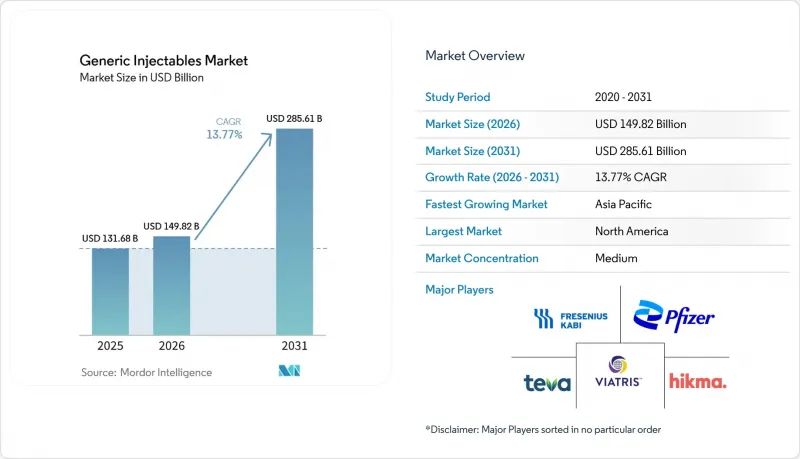
Mordor Intelligence에 의하면, 제네릭 주사제 시장 규모는 2025년에 1,316억 8,000만 달러로 평가되었습니다. 2026년 1,498억 2,000만 달러에서 2031년까지 2,856억 1,000만 달러에 이를 것으로 예상되며, 예측 기간(2026-2031년) CAGR은 13.77%를 나타낼 전망입니다.
본 보고서는 제품 유형(바이알, 앰플 등), 분자 유형(저분자 제네릭 등), 치료 분야(종양학, 항감염제, 순환기계 등), 투여 경로(정맥 내, 근육 내 등), 유통 채널(병원 약국 등), 지역(북미 등)별로 분류되어 있습니다. 시장 전망은 금액(달러) 기준으로 제시되어 있습니다.
세계의 제네릭 주사제 시장 동향 및 인사이트
특허 만료의 물결이 제네릭 의약품 출시를 가속화
제네릭 주사제 시장은 브랜드 주사제의 독점권 상실이 광범위하게 확산되는 흐름의 혜택을 받고 있으며, 이에 따라 간이 승인 여지가 확대되고 포트폴리오 교체가 가속화되고 있습니다. 이는 병원용 의약품에서 특히 중요한데, 단 한 건의 독점권 상실만으로도 종양학, 지지 요법, 급성기 의료 각 카테고리에서 여러 후속 제품의 출시가 가능해지기 때문입니다. FDA는 2026년 1분기에 볼테조미브 주사용 분말 및 아프레피탄 주사액을 포함한 4개의 제네릭 주사제를 승인했습니다. 이는 무균 제제의 승인 파이프라인이 여전히 활발하며, 출시의 호기에 대응하고 있음을 보여줍니다. 제네릭 주사제 시장은 무균 제제 개발에 있어 기술적 장벽이 경구 고형제보다 높다는 사실로부터도 혜택을 받고 있습니다. 따라서 많은 진출기업들은 동시에 출시할 수 있는 적격 경쟁사가 적은 제품을 여전히 목표로 삼고 있습니다. 이는 특히 브랜드 의약품의 보호 기간이 만료될 때, 병원 측이 승인된 대체품을 즉시 확보하고자 할 경우, 경쟁 초기 단계에서 보다 지속 가능한 판매량 기반을 뒷받침하는 요인이 됩니다. 그 결과, 분자 자체만큼이나 시기, 규제 대응 준비 상황, 그리고 무균 제조 능력이 중요한 시장 환경이 조성되고 있습니다.
합리적인 가격의 무균 항암제 및 항감염제에 대한 수요 증가
제네릭 주사제 시장은 엄격한 품질 및 공급 기준을 충족하면서도 저비용의 항암제 및 항감염제를 원하는 병원 측 수요에 의해 계속해서 지지를 받고 있습니다. 항암제는 2025년 시점에서 이미 매출의 33.26%를 차지했으며, 2031년까지 연평균 성장률(CAGR) 16.55%를 나타낼 것으로 예측됩니다. 이에 따라 항암제는 현재의 판매량과 미래의 성장 양면 모두에서 중심적인 위치를 계속 차지하게 될 것입니다. 항감염제 분야에서는 병원들이 여전히 카르바페넴계, β-락탐계, 항진균제 및 치료 지연을 용납할 수 없는 기타 급성기 치료제에 이르기까지 광범위한 주사제 확보를 필요로 하고 있습니다. 이러한 수요는 구매 행태에 변화를 가져오고 있습니다. 구매 담당자들은 품절되기 쉬운 카테고리나 임상적으로 중요한 카테고리에서 단순히 최저가 입찰자에게만 의존하기보다는 승인된 공급업체 목록이 폭넓은 것을 선호하는 경향이 있기 때문입니다. 따라서 제네릭 주사제 시장은 가격 외에도 공급의 지속성, 승인된 제조 품질, 그리고 확실한 재고 보충을 중시하는 조달 모델의 혜택을 받고 있습니다. 이는 공급 중단으로 인한 비용이 제한적인 조달 전략에 따른 비용 절감 효과를 상회할 가능성이 있는 병원 처방 목록에서 특히 중요합니다.
무균 충전 및 마무리 능력의 병목 현상
제네릭 주사제 시장은 여전히 무균 충전 및 마무리 능력 측면에서 심각한 운영상의 제약에 직면해 있습니다. 이는 수요 증가 속도가 규제를 준수하는 상업용 생산 라인의 확장 속도를 앞지를 가능성이 있기 때문입니다. 무균 제조에는 전용 설비, 엄격한 검증, 그리고 규제 대상 판매에 공급할 수 있는 생산량에 도달하기까지의 긴 가동 준비 기간이 필요하기 때문에 이 문제는 더 단순한 제형에 비해 주사제에서 더욱 심각합니다. 2024년 PDA가 실시한 부속서 1 이행 현황 조사에 따르면, 응답한 시설의 40%가 일정 연장이 필요하다고 답했으며, 30%는 200만 달러를 초과하는 설비 갱신 투자를 보고했는데, 이는 이용 가능한 규제 준수 생산 능력이 단순한 시설 수 통계가 시사하는 것보다 훨씬 더逼迫되어 있음을 보여줍니다. 따라서 제네릭 주사제 시장은 여러 출시 시기, 품귀 현상이 발생하는 품목, 그리고 생산 능력 증강이 동일한 계획 기간 내에 겹칠 경우 취약한 상황에 빠지게 됩니다. 새로운 생산 능력 확충은 도움이 되겠지만, 일정, 검증 및 규제 대응 준비와 관련된 단기적인 압박을 해소해 주지는 못합니다. 그 결과, 일부 공급업체는 승인을 획득했더라도 이를 적시에 상업적 공급으로 연결하는 데 어려움을 겪을 수 있습니다.
부문 분석
2025년에는 바이알이 매출의 45.31%를 차지했으나, 프리필드 주사기는 2031년까지 연평균 성장률(CAGR) 16.38%를 나타낼 것으로 예측되며, 이는 제네릭 주사제 시장이 기존의 병원 내 사용과 보다 새로운 투여 방식에 대한 선호 사이에서 균형을 잡고 있음을 보여줍니다. 바이알은 특히 투여량의 유연성이나 기존 투여 시스템이 여전히 중요시되는 의료 기관에서 확립된 종양학 정맥 주입 요법이나 항감염 프로토콜에 적합합니다. 프리필드 주사기의 인기가 높아지고 있는 이유는 조제 절차를 줄이고 더 안전한 취급을 가능하게 할 뿐만 아니라, 피하 투여 바이오의약품 및 ‘즉시 사용 가능한’ 치료 모델로의 광범위한 전환과 부합하기 때문입니다. 2026년 6월, 6mg 프리필드 주사기 제제인 페그필글라스팀의 바이오시밀러 ‘Nylaspeg’에 대해 CHMP(유럽의약품청 의약품평가위원회)가 긍정적인 견해를 표명한 것은 새로운 바이오시밀러가 처음부터 ‘즉시 사용 가능한’ 형태로 시장에 진입하는 경향이 강해지고 있음을 반영합니다. 제네릭 주사제 시장에서 이는 중요한 의미를 지닙니다. 분자 승인부터 병원이나 환자가 이미 선호하는 형태로 실제 임상에서 채택되기까지의 기간을 단축하기 때문입니다.
앰플은 특히 폐쇄형 시스템을 통한 대체품이 아직 표준 요건이 되지 않은 환경에서 마취 및 응급의료 분야에서 여전히 중요한 역할을 수행하고 있습니다. 점적백이나 대용량 비경구 제제는 대량 투여가 여전히 일상적인 중환자 치료, 전해질 보충, 비경구 영양 분야에서 안정적인 기관 수요를 유지하고 있습니다. 카트리지는 편의성과 기기 호환성이 중시되는 인슐린 및 GLP-1 펜형 투여 시스템과 관련된 제네릭 주사제 시장의 일부 분야에서 중요한 역할을 하고 있습니다. 유연한 생산 라인을 통해 바이알과 프리필드 주사기의 생산을 전환할 수 있는 제조업체는 조달 계약에서 단일 공급 관계 하에 기존 제제와 즉시 사용 가능한 제제가 모두 요구되는 경우 더 유리한 입장에 있습니다. 이러한 유연성 덕분에 공급업체는 기존 카테고리에서의 점유율을 유지하면서 새로운 투여 형태로의 신속한 전환에도 참여할 수 있습니다.
2025년 시점에서 저분자 제네릭 의약품은 제네릭 주사제 시장 규모의 58.24%를 차지했으나, 고분자 주사제 및 바이오시밀러는 2031년까지 연평균 성장률(CAGR) 15.52%로 성장할 것으로 예측됩니다. 저분자 의약품은 정맥 내 투여용 항생제, 세포독성 항암제, 진통제, 심혈관계 주사제 등 조달 수요가 광범위한 병원용 카테고리를 포함하고 있어, 현재 수익의 핵심으로 자리 잡고 있습니다. 이러한 의약품의 규제 경로는 보다 확립되어 있으며, 많은 의료 시스템에서 승인된 제품의 대규모 도입 기반을 뒷받침하고 있습니다. 대조적으로, 고분자 주사제의 성장이 가속화되고 있는 것은 제네릭 주사제 시장이 향하고 있는 방향성을 보여줍니다. 이는 생물학적 제제의 공정 개발, 분석 작업 및 상업적 규모의 무균 제조를 지원할 수 있는 기업이 제한적이기 때문입니다. FDA의 바이오시밀러 관련 기록 또한 이 기회 영역이 꾸준히 확대되고 있음을 보여주고 있으며, 2025년에는 18건의 주사용 바이오시밀러가 승인되고, 2026년 초에는 총 90건의 바이오시밀러가 승인될 전망입니다.
이러한 전환에 따라 제네릭 주사제 시장 전체의 투자 우선순위가 변화하고 있습니다. 현재 가장 매력적인 장기 주기 기회는 단순한 범용 분자뿐만 아니라 복잡한 바이오의약품에서도 존재하기 때문입니다. 2026년 6월, 아우로빈드 파마(Aurobindo Pharma)는 테란가나 주에 ‘TheraNym’ 바이오의약품 수탁 제조 시설을 설립했습니다. 이 시설에는 15KL 규모의 바이오리액터와 무균 충전 및 마무리 생산 능력이 갖춰져 있어, 인도 제조업체들이 이러한 변화에 대비해 인프라를 구축하고 있음을 보여줍니다. 바이오시밀러 주사제로의 전환은 경쟁의 문턱도 높이고 있습니다. 기업에게는 바이오의약품 제조, 무균 마무리, 규제 대응을 연계하는 보다 광범위한 사업 모델이 필요하기 때문입니다. 즉, 제네릭 주사제 시장에서 미래의 리더십은 단순히 제네릭 의약품의 신청 건수가 많다는 점에만 의존하는 것이 아니라, 공급업체가 고복잡도의 무균 제조 자산을 확장할 수 있는지 여부에 따라 크게 좌우될 것입니다. 현재 이러한 전환에 착수한 제조업체들은 더 많은 대형 생물학적 제제의 독점권이 만료되고, 경쟁의 무대가 더욱 확대될 시기에 대비하고 있는 것입니다.
지역별 분석
북미는 2024년 제네릭 주사제 시장 매출 점유율의 36.78%를 차지하며 계속해서 주도적인 위치를 유지했습니다. 이는 정교한 병원 인프라, 고도의 조제 자동화, 그리고 복잡한 제네릭 의약품의 승인을 신속하게 처리하는 명확한 규제 체계에 힘입은 결과입니다. 의료 시스템은 로봇 조제 플랫폼에 대한 투자를 지속하고 있으며, 투약 오류와 간호 업무 부담을 줄여주는 ‘투여 준비 완료’ 제형으로 전환하고 있습니다. 또한, 보험 급여 정책에서는 하류 의료비를 절감하는 의료기기 대응형 제네릭 의약품에 대한 프리미엄 가격 책정이 허용되고 있습니다.
아시아태평양은 인도가 ‘생산 연계 인센티브(PLI)’ 제도를 확대하고, 20억 달러를 무균 제조 능력 확충 및 기술 업그레이드에 투자함에 따라 2030년까지 연평균 성장률(CAGR) 16.43%로 가장 높은 성장률을 기록하고 있습니다. 중국은 국가의약품감독관리국의 기준을 ICH 지침에 부합하도록 조정하여 수출 신뢰도를 높이고 있습니다. 제조 클러스터는 낮은 인건비와 규제 조화의 가속화를 활용하여 전 세계의 위탁 충전 및 마무리 작업을 수주하고 있습니다. 일본, 한국, 호주는 바이오시밀러의 조기 도입과 지원적인 가격 책정 체계를 통해 지역의 부가가치를 높이고 있습니다.
유럽은 엄격한 품질 기준, 확고한 의약품 제조거점, 그리고 환자의 접근성을 확대하는 단일 지불자 방식의 환급 제도 덕분에 여전히 매우 중요한 역할을 수행하고 있습니다. 개정된 EU GMP 부속서 1의 시행으로 인해 규정 준수 비용은 상승하겠지만, 궁극적으로는 공급의 신뢰성이 강화될 것입니다. 독일과 프랑스는 충전·포장 공정의 자동화 도입을 주도하고 있는 반면, 동유럽 국가들은 경쟁력 있는 세제를 통해 수탁 생산을 유치하고 있습니다. 서유럽의 제네릭 주사제 시장 규모는 종양학 및 면역학 적응증 분야에서 바이오시밀러의 채택이 확대됨에 따라 완만하게 성장하고 있습니다.
기타 혜택 :
- 엑셀 형식 시장 예측(ME) 시트
- 3개월간의 애널리스트 지원
자주 묻는 질문
목차
제1장 서론
제2장 조사 방법
제3장 주요 요약
제4장 시장 구도
제5장 시장 규모 및 성장 예측
제6장 경쟁 구도
제7장 시장 기회 및 향후 전망
KTH 26.08.05According to Mordor Intelligence, the generic injectables market size was valued at USD 131.68 billion in 2025 and is estimated to grow from USD 149.82 billion in 2026 to reach USD 285.61 billion by 2031, at a CAGR of 13.77% during the forecast period (2026-2031).
This report is Segmented by Product Type (Vials, Ampoules, and More), Molecule Type (Small-Molecule Generics, and More), Therapeutic Area (Oncology, Anti-Infectives, Cardiovascular, and More), Route of Administration (Intravenous, Intramuscular, and More), Distribution Channel (Hospital Pharmacies, and More), and Geography (North America and More). The Market Forecasts are Provided in Terms of Value (USD).
Global Generic Injectables Market Trends and Insights
Patent Cliff Wave Accelerating Generic Launches
The Generic Injectables Market is benefiting from a broad wave of branded injectable exclusivity losses that is opening more room for abbreviated approvals and faster portfolio turnover. This matters most in hospital drugs, because a single loss of exclusivity can unlock multiple follow-on launches across oncology, supportive care, and acute care categories. The FDA approved 4 first generic injectable drugs in the first quarter of 2026, including bortezomib powder for injection and aprepitant injection, which shows that the sterile approval pipeline remains active and responsive to launch windows. The Generic Injectables Market also gains from the fact that technical barriers in sterile development are higher than in oral solids, so many entrants still target products where fewer qualified competitors can launch at the same time. That supports a more durable volume base during the early phase of competition, especially when hospitals want approved alternatives ready as branded products lose protection. The result is a launch environment where timing, regulatory readiness, and sterile capacity matter as much as the molecule itself.
Rising Demand for Sterile Affordable Oncology and Anti-Infective Therapies
The Generic Injectables Market continues to draw support from hospital demand for lower-cost oncology and anti-infective products that still meet strict quality and supply standards. Oncology already held 33.26% of revenue in 2025 and is projected to post a 16.55% CAGR through 2031, which keeps it at the center of both present volume and future growth. In anti-infectives, hospitals still need broad-spectrum injectable coverage across carbapenems, beta-lactams, antifungals, and other acute care therapies where treatment delays are not acceptable. That need changes purchasing behavior, because buyers often prefer a wider approved supplier list in shortage-prone or clinically sensitive categories instead of relying on only the lowest bidder. The Generic Injectables Market therefore benefits from a procurement model that rewards continuity, approved manufacturing quality, and dependable replenishment in addition to price. This is especially important in hospital formularies where the cost of disruption can be greater than the savings from a narrow sourcing strategy.
Sterile Fill-Finish Capacity Bottlenecks
The Generic Injectables Market still faces a hard operational limit in sterile fill-finish capacity, because demand can rise faster than compliant commercial lines can be expanded. This issue is more serious in injectables than in simpler dosage forms, since aseptic production needs specialized equipment, strict validation, and longer ramp-up periods before output becomes usable for regulated sales. The 2024 PDA survey on Annex 1 implementation showed that 40% of responding facilities needed timeline extensions and 30% reported upgrade investments above USD 2 million, which indicates that available compliant capacity is tighter than simple facility counts suggest. The Generic Injectables Market is therefore vulnerable when several launch windows, shortage categories, and capacity upgrades overlap in the same planning period. New capacity additions help, but they do not remove the short-term pressure on scheduling, validation, and regulatory readiness. As a result, some suppliers may hold approvals yet still struggle to convert them into timely commercial supply.
Other drivers and restraints analyzed in the detailed report include:
- Biosimilar and Complex Injectable Approvals Broadening Addressable Demand
- Hospital Preference for Ready-to-Use and Pre-Administration Formats
- Tender-Led Price Compression and GPO Consolidation
For complete list of drivers and restraints, kindly check the Table Of Contents.
Segment Analysis
Vials held 45.31% of revenue in 2025, while prefilled syringes are projected to grow at a 16.38% CAGR through 2031, which shows how the Generic Injectables Market is balancing legacy hospital use with newer delivery preferences. Vials still fit entrenched oncology infusion and anti-infective protocols, especially in institutional settings where dose flexibility and existing administration systems remain important. Prefilled syringes are gaining ground because they reduce preparation steps, support safer handling, and match the wider shift toward subcutaneous biologics and ready-to-use care models. The June 2026 positive CHMP opinion for Nylaspeg, a pegfilgrastim biosimilar in a 6 mg prefilled syringe presentation, reflected how new biosimilar launches are increasingly entering the market in ready-to-use formats from the start. In the Generic Injectables Market, that matters because it shortens the gap between molecule approval and real-world adoption in the format hospitals and patients already prefer.
Ampoules still have a role in anesthesia and emergency medicine, especially in settings where closed-system alternatives are not yet the default requirement. IV bags and large-volume parenterals keep stable institutional demand in critical care, electrolyte replacement, and parenteral nutrition, where high-volume administration remains routine. Cartridges serve a narrower but relevant part of the Generic Injectables Market tied to insulin and GLP-1 pen delivery systems, where convenience and device compatibility matter. Manufacturers that can move between vial and prefilled syringe output on flexible lines are better positioned when procurement contracts ask for both traditional and ready-to-use presentations under one supply relationship. That flexibility can help suppliers hold share in established categories while still participating in the faster migration toward newer delivery formats.
Small-molecule generics held 58.24% share of the Generic Injectables Market size in 2025, while large-molecule injectables and biosimilar generics are projected to expand at a 15.52% CAGR through 2031. Small molecules remain the core of present revenue because they include deep hospital categories such as IV antibiotics, cytotoxic chemotherapy, analgesics, and cardiovascular injectables with broad procurement demand. Their regulatory pathways are more established, and that supports a large installed base of approved products across many health systems. By contrast, the faster growth in large-molecule injectables shows where the Generic Injectables Market is moving, because fewer companies can support biologic process development, analytical work, and sterile manufacturing at commercial scale. FDA biosimilar records also show a steady buildout in this opportunity set, including 18 injectable biosimilar approvals in 2025 and 90 approved biosimilars in total as of early 2026.
This transition is changing investment priorities across the Generic Injectables Market, because the most attractive long-cycle opportunities now sit in complex biologics rather than only in commodity molecules. Aurobindo Pharma's June 2026 launch of the TheraNym biologics contract manufacturing facility in Telangana, with 15 KL bioreactors and aseptic fill-finish capability, showed how Indian producers are building infrastructure for this shift. The move toward biosimilar injectables also raises the competitive threshold, since companies need a broader operating model that links biologic manufacturing, sterile finishing, and regulatory execution. That means the future leadership pattern in the Generic Injectables Market will depend less on the breadth of simple generic filings alone and more on whether suppliers can scale high-complexity sterile assets. Manufacturers that begin this transition now are preparing for a period when more large biologic injectables lose exclusivity and create a wider competitive field.
Complete Report Scope:
- By Product Type
- Vials
- Ampoules
- Prefilled Syringes
- Cartridges
- IV Bags and Large Volume Parenterals
- By Molecule Type
- Small-Molecule Generics
- Large-Molecule Injectables and Biosimilar Generics
- By Therapeutic Area
- Oncology
- Anti-Infectives
- Cardiovascular
- Diabetes and Metabolic Disorders
- Central Nervous System Disorders
- Other Therapeutic Areas
- By Route of Administration
- Intravenous
- Intramuscular
- Subcutaneous
- Other Routes of Administration
- By Distribution Channel
- Hospital Pharmacies
- Retail and Mail-Order Pharmacies
- Online Pharmacies
- Other Distribution Channel
- By Geography
- North America
- United States
- Canada
- Mexico
- Europe
- Germany
- United Kingdom
- France
- Italy
- Spain
- Rest of Europe
- Asia-Pacific
- China
- Japan
- India
- Australia
- South Korea
- Rest of Asia-Pacific
- Middle East and Africa
- GCC
- South Africa
- Rest of Middle East and Africa
- South America
- Brazil
- Argentina
- Rest of South America
- North America
Geography Analysis
North America retained leadership with 36.78% of the generic injectables market revenue share in 2024, supported by sophisticated hospital infrastructure, advanced compounding automation, and a clear regulatory framework that speeds complex generic approvals. Health systems continue to invest in robotic preparation platforms and gravitate to ready-to-administer presentations that curb medication errors and nursing workload. Reimbursement policies accommodate premium pricing for device-enabled generics that cut downstream care costs.
Asia-Pacific generates the fastest CAGR at 16.43% through 2030 as India scales its Production Linked Incentive (PLI) scheme, channeling USD 2 billion into sterile capacity expansions and technology upgrades. China aligns its National Medical Products Administration standards with ICH guidelines, enhancing export credibility. Manufacturing clusters leverage lower labor costs and accelerating regulatory harmonization to capture global contract fill-finish work. Japan, South Korea, and Australia lift regional value through early adoption of biosimilars and supportive pricing frameworks.
Europe remains pivotal thanks to its stringent quality standards, entrenched pharmaceutical manufacturing base, and single-payer reimbursement that broadens patient access. Implementation of the revised EU GMP Annex 1 raises compliance costs yet ultimately strengthens supply reliability. Germany and France lead automated fill-finish adoption, while Eastern European nations attract contract work through competitive tax regimes. The generic injectables market size in Western Europe edges upward as biosimilar adoption deepens across oncology and immunology indications.
- Accord Healthcare Limited
- Apotex
- Aurobindo Pharma
- Baxter
- Cipla
- Dr. Reddy's Laboratories
- Endo International
- Fresenius
- Glenmark Pharmaceuticals
- Hikma Pharmaceuticals
- Intas Pharmaceutical
- Lupin
- Pfizer
- Sandoz Group AG
- Sawai Pharmaceutical Group
- Stada Arzneimittel
- Sun Pharmaceuticals Industries
- Teva Pharmaceutical Industries
- Viatris
- Zydus Lifesciences Limited
Additional Benefits:
- The market estimate (ME) sheet in Excel format
- 3 months of analyst support
TABLE OF CONTENTS
1 Introduction
- 1.1 Study Assumptions & Market Definition
- 1.2 Scope of the Study
2 Research Methodology
3 Executive Summary
4 Market Landscape
- 4.1 Market Overview
- 4.2 Market Drivers
- 4.2.1 Patent Cliff Wave Accelerating Generic Launches
- 4.2.2 Rising Demand for Sterile Affordable Oncology and Anti-Infective Therapies
- 4.2.3 Hospital Preference for Ready-to-Use and Pre-Administration Formats
- 4.2.4 Biosimilar and Complex Injectable Approvals Broadening Addressable Demand
- 4.2.5 AI-Assisted Formulation and Analytical Development Shortening Development Cycles
- 4.2.6 Lyophilized-to-Liquid Conversion Lowering Cold-Chain and COGS Burden
- 4.3 Market Restraints
- 4.3.1 Sterile Fill-Finish Capacity Bottlenecks
- 4.3.2 Tender-Led Price Compression and GPO Consolidation
- 4.3.3 Annex 1 and Sterility Compliance Cost Escalation
- 4.3.4 Volatile Supply of Type I Glass and COP Components
- 4.4 Supply Chain Analysis
- 4.5 Regulatory Landscape
- 4.6 Technological Outlook
- 4.7 Porter's Five Forces Analysis
- 4.7.1 Bargaining Power of Suppliers
- 4.7.2 Bargaining Power of Buyers
- 4.7.3 Threat of New Entrants
- 4.7.4 Threat of Substitutes
- 4.7.5 Industry Rivalry
5 Market Size & Growth Forecasts (Value, USD)
- 5.1 By Product Type
- 5.1.1 Vials
- 5.1.2 Ampoules
- 5.1.3 Prefilled Syringes
- 5.1.4 Cartridges
- 5.1.5 IV Bags and Large Volume Parenterals
- 5.2 By Molecule Type
- 5.2.1 Small-Molecule Generics
- 5.2.2 Large-Molecule Injectables and Biosimilar Generics
- 5.3 By Therapeutic Area
- 5.3.1 Oncology
- 5.3.2 Anti-Infectives
- 5.3.3 Cardiovascular
- 5.3.4 Diabetes and Metabolic Disorders
- 5.3.5 Central Nervous System Disorders
- 5.3.6 Other Therapeutic Areas
- 5.4 By Route of Administration
- 5.4.1 Intravenous
- 5.4.2 Intramuscular
- 5.4.3 Subcutaneous
- 5.4.4 Other Routes of Administration
- 5.5 By Distribution Channel
- 5.5.1 Hospital Pharmacies
- 5.5.2 Retail and Mail-Order Pharmacies
- 5.5.3 Online Pharmacies
- 5.5.4 Other Distribution Channel
- 5.6 By Geography
- 5.6.1 North America
- 5.6.1.1 United States
- 5.6.1.2 Canada
- 5.6.1.3 Mexico
- 5.6.2 Europe
- 5.6.2.1 Germany
- 5.6.2.2 United Kingdom
- 5.6.2.3 France
- 5.6.2.4 Italy
- 5.6.2.5 Spain
- 5.6.2.6 Rest of Europe
- 5.6.3 Asia-Pacific
- 5.6.3.1 China
- 5.6.3.2 Japan
- 5.6.3.3 India
- 5.6.3.4 Australia
- 5.6.3.5 South Korea
- 5.6.3.6 Rest of Asia-Pacific
- 5.6.4 Middle East and Africa
- 5.6.4.1 GCC
- 5.6.4.2 South Africa
- 5.6.4.3 Rest of Middle East and Africa
- 5.6.5 South America
- 5.6.5.1 Brazil
- 5.6.5.2 Argentina
- 5.6.5.3 Rest of South America
- 5.6.1 North America
6 Competitive Landscape
- 6.1 Market Concentration
- 6.2 Market Share Analysis
- 6.3 Company Profiles (includes Global Level Overview, Market Level Overview, Core Segments, Financials as available, Strategic Information, Market Rank/Share, Products and Services, Recent Developments)
- 6.3.1 Accord Healthcare Limited
- 6.3.2 Apotex Inc.
- 6.3.3 Aurobindo Pharma Limited
- 6.3.4 Baxter International Inc.
- 6.3.5 Cipla Ltd.
- 6.3.6 Dr. Reddy's Laboratories Ltd.
- 6.3.7 Endo International plc
- 6.3.8 Fresenius Kabi
- 6.3.9 Glenmark Pharmaceuticals Ltd.
- 6.3.10 Hikma Pharmaceuticals PLC
- 6.3.11 Intas Pharmaceuticals Ltd.
- 6.3.12 Lupin Limited
- 6.3.13 Pfizer Inc.
- 6.3.14 Sandoz Group AG
- 6.3.15 Sawai Pharmaceutical Group
- 6.3.16 STADA Arzneimittel AG
- 6.3.17 Sun Pharmaceutical Industries Ltd.
- 6.3.18 Teva Pharmaceutical Industries Ltd.
- 6.3.19 Viatris Inc.
- 6.3.20 Zydus Lifesciences Limited
7 Market Opportunities & Future Outlook
- 7.1 White-Space and Unmet-Need Assessment