
|
시장보고서
상품코드
2097259
항공기 전기화 시장 : 점유율 분석, 업계 동향 및 통계, 성장 예측(2026-2031년)Aircraft Electrification - Market Share Analysis, Industry Trends & Statistics, Growth Forecasts (2026 - 2031) |
||||||
 Mordor Intelligence
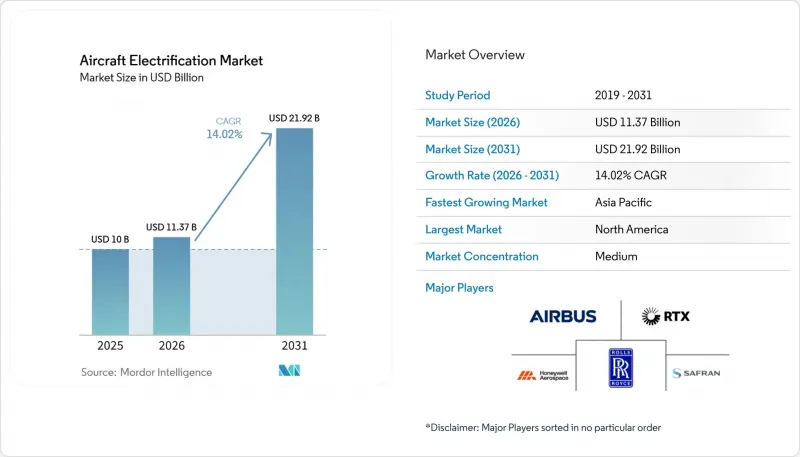
Mordor Intelligence에 의하면, 항공기 전기화 시장 규모는 2025년 100억 달러에서 2026년에는 113억 7,000만 달러로 확대되어 2026년부터 2031년까지 CAGR 14.02%로 성장을 지속하여, 2031년에는 219억 2,000만 달러에 이를 것으로 예측됩니다.
본 보고서는 기술별(모어 일렉트릭 항공기, 하이브리드 일렉트릭 항공기, 풀 일렉트릭 항공기), 플랫폼별(민간, 군용, 기타), 시스템별(발전, 배전, 기타), 출력 등급별(100 kW 미만, 100-500 kW 미만, 기타), 지역별(북미, 유럽, 기타)로 분류되어 있습니다. 시장 전망은 금액(달러) 기준으로 제시되어 있습니다.
전 세계 항공기 전기화 시장 동향과 인사이트
항공사 기체에 대한 넷제로 의무화가 전기 추진의 보급을 가속화하고 있습니다.
항공사의 넷제로 노력에 따라 환경 목표가 항공기 전기화 시장의 단기 계획에 있어 전제조건이 되고 있습니다. IATA 가맹 항공사들은 2050년까지 운항에 따른 탄소 배출량을 넷제로로 만들겠다고 공약하고 있으며, 이 공약이 현재 주요 항공사들의 장기적인 기체 구성 결정을 좌우하고 있습니다. 유럽에서는 2026년에 항공 사업자들이 더욱 엄격한 탄소 비용 환경에 진입함에 따라 정책 체계가 강화되고 있으며, 이로 인해 저배출 추진 방식의 가치가 높아지고 있습니다. 2025년 2월에 업데이트된 ‘Destination 2050’ 로드맵에서는 전기 항공기 및 수소 항공기에 대한 대응 준비를 인프라에 대한 공동 투자의 필요성과 동등한 수준으로 위치시키고 있으며, 이를 통해 항공기 전기화 시장 내 프로그램의 장기적인 가시성이 뒷받침되고 있습니다. 이는 운항 빈도가 높은 단거리 노선 네트워크에서 특히 중요합니다. 왜냐하면 이러한 노선은 장거리 노선에 비해 탄소 비용의 영향을 더 빨리 받게 되며, 하이브리드 전기 항공기의 활용 사례를 조기에 도입할 수 있기 때문입니다. 그 결과, 전동화는 기술적 선택지에서 항공사의 계획 주기 내 기체 교체 기준으로 전환되고 있습니다.
고체 배터리 및 리튬 금속 배터리 팩의 에너지 밀도가 450 Wh/kg을 돌파
배터리 기술의 발전으로 항공기 전기화 시장을 뒷받침하는 성능 상한선은 향상되고 있지만, 그 경로는 항공기의 크기와 운용 목적에 따라 여전히 선택적인 성격을 띠고 있습니다. 『Applied Energy』의 2025년 리뷰에 따르면, 하이브리드 전기식 통근용 항공기의 상용화를 위해서는 2035년까지 팩 수준의 에너지 밀도가 350 Wh/kg에서 400 Wh/kg에 도달해야 한다고 합니다. 이 임계값이 중요한 이유는 논의가 단순한 실현 가능성 검토에서 어떤 지역 노선이 가장 먼저 상업적으로 실용화될 수 있는지로 전환되기 때문입니다. 또한 제공된 자료에 따르면, 2026년에는 고체 배터리 및 리튬 금속 시스템에 대한 시험 활동이 진행될 예정이며, 이는 기술 곡선이 기존의 항공 로드맵에서 예상했던 것보다 빠르게 개선되고 있다는 관점을 뒷받침합니다. 자동차 산업 규모의 노력도 셀 조달에 도움이 될 가능성이 있습니다. 항공우주 분야 외부의 시범 생산 프로그램을 통해 항공기 전용 생산량이 일정 규모에 도달하기 전에 제조 비용을 절감할 수 있기 때문입니다. 이를 통해 항공기 전기화 시장에서는 배터리 중량을 관리할 수 있는 통근용 항공기, eVTOL 플랫폼 및 기타 단거리 설계 분야에서 보다 명확한 중기적 로드맵이 드러납니다.
배터리의 에너지 밀도와 제트 A 연료 간의 격차(30배 이상 낮음)
에너지 밀도의 격차는 2031년까지 항공기 전기화 시장이 완전 전기 비행으로 얼마나 진전할 수 있을지에 있어 여전히 주요한 구조적 제약 요인으로 남아 있습니다. 사용자가 제공한 초안에 인용된 NASA 연구에 따르면, 현재의 배터리 화학 성분으로는 150인승급을 포함한 대형 상업용 항공기의 완전 전기 운항을 실현할 수 없는 것으로 나타났습니다. 문제는 배터리가 개선되고 있는지 여부가 아니라, 비행 거리나 승객 수 증가에 따라 발생하는 질량 및 부피 증가를 상쇄할 수 있을 만큼 그 개선 속도가 충분히 빠른지에 있습니다. 따라서 단기적인 상용화 경로는 협폭기 기단의 광범위한 교체가 아니라, 하이브리드 전기식 아키텍처나 소형 완전 전기 항공기를 중심으로 이루어질 것입니다. 또한, 항공기 전기화 시장에서 단기적으로 가장 큰 기회는 무인항공기(UAV), eVTOL, 그리고 단거리 지역 노선용 기체에 국한됩니다. 배터리의 화학 성분에 따라 그 격차가 더욱 좁혀질 때까지는 완전 전동화의 대상이 되는 시장은 제한적인 수준에 머물 것으로 보입니다.
부문 분석
2025년 시점에서 ‘모어 일렉트릭(More Electric)’ 항공기는 항공기 전기화 시장 점유율의 54.65%를 차지하고 있으며, 이는 시장에서 여전히 급격한 플랫폼 변경보다는 위험이 낮은 도입 경로가 선호되고 있음을 보여줍니다. 이러한 항공기는 현행 나로우바디 및 와이드바디 기종에서 전동화된 작동 장치, 환경 제어 및 기내 전력 분배 시스템을 채택하고 있어, 새로운 추진 개념보다 기존 생산 프로그램에 더 쉽게 적용될 수 있습니다. 이러한 도입 완료 기체의 우위 덕분에, 예측 기간 동안 모어 일렉트릭 항공기는 항공기 전기화 시장 전체에서 수익 창출의 중심적인 위치를 계속 차지할 것입니다. 하이브리드 전기 항공기는 현재 규모는 작지만, 현행 배터리의 한계와 단거리 지역 노선의 배기가스 규제 요건을 연결하는 가교 역할을 하기 때문에 전략적으로 중요합니다. GE Aerospace는 2026년 6월, 메가와트급 하이브리드 전기 엔진 시스템의 첫 통합 지상 시험을 완료했습니다. 이는 하이브리드 방식이 개념 단계에서 비행 준비 단계의 검증으로 넘어가고 있음을 보여줍니다.
완전 전기 항공기는 가장 빠르게 성장하는 기술 분야로, 2026년부터 2031년까지 연평균 성장률(CAGR) 19.86%가 예상됩니다. 이는 최초의 실용적인 이용 사례가 소형 항공기, 무인 항공기(UAV), 그리고 eVTOL(전동 수직 이착륙기)의 설계에 위치하고 있기 때문입니다. 또한, 항공기 전기화 시장의 규제 상황도, 특히 19석 미만 카테고리에서 현재의 상업 활동과 부합하는 형태로 더욱 명확하게 정의되고 있습니다. 2026년 3월, 『연방항공규정(FAR)』은 ZeroAvia의 ZA601 600kW 전기 엔진에 대한 최종 특별 조건을 공표했습니다. 이는 향후 전기 추진 프로그램을 위한 인증 선례를 확립하는 데 있어 실질적인 한 걸음이 될 것입니다. 또한, ZeroAvia의 수주 파이프라인에는 3,000건 이상의 사전 주문이 접수되어 있으며, 본격적인 양산이 시작되기도 전부터 장기적인 공급업체로서의 지위를 둘러싼 경쟁이 이미 시작되었음을 시사합니다.
2025년, 상업용 항공은 항공기 전기화 시장의 46.75%를 차지했습니다. 이는 대규모 항공기 운용사 및 주요 OEM의 생산 라인이 다른 어떤 플랫폼 그룹보다 빠르게 '모어 일렉트릭(More Electric)' 시스템을 채택하고 있기 때문입니다. 이 부문은 완전 전기 추진으로의 즉각적인 전환이 필요하지 않은 전기화 서브시스템의 광범위한 채택으로 혜택을 보고 있으며, 이를 통해 도입을 현재의 항공기 프로그램이나 개조 경로와 연계할 수 있게 되었습니다. 또한, 2025년 7월에 최종 확정된 규정도 이를 뒷받침하고 있습니다. 이로 인해 경량 항공기 및 훈련용 항공기 부문에서는 전기 구동 설계에 대해 더 폭넓은 인증 경로를 이용할 수 있게 되었기 때문입니다. 따라서 비즈니스 항공 및 일반 항공은 항공기 전기화 시장에서 프로토타입 개발과 지속적인 납품량을 연결하는 중요한 가교 역할을 하고 있습니다. 군용기 및 무인항공기(UAV)는 항공사의 조달 주기와는 별개로, 전동 모터, 배터리, 전력 변환 장치 및 저시그니처 임무 시스템에 대한 수요를 유지하고 있어 상업적으로도 여전히 중요한 위치를 차지하고 있습니다.
첨단 항공 모빌리티(AAM)는 2031년까지 연평균 성장률(CAGR)이 23.90%에 달하고, 가장 빠르게 성장하는 플랫폼 분야입니다. 이는 항공기 인증, 충전 체계 구축, 도시 차원의 운영 계획이 여러 지역에서 병행하여 진전되고 있기 때문입니다. 항공기 전기화 산업이 여기서 특히 주목받는 이유는 플랫폼 설계, 소프트웨어, 충전, 인프라 및 운항 승인이 모두 병행하여 성숙해져야 하기 때문입니다. 2026년 4월 두바이에서 완공 예정인 상용 버티포트는 이러한 연계의 명확한 예라고 할 수 있습니다. 이 시설은 주요 공항 인근에서 Joby Aviation의 향후 에어택시 운항을 지원하도록 설계되었기 때문입니다. 이러한 추세는 특정 지역에 국한되지 않고, 인도, 중국, 일본, 중동에서도 새로운 시험 및 공급망 활동이 관찰되고 있습니다. 이로 인해 항공기 전기화 시장에서는 상용화 시기가 항공기 자체의 준비 상황과 마찬가지로 인프라 구축 현황에 크게 좌우되는 분야가 형성되고 있습니다.
지역별 분석
북미는 2025년에 매출의 38.98%를 차지해, 그 배경에는 FAA(연방항공청)가 eVTOL 및 하이브리드 지역 수송기를 위한 특별 조건부 감항성 기준을 조기에 발표한 점이 꼽힙니다. 미국 각 주의 인센티브는 코네티컷주 및 워싱턴주의 배터리 모듈 공장을 대상으로 하고 있으며, 국내 공급의 회복력을 강화하고 있습니다. 캐나다의 ‘지속 가능한 항공 기술(Sustainable Aviation Technology)’ 프로그램은 하이브리드 전기 아키텍처와 부품 호환성을 갖춘 수소 연소 실증 프로젝트에 공동 투자하여 지역 공급망을 더욱 공고히 하고 있습니다.
유럽은 EASA를 통해 보완적인 규제 체계를 정비하고, FAA와의 상호 인정 절차를 확립함으로써 인증 주기를 단축하고 있습니다. 프랑스는 ‘France 2030’의 틀 아래 9개의 탄소 제로 항공기 프로젝트에 1억 유로(1억 1,769만 달러)를 투입하여 메가와트급 모터 설계 인재 풀을 확대되고 있습니다. 영국의 ‘Future of Flight’ 계획은 2028년까지 eVTOL의 정기 운항을 목표로 하고 있으며, 도심 버티포트 입찰을 촉진하는 동시에 유럽 대륙 전체의 항공기 전기화 시장을 폭넓게 지원하고 있습니다.
아시아태평양은 배터리 제조 분야의 규모의 경제와 도시화에 힘입어 2031년까지 연평균 성장률(CAGR) 18.28%라는 가장 빠른 성장세를 기록하고 있습니다. CATL은 자동차 업계의 생산 설비를 활용해 항공기용 등급 셀 생산을 가속화하고 있는 반면, 일본의 반도체 제조업체는 1 MHz 인버터 스위칭에 필수적인 질화갈륨(GaN) 웨이퍼를 공급하고 있습니다. 호주 및 뉴질랜드의 시험 비행 구역에서는 항공 교통 혼잡이 비교적 적어 조기 비행 시험이 가능해지며, 지역 항공 택시 모델의 인증 기간을 단축하고 있습니다. 규제 측면의 지연은 있지만, 제조 비용의 우위와 전기 모빌리티에 대한 정책적 열의 덕분에 이 지역은 항공기 전기화 시장의 밸류체인에서 매우 중요한 거점이 되고 있습니다.
기타 혜택:
- 엑셀 형식 시장 예측(ME) 시트
- 3개월간의 애널리스트 지원
자주 묻는 질문
목차
제1장 서론
제2장 조사 방법
제3장 주요 요약
제4장 시장 구도
제5장 시장 규모와 성장 예측
제6장 경쟁 구도
제7장 시장 기회와 향후 전망
JHS 26.08.05According to Mordor Intelligence, the aircraft electrification market size is expected to grow from USD 10.00 billion in 2025 to USD 11.37 billion in 2026, and is forecast to reach USD 21.92 billion by 2031, at a 14.02% CAGR over 2026-2031.
This report is Segmented by Technology (More-Electric Aircraft, Hybrid-Electric Aircraft, and Fully Electric Aircraft), Platform (Commercial, Military, and More), System (Power Generation, Power Distribution, and More), Power Class (Less Than 100 KW, 100 To Less Than 500 KW, and More), and Geography (North America, Europe, and More). The Market Forecasts are Provided in Terms of Value (USD).
Global Aircraft Electrification Market Trends and Insights
Airline Fleet Net-zero Mandates Accelerate E-propulsion
Airline net-zero commitments are turning environmental targets into near-term planning assumptions for the aircraft electrification market. IATA member airlines are committed to net-zero carbon emissions from operations by 2050, and that commitment now shapes long-range fleet decisions across major carriers. In Europe, policy-setting is becoming less forgiving as aviation operators enter a tougher carbon-cost environment in 2026, raising the value of lower-emission propulsion pathways. The Destination 2050 roadmap, updated in February 2025, also places readiness for electric and hydrogen aircraft alongside the need for infrastructure co-investment, thereby supporting longer program visibility for the aircraft electrification market. This matters most in high-frequency short-haul networks because those routes feel carbon costs sooner and can absorb hybrid-electric use cases earlier than long-haul fleets. The result is that electrification is moving from a technical option to a renewal criterion inside airline planning cycles.
Solid-state and Li-metal Packs Surpass 450 Wh/kg
Battery progress is improving the performance ceiling that supports the aircraft electrification market, even if the path remains selective by aircraft size and mission. A 2025 review in Applied Energy states that pack-level densities of 350 Wh/kg to 400 Wh/kg by 2035 are needed to make hybrid-electric commuter aircraft viable. That threshold matters because it moves the discussion away from basic feasibility and toward which regional missions can become commercially practical first. The user-supplied material also points to 2026 test activity in solid-state and lithium-metal systems, which supports the view that the technology curve is improving faster than earlier aviation roadmaps assumed. An automotive scale is also likely to help with cell sourcing, as pilot production programs outside aerospace can lower manufacturing costs before aviation-specific volumes become meaningful. This leaves the aircraft electrification market with a clearer medium-term route in commuter aircraft, eVTOL platforms, and other short-range designs where battery weight can be managed.
Battery Energy Gap vs. Jet-A (More than 30x Lower)
The energy density gap remains the main structural limit on how far the aircraft electrification market can move toward full-electric flight by 2031. NASA work cited in the user-supplied draft shows that current battery chemistry does not support all-electric operation for larger commercial aircraft, including the 150-passenger class. The problem is not whether batteries are improving, but whether they are improving fast enough to offset the mass and volume penalties that arise as mission range and passenger count increase. That keeps the near-term commercial path centered on hybrid-electric architectures and smaller fully electric aircraft rather than broad replacement of narrowbody fleets. It also narrows the strongest near-term opportunities in the aircraft electrification market to UAVs, eVTOLs, and short regional platforms. Until battery chemistry closes more of that gap, the addressable market for full electrification will remain selective.
Other drivers and restraints analyzed in the detailed report include:
- Vertiport Build-outs Unlock Urban Air-mobility Corridors
- Military Demand for Low-acoustic ISR Drones
- Sparse MW-class Charging at Secondary Airports
For complete list of drivers and restraints, kindly check the Table Of Contents.
Segment Analysis
More-electric aircraft held 54.65% of the aircraft electrification market share in 2025, indicating that the market still favors lower-risk adoption paths over abrupt platform changes. These aircraft use electrified actuation, environmental control, and onboard power distribution across current narrowbody and widebody fleets, so they fit existing production programs more easily than new propulsion concepts. That installed-base advantage keeps more-electric aircraft at the center of revenue generation across the aircraft electrification market through the forecast period. Hybrid-electric aircraft remain smaller today, but they are strategically important because they bridge current battery limits and the emissions needs of short regional missions. GE Aerospace completed the first integrated ground test of a megawatt-class hybrid-electric engine system in June 2026, which shows that the hybrid pathway is moving from concept work toward flight-ready validation.
Fully electric aircraft are the fastest-growing technology segment, with a projected 19.86% CAGR from 2026 to 2031, because the first workable use cases sit in smaller aircraft, UAVs, and eVTOL designs. The regulatory landscape is also becoming more clearly defined for the aircraft electrification market, especially in the sub-19-seat category, which aligns with current commercial activity. The Federal Register (FAR) published final special conditions for ZeroAvia's ZA601 600 kW electric engine in March 2026, marking a practical step in establishing certification precedent for future electric propulsion programs. ZeroAvia's order pipeline of more than 3,000 preorders also suggests that long-term supplier positions are already being contested before full volume commercialization begins.
Commercial aviation accounted for 46.75% of the aircraft electrification market in 2025 because large fleet operators and major OEM production lines adopt more-electric systems faster than any other platform group. The segment benefits from the widespread adoption of electrified subsystems that do not require an immediate shift to full-electric propulsion, thereby keeping adoption tied to current aircraft programs and retrofit paths. It also gains support from the rule finalized in July 2025, because lighter and training-oriented aircraft categories can now move through a broader certification path for electric designs. This makes business and general aviation an important bridge between prototype activity and recurring delivery volume in the aircraft electrification market. Military aircraft and UAVs remain commercially relevant because they sustain demand for electric motors, batteries, power conversion, and low-signature mission systems outside airline purchasing cycles.
Advanced air mobility is the fastest-growing platform segment, with a 23.90% CAGR through 2031, as aircraft certification, charging readiness, and city-level operating plans advance in tandem across several regions. The aircraft electrification industry is especially visible here because platform design, software, charging, infrastructure, and operating approval all need to mature in parallel. Dubai's commercial vertiport completion in April 2026 is a clear example of this alignment, since the facility was designed to support Joby Aviation's future air taxi operations near a major airport. The same pattern is appearing beyond a single geography, with new testing and supply chain activity in India, China, Japan, and the Middle East. That gives the aircraft electrification market a platform category where commercial timing is now linked as much to infrastructure rollout as to aircraft readiness.
Complete Report Scope:
- By Technology
- More-Electric Aircraft
- Hybrid-Electric Aircraft
- Fully Electric Aircraft
- By Platform
- Commercial
- Narrowbody
- Widebody
- Regional Jets
- Business Jets and General Aviation Aircraft
- Commercial Helicopters
- Military
- Fighter Jets
- Transport Aircraft
- Special Mission Aircraft
- Military Helicopters
- Unmanned Aerial Vehicles (UAVs)
- Advanced Air Mobility
- Commercial
- By System
- Power Generation
- Power Distribution
- Power Conversion
- Energy Storage
- By Power Class
- Less than 100 kW
- 100 to Less than 500 kW
- 500 to Less than 1,000 kW
- Greater than 1,000 kW
- By Geography
- North America
- United States
- Canada
- Mexico
- Europe
- United Kingdom
- France
- Germany
- Italy
- Rest of Europe
- Asia-Pacific
- China
- India
- Japan
- South Korea
- Rest of Asia-Pacific
- South America
- Brazil
- Rest of South America
- Middle East and Africa
- Middle East
- Saudi Arabia
- United Arab Emirates
- Israel
- Rest of Middle East
- Africa
- South Africa
- Rest of Africa
- Middle East
- North America
Geography Analysis
North America retained 38.98% revenue in 2025, underpinned by the FAA's early issuance of special-conditions airworthiness standards for eVTOLs and hybrid regional transports. US state incentives cover battery-module plants in Connecticut and Washington, strengthening domestic supply resilience. Canada's Sustainable Aviation Technology program co-funds hydrogen-combustion demonstrations that share component commonality with hybrid-electric architectures, further anchoring regional supply networks.
Europe codifies a complementary ruleset through EASA, creating mutual-recognition pathways with the FAA to shorten certification cycles. France funnels EUR 100 million (USD 117.69 million) into nine zero-carbon aircraft projects under the France 2030 banner, expanding the talent pool for megawatt-motor design. The UK's Future of Flight plan targets routine eVTOL service by 2028, unlocking city-center vertiport tenders and supporting the broader aircraft electrification market across the continent.
Asia-Pacific posts the fastest growth, at an 18.28% CAGR through 2031, driven by economies of scale in battery manufacturing and urbanization. CATL leverages automotive-sector tooling to fast-track aviation-grade cell production, while Japanese chipmakers supply gallium-nitride (GaN) wafers critical for 1 MHz inverter switching. Australian and New Zealand test ranges facilitate early flight trials with lower air-traffic congestion, shaving certification time for regional air-taxi models. Despite regulatory lags, manufacturing cost advantages, and policy enthusiasm around electric mobility, the region is a pivotal node within the aircraft electrification market value chain.
- Honeywell Aerospace Inc.
- Safran SA
- General Electric Company
- Rolls-Royce Holdings plc
- RTX Corporation
- Airbus SE
- Ampaire Inc.
- ZeroAvia, Inc.
- Wright Electric Inc.
- magniX USA, Inc.
- GKN Aerospace Services Limited
- Thales Group
- BAE Systems plc
- Astronics Corporation
- Moog Inc.
- EaglePicher Technologies, LLC
- Crane Company
Additional Benefits:
- The market estimate (ME) sheet in Excel format
- 3 months of analyst support
TABLE OF CONTENTS
1 INTRODUCTION
- 1.1 Study Assumptions and Market Definition
- 1.2 Scope of the Study
2 RESEARCH METHODOLOGY
3 EXECUTIVE SUMMARY
4 MARKET LANDSCAPE
- 4.1 Market Overview
- 4.2 Market Drivers
- 4.2.1 Airline-fleet net-zero mandates accelerate e-propulsion
- 4.2.2 Solid-state and Li-metal packs surpassing 450 Wh/kg
- 4.2.3 Military demand for low-acoustic ISR drones
- 4.2.4 Vertiport build-outs unlock urban air-mobility corridors
- 4.2.5 Slot-constrained regional hubs push less than 500 nm electric legs
- 4.2.6 Power-semiconductor (SiC/GaN) cost curve halves by 2028
- 4.3 Market Restraints
- 4.3.1 Battery energy gap vs. Jet-A (More than 30X lower)
- 4.3.2 Sparse MW-class charging at secondary airports
- 4.3.3 Rare-earth magnet supply-chain volatility
- 4.3.4 Investor pullback post-SPAC stalls late-stage OEMs
- 4.4 Value Chain Analysis
- 4.5 Regulatory Landscape
- 4.6 Technological Outlook
- 4.7 Porter's Five Forces Analysis
- 4.7.1 Threat of New Entrants
- 4.7.2 Bargaining Power of Suppliers
- 4.7.3 Bargaining Power of Buyers
- 4.7.4 Threat of Substitutes
- 4.7.5 Intensity of Competitive Rivalry
5 MARKET SIZE AND GROWTH FORECASTS (VALUE)
- 5.1 By Technology
- 5.1.1 More-Electric Aircraft
- 5.1.2 Hybrid-Electric Aircraft
- 5.1.3 Fully Electric Aircraft
- 5.2 By Platform
- 5.2.1 Commercial
- 5.2.1.1 Narrowbody
- 5.2.1.2 Widebody
- 5.2.1.3 Regional Jets
- 5.2.1.4 Business Jets and General Aviation Aircraft
- 5.2.1.5 Commercial Helicopters
- 5.2.2 Military
- 5.2.2.1 Fighter Jets
- 5.2.2.2 Transport Aircraft
- 5.2.2.3 Special Mission Aircraft
- 5.2.2.4 Military Helicopters
- 5.2.3 Unmanned Aerial Vehicles (UAVs)
- 5.2.4 Advanced Air Mobility
- 5.2.1 Commercial
- 5.3 By System
- 5.3.1 Power Generation
- 5.3.2 Power Distribution
- 5.3.3 Power Conversion
- 5.3.4 Energy Storage
- 5.4 By Power Class
- 5.4.1 Less than 100 kW
- 5.4.2 100 to Less than 500 kW
- 5.4.3 500 to Less than 1,000 kW
- 5.4.4 Greater than 1,000 kW
- 5.5 By Geography
- 5.5.1 North America
- 5.5.1.1 United States
- 5.5.1.2 Canada
- 5.5.1.3 Mexico
- 5.5.2 Europe
- 5.5.2.1 United Kingdom
- 5.5.2.2 France
- 5.5.2.3 Germany
- 5.5.2.4 Italy
- 5.5.2.5 Rest of Europe
- 5.5.3 Asia-Pacific
- 5.5.3.1 China
- 5.5.3.2 India
- 5.5.3.3 Japan
- 5.5.3.4 South Korea
- 5.5.3.5 Rest of Asia-Pacific
- 5.5.4 South America
- 5.5.4.1 Brazil
- 5.5.4.2 Rest of South America
- 5.5.5 Middle East and Africa
- 5.5.5.1 Middle East
- 5.5.5.1.1 Saudi Arabia
- 5.5.5.1.2 United Arab Emirates
- 5.5.5.1.3 Israel
- 5.5.5.1.4 Rest of Middle East
- 5.5.5.2 Africa
- 5.5.5.2.1 South Africa
- 5.5.5.2.2 Rest of Africa
- 5.5.5.1 Middle East
- 5.5.1 North America
6 COMPETITIVE LANDSCAPE
- 6.1 Market Concentration
- 6.2 Strategic Moves
- 6.3 Market Share Analysis
- 6.4 Company Profiles (includes Global level Overview, Market level Overview, Core Segments, Financials as available, Strategic Information, Market Rank/Share for key companies, Products and Services, and Recent Developments)
- 6.4.1 Honeywell Aerospace Inc.
- 6.4.2 Safran SA
- 6.4.3 General Electric Company
- 6.4.4 Rolls-Royce Holdings plc
- 6.4.5 RTX Corporation
- 6.4.6 Airbus SE
- 6.4.7 Ampaire Inc.
- 6.4.8 ZeroAvia, Inc.
- 6.4.9 Wright Electric Inc.
- 6.4.10 magniX USA, Inc.
- 6.4.11 GKN Aerospace Services Limited
- 6.4.12 Thales Group
- 6.4.13 BAE Systems plc
- 6.4.14 Astronics Corporation
- 6.4.15 Moog Inc.
- 6.4.16 EaglePicher Technologies, LLC
- 6.4.17 Crane Company
7 MARKET OPPORTUNITIES AND FUTURE OUTLOOK
- 7.1 White-space and Unmet-Need Assessment