

|
시장보고서
상품코드
2097261
고소작업대 : 시장 점유율 분석, 업계 동향 및 통계, 성장 예측(2026-2031년)Aerial Work Platform - Market Share Analysis, Industry Trends & Statistics, Growth Forecasts (2026 - 2031) |
||||||
 Mordor Intelligence
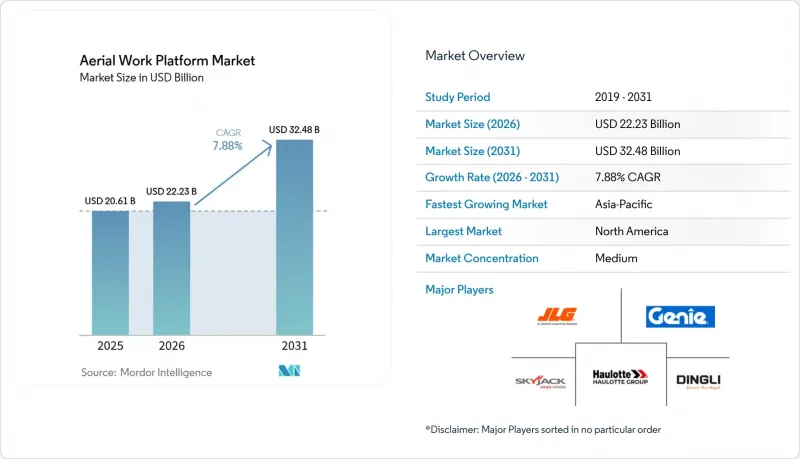
Mordor Intelligence에 의하면, 고소작업대 시장 규모는 2025년 206억 1,000만 달러로 평가되었습니다. 2026년에는 222억 3,000만 달러로 확대되어 2026년부터 2031년에 걸쳐 CAGR 7.88%로 성장을 지속하여, 2031년에는 324억 8,000만 달러에 이를 것으로 예측됩니다.
본 보고서는 제품별(붐 리프트, 시저 리프트, 수직 리프트, 트레일러 탑재형 리프트), 구동 방식별(내연기관, 전기, 하이브리드), 작업 높이별(20피트 미만, 21-50피트, 51-100피트, 100피트 이상), 용도별(건설, 유틸리티, 기타), 지역별로 분류되어 있습니다. 시장 전망은 금액(달러) 기준으로 제시되어 있습니다.
세계의 고소작업대 시장 동향 및 인사이트
전 세계 인프라 및 상업 건설 붐
미국, 캐나다, 인도의 인프라 부양책에 힘입은 메가 프로젝트는 고소작업대 시장에 대한 장비 교체 수요를 지속적으로 유발하고 있습니다. 미국의 ‘인프라 투자 및 고용법’만으로도 고속도로, 교량, 공공시설 개보수를 아우르는 다년간의 자금이 확보되었습니다. 데이터센터, 기가팩토리, 다층 산업 플랜트 등 구조의 복잡성이 증가함에 따라, 긴 리치와 콤팩트한 섀시 실적를 겸비한 접근 장비가 요구되고 있습니다. 이에 따라 각 제조업체들은 ANSI A92 안전 사용 규정을 준수하는 2차 보호 장치와 실시간 하중 감지 모듈을 탑재한, 더 높은 용량의 관절식 붐을 잇달아 시장에 출시하고 있습니다. 렌탈 업체들은 이러한 기능 업그레이드를 최종 사용자에게 제공하고 있으며, 일부 하위 부문에서 전체 건설 지출이 감소 추세를 보이고 있음에도 불구하고 가동률은 견조한 추세를 보이고 있습니다.
근로자 안전에 관한 규제 강화
OSHA 규격 1926.453 및 1910.67, 그리고 2018년 ANSI A92 전면 개정에 따라, 고용주는 모든 이동식 고소 작업대(MEWP)에 대해 기종별 교육, 추락 방지 장치, 그리고 문서화된 점검을 제공해야 할 의무가 있습니다. 이 일련의 규제로 인해 구형 또는 인증을 받지 않은 장비의 도입 비용이 실질적으로 상승함에 따라, 도급업체들은 경사 경보, 플랫폼 하중 센서, 자동 하강 제어 기능을 탑재한 새로운 장비로 전환하고 있습니다. 규정 준수 감사 빈도가 높아지면서, 프로젝트 발주처가 MEWP 인증을 기준으로 하도급업체에 대한 사전 심사를 실시하는 사례가 증가하고 있습니다. 이에 대응하여 장비 제조업체들은 2024년 ‘최우수 안전 혁신상’을 수상한 Haulotte사의 FASTN 랜야드 앵커 감지 기능과 같은 혁신적인 기술로 대응하고 있습니다. 이처럼 진행 중인 안전 문화의 변화로 인해, 규정 준수 기능이 통합된 장비의 프리미엄 가격 책정력이 더욱 강화되고 있습니다.
높은 초기 투자 비용과 기존 작업 방식과의 비교
2020년부터 2024년에 걸쳐 철강 및 전자 부품 비용이 급등함에 따라, 신형 중급 시저 리프트의 정가는 30% 가까이 상승하여 비계나 사다리 같은 대체 수단과의 가격 차이가 확대되었습니다. 그 결과, 소규모 업체의 경우 구매를 정당화하기 어려워져 대신 단기 렌탈을 선택하거나, 저고도 작업에서는 노동 집약적인 기존 방식으로 되돌아가는 경향이 있습니다. 반면, 자동화 및 안전 대책을 통한 비용 절감이 초기 투자의 일부를 상쇄하고 있습니다. 각 제조업체는 운송 비용을 절감하는 모듈식 구성품, 파이프 랙 및 패널 크래들 등 단일 기계의 가동률을 높이는 다기능 액세서리를 제공함으로써 이러한 수요에 대응하고 있습니다.
부문 분석
2025년 고소작업대 시장에서 붐 리프트는 43.24%라는 최대 점유율을 차지했으며, 혼잡한 작업 현장에서는 다직종에서의 범용성이 여전히 최우선 과제인 만큼 이 위치를 유지할 것으로 예측됩니다. 아티큘레이팅 모델은 베이스 차량의 위치를 변경하지 않고도 철골 구조물이나 HVAC 덕트를 회피할 수 있는 리치 각도를 갖추고 있어 작업 사이클의 생산성을 향상시키고 있습니다. 2024년에 출시된 Haulotte사의 ‘HA20 RTJ PRO’는 더 빠른 승강 속도와 최대 적재량에서 전체 높이 작동을 가능하게 하는 하중 감지식 섀시 등 성능 지표로의 전환을 상징하는 제품입니다. 시저 리프트는 여러 작업자가 참여하는 실내 인테리어 공사에서 주류를 이루고 있지만, 점진적인 상품화가 진행됨에 따라 가격 하락 압력이 계속되고 있습니다. 수직 마스트 리프트는 제로 턴 반경을 중시하는 창고 운영 사업자에 의해 주도되어 연평균 성장률(CAGR) 8.84%라는 가장 높은 성장률을 보일 것으로 전망됩니다. 트레일러 탑재형 붐 리프트는 유틸리티 및 통신사의 유지보수 분야에서 여전히 중요한 역할을 수행하고 있지만, 자체 주행식 유닛은 지방에서 중량 제한을 초과하여 도로 규제를 위반할 우려가 있습니다.
시간이 지남에 따라 각 제조업체는 제품군 전반에 걸쳐 텔레매틱스 하드웨어를 표준화하고 있으며, 이를 통해 렌탈 회사는 붐 리프트와 시저 리프트의 성능 데이터를 단일 대시보드에 통합할 수 있게 됩니다. 엔진 정지 시 전기 크리프 모드를 갖춘 하이브리드 파워트레인은 고급 붐 리프트에서 중형 시저 리프트로 확대 적용되고 있으며, 이는 도심 지역의 배기가스 규제를 충족시킵니다. 붐 리프트의 중고 가격은 모든 카테고리 중에서 여전히 가장 높기 때문에 차량 소유주들은 이 기종에 불균형적으로 많은 자본을 할당하고 있으며, 이는 고소작업대 시장에서의 우위를 더욱 공고히 하고 있습니다.
2025년에도 고소작업대 시장에서 내연기관 시장 점유율은 여전히 61.74%를 차지했지만, 전기식 모델은 다른 어떤 추진 방식보다 빠르게 점유율을 확대되고 있습니다. 도시 지역의 조례에 따라 재개발 현장에서의 디젤 사용이 단계적으로 폐지됨에 따라, 전기식 고소 작업 차량 시장 규모는 연평균 성장률(CAGR) 10.26%라는 두 자릿수 성장률을 기록하며 확대되고 있습니다. 리튬 이온 배터리 팩은 야간에 전력망에서 충전할 경우, 프로판에 상응하는 연료에 비해 에너지 비용을 약 30% 절감하면서도 40피트 가위식 리프트에 1교대 분량의 가동 시간을 확보할 수 있게 되었습니다. 하이브리드 구성은 충전 인프라가 갖춰지지 않은 외딴 지역에서의 용도에 있어, 소형 엔진과 회생 제동을 결합함으로써 가동 시간을 연장하고, 과도기적인 해결책을 제공합니다.
각 OEM 업체들은 배터리용 금속 가격 급등이라는 피할 수 없는 위험에 직면해 있지만, 많은 기업이 자동차 제조업체와 공동으로 양극재 공급 계약을 체결함으로써 위험을 분산하고 있습니다. 영국 HS2 철도 부지 내에서는 현장용 급속 충전소의 시범 운영이 진행 중이며, 연방 정부의 인프라 보조금을 통해 북미 고속도로에서도 유사한 노력이 확대될 전망입니다. 안전 기준도 진화하고 있으며, 리튬 이온 배터리 팩으로 인한 화재가 잇따른 것을 계기로 UL 2580 내화성 인증은 대형 렌탈 기업들의 구매 기준이 되고 있습니다. 그 결과, 2027년 이후 배터리의 절대적인 비용은 점차 하락하는 추세를 보일 것, 전동화의 진전은 고소작업대 시장의 프리미엄 부문을 더욱 강화할 것으로 보입니다.
지역별 분석
2025년, 북미는 고소작업대 시장에서 34.76%의 시장 점유율을 차지했습니다. ANSI A92 규격 준수 및 대규모 연방 정부 자금 배분을 통해 추진되는 지속적인 갱신 주기가 텔레매틱스 기능을 탑재한 신규 차량군에 대한 수요를 뒷받침하고 있습니다. 유나이티드 렌탈스(United Rentals)와 같은 기업들은 이 지역에서 주도적인 위치를 뒷받침할 만한 규모를 보여주고 있습니다. 캐나다의 성장은 자원 부문의 확대와 도심 지역의 리모델링 의무화가 주를 이루는 반면, 멕시코에서는 니어쇼어링 붐에 힘입어 자동차 및 전자기기 공장을 위한 중고도용 전동 고소작업대 구매가 촉진되고 있습니다.
아시아태평양은 급속한 도시화와 산업의 다각화에 힘입어 9.27%라는 가장 높은 연평균 성장률(CAGR)을 달성할 전망입니다. 중국의 건설기계 시장 전체는 2023년에 위축되었으나, 2024년 중반부터 안정화되기 시작했으며, 금융 완화 정책에 힘입어 도시 지역 프로젝트 및 데이터센터 회랑을 위한 AWP 수주가 다시 활성화될 것으로 예측됩니다. 인도 시장은 대규모 철도 및 공항 프로젝트의 확장에 힘입어 성장하고 있습니다. 동남아시아 국가들?인도네시아, 베트남, 필리핀?은 지역 전자상거래 사업자들이 다층형 풀필먼트 허브를 잇달아 구축함에 따라 새로운 성장 거점으로 부상하고 있으며, 30-40피트급 전동 고소작업대에 대한 수요를 견인하고 있습니다.
유럽은 여전히 성숙한 시장이지만, 혁신 지향성이 강한 시장이기도 합니다. 독일과 핀란드에서는 2023년에 두 자릿수 대수의 차량 증설이 나타났으나, 스페인 등 남유럽 국가들은 재정적 제약으로 어려움을 겪으며 회복 속도에 편차가 있었습니다. 더 엄격해진 스테이지 V 배기가스 규제로 인해 디젤식 시저 리프트에서 하이브리드 또는 완전 전기식으로의 전환이 가속화되고 있습니다. 특히 네덜란드와 스칸디나비아 국가에서는 도심 프로젝트에 대해 ‘지역 내 배출 제로’ 의무가 부과되고 있어 이러한 경향이 두드러집니다. 중동에서는 사우디아라비아의 NEOM 구역 전역에 걸친 거대 프로젝트를 위해 초고소 작업에 대한 수요가 증가하고 있습니다. 아프리카와 남미는 여전히 비교적 개발도상 단계이지만, 인프라 자금 조달이 개선됨에 따라 중고 장비 수입이 서서히 증가하고 있습니다. 이러한 지역별 특징을 종합해 보면, 고소작업대 시장은 불균일하지만 전체적으로는 상승 추세를 보이고 있음이 분명해집니다.
기타 혜택 :
- 엑셀 형식 시장 예측(ME) 시트
- 3개월간의 애널리스트 지원
자주 묻는 질문
목차
제1장 서론
제2장 조사 방법
제3장 주요 요약
제4장 시장 구도
제5장 시장 규모 및 성장 예측
제6장 경쟁 구도
제7장 시장 기회 및 향후 전망
KTH 26.08.05According to Mordor Intelligence, the aerial work platform market size is expected to grow from USD 20.61 billion in 2025 to USD 22.23 billion in 2026, and is forecast to reach USD 32.48 billion by 2031, at a 7.88% CAGR over 2026-2031.
This report is Segmented by Product (Boom Lifts, Scissor Lifts, Vertical Lifts, and Trailer-Mounted Lifts), Propulsion Type (Internal-Combustion Engine, Electric, and Hybrid), Lifting Height (Below 20 Ft, 21-50 Ft, 51-100 Ft, and Above 100 Ft), Application (Construction, Utilities, and More), and Geography. The Market Forecasts are Provided in Terms of Value (USD).
Global Aerial Work Platform Market Trends and Insights
Global Infrastructure and Commercial Construction Boom
Mega-projects backed by infrastructure stimulus in the United States, Canada, and India inject sustained demand for fleet replacement into the aerial work platforms market. The U.S. Infrastructure Investment and Jobs Act alone has unlocked multi-year funding that covers highways, bridges, and utility upgrades. Heightened structural complexity-data centers, gigafactories, and multi-story industrial plants-requires access equipment that combines long outreach with compact chassis footprints. Manufacturers are therefore debuting higher-capacity articulating booms fitted with secondary guarding and real-time load-sensing modules that comply with ANSI A92 safe-use rules. Rental companies pass these feature upgrades through to end users, and utilization rates have remained resilient even as broader construction spend ebbs in some sub-segments.
Stricter Worker-Safety Regulations
OSHA standards 1926.453 and 1910.67, and the 2018 ANSI A92 overhaul, require employers to provide machine-specific training, fall-arrest equipment, and documented inspections for all mobile elevating work platforms . The rule set has effectively raised the entry cost for older or uncertified units, steering contractors toward newer fleets that embed tilt alarms, platform load sensors, and automated descent controls. Compliance audits have become more frequent, and project owners increasingly pre-qualify subcontractors based on MEWP certification. Equipment makers answer this with innovations such as Haulotte's FASTN lanyard-anchorage detection, which secured Best Safety Innovation honors in 2024. The ongoing safety culture shift thus reinforces premium pricing power for devices with integrated compliance features.
High Capital Costs vs. Conventional Access Methods
List prices for new mid-range scissor lifts rose nearly 30% between 2020 and 2024 as steel and electronics costs spiked, widening the gap against scaffolding or ladder alternatives. Smaller trades, therefore, struggle to justify ownership, opting instead for short-term rentals or reverting to labor-intensive solutions for lower-height jobs. While automation and safety savings partly offset upfront outlays. Manufacturers are responding with modular components that reduce transport costs and multifunctional accessories, such as pipe racks or panel cradles, that increase the utilization of single machines.
Other drivers and restraints analyzed in the detailed report include:
- Telematics-Enabled Predictive Maintenance and Remote Diagnostics
- Rising Use in Film/Media Production and Event Staging
- Availability of Low-Cost Used Equipment and Substitutes
For complete list of drivers and restraints, kindly check the Table Of Contents.
Segment Analysis
Boom lifts held the largest share, at 43.24%, of the aerial work platforms market in 2025, a position they are projected to defend as multi-trade versatility remains paramount on congested job sites. Articulating models integrate outreach angles that enable operators to clear steel structures and HVAC ductwork without repositioning base vehicles, boosting cycle productivity. Haulotte's HA20 RTJ PRO, launched in 2024, is emblematic of the category's pivot toward performance metrics such as faster lift speeds and load-sensing chassis that enable full-height operation at full load capacity. Scissor lifts dominate multi-worker indoor fit-out tasks, but steady commoditization keeps their price points under downward pressure. Vertical mast lifts are on track for the fastest 8.84% CAGR, driven by warehouse operators who value their zero-turn radii. Trailer-mounted booms remain relevant for utilities and telecoms maintenance, whereas self-propelled units would exceed weight limits in rural areas and breach road regulations.
Over time, manufacturers standardize telematics hardware across product families, enabling rental companies to consolidate boom-lift and scissor performance data into a single dashboard. Hybrid powertrains with engine-off electric creep modes are migrating from high-end booms into midsize scissors, aligning with city-center emissions bylaws. Because boom-lift resale values remain highest among all categories, fleet owners allocate disproportionate capital toward these units, reinforcing their primacy in the aerial work platforms market.
Internal-combustion engines still capture 61.74% market share in the aerial work platforms market in 2025, yet electric variants capture an incremental share faster than any other propulsion cohort. The aerial work platforms market size for electric models is expanding at a double-digit 10.26% CAGR as urban ordinances phase out diesel on redevelopment sites. Lithium-ion packs now deliver full-shift autonomy for a 40-ft scissor at an energy cost about 30% lower than propane equivalents when charged overnight on the grid. Hybrid configurations provide bridge solutions in remote applications lacking charging infrastructure, combining downsized engines with regenerative braking to extend runtime.
OEMs face unavoidable exposure to battery-metal price surges, but many hedge by signing cathode-material contracts alongside automakers. On-site fast-charge stations are being trialed on United Kingdom. HS2 rail lots and will likely cascade into North American highways funded by federal infrastructure grants. Safety codes are also evolving; UL 2580 fire-resistance certification has become a purchasing criterion for rental majors following several high-profile lithium-pack fires. Consequently, electric adoption will reinforce the premium tier of the aerial work platforms market even as absolute battery costs gradually trend lower post-2027.
Complete Report Scope:
- By Product
- Boom Lifts
- Scissor Lifts
- Vertical Lifts
- Trailer-Mounted Lifts
- By Propulsion Type
- Internal-Combustion Engine (ICE)
- Electric
- Hybrid
- By Lifting Height
- Below 20 ft
- 21 - 50 ft
- 51 - 100 ft
- Above 100 ft
- By Application
- Construction
- Utilities
- Logistics and Transportation
- Manufacturing
- Others
- By Geography
- North America
- United States
- Canada
- Rest of North America
- South America
- Brazil
- Argentina
- Rest of South America
- Europe
- Germany
- United Kingdom
- France
- Italy
- Spain
- Rest of Europe
- Asia-Pacific
- China
- India
- Japan
- South Korea
- Australia
- Rest of Asia-Pacific
- Middle East and Africa
- Saudi Arabia
- United Arab Emirates
- South Africa
- Rest of Middle East and Africa
- North America
Geography Analysis
North America commanded 34.76% market share in the aerial work platforms market in 2025. Continuous replacement cycles driven by ANSI A92 compliance and large federal funding allocations sustain demand for new telematics-equipped fleets. Companies like United Rentals evidence the scale underpinning this geographic leadership. Canadian growth centers on resource-sector expansion and retrofit mandates in urban cores, whereas Mexico's near-shoring boom stimulates purchases of mid-height electrics for automotive and electronics plants.
Asia-Pacific is on track to achieve the fastest CAGR at 9.27%, supported by rapid urbanization and industrial diversification. While China's broader construction equipment market shrank in 2023, stabilization began in mid-2024, and policy credit easing is expected to rekindle AWP orders for metro projects and data-center corridors. The Indian market is growing through the expansion of mega rail and airport projects. Southeast Asian economies-Indonesia, Vietnam, and the Philippines-are emerging hotspots as regional e-commerce players replicate multi-level fulfillment hubs, fuelling appetite for 30- to 40-ft electrics.
Europe remains a mature but innovation-oriented market. Germany and Finland saw double-digit fleet additions in 2023, but southern states such as Spain wrestled with fiscal constraints, producing uneven recovery patterns. Stricter Stage V emissions standards accelerate replacement of diesel scissors with hybrid or fully electric alternatives, particularly in the Netherlands and Scandinavia, where zero-local-emission mandates apply to city-center projects. The Middle East is ramping up ultra-high-reach needs for giga-projects across Saudi Arabia's NEOM zones. Africa and South America remain comparatively nascent, yet gain incremental imports of used units as infrastructure financing improves. Together, these regional nuances underline the non-uniform but overall upward trajectory of the aerial work platforms market.
- JLG Industries (Oshkosh Corp.)
- Genie - Terex Corporation.
- Haulotte Group
- Skyjack - Linamar Corporation
- Zhejiang Dingli Machinery
- MEC Aerial Work Platforms
- Aichi Corporation
- Tadano Ltd.
- Bronto Skylift
- Niftylift Ltd.
- Sinoboom Intelligent Equipment
- Manitou Group
- Snorkel International
- Palfinger AG
- CTE SpA
- Ruthmann Holdings
- DINO LIFT OY
- Magni Telescopic Handlers
- Runshare Heavy Industry
- Mantall Heavy Industry
Additional Benefits:
- The market estimate (ME) sheet in Excel format
- 3 months of analyst support
TABLE OF CONTENTS
1 Introduction
- 1.1 Study Assumptions & Market Definition
- 1.2 Scope of the Study
2 Research Methodology
3 Executive Summary
4 Market Landscape
- 4.1 Market Overview
- 4.2 Market Drivers
- 4.2.1 Global Infrastructure and Commercial Construction Boom
- 4.2.2 Stricter Worker-Safety Regulations
- 4.2.3 Growing Rental Penetration of AWPs
- 4.2.4 Rapid Warehouse Automation in E-Commerce Logistics
- 4.2.5 Telematics-Enabled Predictive Maintenance and Remote Diagnostics
- 4.2.6 Rising Use in Film/Media Production and Event Staging
- 4.3 Market Restraints
- 4.3.1 High Capital Costs Vs. Conventional Access Methods
- 4.3.2 Availability of Low-Cost Used Equipment and Substitutes
- 4.3.3 Battery-Metals Supply Bottlenecks for Electric AWPs
- 4.3.4 Escalating Liability-Insurance Costs After Accidents
- 4.4 Regulatory Landscape
- 4.5 Technological Outlook
- 4.6 Porter's Five Forces Analysis
- 4.6.1 Threat of New Entrants
- 4.6.2 Bargaining Power of Suppliers
- 4.6.3 Bargaining Power of Buyers
- 4.6.4 Threat of Substitutes
- 4.6.5 Competitive Rivalry
5 Market Size & Growth Forecasts
- 5.1 By Product
- 5.1.1 Boom Lifts
- 5.1.2 Scissor Lifts
- 5.1.3 Vertical Lifts
- 5.1.4 Trailer-Mounted Lifts
- 5.2 By Propulsion Type
- 5.2.1 Internal-Combustion Engine (ICE)
- 5.2.2 Electric
- 5.2.3 Hybrid
- 5.3 By Lifting Height
- 5.3.1 Below 20 ft
- 5.3.2 21 - 50 ft
- 5.3.3 51 - 100 ft
- 5.3.4 Above 100 ft
- 5.4 By Application
- 5.4.1 Construction
- 5.4.2 Utilities
- 5.4.3 Logistics and Transportation
- 5.4.4 Manufacturing
- 5.4.5 Others
- 5.5 By Geography
- 5.5.1 North America
- 5.5.1.1 United States
- 5.5.1.2 Canada
- 5.5.1.3 Rest of North America
- 5.5.2 South America
- 5.5.2.1 Brazil
- 5.5.2.2 Argentina
- 5.5.2.3 Rest of South America
- 5.5.3 Europe
- 5.5.3.1 Germany
- 5.5.3.2 United Kingdom
- 5.5.3.3 France
- 5.5.3.4 Italy
- 5.5.3.5 Spain
- 5.5.3.6 Rest of Europe
- 5.5.4 Asia-Pacific
- 5.5.4.1 China
- 5.5.4.2 India
- 5.5.4.3 Japan
- 5.5.4.4 South Korea
- 5.5.4.5 Australia
- 5.5.4.6 Rest of Asia-Pacific
- 5.5.5 Middle East and Africa
- 5.5.5.1 Saudi Arabia
- 5.5.5.2 United Arab Emirates
- 5.5.5.3 South Africa
- 5.5.5.4 Rest of Middle East and Africa
- 5.5.1 North America
6 Competitive Landscape
- 6.1 Market Concentration
- 6.2 Strategic Moves
- 6.3 Market Share Analysis
- 6.4 Company Profiles (includes Global-level Overview, Market-level Overview, Core Segments, Financials, Strategic Information, Market Rank/Share for key companies, Products & Services, Recent Developments)
- 6.4.1 JLG Industries (Oshkosh Corp.)
- 6.4.2 Genie - Terex Corporation.
- 6.4.3 Haulotte Group
- 6.4.4 Skyjack - Linamar Corporation
- 6.4.5 Zhejiang Dingli Machinery
- 6.4.6 MEC Aerial Work Platforms
- 6.4.7 Aichi Corporation
- 6.4.8 Tadano Ltd.
- 6.4.9 Bronto Skylift
- 6.4.10 Niftylift Ltd.
- 6.4.11 Sinoboom Intelligent Equipment
- 6.4.12 Manitou Group
- 6.4.13 Snorkel International
- 6.4.14 Palfinger AG
- 6.4.15 CTE SpA
- 6.4.16 Ruthmann Holdings
- 6.4.17 DINO LIFT OY
- 6.4.18 Magni Telescopic Handlers
- 6.4.19 Runshare Heavy Industry
- 6.4.20 Mantall Heavy Industry


