
|
시장보고서
상품코드
2097266
항공기 견인 바 시장 : 점유율 분석, 업계 동향 및 통계, 성장 예측(2026-2031년)Aircraft Towbar - Market Share Analysis, Industry Trends & Statistics, Growth Forecasts (2026 - 2031) |
||||||
 Mordor Intelligence
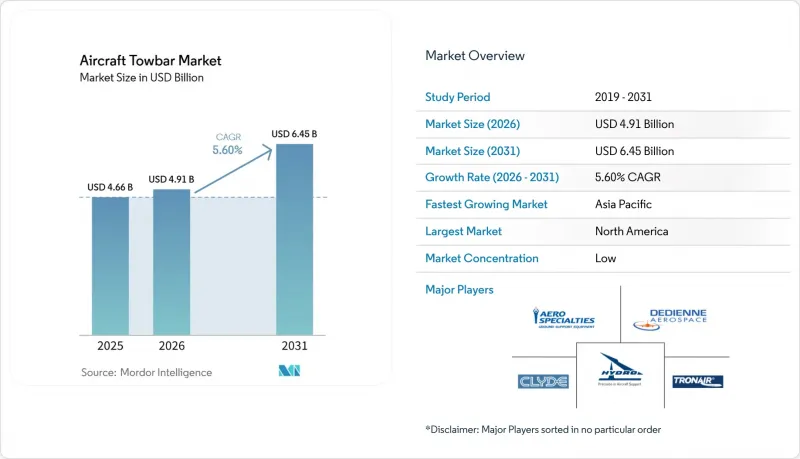
Mordor Intelligence에 의하면, 항공기 견인 바 시장 규모는 2025년에 46억 6,000만 달러로 평가되었고 2026년 49억 1,000만 달러에서 2031년까지 64억 5,000만 달러에 이를 것으로 예측되며, 예측 기간(2026-2031년) CAGR은 5.60%를 나타낼 전망입니다.
본 보고서는 견인 바 유형별(리지드형 및 표준형 견인 바, 멀티헤드형 및 유니버설형 견인 바 등), 항공기 유형별(민간 항공, 군용 항공, 일반 항공 등), 최종 사용자별(민간 항공사 등), 소재별(강합금제 견인 바 등), 지역별(북미, 유럽, 기타)로 분류되어 있습니다. 시장 전망은 금액(달러) 기준으로 제시되어 있습니다.
전 세계 항공기 견인 바 시장 동향 및 인사이트
전 세계 민간 항공기 기단의 급속한 확대
기단의 확대는 항공기 견인 바 시장 수요에 있어 단기적으로 가장 뚜렷한 촉진요인으로 계속 작용하고 있습니다. 2025년 전 세계 민간 항공기 인도 대수는 전년 대비 25% 증가한 1,411대를 기록했으며, 와이드바디기 인도 대수는 43% 증가한 246대를 기록했습니다. 또한 ADS는 이러한 추세가 2026년에도 지속될 것이라고 지적하고 있습니다. 와이드바디기 생산 확대의 회복과 A321XLR 등 신형 기종의 등장으로 인해, 최근 몇 년간 교체가 제한적이었던 대형 프레임 견인 시스템에 대한 신규 수주가 발생하고 있습니다. 대부분의 상업용 항공기용 견인 바 구성은 기체 형식에 따라 다르기 때문에 항공기 인도 시에는 도입 시점뿐만 아니라 운영 기간 전반에 걸쳐 조달이 필요합니다. 2026년 2월에 재확인된 SAE ARP1915E는 중량 구분별 견인 바 연결 치수에 관한 지침으로 계속 유지되고 있으며, 이 규격에 따라 조달은 OEM 및 운항사의 요구 사항과 밀접하게 부합하고 있습니다.
신흥 시장의 공항 인프라 확장
대규모 공항 건설 프로젝트로 인해 항공기 견인 바 시장의 도입 기반이 확대되고 있습니다. 이는 새로운 주차 스팟, 터미널, 원격 베이(bay)가 건설될 때마다 이를 뒷받침할 램프 설비가 필요하기 때문입니다. ACI 아시아태평양·중동 지부는 2025년부터 2035년까지의 공항 투자액을 2,400억 달러로 추산하고 있으며, 이 중 1,360억 달러는 기존 시설의 현대화에, 1,040억 달러는 신규 개발에 투입될 전망입니다. 두바이의 알 막툼 국제공항에서는 1단계 공사를 위해 2026년에 발주될 계약액이 550억 디르함(150억 달러)에 달할 것으로 결정되었으며, 이는 지상 지원 장비의 조달 주기가 장기화될 것임을 시사합니다. 그린필드 공항은 기존 장비군이 존재하지 않기 때문에 기존 공항보다 초기부터 더 많은 견인 바을 확보한 상태로 시작할 수 있다는 점에서 특히 가치가 높다고 할 수 있습니다. IATA의 지상 취급 프레임워크와 민간 항공 운항 규정 또한 기준이 되는 설비 비율을 지지하고 있어, 항공사별 선호도가 달라도 조달 수요를 유지하는 데 도움이 되고 있습니다.
주요 허브 공항에서의 견인 바 없는 트랙터 도입
대형 허브 공항의 항공기 견인 바 시장에 있어, 견인 바 없는 시스템은 여전히 가장 명확한 구조적 제약 요인으로 남아 있습니다. Goldhofer는 2025년 9월, ERJ-170부터 B777-300ER에 이르는 항공기에 대응 가능한 견인 바 없는 플랫폼으로, 완전 전기식 ‘아틀라스 2’를 도입했습니다. 이를 통해 제로 배출 견인 바 없는 운용의 대상 범위가 확대되었습니다. 또한 KLM은 2025년 12월, TCR과의 임대 계약에 따라 암스테르담 스키폴 공항에 Goldhofer의 전동 견인 트랙터 ‘피닉스 AST2E’를 도입했습니다. 이는 주요 항공사들이 이미 일부 운항에서 견인 바에 의존하는 램프 설비를 대체하고 있음을 보여줍니다. 이러한 영향은 처리 능력이 높은 협폭기용 게이트에서 가장 두드러집니다. 반면, 지방 공항, 화물 램프, 군사 시설 및 MRO 시설에서는 비용과 운영 유연성의 관점에서 여전히 기존 시스템에 크게 의존하고 있습니다. 또한, EASA의 현행 지상 취급 프레임워크에서는 전환 기간 동안 백업 능력 유지가 허용되고 있기 때문에 기존 시스템을 완전히 대체하는 움직임이 당장 널리 확산되기는 어려울 것입니다.
부문 분석
2025년, 리지드형 및 표준형 견인 바는 항공기 견인 바 시장 점유율의 40.54%를 차지하며, 견인 바 유형별 수요에서 1위를 유지했습니다. 이러한 위상은 낮은 단가, 운항 사업자들의 폭넓은 친숙도, 확립된 견인 기준에 대한 용이한 준수, 그리고 교체 부품 및 서비스를 위한 탄탄한 애프터마켓을 반영한 것입니다. 또한, 이 부문은 전 세계 상업 허브 공항 운영에서 나로우바디 항공기가 주류를 이루고 있다는 점도 호재로 작용하고 있으며, 이러한 공항에서는 표준화된 절차에 따라 검증된 기존 장비가 여전히 선호되고 있습니다. 조절식 및 신축식 제품의 판매량은 여전히 적은 상황입니다. 그럼에도 불구하고, 기체 처리 능력보다 앞바퀴 높이 조절이 중요한 원격 주차 구역이나 정비 환경에서는 여전히 실용적인 역할을 수행하고 있습니다.
항공기 견인 바 시장이 혼합 기단의 효율화 및 에이프런 내 보관 공간 절감으로 전환됨에 따라, 멀티헤드형 및 유니버설형 제품의 인기가 높아지고 있습니다. 교체 가능한 견인 헤드를 갖춘 단일 메인 바 하나로 수십 대의 항공기 장착 지점에 대응할 수 있기 때문에 이러한 시스템은 동일한 램프 거점에서 와이드바디기와 나로우바디기 운항을 모두 담당하는 운영사에게 유용합니다. 전동 및 자가 주행식 견인 바 시장 규모는 2031년까지 연평균 성장률(CAGR) 7.24%로 확대될 것으로 예상되며, 이는 가장 빠르게 성장하는 유형 부문이 될 것입니다. 이러한 성장은 공항 및 지상 취급 사업자의 전동화 프로그램과 밀접한 관련이 있으며, 배터리 통합을 통해 충전기, 배터리 팩, 제어 장치, 소프트웨어 지원과 같은 애프터마켓 수익 기회도 확대되고 있습니다.
2025년에는 상업용 항공기가 부문 수요의 56.27%를 차지하며, 항공기 견인 바 시장에서 가장 큰 항공기 카테고리가 되었습니다. A320 계열이나 B737 MAX와 같은 협폭기(narrow-body)는 일일 견인 바 사용률이 가장 높기 때문에 일상적인 조달 및 교체 측면에서 여전히 가장 큰 수요 기반을 형성하고 있습니다. 광폭기(wide-body)는 대수는 적지만, 대응하는 시스템이 대형이라 판매 가격이 높고 운영 요건도 엄격하기 때문에 수주 금액은 높아집니다. 지역 제트기 역시 여전히 중요한 위치를 차지하고 있습니다. 이는 지방 도시로의 네트워크 확장이 일부 신흥 항공 시장에서 신규 인도 및 관련 지상 장비에 대한 수요를 지속적으로 뒷받침하고 있기 때문입니다.
군용기 및 일반 항공기는 플랫폼이나 임무 프로파일에 따라 사양이 크게 다르기 때문에 항공기 견인 바 시장에서 더욱 세분화된 수요 패턴을 보이고 있습니다. 군사 용도의 경우, 많은 경우 맞춤형 견인 바 설계나 독자적인 인증 절차가 요구되므로, 이미 방위 관련 승인을 획득한 공급업체의 수익이 보장됩니다. eVTOL 및 경량 전기 항공기용 항공기 견인 바 시장 규모는 2031년까지 연평균 성장률(CAGR) 8.91%로 확대될 것으로 예측되며, 항공기 유형별 부문 중 가장 빠르게 성장하는 분야가 될 전망입니다. 이 카테고리는 현재로서는 매출 측면에서 아직 규모가 작습니다. 그러나 낮은 결합 높이, 경량 구조, 다양한 견인 인터페이스 등의 요인으로 인해 새로운 기기 계층이 형성되고 있으며, 인증이 더욱 보편화되면 더 강력한 조달 주기로 발전할 가능성이 있습니다.
지역별 분석
2025년 시점에서 북미는 항공기 견인 바 시장 점유율의 41.98%를 차지하며, 시장에서 가장 규모가 큰 지역 거점입니다. 이 지역은 활발한 상업 비행, 대규모 허브 네트워크, 그리고 주로 미국에 집중된 OEM, 서비스 제공업체, 애프터마켓 지원으로 구성된 성숙한 생태계의 혜택을 누리고 있습니다. Tronair, HALL Industries, AERO Specialties 등공급업체 역시 항공사 고객과의 지리적 근접성과 미국 항공 사업과 연계된 오랜 조달 채널로부터 혜택을 받고 있습니다. 리스 모델을 통한 GSE 자산 중 북미가 차지하는 비중은 고작 10%에 불과하기 때문에 리스는 여전히 유용한 차별화 요소로 작용하고 있습니다. 대조적으로, 유럽에서는 리스 구조에 따른 GSE 자산이 약 절반을 차지하며, 대부분의 경우 풀서비스 계약에 유지보수가 포함되어 있습니다. 유럽은 항공기 견인 바 시장에서 여전히 성숙한 고부가가치 지역이며, 유럽연합 집행위원회 위임규정(EU) 2025/20에 따른 더욱 엄격한 규정 준수 요건이 인증을 받은 고사양 장비에 대한 수요를 지속적으로 견인하고 있습니다.
아시아태평양의 항공기 견인 바 시장 규모는 2031년까지 연평균 성장률(CAGR) 6.52%로 확대될 것으로 예측되며, 지역별 부문 중 가장 빠른 성장을 이룰 전망입니다. ACI 아시아태평양·중동은 2025년부터 2035년까지 해당 지역 전체에서 2,400억 달러 규모의 공항 투자가 이루어질 것으로 추정하고 있으며, 이를 통해 항공기 견인 바 시장에는 향후 지상 지원 장비 조달을 위한 견고한 파이프라인이 제공될 것입니다. 중국, 인도, 일본, 한국은 계속해서 주요 수요 거점이 될 것이며, 중국의 국내 항공기 프로그램은 많은 유럽 및 미국 공급업체들이 아직 충분히 진출하지 못한 COMAC 호환 견인 바 구성에 있어 구체적인 시장 기회를 제공합니다. 베트남의 롱탄 국제공항은 2026년 12월 상업 운항 개시를 향해 순조롭게 진행되고 있으며, 예산 1287억 대만 달러(40억 2,000만 달러)가 책정된 대만 타오위안 공항 제3터미널 프로젝트도 완공을 향해 진전되고 있습니다. 또한, 나리타 공항의 레벨 4 자율 견인 시스템 도입은 아시아태평양 일부 항공사들이 얼마나 신속하게 자동화를 램프 전략에 통합하고 있는지를 보여줍니다.
남미에서는 항공기 견인 바 시장에서 보다 꾸준하고 완만한 성장이 관찰됩니다. 특히 브라질은 국내 항공 산업의 기반이 방대하고 공항 개보수 공사가 지속되고 있어 중심적인 역할을 담당하고 있습니다. 중동 및 아프리카에서는 보다 자본 집약적인 경향이 나타나고 있으며, 두바이의 알 막툼 공항 확장 계획과 리야드의 킹 살만 국제공항 건설은 모두 신규 및 교체용 GSE(지상 지원 장비)에 대한 수년에 걸친 조달 붐을 예고하고 있습니다. 2026년 1월로 예정된 리야드의 제3활주로 착공으로 인해 시간당 항공기 이착륙 처리 능력이 31% 증가할 것으로 예상되며, 이는 견인 장비에 대한 향후 수요를 직접 뒷받침하게 될 것입니다. 또한, Dedienne Aerospace가 2026년에 두바이 시설을 5,000제곱미터로 확장하기로 결정한 것은 중동 및 아프리카 및 튀르키예 전역에서 다가올 조달 주기를 앞두고, 유서 깊은 공급업체들이 조기에 입지를 다지려 하고 있음을 보여줍니다.
기타 혜택:
- 엑셀 형식 시장 예측(ME) 시트
- 3개월간의 애널리스트 지원
자주 묻는 질문
목차
제1장 서론
제2장 조사 방법
제3장 주요 요약
제4장 시장 구도
제5장 시장 규모와 성장 예측
제6장 경쟁 구도
제7장 시장 기회와 향후 전망
JHS 26.08.05According to Mordor Intelligence, the aircraft towbar market size was valued at USD 4.66 billion in 2025 and estimated to grow from USD 4.91 billion in 2026 to reach USD 6.45 billion by 2031, at a CAGR of 5.60% during the forecast period (2026-2031).
This report is Segmented by Towbar Type (Rigid and Standard Towbars, Multi-Head and Universal Towbars, and More), Aircraft Type (Commercial Aviation, Military Aviation, General Aviation, and More), End User (Commercial Airlines, and More), Material (Steel-Alloy Towbars, and More), and Geography (North America, Europe, and Others). The Market Forecasts are Provided in Terms of Value (USD).
Global Aircraft Towbar Market Trends and Insights
Rapid Growth in Global Commercial Aircraft Fleet
Fleet expansion remains the clearest near-term driver of demand for the aircraft towbar market. Global commercial aircraft deliveries rose 25% year over year in 2025 to 1,411 units, while widebody deliveries increased 43% to 246 aircraft, and ADS pointed to continued momentum into 2026. The return of widebody production growth and the entry of aircraft such as the A321XLR are creating new orders for larger-frame towing systems that had seen limited renewal for several years. Each aircraft delivery entails procurement not only at induction but also throughout the aircraft's operating life, because most commercial towbar setups remain aircraft-type-specific. SAE ARP1915E, reaffirmed in February 2026, continues to guide tow bar connection dimensions by mass category, and that standard keeps procurement tightly aligned with OEM and operator requirements.
Airport Infrastructure Expansion Across Emerging Markets
Large airport construction programs are widening the installed base for the aircraft towbar market because every new stand, terminal, and remote bay requires supporting ramp equipment. ACI Asia-Pacific and Middle East placed airport investment at USD 240 billion for 2025-2035, including USD 136 billion for brownfield modernization and USD 104 billion for greenfield development. Dubai's Al Maktoum International Airport moved ahead with AED 55 billion (USD 15 billion) in contracts to be awarded in 2026 for Phase 1 works, indicating a long procurement cycle for ground support equipment. Greenfield sites are especially valuable because they lack legacy equipment pools and therefore start with higher initial towbar inventories than established airports. IATA ground handling frameworks and civil aviation operating rules also support baseline equipment ratios, which help maintain procurement demand even when airline preferences differ.
Towbar-Less Tractor Adoption at Major Hubs
Towbarless systems remain the clearest structural restraint on the aircraft towbar market at large hub airports. Goldhofer introduced the all-electric Atlas 2 in September 2025 as a towbarless platform capable of handling aircraft ranging from the ERJ-170 to the B777-300ER, thereby widening the addressable range for zero-emission towbarless operations. KLM also deployed electric Goldhofer Phoenix AST2E tow tractors at Amsterdam Schiphol in December 2025 under a lease arrangement with TCR, indicating that major carriers are already replacing towbar-dependent ramp setups in select operations. The effect is strongest at high-throughput narrowbody gates. At the same time, regional airports, cargo ramps, military sites, and MRO facilities still rely heavily on conventional systems due to cost and operational flexibility. EASA's current ground handling framework also supports continued backup capability during transition periods, which limits the immediate reach of full displacement.
Other drivers and restraints analyzed in the detailed report include:
- Accelerating Shift Toward Electric Ground Support Equipment
- OEM Push for Mixed-Fleet Compatible Multi-Type Towbars
- Supply Constraints for Aerospace-Grade Lightweight Materials
For complete list of drivers and restraints, kindly check the Table Of Contents.
Segment Analysis
Rigid and standard towbars held 40.54% of the aircraft towbar market share in 2025, which kept them in the lead across towbar type demand. Their position reflects low unit cost, broad operator familiarity, straightforward compliance with established towing standards, and a deep aftermarket for replacement parts and service. The segment also benefits from the narrowbody bias of global commercial hub operations, where standardized procedures still favor proven conventional equipment. Adjustable and telescopic variants remain smaller in volume. Still, they continue to play a practical role in remote-stand use and maintenance environments where nose gear height variation matters more than fleet throughput.
Multi-head and universal products are gaining ground as the aircraft towbar market shifts toward mixed-fleet efficiency and lower apron storage needs. A single main bar with interchangeable tow heads can support dozens of aircraft attachment points, making these systems useful for operators that cover both widebody and narrowbody traffic from the same ramp base. The aircraft towbar market size for electric and self-powered towbars is projected to expand at a 7.24% CAGR through 2031, making this the fastest-growing type segment. That growth is tied to airport and ground handler electrification programs, while battery integration is also opening aftermarket revenue in chargers, battery packs, controls, and software support.
Commercial aviation accounted for 56.27% of segment demand in 2025, which made it the largest aircraft category in the aircraft towbar market. Narrowbody platforms such as the A320 family and B737 MAX create the highest daily towbar usage rates, so they remain the largest volume base for routine procurement and replacement. Widebody aircraft generate fewer units but higher-value orders because larger compatible systems carry higher selling prices and stricter operating requirements. Regional jets also remain relevant because network growth into secondary cities continues to support new deliveries and demand for related ground equipment in several developing aviation markets.
Military and general aviation present a more fragmented demand pattern in the aircraft towbar market because specifications vary more widely across platforms and mission profiles. Military work often requires custom towbar designs and certification pathways, which protect revenue for vendors that already hold defense-related approvals. The aircraft towbar market size for eVTOL and light electric aircraft is projected to grow at an 8.91% CAGR through 2031, making it the fastest-growing aircraft-type segment. That category is still small in revenue terms today. Still, low coupling heights, lighter structures, and differing tow interfaces are creating a new equipment tier that could turn into a stronger procurement cycle once certifications become more common.
Complete Report Scope:
- By Towbar Type
- Rigid and Standard Towbars
- Multi-Head and Universal Towbars
- Adjustable and Telescopic Towbars
- Electric and Self-Powered Towbars
- Other Towbar Types
- By Aircraft Type
- Commercial Aviation
- Narrowbody Aircraft
- Widebody Aircraft
- Regional Jets
- Military Aviation
- Fighter Jets
- Special Mission Aircraft
- Transport Aircraft
- Rotorcraft
- General Aviation
- eVTOL and Light Electric Aircraft
- Commercial Aviation
- By End User
- Commercial Airlines
- Cargo Operators
- Airport Ground Handling Companies
- MRO and Line Maintenance Facilities
- Other End Users
- By Material
- Steel-Alloy Towbars
- Aluminum-Alloy Towbars
- High-Strength Steel and Chromoly Towbars
- Composite-Fiber Towbars
- Other Materials
- By Geography
- North America
- United States
- Canada
- Mexico
- Europe
- United Kingdom
- France
- Germany
- Russia
- Rest of Europe
- Asia-Pacific
- China
- India
- Japan
- South Korea
- Rest of Asia-Pacific
- South America
- Brazil
- Rest of South America
- Middle East and Africa
- Middle East
- Saudi Arabia
- United Arab Emirates
- Rest of Middle East
- Africa
- South Africa
- Rest of Africa
- Middle East
- North America
Geography Analysis
North America accounted for 41.98% of the aircraft towbar market share in 2025, making it the largest regional base in the market. The region benefits from dense commercial flight activity, large hub networks, and a mature ecosystem of OEMs, service providers, and aftermarket support, heavily centered in the US. Suppliers such as Tronair, HALL Industries, and AERO Specialties also gain from proximity to airline customers and long-established procurement channels tied to US aviation operations. Leasing remains a useful differentiator because North America accounts for only 10% of GSE assets under lease models. In contrast, Europe accounts for roughly half of all GSE assets under lease structures, often with maintenance bundled in full-service agreements. Europe remains a mature and high-value region for the aircraft towbar market, and stricter compliance expectations under Commission Delegated Regulation (EU) 2025/20 continue to drive demand for certified, higher-specification equipment.
The aircraft towbar market size for Asia-Pacific is projected to expand at a 6.52% CAGR through 2031, making it the fastest-growing regional segment. ACI Asia-Pacific and the Middle East identified USD 240 billion in airport investment across the region for 2025-2035, providing the aircraft towbar market with a strong pipeline of future ground support procurement. China, India, Japan, and South Korea remain the main demand centers, and China's domestic aircraft programs add a specific opening for COMAC-compatible towbar configurations that are still underpenetrated by many Western suppliers. Vietnam's Long Thanh International Airport remained on track for commercial operations in December 2026, while Taiwan Taoyuan Airport's Terminal 3 project, budgeted at TWD 128.7 billion (USD 4.02 billion), also moved toward completion, and Narita's Level 4 autonomous towing deployment shows how quickly some Asia-Pacific operators are folding automation into ramp strategy.
South America brings steadier, more measured growth to the aircraft towbar market, with Brazil at the center due to its large domestic aviation base and ongoing airport upgrade activity. The Middle East and Africa show a more capital-intensive profile, with Dubai's Al Maktoum expansion and Riyadh's King Salman International Airport both pointing to multi-year procurement waves for new and replacement GSE. Riyadh's third runway groundbreaking in January 2026 is expected to increase hourly movement capacity by 31%, directly supporting future demand for towing equipment. Dedienne Aerospace's decision to expand its Dubai facility to 5,000 sqm in 2026 also shows that established suppliers are positioning early for the next procurement cycle across the Middle East, Africa, and Turkey.
- Tronair Inc.
- AERO Specialties, Inc.
- Clyde Machines Inc.
- HYDRO Systems GmbH and Co. KG
- TowFLEXX GmbH
- HALL Industries, Inc.
- Dedienne Aerospace SAS
- GROUND SUPPORT EQUIPMENT COMPOUND SYSTEMS SLU
- Langa Industrial S.A.U.
- Panus Assembly Co., Ltd.
- Mototok International GmbH
- Brackett Aircraft Company, Inc.
- TUG TECHNOLOGIES CORPORATION (Textron Inc.)
- Advanced Ground Systems Engineering, LLC
- TECHMAN-HEAD
- K&M airporttechnik GmbH
- Goldhofer AG
Additional Benefits:
- The market estimate (ME) sheet in Excel format
- 3 months of analyst support
TABLE OF CONTENTS
1 INTRODUCTION
- 1.1 Study Assumptions and Market Definition
- 1.2 Scope of the Study
2 RESEARCH METHODOLOGY
3 EXECUTIVE SUMMARY
4 MARKET LANDSCAPE
- 4.1 Market Overview
- 4.2 Market Drivers
- 4.2.1 Rapid growth in global commercial aircraft fleet and MRO demand
- 4.2.2 Airport infrastructure expansion across emerging economies
- 4.2.3 Accelerating shift toward electric ground support equipment mandates
- 4.2.4 OEM push for mixed-fleet compatible multi-head towbars
- 4.2.5 eVTOL and light electric aircraft ground handling requirements
- 4.2.6 Towbar leasing and equipment-as-a-service adoption
- 4.3 Market Restraints
- 4.3.1 Towbar-less tractor adoption at major hubs
- 4.3.2 Cyclic volatility in aircraft production and deliveries
- 4.3.3 Regulatory qualification burden for load testing and fatigue validation
- 4.3.4 Supply constraints for aerospace-grade lightweight materials
- 4.4 Value Chain Analysis
- 4.5 Regulatory Landscape
- 4.6 Technological Outlook
- 4.7 Porter's Five Forces Analysis
- 4.7.1 Threat of New Entrants
- 4.7.2 Bargaining Power of Suppliers
- 4.7.3 Bargaining Power of Buyers
- 4.7.4 Threat of Substitutes
- 4.7.5 Intensity of Competitive Rivalry
5 MARKET SIZE AND GROWTH FORECASTS (VALUE)
- 5.1 By Towbar Type
- 5.1.1 Rigid and Standard Towbars
- 5.1.2 Multi-Head and Universal Towbars
- 5.1.3 Adjustable and Telescopic Towbars
- 5.1.4 Electric and Self-Powered Towbars
- 5.1.5 Other Towbar Types
- 5.2 By Aircraft Type
- 5.2.1 Commercial Aviation
- 5.2.1.1 Narrowbody Aircraft
- 5.2.1.2 Widebody Aircraft
- 5.2.1.3 Regional Jets
- 5.2.2 Military Aviation
- 5.2.2.1 Fighter Jets
- 5.2.2.2 Special Mission Aircraft
- 5.2.2.3 Transport Aircraft
- 5.2.2.4 Rotorcraft
- 5.2.3 General Aviation
- 5.2.4 eVTOL and Light Electric Aircraft
- 5.2.1 Commercial Aviation
- 5.3 By End User
- 5.3.1 Commercial Airlines
- 5.3.2 Cargo Operators
- 5.3.3 Airport Ground Handling Companies
- 5.3.4 MRO and Line Maintenance Facilities
- 5.3.5 Other End Users
- 5.4 By Material
- 5.4.1 Steel-Alloy Towbars
- 5.4.2 Aluminum-Alloy Towbars
- 5.4.3 High-Strength Steel and Chromoly Towbars
- 5.4.4 Composite-Fiber Towbars
- 5.4.5 Other Materials
- 5.5 By Geography
- 5.5.1 North America
- 5.5.1.1 United States
- 5.5.1.2 Canada
- 5.5.1.3 Mexico
- 5.5.2 Europe
- 5.5.2.1 United Kingdom
- 5.5.2.2 France
- 5.5.2.3 Germany
- 5.5.2.4 Russia
- 5.5.2.5 Rest of Europe
- 5.5.3 Asia-Pacific
- 5.5.3.1 China
- 5.5.3.2 India
- 5.5.3.3 Japan
- 5.5.3.4 South Korea
- 5.5.3.5 Rest of Asia-Pacific
- 5.5.4 South America
- 5.5.4.1 Brazil
- 5.5.4.2 Rest of South America
- 5.5.5 Middle East and Africa
- 5.5.5.1 Middle East
- 5.5.5.1.1 Saudi Arabia
- 5.5.5.1.2 United Arab Emirates
- 5.5.5.1.3 Rest of Middle East
- 5.5.5.2 Africa
- 5.5.5.2.1 South Africa
- 5.5.5.2.2 Rest of Africa
- 5.5.5.1 Middle East
- 5.5.1 North America
6 COMPETITIVE LANDSCAPE
- 6.1 Market Concentration
- 6.2 Strategic Moves
- 6.3 Market Share Analysis
- 6.4 Company Profiles (includes Global level Overview, Market level overview, Core Segments, Financials as available, Strategic Information, Market Rank/Share for key companies, Products and Services, and Recent Developments)
- 6.4.1 Tronair Inc.
- 6.4.2 AERO Specialties, Inc.
- 6.4.3 Clyde Machines Inc.
- 6.4.4 HYDRO Systems GmbH and Co. KG
- 6.4.5 TowFLEXX GmbH
- 6.4.6 HALL Industries, Inc.
- 6.4.7 Dedienne Aerospace SAS
- 6.4.8 GROUND SUPPORT EQUIPMENT COMPOUND SYSTEMS SLU
- 6.4.9 Langa Industrial S.A.U.
- 6.4.10 Panus Assembly Co., Ltd.
- 6.4.11 Mototok International GmbH
- 6.4.12 Brackett Aircraft Company, Inc.
- 6.4.13 TUG TECHNOLOGIES CORPORATION (Textron Inc.)
- 6.4.14 Advanced Ground Systems Engineering, LLC
- 6.4.15 TECHMAN-HEAD
- 6.4.16 K&M airporttechnik GmbH
- 6.4.17 Goldhofer AG
7 MARKET OPPORTUNITIES AND FUTURE OUTLOOK
- 7.1 White-space and Unmet-Need Assessment