

|
시장보고서
상품코드
2097279
AI 툴킷 : 시장 점유율 분석, 업계 동향 및 통계, 성장 예측(2025-2030년)AI Toolkit - Market Share Analysis, Industry Trends & Statistics, Growth Forecasts (2025 - 2030) |
||||||
 Mordor Intelligence
Mordor Intelligence에 의하면, AI 툴킷 시장 규모는 2025년에 301억 6,000만 달러로 평가되었고, 2030년까지 1,587억 3,000만 달러에 이를 것으로 예측되며, 2025-2030년 CAGR 39.39%로 성장할 전망입니다.
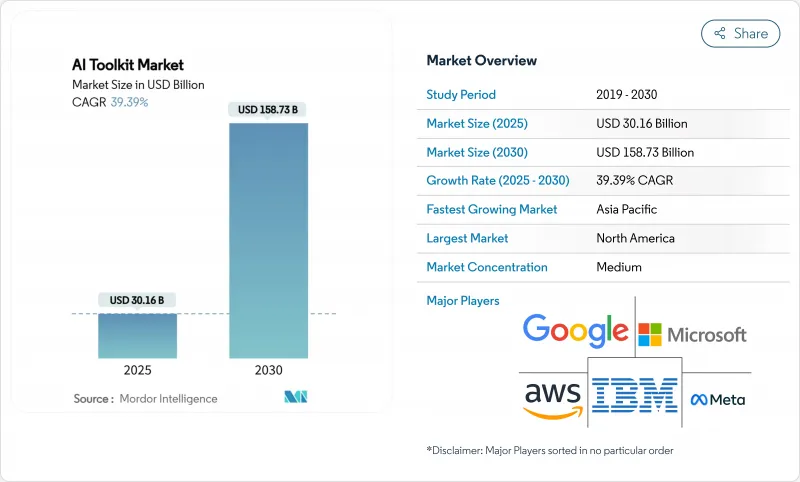
본 보고서는 도입 모델(클라우드 기반, On-Premise형, 하이브리드형), 구성 요소(소프트웨어 라이브러리 및 프레임워크, 사전 학습된 모델, SDK 및 API, 엔드투엔드 플랫폼), 최종 사용자 산업(은행, 금융서비스 및 보험(BFSI), 헬스케어 및 생명과학, 소매 및 전자상거래, 제조업 등), 조직 규모(대기업 및 중소기업), 그리고 지역별로 분류되어 있습니다. 시장 전망은 금액(달러) 기준으로 제시되어 있습니다.
세계의 AI 툴킷 시장 동향 및 인사이트
기업 내 생성형 AI 워크로드의 급속한 서론
생성형 AI는 실험 단계의 장벽을 넘어섰습니다. 현재 기업의 78%가 실제 운영 시스템을 도입하고 있으며, 87%는 2년 이내에 추가 확장을 위해 예산을 편성하고 있습니다. 제조업은 이러한 전환을 상징적으로 보여주며, 93%가 2024년에 새로운 AI 프로젝트를 시작하여 단순한 비용 절감뿐만 아니라 처리량과 품질 향상을 추구하고 있습니다. 통신 사업자들은 2025년까지 네트워크 토폴로지와 예측 유지보수를 최적화하는 에이전트형 AI를 통해 연간 110억 달러의 수익을 기대하고 있습니다. 조기 도입 기업들은 12개월 이내에 20-30%의 생산성 향상을 보고하고 있으며, 사내 성공 사례가 새로운 투자를 촉진하는 선순환이 형성되고 있습니다.
하이퍼스케일러의 클라우드 AI 서비스가 진입 장벽을 낮추고 있습니다.
Google Cloud의 Hugging Face 통합을 통해 개발자는 35만 개의 모델과 저비용 TPU에 원활하게 접근할 수 있게 되어, 기존의 예산 및 기술적 장벽이 해소되었습니다. Azure AI Foundry Agent Service와 같은 표준화된 멀티 에이전트 툴킷은 오케스트레이션의 복잡성을 줄여주며, Model Context Protocol과 같은 개방형 프로토콜은 벤더 간 통합을 효율화하고 있습니다. 경쟁 압력으로 인해 클라우드의 다양화가 그 어느 때보다 빠르게 진행되고 있습니다. ChatGPT는 현재 5개국에 걸쳐 Google, Oracle, CoreWeave, Microsoft Azure의 인프라에서 운영되고 있으며, 지연 시간에 대한 내성과 가격 협상력을 높이고 있습니다.
고급 AI 엔지니어링 인력 부족
멀티모달 모델 운영, 프롬프트 엔지니어링, 윤리적 AI 전문가에 대한 수요가 공급을 초과하고 있으며, 아시아태평양 기업의 60%가 현지 전문 인력을 양성할 계획을 세우고 있음에도 불구하고 채용 측면에서 격차를 겪고 있습니다. 대형 기술 기업들은 인력 배치를 재검토하고 있으며, Salesforce는 1,000개의 직위를 감축하는 한편, AI 기술을 갖춘 영업 담당자를 채용하고 2025년 소프트웨어 개발자의 순증 채용을 동결했습니다. 중소기업은 급여 조건 경쟁에서 고전하고 있어, 매니지드 서비스나 자동화된 파이프라인으로의 전환을 강요받고 있습니다.
부문 분석
하이브리드 구성은 가장 빠르게 확산되고 있는 접근 방식으로, 기업들이 주권과 탄력적인 컴퓨팅의 균형을 모색함에 따라 연평균 성장률(CAGR) 40.31%로 확대되고 있습니다. 2024년, 클라우드는 AI 툴킷 시장 점유율의 61.23%를 유지했으나, 아웃바운드 통신 비용을 절감하기 위해 사내 GPU 클러스터를 구축하는 미국 기업들 사이에서 On-Premise에 대한 관심이 다시 높아지고 있습니다. 하이브리드 모델은 기밀성이 높은 데이터 세트를 On-Premise에 보관하면서 버스트 워크로드를 클라우드에서 처리할 수 있어, 규정 준수 체계와 재해 복구 능력이 향상됩니다.
엣지 기술의 발전이 이러한 전환을 더욱 가속화하고 있습니다. 예측에 따르면 2030년까지 엣지 AI 매출은 496억 달러에 달할 것으로 예상되며, 이는 기존 하드웨어에서 실행 가능한 소형 모델과의 시너지 효과 덕분입니다. 중소기업은 멀티클라우드 환경을 합리화하는 거버넌스 포털을 중시하는 반면, 대기업은 장기적인 총소유비용(TCO)을 평준화하는 리저브드 인스턴스 할인 협상을 진행하고 있습니다. 전반적으로 하이브리드 솔루션과 관련된 AI 툴킷 시장 규모는 2030년까지 3배로 확대될 전망이며, 조달 우선순위는 연결성, 가시성 및 모델 라이프사이클 관리 도구로 이동하고 있습니다.
2024년, AI 툴킷 시장 규모의 37.15%를 소프트웨어 라이브러리가 차지했으나, 기업들이 비용이 많이 드는 처음부터의 훈련을 피함에 따라 사전 학습된 모델은 연평균 성장률(CAGR) 41.62%로 가장 빠르게 성장하고 있습니다. Hugging Face의 35만 개에 달하는 리포지토리(평가액 45억 달러)는 즉시 배포 가능한 체크포인트를 제공함으로써 이러한 변화를 주도하고 있습니다. SDK의 보급은 모바일 수요에 힘입어 확대되고 있으며, AI 지원 앱의 매출은 2032년까지 7,774억 달러에 달할 가능성이 있습니다.
경쟁 구도는 플랫폼의 폭과 토큰 단가를 중심으로 전개되고 있습니다. Anthropic사의 ‘Claude 3.5 Sonnet’ 다운로드 수는 3개월 만에 3만 8,000건에서 10만 건으로 급증하며, 속도와 가격 면에서 개발자들의 지지를 얻었습니다. 업계 재편은 계속되고 있으며, Snowflake는 Reka AI를 10억 달러에 인수하여 멀티모달 자산을 자사의 데이터 클라우드에 통합했습니다. 이는 Databricks가 MosaicML을 13억 달러에 인수한 것과 맥을 같이하는 움직임입니다. 프레임워크가 성숙해짐에 따라 AI 툴킷 시장은 통합 장벽이 낮아지고 개념 증명(PoC) 주기가 단축되는 혜택을 누리고 있습니다.
지역별 분석
북미는 기업의 설비 투자, NIST의 AI 위험 관리 프레임워크, 그리고 탄탄한 스타트업 생태계를 배경으로 2024년 AI 툴킷 시장 점유율 32.43%를 유지했습니다. 연방 정부의 조달도 상업 분야의 발전과 발맞추고 있으며, 미국 국방부의 8억 달러 규모 다중 공급업체 LLM 계약은 안전하고 자율적인 워크플로우에 대한 수요를 더욱 높이고 있습니다.
아시아태평양은 가장 빠르게 성장하고 있으며, 2030년까지 연평균 성장률(CAGR)이 43.08%를 나타낼 것으로 전망됩니다. 이는 중국의 21억 달러 규모 생성형 AI 투자와 일본의 10조 엔(695억 달러) 규모 반도체 계획이 각국의 국내 생산 능력을 강화하고 있기 때문입니다. 이 지역의 기업들은 지역 특화 언어 모델을 중시하고 있습니다. 아시아태평양 기업의 60%는 문화적 뉘앙스를 반영하기 위해 2025년까지 자체 개발한 LLM을 도입할 의향을 밝혔습니다. 싱가포르의 ‘AI-Verify’나 인도의 ‘Digital India’ 액셀러레이터와 같은 정부의 청사진은 규제 명확화와 클라우드 크레딧을 제공함으로써 국내 생태계를 육성하고 있습니다.
유럽은 ‘EU AI법’에 따라 전진하고 있으며, 벤더들이 규정 준수 툴킷에 통합하는 거버넌스 모듈 및 설명 가능성 대시보드에 대한 수요를 주도하고 있습니다. 남미 및 중동 및 아프리카은 여전히 발전 단계에 있지만 전략적으로 중요합니다. 아랍에미리트(UAE)는 2031년까지 AI를 활용한 GDP 증대를 목표로 하고 있는 반면, 사우디아라비아의 '비전 2030'은 스마트 시티 시범 사업에 막대한 투자를 진행하고 있습니다. 이러한 다지역적 확장을 통해 AI 툴킷 시장은 수익 다각화를 도모할 수 있으며, 공급업체는 특정 지역의 경기 둔화 영향을 완화할 수 있습니다.
기타 혜택 :
- 엑셀 형식 시장 예측(ME) 시트
- 3개월간의 애널리스트 지원
자주 묻는 질문
목차
제1장 서론
제2장 조사 방법
제3장 주요 요약
제4장 시장 구도
제5장 시장 규모 및 성장 예측
제6장 경쟁 구도
제7장 시장 기회 및 향후 전망
KTH 26.08.05According to Mordor Intelligence, the AI toolkit market size stands at USD 30.16 billion in 2025 and is projected to reach USD 158.73 billion by 2030, expanding at a 39.39% CAGR during 2025-2030.
This report is Segmented by Deployment Model (Cloud-Based, On-Premise, and Hybrid), Component (Software Libraries and Frameworks, Pre-Trained Models, Sdks and APIs, and End-To-End Platforms), End-User Industry (BFSI, Healthcare and Life Sciences, Retail and E-Commerce, Manufacturing, and More), Organization Size (Large Enterprises, and SMEs), and Geography. The Market Forecasts are Provided in Terms of Value (USD).
Global AI Toolkit Market Trends and Insights
Rapid Enterprise Adoption of Generative-AI Workloads
Generative-AI has crossed the experimentation threshold; 78% of enterprises now deploy live systems and 87% budget for further roll-outs within two years. Manufacturers illustrate the pivot, with 93% initiating new AI projects in 2024 to pursue gains in throughput and quality rather than narrow cost cuts. Telcos anticipate USD 11 billion annual revenue from agentic AI that optimizes network topology and predictive maintenance by 2025. Early adopters report 20-30% productivity lifts inside twelve months, creating a flywheel as internal success stories spur fresh investment.
Hyperscaler Cloud AI Services Lowering Entry Barriers
Google Cloud's Hugging Face integration gives developers frictionless access to 350,000 models plus low-cost TPUs, stripping away historic budget and skills hurdles. Standardized multi-agent toolkits such as Azure AI Foundry Agent Service reduce orchestration complexity, while open protocols like Model Context Protocol streamline cross-vendor integrations. Competitive pressure is driving unprecedented cloud diversification; ChatGPT now runs on Google, Oracle, CoreWeave, and Microsoft Azure footprints across five countries, enhancing latency resilience and pricing leverage.
Shortage of Advanced AI Engineering Talent
Demand for multimodal model-ops, prompt-engineering, and ethical-AI specialists outstrips supply, with 60% of APAC firms planning to train local talent yet facing hiring gaps. Tech majors are reallocating headcount: Salesforce cut 1,000 roles while hiring AI-skilled sellers and freezing net new software-developer positions for 2025. SMEs struggle to match compensation, pushing them toward managed services and automated pipelines.
Other drivers and restraints analyzed in the detailed report include:
- Open-Source Frameworks Accelerating Developer Ecosystems
- Rise of Domain-Specific Foundation Models
- GPU Supply-Chain Bottlenecks
For complete list of drivers and restraints, kindly check the Table Of Contents.
Segment Analysis
Hybrid configurations are the fastest-rising approach, expanding at 40.31% CAGR as firms balance sovereignty with elastic compute. In 2024, cloud maintained 61.23% AI toolkit market share, but on-premises interest is resurging among US enterprises building internal GPU clusters to trim egress fees. Hybrid models allow sensitive datasets to stay on-site while burst workloads tap the cloud, improving compliance posture and disaster recovery.
Edge advances intensify the pivot. Forecasts place edge AI revenue at USD 49.6 billion by 2030, aligning with compact models able to run on existing hardware. SMEs value governance portals that rationalize multi-cloud estates, while large firms negotiate reserved-instance discounts that flatten long-term TCO. Overall, the AI toolkit market size tied to hybrid solutions is poised to triple by 2030, reshaping procurement priorities toward connectivity, observability, and model-lifecycle tooling.
Software libraries delivered 37.15% of the AI toolkit market size in 2024, but pre-trained models grow fastest at 41.62% CAGR as firms skip costly green-field training. Hugging Face's 350,000-strong repository, valued at USD 4.5 billion, anchors this shift by offering immediately deployable checkpoints. SDK uptake is buoyed by mobile demand; AI-ready apps could reach USD 777.4 billion revenue by 2032.
Competitive dynamics revolve around platform breadth and cost-per-token. Anthropic's Claude 3.5 Sonnet downloads leaped from 38,000 to 100,000 within three months, winning developer mindshare on speed and pricing. Consolidation continues-Snowflake paid USD 1 billion for Reka AI to fold multimodal assets into its data-cloud, echoing Databricks' USD 1.3 billion MosaicML purchase. As frameworks mature, the AI toolkit market benefits from reduced integration friction and faster proof-of-concept cycles.
Complete Report Scope:
- By Deployment Model
- Cloud-based
- On-premise
- Hybrid
- By Component
- Software Libraries and Frameworks
- Pre-trained Models
- SDKs and APIs
- End-to-End Platforms
- By Organization Size
- Large Enterprises
- Small and Medium-sized Enterprises (SMEs)
- By End-User Industry
- Banking, Financial Services and Insurance (BFSI)
- Healthcare and Life Sciences
- Retail and E-commerce
- Manufacturing
- IT and Telecom
- Government and Defense
- Other End-user Industries
- By Geography
- North America
- United States
- Canada
- Mexico
- Europe
- Germany
- United Kingdom
- France
- Italy
- Spain
- Russia
- Rest of Europe
- Asia-Pacific
- China
- Japan
- South Korea
- India
- Australia
- Rest of Asia-Pacific
- South America
- Brazil
- Argentina
- Chile
- Colombia
- Rest of South America
- Middle East and Africa
- Middle East
- Saudi Arabia
- United Arab Emirates
- Turkey
- Rest of Middle East
- Africa
- South Africa
- Nigeria
- Kenya
- Rest of Africa
- Middle East
- North America
Geography Analysis
North America retained 32.43% AI toolkit market share in 2024 on the back of enterprise capex, the NIST AI Risk-Management Framework, and a dense startup ecosystem. Federal procurement aligns with commercial advances; the Pentagon's USD 800 million multi-vendor LLM contracts deepen demand for secure, agentic workflows.
Asia-Pacific is the fastest riser, posting a 43.08% CAGR through 2030 as China's USD 2.1 billion generative-AI outlay and Japan's JPY 10 trillion (USD 69.5 billion) semiconductor plan feed domestic capacity. Regional players emphasize localized language models; 60% of APAC firms intend to deploy home-grown LLMs by 2025 to reflect cultural nuance. Government blueprints such as Singapore's AI-Verify and India's Digital India accelerator supply regulatory clarity and cloud credits that nurture domestic ecosystems.
Europe advances under the EU AI Act, generating pull-through for governance modules and explainability dashboards that vendors bundle into compliance toolkits. South America and the Middle East & Africa remain nascent but strategically important: the UAE targets AI-enabled GDP uplift by 2031, while Saudi Arabia's Vision 2030 invests heavily in smart-city pilots. This multi-regional canvas ensures diversified revenue for the AI toolkit market and cushions suppliers against single-region slowdowns.
- Google LLC
- Microsoft Corporation
- Meta Platforms Inc.
- IBM Corporation
- Amazon Web Services Inc.
- NVIDIA Corporation
- OpenAI LP
- Hugging Face SA
- Databricks Inc.
- Snowflake Inc.
- Anthropic PBC
- Cohere Technologies Inc.
- DataRobot Inc.
- H2O.AI Inc.
- Anaconda Inc.
- RapidMiner Inc.
- TDK Corporation
- SAP SE
- Oracle Corporation
- Salesforce Inc.
Additional Benefits:
- The market estimate (ME) sheet in Excel format
- 3 months of analyst support
TABLE OF CONTENTS
1 INTRODUCTION
- 1.1 Study Assumptions and Market Definition
- 1.2 Scope of the Study
2 RESEARCH METHODOLOGY
3 EXECUTIVE SUMMARY
4 MARKET LANDSCAPE
- 4.1 Market Overview
- 4.2 Market Drivers
- 4.2.1 Rapid enterprise adoption of generative-AI workloads
- 4.2.2 Hyperscaler cloud AI services lowering entry barriers
- 4.2.3 Open-source frameworks accelerating developer ecosystems
- 4.2.4 Model-governance and explainability mandates (GxP/AI Act)
- 4.2.5 Rise of domain-specific foundation models
- 4.2.6 Subscription-based "toolkit-as-a-service" packaging
- 4.3 Market Restraints
- 4.3.1 Shortage of advanced AI engineering talent
- 4.3.2 Data-sovereignty and privacy regulations
- 4.3.3 GPU supply-chain bottlenecks
- 4.3.4 Fragmentation across competing AI compute stacks
- 4.4 Value Chain Analysis
- 4.5 Regulatory Landscape
- 4.6 Technological Outlook
- 4.7 Porter's Five Forces Analysis
- 4.7.1 Threat of New Entrants
- 4.7.2 Bargaining Power of Suppliers
- 4.7.3 Bargaining Power of Buyers
- 4.7.4 Threat of Substitutes
- 4.7.5 Competitive Rivalry
5 MARKET SIZE AND GROWTH FORECASTS (VALUES)
- 5.1 By Deployment Model
- 5.1.1 Cloud-based
- 5.1.2 On-premise
- 5.1.3 Hybrid
- 5.2 By Component
- 5.2.1 Software Libraries and Frameworks
- 5.2.2 Pre-trained Models
- 5.2.3 SDKs and APIs
- 5.2.4 End-to-End Platforms
- 5.3 By Organization Size
- 5.3.1 Large Enterprises
- 5.3.2 Small and Medium-sized Enterprises (SMEs)
- 5.4 By End-User Industry
- 5.4.1 Banking, Financial Services and Insurance (BFSI)
- 5.4.2 Healthcare and Life Sciences
- 5.4.3 Retail and E-commerce
- 5.4.4 Manufacturing
- 5.4.5 IT and Telecom
- 5.4.6 Government and Defense
- 5.4.7 Other End-user Industries
- 5.5 By Geography
- 5.5.1 North America
- 5.5.1.1 United States
- 5.5.1.2 Canada
- 5.5.1.3 Mexico
- 5.5.2 Europe
- 5.5.2.1 Germany
- 5.5.2.2 United Kingdom
- 5.5.2.3 France
- 5.5.2.4 Italy
- 5.5.2.5 Spain
- 5.5.2.6 Russia
- 5.5.2.7 Rest of Europe
- 5.5.3 Asia-Pacific
- 5.5.3.1 China
- 5.5.3.2 Japan
- 5.5.3.3 South Korea
- 5.5.3.4 India
- 5.5.3.5 Australia
- 5.5.3.6 Rest of Asia-Pacific
- 5.5.4 South America
- 5.5.4.1 Brazil
- 5.5.4.2 Argentina
- 5.5.4.3 Chile
- 5.5.4.4 Colombia
- 5.5.4.5 Rest of South America
- 5.5.5 Middle East and Africa
- 5.5.5.1 Middle East
- 5.5.5.1.1 Saudi Arabia
- 5.5.5.1.2 United Arab Emirates
- 5.5.5.1.3 Turkey
- 5.5.5.1.4 Rest of Middle East
- 5.5.5.2 Africa
- 5.5.5.2.1 South Africa
- 5.5.5.2.2 Nigeria
- 5.5.5.2.3 Kenya
- 5.5.5.2.4 Rest of Africa
- 5.5.5.1 Middle East
- 5.5.1 North America
6 COMPETITIVE LANDSCAPE
- 6.1 Market Concentration
- 6.2 Strategic Moves
- 6.3 Market Share Analysis
- 6.4 Company Profiles (includes Global-level Overview, Market-level Overview, Core Segments, Financials as available, Strategic Information, Market Rank/Share for key companies, Products and Services, and Recent Developments)
- 6.4.1 Google LLC
- 6.4.2 Microsoft Corporation
- 6.4.3 Meta Platforms Inc.
- 6.4.4 IBM Corporation
- 6.4.5 Amazon Web Services Inc.
- 6.4.6 NVIDIA Corporation
- 6.4.7 OpenAI LP
- 6.4.8 Hugging Face SA
- 6.4.9 Databricks Inc.
- 6.4.10 Snowflake Inc.
- 6.4.11 Anthropic PBC
- 6.4.12 Cohere Technologies Inc.
- 6.4.13 DataRobot Inc.
- 6.4.14 H2O.ai Inc.
- 6.4.15 Anaconda Inc.
- 6.4.16 RapidMiner Inc.
- 6.4.17 TDK Corporation
- 6.4.18 SAP SE
- 6.4.19 Oracle Corporation
- 6.4.20 Salesforce Inc.
7 MARKET OPPORTUNITIES AND FUTURE OUTLOOK
- 7.1 White-space and Unmet-need Assessment


