

|
시장보고서
상품코드
2097281
IP DECT 전화 : 시장 점유율 분석, 업계 동향 및 통계, 성장 예측(2025-2030년)IP DECT Phones - Market Share Analysis, Industry Trends & Statistics, Growth Forecasts (2025 - 2030) |
||||||
 Mordor Intelligence
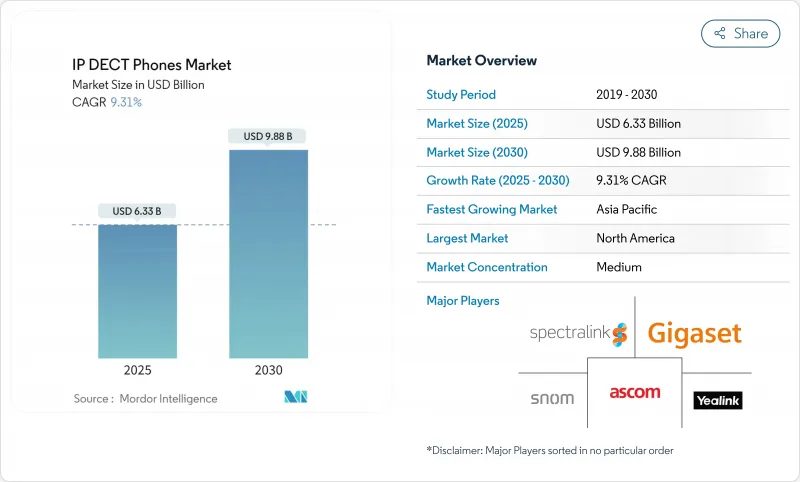
Mordor Intelligence에 의하면, IP DECT 전화 시장 규모는 2025년에 63억 3,000만 달러로 평가되었고, 2030년까지 98억 8,000만 달러에 이르며, CAGR은 9.31%를 나타낼 것으로 예측됩니다.
본 보고서는 구성 요소(제품 및 서비스), 유통 채널(B2B 및 B2C), 최종 사용자(중소기업, 대기업, 가정용 사용자), 용도(의료, 소매, 사무실 통신, 주거 등) 및 지역별로 분류되어 있습니다. 시장 전망은 금액(달러) 기준으로 제시되어 있습니다.
세계의 IP DECT 전화 시장 동향 및 인사이트
기존 PBX에서 클라우드 IP 플랫폼으로의 급속한 전환
하드웨어에 의존하는 PBX를 클라우드 서비스로 대체하는 조직에게는 DECT가 오랫동안 제공해 온 견고한 이동성을 희생하지 않으면서도 Microsoft Teams, Zoom 및 이와 유사한 UCaaS 제품군에 등록할 수 있는 엔드포인트가 필요합니다. Yealink의 SIP 게이트웨이를 활용하면 기존 DECT 베이스 스테이션을 Teams 워크플로우에 통합할 수 있어, 단일 핸드셋으로 통화 전환, 보류, 동시 수신이 가능해집니다. 마요트 병원 센터와 같은 의료 기관에서는 클라우드 통합형 DECT로 전환한 후 통화 대기 시간이 단축되고 직원 만족도가 향상된 것을 확인했으며, 관리형 모빌리티가 환자 치료와 IT 운영 비용 모두를 개선한다는 사실을 입증하고 있습니다. 벤더 포털을 통한 멀티셀 시스템의 일원화된 관리로 현장 출장 대응 및 보안 패치 적용 지연이 감소함에 따라, 클라우드 지원 DECT는 기업의 신규 입찰에서 표준 구매 사양으로 자리 잡고 있습니다. PBX 교체 프로젝트가 잇달아 본격화됨에 따라, IP DECT 전화기 시장에서는 하드웨어의 지속적인 업그레이드에 더해 클라우드 커넥터를 통한 지속적인 라이선스 수익이 예상되며, 예측 기간 동안 두 자릿수 성장을 유지할 전망입니다.
스마트 팩토리에서의 견고한 On-Premise 모빌리티에 대한 수요
인더스트리 4.0 이니셔티브에서는 생산 효율의 핵심 요소로 모빌리티가 자리 잡고 있습니다. 이는 라인 감독자, 품질 검사원, 유지보수 담당자가 시끄러운 제조 현장에서 혼잡한 Wi-Fi나 불안정한 휴대전화 신호에 의존할 수 없기 때문입니다. Yealink사의 W59R과 같은 IP67 규격 지원 단말기는 먼지, 습기, 온도 변화에 견딜 뿐만 아니라 안전 기준을 준수하기 위해 맨다운 알람 및 푸시-투-토크 기능도 탑재하고 있습니다. 제약 기업인 Siegfried Holding사는 50개 건물에 200개의 안테나를 설치하여 음성 통신, 위치 추적, 개인 안전 확보를 단일 DECT 백본 상에서 통합했습니다. 이는 가동 중단이 허용되지 않는 상황에서 공장이 달성할 수 있는 규모를 여실히 보여줍니다. DECT-2020 NR 센서를 동일한 네트워크 위에 중첩하여 도입할 수 있어 배선 및 유지보수 부담이 줄어들기 때문에 조달 담당자들은 공장 현대화 과정에서 DECT를 지정하고 있습니다. 중국, 인도, 동남아시아의 산업 단지는 다른 어느 지역보다 빠르게 면적을 확장하고 있어, 2030년까지 아시아태평양은 견고한 핸드셋 수요의 중심지가 될 것입니다.
UC 소프트폰 모바일 앱의 보급
Microsoft Teams, Zoom Phone, 그리고 셀 수 없이 많은 UCaaS 제품군 덕분에 모든 스마트폰이 음성, 영상, 메시징의 엔드포인트로 변모하면서, 전용 무선 핸드셋에 대한 필요성은 상대적으로 줄어들고 있습니다. 신속한 비용 절감을 목표로 하는 기업들은 소프트폰이 직원의 주머니 속에 들어 있는 소비자용 하드웨어를 활용하고, 무선으로 업데이트되며, 분석 대시보드를 기본으로 탑재하고 있다는 점을 인식하고 있습니다. 이러한 영향이 가장 두드러지게 나타나는 곳은 내구성이나 위치 기반 알림 기능이 필수적이지 않은 사무 업무 중심의 사무실 환경입니다. 하지만 위생 관리, 배터리 지속 시간, 혹은 규제가 엄격한 환경으로 인해 개인용 기기 사용이 제한되는 상황에서는 DECT가 여전히 우위를 점하고 있습니다. Poly사의 ‘Rove’ 시리즈는 모바일 앱의 물결이 밀려오는 와중에도 항균 코팅과 교체 가능한 배터리를 통해 병원 내 입지를 유지하고 있음을 보여줍니다.
부문 분석
2024년에도 IP DECT 전화기 시장 규모의 73.49%를 제품이 계속 차지했으며, 이는 기업들이 DECT-2020 NR 지원 및 항균 기능 도입을 추구하는 가운데, 핸드셋과 베이스 스테이션의 교체가 지속되고 있음을 반영합니다. 그러나 서비스 분야의 성장률은 연평균 성장률(CAGR) 9.37%로 더욱 빠르게 확대되고 있는데, 이는 도입 규모가 단일 건물을 넘어설 경우 조직이 계획 수립, 주파수 대역 조사 및 원격 장비 관리를 점점 더 요구하게 되기 때문입니다. 각 벤더사는 무선 펌웨어 배포, KPI 대시보드, API 연동 기능을 ITSM 제품군에 통합함으로써, 하드웨어 이익률 하락을 완화하는 지속적인 수익원을 창출하고 있습니다.
이러한 변화는 다국적 기업의 도입 사례에서 두드러지게 나타납니다. 이러한 환경에서는 중앙 집중화된 팀이 전문 서비스를 구매하여 수천 개의 엔드포인트 전반에 걸쳐 QoS를 유지하고 있습니다. Poly의 클라우드 포털은 보증, 배터리 상태, 위치 정보 데이터가 예측 유지보수에 활용되어 현장 방문 및 예기치 않은 다운타임을 줄이는 방식을 보여줍니다. 클라우드 UC 제공업체들이 매니지드 모빌리티의 업셀링을 추진하는 가운데, 통합업체들은 DECT를 광범위한 캠퍼스 네트워크 내의 턴키 계층으로 포지셔닝함으로써, IP DECT 전화 시장에서 서비스가 지속적인 성장 동력이 되도록 보장하고 있습니다.
2024년, B2B 채널은 IP DECT 전화 시장의 88.38%를 차지했습니다. 이는 통합업체의 전문 지식과 대규모 솔루션 판매의 필요성 때문입니다. 복잡한 현장 조사, PoE 스위치 업그레이드, VLAN 세분화과 같은 요구 사항이 있기 때문에 기업들은 소매점보다 전문 리셀러나 벤더와의 직접 거래를 선호합니다. 핸드셋 주문은 수백 대 규모에 달하며, 많은 경우 엣지 보안 어플라이언스나 통합 커뮤니케이션 라이선스와 번들로 제공됩니다.
그럼에도 불구하고, 원격 근무자들이 전문적인 음질과 간섭 없는 통화를 통해 재택 근무 생산성이 향상된다는 점을 실감함에 따라 B2C 수요는 연평균 성장률(CAGR) 9.43%로 증가하고 있습니다. Gigaset과 같은 벤더는 직관적으로 조작할 수 있는 핸드셋과 플러그 앤 플레이 지원 베이스 스테이션을 세트로 판매하며, 일반 소비자용 무선 전화기와 기업용 DECT 기능 간의 사용 편의성 격차를 해소하고 있습니다. 이러한 키트는 전자상거래 포털이나 가전 양판점에서 판매되고 있지만, 평균 판매 가격은 여전히 기업용 수준보다 낮아 B2B 거래량에 비해 단기적인 수익에 미치는 영향은 제한적입니다.
지역별 분석
북미는 클라우드 UC의 조기 도입, 엄격한 의료 현장의 감염 관리 규정, 그리고 하이브리드형 프라이빗 5G/DECT 모빌리티 솔루션으로의 업그레이드가 진행되고 있는 활발한 제조 거점의 존재로 인해, 2024년에는 매출의 38.46%를 차지하며 IP DECT 전화 시장을 주도했습니다. 지역별 의료 시스템에서는 항균 기능 및 위치 정보 서비스가 표준 사양으로 채택됨에 따라 단말기 교체 주기가 가속화되었습니다. 한편, 대형 소매업체들은 커브사이드 풀필먼트(curbside fulfillment)에 대응하기 위해 매장 내 통신 시스템을 현대화했습니다. 연방 정부의 주파수 대역 안정적 확보와 진화된 판매 채널 생태계 덕분에, 벤더들은 첨단 모델의 재고 확보에 대한 자신감을 더욱 강화하고 있습니다.
한편, 아시아태평양은 2030년까지 연평균 성장률(CAGR) 9.81%로 가장 높은 성장세를 보이고 있습니다. 중국과 인도에서는 DECT의 결정론적 지연 특성이 자동 운반 차량(AGV) 및 작업자 안전 비콘을 지원하는 스마트 팩토리 구축이 계속되고 있습니다. 동남아시아 지자체의 스마트 시티 프로젝트에서는 DECT-2020 NR을 채택하여 가로등, 폐기물 관리, 공공 Wi-Fi의 백홀을 단일 비면허 대역에서 통합하고 있습니다. 일본과 한국의 의료 분야 투자는 민간 5G 테스트베드와 맞물려, DECT와 5G 슬라이스 간 원활한 로밍이 가능한 하이브리드 단말기에 대한 수요를 비약적으로 높이고 있습니다. 이 지역의 물류 허브와 항만에서는 전파가 잘 통과하지 않는 철골 구조물이 과제로 대두되고 있어, DECT의 견고성은 라이선싱 셀룰러 중계기를 대체할 수 있는 낮은 CAPEX의 대안으로 자리 잡고 있습니다.
유럽에서는 DECT의 오랜 역사와 명확한 CE 인증 제도의 뒷받침을 받아, 견조한 한 자릿수 중반대의 성장 궤도를 유지하고 있습니다. 이 지역의 기업들은 ETSI의 주도와 에너지 효율이 높은 IoT 개조에 대한 정부 보조금의 지원을 받아, 조기에 NR+로의 전환을 추진하고 있습니다. 독일과 북유럽 국가들의 노후화된 제조 공장에서는 기존 DECT 기지국에 메쉬 센서를 추가함으로써 기존 인프라에서 더 큰 가치를 이끌어내고, 단말기 교체 수요를 뒷받침하고 있습니다. 남미, 중동 및 아프리카는 다른 지역에 비해 뒤처져 있지만, 통신 사업자들이 1.9GHz 대역의 DECT 채널에 간섭을 일으킬 가능성이 있는 중파 대역의 재할당을 모색하고 있어 상승 추세를 보이고 있습니다. 이에 따라 각 벤더사는 서비스 연속성을 확보하기 위한 간섭 적응 기능을 추진하고 있으며, 신중하면서도 긍정적인 도입 곡선을 유지하고 있습니다.
기타 혜택 :
- 엑셀 형식 시장 예측(ME) 시트
- 3개월간의 애널리스트 지원
자주 묻는 질문
목차
제1장 서론
제2장 조사 방법
제3장 주요 요약
제4장 시장 구도
제5장 시장 규모 및 성장 예측
제6장 경쟁 구도
제7장 시장 기회 및 향후 전망
KTH 26.08.05According to Mordor Intelligence, the IP DECT phones market size stands at USD 6.33 billion in 2025 and is projected to reach USD 9.88 billion by 2030, recording a 9.31% CAGR.
This report is Segmented by Component (Product, and Services), Distribution Channel (B2B, and B2C), End User (Small Enterprises, Large Enterprises, and Home Users), Application (Healthcare, Retail, Office Communication, Residential, and More), and Geography. The Market Forecasts are Provided in Terms of Value (USD).
Global IP DECT Phones Market Trends and Insights
Rapid Migration from Legacy PBX to Cloud IP Platforms
Organizations replacing hardware-bound PBXs with cloud services need endpoints that can register to Microsoft Teams, Zoom, and similar UCaaS suites without giving up the bullet-proof mobility long associated with DECT. Yealink's SIP Gateway allows existing DECT bases to participate in Teams workflows, enabling call transfer, parking, and simultaneous ring on a single handset. Hospitals such as Mayotte Hospital Centre documented shorter call queues and higher staff satisfaction after shifting to cloud-integrated DECT, proving that managed mobility improves both patient care and IT overhead. Centralized administration of multi-cell systems through vendor portals reduces truck rolls and security patch delays, making cloud-ready DECT a default purchase specification in new enterprise tenders. As more PBX replacement projects go live, the IP DECT phones market registers repeat hardware upgrades as well as recurring license revenue for cloud connectors, sustaining double-digit expansion over the forecast window.
Smart-Factory Demand for Rugged On-Premise Mobility
Industry 4.0 programs place mobility at the heart of production efficiency because line supervisors, quality inspectors, and maintenance staff cannot rely on congested Wi-Fi or spotty cellular signals on a noisy shop floor. IP67-rated handsets such as Yealink's W59R tolerate dust, moisture, and temperature swings while embedding man-down alarms and push-to-talk for safety compliance. Pharmaceutical player Siegfried Holding fitted 200 antennas across 50 buildings to combine voice, location tracking, and personal security on a single DECT backbone, illustrating the scale that factories can reach when downtime is unacceptable. The ability to layer DECT-2020 NR sensors onto the same network reduces cabling and maintenance, driving procurement managers to specify DECT in factory modernizations. Because industrial estates in China, India, and Southeast Asia are expanding floor space faster than any other region, Asia-Pacific becomes the epicenter of rugged handset demand through 2030.
Proliferation of UC Softphone Mobile Apps
Microsoft Teams, Zoom Phone, and countless UCaaS suites have turned every smartphone into a voice, video, and messaging endpoint, trimming the perceived need for a dedicated cordless handset. Corporations hunting for quick savings realize that softphones piggyback on consumer hardware already in employee pockets, shift updates over the air, and bundle analytics dashboards out-of-the-box. The impact lands hardest in desk-centric office settings where ruggedization or location-based alerting are not critical. Even so, DECT keeps an edge where hygiene, battery endurance, or regulated environments bar personal devices. Poly's Rove series demonstrates how antimicrobial coatings and replaceable batteries preserve a foothold in hospitals despite the mobile-app wave.
Other drivers and restraints analyzed in the detailed report include:
- Roll-out of DECT-2020 NR Converging Voice and IoT
- Hybrid Wi-Fi 6 / Private-5G DECT Handsets
- SMB IT-Budget Contraction Post-2024
For complete list of drivers and restraints, kindly check the Table Of Contents.
Segment Analysis
Products continued to command 73.49% of the IP DECT phones market size in 2024, reflecting the ongoing refresh of handsets and base stations as enterprises chase DECT-2020 NR readiness and antimicrobial features. Yet the services slice is growing faster at 9.37% CAGR because organizations increasingly demand planning, spectrum surveying, and remote fleet management once deployments exceed a single building. Vendors bundle over-the-air firmware distribution, KPI dashboards, and API hooks into ITSM suites, creating annuity revenue that tempers hardware margin erosion.
The shift is visible in multi-national rollouts where centralized teams buy professional services to maintain QoS across thousands of endpoints. Poly's cloud portal illustrates how warranty, battery health, and location data feed into predictive maintenance that cuts site visits and unplanned downtime. As cloud UC providers upsell managed mobility, integrators position DECT as a turnkey layer within broader campus networks, ensuring that services remain the growth lever within the IP DECT phones market.
B2B channels held 88.38% of IP DECT phones market size in 2024 thanks to integrator expertise and the need for solution selling at scale. Complex site surveys, PoE switch upgrades, and VLAN segmentation mean that enterprises prefer specialist resellers or direct vendor engagement over retail outlets. Handset orders run into hundreds of units, often bundled with edge security appliances and unified communications licenses.
Nonetheless, B2C demand is climbing at 9.43% CAGR as remote workers discover that professional audio quality and interference-free calls elevate home productivity. Vendors like Gigaset package plug-and-play bases with intuitive handsets, bridging the familiarity gap between consumer cordless phones and enterprise DECT capability. E-commerce portals and electronics chains carry these kits, but average selling prices remain below enterprise levels, limiting near-term revenue impact relative to B2B volumes.
Complete Report Scope:
- By Component
- Product
- Services
- By Distribution Channel
- B2B
- B2C
- By End User
- Small Enterprises
- Large Enterprises
- Home Users
- By Application
- Healthcare
- Retail
- Office Communication
- Residential
- Other Applications
- By Geography
- North America
- United States
- Rest of North America
- South America
- Brazil
- Rest of South America
- Europe
- Germany
- United Kingdom
- France
- Rest of Europe
- Asia-Pacific
- China
- Japan
- India
- Rest of Asia-Pacific
- Middle East and Africa
- Middle East
- Africa
- North America
Geography Analysis
North America led the IP DECT phones market with 38.46% revenue in 2024 thanks to early cloud UC adoption, stringent clinical infection-control rules, and an active manufacturing corridor upgrading to hybrid private-5G/DECT mobility solutions. Regional healthcare systems expedited handset replacement cycles once antimicrobial and location-services became standard, while large retailers modernized in-store communication to support curbside fulfillment. Federal spectrum stability and an evolved channel ecosystem further cement vendor confidence in stocking advanced models.
Asia-Pacific, however, posts the fastest 9.81% CAGR through 2030. China and India continue to build smart factories where DECT's deterministic latency underpins automated guided vehicles and worker safety beacons. Municipal smart-city projects in Southeast Asia adopt DECT-2020 NR to unify street-lighting, waste-management, and public Wi-Fi backhaul over a single unlicensed band. Healthcare investment in Japan and South Korea, combined with private-5G testbeds, multiplies demand for hybrid handsets that roam seamlessly between DECT and 5G slices. Because logistics hubs and ports across the region face RF hostile steel structures, DECT's resilience offers a low-CAPEX alternative to licensed cellular repeaters.
Europe maintains a solid mid-single-digit growth trajectory anchored by DECT's historical roots and clear CE certification regimes. Enterprises there pivot to NR+ early, encouraged by ETSI's stewardship and government grants for energy-efficient IoT retrofits. Aging manufacturing plants in Germany and the Nordics add mesh sensors to legacy DECT bases, squeezing more value out of existing infrastructure and underpinning replacement handset demand. South America along with the Middle East and Africa trails but shows upside as telcos seek mid-band reallocations that could disrupt 1.9 GHz DECT channels; vendors therefore push interference adaptation features to protect service continuity, sustaining cautious but positive adoption curves.
- Ascom Holding AG
- Spectralink Corporation
- Gigaset Communications GmbH
- Snom Technology GmbH
- Yealink Network Technology Co., Ltd.
- Grandstream Networks, Inc.
- Fanvil Technology Co., Ltd.
- RTX A/S
- VTech Holdings Limited
- Doro AB
- Alcatel-Lucent Enterprise
- Escene Communication Co., Ltd.
- Jabra (GN Audio A/S)
- Innovaphone AG
- Digium Telecomunicaciones S.L.
- Akuvox (Nexhome Technology Co., Ltd.)
- Epygi Technologies, LLC
- Atcom Technology Co., Ltd.
- ClearOne, Inc.
- JPL Telecom Ltd.
- Snom Solutions Pty Ltd.
Additional Benefits:
- The market estimate (ME) sheet in Excel format
- 3 months of analyst support
TABLE OF CONTENTS
1 INTRODUCTION
- 1.1 Study Assumptions and Market Definition
- 1.2 Scope of the Study
2 RESEARCH METHODOLOGY
3 EXECUTIVE SUMMARY
4 MARKET LANDSCAPE
- 4.1 Market Overview
- 4.2 Market Drivers
- 4.2.1 Rapid migration from legacy PBX to cloud IP platforms
- 4.2.2 Smart-factory demand for rugged on-premise mobility
- 4.2.3 Roll-out of DECT-2020 NR converging voice and IoT
- 4.2.4 Hybrid Wi-Fi 6 / Private-5G DECT handsets
- 4.2.5 Infection-control compliant healthcare handsets
- 4.2.6 Ultra-low-energy DECT chipsets lowering TCO
- 4.3 Market Restraints
- 4.3.1 Proliferation of UC softphone mobile apps
- 4.3.2 Possible spectrum re-allocation in Asia-Pacific and LatAm
- 4.3.3 Growing e-waste and sustainability scrutiny
- 4.3.4 SMB IT-budget contraction post-2024
- 4.4 Technological Outlook
- 4.5 Regulatory Landscape
- 4.6 Porter's Five Forces Analysis
- 4.6.1 Bargaining Power of Buyers
- 4.6.2 Bargaining Power of Suppliers
- 4.6.3 Threat of New Entrants
- 4.6.4 Threat of Substitutes
- 4.6.5 Competitive Rivalry
5 MARKET SIZE AND GROWTH FORECASTS
- 5.1 By Component
- 5.1.1 Product
- 5.1.2 Services
- 5.2 By Distribution Channel
- 5.2.1 B2B
- 5.2.2 B2C
- 5.3 By End User
- 5.3.1 Small Enterprises
- 5.3.2 Large Enterprises
- 5.3.3 Home Users
- 5.4 By Application
- 5.4.1 Healthcare
- 5.4.2 Retail
- 5.4.3 Office Communication
- 5.4.4 Residential
- 5.4.5 Other Applications
- 5.5 By Geography
- 5.5.1 North America
- 5.5.1.1 United States
- 5.5.1.2 Rest of North America
- 5.5.2 South America
- 5.5.2.1 Brazil
- 5.5.2.2 Rest of South America
- 5.5.3 Europe
- 5.5.3.1 Germany
- 5.5.3.2 United Kingdom
- 5.5.3.3 France
- 5.5.3.4 Rest of Europe
- 5.5.4 Asia-Pacific
- 5.5.4.1 China
- 5.5.4.2 Japan
- 5.5.4.3 India
- 5.5.4.4 Rest of Asia-Pacific
- 5.5.5 Middle East and Africa
- 5.5.5.1 Middle East
- 5.5.5.2 Africa
- 5.5.1 North America
6 COMPETITIVE LANDSCAPE
- 6.1 Market Concentration
- 6.2 Strategic Moves
- 6.3 Market Share Analysis
- 6.4 Company Profiles (includes Global level Overview, Market level overview, Core Segments, Financials as available, Strategic Information, Market Rank/Share for key companies, Products and Services, and Recent Developments)
- 6.4.1 Ascom Holding AG
- 6.4.2 Spectralink Corporation
- 6.4.3 Gigaset Communications GmbH
- 6.4.4 Snom Technology GmbH
- 6.4.5 Yealink Network Technology Co., Ltd.
- 6.4.6 Grandstream Networks, Inc.
- 6.4.7 Fanvil Technology Co., Ltd.
- 6.4.8 RTX A/S
- 6.4.9 VTech Holdings Limited
- 6.4.10 Doro AB
- 6.4.11 Alcatel-Lucent Enterprise
- 6.4.12 Escene Communication Co., Ltd.
- 6.4.13 Jabra (GN Audio A/S)
- 6.4.14 Innovaphone AG
- 6.4.15 Digium Telecomunicaciones S.L.
- 6.4.16 Akuvox (Nexhome Technology Co., Ltd.)
- 6.4.17 Epygi Technologies, LLC
- 6.4.18 Atcom Technology Co., Ltd.
- 6.4.19 ClearOne, Inc.
- 6.4.20 JPL Telecom Ltd.
- 6.4.21 Snom Solutions Pty Ltd.
7 MARKET OPPORTUNITIES AND FUTURE OUTLOOK
- 7.1 White-space and Unmet-Need Assessment


