

|
시장보고서
상품코드
2097288
AI 탑재 스토리지 : 시장 점유율 분석, 업계 동향 및 통계, 성장 예측(2025-2030년)AI-powered Storage - Market Share Analysis, Industry Trends & Statistics, Growth Forecasts (2025 - 2030) |
||||||
 Mordor Intelligence
Mordor Intelligence에 의하면, AI 탑재 스토리지 시장 규모는 2025년에 270억 6,000만 달러로 평가되었고, 2030년까지 766억 달러까지 확대되며 CAGR은 23.13%라고 하는 견고성장을 나타내고 있습니다.
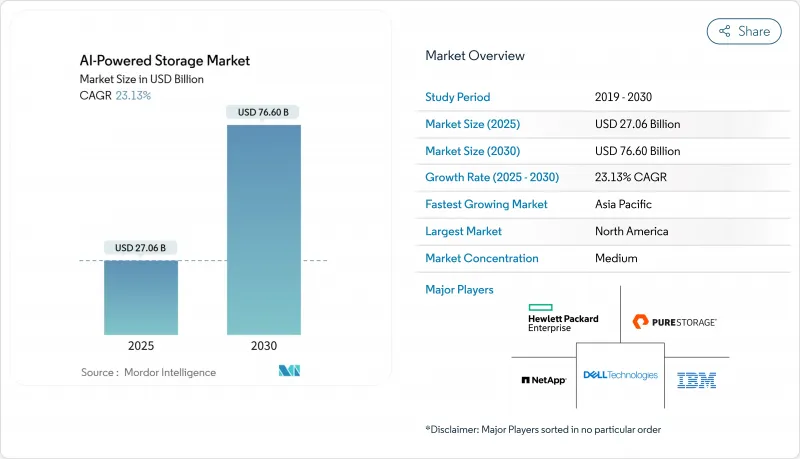
본 보고서는 도입 형태(On-Premise, 클라우드, 하이브리드), 스토리지 아키텍처(올플래시 어레이, 하이브리드 어레이 등), 구성 요소(하드웨어, 소프트웨어, 서비스), 최종 사용자 산업(IT 및 통신, 은행, 금융서비스 및 보험(BFSI), 헬스케어 및 생명과학 등), 지역(북미, 남미, 유럽, 아시아태평양, 중동 및 아프리카)별로 분류되어 있습니다. 시장 예측은 금액(달러) 기준으로 제시되어 있습니다.
세계의 AI 탑재 스토리지 시장 동향 및 인사이트
GenAI 워크로드의 폭발적인 증가
페타바이트 규모의 훈련 데이터셋과 마이크로초 단위의 추론 서비스 수준 계약(SLA)으로 인해, 스토리지 I/O는 AI 병목 현상 목록의 최상위권으로 부상했습니다. 대규모 언어 모델에는 지속적인 멀티테라비트급 처리량이 필요하며, 성능 목표 중 하나라도 달성하지 못하면 훈련 주기가 며칠에서 몇 주까지 늘어날 가능성이 있습니다. 노스웨스턴 메디슨에서는 GPU 클러스터와 플래시 퍼스트 어레이를 결합한 Dell-NVIDIA GenAI 스택을 도입한 결과, 방사선과 워크플로가 40% 향상되었습니다. 기업들은 현재 스토리지의 지연 시간과 대역폭을 경쟁적 차별화 요인으로 간주하며, GPU가 유휴 상태에 빠지지 않고 항상 최대 성능으로 작동하도록 하는 아키텍처에 예산을 할당하고 있습니다. 그 결과, AI 탑재 스토리지 시장은 큰 성장세를 보이고 있습니다.
기업의 On-Premise AI로의 전환
금융 서비스, 의료, 공공 부문의 조직들은 데이터 주권에 관한 규제 요건을 충족하고 지연 시간의 위험을 완화하기 위해 On-Premise 데이터 처리를 재개하고 있습니다. BNY 멜론이 자사 데이터센터에 NVIDIA DGX SuperPOD를 도입한 사례는 규제가 엄격한 업계가 On-Premise 컴퓨팅과 고성능 NVMe 패브릭을 융합하여 거버넌스를 유지하면서도 실시간 사기 분석을 실현하는 방법을 보여줍니다. 기밀 데이터를 로컬에 분할 저장하고 개발 워크로드를 클라우드로 이전하는 하이브리드 전략으로 인해 엔터프라이즈급 스토리지 어플라이언스의 잠재 고객 기반이 확대되고 있으며, 이는 AI 기반 스토리지 시장의 성장을 더욱 촉진하고 있습니다.
데이터센터의 전력 및 냉각 제약
현재 GPU 랙은 40-140 kW의 전력을 소비하지만, 기존 서버의 경우 15 kW 미만이었습니다. 이러한 열 부하로 인해 액체 냉각 시스템의 개조나 전원 체인의 업그레이드가 불가피해져, 설비 투자 비용 증가와 도입 기간 장기화를 초래하고 있습니다. 스토리지 어레이는 스로틀링 현상 없이 이러한 고밀도·고열 부하 환경에서 공존해야 하므로, 설계자들은 에너지 효율이 뛰어난 컨트롤러 및 드라이브 기술을 채택해야 하는 상황에 직면해 있습니다.
부문 분석
하이브리드 배포는 2030년까지 연평균 성장률(CAGR) 25.70%를 나타낼 것으로 예측되며, 이는 기업들이 클라우드의 민첩성과 On-Premise의 주권을 동시에 확보하기를 원하고 있음을 여실히 보여줍니다. 2024년 매출의 47.60%는 여전히 클라우드가 차지했지만, 지연 시간에 민감한 추론을 사용자당에 배치하면서도 모델 훈련을 하이퍼스케일러로 오프로드할 수 있다는 점이 하이브리드를 ‘전략적 기본 옵션’으로 차별화하고 있습니다. 창궈 기념병원의 AIRI 도입 사례는 의료 영상 추론 처리를 로컬에서 유지하면서 모델 재훈련을 클라우드로 오프로드함으로써 규정 준수 및 비용 효율성을 유지하고 있음을 보여줍니다. AI 지원 스토리지 시장은 이러한 듀얼 사이트 전략의 혜택을 받고 있습니다. 이는 각 거점에서는 여전히 페타바이트급 플래시 스토리지와 GPU에 최적화된 처리량이 요구되기 때문입니다.
관리 도메인의 분리 또한 서비스 수요를 높이고 있습니다. 기업들은 서로 다른 환경 전반에 걸친 통합된 가시성, 데이터 복제 워크플로우, 그리고 AI-Ops 텔레메트리를 요구하고 있습니다. 사이트 간 중복 제거 및 자동 계층화를 활용하는 벤더들은 기존에는 취약했던 사일로를 정책 기반 데이터 패브릭으로 전환함으로써 AI 탑재 스토리지 시장에서의 점유율을 확대되고 있습니다.
2024년 지출 중 올플래시 어레이가 40.90%를 차지했으며, AI 프로덕션 클러스터의 기반으로서의 입지를 공고히 했습니다. 한편, 조직들이 분산 네트워크상에서 직접 어태치먼트 수준의 지연 시간을 추구함에 따라 NVMe-oF는 연평균 27.80%의 성장률이 예상됩니다. 조기 도입 기업에 따르면, TCP 기반 어레이에서 전용 설계된 NVMe-oF 패브릭으로 전환한 결과, GPU 활용률이 70-80% 향상되었으며, GenAI 훈련 주기를 며칠 단축할 수 있었습니다고 합니다. NVMe-oF 아키텍처와 관련된 AI 지원 스토리지 시장 규모는 GPU 클러스터 도입 확대에 비례하여 성장할 것으로 예상되며, 하이엔드 엔터프라이즈 예산 내에서 그 입지를 더욱 공고히할 것입니다.
하이브리드 및 오브젝트 계층은 아카이브나 전처리 단계에서 여전히 역할을 수행하고 있지만, AI 배치 파이프라인은 핫 데이터셋을 영구 메모리나 PCIe Gen 5 NVMe 계층으로 점점 더 집중시키고 있습니다. 벤더 중립성과 신속한 기능 반복을 추구하는 운영 담당자들 사이에서 소프트웨어 정의형 접근 방식이 주목받고 있습니다.
지역별 분석
2024년 북미의 38.70% 시장 점유율은 애슈번, 산타클라라, 댈러스에 집중된 하이퍼스케일 시설은 물론, 대학 및 국립 연구소의 연구 클러스터에 기인합니다. CoreWeave가 Core Scientific을 90억 달러에 인수함에 따라 1.3 GW의 GPU 지원 용량이 추가되었으며, 이는 이 지역의 우위를 뒷받침하는 자본 규모를 여실히 보여주었습니다. 경쟁 환경은 여전히 치열하면서도 성숙해졌으며, 기업들은 검증된 레퍼런스 스택을 표준화하고, 단순한 기기 자체보다는 라이프사이클 관리 서비스로 지출의 중점을 옮기고 있습니다.
아시아태평양의 연평균 성장률(CAGR) 25.10%는 중국 공업정보화부가 제시한 국가 AI 전략, 인도의 ‘디지털 인디아 2.0’ 정책, 그리고 싱가포르의 ‘AI Verify’ 프로그램에 기인합니다. 삼성의 CXL 2.0 DRAM 및 네이버와의 제휴와 같은 국내 반도체 이니셔티브는 자국 주도형 공급망을 강화하고 있습니다. 각국 정부는 자카르타, 호치민시, 하이데라바드 등지에서 하이퍼스케일 시설 건설을 지원하고 있으며, 데이터 로컬리티 관련 법규를 준수한 AI 최적화 스토리지 패브릭에 대한 급속한 추종 수요를 창출하고 있습니다.
유럽, 중동 및 아프리카, 남미에서는 지역별로 성숙도 추세가 다릅니다. 유럽의 동향은 ‘AI법’ 준수 및 에너지 효율이 높은 데이터센터 의무화를 중심으로 전개되고 있습니다. 중동에서는 정부계 펀드를 통해 페타스케일 규모의 프로젝트에 자금을 지원하고 있으며, UAE는 AI 데이터센터 자산으로 300억-500억 유로를 목표로 하고 있습니다. 남미의 통신 사업자들은 주파수 대역 할당을 개선하기 위해 엣지 교환국에 AI 추론을 도입하고 있으며, 이에 따라 소형이고 견고한 NVMe 어레이가 요구되고 있습니다.
기타 혜택 :
- 엑셀 형식 시장 예측(ME) 시트
- 3개월간의 애널리스트 지원
자주 묻는 질문
목차
제1장 서론
제2장 조사 방법
제3장 주요 요약
제4장 시장 구도
제5장 시장 규모 및 성장 예측
제6장 경쟁 구도
제7장 시장 기회 및 향후 전망
KTH 26.08.05According to Mordor Intelligence, the AI-powered storage market size reached USD 27.06 billion in 2025 and is forecast to climb to USD 76.6 billion by 2030, reflecting a strong 23.13% CAGR.
This report is Segmented by Deployment Mode (On-Premises, Cloud, Hybrid), Storage Architecture (All-Flash Arrays, Hybrid Arrays, and More), Component (Hardware, Software, Services), End-User Industry (IT and Telecom, BFSI, Healthcare and Life Sciences, and More), and Geography (North America, South America, Europe, APAC, Middle East and Africa). The Market Forecasts are Provided in Terms of Value (USD).
Global AI-powered Storage Market Trends and Insights
GenAI Workload Explosion
Petabyte-scale training sets and microsecond inference service-level agreements have vaulted storage I/O to the top of the AI bottleneck list. Large language models require sustained multi-terabit throughput, and even a single missed performance target can stretch training cycles from days to weeks. Northwestern Medicine recorded a 40% radiology-workflow uplift after deploying Dell-NVIDIA GenAI stacks that pair GPU clusters with flash-first arrays. Enterprises now treat storage latency and bandwidth as competitive differentiators, dedicating budget to architectures that keep GPUs fully fed rather than idling. As a result, the AI-powered Storage Market is gaining significant momentum.
Enterprise Shift to On-Prem AI
Financial-services, healthcare, and public-sector organizations are reinstating local data processing to satisfy sovereignty mandates and mitigate latency risk. BNY Mellon's adoption of an NVIDIA DGX SuperPOD in its own data center illustrates how regulated industries marry on-prem compute with high-performance NVMe fabrics to enable real-time fraud analytics while preserving governance. Hybrid strategies that shard sensitive data locally and push development workloads to cloud are expanding the addressable base for enterprise-grade storage appliances, further fueling the growth of the AI-powered Storage Market.
Power and Cooling Limits in DCs
GPU racks now draw 40-140 kW versus sub-15 kW for legacy servers. The thermal envelope forces liquid cooling retrofits and power-chain upgrades that inflate capital cost and elongate deployment windows. Storage arrays must coexist in these dense thermodynamic pockets without throttling, compelling designers to embrace energy-efficient controllers and drive technologies.
Other drivers and restraints analyzed in the detailed report include:
- Flash/NVMe USD/GB Free-Fall
- GPU-Centric Server Designs
- Skills Gap in AI-Ops Storage Tuning
For complete list of drivers and restraints, kindly check the Table Of Contents.
Segment Analysis
Hybrid deployments are forecast to post a 25.70% CAGR to 2030, underscoring enterprises' desire to straddle cloud agility and on-prem sovereignty. Although cloud retains 47.60% of 2024 revenue, the ability to pin latency-sensitive inference close to users while off-loading model training to hyperscalers differentiates hybrid as the strategic default. Chang Gung Memorial Hospital's AIRI rollout shows how medical imaging inference remains local while model retraining bursts to cloud, sustaining compliance and cost efficiency. The AI-powered Storage Market benefits from this dual-site strategy because each location still demands petabyte-class flash and GPU-optimized throughput.
Separate management domains also elevate services demand: enterprises seek unified visibility, data-replication workflows, and AI-Ops telemetry across distinct estates. Vendors capitalizing on cross-site deduplication and automated tiering earn share within the AI-powered Storage Market by turning previously brittle silos into policy-driven data fabrics.
All-flash arrays controlled 40.90% of 2024 spending, cementing their role as the baseline for AI production clusters. NVMe-oF, however, is charted to grow 27.80% annually as organizations pursue direct-attached-class latency across distributed networks. Early adopters report 70-80% GPU-utilization gains after migrating from TCP-based arrays to purpose-built NVMe-oF fabrics, shaving days from GenAI training cycles. The AI-powered Storage Market size linked to NVMe-oF architectures is expected to rise proportionally with GPU cluster rollouts, reinforcing its position in premium enterprise budgets.
Hybrid and object tiers retain roles in archival and pre-processing stages, but AI batch pipelines increasingly funnel hot datasets onto persistent-memory or PCIe Gen 5 NVMe layers. Software-defined approaches gain mindshare among operators wanting vendor neutrality and rapid feature iteration.
Complete Report Scope:
- By Deployment Mode
- On-premises
- Cloud
- Hybrid
- By Storage Architecture
- All-flash Arrays
- Hybrid Arrays
- Object Storage
- Software-defined Storage
- NVMe-oF Systems
- By Component
- Hardware
- Software
- Services
- By End-user Industry
- IT and Telecom
- BFSI
- Healthcare and Life Sciences
- Media and Entertainment
- Government and Defense
- Others
- By Geography
- North America
- United States
- Canada
- Mexico
- Europe
- United Kingdom
- Germany
- France
- Italy
- Rest of Europe
- Asia-Pacific
- China
- Japan
- India
- South Korea
- Rest of Asia-Pacific
- Middle East
- Israel
- Saudi Arabia
- United Arab Emirates
- Turkey
- Rest of Middle East
- Africa
- South Africa
- Egypt
- Rest of Africa
- South America
- Brazil
- Argentina
- Rest of South America
- North America
Geography Analysis
North America's 38.70% share in 2024 stems from hyperscale estates concentrated in Ashburn, Santa Clara, and Dallas, alongside research clusters at universities and national labs. CoreWeave's USD 9 billion acquisition of Core Scientific added 1.3 GW of GPU-ready capacity, illustrating the capital scale underpinning regional dominance. Competitive dynamics remain intense but mature, with enterprises standardizing on validated reference stacks and pivoting spend toward lifecycle-management services rather than raw devices.
Asia-Pacific's 25.10% CAGR arises from sovereign-AI strategies declared by China's Ministry of Industry and IT, India's Digital India 2.0 policy, and Singapore's AI Verify programme. Domestic silicon initiatives, such as Samsung's CXL 2.0 DRAM and NAVER collaboration, reinforce the indigenous supply chain. Governments underwrite hyperscale builds in Jakarta, Ho Chi Minh City, and Hyderabad, creating rapid follow-on demand for AI-tuned storage fabrics that respect data-locality statutes.
Europe, the Middle East and Africa, and South America combine heterogeneous maturity profiles. Europe's trajectory revolves around AI Act compliance and energy-efficient data-center mandates. The Middle East bankrolls petascale projects via sovereign wealth funds, with the UAE targeting EUR 30-50 billion in AI data-center assets. South American telecoms deploy AI inference at edge exchanges to improve spectrum allocation, requiring compact, ruggedized NVMe arrays.
- Dell Technologies Inc.
- NetApp, Inc.
- Pure Storage, Inc.
- International Business Machines Corporation
- Hewlett Packard Enterprise Company
- Huawei Technologies Co., Ltd.
- Hitachi Vantara Corporation
- Lenovo Group Limited
- Super Micro Computer, Inc.
- NVIDIA Corporation
- Western Digital Corporation
- Seagate Technology Holdings plc
- Micron Technology, Inc.
- Samsung Electronics Co., Ltd.
- Intel Corporation
- Amazon Web Services, Inc.
- Microsoft Corporation
- Google LLC
- Nutanix, Inc.
- VAST Data, Inc.
- Solidigm Technology LLC
Additional Benefits:
- The market estimate (ME) sheet in Excel format
- 3 months of analyst support
TABLE OF CONTENTS
1 INTRODUCTION
- 1.1 Scope of the Study
- 1.2 Study Assumptions and Market Definition
2 RESEARCH METHODOLOGY
3 EXECUTIVE SUMMARY
4 MARKET LANDSCAPE
- 4.1 Market Overview
- 4.2 Market Drivers
- 4.2.1 GenAI workload explosion
- 4.2.2 Enterprise shift to on-prem AI
- 4.2.3 Flash/NVMe USD/GB free-fall
- 4.2.4 GPU-centric server designs
- 4.2.5 Sovereign-cloud data-residency rules
- 4.2.6 Emerging AI data-lifecycle platforms
- 4.3 Market Restraints
- 4.3.1 Power and cooling limits in DCs
- 4.3.2 Skills gap in AI-Ops storage tuning
- 4.3.3 ASIC/accelerator vendor lock-in
- 4.3.4 Capex spikes from flash supply swings
- 4.4 Value Chain Analysis
- 4.5 Regulatory Landscape
- 4.6 Technological Outlook
- 4.7 Porter's Five Forces Analysis
- 4.7.1 Threat of New Entrants
- 4.7.2 Bargaining Power of Suppliers
- 4.7.3 Bargaining Power of Buyers
- 4.7.4 Threat of Substitutes
- 4.7.5 Competitive Rivalry
5 MARKET SIZE AND GROWTH FORECASTS (VALUE)
- 5.1 By Deployment Mode
- 5.1.1 On-premises
- 5.1.2 Cloud
- 5.1.3 Hybrid
- 5.2 By Storage Architecture
- 5.2.1 All-flash Arrays
- 5.2.2 Hybrid Arrays
- 5.2.3 Object Storage
- 5.2.4 Software-defined Storage
- 5.2.5 NVMe-oF Systems
- 5.3 By Component
- 5.3.1 Hardware
- 5.3.2 Software
- 5.3.3 Services
- 5.4 By End-user Industry
- 5.4.1 IT and Telecom
- 5.4.2 BFSI
- 5.4.3 Healthcare and Life Sciences
- 5.4.4 Media and Entertainment
- 5.4.5 Government and Defense
- 5.4.6 Others
- 5.5 By Geography
- 5.5.1 North America
- 5.5.1.1 United States
- 5.5.1.2 Canada
- 5.5.1.3 Mexico
- 5.5.2 Europe
- 5.5.2.1 United Kingdom
- 5.5.2.2 Germany
- 5.5.2.3 France
- 5.5.2.4 Italy
- 5.5.2.5 Rest of Europe
- 5.5.3 Asia-Pacific
- 5.5.3.1 China
- 5.5.3.2 Japan
- 5.5.3.3 India
- 5.5.3.4 South Korea
- 5.5.3.5 Rest of Asia-Pacific
- 5.5.4 Middle East
- 5.5.4.1 Israel
- 5.5.4.2 Saudi Arabia
- 5.5.4.3 United Arab Emirates
- 5.5.4.4 Turkey
- 5.5.4.5 Rest of Middle East
- 5.5.5 Africa
- 5.5.5.1 South Africa
- 5.5.5.2 Egypt
- 5.5.5.3 Rest of Africa
- 5.5.6 South America
- 5.5.6.1 Brazil
- 5.5.6.2 Argentina
- 5.5.6.3 Rest of South America
- 5.5.1 North America
6 COMPETITIVE LANDSCAPE
- 6.1 Market Concentration
- 6.2 Strategic Moves
- 6.3 Market Share Analysis
- 6.4 Company Profiles (includes Global level Overview, Market level overview, Core Segments, Financials as available, Strategic Information, Market Rank/Share for key companies, Products and Services, and Recent Developments)
- 6.4.1 Dell Technologies Inc.
- 6.4.2 NetApp, Inc.
- 6.4.3 Pure Storage, Inc.
- 6.4.4 International Business Machines Corporation
- 6.4.5 Hewlett Packard Enterprise Company
- 6.4.6 Huawei Technologies Co., Ltd.
- 6.4.7 Hitachi Vantara Corporation
- 6.4.8 Lenovo Group Limited
- 6.4.9 Super Micro Computer, Inc.
- 6.4.10 NVIDIA Corporation
- 6.4.11 Western Digital Corporation
- 6.4.12 Seagate Technology Holdings plc
- 6.4.13 Micron Technology, Inc.
- 6.4.14 Samsung Electronics Co., Ltd.
- 6.4.15 Intel Corporation
- 6.4.16 Amazon Web Services, Inc.
- 6.4.17 Microsoft Corporation
- 6.4.18 Google LLC
- 6.4.19 Nutanix, Inc.
- 6.4.20 VAST Data, Inc.
- 6.4.21 Solidigm Technology LLC
7 MARKET OPPORTUNITIES AND FUTURE OUTLOOK
- 7.1 White-space and Unmet-Need Assessment


