

|
시장보고서
상품코드
2097294
브로멜라인 제품 시장 : 점유율 분석, 업계 동향 및 통계, 성장 예측(2026-2031년)Bromelain Products - Market Share Analysis, Industry Trends & Statistics, Growth Forecasts (2026 - 2031) |
||||||
 Mordor Intelligence
Mordor Intelligence에 의하면, 브로멜라인 제품 시장 규모는 2025년 126억 8,000만 달러에서 2026년에는 135억 9,000만 달러로 확대되어 2026년부터 2031년까지 CAGR 7.17%로 성장을 지속하여, 2031년에는 192억 달러에 이를 것으로 예측됩니다.
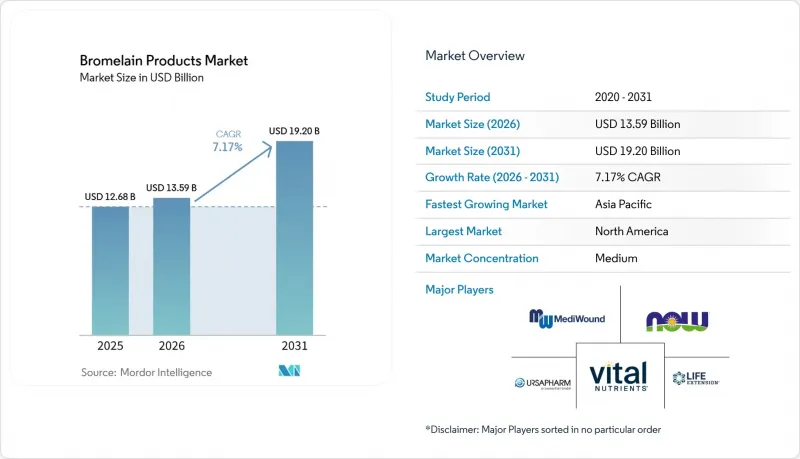
본 보고서는 원료별(줄기 유래 브로멜라인, 과일 유래 브로멜라인), 제형별(분말, 액체, 캡슐/정제, 기타), 치료 용도별(상처 데브리드먼트 및 화상 치료, 항염증 및 통증 관리, 호흡기·이비인후과 용도 등), 유통 채널별(병원 약국 등), 그리고 지역별로 분류되어 있습니다. 시장 전망은 금액(달러) 기준으로 제시되어 있습니다.
전 세계 브로멜라인 제품 시장 동향 및 인사이트
만성 상처 및 당뇨병성 궤양 발생률 증가가 효소 기반 데브리드먼트 수요를 견인
당뇨병성 족부 궤양은 지속적인 임상적 부담으로 남아 있으며, 2024년 2상 임상시험에서 MediWound의 'EscharEx'는 63%의 완전 데브리드먼트를 달성한 반면, 콜라게나제는 0%에 그쳤습니다. 이에 따라 메디케어는 브로멜라인 기반 상처 치료 제품의 적용 범위를 확대하게 되었습니다. 최근 연구에 따르면, 만성 궤양 치유에 중요한 요인인 바이오필름이 98% 감소한 것으로 보고되었습니다. 이러한 정책 전환으로 브로멜라인은 ‘구제 수단’에서 ‘1차 선택’으로 위상이 높아졌으며, 브로멜라인 제품 시장이 확대되고 있습니다.
OTC 건강 보조제에서 천연 유래 항염증제의 채택 확대
2024년 무작위 대조 시험에서 수술 후 통증 완화 측면에서 브로멜라인이 디클로페낙과 동등한 효과를 보인 것으로 밝혀져, 임상의와 소비자들이 효소 기반 제품을 고려하는 계기가 되었습니다. FDA는 21 CFR 184.1024에 근거하여 GRAS(일반적으로 안전하다고 인정되는) 지위를 승인했으며, 이에 따라 건강보조식품 브랜드는 명확한 표시가 가능해졌습니다. 그러나 독립적인 검사를 통해 온라인에서 판매되는 제품의 4분의 3에서 유효 성분 함량이 기준에 미치지 못하는 것으로 밝혀지면서, 소비자들은 제3자 기관에 의해 검증된 고품질 제품을 선택하고 있습니다. 월마트가 2025년에 브로멜라인을 취급하기로 한 것은 대형 소매업체들의 브로멜라인 수용이 진행되고 있음을 보여줍니다.
로트 간 효소 활성의 편차가 효과의 불균일성을 초래하고 있습니다.
품질 편차는 브로멜라인의 더 광범위한 보급을 저해하는 가장 두드러진 요인 중 하나로 남아 있습니다. 『International Journal of Molecular Sciences』에 게재된 2026년 연구에 따르면, 시판 중인 브로멜라인 제품 4종을 검사한 결과, 그중 3종이 표시된 효소 활성을 발휘하지 않는 것으로 밝혀졌습니다. 2건의 사례에서는 측정 가능한 단백질 분해 기능이 검출되지 않았으며, 1개의 제품에 대해서는 그 활성이 공개되지 않은 파파인의 혼입에 의존하는 것으로 보였습니다. 또한 이 연구에서는 표준 GDU 측정법으로는 진정한 브로멜라인 활성과 파파인을 확실하게 구별할 수 없습니다는 점도 지적되었습니다. 이는 활성이 약한 로트나 불순물이 혼입된 로트라도 일반적인 공급업체의 검사를 통과할 가능성이 있음을 의미합니다.
이로 인해 공급망 전반에 걸쳐 제품 성능에 편차가 발생하며, 투여량의 안정성이 가장 중요한 상처 데브리드먼트나 종양학 지원 등의 임상 용도에 대한 신뢰성이 훼손됩니다. 실제 로트별 측정 결과는 정량 하한선 미만에서 표시 사양의 123%를 초과하는 범위까지 다양하여, 이로 인해 표준화된 사용이 어려워지고, 보다 강력한 인증 기법을 도입할 수 있는 대형 제조업체에 유리한 상황이 조성되고 있습니다.
부문 분석
2025년 시점에서 줄기 유래 브로멜라인은 브로멜라인 제품 시장 점유율의 59.63%를 차지하고 있으며, 병원 프로토콜에서는 줄기 추출물이 제공하는 더 높고 예측 가능한 효소 활성이 요구되기 때문에 여전히 지배적인 지위를 유지하고 있습니다. 그러나 지속가능성에 대한 우려와 기후 변화로 인한 공급 충격으로 인해 제조업체들은 공급원의 다각화를 모색해야 하는 상황에 놓여 있습니다. 과일 유래 브로멜라인은 원료 비용을 절감하는 폐기물 활용의 발전에 힘입어 2031년까지 연평균 성장률(CAGR) 10.83%로 성장할 전망입니다. 태국, 인도네시아, 필리핀에서는 2025년 지역 시장 동향 보고서에 언급된 엘니뇨 현상으로 인한 작황 부진을 대비한 헤지 수단으로, 줄기와 과일을 혼합하여 사용하는 가공업체가 증가하고 있습니다. 제약 업계의 구매자들은 투여량의 정확성을 확보하기 위해 여전히 줄기 유래 원료를 선호하고 있지만, 일반 소비자를 대상으로 한 건강기능식품을 타겟으로 하는 제제 개발자들은 과일 유래 브로멜라인을 ‘클린 라벨’ 전략을 실현하기 위한 저비용 대안으로 간주하고 있습니다.
순환형 경제의 흐름에 따라 과일 유래 브로멜라인의 매력이 높아지고 있습니다. 이는 가공업체가 효소와 함께 에탄올 및 자일리톨을 회수함으로써 공장의 경제성을 높이고 폐기물을 줄일 수 있기 때문입니다. 또한, 신흥 종양학 및 호흡기계 의약품 개발 기업들도 줄기 수확량의 변동이 심해질 경우에 대비해 두 가지 공급원을 확보하기 위해 과일 유래 원료를 시험적으로 채택하고 있습니다. 콜드체인 물류 및 ISO 인증을 받은 분석법에 대한 지속적인 투자로 인해 두 원료 공급원 간의 품질 격차는 점차 줄어들고 있지만, 상환 코드는 여전히 줄기 유래 활성 단위에 연동되어 있어 단기적인 수요를 고정시키고 있습니다. 향후 몇 년 동안 혼합 원료 계약이 증가할 것으로 예상되어 줄기 유래 원료의 우위는 점차 약화될 것이지만, 브로멜라인 제품 시장은 원료 산지보다는 활성 값에 기반한 사양에 계속 중점을 둘 것으로 전망됩니다.
2025년에는 분말 제제가 브로멜라인 제품 시장 규모의 44.37%를 차지했습니다. 이는 동결 건조를 통해 2-8℃에서 24개월간 활성이 유지되어, 병원의 재고 관리 및 조제가 간소화되기 때문입니다. 액상 제품은 콜드체인 비용과 활성의 급격한 저하로 인해 출하량의 15% 미만에 그치고 있습니다. 한편, 캡슐 및 정제 제품 라인은 최대의 생물학적 활성보다는 편의성을 중시하는 소매 구매자를 대상으로 제공되고 있습니다. 외용 젤, 리포솜, 마이크로캡슐화 비드(이 모든 것은 ‘기타’로 분류됩니다)는 혁신적인 기업들이 표적 전달 및 서방형을 추구하고 있기 때문에 2031년까지 연평균 성장률(CAGR) 9.48%로 확대되고 있습니다.
NexoBrid의 외용 젤이 확립한 임상적 선례에 힘입어, 개발자들은 분말 형태로는 도달할 수 없는 상처, 피부과 및 점막 분야로의 적용을 모색하고 있습니다. 현재 파일럿 단계에 접어든 장용성 마이크로캡슐은 브로멜라인을 위에서의 분해로부터 보호하여 장 내 특정 부위에서 방출되도록 합니다. 이 기능은 항염증 요법 및 소화기 계통 치료 분야에서 높이 평가받고 있습니다. 입원 환자 시장에서는 분말의 우위가 지속될 전망이지만, 소매 및 전문 유통 채널에서는 활성 단위당 이익률이 높은 차별화된 제형이 중시되고 있습니다. 약제경제 모델이 투여량보다 치료 성과를 중시하게 됨에 따라, 제형 간의 경쟁은 표면적인 농도 수치가 아닌 입증 가능한 임상적 우위를 중심으로 전개될 것입니다.
지역별 분석
북미는 FDA 승인, 메디케어에 의한 보험 적용, 그리고 임상의들의 조기 채택에 힘입어 2025년 전 세계 매출의 39.48%를 차지했습니다. 높은 인건비와 규정 준수 비용이 가격 경쟁력을 억제하고 있지만, 규제의 명확성 덕분에 수출업체들은 다른 지역에서 우위를 점하고 있습니다.
유럽은 시장 규모가 큰 반면, 분열되어 있습니다. 회원국별 분류의 차이로 인해 제품 출시가 지연되고, EU 전역을 대상으로 한 임상시험이 복잡해지고 있습니다. 그럼에도 불구하고, 이 지역의 대학 병원에서는 세계 지침에 영향을 미치는 중요한 병용 요법 연구가 진행되고 있습니다.
아시아태평양은 파인애플 농업 분야의 우위와 의료비 증가를 반영하여 9.58%의 예측 연평균 성장률(CAGR)을 기록하고 있습니다. 대만, 태국, 인도에서는 폐기물의 효율적 활용을 통해 비용을 절감하고, ESG를 중시하는 구매자를 확보하기 위해 추출 능력을 확대되고 있습니다. 기후 변화에 따른 작물 위험은 여전히 운영상의 과제로 남아 있습니다.
기타 혜택:
- 엑셀 형식 시장 예측(ME) 시트
- 3개월간의 애널리스트 지원
자주 묻는 질문
목차
제1장 서론
제2장 조사 방법
제3장 주요 요약
제4장 시장 구도
제5장 시장 규모와 성장 예측
제6장 경쟁 구도
제7장 시장 기회와 향후 전망
JHS 26.08.07According to Mordor Intelligence, the bromelain products market size is expected to grow from USD 12.68 billion in 2025 to USD 13.59 billion in 2026 and is forecast to reach USD 19.20 billion by 2031 at 7.17% CAGR over 2026-2031.
This report is Segmented by Source (Stem Bromelain, Fruit Bromelain), Form (Powder, Liquid, Capsule/Tablet, Others), Therapeutic Application (Wound Debridement & Burn Care, Anti-Inflammatory & Pain Management, Respiratory & ENT Applications, and More), Distribution Channel (Hospital Pharmacies, and More), and Geography. The Market Forecasts are Provided in Terms of Value (USD).
Global Bromelain Products Market Trends and Insights
Rising Incidence Of Chronic Wounds & Diabetic Ulcers Boosting Enzymatic Debridement Demand
Diabetic foot ulcers create a persistent clinical burden, and MediWound's EscharEx achieved 63% complete debridement versus 0% for collagenase in Phase II trials during 2024, prompting Medicare to expand coverage for bromelain-based wound products.Recent studies reported 98% biofilm reduction, a key factor in chronic ulcer healing. The policy shift elevates bromelain from a salvage tool to a frontline option, widening the bromelain products market.
Increasing Adoption Of Natural Anti-Inflammatory Agents In OTC Health Supplements
Randomized trials in 2024 showed bromelain matching diclofenac for post-operative pain relief, encouraging clinicians and consumers to consider enzyme-based options. The FDA affirms GRAS status under 21 CFR 184.1024, enabling clear label claims for supplement brands.However, independent testing uncovered potency shortfalls in three-quarters of online listings, nudging shoppers toward premium, third-party-verified products. Walmart's 2025 listing of bromelain signals mainstream retail acceptance.
Batch-To-Batch Enzyme-Activity Variability Causing Inconsistent Outcomes
Quality inconsistency remains one of the clearest restraints on broader bromelain adoption. A 2026 study in the International Journal of Molecular Sciences tested 4 commercial bromelain products and found that 3 did not deliver the declared enzymatic activity. In 2 cases, no measurable proteolytic function was detected, while 1 product appeared to rely on undisclosed papain adulteration for its activity. The study also noted that standard GDU assays cannot reliably separate true bromelain activity from papain, which means weak or adulterated batches may still pass routine supplier checks.
This creates uneven product performance across the supply chain and weakens confidence in clinical uses such as wound debridement and oncology support, where dosing consistency matters most. Real-world batch results ranged from below the limit of quantification to more than 123% of declared specifications, which makes standardized use difficult and favors larger manufacturers that can afford stronger authentication methods.
Other drivers and restraints analyzed in the detailed report include:
- Integration Of Bromelain In Combination Therapies For Post-Operative Inflammation
- Growing Clinical Evidence For Mucolytic Efficacy In Respiratory Conditions
- Adverse Reactions & Contraindications In Coagulopathy / Pineapple Allergy Patients
For complete list of drivers and restraints, kindly check the Table Of Contents.
Segment Analysis
Stem bromelain accounted for 59.63% of the bromelain products market share in 2025 and retains the dominant position because hospital protocols demand the higher, more predictable enzymatic activity delivered by stem extracts. Sustainability concerns and climate-driven supply shocks, however, are pushing manufacturers to diversify; fruit bromelain is set to expand at a 10.83% CAGR through 2031, helped by waste-stream valorization that lowers raw-material costs. A growing number of processors in Thailand, Indonesia, and the Philippines are integrating stem and fruit feedstocks to hedge against El Nino-related crop losses documented in 2025 regional market updates. Pharmaceutical buyers still prefer stem material for dosage accuracy, yet formulators targeting consumer supplements view fruit bromelain as a lower-priced path to "clean label" positioning.
Circular-economy narratives strengthen fruit bromelain's appeal because processors recover ethanol and xylitol alongside the enzyme, improving plant economics and reducing waste. Emerging oncology and respiratory developers also test fruit-sourced material to secure dual-origin supply in case stem harvest volatility escalates. Sustained investment in cold-chain logistics and ISO-certified assays is narrowing quality gaps between the two sources, but reimbursement codes remain tied to stem activity units, locking in near-term demand. Over the outlook period, blended-feedstock contracts are expected to rise, gradually diluting stem's lead while keeping the bromelain products market focused on activity-driven specifications rather than raw-material origin.
Powder formulations captured 44.37% of the bromelain products market size in 2025 because lyophilization locks in activity for 24 months at 2 °C-8 °C, simplifying hospital stocking and compounding. Liquids remain less than 15% of shipments due to cold-chain costs and rapid potency decay, while capsule and tablet lines serve retail buyers seeking convenience over maximal bioactivity. Topical gels, liposomes, and micro-encapsulated beads-all grouped under "others"-are advancing at a 9.48% CAGR through 2031 as innovators chase targeted delivery and controlled release.
Clinical precedent set by NexoBrid's topical gel encourages developers to pursue wounds, dermatology, and mucosal applications that powders cannot reach. Enteric-coated microcapsules now entering pilot scale protect bromelain from gastric degradation and allow site-specific intestinal release, a capability valued in anti-inflammatory and gastrointestinal protocols. Powder's dominance will persist in inpatient settings, yet retail and specialty channels prize differentiated formats that command higher margins per activity unit. As pharmaco-economic models reward outcomes over dosage volume, the form factor race will pivot on demonstrable clinical advantages rather than headline concentration numbers.
Complete Report Scope:
- By Source
- Stem Bromelain
- Fruit Bromelain
- By Form
- Powder
- Liquid
- Capsule / Tablet
- Others
- By Therapeutic Application
- Wound Debridement & Burn Care
- Anti-inflammatory & Pain Management
- Respiratory & ENT Applications
- Gastrointestinal Digestive Aid
- Oncology Adjuvant Therapy
- Others (Obesity, Cardiovascular Support)
- By Distribution Channel
- Hospital Pharmacies
- Retail Pharmacies & Drug Stores
- Online Pharmacies
- By Geography
- North America
- United States
- Canada
- Mexico
- Europe
- Germany
- United Kingdom
- France
- Italy
- Spain
- Rest of Europe
- Asia-Pacific
- China
- Japan
- India
- Australia
- South Korea
- Rest of Asia-Pacific
- Middle East and Africa
- GCC
- South Africa
- Rest of Middle East and Africa
- South America
- Brazil
- Argentina
- Rest of South America
- North America
Geography Analysis
North America sustained 39.48% of 2025 global sales, aided by FDA approvals, Medicare reimbursement, and early clinician adoption. High labor and compliance costs curb price competitiveness, but regulatory clarity gives exporters an edge in other regions.
Europe is sizable yet fragmented: differing member-state classifications slow product launches and complicate pan-EU trials. Nonetheless, academic hospitals there conduct pivotal combination studies that influence global guidelines.
Asia-Pacific posts a 9.58% forecast CAGR, reflecting its dominance in pineapple agriculture and rising healthcare outlays. Taiwan, Thailand, and India scale extraction capacity, using waste-stream valorization to cut costs and win ESG-minded buyers. Climate-related crop risk remains an operational challenge.
- Ursapharm Arzneimittel GmbH
- MediWound
- Vital Nutrients
- Life Extension
- NOW Foods
- Doctor's Best
- Swanson Health Products
- Solaray
- Jarrow Formulas
- Garden of Life
- Enzymedica
- Source Naturals
- Country Life
- Nature's Bounty
- Puritan's Pride
- KAL
- Bluebonnet Nutrition
Additional Benefits:
- The market estimate (ME) sheet in Excel format
- 3 months of analyst support
TABLE OF CONTENTS
1 Introduction
- 1.1 Study Assumptions and Market Definition
- 1.2 Scope of the Study
2 Research Methodology
3 Executive Summary
4 Market Landscape
- 4.1 Market Overview
- 4.2 Market Drivers
- 4.2.1 Rising Incidence Of Chronic Wounds & Diabetic Ulcers Boosting Enzymatic Debridement Demand
- 4.2.2 Increasing Adoption Of Natural Anti-Inflammatory Agents In OTC Health Supplements
- 4.2.3 Integration Of Bromelain In Combination Therapies For Post-Operative Inflammation
- 4.2.4 Growing Clinical Evidence For Mucolytic Efficacy In Respiratory Conditions
- 4.2.5 Development Of Bromelain-Based Topical Formulations For Burn Debridement
- 4.2.6 Emergence Of Bromac Protocol For Cytokine-Storm Attenuation In Viral Infections
- 4.3 Market Restraints
- 4.3.1 Batch-To-Batch Enzyme-Activity Variability Causing Inconsistent Outcomes
- 4.3.2 Adverse Reactions & Contraindications In Coagulopathy / Pineapple Allergy Patients
- 4.3.3 Regulatory Ambiguity Between Drug Vs. Dietary-Supplement Classification
- 4.3.4 Dependence On Pineapple Agro-Waste Supply Subject To Climate Volatility
- 4.4 Value / Supply-Chain Analysis
- 4.5 Regulatory Landscape
- 4.6 Technology Outlook
- 4.7 Porter's Five Forces Analysis
- 4.7.1 Bargaining Power of Suppliers
- 4.7.2 Bargaining Power of Buyers
- 4.7.3 Threat of New Entrants
- 4.7.4 Threat of Substitutes
- 4.7.5 Intensity of Competitive Rivalry
5 Market Size and Growth Forecasts (Value-USD)
- 5.1 By Source
- 5.1.1 Stem Bromelain
- 5.1.2 Fruit Bromelain
- 5.2 By Form
- 5.2.1 Powder
- 5.2.2 Liquid
- 5.2.3 Capsule / Tablet
- 5.2.4 Others
- 5.3 By Therapeutic Application
- 5.3.1 Wound Debridement & Burn Care
- 5.3.2 Anti-inflammatory & Pain Management
- 5.3.3 Respiratory & ENT Applications
- 5.3.4 Gastrointestinal Digestive Aid
- 5.3.5 Oncology Adjuvant Therapy
- 5.3.6 Others (Obesity, Cardiovascular Support)
- 5.4 By Distribution Channel
- 5.4.1 Hospital Pharmacies
- 5.4.2 Retail Pharmacies & Drug Stores
- 5.4.3 Online Pharmacies
- 5.5 By Geography
- 5.5.1 North America
- 5.5.1.1 United States
- 5.5.1.2 Canada
- 5.5.1.3 Mexico
- 5.5.2 Europe
- 5.5.2.1 Germany
- 5.5.2.2 United Kingdom
- 5.5.2.3 France
- 5.5.2.4 Italy
- 5.5.2.5 Spain
- 5.5.2.6 Rest of Europe
- 5.5.3 Asia-Pacific
- 5.5.3.1 China
- 5.5.3.2 Japan
- 5.5.3.3 India
- 5.5.3.4 Australia
- 5.5.3.5 South Korea
- 5.5.3.6 Rest of Asia-Pacific
- 5.5.4 Middle East and Africa
- 5.5.4.1 GCC
- 5.5.4.2 South Africa
- 5.5.4.3 Rest of Middle East and Africa
- 5.5.5 South America
- 5.5.5.1 Brazil
- 5.5.5.2 Argentina
- 5.5.5.3 Rest of South America
- 5.5.1 North America
6 Competitive Landscape
- 6.1 Market Concentration
- 6.2 Market Share Analysis
- 6.3 Company profiles (includes Global level Overview, Market level overview, Core Segments, Financials as available, Strategic Information, Market Rank/Share for key companies, Products and Services, and Recent Developments)
- 6.3.1 Ursapharm Arzneimittel GmbH
- 6.3.2 MediWound Ltd
- 6.3.3 Vital Nutrients
- 6.3.4 Life Extension
- 6.3.5 NOW Foods
- 6.3.6 Doctor's Best
- 6.3.7 Swanson Health Products
- 6.3.8 Solaray
- 6.3.9 Jarrow Formulas
- 6.3.10 Garden of Life
- 6.3.11 Enzymedica
- 6.3.12 Source Naturals
- 6.3.13 Country Life
- 6.3.14 Nature's Bounty
- 6.3.15 Puritan's Pride
- 6.3.16 KAL
- 6.3.17 Bluebonnet Nutrition
7 Market Opportunities & Future Outlook
- 7.1 White-space & Unmet-Need Assessment


