|
시장보고서
상품코드
2097300
다중 암 조기 발견 시장 : 점유율 분석, 업계 동향 및 통계, 성장 예측(2025-2030년)Multi Cancer Early Detection - Market Share Analysis, Industry Trends & Statistics, Growth Forecasts (2025 - 2030) |
||||||
 Mordor Intelligence
Mordor Intelligence에 의하면, 다중 암 조기 발견 시장 규모는 2025년에 13억 4,000만 달러가 되고, 2030년까지 19억 1,000만 달러에 이르고, CAGR 7.34%로 확대될 것으로 예측됩니다.
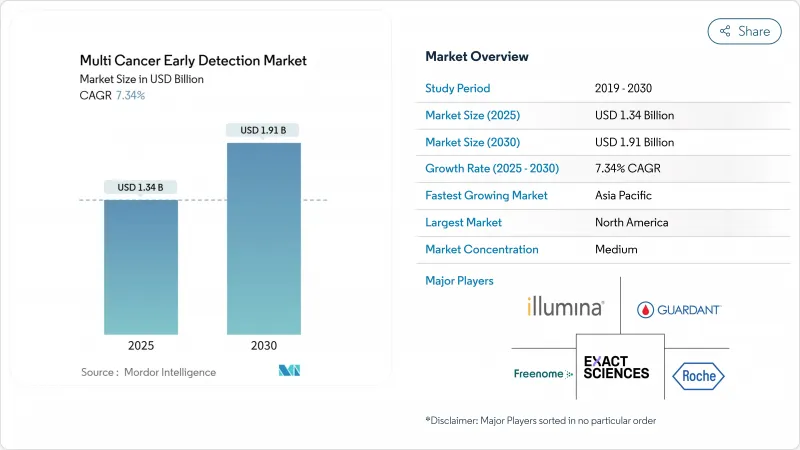
본 보고서는 검사 유형별(유전자 패널 LDT, IVD 키트, 연구용 패널 전용, 기타), 바이오마커 유형별(cfDNA 메틸화, 체세포 변이 패널, 프래그먼트 오믹스/수수성, 멀티 애널라이트), 기술 플랫폼별(NGS, 디지털 PCR/BEAMing 등), 최종 사용자별(병원·대학병원 등), 지역별로 분류되어 있습니다. 시장 전망은 금액(달러) 기준으로 제시되어 있습니다.
전 세계 다중 암 조기 발견 시장 동향 및 인사이트
선별 검사가 어려운 암의 발생률 증가와 비침습적 집단 선별 검사에 대한 수요
췌장암, 난소암, 폐암은 미국에서 매년 40만 명 이상의 신규 진단을 차지하고 있지만, 이들 모두에 대해 널리 수용되고 있는 집단 수준의 선별 검사는 존재하지 않습니다. GRAIL의 PATHFINDER 임상시험에서는 단 한 번의 채혈로 50종 이상의 종양 분자 신호를 조기 단계에서 검출할 수 있음이 입증되어, 기존의 영상 진단에는 없는 임상적 유용성이 확인되었습니다. 가치 중심의 의료 제공업체들은 1기 치료 비용이 환자 1인당 4기보다 6만 달러 저렴할 것으로 추산하고 있으며, 이것이 연례 검진에 다중 암 패널을 도입하는 직접적인 동기가 되고 있습니다. 이러한 경제적 논점은 가입자의 평생 의료비를 부담할 책임을 지는 책임의료기구(ACO)의 공감을 얻고 있습니다. 그 결과, 의료 시스템은 예산을 진행성 암 치료에서 예방적 체액 생검 프로그램으로 전환하고 있습니다. 고용주들 또한 조기 진단이 결근 및 장애 수당 지급을 줄여준다는 점을 인식하고, 생산성 측면에서 유사한 데이터를 파악하고 있습니다.
cfDNA 메틸화 NGS 워크플로우의 급속한 발전과 시약 비용 절감
일루미나(Illumina)가 2024년에 출시한 NovaSeq X는 이전 세대 모델에 비해 기가베이스당 시퀀싱 비용을 절반으로 줄였으며, 50유형의 암 메틸화 패널에 대한 시약 총 비용을 500달러 미만으로 낮췄습니다. Burning Rock Biotech는 이러한 비용 절감 효과를 활용하여 자사의 OverC 어세이에 대해 중국과 미국 양국에서 ‘획기적인 의료기기(Breakthrough Device)’ 지정을 획득함으로써, 전 세계 규제 당국의 지지가 높아지고 있음을 입증했습니다. 메틸화 시그니처는 종양 진행 과정 전반에 걸쳐 안정적이며, 진단 선별을 용이하게 하는 원발 조직의 단서도 포함되어 있기 때문에 임상의들은 돌연변이만을 검출하는 패널보다 메틸화 패널을 선호합니다. 분석 비용의 감소로 인해 지역 검사실이 멀리 떨어진 참조 센터로 검체를 보내는 대신 시퀀서를 도입하는 것이 경제적으로 가능해졌습니다. 가격이 하락함에 따라 비용 대비 효과 비율이 대장 내시경 검사의 벤치마크와 일치하게 되어, 보험 지급 기관의 보험 수리사는 보험 적용을 정당화할 수 있게 되었습니다. 이러한 동향들이 맞물려 검사 건수를 증가시키고, 중소득 국가 및 지역에서의 도입을 촉진하고 있습니다.
높은 검사 비용과 제한된 보험 환급 경로
500달러에서 1,500달러 사이의 평균 정가는 특히 1인당 의료 예산이 OECD 기준보다 낮은 지역에서 집단 검진의 재정적 허용 범위를 여전히 초과하고 있습니다. 메디케어가 보장하는 범위는 유전자 검사의 극히 일부에 불과하기 때문에 암 발병률이 가장 높은 고령층은 많은 경우 본인 부담을 감수해야 합니다. GRAIL의 ‘Galleri’ 정가는 949달러이지만, 보험사들은 여전히 이를 유방촬영술이나 FIT 검사에 비해 ‘고액’으로 분류하고 있습니다. 신흥 시장에서는 공적 보험사가 대규모 액체 생검에 대한 자금 지원을 정당화할 수 있는 보험 수리 데이터를 보유하고 있지 않아 더 큰 장벽에 직면해 있습니다. 민간 보험의 적용 상황은 일관되지 않으며, 지불을 치료 성과와 연계하는 가치 기반 계약에는 많은 스타트업 기업이 아직 축적하지 못한 장기적인 증거가 필요합니다. 단가가 300달러에 근접할 때까지는 고소득층 이외의 계층으로의 보급은 제한적일 것입니다.
부문 분석
유전자 패널을 활용한 실험실 개발 검사(LDT)는 2024년 수주량의 94.21%를 차지했습니다. 이는 CLIA 인증 검사실이 FDA에 대한 장기적인 신청 절차를 거치지 않고도 패널 개선을 유연하게 수행할 수 있음을 반영합니다. LDT로서의 지위 덕분에 새로운 메틸화 마커를 신속하게 통합할 수 있게 되었으며, 분석 감도는 규제 지침의 곡선을 상회하는 수준을 유지하고 있습니다. 그러나 체외진단용 키트 부문은 2025-2030년 연평균 성장률(CAGR) 11.33%를 기록하며, 다른 모든 카테고리를 능가하는 성장세를 보이고 있습니다. FDA의 브레이크스루 패스웨이(Breakthrough Pathway) 및 이와 연계된 CMS의 심사를 통해 제조업체들은 전미에서 환급 코드 적용을 가능하게 하는 ‘전체 기기 승인’ 획득을 적극적으로 추진하고 있습니다. Exact Sciences의 ‘Cancerguard’ 프로그램은 이러한 변화를 잘 보여주고 있으며, 시판 전 승인 신청 서류를 뒷받침하기 위해 2만 명의 참가자를 대상으로 한 임상시험에 투자하고 있습니다. LDT 제공업체들은 현재 임상시험 참여 비용과 키트로의 전환을 통한 보험 급여 혜택을 저울질하며 검토하고 있습니다.
IVD 키트를 통한 다중 암 조기 발견 시장 규모는 최초의 의료기기가 전국적인 보험 적용 승인을 획득하면 급격히 확대될 가능성이 있습니다. 병원 조달 위원회는 법적 책임이 적고 전자 발주 프로세스가 미리 설정되어 있기 때문에 FDA 승인을 받은 솔루션을 선호합니다. LDT의 유서 깊은 기업들은 시장 점유율을 유지하기 위해 임상 의사결정 지원 포털을 강화하거나, 확인 검사를 포함한 서비스 제공과 같은 대응을 하고 있습니다. 연구용 패널 시장은 규모는 작지만 중요한 틈새 시장으로, 차세대 상용 분석법으로 이어지는 바이오마커 발견 프로젝트를 뒷받침하고 있습니다. ‘기타’ 형식, 예를 들어 마이크로플루이딕스 나노웰 카트리지 등은 아직 초기 단계이지만, 분산형 1차 진료 환경에서의 잠재력이 인정받아 벤처 자금을 유치하고 있습니다.
2024년에는 63.24%의 점유율을 차지할 것으로 예상되는 cfDNA 메틸화가 바이오마커 선정에서 주도적인 위치를 차지하고 있습니다. 이는 그 후성유전학적 흔적이 암 특이적일 뿐만 아니라 조직 특이적이기도 하기 때문입니다. 수백만 개의 CpG 아일랜드를 활용해 학습된 머신러닝 파이프라인은 확률 맵을 생성하고, 방사선과 의사에게 종양의 발생원 가능성을 제시함으로써 검사 과정을 효율화하고 있습니다. DNA, 단백질, 당사슬의 시그니처를 통합한 멀티애널라이트 패널은 상호 보완적인 분석 대상 물질 덕분에 초기 단계 감도가 90% 이상의다는 증거를 바탕으로 10.47%라는 가장 높은 연평균 성장률(CAGR)을 기록하고 있습니다. GRAIL의 'Galleri'는 메틸화와 독자적인 분류기 아키텍처를 통합하여, 단 한 번의 분석으로 50가지 암을 포괄함으로써 검사 범위의 폭넓음에 있어 경쟁사의 기준을 확립하고 있습니다. 체세포 돌연변이 패널은 특징적인 드라이버 유전자를 가진 종양 유형에서는 여전히 유용하지만, 단일 오믹스 분석의 범위 내에서는 코호트 스크리닝의 이질성을 충분히 해결하지 못합니다.
프래그먼트 오믹스와 이수성 검출은 염색체의 절단 패턴이나 복제수 이상을 정량화함으로써 상호 보완적인 신호원을 제공합니다. 이러한 기능은 방출되는 DNA가 극히 적거나 특징적인 메틸화 패턴을 갖지 않는 암 모델을 보완합니다. 과제는 계산 처리에 있습니다. 즉, 희소한 돌연변이 카운트, 광범위한 메틸화 매트릭스, 그리고 높은 동적 범위를 가진 단백질 스펙트럼을 임상적으로 해석 가능한 형태로 통합하는 것입니다. 각 벤더사는 환자 1,000명당 테라바이트 규모의 원시 데이터를 관리하기 위해, 대부분의 경우 클라우드 배포를 통해 확장 가능한 바이오인포매틱스에 투자하고 있습니다. 그 결과로 얻어지는 것이 종양 전문의가 확신을 가지고 조치를 취할 수 있게 해주는 복합 위험 점수입니다.
지역별 분석
북미는 2024년 매출의 32.31%를 차지하고 있으며, 그 배경에는 1년 내에 여러 건의 ‘획기적인 의료기기’ 지정을 승인한 성숙한 규제 환경이 있습니다. CMS(미국 의료보험의료서비스센터)의 병행 심사를 통해 환급 시기가 조정되므로, 혁신 기업은 출시 시 자신 있게 가격을 책정할 수 있습니다. 기업 주도형 수요가 판매량을 끌어올리고 있습니다. 이는 자체 보험 제도를 채택한 기업이 피할 수 있었던 후기 치료 비용을 직접 회수할 수 있기 때문입니다. 캐나다는 미국에 비해 뒤처져 있지만, 시범 프로그램에 보조금을 지원하는 각 주의 유전체학 이니셔티브의 혜택을 받고 있습니다. 멕시코의 민간 병원 체인은 고소득층 환자를 대상으로 미국에서 유효성이 확인된 검사를 수입하고 있지만, 공공 부문에서의 도입은 비용 하락을 기다리고 있는 상황입니다.
아시아태평양은 중국의 정밀의료 보조금과 일본의 급속한 고령화에 힘입어 연평균 성장률(CAGR) 9.32%로 가장 빠르게 성장하고 있는 지역입니다. Burning Rock Biotech와 BGI Genomics는 정부의 암 대책 전략에 기여하는 대규모 검증 코호트 연구를 수행하고 있습니다. 호주는 10개년 암 대책 계획의 일환으로, 다중 암 패널을 포함한 전국적인 유전체 스크리닝 시범 사업에 자금을 지원하고 있습니다. 인도의 민간 종양학 네트워크는 시퀀서를 직접 구매하고, 저렴한 인건비를 활용하여 급증하는 중산층을 대상으로 경쟁력 있는 가격의 검사를 제공합니다. 규제의 다양성은 여전히 장벽으로 작용하고 있지만, 아세안(ASEAN) 회원국 간의 상호 인정 협정을 통해 국경을 넘는 검사 키트의 유통이 원활해질 가능성이 있습니다.
유럽에서는 꾸준한 진전이 나타나고 있지만, 보험 환급 제도의 불균일성이라는 과제에 직면해 있습니다. 잉글랜드 국민보건서비스(NHS)는 혈액 검사를 통한 선별 검사로 발생하는 영상 진단 수요를 흡수하기 위해 지역 진단센터에 자금을 배정했으나, 방사선사 부족으로 인해 처리 능력 향상이 지연되고 있습니다. 독일과 프랑스에서는 조기 발견을 통한 비용 절감을 장려하는 건강보험 기금 모델 하에서 진전이 빠른 반면, 남유럽 국가들의 제도는 비용 측면에서 신중한 태도를 유지하고 있습니다. EU의 체외진단용 의료기기 규정은 통일된 성능 기준과 감시 기준을 부과하고 있어 시장 출시까지의 기간이 길어질 가능성은 있지만, 궁극적으로는 품질의 조화가 이루어질 것입니다.
중동 및 아프리카 및 남미는 현재 한 자릿수 초반의 낮은 점유율에 머물러 있습니다. 걸프협력회의(GCC) 회원국에서는 고급 외국인 전용 클리닉을 대상으로 서유럽의 검사 키트를 구매하고 있으며, 이것이 사업 확장의 발판이 되고 있습니다. 브라질의 민간 보험사는 고위험 가입자를 대상으로 MCED의 보험 적용을 시범적으로 도입하고 있으나, 예산 제약으로 인해 공적 보험 제도에 도입되기까지는 아직 수년이 소요될 전망입니다.
기타 혜택:
- 엑셀 형식 시장 예측(ME) 시트
- 3개월간의 애널리스트 지원
자주 묻는 질문
목차
제1장 서론
제2장 조사 방법
제3장 주요 요약
제4장 시장 구도
제5장 시장 규모와 성장 예측
제6장 경쟁 구도
제7장 시장 기회와 향후 전망
JHSAccording to Mordor Intelligence, the multi-cancer early detection market size stood at USD 1.34 billion in 2025 and is forecast to reach USD 1.91 billion by 2030, advancing at a 7.34% CAGR.
This report is Segmented by Test Type (Gene-Panel LDTs, IVD Kits, Research-Use-Only Panels, Others), Biomarker Class (cfDNA Methylation, Somatic Mutation Panels, Fragmentomics/Aneuploidy, Multi-Analyte), Technology Platform (NGS, Digital PCR/BEAMing, and More), End-User (Hospitals & Academic Medical Centers, and More), and Geography. The Market Forecasts are Provided in Terms of Value (USD).
Global Multi Cancer Early Detection Market Trends and Insights
Rising Incidence of Hard-to-Screen Cancers & Demand for Non-Invasive Population Screening
Pancreatic, ovarian, and lung cancers account for more than 400,000 new U.S. diagnoses each year, yet none has a widely accepted population-level screen. GRAIL's PATHFINDER trial showed that a single blood draw can detect molecular signals from over 50 tumor types at an early stage, demonstrating clinical utility that traditional imaging lacks. Value-based providers calculate that stage I treatment is USD 60,000 less per patient than stage IV, creating a direct incentive to incorporate multi-cancer panels into annual exams. The economic argument resonates with accountable care organizations responsible for lifetime member costs. Health systems are therefore shifting budgets from late-stage therapeutics toward preventive liquid biopsy programs. Employers view the same data through a productivity lens, recognizing that an early diagnosis reduces absenteeism and disability payments.
Rapid Advances in cfDNA-Methylation NGS Workflows and Reagent Cost Compression
Illumina's 2024 NovaSeq X reduced sequencing cost per gigabase by half compared with its predecessor, dropping the blended reagent cost of a 50-cancer methylation panel below USD 500.Burning Rock Biotech leveraged those gains to obtain breakthrough device status in both China and the United States for its OverC assay, underscoring global regulatory momentum. Methylation signatures are stable across tumor evolution and include tissue-of-origin clues that facilitate diagnostic triage, so clinicians prefer them over mutation-only panels. Lower run costs make it economically feasible for regional labs to install sequencers rather than send samples to distant reference centers. As price falls, payer actuaries can justify coverage because the cost-benefit ratio aligns with colonoscopy benchmarks. These dynamics collectively accelerate volume and open mid-income geographies to adoption.
High Test Price & Limited Reimbursement Pathways
Average list prices between USD 500 and USD 1,500 remain above the financial comfort zone for population screens, especially where per-capita health budgets lag OECD norms. Medicare covers only a narrow subset of genetic assays, so older adults-the cohort with highest cancer incidence-often pay out of pocket. GRAIL's Galleri lists at USD 949, a figure payers still classify as premium relative to mammography or FIT tests. Emerging markets face steeper hurdles because public payers lack actuarial data to justify large-scale liquid biopsy funding. Private coverage is inconsistent, and value-based contracts tying payment to outcomes require long-range evidence many startups have yet to accumulate. Until unit costs approach USD 300, penetration outside high-income populations will stay restrained.
Other drivers and restraints analyzed in the detailed report include:
- Favorable FDA Breakthrough Device Designations & CMS Parallel Review Pilots
- Self-Insured Employers Adding MCED Tests to Wellness Benefits
- Persisting False-Positive / False-Negative Concerns & Need for Confirmatory Imaging
For complete list of drivers and restraints, kindly check the Table Of Contents.
Segment Analysis
Gene-panel laboratory-developed tests commanded 94.21% of 2024 orders, reflecting the flexibility CLIA labs enjoy in iterating panels without a protracted FDA filing. LDT status allowed rapid incorporation of new methylation markers, keeping analytical sensitivity ahead of regulatory guidance curves. Yet the in-vitro diagnostic kit segment outpaces every other category with an 11.33% CAGR from 2025 to 2030. FDA breakthrough pathways and synchronized CMS review encourage manufacturers to pursue full-device clearances that unlock nationwide reimbursement codes. Exact Sciences' Cancerguard program embodies this shift, investing in a 20,000-participant trial to support a pre-market approval dossier. LDT providers now weigh the cost of trial enrollment against the reimbursement upside of kit conversion.
The multi-cancer early detection market size for IVD kits could rise sharply once the first device wins national coverage determination. Hospital purchasing committees prefer FDA-cleared solutions because liability is lower and electronic ordering pathways are preconfigured. LDT stalwarts respond by enhancing clinical decision-support portals and offering bundled confirmatory testing to preserve share. Research-use-only panels remain a small but vital niche, supplying biomarker discovery projects that feed the next generation of commercial assays. "Other" formats such as microfluidic nanowell cartridges remain early stage but draw venture funding for potential in decentralized primary-care settings.
With a 63.24% share in 2024, cfDNA methylation dominates biomarker selection because its epigenetic footprints are both cancer-specific and tissue-resolving. Machine-learning pipelines trained on millions of CpG islands produce probability maps that point radiologists toward likely tumor origin, streamlining work-ups. Multi-analyte panels that merge DNA, protein, and glycan signatures deliver the fastest 10.47% CAGR, riding evidence that complementary analytes lift early-stage sensitivity beyond 90%. GRAIL's Galleri integrates methylation with proprietary classifier architecture to cover 50 cancers in one assay, setting the competitive bar for breadth. Somatic mutation panels persist in tumor types with hallmark driver genes, but their single-omic scope struggles against heterogeneity in cohort screening.
Fragmentomics and aneuploidy detection offer orthogonal signal sources by quantifying chromosomal break patterns and copy-number distortion. These features enrich models for cancers that shed scant DNA or lack distinctive methyl footprints. The challenge is computational: fusing sparse mutation counts, wide methylation matrices, and high-dynamic-range protein spectra in a clinically interpretable form. Vendors invest in scalable bioinformatics, often via cloud deployment, to manage terabytes of raw data per thousand patients. The payoff is a composite risk score that oncologists can act on with confidence.
Complete Report Scope:
- By Test Type
- Gene-panel LDTs
- IVD Kits (regulated)
- Research-use-only Panels
- Others
- By Biomarker Class
- cfDNA Methylation
- Somatic Mutation Panels
- Fragmentomics / Aneuploidy
- Multi-analyte (DNA + Protein + Glycan)
- By Technology Platform
- Next-Generation Sequencing
- Digital PCR / BEAMing
- Mass-Spectrometry-Based Protein Assays
- AI-enabled Multi-omics Analytics
- By End-User
- Hospitals & Academic Medical Centers
- Independent / Reference Laboratories
- Specialty Oncology & Diagnostic Clinics
- Corporate Wellness / Concierge Health Providers
- By Geography
- North America
- United States
- Canada
- Mexico
- Europe
- Germany
- United Kingdom
- France
- Italy
- Spain
- Rest of Europe
- Asia-Pacific
- China
- Japan
- India
- Australia
- South Korea
- Rest of Asia-Pacific
- Middle East and Africa
- GCC
- South Africa
- Rest of Middle East and Africa
- South America
- Brazil
- Argentina
- Rest of South America
- North America
Geography Analysis
North America controlled 32.31% of 2024 revenue, anchored by a mature regulatory ecosystem that granted multiple breakthrough device designations in one calendar year. CMS parallel review keeps reimbursement clocks synchronized, so innovators can price confidently at launch. Employer-sponsored demand boosts volume because self-insured corporations recoup avoided late-stage care costs directly. Canada trails the United States but benefits from provincial genomics initiatives that subsidize pilot programs. Mexico's private hospital chains import U.S.-validated tests for high-income patients, while public-sector adoption waits on cost drops.
Asia-Pacific is the fastest-growing territory at 9.32% CAGR, propelled by China's precision-medicine grants and Japan's rapidly aging populace. Burning Rock Biotech and BGI Genomics conduct mega-scale verification cohorts that feed governmental cancer-control strategies. Australia funds national genomic screening pilots that include multi-cancer panels as part of its 10-year Cancer Plan. India's private oncology networks buy sequencers outright, taking advantage of lower labor costs to competitively price tests for the burgeoning middle class. Regulatory diversity remains a hurdle, yet mutual-recognition compacts among ASEAN members could ease cross-border kit distribution.
Europe advances steadily but faces heterogeneous reimbursement structures. NHS England earmarked capital for Community Diagnostic Centres to absorb imaging demand generated by blood-based screens, yet radiographer shortages slow throughput. Germany and France move faster under sickness-fund models that reward early detection savings, whereas Southern European systems remain cautious on cost grounds. The EU In Vitro Diagnostic Regulation imposes uniform performance and vigilance standards, which may lengthen time-to-market but ultimately harmonize quality.
Middle East and Africa plus South America presently contribute low single-digit shares. Gulf Cooperation Council states buy Western assays for premium expatriate clinics, creating beachheads for expansion. Brazil's private insurers trial MCED coverage for high-risk members, but public adoption is years away due to budget constraints.
- AnPac Bio-Medical Science Co.
- BGI Genomics Co., Ltd.
- Burning Rock Biotech Ltd.
- Elypta AB
- Exact Sciences
- Roche
- Freenome Holdings, Inc.
- GRAIL, LLC
- Guardant Health, Inc.
- Helio Health, Inc.
- Illumina
- Lucence Diagnostics Pte Ltd
- Natera, Inc.
- Nucleix Ltd.
- QIAGEN
- Singlera Genomics, Inc.
- Thermo Fisher Scientific
Additional Benefits:
- The market estimate (ME) sheet in Excel format
- 3 months of analyst support
TABLE OF CONTENTS
1 Introduction
- 1.1 Study Assumptions and Market Definition
- 1.2 Scope of the Study
2 Research Methodology
3 Executive Summary
4 Market Landscape
- 4.1 Market Overview
- 4.2 Market Drivers
- 4.2.1 Rising Incidence Of Hard-To-Screen Cancers & Demand For Non-Invasive Population Screening
- 4.2.2 Rapid Advances In Cfdna-Methylation NGS Workflows And Reagent Cost Compression
- 4.2.3 Favourable FDA Breakthrough Device Designations & CMS Parallel Review Pilots
- 4.2.4 Self-Insured Employers Adding MCED Tests To Wellness Benefits
- 4.2.5 AI-Powered Multi-Omics Fusion Improving Early-Stage Sensitivity
- 4.2.6 Subscription-Based Longevity Clinics Driving Early Paid Uptake
- 4.3 Market Restraints
- 4.3.1 High Test Price & Limited Reimbursement Pathways
- 4.3.2 Persisting False-Positive / False-Negative Concerns & Need For Confirmatory Imaging
- 4.3.3 Equity & Consent Dilemmas In Population-Wide Genomic Screening
- 4.3.4 Shortage Of Downstream Diagnostic Imaging Capacity For Positive Cases
- 4.4 Value / Supply-Chain Analysis
- 4.5 Regulatory Landscape
- 4.6 Technology Outlook
- 4.7 Porter's Five Forces Analysis
- 4.7.1 Bargaining Power of Suppliers
- 4.7.2 Bargaining Power of Buyers
- 4.7.3 Threat of New Entrants
- 4.7.4 Threat of Substitutes
- 4.7.5 Intensity of Competitive Rivalry
5 Market Size and Growth Forecasts (Value-USD)
- 5.1 By Test Type
- 5.1.1 Gene-panel LDTs
- 5.1.2 IVD Kits (regulated)
- 5.1.3 Research-use-only Panels
- 5.1.4 Others
- 5.2 By Biomarker Class
- 5.2.1 cfDNA Methylation
- 5.2.2 Somatic Mutation Panels
- 5.2.3 Fragmentomics / Aneuploidy
- 5.2.4 Multi-analyte (DNA + Protein + Glycan)
- 5.3 By Technology Platform
- 5.3.1 Next-Generation Sequencing
- 5.3.2 Digital PCR / BEAMing
- 5.3.3 Mass-Spectrometry-Based Protein Assays
- 5.3.4 AI-enabled Multi-omics Analytics
- 5.4 By End-User
- 5.4.1 Hospitals & Academic Medical Centers
- 5.4.2 Independent / Reference Laboratories
- 5.4.3 Specialty Oncology & Diagnostic Clinics
- 5.4.4 Corporate Wellness / Concierge Health Providers
- 5.5 By Geography
- 5.5.1 North America
- 5.5.1.1 United States
- 5.5.1.2 Canada
- 5.5.1.3 Mexico
- 5.5.2 Europe
- 5.5.2.1 Germany
- 5.5.2.2 United Kingdom
- 5.5.2.3 France
- 5.5.2.4 Italy
- 5.5.2.5 Spain
- 5.5.2.6 Rest of Europe
- 5.5.3 Asia-Pacific
- 5.5.3.1 China
- 5.5.3.2 Japan
- 5.5.3.3 India
- 5.5.3.4 Australia
- 5.5.3.5 South Korea
- 5.5.3.6 Rest of Asia-Pacific
- 5.5.4 Middle East and Africa
- 5.5.4.1 GCC
- 5.5.4.2 South Africa
- 5.5.4.3 Rest of Middle East and Africa
- 5.5.5 South America
- 5.5.5.1 Brazil
- 5.5.5.2 Argentina
- 5.5.5.3 Rest of South America
- 5.5.1 North America
6 Competitive Landscape
- 6.1 Market Concentration
- 6.2 Market Share Analysis
- 6.3 Company Profiles (includes Global level Overview, Market level overview, Core Segments, Financials as available, Strategic Information, Market Rank/Share for key companies, Products and Services, and Recent Developments)
- 6.3.1 AnPac Bio-Medical Science Co.
- 6.3.2 BGI Genomics Co., Ltd.
- 6.3.3 Burning Rock Biotech Ltd.
- 6.3.4 Elypta AB
- 6.3.5 Exact Sciences Corporation
- 6.3.6 F. Hoffmann-La Roche AG
- 6.3.7 Freenome Holdings, Inc.
- 6.3.8 GRAIL, LLC
- 6.3.9 Guardant Health, Inc.
- 6.3.10 Helio Health, Inc.
- 6.3.11 Illumina, Inc.
- 6.3.12 Lucence Diagnostics Pte Ltd
- 6.3.13 Natera, Inc.
- 6.3.14 Nucleix Ltd.
- 6.3.15 Qiagen N.V.
- 6.3.16 Singlera Genomics, Inc.
- 6.3.17 Thermo Fisher Scientific, Inc.
7 Market Opportunities & Future Outlook
- 7.1 White-space & Unmet-Need Assessment