
|
시장보고서
상품코드
2097318
질소산화물 제어 시스템 : 시장 점유율 분석, 업계 동향 및 통계, 성장 예측(2026-2031년)Nitrogen Oxide (NOx) Control Systems - Market Share Analysis, Industry Trends & Statistics, Growth Forecasts (2026 - 2031) |
||||||
 Mordor Intelligence
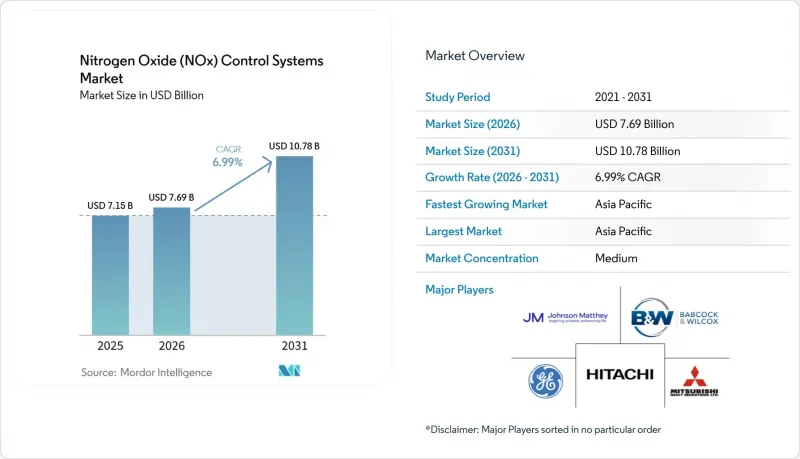
Mordor Intelligence에 의하면, 질소산화물 제어 시스템 시장 규모는 2025년 71억 5,000만 달러로 평가되었습니다. 2026년에는 76억 9,000만 달러로 확대되어 2026년부터 2031년에 걸쳐 CAGR 6.99%로 성장을 지속하여, 2031년에는 107억 8,000만 달러에 이를 것으로 예측됩니다.
본 보고서는 기술별(SCR, SNCR, 저NOx 버너, 배기 가스 재순환, 스크러버), 용도별(발전, 산업용 보일러, 시멘트, 화학, 자동차, 선박), 최종 이용 산업별(에너지·유틸리티, 제조업 등), 지역별(북미, 유럽, 아시아태평양, 남미, 중동 및 아프리카)로 분류되어 있습니다. 시장 예측은 금액(달러)으로 제시되어 있습니다.
세계의 질소산화물 제어 시스템 시장 동향 및 인사이트
다양한 분야에 걸친 NOx 배출 상한선 강화가 규제 준수를 위한 투자를 촉진
미국의 ‘굿 네이버 룰(Good Neighbor Rule)’, Euro VII 도로 차량 배출 기준, 그리고 IMO Tier III 선박 배출 기준의 조화를 통해 고정 설비 및 이동 자산의 규정 준수 달성 기간이 단축되고 있습니다. 2024년부터 2025년에 걸친 소송으로 인한 지연으로 인해 미국 내 일부 개조 계약 체결이 연기되었으나, 기초가 되는 규제는 여전히 유효하며, 현재 각 유틸리티체들은 지연되었던 발주를 순차적으로 진행하고 있습니다. 유로 VII의 ‘실주행 배기가스 프로토콜’에 따라 2027년까지 허용 NOx 계수가 1.43으로 하향 조정되며, 폐쇄형 SCR 및 슬립 촉매의 도입으로 차량 1대당 800-1,200달러의 추가 비용이 발생합니다. 2026년에 지중해가 배출 규제 구역에 포함됨에 따라, Tier III 의무 적용 대상이 4,300척의 선박으로 더욱 확대되어, 질소산화물 제어 시스템 시장에서 해운 부문의 연간 수요가 증가했습니다. 2027년에 시행될 캘리포니아주의 0.02 g/hp-hr 대형 차량 규제로 인해 감지 정밀도 요건이 10배로 상향 조정되어, ppm 단위의 감지 모듈에 대한 수요가 촉진되고 있습니다. 이러한 규제 상한선이 결합되어 질소산화물 제어 시스템 시장 전체에 걸쳐 예측 가능한 장기적인 수요 전망이 확보되었습니다.
석탄 화력 및 가스 터빈 발전소의 SCR 사후 개조 가속화
기존 발전소의 개조는 여전히 고정 배출원에서 가장 큰 비즈니스 기회입니다. 중국은 석탄 화력 발전소에 대해 2027년까지 암모니아 10% 혼소를 시범적으로 실시하도록 지시하고 있으며, 고활성 다층 촉매가 설치되지 않는 한 이 조치로 인해 열 NOx 배출량이 증가하게 될 것입니다. 인도에서는 신규 건설 발전 단위에 대해 100 mg/Nm³, 기존 설비에 대해서는 450 mg/Nm³의 상한선이 설정되어 있습니다. 주립 전력 회사는 구형 설비에 대해 저비용 SNCR을 선호하는 반면, 신규 복합 사이클 발전 설비에서는 SCR이 표준화되어 있어 질소산화물 제어 시스템 시장의 견조한 수주 전망을 유지하고 있습니다. 북미에서는 GE Vernova사의 83 GW에 달하는 가스 터빈 수주 잔고와 6억 달러 규모의 촉매 제조 시설이 지속적인 개보수 및 신규 건설 활동을 반영하고 있습니다. 캐나다의 정유업체들은 주 정부의 대기 오염 배출 한도를 충족하기 위해 습식 가스 세정 기술과 고효율 SCR을 결합하고 있으며, 이는 여러 오염 물질에 대한 규제 요건이 시스템 통합의 범위를 어떻게 확대하고 있는지를 보여줍니다. 이러한 요인들이 복합적으로 작용하여 SCR 솔루션의 연간 성장률은 8.0%를 유지하고 있습니다.
SCR 및 SNCR 솔루션의 높은 CAPEX·OPEX
인도의 660 MW 석탄 화력 발전 설비에서 대규모 SCR 비용은 연간 5억 1,000만 달러를 초과할 가능성이 있으며, 2035년 이전에 폐쇄될 자산의 경우 국영 발전 사업자에게 이 부담은 정당화될 수 없는 것으로 간주됩니다. 3-5년마다 이루어지는 촉매 교체에는 발전 블록당 200만-800만 미달러의 비용이 소요되며, 또한 500 MW 발전소의 경우 시약 소비로 인해 연간 120만 미달러의 추가 비용이 발생하므로, 경쟁이 치열한 전력 시장에서 발전 마진을 압박하고 있습니다. 선박 개조의 경우, 30톤 규모의 SCR 반응기를 설치하려면 300만 달러 이상의 구조 보강 비용이 필요하여 노후화된 벌크선 부문에서의 도입이 제한되고 있습니다. 이러한 경제적 요인들이 도입을 제약하고 있으며, 이로 인해 질소산화물 제어 시스템 시장의 연평균 성장률(CAGR) 전망치를 0.8포인트 하향 조정하고 있습니다.
부문 분석
2025년 시점에서 질소산화물 제어 시스템 시장 점유율의 55.7%를 ' 선택적 촉매 환원(SCR)’이 차지했으며, 발전소 개보수 및 IMO Tier III 규제에 대한 선박 대응을 배경으로, 해당 부문은 2031년까지 연평균 성장률(CAGR) 8.0%를 나타낼 것으로 예측됩니다.
선택적 비촉매 환원(SNCR)은 자본 집약도가 낮아 시장 점유율은 비교적 작지만, 850°C를 초과하는 운전 온도 요건으로 인해 그 도입은 시멘트 및 보일러 용도로 제한되어 있습니다. 저NOx 버너와 배기가스 재순환(FGR)은 시약 물류가 과제인 새로운 산업용 로에서 보급이 확대되고 있습니다. 흡착식 및 하이브리드 시스템은 2031년까지 현재 규모의 3배로 성장할 가능성이 있습니다. 이는 재생형 흡착제가 암모니아를 사용하지 않고도 95%의 제거율을 달성하고 있어, 외딴 지역의 수소 마이크로그리드에서 질소산화물 제어 시스템 시장을 확대하고 있기 때문입니다.
지역별 분석
아시아태평양은 2025년에 전 세계 매출의 44.6%를 차지했으며, 2031년까지 연평균 성장률(CAGR) 7.7%를 유지할 것으로 전망됩니다. 이는 중국이 신규 석탄 화력 발전 설비에 대해 50 mg/Nm³의 배출 상한선을 설정하고 있으며, 인도가 구형 발전 설비에서 저비용 SNCR 시스템을 우선적으로 도입하고 있기 때문입니다. 상하이의 OBD 플랫폼은 이미 지역 전체의 NOx 배출량을 22% 감축했으며, 이는 데이터 기반 규제 집행 모델로의 전환을 반영한 것으로, 커넥티드 시스템에 대한 수요를 높이고 있습니다.
북미의 매출은 2027년에 시행될 EPA 및 CARB의 0.02 g/hp-hr 규제에 힘입어 증가하고 있습니다. 이 규제로 인해 센서 정밀도에 대한 수요가 10배 증가했으며, 촉매 상태 분석에 대한 투자가 촉진되고 있습니다. 미국에서는 하이퍼스케일 데이터센터의 46%가 연간 NOx 배출 제한이 25-50톤으로 설정된 기준 미달 지역에 위치해 있어, 개발자들은 초저배출 터빈 도입을 서두르고 있습니다. 캐나다에서는 정유시설가 여러 오염 물질에 대한 규제 요건을 충족하기 위해 습식 가스 스크러버를 도입하고 있는 반면, 멕시코 시멘트 업계에서는 주 차원의 규제 집행에 편차가 있음에도 불구하고 단계 연소 버너로의 전환이 진행되고 있습니다.
유럽에서는 유로 VII 기준 및 2026년 7월 ‘산업 배출 지침’ 개정에 따라 열출력 100MW를 초과하는 시설에 대해 지속적인 모니터링이 의무화됨에 따라, 이익률은 더욱 엄격한 상황 속에서 수익이 창출되고 있습니다. 지역별 수주 현황에서는 독일과 영국이 주도적인 입지를 차지하고 있으며, 노르웨이의 해양 설비에서는 SCR 개조가 가속화되고 있습니다. 러시아의 프로젝트는 제재 조치로 인해 여전히 정체된 상태입니다. 남미에서는 페트로브라스의 SNOX 기술 상용화가 성장을 뒷받침하고 있습니다. 중동 및 아프리카에서는 암모니아 물류 문제를 해결하기 위한 대안으로 오존 주입 기술 및 재생 흡착 기술을 검토하는 시범 프로젝트가 진행되고 있습니다.
기타 혜택 :
- 엑셀 형식 시장 예측(ME) 시트
- 3개월간의 애널리스트 지원
자주 묻는 질문
목차
제1장 서론
제2장 조사 방법
제3장 주요 요약
제4장 시장 구도
제5장 시장 규모 및 성장 예측
제6장 경쟁 구도
제7장 시장 기회 및 향후 전망
KTH 26.08.05According to Mordor Intelligence, the nitrogen oxide control systems market size is expected to grow from USD 7.15 billion in 2025 to USD 7.69 billion in 2026 and is forecast to reach USD 10.78 billion by 2031 at 6.99% CAGR over 2026-2031.
This report is Segmented by Technology (SCR, SNCR, Low-NOx Burners, Flue Gas Recirculation, Scrubbers), Application (Power Generation, Industrial Boilers, Cement, Chemicals, Automotive, Marine), End-Use Industry (Energy & Utilities, Manufacturing, and More), and Geography (North America, Europe, Asia-Pacific, South America, Middle East & Africa). Market Forecasts are Provided in Value (USD).
Global Nitrogen Oxide (NOx) Control Systems Market Trends and Insights
Stricter Multi-Sector NOx Emission Caps Drive Compliance Investments
The alignment of the U.S. Good Neighbor Rule, Euro VII on-road limits, and IMO Tier III marine standards are compressing compliance timelines across stationary and mobile assets. Litigation delays in 2024-2025 postponed some U.S. retrofit awards; however, the underlying rule remained in effect, and utilities are now releasing backlogged purchase orders. Euro VII's real-driving-emissions protocol lowers permissible NOx factors to 1.43 by 2027, adding USD 800-1,200 per vehicle for close-coupled SCR and slip catalysts. The inclusion of the Mediterranean in the Emission Control Area in 2026 extended Tier III obligations to an additional 4,300 vessels, lifting annual marine-sector demand for the nitrogen oxide control systems market. California's 0.02 g/hp-hr heavy-duty rule, effective 2027, increases sensing precision requirements tenfold, driving demand for parts-per-million detection modules. Together, these regulatory caps support predictable long-term demand visibility across the nitrogen oxide control systems market.
Accelerated SCR Retrofits in Coal-Fired and Gas-Turbine Power Plants
Retrofitting legacy plants remains the largest stationary source opportunity. China has directed coal generators to trial 10% ammonia co-firing by 2027, a move that increases thermal NOx emissions unless high-activity, multi-layer catalysts are installed. India has capped new-build units at 100 mg/Nm3 and legacy fleets at 450 mg/Nm3; state utilities favor lower-cost SNCR for older assets, while new combined-cycle blocks standardize on SCR, maintaining a strong pipeline for the nitrogen oxide control systems market. In North America, GE Vernova's 83 GW gas-turbine backlog, paired with a USD 600 million catalyst facility, reflects sustained retrofit and greenfield activity. Canadian refiners are combining wet-gas scrubbing with high-efficiency SCR to meet provincial airshed quotas, demonstrating how multi-pollutant compliance requirements expand system-integration scope. Together, these factors support an 8.0% annual growth rate for SCR solutions.
High CAPEX-OPEX of SCR and SNCR Solutions
Large-scale SCR costs can exceed USD 0.51 billion annually for a 660 MW coal unit in India, a burden that state generators consider unjustifiable for assets retiring before 2035. Catalyst replacement every 3-5 years adds USD 2-8 million per power block, while reagent consumption can cost an additional USD 1.2 million annually for a 500 MW plant, eroding dispatch margins in competitive power markets. For marine retrofits, 30-ton SCR reactors require structural reinforcement costing USD 3 million or more, limiting uptake in the aging bulk-carrier segment. These economics constrain adoption and reduce the nitrogen oxide control systems market CAGR forecast by 0.8 percentage points.
Other drivers and restraints analyzed in the detailed report include:
- Diesel Vehicle Stock Driving DEF Consumption and On-Road SCR Adoption
- Industrial Boiler Revamps with Low-NOx Burners in Chemicals and Cement
- Volatile Urea and DEF Pricing Squeezes End-User Budgets
For complete list of drivers and restraints, kindly check the Table Of Contents.
Segment Analysis
Selective catalytic reduction accounted for 55.7% of the nitrogen oxide control systems market share in 2025, and the segment is forecast to post an 8.0% CAGR through 2031, supported by power plant retrofits and IMO Tier III marine adoption.
Selective non-catalytic reduction holds a relatively smaller share due to its lower capital intensity; however, operational temperature requirements above 850°C limit its uptake to cement and boiler applications. Low-NOx burners and flue-gas recirculation are gaining traction in new industrial furnaces where reagent logistics are challenging. Adsorptive and hybrid systems could grow to triple their current size by 2031, as regenerative sorbents demonstrate 95% removal without ammonia, expanding the nitrogen oxide control systems market in remote hydrogen microgrids.
Complete Report Scope:
- By Technology
- Selective Catalytic Reduction (SCR)
- Selective Non-Catalytic Reduction (SNCR)
- Low-NOx Burners
- Flue Gas Recirculation
- Scrubber and Hybrid Systems
- By Application
- Power Generation
- Industrial Boilers and Furnaces
- Cement Manufacturing
- Chemicals and Petrochemicals
- On-road and Off-road Automotive
- Marine Engines
- By End-Use Industry
- Energy and Utilities
- Manufacturing and Process Industries
- Transportation (Road, Rail, Marine)
- Others (Municipal, Commercial)
- By Geography
- North America
- United States
- Canada
- Mexico
- Europe
- United Kingdom
- Germany
- France
- Spain
- Nordic Countries
- Russia
- Rest of Europe
- Asia-Pacific
- China
- India
- Japan
- South Korea
- ASEAN Countries
- Rest of Asia-Pacific
- South America
- Brazil
- Argentina
- Colombia
- Rest of South America
- Middle East and Africa
- United Arab Emirates
- Saudi Arabia
- South Africa
- Egypt
- Rest of Middle East and Africa
- North America
Geography Analysis
Asia-Pacific accounted for 44.6% of global revenue in 2025 and is projected to sustain a 7.7% CAGR through 2031, driven by China's 50 mg/Nm3 emission ceiling for new coal units and India's preference for lower-cost SNCR systems in older fleets. Shanghai's OBD platform has already achieved a 22% regional NOx reduction, reflecting a shift toward data-driven enforcement models that are increasing demand for connected systems.
North America's revenue is anchored by the 2027 EPA and CARB 0.02 g/hp-hr regulation, which increases the demand for sensor precision tenfold and supports investment in catalyst health analytics. In the United States, 46% of hyperscale data centers are located in non-attainment zones with annual NOx limits between 25 and 50 tons, prompting developers to adopt ultra-low-emission turbines. In Canada, refineries are implementing wet-gas scrubbers to meet multi-pollutant compliance requirements, while Mexico's cement industry is transitioning to staged-combustion burners despite inconsistent state-level regulatory enforcement.
Europe's revenue is generated under tighter margins due to Euro VII standards and the July 2026 revisions to the Industrial Emissions Directive, which require continuous monitoring for facilities exceeding 100 MW thermal capacity. Germany and the United Kingdom lead regional orders, while Norway's offshore fleet is accelerating SCR retrofits. Projects in Russia remain stalled due to sanctions. In South America, growth is supported by Petrobras' commercialization of SNOX technology. In the Middle East and Africa, pilot projects are advancing to explore ozone-injection and regenerative adsorption technologies as alternatives to address ammonia logistics challenges.
- Alfa Laval AB
- ANDRITZ AG
- Babcock & Wilcox Enterprises, Inc.
- BASF SE
- Caterpillar Inc.
- CECO Environmental Corp.
- Clean Diesel Technologies, Inc.
- Cummins Inc.
- DCL International Inc.
- Doosan Lentjes GmbH
- Ducon Technologies Inc.
- FLSmidth & Co. A/S
- GE Vernova Inc.
- Kanadevia Corporation
- IHI Corporation
- Johnson Matthey Plc
- Mitsubishi Heavy Industries, Ltd.
- Siemens Energy AG
- Valmet Oyj
- Yara International ASA
Additional Benefits:
- The market estimate (ME) sheet in Excel format
- 3 months of analyst support
TABLE OF CONTENTS
1 Introduction
- 1.1 Study Assumptions & Market Definition
- 1.2 Scope of the Study
2 Research Methodology
3 Executive Summary
4 Market Landscape
- 4.1 Market Overview
- 4.2 Market Drivers
- 4.2.1 Stricter multi-sector NOx emission caps (U.S. Good Neighbor, EU Euro VII, IMO Tier III)
- 4.2.2 Accelerated SCR retrofits in coal-fired & gas turbine power plants
- 4.2.3 Diesel vehicle stock driving DEF consumption & on-road SCR adoption
- 4.2.4 Industrial boiler revamps with low-NOx burners in chemicals & cement
- 4.2.5 AI-enabled remote-OBD compliance unlocking carbon-credit subsidies
- 4.2.6 Hydrogen-based low-temperature SCR catalysts moving from lab to pilot
- 4.3 Market Restraints
- 4.3.1 High CAPEX?OPEX of SCR & SNCR solutions
- 4.3.2 Volatile urea/DEF pricing squeezes end-user budgets
- 4.3.3 Ammonia-slip limits adding secondary abatement cost
- 4.3.4 Fleet electrification curbing future transport NOx demand
- 4.4 Supply-Chain Analysis
- 4.5 Regulatory Landscape
- 4.6 Technological Outlook
- 4.7 Porter's Five Forces
- 4.7.1 Threat of New Entrants
- 4.7.2 Bargaining Power of Buyers
- 4.7.3 Bargaining Power of Suppliers
- 4.7.4 Threat of Substitutes
- 4.7.5 Competitive Rivalry
5 Market Size & Growth Forecasts
- 5.1 By Technology
- 5.1.1 Selective Catalytic Reduction (SCR)
- 5.1.2 Selective Non-Catalytic Reduction (SNCR)
- 5.1.3 Low-NOx Burners
- 5.1.4 Flue Gas Recirculation
- 5.1.5 Scrubber and Hybrid Systems
- 5.2 By Application
- 5.2.1 Power Generation
- 5.2.2 Industrial Boilers and Furnaces
- 5.2.3 Cement Manufacturing
- 5.2.4 Chemicals and Petrochemicals
- 5.2.5 On-road and Off-road Automotive
- 5.2.6 Marine Engines
- 5.3 By End-Use Industry
- 5.3.1 Energy and Utilities
- 5.3.2 Manufacturing and Process Industries
- 5.3.3 Transportation (Road, Rail, Marine)
- 5.3.4 Others (Municipal, Commercial)
- 5.4 By Geography
- 5.4.1 North America
- 5.4.1.1 United States
- 5.4.1.2 Canada
- 5.4.1.3 Mexico
- 5.4.2 Europe
- 5.4.2.1 United Kingdom
- 5.4.2.2 Germany
- 5.4.2.3 France
- 5.4.2.4 Spain
- 5.4.2.5 Nordic Countries
- 5.4.2.6 Russia
- 5.4.2.7 Rest of Europe
- 5.4.3 Asia-Pacific
- 5.4.3.1 China
- 5.4.3.2 India
- 5.4.3.3 Japan
- 5.4.3.4 South Korea
- 5.4.3.5 ASEAN Countries
- 5.4.3.6 Rest of Asia-Pacific
- 5.4.4 South America
- 5.4.4.1 Brazil
- 5.4.4.2 Argentina
- 5.4.4.3 Colombia
- 5.4.4.4 Rest of South America
- 5.4.5 Middle East and Africa
- 5.4.5.1 United Arab Emirates
- 5.4.5.2 Saudi Arabia
- 5.4.5.3 South Africa
- 5.4.5.4 Egypt
- 5.4.5.5 Rest of Middle East and Africa
- 5.4.1 North America
6 Competitive Landscape
- 6.1 Market Concentration
- 6.2 Strategic Moves (M&A, Partnerships, PPAs)
- 6.3 Market Share Analysis (Market Rank/Share for key companies)
- 6.4 Company Profiles (includes Global level Overview, Market level overview, Core Segments, Financials as available, Strategic Information, Products & Services, and Recent Developments)
- 6.4.1 Alfa Laval AB
- 6.4.2 ANDRITZ AG
- 6.4.3 Babcock & Wilcox Enterprises, Inc.
- 6.4.4 BASF SE
- 6.4.5 Caterpillar Inc.
- 6.4.6 CECO Environmental Corp.
- 6.4.7 Clean Diesel Technologies, Inc.
- 6.4.8 Cummins Inc.
- 6.4.9 DCL International Inc.
- 6.4.10 Doosan Lentjes GmbH
- 6.4.11 Ducon Technologies Inc.
- 6.4.12 FLSmidth & Co. A/S
- 6.4.13 GE Vernova Inc.
- 6.4.14 Kanadevia Corporation
- 6.4.15 IHI Corporation
- 6.4.16 Johnson Matthey Plc
- 6.4.17 Mitsubishi Heavy Industries, Ltd.
- 6.4.18 Siemens Energy AG
- 6.4.19 Valmet Oyj
- 6.4.20 Yara International ASA
7 Market Opportunities & Future Outlook
- 7.1 White-space & Unmet-need Assessment