

|
시장보고서
상품코드
2097322
선박 에너지 저장 시스템 : 시장 점유율 분석, 업계 동향 및 통계, 성장 예측(2025-2030년)Vessel Energy Storage System - Market Share Analysis, Industry Trends & Statistics, Growth Forecasts (2025 - 2030) |
||||||
 Mordor Intelligence
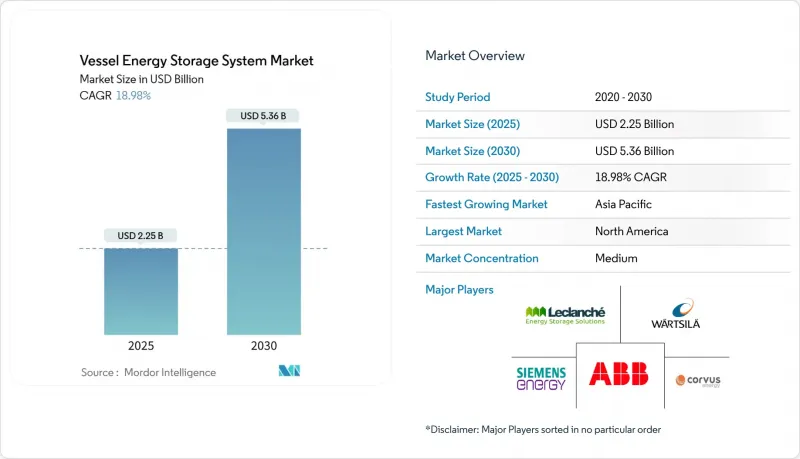
에 의하면, 선박 에너지 저장 시스템 시장 규모는 2025년에 22억 5,000만 달러로 평가되었습니다. 예측 기간(2025-2030년) CAGR 18.98%로 확대되어 2030년에는 53억 6,000만 달러에 이를 전망입니다.
본 보고서는 유형별(배터리 에너지 저장 시스템, 슈퍼커패시터 등), 에너지원별(재생에너지원 등), 설치 방식별(신조선 및 개조선), 선박 유형별(화물선, 여객선, 군함 등), 용도별(주 추진 시스템, 하이브리드 동력 시스템 등), 지역별(북미, 유럽, 아시아태평양 등)로 분류되어 있습니다.
세계의 선박 에너지 저장 시스템 시장 동향 및 인사이트
IMO의 엄격한 온실가스(GHG) 및 CII 규제
IMO의 2024년 넷제로(Net Zero) 프레임워크에서는 비효율적인 선박에 대해 입항 제한이나 보험료 인상을 부과하는 운영 평가가 도입되어, 규제 준수는 선주에게 있어 존망을 좌우하는 비용이 되고 있습니다. 또한, ‘FuelEU Maritime’에 따라 EU 수역을 항해하는 5,000총톤 이상의 선박에 대해 2025년부터 재생 가능 연료 사용 의무가 추가되어, 이익률은 더욱 압박받고 있습니다. 에너지 저장 시스템을 통해 운항 사업자는 추진 부하를 전환하여 규제가 엄격한 항로에서의 배출량 피크를 억제하고, 유리한 용선료를 확보할 수 있게 됩니다. 개정된 수명 주기 배출량 지침에서는 배터리를 통한 효율 향상이 평가 대상이 되며, 조기에 도입하는 사업자는 경쟁에서 선구자가 될 것입니다.
리튬 이온 배터리의 kWh당 단가 급락
자동차 제조업체의 규모의 경제와 더욱 안전한 화학 조성에 힘입어, 선박용 리튬철인산염 배터리 팩은 고주파 운항 노선에서 디젤 발전기와 비용 균형을 달성했습니다. 고체 배터리 프로토타입은 IP67 방수 성능을 유지하면서 이미 190 Wh/kg에 도달했습니다. DEFORD의 나트륨 이온 배터리는 리튬 가격 변동 위험을 제거하고, 첨단 배터리 관리 시스템이 실시간 항로 분석을 바탕으로 충전 주기를 최적화함으로써 1kW시당 가치를 극대화하고 있습니다.
ESS 설비 투자(CAPEX)와 디젤 발전 세트의 비교
선박용 배터리 시스템 일체에는 여전히 1MW당 약 17만 5,000달러의 투자가 필요하며, 자금 사정이 어려운 운항 사업자에게는 큰 부담이 되고 있습니다. 기존의 금융 구조에서는 미래의 연료비 절감 효과가 과소평가되어 있어, 선주들은 기술의 노후화에 대한 우려를 품지 않을 수 없습니다. 그러나 초기 위험을 전문 금융 기관에 전가하는 BaaS(Battery-as-a-service) 계약이나 성능 보증이 포함된 리스 계약이 등장함에 따라 이러한 제약은 점차 완화되고 있습니다.
부문 분석
2024년, 설치 가치 기준으로 측정된 선박 에너지 저장 시스템 시장에서 배터리식 에너지 저장 시스템(ESS)이 78.3%의 점유율을 차지했습니다. 이는 주로 자동차 분야의 학습 곡선에 힘입어 선박용 배터리 팩의 납품 가격이 kWh당 450달러 아래로 떨어진 것이 주된 요인입니다. 이러한 우위는 고밀도화와 화재 위험 감소가 기대되는 전고체 배터리의 전망에 힘입어, 2030년까지 연평균 성장률(CAGR) 21.5%라는 상당한 성장 전망으로 이어지고 있습니다. 한편, 슈퍼커패시터는 초고속 충방전이 요구되는 페리 노선에서 보급이 확대되고 있으며, 플라이휠은 무한한 사이클 수가 최우선으로 요구되는 해군의 펄스 전원 분야에서 활용되고 있습니다. 압축 공기 에너지 저장(CAES)은 선체 용적의 제약으로 인해 여전히 보급이 제한적이지만, 바나듐 흐름 전지는 최근 장기 운용이 요구되는 원양 조사선을 대상으로 ABS의 기술 인증을 획득했습니다. 현재 각 스타트업 기업들은 커패시터, 리튬 배터리, 플로우 배터리를 단일 랙에 통합한 하이브리드 팩을 추진하고 있으며, 공간을 희생하지 않으면서 운영자에게 모든 면에서 최적의 성능을 제공합니다.
선박 에너지 저장 시스템 시장에서는 배터리 통합 업체들이 DNV의 ‘전파 시험 A’ 등 해사 분야 특유의 안전 인증 획득을 목표로 하고 있습니다. 주요 공급업체들은 배터리에 독자적인 소화 시스템, 냉각 시스템, 데이터 분석 기능을 결합함으로써 단순한 kW시 단가를 넘어선 차별화를 꾀하고 있습니다. 군사 등급의 리튬 열폭주 방지 기술을 상업용 페리에 라이선싱함으로써 방위 분야와 민간 분야의 기술 격차가 좁혀지고, 배터리 벤더에게 비즈니스 기회가 확대되고 있습니다.
하이브리드 시스템은 2024년 총 매출의 54.8%를 차지했습니다. 이는 선주가 배터리를 디젤 엔진이나 LNG 엔진과 결합함으로써 추진 위험을 헤지하고, 대양 횡단 자율 항해를 저해하지 않으면서도 연안 항로에서 규제를 준수할 수 있게 되었기 때문입니다. 연료전지는 연평균 성장률(CAGR) 35.7%를 기록하며, 스칸디나비아와 일본 각지에서 부상하고 있는 수소 벙커링 회랑의 기세를 타고 있습니다. 재생에너지만을 이용하는 플랫폼은 여전히 틈새 시장으로 남아 있지만, 태양광 발전 데크나 보조용 풍력 로터를 통해 선내 배터리에 전력을 공급함으로써 주목을 받고 있습니다. 기존 엔진은 현재 발전 효율을 최적화하는 ‘스피닝 리저브(spinning reserve)’ 모드로 가동되는 사례가 늘어나고 있으며, 에너지 저장 시스템과 연동함으로써 연료 소비를 최대 20%까지 절감하고 있습니다.
혁신의 핵심은 여러 발전 방식과 축전 장치 간에 실시간으로 조정을 수행하는 제어 소프트웨어에 있습니다. Corvus Energy의 본질적으로 가스 안전성을 갖춘 연료전지 모듈은 2024년에 DNV의 승인을 획득하여, 페리나 해양 지원선의 선체에 수소 스택을 통합하는 움직임을 가속화했습니다. PowerX의 배터리 탱커 구상은 선박을 이동식 에너지 저장 자산으로 재정의하는 것으로, 선박 에너지 저장 시스템 시장이 추진력을 넘어 부유식 그리드 인프라로 확대되고 있음을 여실히 보여줍니다.
지역별 분석
북미는 2024년 매출의 34.5%를 차지했으며, 미 해군의 4,500만 달러 규모 LOC-NESS 프로그램과 정박 중 보조 엔진 사용에 벌금을 부과하는 캘리포니아주의 콜드 아이언 규제가 이를 뒷받침했습니다. 멕시코만 연안 전역의 조선소들은 신규 PSV 수주 시 배터리실을 표준 옵션으로 포함하고 있으며, 캐나다 오대호 운항사들은 향후 도입될 주 정부의 탄소 배출 상한선에 대응하기 위해 벌크선 개조를 진행하고 있습니다.
유럽에서는 ‘FuelEU Maritime’의 재생 가능 연료 기준과 노르웨이의 완전 전기식 페리 네트워크의 혜택을 받고 있으며, 선급 규정, 조선소의 노하우, 자금 조달 수단이 밀접하게 연계된 생태계가 형성되고 있습니다. 로테르담에서의 하이브리드 예인선 시범 운용과 발트해의 3종 연료 크루즈선 구상이 기술 보급을 가속화하고 있습니다. 유럽의 배터리 공급업체들은 풍력 발전소 개발업체와 제휴하여 선박과 전력망을 결합한 서비스 입찰에 참여하고 있으며, 이는 업계의 경계를 모호하게 만들고 선박 에너지 저장 시스템 시장을 확대시키고 있습니다.
아시아태평양은 중국의 배터리 비용 경쟁력과 한국의 해군 계약에 힘입어 24.8%라는 가장 높은 연평균 성장률(CAGR)을 기록하고 있습니다. 일본의 PowerX는 해상 풍력발전을 소비지로 수송하는 배터리 탱커를 구상하며 새로운 수익 모델을 제시하고 있습니다. 인도네시아와 필리핀 전역에서 무공해 섬 간 페리에 대한 보조금 지원으로 인해 하류 시장에서 큰 수요가 발생하고 있습니다. 한편, 호주의 ‘블루 하이웨이(Blue Highway)’ 구상에서는 선박의 에너지 저장 시스템을 연안의 수소 밸류체인에 통합하고 있습니다.
기타 혜택 :
- 엑셀 형식 시장 예측(ME) 시트
- 3개월간의 애널리스트 지원
자주 묻는 질문
목차
제1장 서론
제2장 조사 방법
제3장 주요 요약
제4장 시장 구도
제5장 시장 규모 및 성장 예측
제6장 경쟁 구도
제7장 시장 기회 및 향후 전망
KTH 26.08.10According to Mordor Intelligence, the vessel energy storage system market size is estimated at USD 2.25 billion in 2025, and is expected to reach USD 5.36 billion by 2030, at a CAGR of 18.98% during the forecast period (2025-2030).
This report is Segmented by Type (Battery Energy Storage Systems, Supercapacitors, and More), Energy Source (Renewable Energy Sources, and More), Installation Configuration (Newbuild and Retrofit), Vessel Type (Cargo Ships, Passenger Ships, Naval Vessels, and More), Application (Main Propulsion Systems, Hybrid Power Systems, and More), and Geography (North America, Europe, Asia-Pacific, and More).
Global Vessel Energy Storage System Market Trends and Insights
Stringent IMO GHG & CII Regulations
The IMO's 2024 net-zero framework imposes operational ratings that limit port access and raise insurance premiums for inefficient ships, turning compliance into an existential cost for owners. FuelEU Maritime adds a 2025 renewable-fuel mandate for vessels above 5,000 GT in EU waters, further tightening margins. Energy storage lets operators shift propulsion loads, trim peak emissions on sensitive routes, and secure preferred charter rates. Revised life-cycle emissions guidelines now credit battery-enabled efficiency gains, turning early adopters into competitive frontrunners.
Rapid Decline in Lithium-Ion $/kWh
Marine-grade lithium iron phosphate packs have crossed the parity line with diesel gensets on high-cycle routes, driven by automaker scale and safer chemistries. Solid-state prototypes already hit 190 Wh/kg while maintaining IP67 waterproof integrity. Sodium-ion alternatives from DEFORD remove lithium-price exposure, and advanced battery-management systems now orchestrate charge cycles with real-time route analytics, squeezing out every kilowatt-hour of value.
High ESS CAPEX vs Diesel Gensets
Complete marine battery systems still demand investments near USD 175,000 per MW, straining operators with tight cash flows. Conventional loan structures undervalue future fuel savings and expose owners to technology-obsolescence fears. Battery-as-a-service contracts and performance-guarantee leases are emerging to transfer upfront risk to specialist financiers, gradually softening this restraint.
Other drivers and restraints analyzed in the detailed report include:
- Acceleration of Hybrid/Fully-Electric Ferry Programs
- Port Electrification & Cold-Ironing Incentives
- Marine Insurer Fire-Risk Premium
For complete list of drivers and restraints, kindly check the Table Of Contents.
Segment Analysis
Battery Energy Storage Systems controlled 78.3% of the vessel energy storage system market share in 2024 as measured by installed value, largely due to automotive learning curves that cut delivered marine pack prices below USD 450 per kWh. That dominance translates into a substantial 21.5% CAGR pipeline through 2030, driven by solid-state promises of higher density and lower fire risk. In parallel, supercapacitors prosper in ultrafast charge-discharge ferry routes, and flywheels serve naval pulse-power niches where infinite cycling is paramount. Compressed air energy storage (CAES) remains restricted by hull-volume penalties, while vanadium flow batteries recently earned ABS technology qualification for long-duration offshore research vessels. Start-ups now promote hybrid packs that blend capacitors, lithium, and flow cells into a single rack, offering operators a best-of-all-worlds profile without sacrificing space.
The vessel energy storage system market sees battery integrators chasing maritime-specific safety certifications such as DNV's Propagation Test A. Top suppliers bundle batteries with proprietary fire-suppression, cooling, and data analytics layers to differentiate beyond raw kilowatt-hour pricing. Licensing military-grade lithium thermal-runaway barriers into commercial ferries is narrowing the technology gulf between defense and civilian segments, expanding addressable opportunities for battery vendors.
Hybrid systems took 54.8% of the total 2024 revenue as owners hedge propulsion risk by pairing batteries with diesel or LNG engines, allowing compliance on coastal legs without jeopardizing trans-ocean autonomy. Fuel cells, posting a 35.7% CAGR, ride the momentum of hydrogen bunkering corridors emerging across Scandinavia and Japan. Renewable-only platforms, though still niche, gain traction through photovoltaic decks and auxiliary wind rotors feeding onboard batteries. Conventional engines now operate increasingly in generator-optimizing "spinning reserve" modes, cutting fuel burn by up to 20% when linked to energy storage.
Innovation centers on control software that arbitrates between multiple generations and storage devices in real time. Corvus Energy's inherently gas-safe fuel-cell module earned DNV approval in 2024, catalyzing integration of hydrogen stacks into ferry and offshore support hulls. PowerX's battery tanker concept reimagines ships as mobile storage assets, underlining how the vessel energy storage system market stretches beyond propulsion into floating grid infrastructure.
Complete Report Scope:
- By Type
- Battery Energy Storage Systems (BESS)
- Supercapacitors
- Flywheel Energy Storage Systems
- Compressed Air Energy Storage (CAES)
- Others
- By Energy Source
- Renewable Energy Sources
- Conventional Energy Sources
- Hybrid Systems
- Fuel Cells
- Others
- By Installation Configuration
- Newbuild
- Retrofit
- By Vessel Type
- Cargo Ships
- Passenger Ships
- Naval Vessels
- Fishing Vessels
- Offshore Support Vessels
- Others
- By Application
- Auxiliary Power Units
- Main Propulsion Systems
- Emergency Power Supply
- Renewable Energy Integration
- Hybrid Power Systems
- By Geography
- North America
- United States
- Canada
- Mexico
- Europe
- Germany
- United Kingdom
- France
- Italy
- NORDIC Countries
- Russia
- Rest of Europe
- Asia-Pacific
- China
- India
- Japan
- South Korea
- ASEAN Countries
- Rest of Asia-Pacific
- South America
- Brazil
- Argentina
- Rest of South America
- Middle East and Africa
- Saudi Arabia
- United Arab Emirates
- South Africa
- Egypt
- Rest of Middle East and Africa
- North America
Geography Analysis
North America led 34.5% of 2024 revenues, boosted by the U.S. Navy's USD 45 million LOC-NESS program and California's cold-ironing rules that penalize auxiliary-engine use at berth. Shipbuilders across the Gulf Coast integrate battery rooms as standard options on new PSV orders, and Canadian Great Lakes operators retrofit bulk carriers to meet forthcoming provincial carbon caps.
Europe benefits from FuelEU Maritime's renewable-fuel thresholds and Norway's fully-electric ferry network, producing a dense ecosystem of class rules, yard experience, and financing instruments. Hybrid tug pilots in Rotterdam and tri-fuel cruise concepts in the Baltic accelerate technology diffusion. European battery suppliers partner with wind-farm developers to bid combined vessel-plus-grid services, blurring sector lines and expanding the vessel energy storage system market.
Asia-Pacific records the steepest 24.8% CAGR, underpinned by China's battery-cost leadership and South Korea's naval contracts. Japan's PowerX envisions battery tankers moving offshore wind power to consumption centers, showcasing new revenue models. Subsidies for zero-emission inter-island ferries across Indonesia and the Philippines open significant downstream demand, while Australia's Blue Highway concepts integrate vessel storage into coastal hydrogen value chains.
- Corvus Energy
- Wartsila Corporation
- ABB Ltd.
- Siemens Energy
- Leclanche SA
- Rolls-Royce Power Systems
- Samsung SDI
- Saft (TotalEnergies)
- EST-Floattech
- Shift Clean Energy
- CATL
- BYD Co. Ltd.
- LG Energy Solution
- Akasol AG (BorgWarner)
- Skeleton Technologies
- Victron Energy
- MAN Energy Solutions
- XALT Energy
- Eco Marine Power
- Toshiba Corporation
Additional Benefits:
- The market estimate (ME) sheet in Excel format
- 3 months of analyst support
TABLE OF CONTENTS
1 Introduction
- 1.1 Study Assumptions & Market Definition
- 1.2 Scope of the Study
2 Research Methodology
3 Executive Summary
4 Market Landscape
- 4.1 Market Overview
- 4.2 Market Drivers
- 4.2.1 Stringent IMO GHG & CII regulations
- 4.2.2 Rapid decline in lithium-ion $/kWh
- 4.2.3 Acceleration of hybrid/fully-electric ferry programmes
- 4.2.4 Port electrification & cold-ironing incentives
- 4.2.5 CII penalty-driven retrofit demand
- 4.2.6 Digital-twin EMS unlocking ESS ROI
- 4.3 Market Restraints
- 4.3.1 High ESS CAPEX vs diesel gensets
- 4.3.2 On-board volume-weight constraints
- 4.3.3 Lithium carbonate price volatility
- 4.3.4 Marine insurer fire-risk premium
- 4.4 Supply-Chain Analysis
- 4.5 Regulatory Landscape
- 4.6 Technological Outlook
- 4.7 Porter's Five Forces
- 4.7.1 Threat of New Entrants
- 4.7.2 Bargaining Power of Buyers
- 4.7.3 Bargaining Power of Suppliers
- 4.7.4 Threat of Substitutes
- 4.7.5 Competitive Rivalry
5 Market Size & Growth Forecasts
- 5.1 By Type
- 5.1.1 Battery Energy Storage Systems (BESS)
- 5.1.2 Supercapacitors
- 5.1.3 Flywheel Energy Storage Systems
- 5.1.4 Compressed Air Energy Storage (CAES)
- 5.1.5 Others
- 5.2 By Energy Source
- 5.2.1 Renewable Energy Sources
- 5.2.2 Conventional Energy Sources
- 5.2.3 Hybrid Systems
- 5.2.4 Fuel Cells
- 5.2.5 Others
- 5.3 By Installation Configuration
- 5.3.1 Newbuild
- 5.3.2 Retrofit
- 5.4 By Vessel Type
- 5.4.1 Cargo Ships
- 5.4.2 Passenger Ships
- 5.4.3 Naval Vessels
- 5.4.4 Fishing Vessels
- 5.4.5 Offshore Support Vessels
- 5.4.6 Others
- 5.5 By Application
- 5.5.1 Auxiliary Power Units
- 5.5.2 Main Propulsion Systems
- 5.5.3 Emergency Power Supply
- 5.5.4 Renewable Energy Integration
- 5.5.5 Hybrid Power Systems
- 5.6 By Geography
- 5.6.1 North America
- 5.6.1.1 United States
- 5.6.1.2 Canada
- 5.6.1.3 Mexico
- 5.6.2 Europe
- 5.6.2.1 Germany
- 5.6.2.2 United Kingdom
- 5.6.2.3 France
- 5.6.2.4 Italy
- 5.6.2.5 NORDIC Countries
- 5.6.2.6 Russia
- 5.6.2.7 Rest of Europe
- 5.6.3 Asia-Pacific
- 5.6.3.1 China
- 5.6.3.2 India
- 5.6.3.3 Japan
- 5.6.3.4 South Korea
- 5.6.3.5 ASEAN Countries
- 5.6.3.6 Rest of Asia-Pacific
- 5.6.4 South America
- 5.6.4.1 Brazil
- 5.6.4.2 Argentina
- 5.6.4.3 Rest of South America
- 5.6.5 Middle East and Africa
- 5.6.5.1 Saudi Arabia
- 5.6.5.2 United Arab Emirates
- 5.6.5.3 South Africa
- 5.6.5.4 Egypt
- 5.6.5.5 Rest of Middle East and Africa
- 5.6.1 North America
6 Competitive Landscape
- 6.1 Market Concentration
- 6.2 Strategic Moves (M&A, Partnerships, PPAs)
- 6.3 Market Share Analysis (Market Rank/Share for key companies)
- 6.4 Company Profiles (includes Global level Overview, Market level overview, Core Segments, Financials as available, Strategic Information, Products & Services, and Recent Developments)
- 6.4.1 Corvus Energy
- 6.4.2 Wartsila Corporation
- 6.4.3 ABB Ltd.
- 6.4.4 Siemens Energy
- 6.4.5 Leclanche SA
- 6.4.6 Rolls-Royce Power Systems
- 6.4.7 Samsung SDI
- 6.4.8 Saft (TotalEnergies)
- 6.4.9 EST-Floattech
- 6.4.10 Shift Clean Energy
- 6.4.11 CATL
- 6.4.12 BYD Co. Ltd.
- 6.4.13 LG Energy Solution
- 6.4.14 Akasol AG (BorgWarner)
- 6.4.15 Skeleton Technologies
- 6.4.16 Victron Energy
- 6.4.17 MAN Energy Solutions
- 6.4.18 XALT Energy
- 6.4.19 Eco Marine Power
- 6.4.20 Toshiba Corporation
7 Market Opportunities & Future Outlook
- 7.1 White-space & Unmet-Need Assessment


