

|
시장보고서
상품코드
2097326
탄소배출권 : 시장 점유율 분석, 업계 동향 및 통계, 성장 예측(2026-2031년)Carbon Credit - Market Share Analysis, Industry Trends & Statistics, Growth Forecasts (2026 - 2031) |
||||||
 Mordor Intelligence
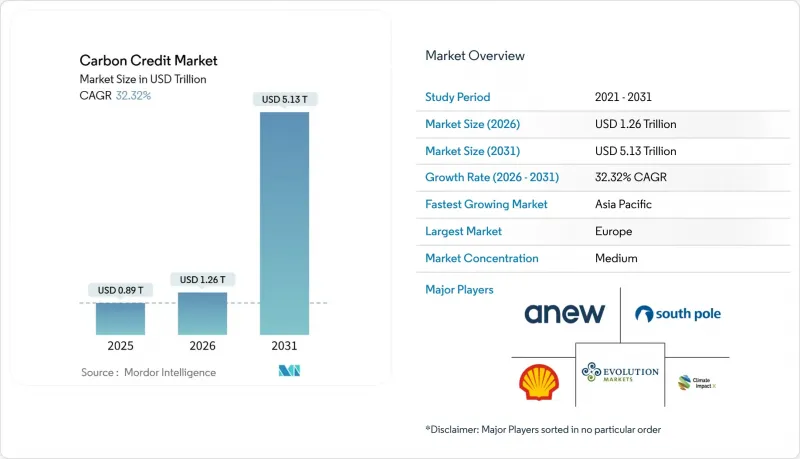
Mordor Intelligence에 의하면, 탄소배출권 시장 규모는 2025년 8,900억 달러로 평가되었습니다. 2026년 1조 2,600억 달러에서 2031년까지 5조 1,300억 달러로 확대되고 2026년부터 2031년까지 연평균 복합 성장률(CAGR)은 32.32%를 나타낼 전망입니다.
본 보고서는 유형별(규제 준수 탄소 시장, 자발적 탄소 시장), 크레딧 유형별(재생에너지 크레딧, 임업·토지 이용 상쇄 등), 거래 형태별(현물, 선물·포워드), 최종 사용자별(에너지·유틸리티 등), 지역별(북미, 유럽, 아시아태평양, 남미, 중동 및 아프리카)로 분류되어 있습니다. 시장 전망은 금액(달러) 기준으로 제시되어 있습니다.
세계의 탄소배출권 시장 동향과 인사이트
신흥 경제국에서의 규정 준수형 배출권 거래 제도(ETS) 확대
2025년, 중국은 철강, 알루미늄, 시멘트를 국내 배출권 거래 제도(ETS) 대상에 포함시켜 80억 tCO2e를 포괄했습니다. 이는 중국 국내 배출량의 약 60-65%에 해당합니다. 탄소 가격은 1tCO2당 60-70위안으로 설정되어 세계 최대의 규제 준수 시장이 확립되었습니다. 인도는 2026년에 전국 규모 시장을 출범할 예정이며, 인도네시아는 2025년에 석탄 화력 발전 시범 사업을 시작하여 아세안 전역에 파급 효과가 나타나고 있음을 시사하고 있습니다. 아랍에미리트(UAE)는 자발적 체계를 도입했고, 사우디아라비아는 상쇄 프로젝트에 100억 달러를 배정함으로써 걸프 국가들을 탄소 시장의 구매자 및 공급자 양측으로 자리매김했습니다. 유동성은 여전히 EU 배출권 거래 제도(EU ETS)보다 낮은 수준이지만, 이러한 제도의 배출 상한선 합계는 2030년까지 30억-40억 tCO2e를 초과할 것으로 예측되어 탄소배출권 시장 규모가 확대되고 있습니다. 제6조에 따른 국경 간 거래도 탄력을 받고 있으며, 2025년 말 기준으로 99건의 양자 협정과 1,000건 이상의 계획 중인 프로젝트가 기록되었습니다.
기업의 넷제로 공약이 VCM 수요를 가속화
1만 개 이상의 기업이 2025년까지 넷제로 배출을 달성하겠다고 공약했으며, 그중 5,000개 이상의 기업이 ‘Science Based Targets initiative(SBTi)’로부터 검증을 받았습니다. 이 검증에서는 1.5°C 온실가스 배출 억제 경로에 따라 연평균 4.2%의 배출 감축이 요구됩니다. 2025년 2월에 도입된 ‘Net Zero V2’ 프레임워크에는 ‘지속적인 배출 책임(Ongoing Emissions Responsibility)’이라는 개념이 포함되어, 목표 달성 경로에서의 사후 크레딧이 공식적으로 인정되었습니다. 이러한 정책 전환에 따라 자발적인 크레딧 상각이 증가하여, 2025년에는 2억 1,100만 tCO2e에 달하며 전년 대비 9% 증가율을 기록했습니다. 직접 공기 포집, 바이오차, 강화 풍화 등을 포함한 제거 크레딧의 가격은 1tCO2당 100-300달러로, 기존의 배출 회피 상쇄에 비해 20-60배의 프리미엄이 붙어 있으며, 이는 구매자가 지속가능성을 중시하고 있음을 반영합니다. 또한, Integrity Council은 2024년 말까지 4억 크레딧에 인증 라벨을 부여했으며, 이로 인해 2025년 총량에서 CCP 태그가 부착된 크레딧의 비중이 3%에서 7%로 증가했습니다. 이는 신뢰할 수 있는 크레딧 공급으로의 전환을 여실히 보여줍니다.
저품질 크레딧공급 과잉이 구매자의 신뢰를 훼손하고 있습니다.
2020년 이전에 발행된 기존 재생에너지 및 조리용 스토브 크레딧은 2025년에 1tCO2당 5달러 미만의 가격으로 시장에 유입되어 추가성에 대한 평가에 부정적인 영향을 미쳤습니다. BeZero Carbon의 등급 평가에 따르면, C 등급 크레딧은 BBB+ 프로젝트 가격의 6분의 1 수준에서 거래되고 있습니다. Shell은 크레딧 상각량을 2024년 1,400만 tCO2e에서 2025년 975만 tCO2e로 줄이며 탄소 제거에 대한 집중도를 높였습니다. 2024년에 발행된 6억 5,000만 크레딧 중 Integrity Council의 인증을 받은 것은 4억 크레딧에 그쳤으며, 인증을 받지 않은 크레딧은 구매자를 확보하는 데 어려움을 겪고 있습니다. 그 결과, 탄소배출권 가격이 CO2 1톤당 10달러 아래로 떨어지면 개발 사업자는 투자 회수 기간이 장기화되는 문제에 직면하게 되며, 새로운 산림 관리 및 재생 에너지 프로젝트의 시작이 지연될 것입니다. 시장의 신뢰는 제품의 품질을 구분하기 위한 등급 시스템과 제3자 감사의 급속한 확대에 달려 있습니다.
부문 분석
2025년에는 컴플라이언스 제도가 총 거래량의 98.22%를 차지했으며, 그 주된 요인은 EU 배출권 거래 제도(EU ETS)와 중국의 80억 tCO2e라는 배출 상한선 때문이었습니다. 거래소의 유동성 덕분에 활발한 헤지 거래가 이루어졌으며, 인터컨티넨탈 익스체인지(ICE)에서는 같은 해 2,090만 건의 환경 관련 계약 청산이 이루어졌습니다. 한편, 자발적 부문은 사후 크레딧을 인정하는 ‘과학 기반 목표 이니셔티브(SBTi)’와 스코프 3 배출량에 대한 압박 고조에 힘입어 연평균 성장률(CAGR) 42.15%라는 강력한 성장 궤도를 보였습니다. 이러한 성장에 힘입어, 규정 준수 시장과 자발적 시장 간의 기존 격차는 점차 좁혀지고 있습니다.
항공사들이 CORSIA 적격 단위를 조달하고, 무결성 태그가 부착된 감축량에 대한 수요를 흡수함에 따라 가격 수렴이 예상됩니다. 이러한 추세에 따라 자발적 크레딧 발행자들은 규정 준수 수준의 모니터링, 보고, 검증(MRV) 기준 채택을 촉진받고 있습니다. 만약 실현된다면, 이러한 가격 수렴의 성공은 규정 준수 제도와 자발적 제도의 요건을 모두 충족할 수 있는 프로젝트 개발자들에게 탄소배출권 시장의 확대로 이어질 가능성이 있습니다.
2025년에는 재생에너지 크레딧가 시장 점유율의 41.8%를 차지했으나, 추가성에 대한 회의적인 시각으로 인해 가격이 1tCO2당 5달러 미만으로 억제되었습니다. 연평균 성장률(CAGR) 39.2%를 나타낼 것으로 예측되는 임업 및 토지 이용 크레딧은 생물다양성에 대한 부수적 혜택과 CORSIA 적합성이라는 이점을 누리고 있지만, 투자자들 사이에서는 여전히 역전 위험에 대한 우려가 남아 있습니다. 신흥 흡수 기술은 비용이 높지만, 세계 브랜드가 중시하는 지속가능성 기준을 충족하고 있으며, 초기 공급 제약이 있음에도 불구하고 장기적으로는 높은整合性을 갖춘 단위로의 전환이 진행될 가능성을 시사하고 있습니다.
2025년에는 임업 크레딧 발행량의 5-10%를 대상으로 하는 보험 적용 범위가 확대되었으며, 한편 위성을 활용한 MRV(측정·보고·검증)를 통해 검증 비용이 대폭 절감되어 기관 투자자들의 자금을 유치했습니다. 제거 크레딧의 프리미엄이 1tCO2당 100-300달러 범위인 점을 고려할 때, 자연 기반 제거 및 인공 제거 시장 점유율은 확대될 것으로 예상되며, 이는 다양한 등록 기관의 가격 동향에 영향을 미칠 것으로 전망됩니다.
지역별 분석
2025년에 유럽이 76.1%의 시장 점유율을 차지한 것은 연간 4.3%의 배출 상한 감축을 의무화하는 EU 배출권 거래 제도(EU ETS)의 영향을 여실히 보여줍니다. 이 제도는 공급을 긴축시키는 시장 안정화 준비금에 의해 더욱 뒷받침되고 있습니다. 2026년 EU 배출권 평균 가격은 tCO2당 84유로에서 93유로(96.04달러에서 106.33달러) 범위에서 형성되며, ICE 및 EEX에서 사상 최고 수준의 유동성을 이끌고 있습니다. 또한, 탄소 국경 조정 메커니즘(CBAM)에 따라 수입품에도 내부 탄소 비용이 적용되면서 해당 지역의 가격 주도력이 확고해졌습니다. 자발적 탄소배출권의 상각량은 5,000만 tCO2에 달했습니다. 이는 주로 런던, 취리히, 암스테르담에 거점을 둔 기업들이 ‘기업 지속가능성 보고 지침(CSRD)’에 대응하는 과정에서 이루어진 것입니다.
아시아태평양은 2031년까지 연평균 성장률(CAGR) 38.7%를 달성할 전망입니다. 이는 80억 tCO2e를 상한선으로 하고, tCO2당 60-70위안(8.83-10.30달러)의 가격을 책정하는 중국의 확대된 배출권 거래 제도(ETS)에 의해 주도되고 있습니다. 인도는 2026년 국가 프로그램 개시를 위해 준비를 진행하고 있습니다. 그 밖의 동향으로는 한국의 K-ETS, 인도네시아의 시범 프로그램, 그리고 새롭게 등장한 양자 간 ‘제6조’ 거래 등이 있으며, 이러한 요소들이 결합되어 다중 시장 생태계를 형성해 가고 있습니다. 이러한 성장을 뒷받침하듯 거래소 인프라도 진화하고 있으며, Xpansiv는 2026년 2월 마카오 거래소와 제휴하여 지역 벤치마크를 확립했고, AirCarbon Exchange는 항공 부문의 구매자를 대상으로 하고 있습니다.
북미에서는 2025년에 캘리포니아주의 배출권 거래 제도, 지역 온실가스 이니셔티브(RGGI), 캐나다의 백스톱 메커니즘 등의 프로그램을 통해 약 5억 tCO2의 배출량 상한선이 설정되었으며, 가격은 1tCO2당 15-35달러 범위에서 형성되었습니다. Nodal Exchange에서는 헤지 거래 참여 증가를 반영하여 배출권 청산량이 사상 최고치를 기록했습니다. 한편, 라틴아메리카, 중동 및 아프리카는 시장 개발의 초기 단계에 머물러 있지만, 상쇄 공급원으로서 매우 중요합니다. 브라질에서 계획 중인 배출권 거래 제도(ETS)와 사우디아라비아의 100억 달러 규모 프로젝트 기금은 유럽 및 아시아의 규정 준수 구매자를 대상으로 한 수출을 목적으로, 자연 기반 크레딧 창출을 확대할 가능성이 있습니다.
기타 혜택 :
- 엑셀 형식 시장 예측(ME) 시트
- 3개월간의 애널리스트 지원
자주 묻는 질문
목차
제1장 서론
제2장 조사 방법
제3장 주요 요약
제4장 시장 구도
제5장 시장 규모 및 성장 예측
제6장 경쟁 구도
제7장 시장 기회 및 향후 전망
KTH 26.08.10According to Mordor Intelligence, the carbon credit market size is projected to expand from USD 0.89 trillion in 2025 and USD 1.26 trillion in 2026 to USD 5.13 trillion by 2031, registering a CAGR of 32.32% between 2026 to 2031.
This report is Segmented by Type (Compliance Carbon Market, Voluntary Carbon Market), Credit-Type (Renewable-Energy Certificates, Forestry and Land-Use Offsets, and More), Delivery Type (Spot, Futures/Forwards), End-User (Energy and Utilities, and More), and Geography (North America, Europe, Asia-Pacific, South America, Middle East and Africa). The Market Forecasts are Provided in Terms of Value (USD).
Global Carbon Credit Market Trends and Insights
Expansion of compliance ETS across emerging economies
In 2025, China incorporated steel, aluminum, and cement into its national emissions trading system, covering 8 billion tCO2e, which accounts for approximately 60-65% of its domestic emissions. The carbon prices were set at CNY 60-70 per tCO2, establishing the world's largest compliance market. India is set to launch a nationwide market in 2026, while Indonesia initiated a coal-power pilot in 2025, indicating a ripple effect across ASEAN. The UAE introduced a voluntary framework, and Saudi Arabia allocated USD 10 billion for offset projects, positioning Gulf countries as both buyers and suppliers in the carbon market. Although liquidity remains lower than the EU ETS, the combined caps of these schemes are projected to surpass 3-4 billion tCO2e by 2030, broadening the scope of the carbon credit market. Cross-border trades under Article 6 are gaining momentum, with 99 bilateral agreements and over 1,000 pipeline projects recorded by late 2025.
Corporate net-zero commitments accelerating VCM demand
Over 10,000 companies have pledged to achieve net-zero emissions by 2025, with more than 5,000 obtaining validation from the Science Based Targets initiative. This validation requires annual emissions reductions of 4.2%, aligned with a 1.5 °C pathway. The introduction of the Net Zero V2 framework in February 2025 incorporated the concept of "Ongoing Emissions Responsibility," formally acknowledging ex-post credits within target pathways. This policy shift contributed to an increase in voluntary retirements, reaching 211 million tCO2e in 2025, a 9% year-on-year growth. Removal credits, including those from direct air capture, biochar, and enhanced weathering, are priced at USD 100-300 per tCO2, representing a 20-60 times premium over traditional avoidance offsets, reflecting a buyer preference for permanence. Additionally, the Integrity Council labeled 400 million credits by late 2024, which increased CCP-tagged retirements from 3% to 7% of the total volume in 2025, highlighting a shift toward high-integrity credit supply.
Oversupply of Low-Quality Credits Eroding Buyer Confidence
Legacy renewable energy and cookstove credits issued before 2020 entered the market at prices below USD 5 per tCO2 in 2025, negatively impacting perceptions of additionality. According to BeZero Carbon's ratings, C-graded units are trading at one-sixth the price of BBB+ projects. Shell reduced its retirements from 14 million tCO2e in 2024 to 9.75 million in 2025, shifting its focus toward removals. Of the 650 million credits issued in 2024, only 400 million were labeled by the Integrity Council, leaving unlabeled stock struggling to attract buyers. As a result, developers face extended payback periods when carbon credit prices drop below USD 10 per tCO2, delaying new forestry and renewable energy projects. Market confidence will depend on the rapid expansion of rating systems and third-party audits to distinguish product quality.
Other drivers and restraints analyzed in the detailed report include:
- Rise in carbon pricing mechanisms and higher allowance prices
- Scope 3 Disclosure Mandates Lifting Removal-Credit Demand
- Fragmented Global Standards & Double-Counting Risks
For complete list of drivers and restraints, kindly check the Table Of Contents.
Segment Analysis
In 2025, compliance schemes accounted for 98.22% of the total volume, driven primarily by the EU ETS and China's cap of 8 billion tCO2e. Exchange liquidity facilitated robust hedging activities, with the Intercontinental Exchange clearing 20.9 million environmental contracts during the year. Meanwhile, the voluntary segment demonstrated a strong growth trajectory, with a CAGR of 42.15%, supported by the Science Based Targets initiative (SBTi) recognizing ex-post credits and increasing pressures related to Scope 3 emissions. This growth is gradually reducing the traditional divide between compliance and voluntary markets.
Price convergence appears likely as airlines procure CORSIA-eligible units and integrate demand for integrity-tagged removals. This trend is encouraging voluntary issuers to adopt compliance-grade monitoring, reporting, and verification (MRV) standards. If achieved, successful convergence could expand the carbon credit market for project developers capable of meeting the requirements of both compliance and voluntary regimes.
In 2025, renewable energy certificates accounted for 41.8% of the market share but faced skepticism regarding additionality, which limited prices to below USD 5 per tCO2. Forestry and land-use credits, projected to grow at a 39.2% CAGR, benefit from biodiversity co-benefits and eligibility under CORSIA, although investors remain concerned about reversal risks. Emerging removal technologies, while more expensive, fulfill permanence criteria valued by global brands, indicating a potential long-term shift toward high-integrity units despite initial supply constraints.
Insurance coverage for 5-10% of forestry issuance in 2025 is expanding, while satellite-based MRV significantly reduces verification costs, attracting institutional capital. With premiums for removals ranging from USD 100 to 300 per tCO2, the market share of nature-based and engineered removals is expected to increase, influencing price trends across various registries.
Complete Report Scope:
- By Type
- Compliance Carbon Market
- Voluntary Carbon Market
- By Credit-Type
- Renewable-Energy Certificates (RECs)
- Forestry and Land-Use Offsets
- Energy-Efficiency Credits
- Industrial-Process Improvements
- By Delivery Type
- Spot (Physical)
- Futures / Forwards
- By End-user
- Energy and Utilities
- Transportation
- Industrial Manufacturing
- Agriculture and Forestry
- By Geography
- North America
- United States
- Canada
- Mexico
- Europe
- Germany
- United Kingdom
- France
- Italy
- NORDIC Countries
- Russia
- Rest of Europe
- Asia-Pacific
- China
- India
- Japan
- South Korea
- ASEAN Countries
- Rest of Asia-Pacific
- South America
- Brazil
- Argentina
- Rest of South America
- Middle East and Africa
- Saudi Arabia
- United Arab Emirates
- South Africa
- Egypt
- Rest of Middle East and Africa
- North America
Geography Analysis
Europe's projected 76.1% market share in 2025 highlights the impact of the EU Emissions Trading System (EU ETS), which enforces a 4.3% annual cap reduction. This system is further supported by the Market Stability Reserve, which has tightened supply. Average EU Allowance prices, ranging from EUR 84 to EUR 93 (USD 96.04 to USD 106.33) per tCO2 in 2026, have driven record liquidity on ICE and EEX. Additionally, the Carbon Border Adjustment Mechanism has extended internal carbon costs to imports, solidifying the region's price leadership. Voluntary carbon credit retirements reached 50 million tCO2, primarily from firms based in London, Zurich, and Amsterdam, as they adapt to the Corporate Sustainability Reporting Directive.
The Asia-Pacific region is on track for a 38.7% compound annual growth rate (CAGR) through 2031, driven by China's expanded ETS, which caps 8 billion tCO2e at prices of CNY 60-70 (USD 8.83-10.30) per tCO2. India is preparing to launch its national program in 2026. Other developments include South Korea's K-ETS, Indonesia's pilot program, and emerging bilateral Article 6 trades, which are collectively shaping a multi-market ecosystem. Supporting this growth, exchange infrastructure is evolving, with Xpansiv partnering with Macao Exchange in February 2026 to establish regional benchmarks, and AirCarbon Exchange targeting aviation sector buyers.
North America accounted for approximately 500 million tCO2 of capped emissions in 2025 through programs such as California's cap-and-trade system, the Regional Greenhouse Gas Initiative (RGGI), and Canada's backstop mechanism, with prices ranging from USD 15 to USD 35 per tCO2. Nodal Exchange achieved record allowance clearances, reflecting increased hedge participation. Meanwhile, Latin America, the Middle East, and Africa remain in the early stages of market development but are critical as offset suppliers. Brazil's planned ETS and Saudi Arabia's USD 10 billion project fund have the potential to scale nature-based credit generation for export to compliance buyers in Europe and Asia.
- Anew Climate, LLC
- AirCarbon Pte. Ltd.
- BP Target Neutral
- Carbon Trade Exchange Ltd.
- CBL Markets
- Chevron Environmental Management
- Climate Impact X Pte. Ltd.
- ClimatePartner GmbH
- Core Climate
- European Energy Exchange AG
- Evolution Markets Inc.
- Finite Carbon Corporation
- Gold Standard Foundation
- Intercontinental Exchange, Inc.
- Nasdaq Commodities
- Rearrange Carbon Markets
- Shell Environmental Products
- South Pole Holding AG
- Thallo Inc.
- Xpansiv Holdings, Inc.
Additional Benefits:
- The market estimate (ME) sheet in Excel format
- 3 months of analyst support
TABLE OF CONTENTS
1 Introduction
- 1.1 Study Assumptions & Market Definition
- 1.2 Scope of the Study
2 Research Methodology
3 Executive Summary
4 Market Landscape
- 4.1 Market Overview
- 4.2 Market Drivers
- 4.2.1 Expansion of compliance ETS across emerging economies
- 4.2.2 Corporate net-zero commitments accelerating VCM demand
- 4.2.3 Rise in carbon pricing mechanisms and higher allowance prices
- 4.2.4 Digital MRV & blockchain boosting credit transparency
- 4.2.5 Scope-3 disclosure mandates lifting removal-credit demand
- 4.2.6 CORSIA Phase-2 tightening spurring nature-based credits
- 4.3 Market Restraints
- 4.3.1 Oversupply of low-quality credits eroding buyer confidence
- 4.3.2 Fragmented global standards & double-counting risks
- 4.3.3 Geopolitical CBAM tensions limiting cross-border flows
- 4.3.4 Re-versal liability concerns hurting forestry financing
- 4.4 Value Chain Analysis
- 4.5 Regulatory Landscape
- 4.6 Technological Outlook
- 4.7 Porters Five Forces
- 4.7.1 Threat of New Entrants
- 4.7.2 Bargaining Power of Buyers
- 4.7.3 Bargaining Power of Suppliers
- 4.7.4 Threat of Substitutes
- 4.7.5 Competitive Rivalry
5 Market Size & Growth Forecasts
- 5.1 By Type
- 5.1.1 Compliance Carbon Market
- 5.1.2 Voluntary Carbon Market
- 5.2 By Credit-Type
- 5.2.1 Renewable-Energy Certificates (RECs)
- 5.2.2 Forestry and Land-Use Offsets
- 5.2.3 Energy-Efficiency Credits
- 5.2.4 Industrial-Process Improvements
- 5.3 By Delivery Type
- 5.3.1 Spot (Physical)
- 5.3.2 Futures / Forwards
- 5.4 By End-user
- 5.4.1 Energy and Utilities
- 5.4.2 Transportation
- 5.4.3 Industrial Manufacturing
- 5.4.4 Agriculture and Forestry
- 5.5 By Geography
- 5.5.1 North America
- 5.5.1.1 United States
- 5.5.1.2 Canada
- 5.5.1.3 Mexico
- 5.5.2 Europe
- 5.5.2.1 Germany
- 5.5.2.2 United Kingdom
- 5.5.2.3 France
- 5.5.2.4 Italy
- 5.5.2.5 NORDIC Countries
- 5.5.2.6 Russia
- 5.5.2.7 Rest of Europe
- 5.5.3 Asia-Pacific
- 5.5.3.1 China
- 5.5.3.2 India
- 5.5.3.3 Japan
- 5.5.3.4 South Korea
- 5.5.3.5 ASEAN Countries
- 5.5.3.6 Rest of Asia-Pacific
- 5.5.4 South America
- 5.5.4.1 Brazil
- 5.5.4.2 Argentina
- 5.5.4.3 Rest of South America
- 5.5.5 Middle East and Africa
- 5.5.5.1 Saudi Arabia
- 5.5.5.2 United Arab Emirates
- 5.5.5.3 South Africa
- 5.5.5.4 Egypt
- 5.5.5.5 Rest of Middle East and Africa
- 5.5.1 North America
6 Competitive Landscape
- 6.1 Market Concentration
- 6.2 Strategic Moves (M&A, Partnerships, PPAs)
- 6.3 Market Share Analysis (Market Rank/Share for key companies)
- 6.4 Company Profiles (includes Global level Overview, Market level overview, Core Segments, Financials as available, Strategic Information, Products & Services, and Recent Developments)
- 6.4.1 Anew Climate, LLC
- 6.4.2 AirCarbon Pte. Ltd.
- 6.4.3 BP Target Neutral
- 6.4.4 Carbon Trade Exchange Ltd.
- 6.4.5 CBL Markets
- 6.4.6 Chevron Environmental Management
- 6.4.7 Climate Impact X Pte. Ltd.
- 6.4.8 ClimatePartner GmbH
- 6.4.9 Core Climate
- 6.4.10 European Energy Exchange AG
- 6.4.11 Evolution Markets Inc.
- 6.4.12 Finite Carbon Corporation
- 6.4.13 Gold Standard Foundation
- 6.4.14 Intercontinental Exchange, Inc.
- 6.4.15 Nasdaq Commodities
- 6.4.16 Rearrange Carbon Markets
- 6.4.17 Shell Environmental Products
- 6.4.18 South Pole Holding AG
- 6.4.19 Thallo Inc.
- 6.4.20 Xpansiv Holdings, Inc.
7 Market Opportunities & Future Outlook
- 7.1 White-space & Unmet-need Assessment


